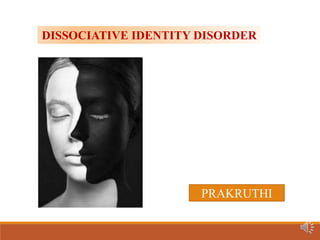
DISSOCIATIVE IDENTITY DISORDER
PRAKRUTHI
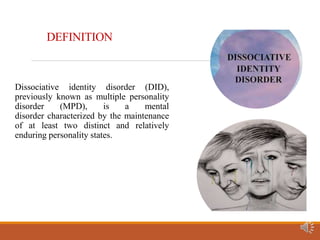
DEFINITION
Dissociative identity disorder (DID),
previously known as multiple personality
disorder (MPD), is a mental
disorder characterized by the maintenance
of at least two distinct and relatively
enduring personality states.
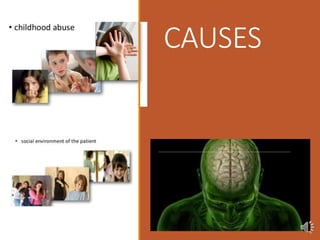
CAUSES
FACTS
There are said to be 236 symptoms of
MPD
• Each personality has its own sense of
self and has its own habits of thought,
emotions, and memory
• These identities may or may not be
aware of each other.
• MPD occurs from 3-9 times more
frequently in women than in men
• Female patients often have more
personalities than men
• People with MPD are above average
intelligence and highly creative
ALTERS
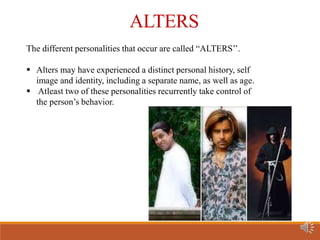
The different personalities that occur are called “ALTERS’’.
 Alters may have experienced a distinct personal history, self
image and identity, including a separate name, as well as age.
 Atleast two of these personalities recurrently take control of
the person’s behavior.
ALTERS
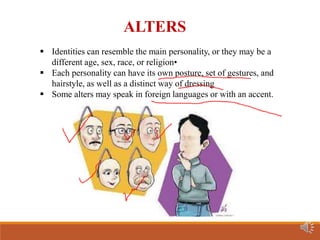
 Identities can resemble the main personality, or they may be a
different age, sex, race, or religion•
 Each personality can have its own posture, set of gestures, and
hairstyle, as well as a distinct way of dressing
 Some alters may speak in foreign languages or with an accent.
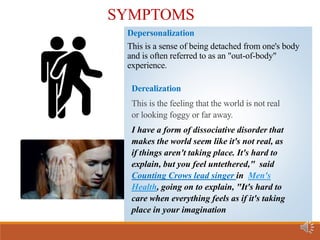
Depersonalization
This is a sense of being detached from one's body
and is often referred to as an "out-of-body"
experience.
Derealization
This is the feeling that the world is not real
or looking foggy or far away.
I have a form of dissociative disorder that
makes the world seem like it's not real, as
if things aren't taking place. It's hard to
explain, but you feel untethered," said
Counting Crows lead singer in Men's
Health, going on to explain, "It's hard to
care when everything feels as if it's taking
place in your imagination
SYMPTOMS
Loss of Memory Flashbacks
Blurred sense of identity
Social isolation
CO-OCCURRING
MENTAL HEALTH
CONDITIONS
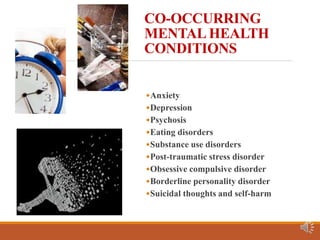
•Anxiety
•Depression
•Psychosis
•Eating disorders
•Substance use disorders
•Post-traumatic stress disorder
•Obsessive compulsive disorder
•Borderline personality disorder
•Suicidal thoughts and self-harm
TREATMENT
HYPNOTHERAPY
PSYCHOTHERAPY
Dissociative identity disorder

Dissociative identity disorder

  • 1.
  • 2.
    DEFINITION Dissociative identity disorder(DID), previously known as multiple personality disorder (MPD), is a mental disorder characterized by the maintenance of at least two distinct and relatively enduring personality states.
  • 3.
  • 4.
    FACTS There are saidto be 236 symptoms of MPD • Each personality has its own sense of self and has its own habits of thought, emotions, and memory • These identities may or may not be aware of each other. • MPD occurs from 3-9 times more frequently in women than in men • Female patients often have more personalities than men • People with MPD are above average intelligence and highly creative
  • 5.
    ALTERS The different personalitiesthat occur are called “ALTERS’’.  Alters may have experienced a distinct personal history, self image and identity, including a separate name, as well as age.  Atleast two of these personalities recurrently take control of the person’s behavior.
  • 6.
    ALTERS  Identities canresemble the main personality, or they may be a different age, sex, race, or religion•  Each personality can have its own posture, set of gestures, and hairstyle, as well as a distinct way of dressing  Some alters may speak in foreign languages or with an accent.
  • 7.
    Depersonalization This is asense of being detached from one's body and is often referred to as an "out-of-body" experience. Derealization This is the feeling that the world is not real or looking foggy or far away. I have a form of dissociative disorder that makes the world seem like it's not real, as if things aren't taking place. It's hard to explain, but you feel untethered," said Counting Crows lead singer in Men's Health, going on to explain, "It's hard to care when everything feels as if it's taking place in your imagination SYMPTOMS
  • 8.
    Loss of MemoryFlashbacks Blurred sense of identity Social isolation
  • 9.
    CO-OCCURRING MENTAL HEALTH CONDITIONS •Anxiety •Depression •Psychosis •Eating disorders •Substanceuse disorders •Post-traumatic stress disorder •Obsessive compulsive disorder •Borderline personality disorder •Suicidal thoughts and self-harm
  • 10.