Group Assignment
Title: Somatization Disorder
Name ID No.
1. Bamlakfekad Getachew…………………..101/13
2. Blen Asmerom…………………………………093/13
3. Eleni mekonen………………………………...006/13
4. Filimawit Mebiratu…………………………..011/13
Submision date:Dec. 3/ 2022
submitted to: Mr. Bezuayehu
Out line
1. Introduction
2. Clinical feature
3. Causes
4. Diagnostic criteria
5. Development and course
6. Prognosis
7. Risk and prognostic factors
8. Differential diagnosis
9. Treatment
10. Reference
Introduction
• “Somatoform”/ “ Somatic” derived from Greek “soma” – body
• Somatic symptom disorder is diagnosed when a person has a
significant focus on physical symptoms, such as pain,
weakness or shortness of breath, to a level that results in
major distress and/or problems functioning. The individual has
excessive thoughts, feelings and behaviors relating to the
physical symptoms.
• Group of illnesses where bodily signs and symptoms are a
major focus
• Believed to originate from faulty mind-body interactions- the
brain sends signals that impinge on the patients awareness
falsely suggesting a serious problem in the body.
• The symptoms are medically unexplained.
• Patients are convinced that their suffering comes from some
type of undetected and untreated bodily derangement
Cont…
• 6 or more month of non delusional preoccupation with
fears of having or the idea that one has a serious
disease based on the persons misinterpretation of bodily
symptoms
• This preoccupation causes significant distress and
impairment in ones life
• Prevalence estimated to be 4to6 percent but may be as
high as 15 percent
• Commonly appears in persons 20 to 30 years of age
• Male=female
• Occurs in about 3 percent of medical students usually in
the first two years
Clinical features
• Patients believe that they have a serious disease that
has not been detected and they cannot be persuaded
the contrary
• As time progresses they may transfer their belief to
another disease
• Their convictions persist despite negative laboratory
tests
• Often accompanied by symptoms of depression and
anxiety and commonly coexists with a depressive and
anxiety disorder.
Cont…
Common characteristics of presenting problem
• Long, complicated medical histories-confused time frames
• Patients frequently report they have been sickly all their life
• Psychological and interpersonal problems
• Suicide threats common but rarely acted upon
• Dramatic and emotional presentation of history and appearance
• Self centred, hungry for admiration, manipulative
Commonest Symptoms reported
• Nausea and vomiting other than during pregnancy
• Pain in the arms and legs
• Shortness of breath unrelated to exertion
• Amnesia
• Complications of pregnancy and menstruation
Causes
• Having anxiety or depression.
• Having a medical condition or recovering from
one.
• Being at risk of developing a medical condition,
such as having a strong family history of a
disease.
• Experiencing stressful life events, trauma or
violence.
• Having experienced past trauma, such as
childhood sexual abuse.
Diagnostic criteria
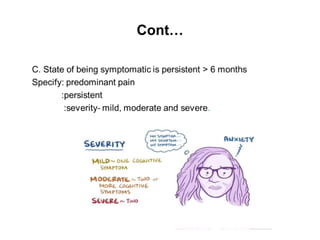
A. One or more somatic symptoms that are distressing or result in
significant disruption of daily life
B. Excessive thoughts, feelings or behaviours related to the somatic
symptoms or associated health concerns as manifested by at least
one of the following:
• Disproportionate and persistent thoughts about the seriousness of
one’s symptoms
• Persistently high levels of anxiety about health or symptoms
• Excessive time and energy devoted to these symptoms or health
concerns
Cont…
Development and Course
• In older individuals, somatic symptoms and concurrent
medical illnesses are common
• Somatic symptom disorder may be underdiagnosed in
older adults either because certain somatic symptoms
(e.g., pain, fatigue) are considered part of normal aging
or because illness worry is considered "understandable"
in older adults who have more general medical illnesses
and medications than do younger people.
• In children, the most common symptoms are recurrent
abdominal pain, headache, fatigue, and nausea. A single
prominent symptom is more common in children than in
adults. While young children may have somatic
complaints, they rarely worry about "illness" per se prior
to adolescence.
Prognosis
• The course of this disorder is usually episodic with
episodes that last from months to years
• There may be an obvious association between
exacerbation of somatic symptoms and psychological
stressors
• A good prognosis is associated with:
– High socioeconomic status
– Treatment responsive anxiety or depression
– Sudden onset
– Absence of personality disorder
– Absence of other non psychological medical condition
• Most children with the disorder recover by late
adolescence or adulthood
Risk and Prognostic Factors
• Temperamental: The personality trait of
negative affectivity (neuroticism) has been
identified as an independent correlate/risk
factor of a high number of somatic symptoms.
Comorbid anxiety or depression is common
and may exacerbate symptoms and
impairment.
• Environmental: Somatic symptom disorder is
more frequent in individuals with few years of
education and low socioeconomic status, and
in those who have recently experienced
stressful life events.
Cont...
• Course modifiers:
 Persistent somatic symptoms are associated with
demographic features (female sex, older age, fewer
years of education, lower socioeconomic status,
unemployment), a reported history of sexual abuse
or other childhood adversity, concurrent chronic
physical illness or psychiatric disorder (depression,
anxiety, persistent depressive disorder [dysthymia],
panic), social stress, and reinforcing social factors
such as illness benefits.
Differential Diagnosis
• Other medical conditions.
• Panic disorder.
• Generalized anxiety disorder.
• Depressive disorders.
• Illness anxiety disorder.
• Conversion disorder (functional neurological
symptom disorder).
• Delusional disorder.
• Body dysmorphic disorder.
• Obsessive-compulsive disorder.
Treatment
• Single, identified physician as primary care giver
• Regular, scheduled visits usually at monthly intervals
• Keep interviews brief with a partial physical exam for
each new symptom expressed
• Generally avoid lab/diagnostic investigations
• Once diagnosed view these problems as being
communications of emotional distress
• Try and raise awareness of these symptoms being
responses to psychological pressures and see if you can
motivate patient to see a mental health clinician
• Individual or group psychotherapy
• Pharmacotherapy is useful only when a patient has an
underlying drug responsive psychiatric condition
Task of psychotherapy
• Decrease the patients personal health expenditures
• Help to cope with their symptoms
• Assist with expressing underlying emotions
• Help to develop alternative strategies for expressing their
feelings
• Psychopharmacological intervention difficult
Reference
• Diagnostic and statistical manual of mental disorder 5th
edition.
Group 2 somatic disorders.pptx

Group 2 somatic disorders.pptx

  • 1.
    Group Assignment Title: SomatizationDisorder Name ID No. 1. Bamlakfekad Getachew…………………..101/13 2. Blen Asmerom…………………………………093/13 3. Eleni mekonen………………………………...006/13 4. Filimawit Mebiratu…………………………..011/13 Submision date:Dec. 3/ 2022 submitted to: Mr. Bezuayehu
  • 2.
    Out line 1. Introduction 2.Clinical feature 3. Causes 4. Diagnostic criteria 5. Development and course 6. Prognosis 7. Risk and prognostic factors 8. Differential diagnosis 9. Treatment 10. Reference
  • 3.
    Introduction • “Somatoform”/ “Somatic” derived from Greek “soma” – body • Somatic symptom disorder is diagnosed when a person has a significant focus on physical symptoms, such as pain, weakness or shortness of breath, to a level that results in major distress and/or problems functioning. The individual has excessive thoughts, feelings and behaviors relating to the physical symptoms. • Group of illnesses where bodily signs and symptoms are a major focus • Believed to originate from faulty mind-body interactions- the brain sends signals that impinge on the patients awareness falsely suggesting a serious problem in the body. • The symptoms are medically unexplained. • Patients are convinced that their suffering comes from some type of undetected and untreated bodily derangement
  • 4.
    Cont… • 6 ormore month of non delusional preoccupation with fears of having or the idea that one has a serious disease based on the persons misinterpretation of bodily symptoms • This preoccupation causes significant distress and impairment in ones life • Prevalence estimated to be 4to6 percent but may be as high as 15 percent • Commonly appears in persons 20 to 30 years of age • Male=female • Occurs in about 3 percent of medical students usually in the first two years
  • 5.
    Clinical features • Patientsbelieve that they have a serious disease that has not been detected and they cannot be persuaded the contrary • As time progresses they may transfer their belief to another disease • Their convictions persist despite negative laboratory tests • Often accompanied by symptoms of depression and anxiety and commonly coexists with a depressive and anxiety disorder.
  • 6.
    Cont… Common characteristics ofpresenting problem • Long, complicated medical histories-confused time frames • Patients frequently report they have been sickly all their life • Psychological and interpersonal problems • Suicide threats common but rarely acted upon • Dramatic and emotional presentation of history and appearance • Self centred, hungry for admiration, manipulative Commonest Symptoms reported • Nausea and vomiting other than during pregnancy • Pain in the arms and legs • Shortness of breath unrelated to exertion • Amnesia • Complications of pregnancy and menstruation
  • 7.
    Causes • Having anxietyor depression. • Having a medical condition or recovering from one. • Being at risk of developing a medical condition, such as having a strong family history of a disease. • Experiencing stressful life events, trauma or violence. • Having experienced past trauma, such as childhood sexual abuse.
  • 8.
    Diagnostic criteria A. Oneor more somatic symptoms that are distressing or result in significant disruption of daily life B. Excessive thoughts, feelings or behaviours related to the somatic symptoms or associated health concerns as manifested by at least one of the following: • Disproportionate and persistent thoughts about the seriousness of one’s symptoms • Persistently high levels of anxiety about health or symptoms • Excessive time and energy devoted to these symptoms or health concerns
  • 9.
  • 10.
    Development and Course •In older individuals, somatic symptoms and concurrent medical illnesses are common • Somatic symptom disorder may be underdiagnosed in older adults either because certain somatic symptoms (e.g., pain, fatigue) are considered part of normal aging or because illness worry is considered "understandable" in older adults who have more general medical illnesses and medications than do younger people. • In children, the most common symptoms are recurrent abdominal pain, headache, fatigue, and nausea. A single prominent symptom is more common in children than in adults. While young children may have somatic complaints, they rarely worry about "illness" per se prior to adolescence.
  • 11.
    Prognosis • The courseof this disorder is usually episodic with episodes that last from months to years • There may be an obvious association between exacerbation of somatic symptoms and psychological stressors • A good prognosis is associated with: – High socioeconomic status – Treatment responsive anxiety or depression – Sudden onset – Absence of personality disorder – Absence of other non psychological medical condition • Most children with the disorder recover by late adolescence or adulthood
  • 12.
    Risk and PrognosticFactors • Temperamental: The personality trait of negative affectivity (neuroticism) has been identified as an independent correlate/risk factor of a high number of somatic symptoms. Comorbid anxiety or depression is common and may exacerbate symptoms and impairment. • Environmental: Somatic symptom disorder is more frequent in individuals with few years of education and low socioeconomic status, and in those who have recently experienced stressful life events.
  • 13.
    Cont... • Course modifiers: Persistent somatic symptoms are associated with demographic features (female sex, older age, fewer years of education, lower socioeconomic status, unemployment), a reported history of sexual abuse or other childhood adversity, concurrent chronic physical illness or psychiatric disorder (depression, anxiety, persistent depressive disorder [dysthymia], panic), social stress, and reinforcing social factors such as illness benefits.
  • 14.
    Differential Diagnosis • Othermedical conditions. • Panic disorder. • Generalized anxiety disorder. • Depressive disorders. • Illness anxiety disorder. • Conversion disorder (functional neurological symptom disorder). • Delusional disorder. • Body dysmorphic disorder. • Obsessive-compulsive disorder.
  • 15.
    Treatment • Single, identifiedphysician as primary care giver • Regular, scheduled visits usually at monthly intervals • Keep interviews brief with a partial physical exam for each new symptom expressed • Generally avoid lab/diagnostic investigations • Once diagnosed view these problems as being communications of emotional distress • Try and raise awareness of these symptoms being responses to psychological pressures and see if you can motivate patient to see a mental health clinician • Individual or group psychotherapy • Pharmacotherapy is useful only when a patient has an underlying drug responsive psychiatric condition
  • 16.
    Task of psychotherapy •Decrease the patients personal health expenditures • Help to cope with their symptoms • Assist with expressing underlying emotions • Help to develop alternative strategies for expressing their feelings • Psychopharmacological intervention difficult
  • 17.
    Reference • Diagnostic andstatistical manual of mental disorder 5th edition.