End-to-end Reliability of
Non-deterministic Stateful Components

               Ph.D. Dissertation Defense,
                   24 September 2010

                      Sumant Tambe
                  sutambe@dre.vanderbilt.edu
                www.dre.vanderbilt.edu/~sutambe


Department of Electrical Engineering & Computer Science
       Vanderbilt University, Nashville, TN, USA
Presentation Road-map
 Overview of the Contributions
 The Orphan Request Problem
    Related Research & Unresolved Challenges
    Solution: Group-failover
 Typed Traversal
    Related Research & Unresolved Challenges
    Solution: LEESA
 Concluding Remarks


                                                2
Dissertation Contributions: Model-driven Fault-tolerance
  Resolves
                    for DRE systems
challenges in     • Component QoS Modeling Language (CQML)
 Specification        • Aspect-oriented Modeling for Modularizing QoS
                        Concerns


 Composition

                  • Generative Aspects for Fault-Tolerance (GRAFT)
                     • Multi-stage model-driven development process
 Deployment          • Weaves dependability concerns in system artifacts
                     • Provides model-to-model, model-to-text, model-to-
                       code transformations

 Configuration

                  • The Group-failover Protocol
                      • Resolves the orphan request problem in multi-tier
   Run-time             component-based DRE systems
                                                                            3
                                                                                3
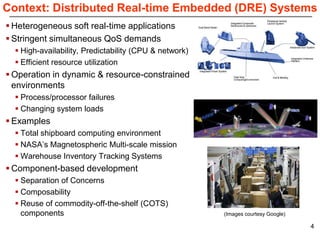
Context: Distributed Real-time Embedded (DRE) Systems
 Heterogeneous soft real-time applications
 Stringent simultaneous QoS demands
   High-availability, Predictability (CPU & network)
   Efficient resource utilization
 Operation in dynamic & resource-constrained
  environments
   Process/processor failures
   Changing system loads
 Examples
   Total shipboard computing environment
   NASA’s Magnetospheric Multi-scale mission
   Warehouse Inventory Tracking Systems
 Component-based development
   Separation of Concerns
   Composability
   Reuse of commodity-off-the-shelf (COTS)
    components                                          (Images courtesy Google)

                                                                                   4
Operational Strings & End-to-end QoS
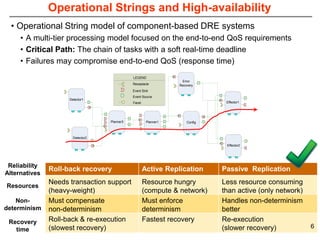
• Operational String model of component-based DRE systems
  • A multi-tier processing model focused on the end-to-end QoS requirements
  • Critical Path: The chain of tasks with a soft real-time deadline
  • Failures may compromise end-to-end QoS (response time)
                                        LEGEND
                                                             Error
                                        Receptacle         Recovery
                                        Event Sink
                                        Event Source
               Detector1
                                        Facet                           Effector1


                             Planner3           Planner1       Config


                 Detector2

                                                                        Effector2


         Must support highly available operational strings!

                                                                                    5
Operational Strings and High-availability
  • Operational String model of component-based DRE systems
     • A multi-tier processing model focused on the end-to-end QoS requirements
     • Critical Path: The chain of tasks with a soft real-time deadline
     • Failures may compromise end-to-end QoS (response time)
                                              LEGEND
                                                                    Error
                                              Receptacle          Recovery
                                              Event Sink
                                              Event Source
                     Detector1
                                              Facet                             Effector1


                                   Planner3            Planner1       Config


                       Detector2

                                                                                Effector2


 Reliability
               Roll-back recovery                     Active Replication       Passive Replication
Alternatives
               Needs transaction support              Resource hungry          Less resource consuming
Resources
               (heavy-weight)                         (compute & network)      than active (only network)
    Non-       Must compensate                        Must enforce             Handles non-determinism
determinism    non-determinism                        determinism              better
 Recovery      Roll-back & re-execution               Fastest recovery         Re-execution
               (slowest recovery)                                              (slower recovery)            6
   time
Non-determinism and the Side Effects of Replication
 DRE systems must tolerate non-determinism
   Many sources of non-determinism in DRE systems
   E.g., Local information (sensors, clocks), thread-scheduling, timers, and more
   Enforcing determinism is not always possible
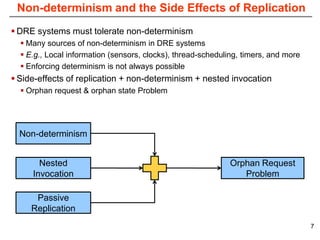
 Side-effects of replication + non-determinism + nested invocation
   Orphan request & orphan state Problem


  Non-determinism


       Nested                                                Orphan Request
     Invocation                                                 Problem

      Passive
     Replication
                                                                                     7
Execution Semantics & Replication
 Execution semantics in distributed systems
  May-be – No more than once, not all subcomponents may execute
  At-most-once – No more than once, all-or-none of the subcomponents will be
   executed (e.g., Transactions)
    Transaction abort decisions are not transparent
  At-least-once – All or some subcomponents may execute more than once
    Applicable to idempotent requests only
  Exactly-once – All subcomponents execute once & once only
    Enhances perceived availability of the system
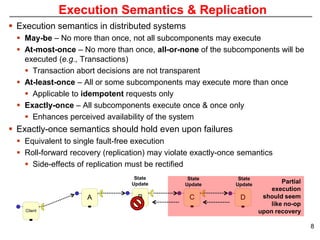
 Exactly-once semantics should hold even upon failures
  Equivalent to single fault-free execution
  Roll-forward recovery (replication) may violate exactly-once semantics
    Side-effects of replication must be rectified
                                  State          State         State
                                 Update         Update        Update
                                                                               Partial
                                                                           execution
                    A              B             C             D        should seem
                                                                           like no-op
    Client                                                             upon recovery

                                                                                         8
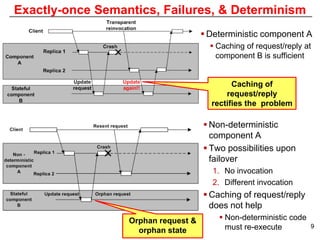
Exactly-once Semantics, Failures, & Determinism
                                      Deterministic component A
                                        Caching of request/reply at
                                         component B is sufficient


                                             Caching of
                                           request/reply
                                       rectifies the problem

                                      Non-deterministic
                                       component A
                                      Two possibilities upon
                                       failover
                                       1. No invocation
                                       2. Different invocation
                                      Caching of request/reply
                                       does not help
                  Orphan request &        Non-deterministic code
                    orphan state           must re-execute          9
Presentation Road-map
 Overview of the Contributions
 Replication & The Orphan Request Problem
    Related Research & Unresolved Challenges
    Solution: Group Failover
 Typed Traversal
    Related Research & Unresolved Challenges
    Solution: LEESA
 Concluding Remarks


                                                10
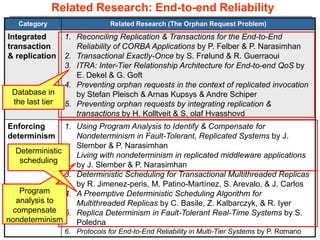
Related Research: End-to-end Reliability
   Category                    Related Research (The Orphan Request Problem)
Integrated       1. Reconciling Replication & Transactions for the End-to-End
transaction         Reliability of CORBA Applications by P. Felber & P. Narasimhan
& replication    2. Transactional Exactly-Once by S. Frølund & R. Guerraoui
                 3. ITRA: Inter-Tier Relationship Architecture for End-to-end QoS by
                    E. Dekel & G. Goft
                 4. Preventing orphan requests in the context of replicated invocation
 Database in        by Stefan Pleisch & Arnas Kupsys & Andre Schiper
 the last tier   5. Preventing orphan requests by integrating replication &
                    transactions by H. Kolltveit & S. olaf Hvasshovd
Enforcing        1. Using Program Analysis to Identify & Compensate for
determinism         Nondeterminism in Fault-Tolerant, Replicated Systems by J.
                    Slember & P. Narasimhan
   Deterministic
                 2. Living with nondeterminism in replicated middleware applications
    scheduling
                    by J. Slember & P. Narasimhan
                 3. Deterministic Scheduling for Transactional Multithreaded Replicas
                    by R. Jimenez-peris, M. Patino-Martínez, S. Arevalo, & J. Carlos
    Program      4. A Preemptive Deterministic Scheduling Algorithm for
   analysis to      Multithreaded Replicas by C. Basile, Z. Kalbarczyk, & R. Iyer
  compensate 5. Replica Determinism in Fault-Tolerant Real-Time Systems by S.
nondeterminism      Poledna                                                          11
                 6. Protocols for End-to-End Reliability in Multi-Tier Systems by P. Romano
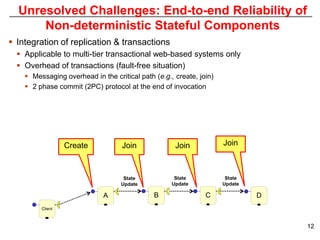
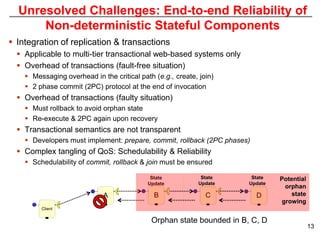
Unresolved Challenges: End-to-end Reliability of
      Non-deterministic Stateful Components
 Integration of replication & transactions
   Applicable to multi-tier transactional web-based systems only
   Overhead of transactions (fault-free situation)
     Messaging overhead in the critical path (e.g., create, join)
     2 phase commit (2PC) protocol at the end of invocation


                  Create           Join              Join            Join


                                    State            State            State
                                   Update           Update           Update

                             A                B                C              D
         Client


                                                                                  12
Unresolved Challenges: End-to-end Reliability of
      Non-deterministic Stateful Components
 Integration of replication & transactions
   Applicable to multi-tier transactional web-based systems only
   Overhead of transactions (fault-free situation)
     Messaging overhead in the critical path (e.g., create, join)
     2 phase commit (2PC) protocol at the end of invocation
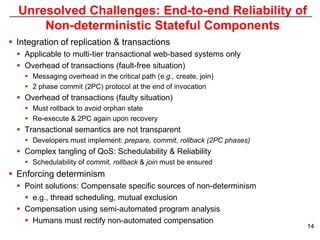
   Overhead of transactions (faulty situation)
     Must rollback to avoid orphan state
     Re-execute & 2PC again upon recovery
   Transactional semantics are not transparent
     Developers must implement: prepare, commit, rollback (2PC phases)
   Complex tangling of QoS: Schedulability & Reliability
     Schedulability of commit, rollback & join must be ensured

                                             State            State     State   Potential
                                            Update           Update    Update
                                                                                 orphan
                             A                B                C          D         state
                                                                                growing
         Client


                                             Orphan state bounded in B, C, D
                                                                                            13
Unresolved Challenges: End-to-end Reliability of
      Non-deterministic Stateful Components
 Integration of replication & transactions
   Applicable to multi-tier transactional web-based systems only
   Overhead of transactions (fault-free situation)
     Messaging overhead in the critical path (e.g., create, join)
     2 phase commit (2PC) protocol at the end of invocation
   Overhead of transactions (faulty situation)
     Must rollback to avoid orphan state
     Re-execute & 2PC again upon recovery
   Transactional semantics are not transparent
     Developers must implement: prepare, commit, rollback (2PC phases)
   Complex tangling of QoS: Schedulability & Reliability
     Schedulability of commit, rollback & join must be ensured
 Enforcing determinism
   Point solutions: Compensate specific sources of non-determinism
     e.g., thread scheduling, mutual exclusion
   Compensation using semi-automated program analysis
     Humans must rectify non-automated compensation
                                                                          14
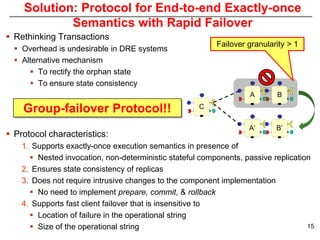
Solution: Protocol for End-to-end Exactly-once
            Semantics with Rapid Failover
 Rethinking Transactions
                                                          Failover granularity > 1
   Overhead is undesirable in DRE systems
   Alternative mechanism
       To rectify the orphan state
       To ensure state consistency
                                                                    A      B

    Group-failover Protocol!!                        C


                                                                   A’      B’
 Protocol characteristics:
    1. Supports exactly-once execution semantics in presence of
       Nested invocation, non-deterministic stateful components, passive replication
    2. Ensures state consistency of replicas
    3. Does not require intrusive changes to the component implementation
       No need to implement prepare, commit, & rollback
    4. Supports fast client failover that is insensitive to
       Location of failure in the operational string
       Size of the operational string                                              15
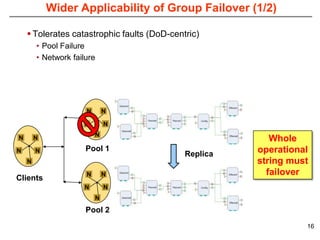
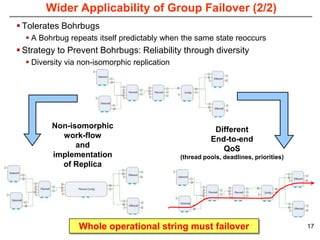
Wider Applicability of Group Failover (1/2)

     Tolerates catastrophic faults (DoD-centric)
        • Pool Failure
        • Network failure


                      N       N

                     N        N
                          N
N       N                                                 Whole
N       N             Pool 1                           operational
                                             Replica
    N                                                  string must
                      N       N                          failover
Clients
                     N        N
                          N
                      Pool 2
                                                                 16
Wider Applicability of Group Failover (2/2)
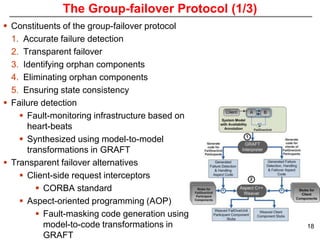
 Tolerates Bohrbugs
   A Bohrbug repeats itself predictably when the same state reoccurs
 Strategy to Prevent Bohrbugs: Reliability through diversity
   Diversity via non-isomorphic replication


         Non-isomorphic                                   Different
           work-flow                                     End-to-end
               and                                          QoS
         implementation                        (thread pools, deadlines, priorities)
           of Replica


                 Whole operational string must failover                                17
The Group-failover Protocol (1/3)
 Constituents of the group-failover protocol
  1. Accurate failure detection
  2. Transparent failover
  3. Identifying orphan components
  4. Eliminating orphan components
  5. Ensuring state consistency
 Failure detection
     Fault-monitoring infrastructure based on
      heart-beats
     Synthesized using model-to-model
      transformations in GRAFT
 Transparent failover alternatives
     Client-side request interceptors
          CORBA standard
     Aspect-oriented programming (AOP)
          Fault-masking code generation using
           model-to-code transformations in       18
           GRAFT
The Group-failover Protocol (2/3)
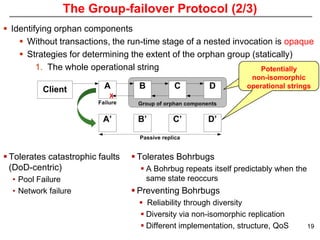
 Identifying orphan components
     Without transactions, the run-time stage of a nested invocation is opaque
     Strategies for determining the extent of the orphan group (statically)
         1. The whole operational string                          Potentially
                                                                   non-isomorphic
                                                                  operational strings


 Tolerates catastrophic faults    Tolerates Bohrbugs
  (DoD-centric)                      A Bohrbug repeats itself predictably when the
  • Pool Failure                      same state reoccurs
  • Network failure                Preventing Bohrbugs
                                    Reliability through diversity
                                    Diversity via non-isomorphic replication
                                    Different implementation, structure, QoS         19
The Group-failover Protocol (2/3)
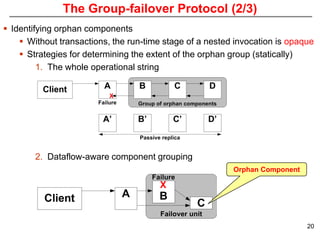
 Identifying orphan components
     Without transactions, the run-time stage of a nested invocation is opaque
     Strategies for determining the extent of the orphan group (statically)
         1. The whole operational string


        2. Dataflow-aware component grouping
                                                          Orphan Component


                                                                             20
The Group-failover Protocol (3/3)
 Eliminating orphan components
     Using deployment and configuration (D&C) infrastructure
     Invoke component life-cycle operations (e.g., activate, passivate)
     Passivation:
         Discards the application-specific state
         Component is no longer remotely addressable

 Ensuring state consistency
    Must assure exactly-once semantics
    State must be transferred atomically
    Strategies for state synchronization
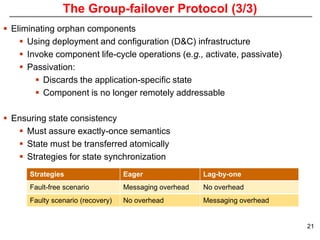
      Strategies                   Eager                Lag-by-one
      Fault-free scenario          Messaging overhead   No overhead
      Faulty scenario (recovery)   No overhead          Messaging overhead


                                                                             21
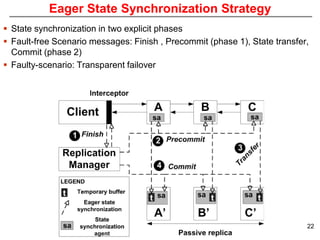
Eager State Synchronization Strategy
 State synchronization in two explicit phases
 Fault-free Scenario messages: Finish , Precommit (phase 1), State transfer,
  Commit (phase 2)
 Faulty-scenario: Transparent failover


                                                                            22
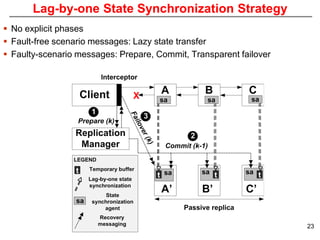
Lag-by-one State Synchronization Strategy
 No explicit phases
 Fault-free scenario messages: Lazy state transfer
 Faulty-scenario messages: Prepare, Commit, Transparent failover


                                                                    23
Evaluation: Overhead of the State
                Synchronization Strategies
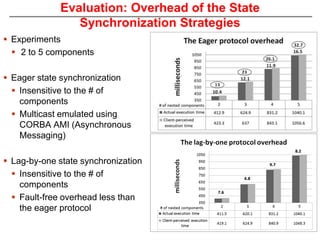
 Experiments
   2 to 5 components

 Eager state synchronization
   Insensitive to the # of
    components
   Multicast emulated using
    CORBA AMI (Asynchronous
    Messaging)

 Lag-by-one state synchronization
   Insensitive to the # of
    components
   Fault-free overhead less than
    the eager protocol
                                                 24
Evaluation: Client-perceived failover latency of
            the Synchronization Strategies
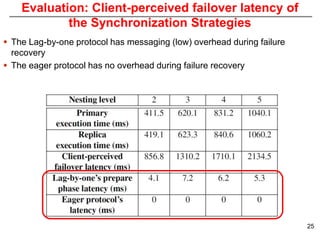
 The Lag-by-one protocol has messaging (low) overhead during failure
  recovery
 The eager protocol has no overhead during failure recovery


                                                                        25
Presentation Road-map
 Overview of the Contributions
 Replication & The Orphan Request Problem
    Related Research & Unresolved Challenges
    Solution: Group Failover
 Typed Traversal
    Related Research & Unresolved Challenges
    Solution: LEESA
 Concluding Remarks


                                                26
Role of Object Structure Traversals in the
Model-driven   Development Lifecycle
Development
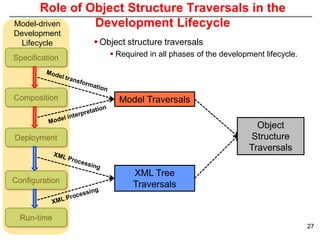
  Lifecycle      Object structure traversals
Specification        Required in all phases of the development lifecycle.


Composition           Model Traversals

                                                              Object
Deployment                                                  Structure
                                                            Traversals

                          XML Tree
Configuration
                          Traversals


  Run-time
                                                                             27
Object Structure Traversal and Object-oriented
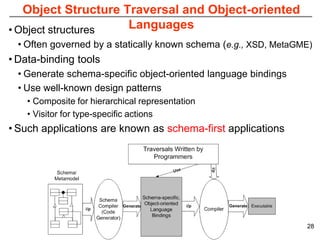
• Object structures  Languages
  • Often governed by a statically known schema (e.g., XSD, MetaGME)
• Data-binding tools
  • Generate schema-specific object-oriented language bindings
  • Use well-known design patterns
    • Composite for hierarchical representation
    • Visitor for type-specific actions
• Such applications are known as schema-first applications


                                                                  28
Unresolved Challenges in Schema-first Applications
• Sacrifice traversal idioms for type-safety
  • Succinctness (axis-oriented expressions)
     • Find all author names in a book catalog (XPath child axis)
      “/catalog/book/author/name”
  • Structure-shyness (resilience to schema evolution)
     • Find names anywhere in the book catalog (XPath descendant axis)
       “//name”
• Highly repetitive, verbose traversal code
  • Schema-specificity --- each class has different interface
  • Intent is lost due to code bloat
• Tangling of traversal specifications with type-specific actions
  • The “visit-all” semantics of the classic visitor are inefficient and insufficient
  • Lack of reusability of traversal specifications and visitors


            Is it possible to achieve type-safety of OO and the
                                                                                    29
                     succinctness of XPath together?
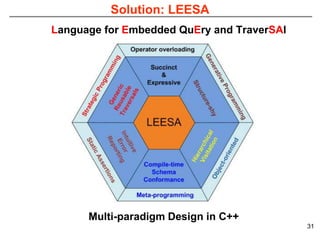
Solution: LEESA
Language for Embedded QuEry and TraverSAl


      Multi-paradigm Design in C++
                                            31
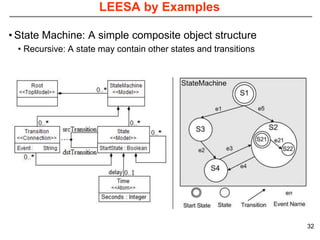
LEESA by Examples

• State Machine: A simple composite object structure
 • Recursive: A state may contain other states and transitions


                                                                 32
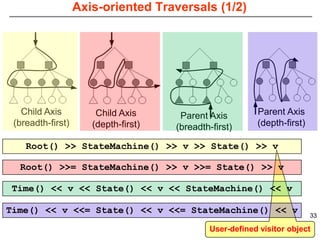
Axis-oriented Traversals (1/2)


   Child Axis          Child Axis      Parent Axis        Parent Axis
 (breadth-first)      (depth-first)   (breadth-first)     (depth-first)

    Root() >> StateMachine() >> v >> State() >> v

  Root() >>= StateMachine() >> v >>= State() >> v

 Time() << v << State() << v << StateMachine() << v

Time() << v <<= State() << v <<= StateMachine() << v
                                                                          33

                                              User-defined visitor object
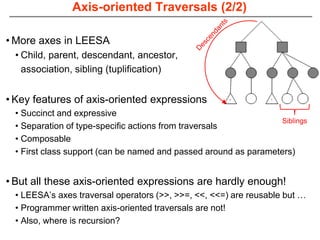
Axis-oriented Traversals (2/2)

• More axes in LEESA
 • Child, parent, descendant, ancestor,
   association, sibling (tuplification)


• Key features of axis-oriented expressions
 • Succinct and expressive
                                                                 Siblings
 • Separation of type-specific actions from traversals
 • Composable
 • First class support (can be named and passed around as parameters)


• But all these axis-oriented expressions are hardly enough!
 • LEESA’s axes traversal operators (>>, >>=, <<, <<=) are reusable but …
 • Programmer written axis-oriented traversals are not!
 • Also, where is recursion?
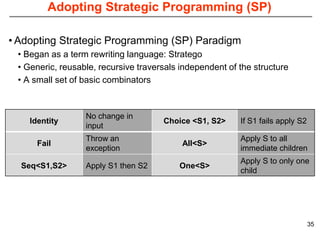
Adopting Strategic Programming (SP)

• Adopting Strategic Programming (SP) Paradigm
 • Began as a term rewriting language: Stratego
 • Generic, reusable, recursive traversals independent of the structure
 • A small set of basic combinators


                  No change in
    Identity                          Choice <S1, S2>     If S1 fails apply S2
                  input
                  Throw an                                Apply S to all
      Fail                                 All<S>
                  exception                               immediate children
                                                          Apply S to only one
  Seq<S1,S2>      Apply S1 then S2        One<S>
                                                          child


                                                                                 35
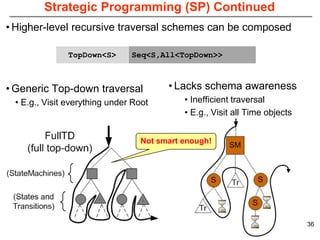
Strategic Programming (SP) Continued
• Higher-level recursive traversal schemes can be composed

              TopDown<S>       Seq<S,All<TopDown>>


• Generic Top-down traversal            • Lacks schema awareness
 • E.g., Visit everything under Root        • Inefficient traversal
                                            • E.g., Visit all Time objects


                                  Not smart enough!


                                                                             36
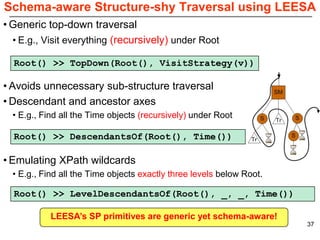
Schema-aware Structure-shy Traversal using LEESA
• Generic top-down traversal
  • E.g., Visit everything (recursively) under Root

  Root() >> TopDown(Root(), VisitStrategy(v))

• Avoids unnecessary sub-structure traversal
• Descendant and ancestor axes
  • E.g., Find all the Time objects (recursively) under Root

  Root() >> DescendantsOf(Root(), Time())

• Emulating XPath wildcards
  • E.g., Find all the Time objects exactly three levels below Root.

  Root() >> LevelDescendantsOf(Root(), _, _, Time())

            LEESA’s SP primitives are generic yet schema-aware!
                                                                       37
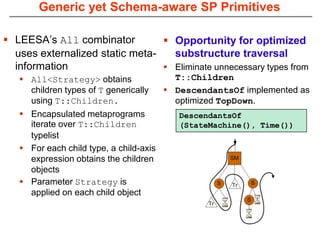
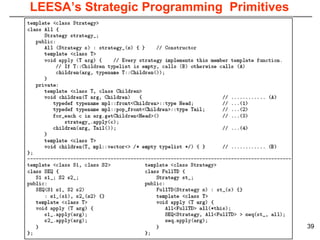
Generic yet Schema-aware SP Primitives

 LEESA’s All combinator          Opportunity for optimized
  uses externalized static meta-   substructure traversal
  information                     Eliminate unnecessary types from
    All<Strategy> obtains                 T::Children
     children types of T generically      DescendantsOf implemented as
     using T::Children.                    optimized TopDown.
    Encapsulated metaprograms              DescendantsOf
     iterate over T::Children               (StateMachine(), Time())
     typelist
    For each child type, a child-axis
     expression obtains the children
     objects
    Parameter Strategy is
     applied on each child object
LEESA’s Strategic Programming Primitives


                                           39
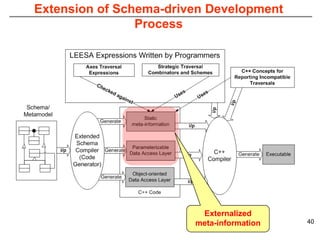
Extension of Schema-driven Development
                Process


                         Externalized
                        meta-information   40
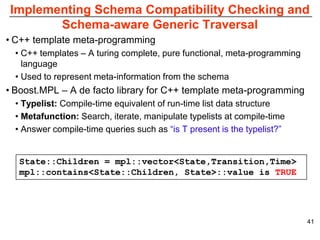
Implementing Schema Compatibility Checking and
       Schema-aware Generic Traversal
• C++ template meta-programming
  • C++ templates – A turing complete, pure functional, meta-programming
    language
  • Used to represent meta-information from the schema
• Boost.MPL – A de facto library for C++ template meta-programming
  • Typelist: Compile-time equivalent of run-time list data structure
  • Metafunction: Search, iterate, manipulate typelists at compile-time
  • Answer compile-time queries such as “is T present is the typelist?”


   State::Children = mpl::vector<State,Transition,Time>
   mpl::contains<State::Children, State>::value is TRUE


                                                                           41
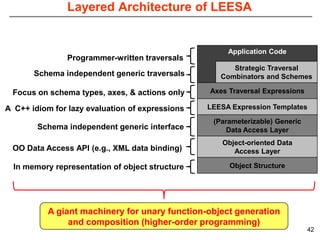
Layered Architecture of LEESA


                                                      Application Code
               Programmer-written traversals
                                                       Strategic Traversal
       Schema independent generic traversals        Combinators and Schemes

 Focus on schema types, axes, & actions only     Axes Traversal Expressions

A C++ idiom for lazy evaluation of expressions   LEESA Expression Templates

                                                  (Parameterizable) Generic
        Schema independent generic interface          Data Access Layer
                                                    Object-oriented Data
 OO Data Access API (e.g., XML data binding)           Access Layer

  In memory representation of object structure        Object Structure


          A giant machinery for unary function-object generation
               and composition (higher-order programming)
                                                                              42
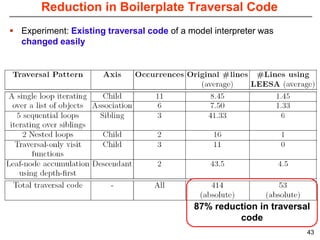
Reduction in Boilerplate Traversal Code
 Experiment: Existing traversal code of a model interpreter was
  changed easily


                                            87% reduction in traversal
                                                     code
                                                                     43
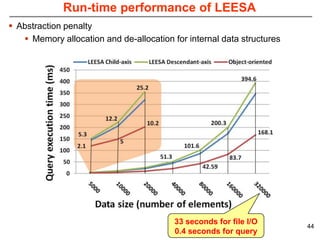
Run-time performance of LEESA
 Abstraction penalty
    Memory allocation and de-allocation for internal data structures


                                          33 seconds for file I/O
                                                                        44
                                          0.4 seconds for query
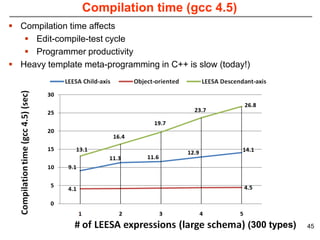
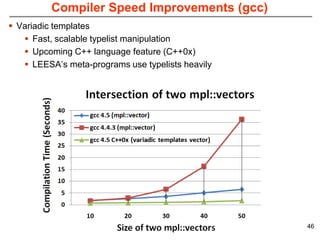
Compilation time (gcc 4.5)
 Compilation time affects
    Edit-compile-test cycle
    Programmer productivity
 Heavy template meta-programming in C++ is slow (today!)


                                                        (300 types)   45
Compiler Speed Improvements (gcc)
 Variadic templates
    Fast, scalable typelist manipulation
    Upcoming C++ language feature (C++0x)
    LEESA’s meta-programs use typelists heavily


                                                   46
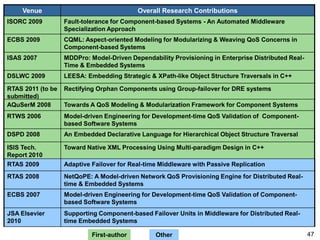
Venue                                  Overall Research Contributions
ISORC 2009         Fault-tolerance for Component-based Systems - An Automated Middleware
                   Specialization Approach
ECBS 2009          CQML: Aspect-oriented Modeling for Modularizing & Weaving QoS Concerns in
                   Component-based Systems
ISAS 2007          MDDPro: Model-Driven Dependability Provisioning in Enterprise Distributed Real-
                   Time & Embedded Systems
DSLWC 2009         LEESA: Embedding Strategic & XPath-like Object Structure Traversals in C++

RTAS 2011 (to be   Rectifying Orphan Components using Group-failover for DRE systems
submitted)
AQuSerM 2008       Towards A QoS Modeling & Modularization Framework for Component Systems
RTWS 2006          Model-driven Engineering for Development-time QoS Validation of Component-
                   based Software Systems
DSPD 2008          An Embedded Declarative Language for Hierarchical Object Structure Traversal

ISIS Tech.         Toward Native XML Processing Using Multi-paradigm Design in C++
Report 2010
RTAS 2009          Adaptive Failover for Real-time Middleware with Passive Replication
RTAS 2008          NetQoPE: A Model-driven Network QoS Provisioning Engine for Distributed Real-
                   time & Embedded Systems
ECBS 2007          Model-driven Engineering for Development-time QoS Validation of Component-
                   based Software Systems
JSA Elsevier       Supporting Component-based Failover Units in Middleware for Distributed Real-
2010               time Embedded Systems

                            First-author         Other                                               47
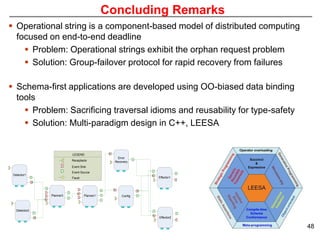
Concluding Remarks
 Operational string is a component-based model of distributed computing
  focused on end-to-end deadline
     Problem: Operational strings exhibit the orphan request problem
     Solution: Group-failover protocol for rapid recovery from failures

 Schema-first applications are developed using OO-biased data binding
  tools
     Problem: Sacrificing traversal idioms and reusability for type-safety
     Solution: Multi-paradigm design in C++, LEESA


                          LEGEND
                                                 Error
                          Receptacle           Recovery
                          Event Sink
                          Event Source
 Detector1
                          Facet                             Effector1


               Planner3           Planner1         Config


   Detector2

                                                            Effector2


                                                                              48
Thank you!


Questions


             49

Ph.D. Dissertation

  • 1.
    End-to-end Reliability of Non-deterministicStateful Components Ph.D. Dissertation Defense, 24 September 2010 Sumant Tambe sutambe@dre.vanderbilt.edu www.dre.vanderbilt.edu/~sutambe Department of Electrical Engineering & Computer Science Vanderbilt University, Nashville, TN, USA
  • 2.
    Presentation Road-map  Overviewof the Contributions  The Orphan Request Problem  Related Research & Unresolved Challenges  Solution: Group-failover  Typed Traversal  Related Research & Unresolved Challenges  Solution: LEESA  Concluding Remarks 2
  • 3.
    Dissertation Contributions: Model-drivenFault-tolerance Resolves for DRE systems challenges in • Component QoS Modeling Language (CQML) Specification • Aspect-oriented Modeling for Modularizing QoS Concerns Composition • Generative Aspects for Fault-Tolerance (GRAFT) • Multi-stage model-driven development process Deployment • Weaves dependability concerns in system artifacts • Provides model-to-model, model-to-text, model-to- code transformations Configuration • The Group-failover Protocol • Resolves the orphan request problem in multi-tier Run-time component-based DRE systems 3 3
  • 4.
    Context: Distributed Real-timeEmbedded (DRE) Systems  Heterogeneous soft real-time applications  Stringent simultaneous QoS demands  High-availability, Predictability (CPU & network)  Efficient resource utilization  Operation in dynamic & resource-constrained environments  Process/processor failures  Changing system loads  Examples  Total shipboard computing environment  NASA’s Magnetospheric Multi-scale mission  Warehouse Inventory Tracking Systems  Component-based development  Separation of Concerns  Composability  Reuse of commodity-off-the-shelf (COTS) components (Images courtesy Google) 4
  • 5.
    Operational Strings &End-to-end QoS • Operational String model of component-based DRE systems • A multi-tier processing model focused on the end-to-end QoS requirements • Critical Path: The chain of tasks with a soft real-time deadline • Failures may compromise end-to-end QoS (response time) LEGEND Error Receptacle Recovery Event Sink Event Source Detector1 Facet Effector1 Planner3 Planner1 Config Detector2 Effector2 Must support highly available operational strings! 5
  • 6.
    Operational Strings andHigh-availability • Operational String model of component-based DRE systems • A multi-tier processing model focused on the end-to-end QoS requirements • Critical Path: The chain of tasks with a soft real-time deadline • Failures may compromise end-to-end QoS (response time) LEGEND Error Receptacle Recovery Event Sink Event Source Detector1 Facet Effector1 Planner3 Planner1 Config Detector2 Effector2 Reliability Roll-back recovery Active Replication Passive Replication Alternatives Needs transaction support Resource hungry Less resource consuming Resources (heavy-weight) (compute & network) than active (only network) Non- Must compensate Must enforce Handles non-determinism determinism non-determinism determinism better Recovery Roll-back & re-execution Fastest recovery Re-execution (slowest recovery) (slower recovery) 6 time
  • 7.
    Non-determinism and theSide Effects of Replication  DRE systems must tolerate non-determinism  Many sources of non-determinism in DRE systems  E.g., Local information (sensors, clocks), thread-scheduling, timers, and more  Enforcing determinism is not always possible  Side-effects of replication + non-determinism + nested invocation  Orphan request & orphan state Problem Non-determinism Nested Orphan Request Invocation Problem Passive Replication 7
  • 8.
    Execution Semantics &Replication  Execution semantics in distributed systems  May-be – No more than once, not all subcomponents may execute  At-most-once – No more than once, all-or-none of the subcomponents will be executed (e.g., Transactions)  Transaction abort decisions are not transparent  At-least-once – All or some subcomponents may execute more than once  Applicable to idempotent requests only  Exactly-once – All subcomponents execute once & once only  Enhances perceived availability of the system  Exactly-once semantics should hold even upon failures  Equivalent to single fault-free execution  Roll-forward recovery (replication) may violate exactly-once semantics  Side-effects of replication must be rectified State State State Update Update Update Partial execution A B C D should seem like no-op Client upon recovery 8
  • 9.
    Exactly-once Semantics, Failures,& Determinism  Deterministic component A  Caching of request/reply at component B is sufficient Caching of request/reply rectifies the problem  Non-deterministic component A  Two possibilities upon failover 1. No invocation 2. Different invocation  Caching of request/reply does not help Orphan request &  Non-deterministic code orphan state must re-execute 9
  • 10.
    Presentation Road-map  Overviewof the Contributions  Replication & The Orphan Request Problem  Related Research & Unresolved Challenges  Solution: Group Failover  Typed Traversal  Related Research & Unresolved Challenges  Solution: LEESA  Concluding Remarks 10
  • 11.
    Related Research: End-to-endReliability Category Related Research (The Orphan Request Problem) Integrated 1. Reconciling Replication & Transactions for the End-to-End transaction Reliability of CORBA Applications by P. Felber & P. Narasimhan & replication 2. Transactional Exactly-Once by S. Frølund & R. Guerraoui 3. ITRA: Inter-Tier Relationship Architecture for End-to-end QoS by E. Dekel & G. Goft 4. Preventing orphan requests in the context of replicated invocation Database in by Stefan Pleisch & Arnas Kupsys & Andre Schiper the last tier 5. Preventing orphan requests by integrating replication & transactions by H. Kolltveit & S. olaf Hvasshovd Enforcing 1. Using Program Analysis to Identify & Compensate for determinism Nondeterminism in Fault-Tolerant, Replicated Systems by J. Slember & P. Narasimhan Deterministic 2. Living with nondeterminism in replicated middleware applications scheduling by J. Slember & P. Narasimhan 3. Deterministic Scheduling for Transactional Multithreaded Replicas by R. Jimenez-peris, M. Patino-Martínez, S. Arevalo, & J. Carlos Program 4. A Preemptive Deterministic Scheduling Algorithm for analysis to Multithreaded Replicas by C. Basile, Z. Kalbarczyk, & R. Iyer compensate 5. Replica Determinism in Fault-Tolerant Real-Time Systems by S. nondeterminism Poledna 11 6. Protocols for End-to-End Reliability in Multi-Tier Systems by P. Romano
  • 12.
    Unresolved Challenges: End-to-endReliability of Non-deterministic Stateful Components  Integration of replication & transactions  Applicable to multi-tier transactional web-based systems only  Overhead of transactions (fault-free situation)  Messaging overhead in the critical path (e.g., create, join)  2 phase commit (2PC) protocol at the end of invocation Create Join Join Join State State State Update Update Update A B C D Client 12
  • 13.
    Unresolved Challenges: End-to-endReliability of Non-deterministic Stateful Components  Integration of replication & transactions  Applicable to multi-tier transactional web-based systems only  Overhead of transactions (fault-free situation)  Messaging overhead in the critical path (e.g., create, join)  2 phase commit (2PC) protocol at the end of invocation  Overhead of transactions (faulty situation)  Must rollback to avoid orphan state  Re-execute & 2PC again upon recovery  Transactional semantics are not transparent  Developers must implement: prepare, commit, rollback (2PC phases)  Complex tangling of QoS: Schedulability & Reliability  Schedulability of commit, rollback & join must be ensured State State State Potential Update Update Update orphan A B C D state growing Client Orphan state bounded in B, C, D 13
  • 14.
    Unresolved Challenges: End-to-endReliability of Non-deterministic Stateful Components  Integration of replication & transactions  Applicable to multi-tier transactional web-based systems only  Overhead of transactions (fault-free situation)  Messaging overhead in the critical path (e.g., create, join)  2 phase commit (2PC) protocol at the end of invocation  Overhead of transactions (faulty situation)  Must rollback to avoid orphan state  Re-execute & 2PC again upon recovery  Transactional semantics are not transparent  Developers must implement: prepare, commit, rollback (2PC phases)  Complex tangling of QoS: Schedulability & Reliability  Schedulability of commit, rollback & join must be ensured  Enforcing determinism  Point solutions: Compensate specific sources of non-determinism  e.g., thread scheduling, mutual exclusion  Compensation using semi-automated program analysis  Humans must rectify non-automated compensation 14
  • 15.
    Solution: Protocol forEnd-to-end Exactly-once Semantics with Rapid Failover  Rethinking Transactions Failover granularity > 1  Overhead is undesirable in DRE systems  Alternative mechanism  To rectify the orphan state  To ensure state consistency A B Group-failover Protocol!! C A’ B’  Protocol characteristics: 1. Supports exactly-once execution semantics in presence of  Nested invocation, non-deterministic stateful components, passive replication 2. Ensures state consistency of replicas 3. Does not require intrusive changes to the component implementation  No need to implement prepare, commit, & rollback 4. Supports fast client failover that is insensitive to  Location of failure in the operational string  Size of the operational string 15
  • 16.
    Wider Applicability ofGroup Failover (1/2)  Tolerates catastrophic faults (DoD-centric) • Pool Failure • Network failure N N N N N N N Whole N N Pool 1 operational Replica N string must N N failover Clients N N N Pool 2 16
  • 17.
    Wider Applicability ofGroup Failover (2/2)  Tolerates Bohrbugs  A Bohrbug repeats itself predictably when the same state reoccurs  Strategy to Prevent Bohrbugs: Reliability through diversity  Diversity via non-isomorphic replication Non-isomorphic Different work-flow End-to-end and QoS implementation (thread pools, deadlines, priorities) of Replica Whole operational string must failover 17
  • 18.
    The Group-failover Protocol(1/3)  Constituents of the group-failover protocol 1. Accurate failure detection 2. Transparent failover 3. Identifying orphan components 4. Eliminating orphan components 5. Ensuring state consistency  Failure detection  Fault-monitoring infrastructure based on heart-beats  Synthesized using model-to-model transformations in GRAFT  Transparent failover alternatives  Client-side request interceptors  CORBA standard  Aspect-oriented programming (AOP)  Fault-masking code generation using model-to-code transformations in 18 GRAFT
  • 19.
    The Group-failover Protocol(2/3)  Identifying orphan components  Without transactions, the run-time stage of a nested invocation is opaque  Strategies for determining the extent of the orphan group (statically) 1. The whole operational string Potentially non-isomorphic operational strings  Tolerates catastrophic faults  Tolerates Bohrbugs (DoD-centric)  A Bohrbug repeats itself predictably when the • Pool Failure same state reoccurs • Network failure  Preventing Bohrbugs  Reliability through diversity  Diversity via non-isomorphic replication  Different implementation, structure, QoS 19
  • 20.
    The Group-failover Protocol(2/3)  Identifying orphan components  Without transactions, the run-time stage of a nested invocation is opaque  Strategies for determining the extent of the orphan group (statically) 1. The whole operational string 2. Dataflow-aware component grouping Orphan Component 20
  • 21.
    The Group-failover Protocol(3/3)  Eliminating orphan components  Using deployment and configuration (D&C) infrastructure  Invoke component life-cycle operations (e.g., activate, passivate)  Passivation:  Discards the application-specific state  Component is no longer remotely addressable  Ensuring state consistency  Must assure exactly-once semantics  State must be transferred atomically  Strategies for state synchronization Strategies Eager Lag-by-one Fault-free scenario Messaging overhead No overhead Faulty scenario (recovery) No overhead Messaging overhead 21
  • 22.
    Eager State SynchronizationStrategy  State synchronization in two explicit phases  Fault-free Scenario messages: Finish , Precommit (phase 1), State transfer, Commit (phase 2)  Faulty-scenario: Transparent failover 22
  • 23.
    Lag-by-one State SynchronizationStrategy  No explicit phases  Fault-free scenario messages: Lazy state transfer  Faulty-scenario messages: Prepare, Commit, Transparent failover 23
  • 24.
    Evaluation: Overhead ofthe State Synchronization Strategies  Experiments  2 to 5 components  Eager state synchronization  Insensitive to the # of components  Multicast emulated using CORBA AMI (Asynchronous Messaging)  Lag-by-one state synchronization  Insensitive to the # of components  Fault-free overhead less than the eager protocol 24
  • 25.
    Evaluation: Client-perceived failoverlatency of the Synchronization Strategies  The Lag-by-one protocol has messaging (low) overhead during failure recovery  The eager protocol has no overhead during failure recovery 25
  • 26.
    Presentation Road-map  Overviewof the Contributions  Replication & The Orphan Request Problem  Related Research & Unresolved Challenges  Solution: Group Failover  Typed Traversal  Related Research & Unresolved Challenges  Solution: LEESA  Concluding Remarks 26
  • 27.
    Role of ObjectStructure Traversals in the Model-driven Development Lifecycle Development Lifecycle  Object structure traversals Specification  Required in all phases of the development lifecycle. Composition Model Traversals Object Deployment Structure Traversals XML Tree Configuration Traversals Run-time 27
  • 28.
    Object Structure Traversaland Object-oriented • Object structures Languages • Often governed by a statically known schema (e.g., XSD, MetaGME) • Data-binding tools • Generate schema-specific object-oriented language bindings • Use well-known design patterns • Composite for hierarchical representation • Visitor for type-specific actions • Such applications are known as schema-first applications 28
  • 29.
    Unresolved Challenges inSchema-first Applications • Sacrifice traversal idioms for type-safety • Succinctness (axis-oriented expressions) • Find all author names in a book catalog (XPath child axis) “/catalog/book/author/name” • Structure-shyness (resilience to schema evolution) • Find names anywhere in the book catalog (XPath descendant axis) “//name” • Highly repetitive, verbose traversal code • Schema-specificity --- each class has different interface • Intent is lost due to code bloat • Tangling of traversal specifications with type-specific actions • The “visit-all” semantics of the classic visitor are inefficient and insufficient • Lack of reusability of traversal specifications and visitors Is it possible to achieve type-safety of OO and the 29 succinctness of XPath together?
  • 30.
    Solution: LEESA Language forEmbedded QuEry and TraverSAl Multi-paradigm Design in C++ 31
  • 31.
    LEESA by Examples •State Machine: A simple composite object structure • Recursive: A state may contain other states and transitions 32
  • 32.
    Axis-oriented Traversals (1/2) Child Axis Child Axis Parent Axis Parent Axis (breadth-first) (depth-first) (breadth-first) (depth-first) Root() >> StateMachine() >> v >> State() >> v Root() >>= StateMachine() >> v >>= State() >> v Time() << v << State() << v << StateMachine() << v Time() << v <<= State() << v <<= StateMachine() << v 33 User-defined visitor object
  • 33.
    Axis-oriented Traversals (2/2) •More axes in LEESA • Child, parent, descendant, ancestor, association, sibling (tuplification) • Key features of axis-oriented expressions • Succinct and expressive Siblings • Separation of type-specific actions from traversals • Composable • First class support (can be named and passed around as parameters) • But all these axis-oriented expressions are hardly enough! • LEESA’s axes traversal operators (>>, >>=, <<, <<=) are reusable but … • Programmer written axis-oriented traversals are not! • Also, where is recursion?
  • 34.
    Adopting Strategic Programming(SP) • Adopting Strategic Programming (SP) Paradigm • Began as a term rewriting language: Stratego • Generic, reusable, recursive traversals independent of the structure • A small set of basic combinators No change in Identity Choice <S1, S2> If S1 fails apply S2 input Throw an Apply S to all Fail All<S> exception immediate children Apply S to only one Seq<S1,S2> Apply S1 then S2 One<S> child 35
  • 35.
    Strategic Programming (SP)Continued • Higher-level recursive traversal schemes can be composed TopDown<S> Seq<S,All<TopDown>> • Generic Top-down traversal • Lacks schema awareness • E.g., Visit everything under Root • Inefficient traversal • E.g., Visit all Time objects Not smart enough! 36
  • 36.
    Schema-aware Structure-shy Traversalusing LEESA • Generic top-down traversal • E.g., Visit everything (recursively) under Root Root() >> TopDown(Root(), VisitStrategy(v)) • Avoids unnecessary sub-structure traversal • Descendant and ancestor axes • E.g., Find all the Time objects (recursively) under Root Root() >> DescendantsOf(Root(), Time()) • Emulating XPath wildcards • E.g., Find all the Time objects exactly three levels below Root. Root() >> LevelDescendantsOf(Root(), _, _, Time()) LEESA’s SP primitives are generic yet schema-aware! 37
  • 37.
    Generic yet Schema-awareSP Primitives  LEESA’s All combinator  Opportunity for optimized uses externalized static meta- substructure traversal information  Eliminate unnecessary types from  All<Strategy> obtains T::Children children types of T generically  DescendantsOf implemented as using T::Children. optimized TopDown.  Encapsulated metaprograms DescendantsOf iterate over T::Children (StateMachine(), Time()) typelist  For each child type, a child-axis expression obtains the children objects  Parameter Strategy is applied on each child object
  • 38.
  • 39.
    Extension of Schema-drivenDevelopment Process Externalized meta-information 40
  • 40.
    Implementing Schema CompatibilityChecking and Schema-aware Generic Traversal • C++ template meta-programming • C++ templates – A turing complete, pure functional, meta-programming language • Used to represent meta-information from the schema • Boost.MPL – A de facto library for C++ template meta-programming • Typelist: Compile-time equivalent of run-time list data structure • Metafunction: Search, iterate, manipulate typelists at compile-time • Answer compile-time queries such as “is T present is the typelist?” State::Children = mpl::vector<State,Transition,Time> mpl::contains<State::Children, State>::value is TRUE 41
  • 41.
    Layered Architecture ofLEESA Application Code Programmer-written traversals Strategic Traversal Schema independent generic traversals Combinators and Schemes Focus on schema types, axes, & actions only Axes Traversal Expressions A C++ idiom for lazy evaluation of expressions LEESA Expression Templates (Parameterizable) Generic Schema independent generic interface Data Access Layer Object-oriented Data OO Data Access API (e.g., XML data binding) Access Layer In memory representation of object structure Object Structure A giant machinery for unary function-object generation and composition (higher-order programming) 42
  • 42.
    Reduction in BoilerplateTraversal Code  Experiment: Existing traversal code of a model interpreter was changed easily 87% reduction in traversal code 43
  • 43.
    Run-time performance ofLEESA  Abstraction penalty  Memory allocation and de-allocation for internal data structures 33 seconds for file I/O 44 0.4 seconds for query
  • 44.
    Compilation time (gcc4.5)  Compilation time affects  Edit-compile-test cycle  Programmer productivity  Heavy template meta-programming in C++ is slow (today!) (300 types) 45
  • 45.
    Compiler Speed Improvements(gcc)  Variadic templates  Fast, scalable typelist manipulation  Upcoming C++ language feature (C++0x)  LEESA’s meta-programs use typelists heavily 46
  • 46.
    Venue Overall Research Contributions ISORC 2009 Fault-tolerance for Component-based Systems - An Automated Middleware Specialization Approach ECBS 2009 CQML: Aspect-oriented Modeling for Modularizing & Weaving QoS Concerns in Component-based Systems ISAS 2007 MDDPro: Model-Driven Dependability Provisioning in Enterprise Distributed Real- Time & Embedded Systems DSLWC 2009 LEESA: Embedding Strategic & XPath-like Object Structure Traversals in C++ RTAS 2011 (to be Rectifying Orphan Components using Group-failover for DRE systems submitted) AQuSerM 2008 Towards A QoS Modeling & Modularization Framework for Component Systems RTWS 2006 Model-driven Engineering for Development-time QoS Validation of Component- based Software Systems DSPD 2008 An Embedded Declarative Language for Hierarchical Object Structure Traversal ISIS Tech. Toward Native XML Processing Using Multi-paradigm Design in C++ Report 2010 RTAS 2009 Adaptive Failover for Real-time Middleware with Passive Replication RTAS 2008 NetQoPE: A Model-driven Network QoS Provisioning Engine for Distributed Real- time & Embedded Systems ECBS 2007 Model-driven Engineering for Development-time QoS Validation of Component- based Software Systems JSA Elsevier Supporting Component-based Failover Units in Middleware for Distributed Real- 2010 time Embedded Systems First-author Other 47
  • 47.
    Concluding Remarks  Operationalstring is a component-based model of distributed computing focused on end-to-end deadline  Problem: Operational strings exhibit the orphan request problem  Solution: Group-failover protocol for rapid recovery from failures  Schema-first applications are developed using OO-biased data binding tools  Problem: Sacrificing traversal idioms and reusability for type-safety  Solution: Multi-paradigm design in C++, LEESA LEGEND Error Receptacle Recovery Event Sink Event Source Detector1 Facet Effector1 Planner3 Planner1 Config Detector2 Effector2 48
  • 48.

Editor's Notes

  • #4 Let me quickly review what I’ve presented in the past. During my proposal I presented CQML and GRAFT, which address the challenges in earlier phases of the development lifecycle. The group-failover was the proposed topic addressing the challenges in the run-time phase.
  • #6 Particularly of interest is the component-based operational string model….An important notion in operational string is that of a critical path….To ensure critical path meets its deadline, two things have to happen.
  • #7 Particularly of interest is the component-based operational string model….An important notion in operational string is that of a critical path….To ensure critical path meets its deadline, two things have to happen.
  • #8 When you use replication for high-availability, you have to deal with the side-effects of replication.
  • #9 To understand the run-time issues, we have to closely examine execution semantics in distributed systems…. Even in case of failures, it should appear that everything executed exactly once. However, roll-forward recovery makes it particularly harder. Although parts of the request are executed multiple time physically, the outcome should be as if everything executed exactly once.
  • #10 Solution to rectifythe side-effects of replication depends upon whether system is deterministic or non-deterministic.
  • #16 We came up with the group-failover protocol. The key characteristic of group-failover protocol is that the failover granularity is greater than 1. Instead of a single component failover, there is group-failover.
  • #17 Conventionally …. The granularity of failover….However, I’ll present 3 scenarios here that argue for failover granularity larger than a single component.
  • #19 To ensure these characteristics, five things must take place accurately in group-failover
  • #20 For identifying orphan components as well, we can exploit model-driven techniques …. To overcome that problem we came up with static strategies to determine the extent of the orphan group.
  • #28 During the course of earlier research, I observed that object structure traversals are needed in all the phases of lifecycle. They manifest in two forms. First is model traversals needed for model transformation &amp; model interpretation. Secondly, for XML processing for configuration of middleware.
  • #29 These object structures are often governed by a static schema…. For improved type-safety, data-binding tools are used….
  • #41 All this magic is made possible due to an extension of the schema-driven development process
  • #44 Several traversal patterns were replaced by LEESA axis-oriented expressions
  • #47 In short, better days are ahead for C++ meta-programming!