– Software Requirements –
         Descriptions and specifications of a system


Objectives:
q To introduce the concepts of user and system
  requirements
q To describe functional / non-functional requirements
q To explain two techniques for describing system
  requirements
q To explain how software requirements may be
  organised in a requirements document
Key Points
Functional and non-functional requirements
User requirements
System requirements
The software requirements document
What is Requirement
Engineering
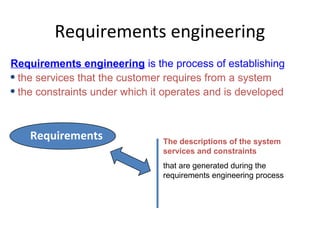
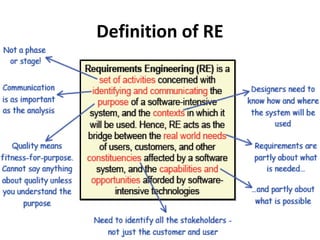
Requirements engineering
Requirements engineering is the process of establishing
q the services that the customer requires from a system

q the constraints under which it operates and is developed


    Requirements                The descriptions of the system
                                services and constraints
                                that are generated during the
                                requirements engineering process
Definition of RE
What are Requirements?
What is a requirement?
• It may range from a high-level abstract statement
  of a service or of a system constraint to a detailed
  mathematical functional specification
• This is inevitable as requirements may serve a
  dual function
   – May be the basis for a bid for a contract - therefore must be
     open to interpretation
   – May be the basis for the contract itself - therefore must be
     defined in detail
   – Both these statements may be called requirements
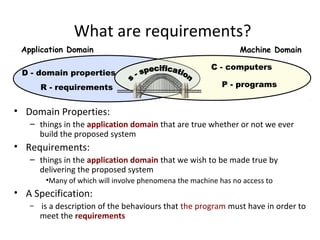
What are requirements?
 Application Domain                                             Machine Domain

                                                        C - computers
 D - domain properties
       R - requirements                                    P - programs


• Domain Properties:
   – things in the application domain that are true whether or not we ever
     build the proposed system
• Requirements:
   – things in the application domain that we wish to be made true by
     delivering the proposed system
        •Many of which will involve phenomena the machine has no access to
• A Specification:
   –   is a description of the behaviours that the program must have in order to
       meet the requirements
What are Requirements?
• Two basic principles of requirements engineering:
   – Separate the problem from the solution
   – Problems and solutions intertwine with one another
• Describing problems:
   – Application Domains vs. Machine Domains
   – Verification vs. Validation
• Systems Engineering
   – Systems vs. software
• Patterns and Types of Problem
   – Requirements patterns
   – Problem Frames
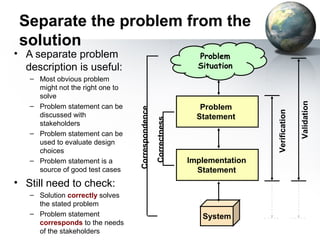
Separate the problem from the
 solution
• A separate problem                                               Problem
  description is useful:                                           Situation
   – Most obvious problem
     might not the right one to
     solve


                                                                                                 Validation
   – Problem statement can be                                       Problem


                                  Correspondence


                                                                                  Verification
     discussed with                                                Statement


                                                   Correctness
     stakeholders
   – Problem statement can be
     used to evaluate design
     choices
   – Problem statement is a                                      Implementation
     source of good test cases                                     Statement
• Still need to check:
   – Solution correctly solves
     the stated problem
   – Problem statement                                              System
     corresponds to the needs
     of the stakeholders
Fitness for purpose?

• Two correctness (verification) criteria:
  – The Program running on a particular Computer
    satisfies the Specification
  – The Specification, in the context of the given domain
    properties, satisfies the requirements
• Two completeness (validation) criteria:
  – We discovered all the important requirements
  – We discovered all the relevant domain properties
Example

• Requirement R
  – “The database shall only be accessible by authorized
    personnel”
• Domain Properties D:
  – Authorized personnel have passwords
  – Passwords are never shared with non-authorized
    personnel
• Specification S:
  – Access to the database shall only be granted after the
    user types an authorized password.
• S + D entail R
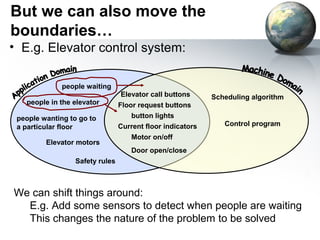
But we can also move the
boundaries…
• E.g. Elevator control system:

              people waiting
                                Elevator call buttons      Scheduling algorithm
   people in the elevator       Floor request buttons
 people wanting to go to            button lights
 a particular floor             Current floor indicators      Control program
                                    Motor on/off
         Elevator motors
                                    Door open/close
                 Safety rules


We can shift things around:
  E.g. Add some sensors to detect when people are waiting
  This changes the nature of the problem to be solved
What do Requirements
Engineers do?
What do Requirements Engineers
do?

• Some notion that there is a “problem” that
  needs solving
  – dissatisfaction with the current state of affairs
  – a new business opportunity
  – a potential saving of cost, time, resource usage,
    etc.
• Requirements Engineer is an agent of change
The requirements engineer
must:
The requirements engineer must:
• Identify the “problem”/”opportunity”
• Which problem needs to be solved? (identify problem
  Boundaries)
• Where is the problem? (understand the Context/Problem
  Domain)
• Whose problem is it? (identify Stakeholders)
• Why does it need solving? (identify the stakeholders’
  Goals)
• How might a software system help? (collect some
  Scenarios)
• When does it need solving? (identify Development
  Constraints)
• What might prevent us solving it? (identify Feasibility
  and Risk)
• And become an expert in the problem domain
Types of requirement

•   User requirements
•   System requirements
•   Domain requirements
•   Functional requirements
•   Non-functional requirements
Types of requirement

• User requirements
  – Statements in natural language plus diagrams of the
    services the system provides and its operational constraints.
    Written for customers
• System requirements
  – A structured document setting out detailed descriptions of
    the system services. Written as a contract between client
    and contractor
• Software specification
  – A detailed software description which can serve as a basis
    for a design or implementation. Written for developers
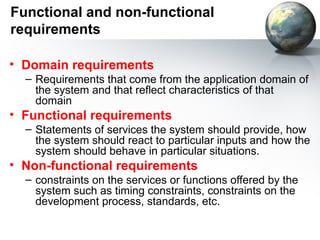
Functional and non-functional
requirements

• Domain requirements
  – Requirements that come from the application domain of
    the system and that reflect characteristics of that
    domain
• Functional requirements
  – Statements of services the system should provide, how
    the system should react to particular inputs and how the
    system should behave in particular situations.
• Non-functional requirements
  – constraints on the services or functions offered by the
    system such as timing constraints, constraints on the
    development process, standards, etc.
What are User requirements
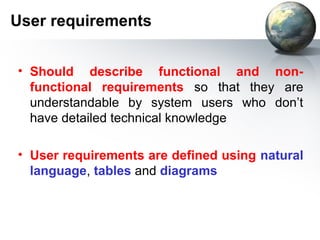
User requirements


• Should describe functional and non-
  functional requirements so that they are
  understandable by system users who don’t
  have detailed technical knowledge

• User requirements are defined using natural
  language, tables and diagrams
What are System requirements
System requirements

– More detailed specifications of user requirements
• Serve as a basis for designing the system
• May be used as part of the system contract
• System requirements may be expressed using
  system models
What are Domain requirements
Domain requirements

• Derived from the application domain and
  describe system characteristics and features
  that reflect the domain

• May be new functional requirements, constraints
  on existing requirements or define specific
  computations
• If domain requirements are not satisfied, the
  system may be unworkable
What are   Domain   requirements
problems
Domain requirements problems

• Understandability
  – Requirements are expressed in the language of the
    application domain
  – This is often not understood by software engineers
    developing the system
• Implicitness
  – Domain specialists understand the area so well that they
    do not think of making the domain requirements explicit
What is Functional Requirement
Functional Requirements

  Describe functionality or system services
• Depend on the type of software, expected users
  and the type of system where the software is used
• Functional user requirements may be high-
  level statements of what the system should do
  BUT functional system requirements should
  describe the system services in detail
The LIBSYS system

• A library system that provides a single interface to
  a number of databases of articles in different
  libraries.
• Users can search for, download and print these
  articles for personal study.
Examples of functional
requirements
Examples of functional
requirements

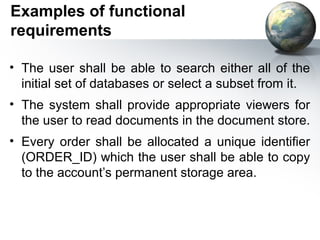
• The user shall be able to search either all of the
  initial set of databases or select a subset from it.
• The system shall provide appropriate viewers for
  the user to read documents in the document store.
• Every order shall be allocated a unique identifier
  (ORDER_ID) which the user shall be able to copy
  to the account’s permanent storage area.
Requirements imprecision
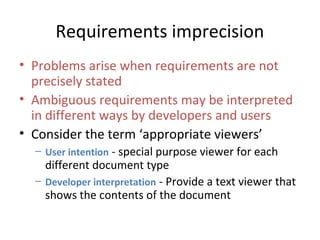
• Problems arise when requirements are not
  precisely stated
• Ambiguous requirements may be interpreted
  in different ways by developers and users
• Consider the term ‘appropriate viewers’
  – User intention - special purpose viewer for each
    different document type
  – Developer interpretation - Provide a text viewer that
    shows the contents of the document
Requirements completeness and
               consistency
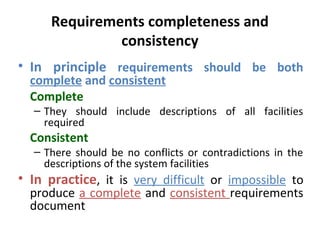
• In principle requirements should be both
  complete and consistent
  Complete
  – They should include descriptions of all facilities
    required
  Consistent
  – There should be no conflicts or contradictions in the
    descriptions of the system facilities
• In practice, it is very difficult or impossible to
  produce a complete and consistent requirements
  document
Types of Non-functional requirement
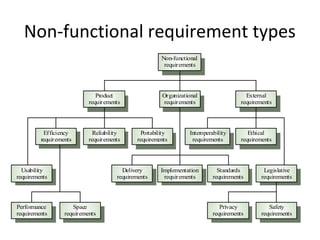
Non-functional requirement types
                                                     Non-functional
                                                      requirements


                              Product                Organizational                    External
                           requirements               requirements                   requirements


          Efficiency        Reliability      Portability        Interoperability        Ethical
         requirements      requirements     requirements         requirements        requirements


  Usability                            Delivery      Implementation         Standards        Legislative
requirements                         requirements     requirements        requirements      requirements


Performance          Space                                                   Privacy           Safety
requirements      requirements                                            requirements      requirements
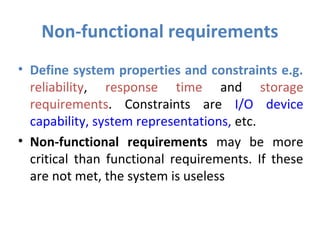
Non-functional requirements
• Define system properties and constraints e.g.
  reliability, response time and storage
  requirements. Constraints are I/O device
  capability, system representations, etc.
• Non-functional requirements may be more
  critical than functional requirements. If these
  are not met, the system is useless
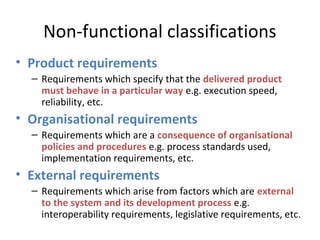
Non-functional classifications
• Product requirements
  – Requirements which specify that the delivered product
    must behave in a particular way e.g. execution speed,
    reliability, etc.
• Organisational requirements
  – Requirements which are a consequence of organisational
    policies and procedures e.g. process standards used,
    implementation requirements, etc.
• External requirements
  – Requirements which arise from factors which are external
    to the system and its development process e.g.
    interoperability requirements, legislative requirements, etc.
Non-functional requirements
examples

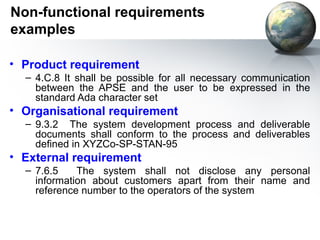
• Product requirement
  – 4.C.8 It shall be possible for all necessary communication
    between the APSE and the user to be expressed in the
    standard Ada character set
• Organisational requirement
  – 9.3.2 The system development process and deliverable
    documents shall conform to the process and deliverables
    defined in XYZCo-SP-STAN-95
• External requirement
  – 7.6.5    The system shall not disclose any personal
    information about customers apart from their name and
    reference number to the operators of the system
Goals and requirements
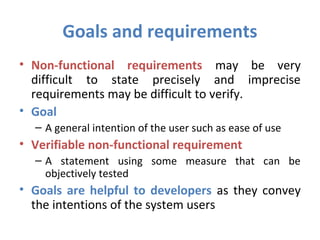
• Non-functional requirements may be very
  difficult to state precisely and imprecise
  requirements may be difficult to verify.
• Goal
  – A general intention of the user such as ease of use
• Verifiable non-functional requirement
  – A statement using some measure that can be
    objectively tested
• Goals are helpful to developers as they convey
  the intentions of the system users
Examples
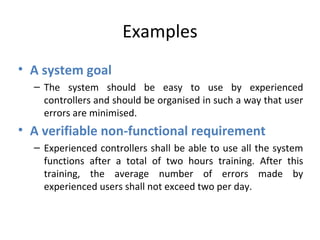
• A system goal
  – The system should be easy to use by experienced
    controllers and should be organised in such a way that user
    errors are minimised.
• A verifiable non-functional requirement
  – Experienced controllers shall be able to use all the system
    functions after a total of two hours training. After this
    training, the average number of errors made by
    experienced users shall not exceed two per day.
Features of Non-Functional Requirements
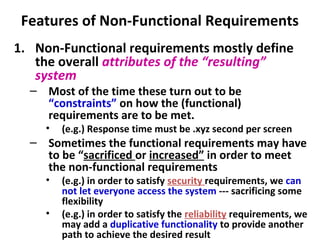
1. Non-Functional requirements mostly define
   the overall attributes of the “resulting”
   system
  – Most of the time these turn out to be
    “constraints” on how the (functional)
    requirements are to be met.
     •   (e.g.) Response time must be .xyz second per screen
  – Sometimes the functional requirements may have
    to be “sacrificed or increased” in order to meet
    the non-functional requirements
     •   (e.g.) in order to satisfy security requirements, we can
         not let everyone access the system --- sacrificing some
         flexibility
     •   (e.g.) in order to satisfy the reliability requirements, we
         may add a duplicative functionality to provide another
         path to achieve the desired result
Features of Non-Functional
           Requirements
1. Some non-functional requirements
   may not address the attributes of the
   resulting system (product), but
   something else
  – (e.g.) the system must be developed with
    a very risk averse process such as Spiral
    or the system must be developed with
    Visual Basic language
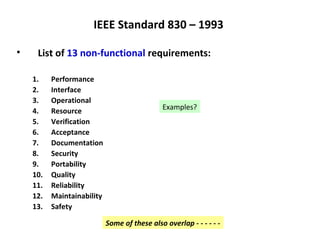
IEEE Standard 830 – 1993

•    List of 13 non-functional requirements:

    1.    Performance
    2.    Interface
    3.    Operational
    4.    Resource                            Examples?
    5.    Verification
    6.    Acceptance
    7.    Documentation
    8.    Security
    9.    Portability
    10.   Quality
    11.   Reliability
    12.   Maintainability
    13.   Safety

                            Some of these also overlap - - - - - -
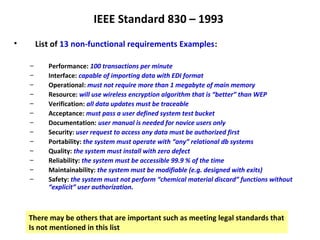
IEEE Standard 830 – 1993
•       List of 13 non-functional requirements Examples:

    –      Performance: 100 transactions per minute
    –      Interface: capable of importing data with EDI format
    –      Operational: must not require more than 1 megabyte of main memory
    –      Resource: will use wireless encryption algorithm that is “better” than WEP
    –      Verification: all data updates must be traceable
    –      Acceptance: must pass a user defined system test bucket
    –      Documentation: user manual is needed for novice users only
    –      Security: user request to access any data must be authorized first
    –      Portability: the system must operate with “any” relational db systems
    –      Quality: the system must install with zero defect
    –      Reliability: the system must be accessible 99.9 % of the time
    –      Maintainability: the system must be modifiable (e.g. designed with exits)
    –      Safety: the system must not perform “chemical material discard” functions without
           “explicit” user authorization.


    There may be others that are important such as meeting legal standards that
    Is not mentioned in this list
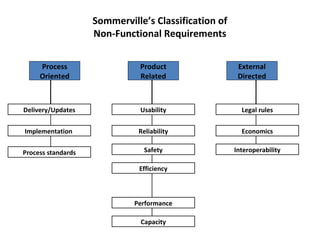
Sommerville’s Classification of
                    Non-Functional Requirements


     Process                  Product                  External
     Oriented                 Related                  Directed


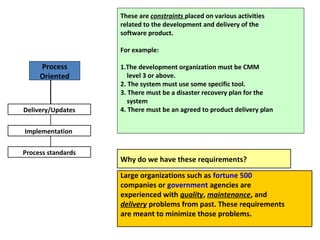
Delivery/Updates               Usability                Legal rules


Implementation                Reliability               Economics


Process standards               Safety                Interoperability

                              Efficiency


                             Performance

                               Capacity
These are constraints placed on various activities
                    related to the development and delivery of the
                    software product.

                    For example:

     Process        1.The development organization must be CMM
     Oriented          level 3 or above.
                    2. The system must use some specific tool.
                    3. There must be a disaster recovery plan for the
                       system
Delivery/Updates    4. There must be an agreed to product delivery plan


Implementation


Process standards
                    Why do we have these requirements?

                    Large organizations such as fortune 500
                    companies or government agencies are
                    experienced with quality, maintenance, and
                    delivery problems from past. These requirements
                    are meant to minimize those problems.
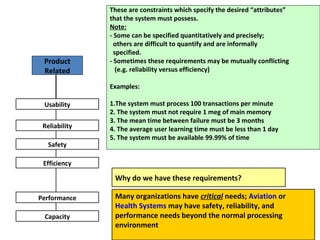
These are constraints which specify the desired “attributes”
               that the system must possess.
               Note:
               - Some can be specified quantitatively and precisely;
                 others are difficult to quantify and are informally
                 specified.
 Product       - Sometimes these requirements may be mutually conflicting
 Related          (e.g. reliability versus efficiency)

               Examples:

 Usability     1.The system must process 100 transactions per minute
               2. The system must not require 1 meg of main memory
               3. The mean time between failure must be 3 months
 Reliability   4. The average user learning time must be less than 1 day
               5. The system must be available 99.99% of time
   Safety

 Efficiency

                Why do we have these requirements?

Performance     Many organizations have critical needs; Aviation or
                Health Systems may have safety, reliability, and
 Capacity       performance needs beyond the normal processing
                environment
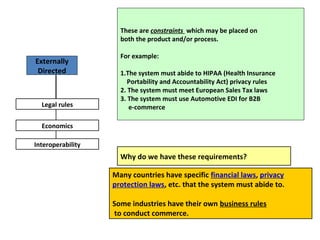
These are constraints which may be placed on
                     both the product and/or process.

                     For example:
Externally
 Directed            1.The system must abide to HIPAA (Health Insurance
                        Portability and Accountability Act) privacy rules
                     2. The system must meet European Sales Tax laws
                     3. The system must use Automotive EDI for B2B
  Legal rules           e-commerce

  Economics

Interoperability
                     Why do we have these requirements?

                   Many countries have specific financial laws, privacy
                   protection laws, etc. that the system must abide to.

                   Some industries have their own business rules
                   to conduct commerce.
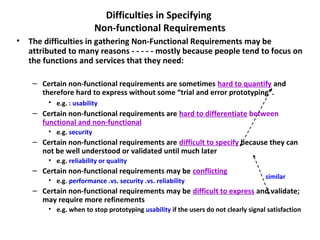
Difficulties in Specifying
Non-functional Requirements
Difficulties in Specifying
                          Non-functional Requirements
• The difficulties in gathering Non-Functional Requirements may be
  attributed to many reasons - - - - - mostly because people tend to focus on
  the functions and services that they need:

    – Certain non-functional requirements are sometimes hard to quantify and
      therefore hard to express without some “trial and error prototyping”.
        • e.g. : usability
    – Certain non-functional requirements are hard to differentiate between
      functional and non-functional
        • e.g. security
    – Certain non-functional requirements are difficult to specify because they can
      not be well understood or validated until much later
        • e.g. reliability or quality
    – Certain non-functional requirements may be conflicting
                                                                                    similar
        • e.g. performance .vs. security .vs. reliability
    – Certain non-functional requirements may be difficult to express and validate;
      may require more refinements
        • e.g. when to stop prototyping usability if the users do not clearly signal satisfaction
What are“Critical” Systems
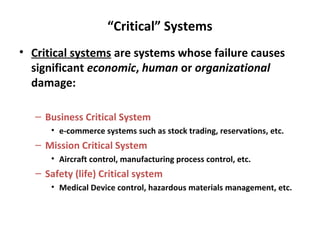
“Critical” Systems
• Critical systems are systems whose failure causes
  significant economic, human or organizational
  damage:

   – Business Critical System
      • e-commerce systems such as stock trading, reservations, etc.
   – Mission Critical System
      • Aircraft control, manufacturing process control, etc.
   – Safety (life) Critical system
      • Medical Device control, hazardous materials management, etc.
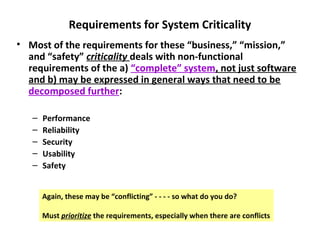
Requirements for System Criticality
• Most of the requirements for these “business,” “mission,”
  and “safety” criticality deals with non-functional
  requirements of the a) “complete” system, not just software
  and b) may be expressed in general ways that need to be
  decomposed further:

   –   Performance
   –   Reliability
   –   Security
   –   Usability
   –   Safety


       Again, these may be “conflicting” - - - - so what do you do?

       Must prioritize the requirements, especially when there are conflicts
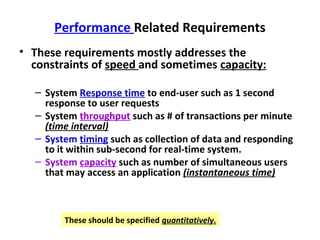
Performance Related Requirements
• These requirements mostly addresses the
  constraints of speed and sometimes capacity:

  – System Response time to end-user such as 1 second
    response to user requests
  – System throughput such as # of transactions per minute
    (time interval)
  – System timing such as collection of data and responding
    to it within sub-second for real-time system.
  – System capacity such as number of simultaneous users
    that may access an application (instantaneous time)


        These should be specified quantitatively.
Reliability Related Requirements

• These requirements addresses constraints on run-time
  behavior of the system:

   – System Availability such as the system is up certain percentage of
     the time.

   – System Failure rate such as average mean time between system
     failures to deliver the user service.


           These should also be specified quantitatively.
Security Related Requirements

• These requirements addresses the issues related to
  unauthorized access: to the system, to specific function, to
  data:

   – System Access protection such as firewall requirement

   – Application Functional Access & Usage protection such as
     authorization and authentication requirement

   – Data Access and Usage protection such as authorization and
     encryption requirement


        Security is also an important factor for other requirement such
        as safety. A little hard to specify these quantitatively.
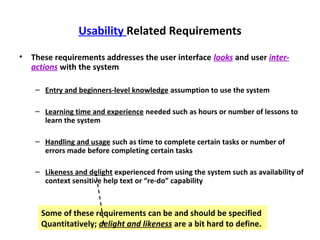
Usability Related Requirements

•   These requirements addresses the user interface looks and user inter-
    actions with the system

     – Entry and beginners-level knowledge assumption to use the system

     – Learning time and experience needed such as hours or number of lessons to
       learn the system

     – Handling and usage such as time to complete certain tasks or number of
       errors made before completing certain tasks

     – Likeness and delight experienced from using the system such as availability of
       context sensitive help text or “re-do” capability


      Some of these requirements can be and should be specified
      Quantitatively; delight and likeness are a bit hard to define.
Safety Critical System Requirements
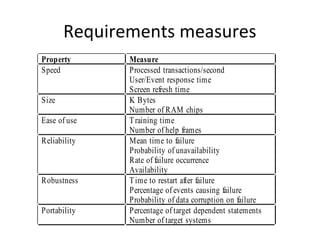
Requirements measures
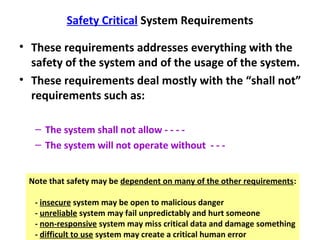
Safety Critical System Requirements

• These requirements addresses everything with the
  safety of the system and of the usage of the system.
• These requirements deal mostly with the “shall not”
  requirements such as:

   – The system shall not allow - - - -
   – The system will not operate without - - -


 Note that safety may be dependent on many of the other requirements:

   - insecure system may be open to malicious danger
   - unreliable system may fail unpredictably and hurt someone
   - non-responsive system may miss critical data and damage something
   - difficult to use system may create a critical human error
Requirements measures
Property      Measure
Speed         Processed transactions/second
              User/Event response time
              Screen refresh time
Size          K Bytes
              Number of RAM chips
Ease of use   T raining time
              Number of help frames
Reliability   Mean time to failure
              Probability of unavailability
              Rate of failure occurrence
              Availability
Robustness    T ime to restart after failure
              Percentage of events causing failure
              Probability of data corruption on failure
Portability   Percentage of target dependent statements
              Number of target systems
Relationship Between Requirement
            and Design
Requirements and design
• In principle, requirements should state what the
  system should do and the design should describe
  how it does this
• In practice, requirements and design are
  inseparable
  – A system architecture may be designed to structure
    the requirements
  – The system may inter-operate with other systems
    that generate design requirements
  – The use of a specific design may be a domain
    requirement
Non-functional Requirements
Objectives
• To introduce non-functional requirements
• To explain the schemes used to classify non-
  functional requirements
• To illustrate various derivation techniques for
  non-functional requirements
• To demonstrate the importance of non-
  functional requirements in critical systems
Non-functional requirements (NFR)
• Non-functional requirements define the overall
  qualities or attributes of the resulting system
• Non-functional requirements place restrictions
  on the product being developed, the
  development process, and specify external
  constraints that the product must meet.
• Examples of NFR include safety, security,
  usability, reliability and performance
  requirements.
Functional and Non-functional
           requirements
• There is no a clear distinction between
  functional and non-functional requirements.
• Whether or not a requirement is expressed as a
  functional or a non-functional requirement
  may depend:
  – on the level of detail to be included in the
   requirements document
  – the degree of trust which exists between a system
   customer and a system developer.
Example
• The system shall ensure that data is protected
  from unauthorised access.
  – Conventionally, this would be considered as a non-
    functional requirement because it does not specify
    specific system functionality which must be
    provided. However, it could have been specified in
    slightly more detail as follows:
  • The system shall include a user authorisation
    procedure where users must identify themselves
    using a login name and password. Only users who
    are authorised in this way may access the system
Types of Non-functional
            requirements

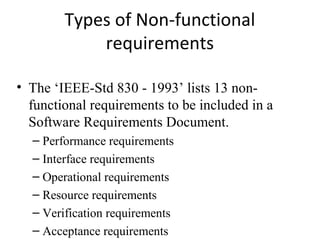
• The ‘IEEE-Std 830 - 1993’ lists 13 non-
  functional requirements to be included in a
  Software Requirements Document.
  – Performance requirements
  – Interface requirements
  – Operational requirements
  – Resource requirements
  – Verification requirements
  – Acceptance requirements
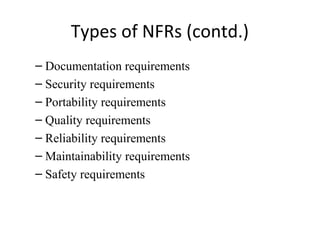
Types of NFRs (contd.)
– Documentation requirements
– Security requirements
– Portability requirements
– Quality requirements
– Reliability requirements
– Maintainability requirements
– Safety requirements
Classification of NFRs
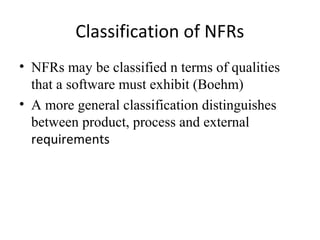
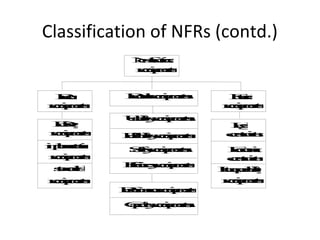
• NFRs may be classified n terms of qualities
  that a software must exhibit (Boehm)
• A more general classification distinguishes
  between product, process and external
  requirements
Classification of NFRs (contd.)
           Nt a
           oc l
           ni
            - o
            f n
            un
           ri e
           em
           q n
            u t
             r s
             e


 P
 rs
 oc
  es      Ptq e
          r cu n
          or i t
          d r s
           u e
             em         El
                        x
                        ta
                        er
                         n
ri e
em
q n
 u t
 r s
 e                     ri e
                       em
                       q n
                        u t
                        r s
                        e
          U ri e
          si e m
          a q n
          b u t
           i
           lt
            yr s
              e
Dey
 lr
 i
 ve                     Le
                         g
                         al
ri e
em
q n
 u t
 r s
  e       Rte m
          el ri e
          li q n
          ii u t
          abyr s
              e         ca
                        oi
                        nt
                         s s
                         tn
                         r
i leo
ma
 pn
  et n
  m ti     Sr i e
           a em
           f q n
           eu t
            t
            yr s
              e        Ei
                        c c
                        o
                        nom
ri e
 em
 q n
  u t
   r s
   e                   ca
                        oi
                        nt
                        s s
                         tn
                         r
 sa
 t r
 ad
  n
  ds      Ec u n
          fer i e
          f nq t
          i yr s
           c em
           i  e
                      Ir rl
                      nei
                       tp t
                       ea
                        oiby
ri e
em
q n
 u t
 r s
 e                    ri e
                       em
                       q n
                        u t
                        r s
                        e
         P ae m
         e nq e
         r cu n
         f ei t
          o rr s
          r
          m e
          C ri e
          ay r n
          p em
          a q t
           c u s
           i
           t e
Product requirements
• Specify the desired characteristics that a
  system or subsystem must possess.
• Most NFRs are concerned with specifying
  constraints on the behaviour of the executing
  system.
Specifying product requirements
• Some product requirements can be formulated
  precisely, and thus easily quantified
  – Performance
  – Capacity
• Others are more difficult to quantify and,
  consequently, are often stated informally
  – Usability
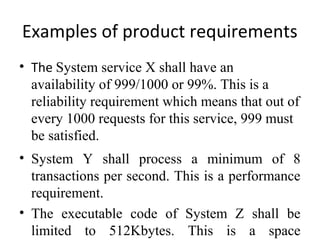
Examples of product requirements
• The System service X shall have an
  availability of 999/1000 or 99%. This is a
  reliability requirement which means that out of
  every 1000 requests for this service, 999 must
  be satisfied.
• System Y shall process a minimum of 8
  transactions per second. This is a performance
  requirement.
• The executable code of System Z shall be
  limited to 512Kbytes. This is a space
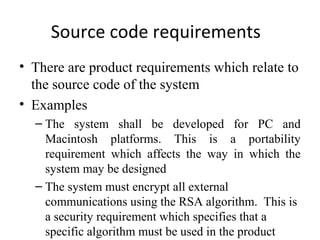
Source code requirements
• There are product requirements which relate to
  the source code of the system
• Examples
  – The system shall be developed for PC and
    Macintosh platforms. This is a portability
    requirement which affects the way in which the
    system may be designed
  – The system must encrypt all external
    communications using the RSA algorithm. This is
    a security requirement which specifies that a
    specific algorithm must be used in the product
Conflicts in product requirements
• Product requirements are often conflict. For
  example:
  – A requirement for a certain level of performance
    may be contradicted by reliability and security
    requirements which use processor capacity to carry
    out dynamic system checking
  – A requirement on the space utilisation of the system
    may be contradicted by another requirement which
    specifies that a standard compiler which does not
    generate compact code must be used
• The process of arriving at a trade-off in these
Process requirements
• Process requirements are constraints placed
  upon the development process of the system
• Process requirements include:
  – Requirements on development standards and
    methods which must be followed
  – CASE tools which should be used
  – The management reports which must be provided
Examples of process requirements
• The development process to be used must be explicitly
  defined and must be conformant with ISO 9000 standards
• The system must be developed using the XYZ suite of
  CASE tools
• Management reports setting out the effort expended on
  each identified system component must be produced every
  two weeks
• A disaster recovery plan for the system development must
  be specified
External requirements
• May be placed on both the product and the
  process
• Derived from the environment in which the
  system is developed
• External requirements are based on:
  – application domain information
  – organisational considerations
  – the need for the system to work with other systems
  – health and safety or data protection regulations
  – or even basic natural laws such as the laws of
Examples of external requirements
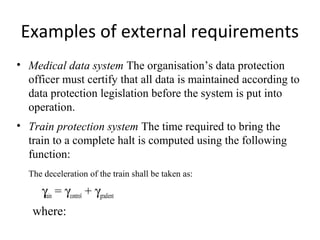
• Medical data system The organisation’s data protection
  officer must certify that all data is maintained according to
  data protection legislation before the system is put into
  operation.
• Train protection system The time required to bring the
  train to a complete halt is computed using the following
  function:
  The deceleration of the train shall be taken as:

    γtrain = γcontrol + γgradient
   where:
External requirement example
             (contd.)
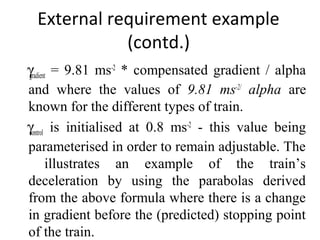
γgradient = 9.81 ms-2 * compensated gradient / alpha
 and where the values of 9.81 ms-2/ alpha are
 known for the different types of train.
γcontrol is initialised at 0.8 ms-2 - this value being
 parameterised in order to remain adjustable. The
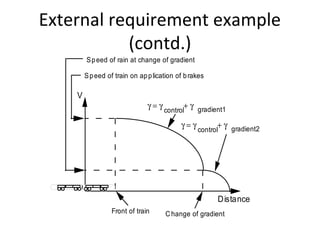
        illustrates an example of the train’s
 deceleration by using the parabolas derived
 from the above formula where there is a change
 in gradient before the (predicted) stopping point
 of the train.
External requirement example
           (contd.)
        S p eed of rain at change of gradient

        S p eed of train on ap p lication of b rakes

    V
                               γ = γ control+ γ gradient1

                                           γ = γ control+ γ gradient2


                                                       Distance
                  Front of train     C hange of gradient
External requirement example
               (contd.)
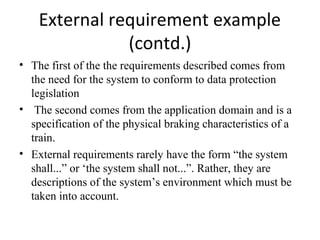
• The first of the the requirements described comes from
  the need for the system to conform to data protection
  legislation
• The second comes from the application domain and is a
  specification of the physical braking characteristics of a
  train.
• External requirements rarely have the form “the system
  shall...” or ‘the system shall not...”. Rather, they are
  descriptions of the system’s environment which must be
  taken into account.
Deriving NFRs
• NFRs are difficult to express
• A number of important issues contribute to the problem of
  expressing non-functional requirements:
   – Certain constraints are related to the design solution
     that is unknown at the requirements stage
   – Certain constraints, are highly subjective and can
     only be determined through complex empirical
     evaluations
   – Non-functional requirements tend to be related to
     one or more functional requirements
   – Non-functional requirements tend to conflict and
Stakeholder concerns
• Stakeholders normally have a number of
  ‘concerns’
• Concerns are typically non-functional
• Examples include:
  – Critical business objectives
  – Essential system characteristics (e.g. security)
  – Safety, performance, functionality and
    maintainability
• Vaguely defined user concerns may be related
  to NFRs
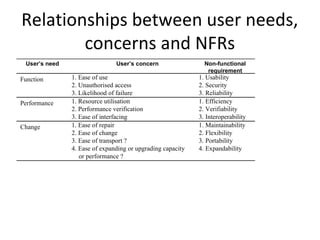
Relationships between user needs,
        concerns and NFRs
 User’s need                   User’s concern                 Non-functional
                                                               requirement
Function       1. Ease of use                               1. Usability
               2. Unauthorised access                       2. Security
               3. Likelihood of failure                     3. Reliability
Performance    1. Resource utilisation                      1. Efficiency
               2. Performance verification                  2. Verifiability
               3. Ease of interfacing                       3. Interoperability
Change         1. Ease of repair                            1. Maintainability
               2. Ease of change                            2. Flexibility
               3. Ease of transport ?                       3. Portability
               4. Ease of expanding or upgrading capacity   4. Expandability
                  or performance ?
Concerns
• A way of expressing critical ‘holistic’
  requirements
• Concerns may be broken down into sub-
  concerns and finally into specific questions
• Questions act as a check list to ensure that
  specific requirements do not conflict with
  global priorities
Concern decomposition
       S
       a
       f
       et
        y                Ci
                         ob
                         m
                         py
                          a
                          tt
                          il
                           i


             Pl
             e
             rs
              on
               a           Se
                           o
                           f
                           tw
                            a
                            r   P
                                h
                                y
                                si
                                 c
                                 al
 C
 o
 ln
 l
 i
 si
  o    Dt
       ee
       r n
       a
       il
        m             H
                      ae
                      rr
                      d
                      wa
             an
             ct
             ci
              d
              e


                      En T
                      x
                      e
                      cu
                       t
                       io i g If
                          m n
                           i
                           n  tc
                               e
                               r
                               ae
  Ee
  xp
   c e
   e d
   ss
    s
          Tm
          rd
          a a
          c g
           k e
           a          E e
                      n n
                      v t
                      im
                       r
                       o
                       n
  f ans
  o ci
  r kt
   t on
   r d
    c i
      o

          Wt a
           h ri b
           a mu
           to n
            i a o
            n ot
            f           Wm
                         i ri ee
                         l e nt
                         lq t c
                          ar a
                            u f
                             e f
Sme
y ub
s s l
 t
 e ta
 m bt
    eo
          tkgqb
          rd i uy
          am i
           c ar r
            a s e
              eed       t e af
                        ho ee
                        e r ch
                         p n
                          rfm ot
d n ds
e de
t aoe
 e ax
 c vc
 t  i s
          ts ? i i
          h mt
           e
           y Hs
            s o
            t
            e wsh       e ga
                        xs r
                         i o?
                         s fe
                         t t
                          i w
                          n
s
p
ee
 d
          pd
          re
           o
           v
           i?
           d
                           Du te
                           o qe d
                            e i n
                            s r n
                             a e e
                              r m
                              e
                 Smt tt e
                 y uc h d
                 s s ue
                 te t
                  m e r
                    e i
                     x nu
                     e  st
Ut d
n a is
d ci
 e on
 rwt
   h o
     n                     d t' v
                           a ia l
                            ta a
                            as i e
                             t nl
                             ht ab
                 At en
                 d u ve
                 a in n
                  e or t
                  xn m
                  ec  i
                      o
cc eu
ae es
ns d
 esc
 xp e
   s  a                    tu Ha
                           h t Sf
                           rh Tc
                            o e ir ?
                             gh nt e
                                 e
de
en
r t
a?
 i
 l
 m

    Wc ee r y
    hse eae
    a ' s d ia
    te s ' nl
    does m i
       xp   n?
             t       Cu b
                     a ft e
                     nn
                      t c
                      h i
                       i
                       s o
                         n
                     p den
                     r e ht
                     oo x
                      vn i
                      i
                      dt s
                         e g
                     eien
                     xno ?
                     e n e
                      c vn
                      u im
                      tor t
Goal-based derivation
• Relates non-functional requirements to the
  goals of the enterprise
• Goal-based NFR derivation is a 3 step
  approach:
  – Identify the enterprise goal
  – Decompose of the goal into sub-goals
  – Identify non-functional requirements.
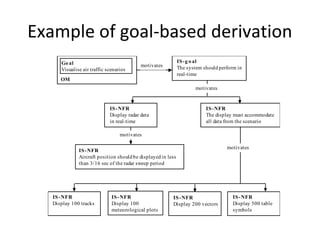
Example of goal-based derivation
      Go al                                                   IS - g o al
                                           motivates          The system should perform in
      Visualise air traffic scenarios
                                                              real-time
      OM
                                                                      motivates


                             IS - NFR                                     IS - NFR
                             Display radar data                           The display must accommodate
                             in real-time                                 all data from the scenario

                                  motivates

                                                                                   motivates
              IS - NFR
              Aircraft position should be displayed in less
              than 3/16 sec of the radar sweep period


   IS - NFR                   IS - NFR                   IS - NFR                     IS - NFR
   Display 100 tracks         Display 100                Display 200 vectors          Display 500 table
                              meteorological plots                                    symbols
Testable NFRs
• Stakeholders may have vague goals which
  cannot be expressed precisely
• Vague and imprecise ‘requirements’ are
  problematic
• NFRs should satisfy two attributes
  – Must be objective
  – Must be testable (Use measurable metrics)
• It is not always possible to express NFRs
  objectively
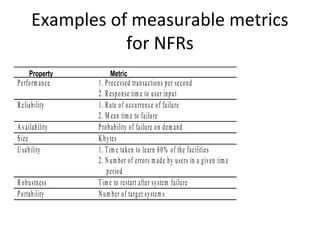
Examples of measurable metrics
                  for NFRs
      Property         Metric
P erfo rm an ce   1 . P ro cessed tran sactio n s p er seco n d
                  2 . R esp o n se tim e to u ser in p u t
R eliab ility     1 . R ate o f o ccu rren ce o f failu re
                  2 . M ean tim e to failu re
A v ailab ility   P ro b ab ility o f failu re o n d em an d
S ize             K b y tes
U sab ility       1 . T im e tak en to learn 8 0 % o f th e facilities
                  2 . N u m b er o f erro rs m ad e b y u sers in a g iv en tim e
                       p erio d
R o b u stn ess   T im e to restart after sy stem failu re
P o rtab ility    N u m b er o f targ et sy stem s
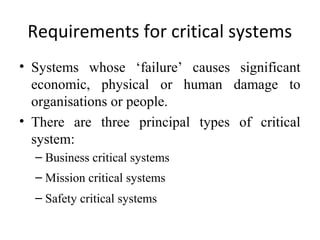
Requirements for critical systems
• Systems whose ‘failure’ causes significant
  economic, physical or human damage to
  organisations or people.
• There are three principal types of critical
  system:
  – Business critical systems
  – Mission critical systems
  – Safety critical systems
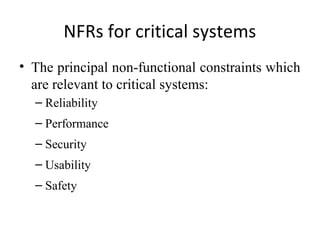
NFRs for critical systems
• The principal non-functional constraints which
  are relevant to critical systems:
  – Reliability
  – Performance
  – Security
  – Usability
  – Safety
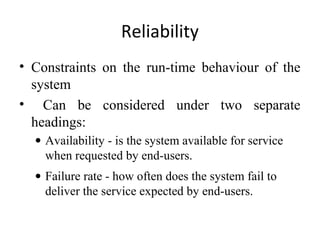
Reliability
• Constraints on the run-time behaviour of the
  system
• Can be considered under two separate
  headings:
  • Availability - is the system available for service
    when requested by end-users.
  • Failure rate - how often does the system fail to
    deliver the service expected by end-users.
Performance
• Constrain the speed of operation of a system
• Types of performance requirements:
  • Response requirements
  • Throughput requirements
  • Timing requirements
Security
• Security requirements are included in a system to ensure:
   – Unauthorised access to the system and its data is not
     allowed
   – Ensure the integrity of the system from accidental
     or malicious damage
• Examples of security requirements are:
   – The access permissions for system data may only be
     changed by the system’s data administrator
   – All system data must be backed up every 24 hours
     and the backup copies stored in a secure location
     which is not in the same building as the system
Usability
• Concerned with specifying the user interface
  and end-user interactions with the system
• Well structured user manuals, informative error
  messages, help facilities and consistent
  interfaces enhance usability
Usability metrics
• Measurable attributes of usability requirements include:
   – Entry requirements Measured in terms of years of
     experience with class of applications or simply age
   – Learning requirements Denotes the time needed to
     learn the facilities of the system. This could be
     measured in terms of speed of learning, say hours
     of training required before independent use is
     possible
   – Handling requirements Denotes the error rate of
     the end-users of the system. This could be
     measured in terms of the errors made when
COQUAMO approach to measuring
         usability
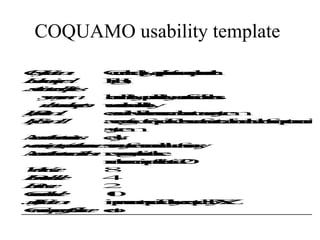
• Provides an automated support facility for
  setting and measuring usability
• Provides a set of ‘templates’ which have to be
  filled in
COQUAMO usability template
Ci
lf o
at
s n
 s
 ii
  c
  a        G l-li en
           eq a td t
           na p nd
            e i p p
            r t
            a yion
             lu c e
                a  e
Lu
e i
v r
e e
 l
 r d
  e
  q        H
           i
           g
           h
Adi
st u
sel
oqs
 c a
 i
 a i t
     e
 sy
  ys
  no
   nm   l a o i se s
        ei p yrl s
        ai e , rn
         rl rt e d
         n, a u i
          bt
           yb f n
              i
              l  i e
 rdp
  ect
  l o
  ac
   t n
   ee  su ny
        nd
         da
         e b
          r i
          s l
          t i
          at
D
en
fi
io
 n
 i1
 t      ei h r l t em
        ah un os
         s w crue
         e i s e st
          w e a s
          t cs n y
             ha
E1
xn
p .
lo1
 s
 io     aef e l ssa llcte
        vi ofafrc e o c
         e m i s u hv mi
         rt rc s e i e p w
         a e ic ot e o e t
          g  s ce
              p     oe f e h
                     v   n
        s
        y
        st
         em
Mu
em
a ns
 set
 u n
  rt e
  e i   d
        ay
         s
mt a c rfs e f e
e g t us od o y
a os
 s oo u r nt s
 u /
  r d r v auu
  i
  n a  e eyml r
              rs v
              s
M co edt
em i
a nt
 se d
 u o sn u k
  rt i
  e n n wi e
          g n
          rt a
          aae
        n rr r i
        ue f s
         m dt 0
         b i os
          e ee
          rq t 2
           u
W
oe
rs
 tc
  a
  s     8
Pe
lel
av
ne
 nd
  l     4
B
ee
s
tc
 as     2
Cv
ue
r e
 r l
 e
 nt
  l     1
        0
Ja
ui
st
t o
 i n
 f
 i
 c      i ot cy t y
        m si r s X
         pe ile d Z
         r nf q b
          v pl u
          e e
           mc e Y
               a e
C ci
on l
n eu c
 s oe o
 e f r
 q f
  u a
  e      s
         t
Safety
• No consensus in the system’s engineering
  community about what is meant by the term
  ‘safety requirement’
  – Sometimes considered to be all requirements
    (functional and non-functional) on safety-related
    systems
  – Sometimes the sub-set of these requirements which
    are directly related to ensuring safe operation and
    sometimes requirements on protection systems
    which are designed to protect against accident
• Usage of the term often depends on the culture
Safety requirement definition
• Informal definition:
  Safety requirements are the ‘shall not’
  requirements which exclude unsafe situations
  from the possible solution space of the system
Examples of safety requirements
• The system shall not permit operation unless
  the operator guard is in place
• The system shall not allow the sedative dose
  delivered to the patient to be greater than the
  maximum value which is determined by the
  patient’s physician
• The system shall not operate if the external
  temperature is below 4 degrees Celsius
Requirements engineering for
      safety-related systems
• The requirements engineering process for
  safety-related systems should incorporate a
  specific safety-analysis activity
• The widely accepted model of the system
  critical systems life cycle (BCS and IEE 1989)
  identifies two stages in the safety analysis
  process:
  – Safety requirements discovery
  – Safety validation
Hazard analysis
• As part of the process of safety analysis, there
  are various activities such as hazard
  identification and analysis
• Various methods such as fault-tree analysis
  and Petri net analysis have been developed for
  safety validation
Integrating safety analysis with RE
• We illustrate in the following sections a simple
  technique for integrating safety analysis with a
  requirements engineering method
• The technique is intended to support the
  process of requirements discovery (safety
  requirements) and validation
Integrating safety analysis with RE
              (contd.)
• The starting point for specifying the system is
  a set of abstract organisational needs and
  constraints
• It is important that the approach used
  incorporates a systematic approach to dealing
  safety issues. These include:
  – Identifying hazards, risks and risk criteria
  – Identifying the necessary risk reduction to meet the
    risk criteria
  – Defining the overall safety requirements
Integrating safety analysis with RE
              (contd.)
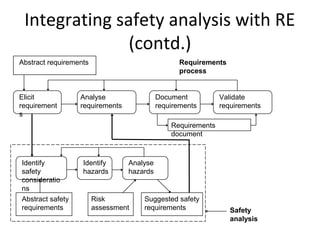
• The requirements process, shown in , has been
  extended to incorporate an explicit safety
  analysis activity
• The safety analysis process is based on
  requirements information drawn from the
  requirements elicitation and documentation
  process
• A set of abstract safety requirements serves as
  a reference model for identifying initial safety
  considerations or concerns
Integrating safety analysis with RE
              (contd.)
• The safety analysis process includes:
  – The identification of safety considerations
  – Hazard identification
  – Hazard analysis
  – Risk analysis and derivation of safety requirements
• Proposed safety requirements are analysed
  together with other system requirements to
  ensure that safety is not compromised
Integrating safety analysis with RE
               (contd.)
Abstract requirements                            Requirements
                                                 process


Elicit            Analyse                  Document           Validate
requirement       requirements             requirements       requirements
s
                                               Requirements
                                               document


Identify           Identify      Analyse
safety             hazards       hazards
consideratio
ns
Abstract safety         Risk         Suggested safety
requirements            assessment   requirements                Safety
                                                                 analysis
Key points
• Non-functional requirements define the overall qualities or
  attributes of the resulting system
• Non-functional requirements may be classified into three
  main types; product, process and external requirements
• Product requirements specify the desired characteristics
  that the system or subsystem must posses
• Non-functional requirements tend to conflict and interact with
  other system requirements
• The principal non-functional constraints which are relevant to
  critical systems are reliability, performance, security, usability
  and safety
How to write requirements:
Guidelines for writing requirements
• Invent a standard format and use it for all
  requirements
• Use language in a consistent way. Use
  shall for mandatory requirements,
  should for desirable requirements
• Use text highlighting to identify key parts of the
  requirement

Avoid the use of computer jargon !!!
Problems with natural language
• Lack of clarity
  – Precision is difficult without making the document difficult
    to read
• Requirements confusion
  – Functional and non-functional requirements tend to be
    mixed-up
• Requirements combination
  – Several different requirements may be expressed together
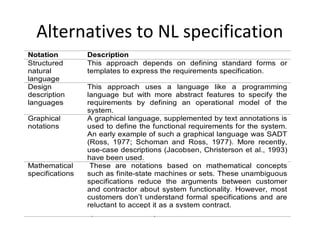
Alternatives to NL specification
Notation         Description
Structured       This approach depends on defining standard forms or
natural          templates to express the requirements specification.
language
Design           This approach uses a language like a programming
description      language but with more abstract features to specify the
languages        requirements by defining an operational model of the
                 system.
Graphical        A graphical language, supplemented by text annotations is
notations        used to define the functional requirements for the system.
                 An early example of such a graphical language was SADT
                 (Ross, 1977; Schoman and Ross, 1977). More recently,
                 use-case descriptions (Jacobsen, Christerson et al., 1993)
                 have been used. I discuss these in the following chapter.
Mathematical      These are notations based on mathematical concepts
specifications   such as finite-state machines or sets. These unambiguous
                 specifications reduce the arguments between customer
                 and contractor about system functionality. However, most
                 customers don’t understand formal specifications and are
                 reluctant to accept it as a system contract. I discuss formal
                 specification in Chapter 9.
What is Requirement Document
The requirements document
• The requirements document is the official
  statement of what is required of the system
  developers

• Should include both a definition and a
  specification of requirements

• It is NOT a design document. As far as
  possible, it should set of WHAT the system
  should do rather than HOW it should do it
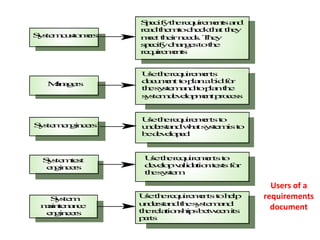
Users of a requirements document
S e if th r q i e e t a d
                  p c y e e u mns n
                               r
                 r a t e t c e k a th y
                  e d h mo h c th t e
S s m u t mr
 y te c so e s   me t ern e s T e
                   e t h i e d. h y
                 s e i yc a g stot e
                  p cf h n e      h
                 r q ie e t
                  e ur mns


                 Ueth r q ir mn
                  s   e e u e e ts
   Mn g r
    a a es       d c mn t p nab f r
                  o u e t o la    id o
                 th s se a dt p nt e
                   e y t m n o la h
                 s s m e eo mn p o e s
                  y te d v l p e t r c s


                 Ueth r q ir mn t
                  s    e e u e e ts o
Ss mni er
y te e gn e s    u d r t n wa s se ist
                  n e sa d h t y t m o
                 b dv l pd
                  e e eo e


  S s me t
   y te t s       Ueth r q ir mn t
                   s    e e u e e ts o
  e gn e s
   ni er          d v l pv li aio t ssf r
                   e eo a d t n e t o
                  th s se
                    e yt m

                                               Users of a
   Ss m
    y te         Ueth r q ir mn t h lp
                  s    e e u e e ts o e      requirements
 mi t n n e
  ane a c        u d r t n t es s m n
                  n esa d h y te a d
                 th r laio s i sb t e ni
                   e e t n hp ewe ts
                                               document
  e gn e s
   ni er
                 pr
                  ats
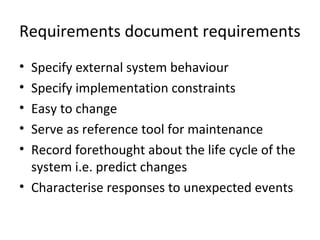
Requirements document requirements
• Specify external system behaviour
• Specify implementation constraints
• Easy to change
• Serve as reference tool for maintenance
• Record forethought about the life cycle of the
  system i.e. predict changes
• Characterise responses to unexpected events
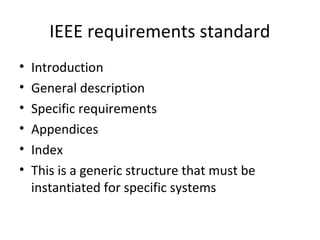
IEEE requirements standard
•   Introduction
•   General description
•   Specific requirements
•   Appendices
•   Index
•   This is a generic structure that must be
    instantiated for specific systems
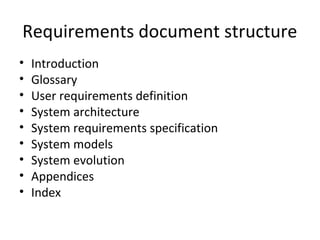
Requirements document structure
•   Introduction
•   Glossary
•   User requirements definition
•   System architecture
•   System requirements specification
•   System models
•   System evolution
•   Appendices
•   Index

Software Requirements_Se lect8 btech

  • 1.
    – Software Requirements– Descriptions and specifications of a system Objectives: q To introduce the concepts of user and system requirements q To describe functional / non-functional requirements q To explain two techniques for describing system requirements q To explain how software requirements may be organised in a requirements document
  • 2.
    Key Points Functional andnon-functional requirements User requirements System requirements The software requirements document
  • 3.
  • 4.
    Requirements engineering Requirements engineeringis the process of establishing q the services that the customer requires from a system q the constraints under which it operates and is developed Requirements The descriptions of the system services and constraints that are generated during the requirements engineering process
  • 5.
  • 6.
  • 7.
    What is arequirement? • It may range from a high-level abstract statement of a service or of a system constraint to a detailed mathematical functional specification • This is inevitable as requirements may serve a dual function – May be the basis for a bid for a contract - therefore must be open to interpretation – May be the basis for the contract itself - therefore must be defined in detail – Both these statements may be called requirements
  • 8.
    What are requirements? Application Domain Machine Domain C - computers D - domain properties R - requirements P - programs • Domain Properties: – things in the application domain that are true whether or not we ever build the proposed system • Requirements: – things in the application domain that we wish to be made true by delivering the proposed system •Many of which will involve phenomena the machine has no access to • A Specification: – is a description of the behaviours that the program must have in order to meet the requirements
  • 9.
    What are Requirements? •Two basic principles of requirements engineering: – Separate the problem from the solution – Problems and solutions intertwine with one another • Describing problems: – Application Domains vs. Machine Domains – Verification vs. Validation • Systems Engineering – Systems vs. software • Patterns and Types of Problem – Requirements patterns – Problem Frames
  • 10.
    Separate the problemfrom the solution • A separate problem Problem description is useful: Situation – Most obvious problem might not the right one to solve Validation – Problem statement can be Problem Correspondence Verification discussed with Statement Correctness stakeholders – Problem statement can be used to evaluate design choices – Problem statement is a Implementation source of good test cases Statement • Still need to check: – Solution correctly solves the stated problem – Problem statement System corresponds to the needs of the stakeholders
  • 11.
    Fitness for purpose? •Two correctness (verification) criteria: – The Program running on a particular Computer satisfies the Specification – The Specification, in the context of the given domain properties, satisfies the requirements • Two completeness (validation) criteria: – We discovered all the important requirements – We discovered all the relevant domain properties
  • 12.
    Example • Requirement R – “The database shall only be accessible by authorized personnel” • Domain Properties D: – Authorized personnel have passwords – Passwords are never shared with non-authorized personnel • Specification S: – Access to the database shall only be granted after the user types an authorized password. • S + D entail R
  • 13.
    But we canalso move the boundaries… • E.g. Elevator control system: people waiting Elevator call buttons Scheduling algorithm people in the elevator Floor request buttons people wanting to go to button lights a particular floor Current floor indicators Control program Motor on/off Elevator motors Door open/close Safety rules We can shift things around: E.g. Add some sensors to detect when people are waiting This changes the nature of the problem to be solved
  • 14.
  • 15.
    What do RequirementsEngineers do? • Some notion that there is a “problem” that needs solving – dissatisfaction with the current state of affairs – a new business opportunity – a potential saving of cost, time, resource usage, etc. • Requirements Engineer is an agent of change
  • 16.
  • 17.
    The requirements engineermust: • Identify the “problem”/”opportunity” • Which problem needs to be solved? (identify problem Boundaries) • Where is the problem? (understand the Context/Problem Domain) • Whose problem is it? (identify Stakeholders) • Why does it need solving? (identify the stakeholders’ Goals) • How might a software system help? (collect some Scenarios) • When does it need solving? (identify Development Constraints) • What might prevent us solving it? (identify Feasibility and Risk) • And become an expert in the problem domain
  • 18.
  • 19.
    Types of requirement • User requirements • System requirements • Domain requirements • Functional requirements • Non-functional requirements
  • 20.
    Types of requirement •User requirements – Statements in natural language plus diagrams of the services the system provides and its operational constraints. Written for customers • System requirements – A structured document setting out detailed descriptions of the system services. Written as a contract between client and contractor • Software specification – A detailed software description which can serve as a basis for a design or implementation. Written for developers
  • 21.
    Functional and non-functional requirements •Domain requirements – Requirements that come from the application domain of the system and that reflect characteristics of that domain • Functional requirements – Statements of services the system should provide, how the system should react to particular inputs and how the system should behave in particular situations. • Non-functional requirements – constraints on the services or functions offered by the system such as timing constraints, constraints on the development process, standards, etc.
  • 22.
    What are Userrequirements
  • 23.
    User requirements • Shoulddescribe functional and non- functional requirements so that they are understandable by system users who don’t have detailed technical knowledge • User requirements are defined using natural language, tables and diagrams
  • 24.
    What are Systemrequirements
  • 25.
    System requirements – Moredetailed specifications of user requirements • Serve as a basis for designing the system • May be used as part of the system contract • System requirements may be expressed using system models
  • 26.
    What are Domainrequirements
  • 27.
    Domain requirements • Derivedfrom the application domain and describe system characteristics and features that reflect the domain • May be new functional requirements, constraints on existing requirements or define specific computations • If domain requirements are not satisfied, the system may be unworkable
  • 28.
    What are Domain requirements problems
  • 29.
    Domain requirements problems •Understandability – Requirements are expressed in the language of the application domain – This is often not understood by software engineers developing the system • Implicitness – Domain specialists understand the area so well that they do not think of making the domain requirements explicit
  • 30.
    What is FunctionalRequirement
  • 31.
    Functional Requirements Describe functionality or system services • Depend on the type of software, expected users and the type of system where the software is used • Functional user requirements may be high- level statements of what the system should do BUT functional system requirements should describe the system services in detail
  • 32.
    The LIBSYS system •A library system that provides a single interface to a number of databases of articles in different libraries. • Users can search for, download and print these articles for personal study.
  • 33.
  • 34.
    Examples of functional requirements •The user shall be able to search either all of the initial set of databases or select a subset from it. • The system shall provide appropriate viewers for the user to read documents in the document store. • Every order shall be allocated a unique identifier (ORDER_ID) which the user shall be able to copy to the account’s permanent storage area.
  • 35.
    Requirements imprecision • Problemsarise when requirements are not precisely stated • Ambiguous requirements may be interpreted in different ways by developers and users • Consider the term ‘appropriate viewers’ – User intention - special purpose viewer for each different document type – Developer interpretation - Provide a text viewer that shows the contents of the document
  • 36.
    Requirements completeness and consistency • In principle requirements should be both complete and consistent Complete – They should include descriptions of all facilities required Consistent – There should be no conflicts or contradictions in the descriptions of the system facilities • In practice, it is very difficult or impossible to produce a complete and consistent requirements document
  • 37.
  • 38.
    Non-functional requirement types Non-functional requirements Product Organizational External requirements requirements requirements Efficiency Reliability Portability Interoperability Ethical requirements requirements requirements requirements requirements Usability Delivery Implementation Standards Legislative requirements requirements requirements requirements requirements Performance Space Privacy Safety requirements requirements requirements requirements
  • 39.
    Non-functional requirements • Definesystem properties and constraints e.g. reliability, response time and storage requirements. Constraints are I/O device capability, system representations, etc. • Non-functional requirements may be more critical than functional requirements. If these are not met, the system is useless
  • 40.
    Non-functional classifications • Productrequirements – Requirements which specify that the delivered product must behave in a particular way e.g. execution speed, reliability, etc. • Organisational requirements – Requirements which are a consequence of organisational policies and procedures e.g. process standards used, implementation requirements, etc. • External requirements – Requirements which arise from factors which are external to the system and its development process e.g. interoperability requirements, legislative requirements, etc.
  • 41.
    Non-functional requirements examples • Productrequirement – 4.C.8 It shall be possible for all necessary communication between the APSE and the user to be expressed in the standard Ada character set • Organisational requirement – 9.3.2 The system development process and deliverable documents shall conform to the process and deliverables defined in XYZCo-SP-STAN-95 • External requirement – 7.6.5 The system shall not disclose any personal information about customers apart from their name and reference number to the operators of the system
  • 42.
    Goals and requirements •Non-functional requirements may be very difficult to state precisely and imprecise requirements may be difficult to verify. • Goal – A general intention of the user such as ease of use • Verifiable non-functional requirement – A statement using some measure that can be objectively tested • Goals are helpful to developers as they convey the intentions of the system users
  • 43.
    Examples • A systemgoal – The system should be easy to use by experienced controllers and should be organised in such a way that user errors are minimised. • A verifiable non-functional requirement – Experienced controllers shall be able to use all the system functions after a total of two hours training. After this training, the average number of errors made by experienced users shall not exceed two per day.
  • 44.
    Features of Non-FunctionalRequirements 1. Non-Functional requirements mostly define the overall attributes of the “resulting” system – Most of the time these turn out to be “constraints” on how the (functional) requirements are to be met. • (e.g.) Response time must be .xyz second per screen – Sometimes the functional requirements may have to be “sacrificed or increased” in order to meet the non-functional requirements • (e.g.) in order to satisfy security requirements, we can not let everyone access the system --- sacrificing some flexibility • (e.g.) in order to satisfy the reliability requirements, we may add a duplicative functionality to provide another path to achieve the desired result
  • 45.
    Features of Non-Functional Requirements 1. Some non-functional requirements may not address the attributes of the resulting system (product), but something else – (e.g.) the system must be developed with a very risk averse process such as Spiral or the system must be developed with Visual Basic language
  • 46.
    IEEE Standard 830– 1993 • List of 13 non-functional requirements: 1. Performance 2. Interface 3. Operational 4. Resource Examples? 5. Verification 6. Acceptance 7. Documentation 8. Security 9. Portability 10. Quality 11. Reliability 12. Maintainability 13. Safety Some of these also overlap - - - - - -
  • 47.
    IEEE Standard 830– 1993 • List of 13 non-functional requirements Examples: – Performance: 100 transactions per minute – Interface: capable of importing data with EDI format – Operational: must not require more than 1 megabyte of main memory – Resource: will use wireless encryption algorithm that is “better” than WEP – Verification: all data updates must be traceable – Acceptance: must pass a user defined system test bucket – Documentation: user manual is needed for novice users only – Security: user request to access any data must be authorized first – Portability: the system must operate with “any” relational db systems – Quality: the system must install with zero defect – Reliability: the system must be accessible 99.9 % of the time – Maintainability: the system must be modifiable (e.g. designed with exits) – Safety: the system must not perform “chemical material discard” functions without “explicit” user authorization. There may be others that are important such as meeting legal standards that Is not mentioned in this list
  • 48.
    Sommerville’s Classification of Non-Functional Requirements Process Product External Oriented Related Directed Delivery/Updates Usability Legal rules Implementation Reliability Economics Process standards Safety Interoperability Efficiency Performance Capacity
  • 49.
    These are constraintsplaced on various activities related to the development and delivery of the software product. For example: Process 1.The development organization must be CMM Oriented level 3 or above. 2. The system must use some specific tool. 3. There must be a disaster recovery plan for the system Delivery/Updates 4. There must be an agreed to product delivery plan Implementation Process standards Why do we have these requirements? Large organizations such as fortune 500 companies or government agencies are experienced with quality, maintenance, and delivery problems from past. These requirements are meant to minimize those problems.
  • 50.
    These are constraintswhich specify the desired “attributes” that the system must possess. Note: - Some can be specified quantitatively and precisely; others are difficult to quantify and are informally specified. Product - Sometimes these requirements may be mutually conflicting Related (e.g. reliability versus efficiency) Examples: Usability 1.The system must process 100 transactions per minute 2. The system must not require 1 meg of main memory 3. The mean time between failure must be 3 months Reliability 4. The average user learning time must be less than 1 day 5. The system must be available 99.99% of time Safety Efficiency Why do we have these requirements? Performance Many organizations have critical needs; Aviation or Health Systems may have safety, reliability, and Capacity performance needs beyond the normal processing environment
  • 51.
    These are constraintswhich may be placed on both the product and/or process. For example: Externally Directed 1.The system must abide to HIPAA (Health Insurance Portability and Accountability Act) privacy rules 2. The system must meet European Sales Tax laws 3. The system must use Automotive EDI for B2B Legal rules e-commerce Economics Interoperability Why do we have these requirements? Many countries have specific financial laws, privacy protection laws, etc. that the system must abide to. Some industries have their own business rules to conduct commerce.
  • 52.
  • 53.
    Difficulties in Specifying Non-functional Requirements • The difficulties in gathering Non-Functional Requirements may be attributed to many reasons - - - - - mostly because people tend to focus on the functions and services that they need: – Certain non-functional requirements are sometimes hard to quantify and therefore hard to express without some “trial and error prototyping”. • e.g. : usability – Certain non-functional requirements are hard to differentiate between functional and non-functional • e.g. security – Certain non-functional requirements are difficult to specify because they can not be well understood or validated until much later • e.g. reliability or quality – Certain non-functional requirements may be conflicting similar • e.g. performance .vs. security .vs. reliability – Certain non-functional requirements may be difficult to express and validate; may require more refinements • e.g. when to stop prototyping usability if the users do not clearly signal satisfaction
  • 54.
  • 55.
    “Critical” Systems • Criticalsystems are systems whose failure causes significant economic, human or organizational damage: – Business Critical System • e-commerce systems such as stock trading, reservations, etc. – Mission Critical System • Aircraft control, manufacturing process control, etc. – Safety (life) Critical system • Medical Device control, hazardous materials management, etc.
  • 56.
  • 57.
    Requirements for SystemCriticality • Most of the requirements for these “business,” “mission,” and “safety” criticality deals with non-functional requirements of the a) “complete” system, not just software and b) may be expressed in general ways that need to be decomposed further: – Performance – Reliability – Security – Usability – Safety Again, these may be “conflicting” - - - - so what do you do? Must prioritize the requirements, especially when there are conflicts
  • 58.
  • 59.
    Performance Related Requirements •These requirements mostly addresses the constraints of speed and sometimes capacity: – System Response time to end-user such as 1 second response to user requests – System throughput such as # of transactions per minute (time interval) – System timing such as collection of data and responding to it within sub-second for real-time system. – System capacity such as number of simultaneous users that may access an application (instantaneous time) These should be specified quantitatively.
  • 60.
  • 61.
    Reliability Related Requirements •These requirements addresses constraints on run-time behavior of the system: – System Availability such as the system is up certain percentage of the time. – System Failure rate such as average mean time between system failures to deliver the user service. These should also be specified quantitatively.
  • 62.
  • 63.
    Security Related Requirements •These requirements addresses the issues related to unauthorized access: to the system, to specific function, to data: – System Access protection such as firewall requirement – Application Functional Access & Usage protection such as authorization and authentication requirement – Data Access and Usage protection such as authorization and encryption requirement Security is also an important factor for other requirement such as safety. A little hard to specify these quantitatively.
  • 64.
  • 65.
    Usability Related Requirements • These requirements addresses the user interface looks and user inter- actions with the system – Entry and beginners-level knowledge assumption to use the system – Learning time and experience needed such as hours or number of lessons to learn the system – Handling and usage such as time to complete certain tasks or number of errors made before completing certain tasks – Likeness and delight experienced from using the system such as availability of context sensitive help text or “re-do” capability Some of these requirements can be and should be specified Quantitatively; delight and likeness are a bit hard to define.
  • 66.
  • 67.
  • 68.
    Safety Critical SystemRequirements • These requirements addresses everything with the safety of the system and of the usage of the system. • These requirements deal mostly with the “shall not” requirements such as: – The system shall not allow - - - - – The system will not operate without - - - Note that safety may be dependent on many of the other requirements: - insecure system may be open to malicious danger - unreliable system may fail unpredictably and hurt someone - non-responsive system may miss critical data and damage something - difficult to use system may create a critical human error
  • 69.
    Requirements measures Property Measure Speed Processed transactions/second User/Event response time Screen refresh time Size K Bytes Number of RAM chips Ease of use T raining time Number of help frames Reliability Mean time to failure Probability of unavailability Rate of failure occurrence Availability Robustness T ime to restart after failure Percentage of events causing failure Probability of data corruption on failure Portability Percentage of target dependent statements Number of target systems
  • 70.
  • 71.
    Requirements and design •In principle, requirements should state what the system should do and the design should describe how it does this • In practice, requirements and design are inseparable – A system architecture may be designed to structure the requirements – The system may inter-operate with other systems that generate design requirements – The use of a specific design may be a domain requirement
  • 72.
  • 73.
    Objectives • To introducenon-functional requirements • To explain the schemes used to classify non- functional requirements • To illustrate various derivation techniques for non-functional requirements • To demonstrate the importance of non- functional requirements in critical systems
  • 74.
    Non-functional requirements (NFR) •Non-functional requirements define the overall qualities or attributes of the resulting system • Non-functional requirements place restrictions on the product being developed, the development process, and specify external constraints that the product must meet. • Examples of NFR include safety, security, usability, reliability and performance requirements.
  • 75.
    Functional and Non-functional requirements • There is no a clear distinction between functional and non-functional requirements. • Whether or not a requirement is expressed as a functional or a non-functional requirement may depend: – on the level of detail to be included in the requirements document – the degree of trust which exists between a system customer and a system developer.
  • 76.
    Example • The systemshall ensure that data is protected from unauthorised access. – Conventionally, this would be considered as a non- functional requirement because it does not specify specific system functionality which must be provided. However, it could have been specified in slightly more detail as follows: • The system shall include a user authorisation procedure where users must identify themselves using a login name and password. Only users who are authorised in this way may access the system
  • 77.
    Types of Non-functional requirements • The ‘IEEE-Std 830 - 1993’ lists 13 non- functional requirements to be included in a Software Requirements Document. – Performance requirements – Interface requirements – Operational requirements – Resource requirements – Verification requirements – Acceptance requirements
  • 78.
    Types of NFRs(contd.) – Documentation requirements – Security requirements – Portability requirements – Quality requirements – Reliability requirements – Maintainability requirements – Safety requirements
  • 79.
    Classification of NFRs •NFRs may be classified n terms of qualities that a software must exhibit (Boehm) • A more general classification distinguishes between product, process and external requirements
  • 80.
    Classification of NFRs(contd.) Nt a oc l ni - o f n un ri e em q n u t r s e P rs oc es Ptq e r cu n or i t d r s u e em El x ta er n ri e em q n u t r s e ri e em q n u t r s e U ri e si e m a q n b u t i lt yr s e Dey lr i ve Le g al ri e em q n u t r s e Rte m el ri e li q n ii u t abyr s e ca oi nt s s tn r i leo ma pn et n m ti Sr i e a em f q n eu t t yr s e Ei c c o nom ri e em q n u t r s e ca oi nt s s tn r sa t r ad n ds Ec u n fer i e f nq t i yr s c em i e Ir rl nei tp t ea oiby ri e em q n u t r s e ri e em q n u t r s e P ae m e nq e r cu n f ei t o rr s r m e C ri e ay r n p em a q t c u s i t e
  • 81.
    Product requirements • Specifythe desired characteristics that a system or subsystem must possess. • Most NFRs are concerned with specifying constraints on the behaviour of the executing system.
  • 82.
    Specifying product requirements •Some product requirements can be formulated precisely, and thus easily quantified – Performance – Capacity • Others are more difficult to quantify and, consequently, are often stated informally – Usability
  • 83.
    Examples of productrequirements • The System service X shall have an availability of 999/1000 or 99%. This is a reliability requirement which means that out of every 1000 requests for this service, 999 must be satisfied. • System Y shall process a minimum of 8 transactions per second. This is a performance requirement. • The executable code of System Z shall be limited to 512Kbytes. This is a space
  • 84.
    Source code requirements •There are product requirements which relate to the source code of the system • Examples – The system shall be developed for PC and Macintosh platforms. This is a portability requirement which affects the way in which the system may be designed – The system must encrypt all external communications using the RSA algorithm. This is a security requirement which specifies that a specific algorithm must be used in the product
  • 85.
    Conflicts in productrequirements • Product requirements are often conflict. For example: – A requirement for a certain level of performance may be contradicted by reliability and security requirements which use processor capacity to carry out dynamic system checking – A requirement on the space utilisation of the system may be contradicted by another requirement which specifies that a standard compiler which does not generate compact code must be used • The process of arriving at a trade-off in these
  • 86.
    Process requirements • Processrequirements are constraints placed upon the development process of the system • Process requirements include: – Requirements on development standards and methods which must be followed – CASE tools which should be used – The management reports which must be provided
  • 87.
    Examples of processrequirements • The development process to be used must be explicitly defined and must be conformant with ISO 9000 standards • The system must be developed using the XYZ suite of CASE tools • Management reports setting out the effort expended on each identified system component must be produced every two weeks • A disaster recovery plan for the system development must be specified
  • 88.
    External requirements • Maybe placed on both the product and the process • Derived from the environment in which the system is developed • External requirements are based on: – application domain information – organisational considerations – the need for the system to work with other systems – health and safety or data protection regulations – or even basic natural laws such as the laws of
  • 89.
    Examples of externalrequirements • Medical data system The organisation’s data protection officer must certify that all data is maintained according to data protection legislation before the system is put into operation. • Train protection system The time required to bring the train to a complete halt is computed using the following function: The deceleration of the train shall be taken as: γtrain = γcontrol + γgradient where:
  • 90.
    External requirement example (contd.) γgradient = 9.81 ms-2 * compensated gradient / alpha and where the values of 9.81 ms-2/ alpha are known for the different types of train. γcontrol is initialised at 0.8 ms-2 - this value being parameterised in order to remain adjustable. The illustrates an example of the train’s deceleration by using the parabolas derived from the above formula where there is a change in gradient before the (predicted) stopping point of the train.
  • 91.
    External requirement example (contd.) S p eed of rain at change of gradient S p eed of train on ap p lication of b rakes V γ = γ control+ γ gradient1 γ = γ control+ γ gradient2 Distance Front of train C hange of gradient
  • 92.
    External requirement example (contd.) • The first of the the requirements described comes from the need for the system to conform to data protection legislation • The second comes from the application domain and is a specification of the physical braking characteristics of a train. • External requirements rarely have the form “the system shall...” or ‘the system shall not...”. Rather, they are descriptions of the system’s environment which must be taken into account.
  • 93.
    Deriving NFRs • NFRsare difficult to express • A number of important issues contribute to the problem of expressing non-functional requirements: – Certain constraints are related to the design solution that is unknown at the requirements stage – Certain constraints, are highly subjective and can only be determined through complex empirical evaluations – Non-functional requirements tend to be related to one or more functional requirements – Non-functional requirements tend to conflict and
  • 94.
    Stakeholder concerns • Stakeholdersnormally have a number of ‘concerns’ • Concerns are typically non-functional • Examples include: – Critical business objectives – Essential system characteristics (e.g. security) – Safety, performance, functionality and maintainability • Vaguely defined user concerns may be related to NFRs
  • 95.
    Relationships between userneeds, concerns and NFRs User’s need User’s concern Non-functional requirement Function 1. Ease of use 1. Usability 2. Unauthorised access 2. Security 3. Likelihood of failure 3. Reliability Performance 1. Resource utilisation 1. Efficiency 2. Performance verification 2. Verifiability 3. Ease of interfacing 3. Interoperability Change 1. Ease of repair 1. Maintainability 2. Ease of change 2. Flexibility 3. Ease of transport ? 3. Portability 4. Ease of expanding or upgrading capacity 4. Expandability or performance ?
  • 96.
    Concerns • A wayof expressing critical ‘holistic’ requirements • Concerns may be broken down into sub- concerns and finally into specific questions • Questions act as a check list to ensure that specific requirements do not conflict with global priorities
  • 97.
    Concern decomposition S a f et y Ci ob m py a tt il i Pl e rs on a Se o f tw a r P h y si c al C o ln l i si o Dt ee r n a il m H ae rr d wa an ct ci d e En T x e cu t io i g If m n i n tc e r ae Ee xp c e e d ss s Tm rd a a c g k e a E e n n v t im r o n f ans o ci r kt t on r d c i o Wt a h ri b a mu to n i a o n ot f Wm i ri ee l e nt lq t c ar a u f e f Sme y ub s s l t e ta m bt eo tkgqb rd i uy am i c ar r a s e eed t e af ho ee e r ch p n rfm ot d n ds e de t aoe e ax c vc t i s ts ? i i h mt e y Hs s o t e wsh e ga xs r i o? s fe t t i w n s p ee d pd re o v i? d Du te o qe d e i n s r n a e e r m e Smt tt e y uc h d s s ue te t m e r e i x nu e st Ut d n a is d ci e on rwt h o n d t' v a ia l ta a as i e t nl ht ab At en d u ve a in n e or t xn m ec i o cc eu ae es ns d esc xp e s a tu Ha h t Sf rh Tc o e ir ? gh nt e e de en r t a? i l m Wc ee r y hse eae a ' s d ia te s ' nl does m i xp n? t Cu b a ft e nn t c h i i s o n p den r e ht oo x vn i i dt s e g eien xno ? e n e c vn u im tor t
  • 98.
    Goal-based derivation • Relatesnon-functional requirements to the goals of the enterprise • Goal-based NFR derivation is a 3 step approach: – Identify the enterprise goal – Decompose of the goal into sub-goals – Identify non-functional requirements.
  • 99.
    Example of goal-basedderivation Go al IS - g o al motivates The system should perform in Visualise air traffic scenarios real-time OM motivates IS - NFR IS - NFR Display radar data The display must accommodate in real-time all data from the scenario motivates motivates IS - NFR Aircraft position should be displayed in less than 3/16 sec of the radar sweep period IS - NFR IS - NFR IS - NFR IS - NFR Display 100 tracks Display 100 Display 200 vectors Display 500 table meteorological plots symbols
  • 100.
    Testable NFRs • Stakeholdersmay have vague goals which cannot be expressed precisely • Vague and imprecise ‘requirements’ are problematic • NFRs should satisfy two attributes – Must be objective – Must be testable (Use measurable metrics) • It is not always possible to express NFRs objectively
  • 101.
    Examples of measurablemetrics for NFRs Property Metric P erfo rm an ce 1 . P ro cessed tran sactio n s p er seco n d 2 . R esp o n se tim e to u ser in p u t R eliab ility 1 . R ate o f o ccu rren ce o f failu re 2 . M ean tim e to failu re A v ailab ility P ro b ab ility o f failu re o n d em an d S ize K b y tes U sab ility 1 . T im e tak en to learn 8 0 % o f th e facilities 2 . N u m b er o f erro rs m ad e b y u sers in a g iv en tim e p erio d R o b u stn ess T im e to restart after sy stem failu re P o rtab ility N u m b er o f targ et sy stem s
  • 102.
    Requirements for criticalsystems • Systems whose ‘failure’ causes significant economic, physical or human damage to organisations or people. • There are three principal types of critical system: – Business critical systems – Mission critical systems – Safety critical systems
  • 103.
    NFRs for criticalsystems • The principal non-functional constraints which are relevant to critical systems: – Reliability – Performance – Security – Usability – Safety
  • 104.
    Reliability • Constraints onthe run-time behaviour of the system • Can be considered under two separate headings: • Availability - is the system available for service when requested by end-users. • Failure rate - how often does the system fail to deliver the service expected by end-users.
  • 105.
    Performance • Constrain thespeed of operation of a system • Types of performance requirements: • Response requirements • Throughput requirements • Timing requirements
  • 106.
    Security • Security requirementsare included in a system to ensure: – Unauthorised access to the system and its data is not allowed – Ensure the integrity of the system from accidental or malicious damage • Examples of security requirements are: – The access permissions for system data may only be changed by the system’s data administrator – All system data must be backed up every 24 hours and the backup copies stored in a secure location which is not in the same building as the system
  • 107.
    Usability • Concerned withspecifying the user interface and end-user interactions with the system • Well structured user manuals, informative error messages, help facilities and consistent interfaces enhance usability
  • 108.
    Usability metrics • Measurableattributes of usability requirements include: – Entry requirements Measured in terms of years of experience with class of applications or simply age – Learning requirements Denotes the time needed to learn the facilities of the system. This could be measured in terms of speed of learning, say hours of training required before independent use is possible – Handling requirements Denotes the error rate of the end-users of the system. This could be measured in terms of the errors made when
  • 109.
    COQUAMO approach tomeasuring usability • Provides an automated support facility for setting and measuring usability • Provides a set of ‘templates’ which have to be filled in
  • 110.
    COQUAMO usability template Ci lfo at s n s ii c a G l-li en eq a td t na p nd e i p p r t a yion lu c e a e Lu e i v r e e l r d e q H i g h Adi st u sel oqs c a i a i t e sy ys no nm l a o i se s ei p yrl s ai e , rn rl rt e d n, a u i bt yb f n i l i e rdp ect l o ac t n ee su ny nd da e b r i s l t i at D en fi io n i1 t ei h r l t em ah un os s w crue e i s e st w e a s t cs n y ha E1 xn p . lo1 s io aef e l ssa llcte vi ofafrc e o c e m i s u hv mi rt rc s e i e p w a e ic ot e o e t g s ce p oe f e h v n s y st em Mu em a ns set u n rt e e i d ay s mt a c rfs e f e e g t us od o y a os s oo u r nt s u / r d r v auu i n a e eyml r rs v s M co edt em i a nt se d u o sn u k rt i e n n wi e g n rt a aae n rr r i ue f s m dt 0 b i os e ee rq t 2 u W oe rs tc a s 8 Pe lel av ne nd l 4 B ee s tc as 2 Cv ue r e r l e nt l 1 0 Ja ui st t o i n f i c i ot cy t y m si r s X pe ile d Z r nf q b v pl u e e mc e Y a e C ci on l n eu c s oe o e f r q f u a e s t
  • 111.
    Safety • No consensusin the system’s engineering community about what is meant by the term ‘safety requirement’ – Sometimes considered to be all requirements (functional and non-functional) on safety-related systems – Sometimes the sub-set of these requirements which are directly related to ensuring safe operation and sometimes requirements on protection systems which are designed to protect against accident • Usage of the term often depends on the culture
  • 112.
    Safety requirement definition •Informal definition: Safety requirements are the ‘shall not’ requirements which exclude unsafe situations from the possible solution space of the system
  • 113.
    Examples of safetyrequirements • The system shall not permit operation unless the operator guard is in place • The system shall not allow the sedative dose delivered to the patient to be greater than the maximum value which is determined by the patient’s physician • The system shall not operate if the external temperature is below 4 degrees Celsius
  • 114.
    Requirements engineering for safety-related systems • The requirements engineering process for safety-related systems should incorporate a specific safety-analysis activity • The widely accepted model of the system critical systems life cycle (BCS and IEE 1989) identifies two stages in the safety analysis process: – Safety requirements discovery – Safety validation
  • 115.
    Hazard analysis • Aspart of the process of safety analysis, there are various activities such as hazard identification and analysis • Various methods such as fault-tree analysis and Petri net analysis have been developed for safety validation
  • 116.
    Integrating safety analysiswith RE • We illustrate in the following sections a simple technique for integrating safety analysis with a requirements engineering method • The technique is intended to support the process of requirements discovery (safety requirements) and validation
  • 117.
    Integrating safety analysiswith RE (contd.) • The starting point for specifying the system is a set of abstract organisational needs and constraints • It is important that the approach used incorporates a systematic approach to dealing safety issues. These include: – Identifying hazards, risks and risk criteria – Identifying the necessary risk reduction to meet the risk criteria – Defining the overall safety requirements
  • 118.
    Integrating safety analysiswith RE (contd.) • The requirements process, shown in , has been extended to incorporate an explicit safety analysis activity • The safety analysis process is based on requirements information drawn from the requirements elicitation and documentation process • A set of abstract safety requirements serves as a reference model for identifying initial safety considerations or concerns
  • 119.
    Integrating safety analysiswith RE (contd.) • The safety analysis process includes: – The identification of safety considerations – Hazard identification – Hazard analysis – Risk analysis and derivation of safety requirements • Proposed safety requirements are analysed together with other system requirements to ensure that safety is not compromised
  • 120.
    Integrating safety analysiswith RE (contd.) Abstract requirements Requirements process Elicit Analyse Document Validate requirement requirements requirements requirements s Requirements document Identify Identify Analyse safety hazards hazards consideratio ns Abstract safety Risk Suggested safety requirements assessment requirements Safety analysis
  • 121.
    Key points • Non-functionalrequirements define the overall qualities or attributes of the resulting system • Non-functional requirements may be classified into three main types; product, process and external requirements • Product requirements specify the desired characteristics that the system or subsystem must posses • Non-functional requirements tend to conflict and interact with other system requirements • The principal non-functional constraints which are relevant to critical systems are reliability, performance, security, usability and safety
  • 122.
    How to writerequirements:
  • 123.
    Guidelines for writingrequirements • Invent a standard format and use it for all requirements • Use language in a consistent way. Use shall for mandatory requirements, should for desirable requirements • Use text highlighting to identify key parts of the requirement Avoid the use of computer jargon !!!
  • 124.
  • 125.
    Problems with naturallanguage • Lack of clarity – Precision is difficult without making the document difficult to read • Requirements confusion – Functional and non-functional requirements tend to be mixed-up • Requirements combination – Several different requirements may be expressed together
  • 126.
    Alternatives to NLspecification
  • 127.
    Alternatives to NLspecification Notation Description Structured This approach depends on defining standard forms or natural templates to express the requirements specification. language Design This approach uses a language like a programming description language but with more abstract features to specify the languages requirements by defining an operational model of the system. Graphical A graphical language, supplemented by text annotations is notations used to define the functional requirements for the system. An early example of such a graphical language was SADT (Ross, 1977; Schoman and Ross, 1977). More recently, use-case descriptions (Jacobsen, Christerson et al., 1993) have been used. I discuss these in the following chapter. Mathematical These are notations based on mathematical concepts specifications such as finite-state machines or sets. These unambiguous specifications reduce the arguments between customer and contractor about system functionality. However, most customers don’t understand formal specifications and are reluctant to accept it as a system contract. I discuss formal specification in Chapter 9.
  • 128.
  • 129.
    The requirements document •The requirements document is the official statement of what is required of the system developers • Should include both a definition and a specification of requirements • It is NOT a design document. As far as possible, it should set of WHAT the system should do rather than HOW it should do it
  • 130.
    Users of arequirements document
  • 131.
    S e ifth r q i e e t a d p c y e e u mns n r r a t e t c e k a th y e d h mo h c th t e S s m u t mr y te c so e s me t ern e s T e e t h i e d. h y s e i yc a g stot e p cf h n e h r q ie e t e ur mns Ueth r q ir mn s e e u e e ts Mn g r a a es d c mn t p nab f r o u e t o la id o th s se a dt p nt e e y t m n o la h s s m e eo mn p o e s y te d v l p e t r c s Ueth r q ir mn t s e e u e e ts o Ss mni er y te e gn e s u d r t n wa s se ist n e sa d h t y t m o b dv l pd e e eo e S s me t y te t s Ueth r q ir mn t s e e u e e ts o e gn e s ni er d v l pv li aio t ssf r e eo a d t n e t o th s se e yt m Users of a Ss m y te Ueth r q ir mn t h lp s e e u e e ts o e requirements mi t n n e ane a c u d r t n t es s m n n esa d h y te a d th r laio s i sb t e ni e e t n hp ewe ts document e gn e s ni er pr ats
  • 132.
  • 133.
    Requirements document requirements •Specify external system behaviour • Specify implementation constraints • Easy to change • Serve as reference tool for maintenance • Record forethought about the life cycle of the system i.e. predict changes • Characterise responses to unexpected events
  • 134.
    IEEE requirements standard • Introduction • General description • Specific requirements • Appendices • Index • This is a generic structure that must be instantiated for specific systems
  • 135.
    Requirements document structure • Introduction • Glossary • User requirements definition • System architecture • System requirements specification • System models • System evolution • Appendices • Index