

Your systems. Working as one.
Sumant Tambe, PhD
Principal Research Engineer and Microsoft VC++ MVP
Real-Time Innovations, Inc.
@sutambe
SFBay Association of C/C++ Users
Jan 13, 2016
Polyglot Programming DC
Mar 16, 2016
7/9/2017 © 2015 RTI 2
Alternative Title
Why should you care?
• Most software written today relies on networking and I/O
• Simplify writing I/O-oriented software
– Correct (bug-free)
– Performs well
• Non-blocking
• Latency-aware
• Multi-core scalable
– Expressive–Simple and direct expression of intent
– Easy to write and read (maintainable)
– Productivity
• Modular
• Reusable
• Extensible
– and have fun while doing that!
7/9/2017 © 2015 RTI 4
Agenda
• Remote Procedure call (RPC) over DDS (DDS-RPC)
standard
• Deep dive into asynchronous programming
– future<T> examples
– C++ await examples
– Abusing C++ await to avoid if-then-else boilerplate
– C++ generator examples
• Composing abstractions
7/9/2017 © 2015 RTI 5
7/9/2017 © Real-Time Innovations, Inc. 6
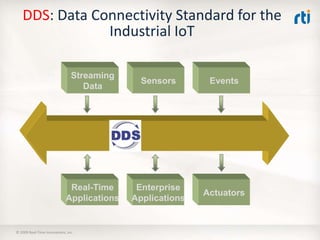
Data Connectivity Standard for the Industrial IoT
DDS: Data Connectivity Standard for the
Industrial IoT
© 2009 Real-Time Innovations, Inc.
Streaming
Data
Sensors Events
Real-Time
Applications
Enterprise
Applications
Actuators
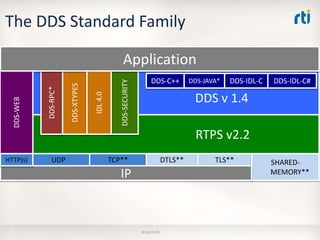
The DDS Standard Family
8
DDS v 1.4
RTPS v2.2
DDS-SECURITY
DDS-XTYPES
Application
UDP TCP** DTLS** TLS**
DDS-C++ DDS-JAVA* DDS-IDL-C DDS-IDL-C#
SHARED-
MEMORY**IP
DDS-WEB
HTTP(s)
IDL4.0
© 2015 RTI
DDS-RPC*
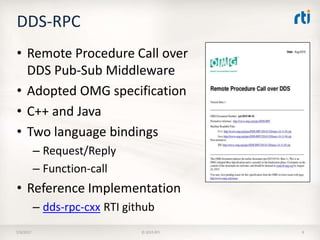
DDS-RPC
• Remote Procedure Call over
DDS Pub-Sub Middleware
• Adopted OMG specification
• C++ and Java
• Two language bindings
– Request/Reply
– Function-call
• Reference Implementation
– dds-rpc-cxx RTI github
7/9/2017 © 2015 RTI 9
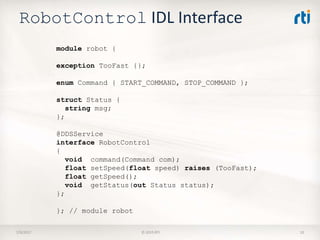
RobotControl IDL Interface
7/9/2017 © 2015 RTI 10
module robot {
exception TooFast {};
enum Command { START_COMMAND, STOP_COMMAND };
struct Status {
string msg;
};
@DDSService
interface RobotControl
{
void command(Command com);
float setSpeed(float speed) raises (TooFast);
float getSpeed();
void getStatus(out Status status);
};
}; // module robot
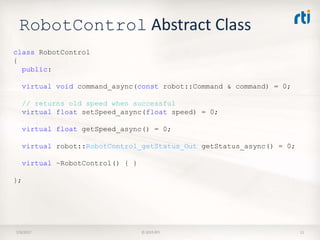
RobotControl Abstract Class
7/9/2017 © 2015 RTI 11
class RobotControl
{
public:
virtual void command_async(const robot::Command & command) = 0;
// returns old speed when successful
virtual float setSpeed_async(float speed) = 0;
virtual float getSpeed_async() = 0;
virtual robot::RobotControl_getStatus_Out getStatus_async() = 0;
virtual ~RobotControl() { }
};
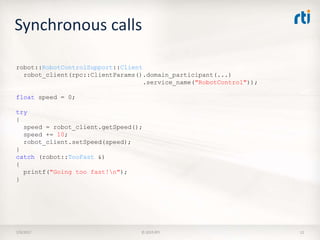
Synchronous calls
7/9/2017 © 2015 RTI 12
robot::RobotControlSupport::Client
robot_client(rpc::ClientParams().domain_participant(...)
.service_name("RobotControl"));
float speed = 0;
try
{
speed = robot_client.getSpeed();
speed += 10;
robot_client.setSpeed(speed);
}
catch (robot::TooFast &)
{
printf("Going too fast!n");
}
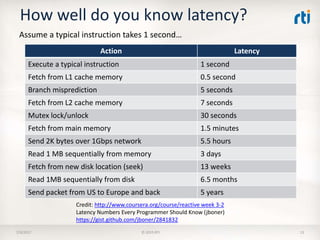
How well do you know latency?
7/9/2017 © 2015 RTI 13
Action Latency
Execute a typical instruction 1 second
Fetch from L1 cache memory 0.5 second
Branch misprediction 5 seconds
Fetch from L2 cache memory 7 seconds
Mutex lock/unlock 30 seconds
Fetch from main memory 1.5 minutes
Send 2K bytes over 1Gbps network 5.5 hours
Read 1 MB sequentially from memory 3 days
Fetch from new disk location (seek) 13 weeks
Read 1MB sequentially from disk 6.5 months
Send packet from US to Europe and back 5 years
Credit: http://www.coursera.org/course/reactive week 3-2
Latency Numbers Every Programmer Should Know (jboner)
https://gist.github.com/jboner/2841832
Assume a typical instruction takes 1 second…
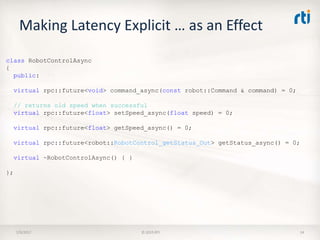
Making Latency Explicit … as an Effect
7/9/2017 © 2015 RTI 14
class RobotControlAsync
{
public:
virtual rpc::future<void> command_async(const robot::Command & command) = 0;
// returns old speed when successful
virtual rpc::future<float> setSpeed_async(float speed) = 0;
virtual rpc::future<float> getSpeed_async() = 0;
virtual rpc::future<robot::RobotControl_getStatus_Out> getStatus_async() = 0;
virtual ~RobotControlAsync() { }
};
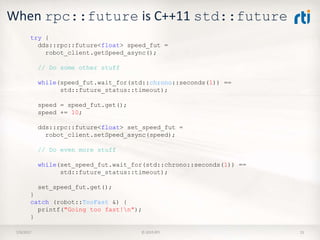
When rpc::future is C++11 std::future
7/9/2017 © 2015 RTI 15
try {
dds::rpc::future<float> speed_fut =
robot_client.getSpeed_async();
// Do some other stuff
while(speed_fut.wait_for(std::chrono::seconds(1)) ==
std::future_status::timeout);
speed = speed_fut.get();
speed += 10;
dds::rpc::future<float> set_speed_fut =
robot_client.setSpeed_async(speed);
// Do even more stuff
while(set_speed_fut.wait_for(std::chrono::seconds(1)) ==
std::future_status::timeout);
set_speed_fut.get();
}
catch (robot::TooFast &) {
printf("Going too fast!n");
}
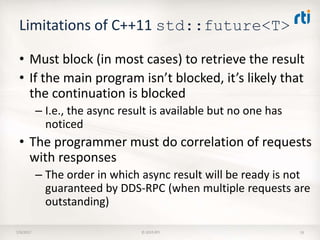
Limitations of C++11 std::future<T>
• Must block (in most cases) to retrieve the result
• If the main program isn’t blocked, it’s likely that
the continuation is blocked
– I.e., the async result is available but no one has
noticed
• The programmer must do correlation of requests
with responses
– The order in which async result will be ready is not
guaranteed by DDS-RPC (when multiple requests are
outstanding)
7/9/2017 © 2015 RTI 16
When rpc::future is C++11 std::future
7/9/2017 © 2015 RTI 17
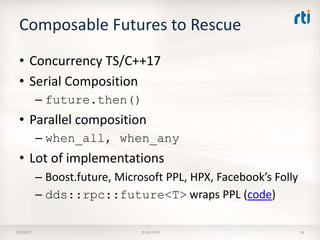
Composable Futures to Rescue
• Concurrency TS/C++17
• Serial Composition
– future.then()
• Parallel composition
– when_all, when_any
• Lot of implementations
– Boost.future, Microsoft PPL, HPX, Facebook’s Folly
– dds::rpc::future<T> wraps PPL (code)
7/9/2017 © 2015 RTI 18
Using future.then()
7/9/2017 © 2015 RTI 19
robot_client
.getSpeed_async()
.then([robot_client](future<float> && speed_fut) {
float speed = speed_fut.get();
printf("getSpeed = %fn", speed);
speed += 10;
return robot_client.setSpeed_async(speed);
})
.then([](future<float> && speed_fut) {
try {
float speed = speed_fut.get();
printf("speed set successfully.n");
}
catch (robot::TooFast &) {
printf("Going too fast!n");
}
});
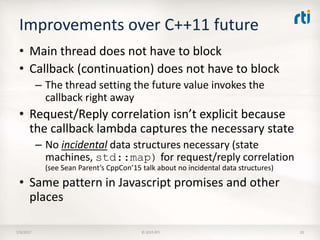
Improvements over C++11 future
• Main thread does not have to block
• Callback (continuation) does not have to block
– The thread setting the future value invokes the
callback right away
• Request/Reply correlation isn’t explicit because
the callback lambda captures the necessary state
– No incidental data structures necessary (state
machines, std::map) for request/reply correlation
(see Sean Parent’s CppCon’15 talk about no incidental data structures)
• Same pattern in Javascript promises and other
places
7/9/2017 © 2015 RTI 20
7/9/2017 © 2015 RTI 21
Speed up the robot to MAX_SPEED
in increments of 10 and without
blocking
7/9/2017 © 2015 RTI 22
dds::rpc::future<float> speedup_until_maxspeed(
robot::RobotControlSupport::Client & robot_client)
{
static const int increment = 10;
return
robot_client
.getSpeed_async()
.then([robot_client](future<float> && speed_fut) {
float speed = speed_fut.get();
speed += increment;
if(speed <= MAX_SPEED) {
printf("speedup_until_maxspeed: new speed = %fn", speed);
return robot_client.setSpeed_async(speed);
}
else
return dds::rpc::details::make_ready_future(speed);
})
.then([robot_client](future<float> && speed_fut) {
float speed = speed_fut.get();
if(speed + increment <= MAX_SPEED)
return speedup_until_maxspeed(robot_client);
else
return dds::rpc::details::make_ready_future(speed);
});
}
Return ready future?
Why not speed?
Is that recursive?
Does the stack grow?... No!
What are these lambdas doing here?
Is that a CPS transform? … Yes!
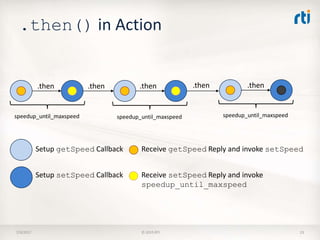
.then() in Action
7/9/2017 © 2015 RTI 23
Setup getSpeed Callback Receive getSpeed Reply and invoke setSpeed
Setup setSpeed Callback Receive setSpeed Reply and invoke
speedup_until_maxspeed
.then .then .then .then .then
speedup_until_maxspeed speedup_until_maxspeed speedup_until_maxspeed
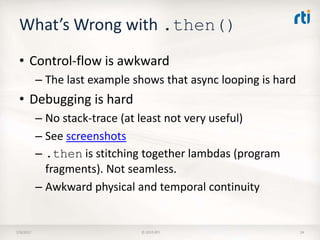
What’s Wrong with .then()
• Control-flow is awkward
– The last example shows that async looping is hard
• Debugging is hard
– No stack-trace (at least not very useful)
– See screenshots
– .then is stitching together lambdas (program
fragments). Not seamless.
– Awkward physical and temporal continuity
7/9/2017 © 2015 RTI 24
Welcome C++ Coroutines
7/9/2017 © 2015 RTI 25
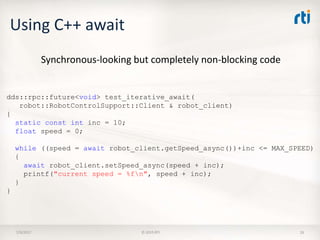
Using C++ await
7/9/2017 © 2015 RTI 26
dds::rpc::future<void> test_iterative_await(
robot::RobotControlSupport::Client & robot_client)
{
static const int inc = 10;
float speed = 0;
while ((speed = await robot_client.getSpeed_async())+inc <= MAX_SPEED)
{
await robot_client.setSpeed_async(speed + inc);
printf("current speed = %fn", speed + inc);
}
}
Synchronous-looking but completely non-blocking code
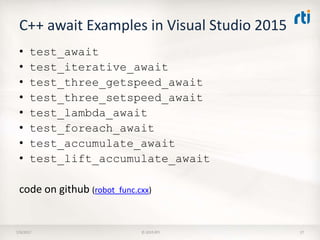
C++ await Examples in Visual Studio 2015
• test_await
• test_iterative_await
• test_three_getspeed_await
• test_three_setspeed_await
• test_lambda_await
• test_foreach_await
• test_accumulate_await
• test_lift_accumulate_await
code on github (robot_func.cxx)
7/9/2017 © 2015 RTI 27
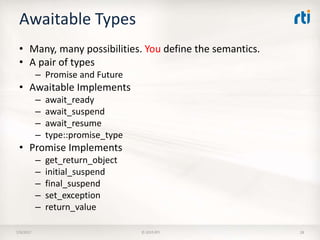
Awaitable Types
• Many, many possibilities. You define the semantics.
• A pair of types
– Promise and Future
• Awaitable Implements
– await_ready
– await_suspend
– await_resume
– type::promise_type
• Promise Implements
– get_return_object
– initial_suspend
– final_suspend
– set_exception
– return_value
7/9/2017 © 2015 RTI 28
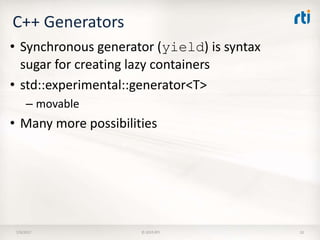
C++ Generators
7/9/2017 © 2015 RTI 32
• Synchronous generator (yield) is syntax
sugar for creating lazy containers
• std::experimental::generator<T>
– movable
• Many more possibilities
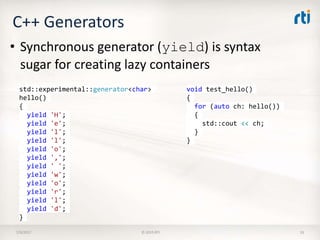
C++ Generators
7/9/2017 © 2015 RTI 33
• Synchronous generator (yield) is syntax
sugar for creating lazy containers
void test_hello()
{
for (auto ch: hello())
{
std::cout << ch;
}
}
std::experimental::generator<char>
hello()
{
yield 'H';
yield 'e';
yield 'l';
yield 'l';
yield 'o';
yield ',';
yield ' ';
yield 'w';
yield 'o';
yield 'r';
yield 'l';
yield 'd';
}
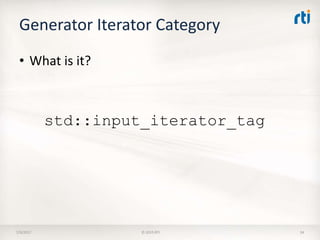
Generator Iterator Category
• What is it?
7/9/2017 © 2015 RTI 34
std::input_iterator_tag
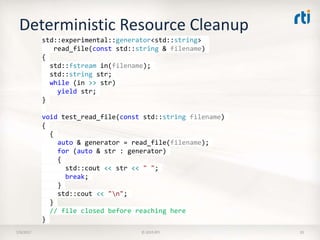
Deterministic Resource Cleanup
7/9/2017 © 2015 RTI 35
std::experimental::generator<std::string>
read_file(const std::string & filename)
{
std::fstream in(filename);
std::string str;
while (in >> str)
yield str;
}
void test_read_file(const std::string filename)
{
{
auto & generator = read_file(filename);
for (auto & str : generator)
{
std::cout << str << " ";
break;
}
std::cout << "n";
}
// file closed before reaching here
}
C++ Generators
7/9/2017 © 2015 RTI 36
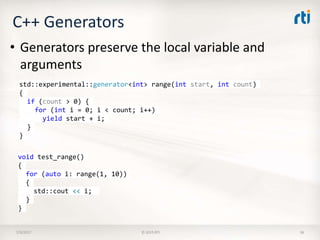
• Generators preserve the local variable and
arguments
void test_range()
{
for (auto i: range(1, 10))
{
std::cout << i;
}
}
std::experimental::generator<int> range(int start, int count)
{
if (count > 0) {
for (int i = 0; i < count; i++)
yield start + i;
}
}
Recursive?
7/9/2017 © 2015 RTI 37
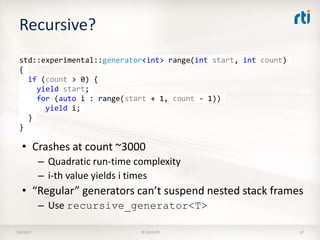
std::experimental::generator<int> range(int start, int count)
{
if (count > 0) {
yield start;
for (auto i : range(start + 1, count - 1))
yield i;
}
}
• Crashes at count ~3000
– Quadratic run-time complexity
– i-th value yields i times
• “Regular” generators can’t suspend nested stack frames
– Use recursive_generator<T>
Composing Abstractions
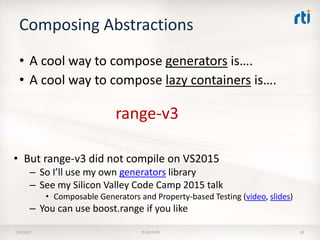
• A cool way to compose generators is….
7/9/2017 © 2015 RTI 38
range-v3
• But range-v3 did not compile on VS2015
– So I’ll use my own generators library
– See my Silicon Valley Code Camp 2015 talk
• Composable Generators and Property-based Testing (video, slides)
– You can use boost.range if you like
• A cool way to compose lazy containers is….
Composing Generators
7/9/2017 © 2015 RTI 39
#include “generator.h” // See my github
std::experimental::generator<char> hello()
{
for (auto ch : "HELLO WORLD")
yield ch;
}
void test_coroutine_gen()
{
std::string msg = “hello@world";
auto gen = gen::make_coroutine_gen(hello)
.map([](char ch) { return char(ch + 32); })
.take(msg.size());
int i = 0;
for (auto ch: gen)
{
std::cout << ch;
assert(ch == msg[i++]);
}
}
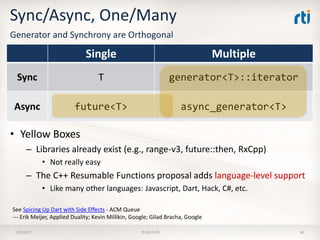
Generator and Synchrony are Orthogonal
• Yellow Boxes
– Libraries already exist (e.g., range-v3, future::then, RxCpp)
• Not really easy
– The C++ Resumable Functions proposal adds language-level support
• Like many other languages: Javascript, Dart, Hack, C#, etc.
7/9/2017 © 2015 RTI 40
Sync/Async, One/Many
Single Multiple
Sync T generator<T>::iterator
Async future<T> async_generator<T>
See Spicing Up Dart with Side Effects - ACM Queue
--- Erik Meijer, Applied Duality; Kevin Millikin, Google; Gilad Bracha, Google
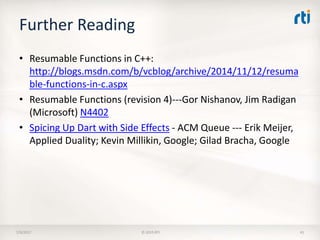
Further Reading
• Resumable Functions in C++:
http://blogs.msdn.com/b/vcblog/archive/2014/11/12/resuma
ble-functions-in-c.aspx
• Resumable Functions (revision 4)---Gor Nishanov, Jim Radigan
(Microsoft) N4402
• Spicing Up Dart with Side Effects - ACM Queue --- Erik Meijer,
Applied Duality; Kevin Millikin, Google; Gilad Bracha, Google
7/9/2017 © 2015 RTI 41

C++ Coroutines

  • 1.
    Your systems. Workingas one. Sumant Tambe, PhD Principal Research Engineer and Microsoft VC++ MVP Real-Time Innovations, Inc. @sutambe SFBay Association of C/C++ Users Jan 13, 2016 Polyglot Programming DC Mar 16, 2016
  • 2.
    7/9/2017 © 2015RTI 2 Alternative Title
  • 3.
    Why should youcare? • Most software written today relies on networking and I/O • Simplify writing I/O-oriented software – Correct (bug-free) – Performs well • Non-blocking • Latency-aware • Multi-core scalable – Expressive–Simple and direct expression of intent – Easy to write and read (maintainable) – Productivity • Modular • Reusable • Extensible – and have fun while doing that! 7/9/2017 © 2015 RTI 4
  • 4.
    Agenda • Remote Procedurecall (RPC) over DDS (DDS-RPC) standard • Deep dive into asynchronous programming – future<T> examples – C++ await examples – Abusing C++ await to avoid if-then-else boilerplate – C++ generator examples • Composing abstractions 7/9/2017 © 2015 RTI 5
  • 5.
    7/9/2017 © Real-TimeInnovations, Inc. 6 Data Connectivity Standard for the Industrial IoT
  • 6.
    DDS: Data ConnectivityStandard for the Industrial IoT © 2009 Real-Time Innovations, Inc. Streaming Data Sensors Events Real-Time Applications Enterprise Applications Actuators
  • 7.
    The DDS StandardFamily 8 DDS v 1.4 RTPS v2.2 DDS-SECURITY DDS-XTYPES Application UDP TCP** DTLS** TLS** DDS-C++ DDS-JAVA* DDS-IDL-C DDS-IDL-C# SHARED- MEMORY**IP DDS-WEB HTTP(s) IDL4.0 © 2015 RTI DDS-RPC*
  • 8.
    DDS-RPC • Remote ProcedureCall over DDS Pub-Sub Middleware • Adopted OMG specification • C++ and Java • Two language bindings – Request/Reply – Function-call • Reference Implementation – dds-rpc-cxx RTI github 7/9/2017 © 2015 RTI 9
  • 9.
    RobotControl IDL Interface 7/9/2017© 2015 RTI 10 module robot { exception TooFast {}; enum Command { START_COMMAND, STOP_COMMAND }; struct Status { string msg; }; @DDSService interface RobotControl { void command(Command com); float setSpeed(float speed) raises (TooFast); float getSpeed(); void getStatus(out Status status); }; }; // module robot
  • 10.
    RobotControl Abstract Class 7/9/2017© 2015 RTI 11 class RobotControl { public: virtual void command_async(const robot::Command & command) = 0; // returns old speed when successful virtual float setSpeed_async(float speed) = 0; virtual float getSpeed_async() = 0; virtual robot::RobotControl_getStatus_Out getStatus_async() = 0; virtual ~RobotControl() { } };
  • 11.
    Synchronous calls 7/9/2017 ©2015 RTI 12 robot::RobotControlSupport::Client robot_client(rpc::ClientParams().domain_participant(...) .service_name("RobotControl")); float speed = 0; try { speed = robot_client.getSpeed(); speed += 10; robot_client.setSpeed(speed); } catch (robot::TooFast &) { printf("Going too fast!n"); }
  • 12.
    How well doyou know latency? 7/9/2017 © 2015 RTI 13 Action Latency Execute a typical instruction 1 second Fetch from L1 cache memory 0.5 second Branch misprediction 5 seconds Fetch from L2 cache memory 7 seconds Mutex lock/unlock 30 seconds Fetch from main memory 1.5 minutes Send 2K bytes over 1Gbps network 5.5 hours Read 1 MB sequentially from memory 3 days Fetch from new disk location (seek) 13 weeks Read 1MB sequentially from disk 6.5 months Send packet from US to Europe and back 5 years Credit: http://www.coursera.org/course/reactive week 3-2 Latency Numbers Every Programmer Should Know (jboner) https://gist.github.com/jboner/2841832 Assume a typical instruction takes 1 second…
  • 13.
    Making Latency Explicit… as an Effect 7/9/2017 © 2015 RTI 14 class RobotControlAsync { public: virtual rpc::future<void> command_async(const robot::Command & command) = 0; // returns old speed when successful virtual rpc::future<float> setSpeed_async(float speed) = 0; virtual rpc::future<float> getSpeed_async() = 0; virtual rpc::future<robot::RobotControl_getStatus_Out> getStatus_async() = 0; virtual ~RobotControlAsync() { } };
  • 14.
    When rpc::future isC++11 std::future 7/9/2017 © 2015 RTI 15 try { dds::rpc::future<float> speed_fut = robot_client.getSpeed_async(); // Do some other stuff while(speed_fut.wait_for(std::chrono::seconds(1)) == std::future_status::timeout); speed = speed_fut.get(); speed += 10; dds::rpc::future<float> set_speed_fut = robot_client.setSpeed_async(speed); // Do even more stuff while(set_speed_fut.wait_for(std::chrono::seconds(1)) == std::future_status::timeout); set_speed_fut.get(); } catch (robot::TooFast &) { printf("Going too fast!n"); }
  • 15.
    Limitations of C++11std::future<T> • Must block (in most cases) to retrieve the result • If the main program isn’t blocked, it’s likely that the continuation is blocked – I.e., the async result is available but no one has noticed • The programmer must do correlation of requests with responses – The order in which async result will be ready is not guaranteed by DDS-RPC (when multiple requests are outstanding) 7/9/2017 © 2015 RTI 16
  • 16.
    When rpc::future isC++11 std::future 7/9/2017 © 2015 RTI 17
  • 17.
    Composable Futures toRescue • Concurrency TS/C++17 • Serial Composition – future.then() • Parallel composition – when_all, when_any • Lot of implementations – Boost.future, Microsoft PPL, HPX, Facebook’s Folly – dds::rpc::future<T> wraps PPL (code) 7/9/2017 © 2015 RTI 18
  • 18.
    Using future.then() 7/9/2017 ©2015 RTI 19 robot_client .getSpeed_async() .then([robot_client](future<float> && speed_fut) { float speed = speed_fut.get(); printf("getSpeed = %fn", speed); speed += 10; return robot_client.setSpeed_async(speed); }) .then([](future<float> && speed_fut) { try { float speed = speed_fut.get(); printf("speed set successfully.n"); } catch (robot::TooFast &) { printf("Going too fast!n"); } });
  • 19.
    Improvements over C++11future • Main thread does not have to block • Callback (continuation) does not have to block – The thread setting the future value invokes the callback right away • Request/Reply correlation isn’t explicit because the callback lambda captures the necessary state – No incidental data structures necessary (state machines, std::map) for request/reply correlation (see Sean Parent’s CppCon’15 talk about no incidental data structures) • Same pattern in Javascript promises and other places 7/9/2017 © 2015 RTI 20
  • 20.
    7/9/2017 © 2015RTI 21 Speed up the robot to MAX_SPEED in increments of 10 and without blocking
  • 21.
    7/9/2017 © 2015RTI 22 dds::rpc::future<float> speedup_until_maxspeed( robot::RobotControlSupport::Client & robot_client) { static const int increment = 10; return robot_client .getSpeed_async() .then([robot_client](future<float> && speed_fut) { float speed = speed_fut.get(); speed += increment; if(speed <= MAX_SPEED) { printf("speedup_until_maxspeed: new speed = %fn", speed); return robot_client.setSpeed_async(speed); } else return dds::rpc::details::make_ready_future(speed); }) .then([robot_client](future<float> && speed_fut) { float speed = speed_fut.get(); if(speed + increment <= MAX_SPEED) return speedup_until_maxspeed(robot_client); else return dds::rpc::details::make_ready_future(speed); }); } Return ready future? Why not speed? Is that recursive? Does the stack grow?... No! What are these lambdas doing here? Is that a CPS transform? … Yes!
  • 22.
    .then() in Action 7/9/2017© 2015 RTI 23 Setup getSpeed Callback Receive getSpeed Reply and invoke setSpeed Setup setSpeed Callback Receive setSpeed Reply and invoke speedup_until_maxspeed .then .then .then .then .then speedup_until_maxspeed speedup_until_maxspeed speedup_until_maxspeed
  • 23.
    What’s Wrong with.then() • Control-flow is awkward – The last example shows that async looping is hard • Debugging is hard – No stack-trace (at least not very useful) – See screenshots – .then is stitching together lambdas (program fragments). Not seamless. – Awkward physical and temporal continuity 7/9/2017 © 2015 RTI 24
  • 24.
  • 25.
    Using C++ await 7/9/2017© 2015 RTI 26 dds::rpc::future<void> test_iterative_await( robot::RobotControlSupport::Client & robot_client) { static const int inc = 10; float speed = 0; while ((speed = await robot_client.getSpeed_async())+inc <= MAX_SPEED) { await robot_client.setSpeed_async(speed + inc); printf("current speed = %fn", speed + inc); } } Synchronous-looking but completely non-blocking code
  • 26.
    C++ await Examplesin Visual Studio 2015 • test_await • test_iterative_await • test_three_getspeed_await • test_three_setspeed_await • test_lambda_await • test_foreach_await • test_accumulate_await • test_lift_accumulate_await code on github (robot_func.cxx) 7/9/2017 © 2015 RTI 27
  • 27.
    Awaitable Types • Many,many possibilities. You define the semantics. • A pair of types – Promise and Future • Awaitable Implements – await_ready – await_suspend – await_resume – type::promise_type • Promise Implements – get_return_object – initial_suspend – final_suspend – set_exception – return_value 7/9/2017 © 2015 RTI 28
  • 28.
    C++ Generators 7/9/2017 ©2015 RTI 32 • Synchronous generator (yield) is syntax sugar for creating lazy containers • std::experimental::generator<T> – movable • Many more possibilities
  • 29.
    C++ Generators 7/9/2017 ©2015 RTI 33 • Synchronous generator (yield) is syntax sugar for creating lazy containers void test_hello() { for (auto ch: hello()) { std::cout << ch; } } std::experimental::generator<char> hello() { yield 'H'; yield 'e'; yield 'l'; yield 'l'; yield 'o'; yield ','; yield ' '; yield 'w'; yield 'o'; yield 'r'; yield 'l'; yield 'd'; }
  • 30.
    Generator Iterator Category •What is it? 7/9/2017 © 2015 RTI 34 std::input_iterator_tag
  • 31.
    Deterministic Resource Cleanup 7/9/2017© 2015 RTI 35 std::experimental::generator<std::string> read_file(const std::string & filename) { std::fstream in(filename); std::string str; while (in >> str) yield str; } void test_read_file(const std::string filename) { { auto & generator = read_file(filename); for (auto & str : generator) { std::cout << str << " "; break; } std::cout << "n"; } // file closed before reaching here }
  • 32.
    C++ Generators 7/9/2017 ©2015 RTI 36 • Generators preserve the local variable and arguments void test_range() { for (auto i: range(1, 10)) { std::cout << i; } } std::experimental::generator<int> range(int start, int count) { if (count > 0) { for (int i = 0; i < count; i++) yield start + i; } }
  • 33.
    Recursive? 7/9/2017 © 2015RTI 37 std::experimental::generator<int> range(int start, int count) { if (count > 0) { yield start; for (auto i : range(start + 1, count - 1)) yield i; } } • Crashes at count ~3000 – Quadratic run-time complexity – i-th value yields i times • “Regular” generators can’t suspend nested stack frames – Use recursive_generator<T>
  • 34.
    Composing Abstractions • Acool way to compose generators is…. 7/9/2017 © 2015 RTI 38 range-v3 • But range-v3 did not compile on VS2015 – So I’ll use my own generators library – See my Silicon Valley Code Camp 2015 talk • Composable Generators and Property-based Testing (video, slides) – You can use boost.range if you like • A cool way to compose lazy containers is….
  • 35.
    Composing Generators 7/9/2017 ©2015 RTI 39 #include “generator.h” // See my github std::experimental::generator<char> hello() { for (auto ch : "HELLO WORLD") yield ch; } void test_coroutine_gen() { std::string msg = “hello@world"; auto gen = gen::make_coroutine_gen(hello) .map([](char ch) { return char(ch + 32); }) .take(msg.size()); int i = 0; for (auto ch: gen) { std::cout << ch; assert(ch == msg[i++]); } }
  • 36.
    Generator and Synchronyare Orthogonal • Yellow Boxes – Libraries already exist (e.g., range-v3, future::then, RxCpp) • Not really easy – The C++ Resumable Functions proposal adds language-level support • Like many other languages: Javascript, Dart, Hack, C#, etc. 7/9/2017 © 2015 RTI 40 Sync/Async, One/Many Single Multiple Sync T generator<T>::iterator Async future<T> async_generator<T> See Spicing Up Dart with Side Effects - ACM Queue --- Erik Meijer, Applied Duality; Kevin Millikin, Google; Gilad Bracha, Google
  • 37.
    Further Reading • ResumableFunctions in C++: http://blogs.msdn.com/b/vcblog/archive/2014/11/12/resuma ble-functions-in-c.aspx • Resumable Functions (revision 4)---Gor Nishanov, Jim Radigan (Microsoft) N4402 • Spicing Up Dart with Side Effects - ACM Queue --- Erik Meijer, Applied Duality; Kevin Millikin, Google; Gilad Bracha, Google 7/9/2017 © 2015 RTI 41

Editor's Notes

  • #7 Everything is distributed as an event (enables discovery): data object updates, a specific data-object existence and disposal, application startup, application shutdown, DR/DW creation/shutdown, topics and their types
  • #8 DDS provides an infrastructure for integrating real-time applications. It also facilitates integrating real-time applications with non-real-time (enterprise) applications, such as command and control systems.