Agenda
   What‘s happening in many-core
    world?
     New Challenges
   Collaborative Research
     Real-Time Innovations (RTI)
     University of North Carolina
     What we (RTI) do, briefly!
   Research: Retargeting embedded
    software stack for many-core
    systems
     Components
     Scalable multi-core Scheduling
     Scalable communication
     Middleware Modernization
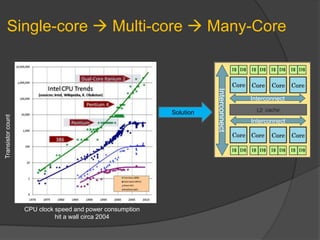
Single-core  Multi-core  Many-Core


                                                                      Interconnect
                                                                                     Interconnect

                                                           Solution
Transistor count


                                                                                     Interconnect


                   CPU clock speed and power consumption
                             hit a wall circa 2004
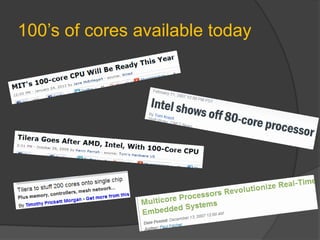
100‘s of cores available today
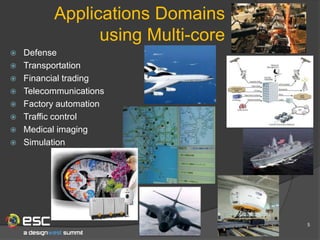
Applications Domains
                using Multi-core
   Defense
   Transportation
   Financial trading
   Telecommunications
   Factory automation
   Traffic control
   Medical imaging
   Simulation


                                   5
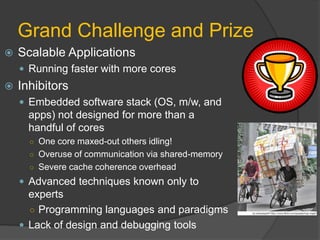
Grand Challenge and Prize
   Scalable Applications
     Running faster with more cores
   Inhibitors
     Embedded software stack (OS, m/w, and
      apps) not designed for more than a
      handful of cores
      ○ One core maxed-out others idling!
      ○ Overuse of communication via shared-memory
      ○ Severe cache coherence overhead
     Advanced techniques known only to
      experts
      ○ Programming languages and paradigms
     Lack of design and debugging tools
Trends in concurrent
    programming (1/7)
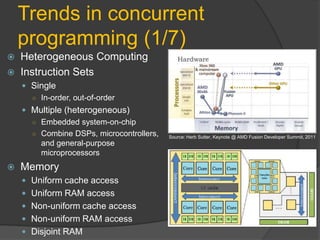
   Heterogeneous Computing
   Instruction Sets
     Single
      ○ In-order, out-of-order
     Multiple (heterogeneous)
      ○ Embedded system-on-chip
      ○ Combine DSPs, microcontrollers,   Source: Herb Sutter, Keynote @ AMD Fusion Developer Summit, 2011
        and general-purpose
        microprocessors
   Memory
     Uniform cache access
     Uniform RAM access
     Non-uniform cache access
     Non-uniform RAM access
     Disjoint RAM
Trends in concurrent
    programming (2/7)
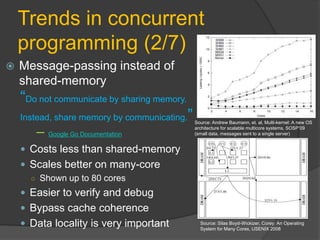
   Message-passing instead of
    shared-memory
    ―Do not communicate by sharing memory.
    Instead, share memory by communicating.  ‖   Source: Andrew Baumann, et. al, Multi-kernel: A new OS

       – Google Go Documentation                 architecture for scalable multicore systems, SOSP‘09
                                                 (small data, messages sent to a single server)


     Costs less than shared-memory
     Scales better on many-core
      ○ Shown up to 80 cores
     Easier to verify and debug
     Bypass cache coherence
     Data locality is very important              Source: Silas Boyd-Wickizer, Corey: An Operating
                                                   System for Many Cores, USENIX 2008
Trends in concurrent
 programming (3/7)
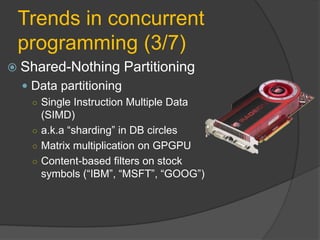
 Shared-Nothing      Partitioning
   Data partitioning
    ○ Single Instruction Multiple Data
      (SIMD)
    ○ a.k.a ―sharding‖ in DB circles
    ○ Matrix multiplication on GPGPU
    ○ Content-based filters on stock
      symbols (―IBM‖, ―MSFT‖, ―GOOG‖)
Trends in concurrent
programming (4/7)
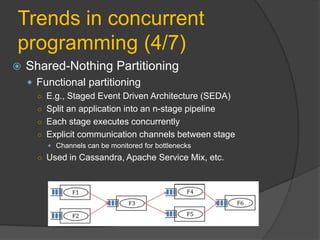
   Shared-Nothing Partitioning
     Functional partitioning
      ○ E.g., Staged Event Driven Architecture (SEDA)
      ○ Split an application into an n-stage pipeline
      ○ Each stage executes concurrently
      ○ Explicit communication channels between stage
         Channels can be monitored for bottlenecks
      ○ Used in Cassandra, Apache Service Mix, etc.
Trends in concurrent
programming (5/7)
 Erlang-Style Concurrency (Actor Model)
 Concurrency-Oriented Programming (COP)
     Fast asynchronous messaging
     Selective message reception
     Copying message-passing semantics (share-nothing
      concurrency)
     Process monitoring
     Fast process creation/destruction
     Ability to support >> 10 000 concurrent processes with largely
      unchanged characteristics

    Source: http://ulf.wiger.net
Trends in concurrent
programming (6/7)
   Consistency via Safely Shared
    Resources
     Replacing coarse-grained locking with fine-
        grained locking
       Using wait-free primitives
       Using cache-conscious algorithms
       Exploit application-specific data locality
       New programming APIs
        ○ OpenCL, PPL, AMP, etc.
Trends in concurrent
programming (7/7)
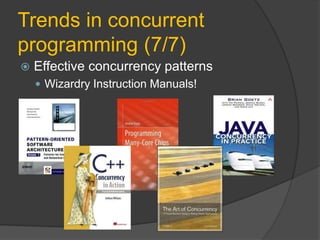
   Effective concurrency patterns
     Wizardry Instruction Manuals!
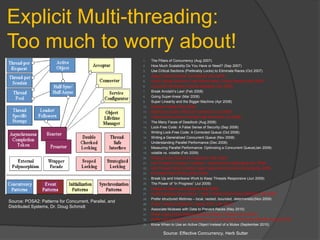
Explicit Multi-threading:
Too much to worry about!
                                                        1.    The Pillars of Concurrency (Aug 2007)
                                                        2.    How Much Scalability Do You Have or Need? (Sep 2007)
                                                        3.    Use Critical Sections (Preferably Locks) to Eliminate Races (Oct 2007)
                                                        4.    Apply Critical Sections Consistently (Nov 2007)
                                                        5.    Avoid Calling Unknown Code While Inside a Critical Section (Dec 2007)
                                                        6.    Use Lock Hierarchies to Avoid Deadlock (Jan 2008)
                                                        7.    Break Amdahl‘s Law! (Feb 2008)
                                                        8.    Going Super-linear (Mar 2008)
                                                        9.    Super Linearity and the Bigger Machine (Apr 2008)
                                                        10.   Interrupt Politely (May 2008)
                                                        11.   Maximize Locality, Minimize Contention (Jun 2008)
                                                        12.   Choose Concurrency-Friendly Data Structures (Jul 2008)
                                                        13.   The Many Faces of Deadlock (Aug 2008)
                                                        14.   Lock-Free Code: A False Sense of Security (Sep 2008)
                                                        15.   Writing Lock-Free Code: A Corrected Queue (Oct 2008)
                                                        16.   Writing a Generalized Concurrent Queue (Nov 2008)
                                                        17.   Understanding Parallel Performance (Dec 2008)
                                                        18.   Measuring Parallel Performance: Optimizing a Concurrent Queue(Jan 2009)
                                                        19.   volatile vs. volatile (Feb 2009)
                                                        20.   Sharing Is the Root of All Contention (Mar 2009)
                                                        21.   Use Threads Correctly = Isolation + Asynchronous Messages (Apr 2009)
                                                        22.   Use Thread Pools Correctly: Keep Tasks Short and Non-blocking(Apr 2009)
                                                        23.   Eliminate False Sharing (May 2009)
                                                        24.   Break Up and Interleave Work to Keep Threads Responsive (Jun 2009)
                                                        25.   The Power of ―In Progress‖ (Jul 2009)
                                                        26.   Design for Many-core Systems (Aug 2009)
                                                        27.   Avoid Exposing Concurrency – Hide It Inside Synchronous Methods (Oct 2009)
                                                        28.   Prefer structured lifetimes – local, nested, bounded, deterministic(Nov 2009)
Source: POSA2: Patterns for Concurrent, Parallel, and
                                                        29.   Prefer Futures to Baked-In ―Async APIs‖ (Jan 2010)
Distributed Systems, Dr. Doug Schmidt
                                                        30.   Associate Mutexes with Data to Prevent Races (May 2010)
                                                        31.   Prefer Using Active Objects Instead of Naked Threads (June 2010)
                                                        32.   Prefer Using Futures or Callbacks to Communicate Asynchronous Results (August 2010)
                                                        33.   Know When to Use an Active Object Instead of a Mutex (September 2010)

                                                                     Source: Effective Concurrency, Herb Sutter
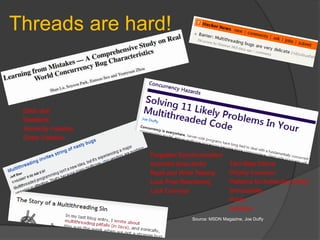
Threads are hard!


 Data race
 Deadlock
 Atomicity Violation
 Order Violation

                       Forgotten Synchronization
                       Incorrect Granularity         Two-Step Dance
                       Read and Write Tearing        Priority Inversion
                       Lock-Free Reordering          Patterns for Achieving Safety
                       Lock Convoys                  Immutability
                                                     Purity
                                                     Isolation
                                     Source: MSDN Magazine, Joe Duffy
Collaborative Research!

                        Prof. James Anderson
                        University of North Carolina
Real-Time Innovations   IEEE Fellow
Sunnyvale, CA
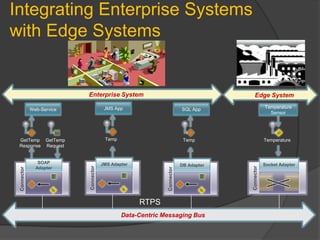
Integrating Enterprise Systems
with Edge Systems


                             Enterprise System                                             Edge System

                                          JMS App                          SQL App                  Temperature
             Web-Service
                                                                                                      Sensor


 GetTemp           GetTemp                Temp                              Temp                    Temperature
 Response          Request


                SOAP                     JMS Adapter                                                Socket Adapter
                                                                           DB Adapter
                             Connector


                                                                                        Connector
               Adapter
                                                               Connector
 Connector


                                                       RTPS
                                                 Data-Centric Messaging Bus
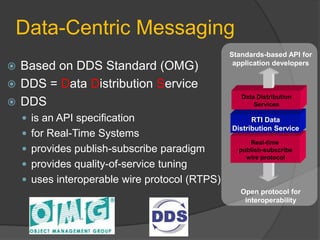
Data-Centric Messaging
                                                Standards-based API for
                                                 application developers
 Based on DDS Standard (OMG)
 DDS = Data Distribution Service
                                                   Data Distribution
 DDS                                                  Services

     is an API specification                         RTI Data
                                                Distribution Service
     for Real-Time Systems
                                                     Real-time
     provides publish-subscribe paradigm         publish-subscribe
                                                    wire protocol
     provides quality-of-service tuning
     uses interoperable wire protocol (RTPS)
                                                   Open protocol for
                                                    interoperability
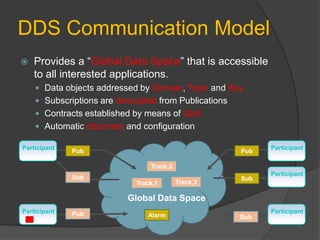
DDS Communication Model
   Provides a ―Global Data Space‖ that is accessible
    to all interested applications.
     Data objects addressed by Domain, Topic and Key
     Subscriptions are decoupled from Publications
     Contracts established by means of QoS
     Automatic discovery and configuration

Participant                                                 Participant
              Pub                                     Pub

                                Track,2
                                                            Participant
              Sub                                     Sub
                            Track,1       Track,3

                          Global Data Space
Participant   Pub                                           Participant
                               Alarm                  Sub
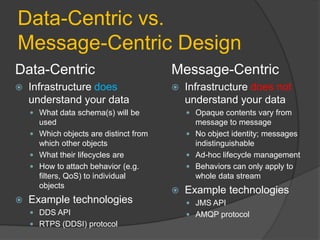
Data-Centric vs.
Message-Centric Design
Data-Centric                            Message-Centric
   Infrastructure does                    Infrastructure does not
    understand your data                    understand your data
     What data schema(s) will be            Opaque contents vary from
      used                                    message to message
     Which objects are distinct from        No object identity; messages
      which other objects                     indistinguishable
     What their lifecycles are              Ad-hoc lifecycle management
     How to attach behavior (e.g.           Behaviors can only apply to
      filters, QoS) to individual             whole data stream
      objects
                                           Example technologies
   Example technologies                     JMS API
     DDS API                                AMQP protocol
     RTPS (DDSI) protocol
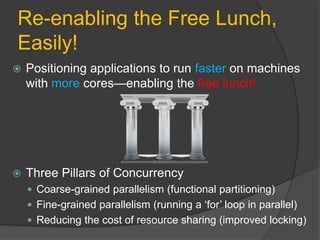
Re-enabling the Free Lunch,
Easily!
   Positioning applications to run faster on machines
    with more cores—enabling the free lunch!


   Three Pillars of Concurrency
     Coarse-grained parallelism (functional partitioning)
     Fine-grained parallelism (running a ‗for‘ loop in parallel)
     Reducing the cost of resource sharing (improved locking)
Scalable Communication and Scheduling
for Many-Core Systems
   Objectives
     Create a Component Framework for Developing
        Scalable Many-core Applications
       Develop Many-Core Resource Allocation and
        Scheduling Algorithms
       Investigate Efficient Message-Passing Mechanisms
        for Component Dataflow
       Architect DDS Middleware to Improve Internal
        Concurrency
       Demonstrate ideas using a prototype
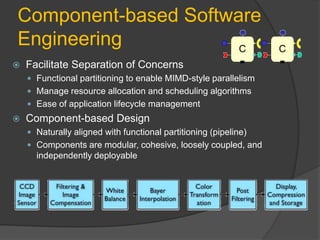
Component-based Software
Engineering           C                                           C
   Facilitate Separation of Concerns
     Functional partitioning to enable MIMD-style parallelism
     Manage resource allocation and scheduling algorithms
     Ease of application lifecycle management
   Component-based Design
     Naturally aligned with functional partitioning (pipeline)
     Components are modular, cohesive, loosely coupled, and
      independently deployable
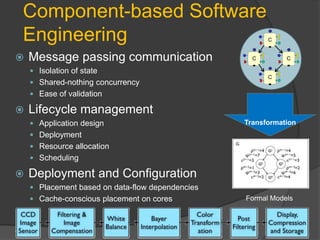
Component-based Software
Engineering                                             C


   Message passing communication                   C        C

     Isolation of state
                                                        C
     Shared-nothing concurrency
     Ease of validation

   Lifecycle management
     Application design                          Transformation
     Deployment
     Resource allocation
     Scheduling

   Deployment and Configuration
     Placement based on data-flow dependencies
     Cache-conscious placement on cores          Formal Models
Scheduling Algorithms for
Many-core
   Academic Research Partner
     Real-Time Systems Group, Prof. James Anderson
     University of North Carolina, Chapel Hill
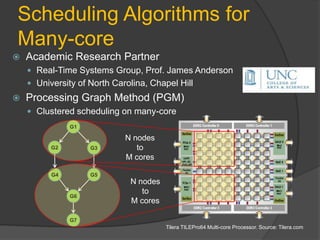
   Processing Graph Method (PGM)
     Clustered scheduling on many-core
               G1

                             N nodes
          G2        G3          to
                             M cores

          G4        G5
                              N nodes
                                 to
               G6
                              M cores

               G7
                                        Tilera TILEPro64 Multi-core Processor. Source: Tilera.com
Scheduling Algorithms for
Many-cores
   Key requirements
     Efficiently utilizing the processing capacity
      within each cluster
     Minimizing data movement across clusters
     Exploit data locality
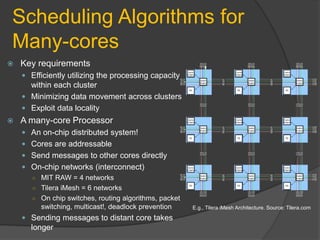
   A many-core Processor
     An on-chip distributed system!
     Cores are addressable
     Send messages to other cores directly
     On-chip networks (interconnect)
      ○ MIT RAW = 4 networks
      ○ Tilera iMesh = 6 networks
      ○ On chip switches, routing algorithms, packet
        switching, multicast!, deadlock prevention     E.g., Tilera iMesh Architecture. Source: Tilera.com

     Sending messages to distant core takes
      longer
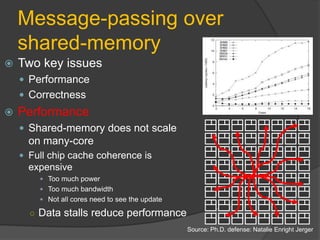
Message-passing over
    shared-memory
   Two key issues
     Performance
     Correctness
   Performance
     Shared-memory does not scale
      on many-core
     Full chip cache coherence is
      expensive
         Too much power
         Too much bandwidth
         Not all cores need to see the update

      ○ Data stalls reduce performance
                                                 Source: Ph.D. defense: Natalie Enright Jerger
Message-passing over
 shared-memory
     Correctness
        Hard to achieve in explicit threading (even in task-based libraries)
        Lock-based programs are not composable
―Perhaps the most fundamental objection [...] is that lock-based programs do not compose: correct fragments may fail when
combined. For example, consider a hash table with thread-safe insert and delete operations. Now suppose that we want to
delete one item A from table t1, and insert it into table t2; but the intermediate state (in which neither table contains the item)
must not be visible to other threads. Unless the implementer of the hash table anticipates this need, there is simply no way to
satisfy this requirement. [...] In short, operations that are individually correct (insert, delete) cannot be composed into larger
correct operations.‖
—Tim Harris et al., "Composable Memory Transactions", Section 2: Background, pg.2


    Message-passing
      Composable
      Easy to verify and debug
      Observe in/out messages only
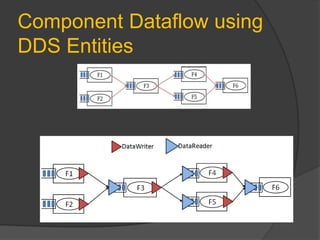
Component Dataflow using
DDS Entities
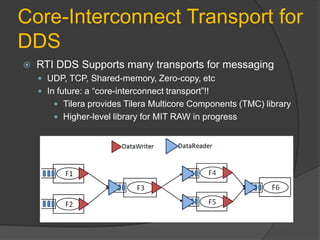
Core-Interconnect Transport for
DDS
   RTI DDS Supports many transports for messaging
     UDP, TCP, Shared-memory, Zero-copy, etc
     In future: a ―core-interconnect transport‖!!
         Tilera provides Tilera Multicore Components (TMC) library
         Higher-level library for MIT RAW in progress
Erlang-Style Concurrency: A
Panacea?
   Actor Model
     OO programming of the concurrency world
   Concurrency-Oriented Programming (COP)
     Fast asynchronous messaging
     Selective message reception
     Copying message-passing semantics (share-nothing
      concurrency)
     Process monitoring
     Fast process creation/destruction
     Ability to support >> 10 000 concurrent processes with largely
      unchanged characteristics

    Source: http://ulf.wiger.net
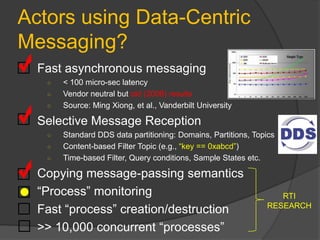
Actors using Data-Centric
Messaging?
  Fast asynchronous messaging
   ○   < 100 micro-sec latency
   ○   Vendor neutral but old (2006) results
   ○   Source: Ming Xiong, et al., Vanderbilt University

  Selective Message Reception
   ○   Standard DDS data partitioning: Domains, Partitions, Topics
   ○   Content-based Filter Topic (e.g., ―key == 0xabcd‖)
   ○   Time-based Filter, Query conditions, Sample States etc.

  Copying message-passing semantics
  ―Process‖ monitoring                                            RTI
  Fast ―process‖ creation/destruction                          RESEARCH

  >> 10,000 concurrent ―processes‖
Middleware Modernization
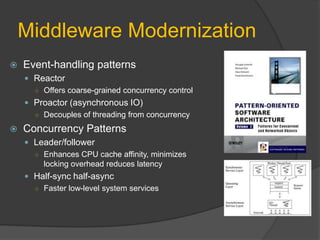
   Event-handling patterns
     Reactor
      ○ Offers coarse-grained concurrency control
     Proactor (asynchronous IO)
      ○ Decouples of threading from concurrency

   Concurrency Patterns
     Leader/follower
      ○ Enhances CPU cache affinity, minimizes
        locking overhead reduces latency
     Half-sync half-async
      ○ Faster low-level system services
Middleware Modernization
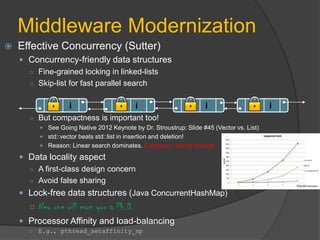
   Effective Concurrency (Sutter)
     Concurrency-friendly data structures
      ○ Fine-grained locking in linked-lists
      ○ Skip-list for fast parallel search


                     i                         i                     i                     i
      ○ But compactness is important too!
           See Going Native 2012 Keynote by Dr. Stroustrup: Slide #45 (Vector vs. List)
           std::vector beats std::list in insertion and deletion!
           Reason: Linear search dominates. Compact = cache-friendly

     Data locality aspect
      ○ A first-class design concern
      ○ Avoid false sharing
     Lock-free data structures (Java ConcurrentHashMap)
      ○ New one will earn you a Ph.D.
     Processor Affinity and load-balancing
      ○   E.g., pthread_setaffinity_np
Concluding Remarks

   Scalable Communication and Scheduling for Many-Core Systems
   Research
     Create a Component Framework for Developing Scalable Many-core
      Applications
     Develop Many-Core Resource Allocation and Scheduling Algorithms
     Investigate Efficient Message-Passing Mechanisms for Component
      Dataflow
     Architect DDS Middleware to Improve Internal Concurrency
Thank you!

Retargeting Embedded Software Stack for Many-Core Systems

  • 2.
    Agenda  What‘s happening in many-core world?  New Challenges  Collaborative Research  Real-Time Innovations (RTI)  University of North Carolina  What we (RTI) do, briefly!  Research: Retargeting embedded software stack for many-core systems  Components  Scalable multi-core Scheduling  Scalable communication  Middleware Modernization
  • 3.
    Single-core  Multi-core Many-Core Interconnect Interconnect Solution Transistor count Interconnect CPU clock speed and power consumption hit a wall circa 2004
  • 4.
    100‘s of coresavailable today
  • 5.
    Applications Domains using Multi-core  Defense  Transportation  Financial trading  Telecommunications  Factory automation  Traffic control  Medical imaging  Simulation 5
  • 6.
    Grand Challenge andPrize  Scalable Applications  Running faster with more cores  Inhibitors  Embedded software stack (OS, m/w, and apps) not designed for more than a handful of cores ○ One core maxed-out others idling! ○ Overuse of communication via shared-memory ○ Severe cache coherence overhead  Advanced techniques known only to experts ○ Programming languages and paradigms  Lack of design and debugging tools
  • 7.
    Trends in concurrent programming (1/7)  Heterogeneous Computing  Instruction Sets  Single ○ In-order, out-of-order  Multiple (heterogeneous) ○ Embedded system-on-chip ○ Combine DSPs, microcontrollers, Source: Herb Sutter, Keynote @ AMD Fusion Developer Summit, 2011 and general-purpose microprocessors  Memory  Uniform cache access  Uniform RAM access  Non-uniform cache access  Non-uniform RAM access  Disjoint RAM
  • 8.
    Trends in concurrent programming (2/7)  Message-passing instead of shared-memory ―Do not communicate by sharing memory. Instead, share memory by communicating. ‖ Source: Andrew Baumann, et. al, Multi-kernel: A new OS – Google Go Documentation architecture for scalable multicore systems, SOSP‘09 (small data, messages sent to a single server)  Costs less than shared-memory  Scales better on many-core ○ Shown up to 80 cores  Easier to verify and debug  Bypass cache coherence  Data locality is very important Source: Silas Boyd-Wickizer, Corey: An Operating System for Many Cores, USENIX 2008
  • 9.
    Trends in concurrent programming (3/7)  Shared-Nothing Partitioning  Data partitioning ○ Single Instruction Multiple Data (SIMD) ○ a.k.a ―sharding‖ in DB circles ○ Matrix multiplication on GPGPU ○ Content-based filters on stock symbols (―IBM‖, ―MSFT‖, ―GOOG‖)
  • 10.
    Trends in concurrent programming(4/7)  Shared-Nothing Partitioning  Functional partitioning ○ E.g., Staged Event Driven Architecture (SEDA) ○ Split an application into an n-stage pipeline ○ Each stage executes concurrently ○ Explicit communication channels between stage  Channels can be monitored for bottlenecks ○ Used in Cassandra, Apache Service Mix, etc.
  • 11.
    Trends in concurrent programming(5/7)  Erlang-Style Concurrency (Actor Model)  Concurrency-Oriented Programming (COP)  Fast asynchronous messaging  Selective message reception  Copying message-passing semantics (share-nothing concurrency)  Process monitoring  Fast process creation/destruction  Ability to support >> 10 000 concurrent processes with largely unchanged characteristics Source: http://ulf.wiger.net
  • 12.
    Trends in concurrent programming(6/7)  Consistency via Safely Shared Resources  Replacing coarse-grained locking with fine- grained locking  Using wait-free primitives  Using cache-conscious algorithms  Exploit application-specific data locality  New programming APIs ○ OpenCL, PPL, AMP, etc.
  • 13.
    Trends in concurrent programming(7/7)  Effective concurrency patterns  Wizardry Instruction Manuals!
  • 14.
    Explicit Multi-threading: Too muchto worry about! 1. The Pillars of Concurrency (Aug 2007) 2. How Much Scalability Do You Have or Need? (Sep 2007) 3. Use Critical Sections (Preferably Locks) to Eliminate Races (Oct 2007) 4. Apply Critical Sections Consistently (Nov 2007) 5. Avoid Calling Unknown Code While Inside a Critical Section (Dec 2007) 6. Use Lock Hierarchies to Avoid Deadlock (Jan 2008) 7. Break Amdahl‘s Law! (Feb 2008) 8. Going Super-linear (Mar 2008) 9. Super Linearity and the Bigger Machine (Apr 2008) 10. Interrupt Politely (May 2008) 11. Maximize Locality, Minimize Contention (Jun 2008) 12. Choose Concurrency-Friendly Data Structures (Jul 2008) 13. The Many Faces of Deadlock (Aug 2008) 14. Lock-Free Code: A False Sense of Security (Sep 2008) 15. Writing Lock-Free Code: A Corrected Queue (Oct 2008) 16. Writing a Generalized Concurrent Queue (Nov 2008) 17. Understanding Parallel Performance (Dec 2008) 18. Measuring Parallel Performance: Optimizing a Concurrent Queue(Jan 2009) 19. volatile vs. volatile (Feb 2009) 20. Sharing Is the Root of All Contention (Mar 2009) 21. Use Threads Correctly = Isolation + Asynchronous Messages (Apr 2009) 22. Use Thread Pools Correctly: Keep Tasks Short and Non-blocking(Apr 2009) 23. Eliminate False Sharing (May 2009) 24. Break Up and Interleave Work to Keep Threads Responsive (Jun 2009) 25. The Power of ―In Progress‖ (Jul 2009) 26. Design for Many-core Systems (Aug 2009) 27. Avoid Exposing Concurrency – Hide It Inside Synchronous Methods (Oct 2009) 28. Prefer structured lifetimes – local, nested, bounded, deterministic(Nov 2009) Source: POSA2: Patterns for Concurrent, Parallel, and 29. Prefer Futures to Baked-In ―Async APIs‖ (Jan 2010) Distributed Systems, Dr. Doug Schmidt 30. Associate Mutexes with Data to Prevent Races (May 2010) 31. Prefer Using Active Objects Instead of Naked Threads (June 2010) 32. Prefer Using Futures or Callbacks to Communicate Asynchronous Results (August 2010) 33. Know When to Use an Active Object Instead of a Mutex (September 2010) Source: Effective Concurrency, Herb Sutter
  • 15.
    Threads are hard! Data race Deadlock Atomicity Violation Order Violation Forgotten Synchronization Incorrect Granularity Two-Step Dance Read and Write Tearing Priority Inversion Lock-Free Reordering Patterns for Achieving Safety Lock Convoys Immutability Purity Isolation Source: MSDN Magazine, Joe Duffy
  • 17.
    Collaborative Research! Prof. James Anderson University of North Carolina Real-Time Innovations IEEE Fellow Sunnyvale, CA
  • 19.
    Integrating Enterprise Systems withEdge Systems Enterprise System Edge System JMS App SQL App Temperature Web-Service Sensor GetTemp GetTemp Temp Temp Temperature Response Request SOAP JMS Adapter Socket Adapter DB Adapter Connector Connector Adapter Connector Connector RTPS Data-Centric Messaging Bus
  • 20.
    Data-Centric Messaging Standards-based API for application developers  Based on DDS Standard (OMG)  DDS = Data Distribution Service Data Distribution  DDS Services  is an API specification RTI Data Distribution Service  for Real-Time Systems Real-time  provides publish-subscribe paradigm publish-subscribe wire protocol  provides quality-of-service tuning  uses interoperable wire protocol (RTPS) Open protocol for interoperability
  • 21.
    DDS Communication Model  Provides a ―Global Data Space‖ that is accessible to all interested applications.  Data objects addressed by Domain, Topic and Key  Subscriptions are decoupled from Publications  Contracts established by means of QoS  Automatic discovery and configuration Participant Participant Pub Pub Track,2 Participant Sub Sub Track,1 Track,3 Global Data Space Participant Pub Participant Alarm Sub
  • 22.
    Data-Centric vs. Message-Centric Design Data-Centric Message-Centric  Infrastructure does  Infrastructure does not understand your data understand your data  What data schema(s) will be  Opaque contents vary from used message to message  Which objects are distinct from  No object identity; messages which other objects indistinguishable  What their lifecycles are  Ad-hoc lifecycle management  How to attach behavior (e.g.  Behaviors can only apply to filters, QoS) to individual whole data stream objects  Example technologies  Example technologies  JMS API  DDS API  AMQP protocol  RTPS (DDSI) protocol
  • 23.
    Re-enabling the FreeLunch, Easily!  Positioning applications to run faster on machines with more cores—enabling the free lunch!  Three Pillars of Concurrency  Coarse-grained parallelism (functional partitioning)  Fine-grained parallelism (running a ‗for‘ loop in parallel)  Reducing the cost of resource sharing (improved locking)
  • 24.
    Scalable Communication andScheduling for Many-Core Systems  Objectives  Create a Component Framework for Developing Scalable Many-core Applications  Develop Many-Core Resource Allocation and Scheduling Algorithms  Investigate Efficient Message-Passing Mechanisms for Component Dataflow  Architect DDS Middleware to Improve Internal Concurrency  Demonstrate ideas using a prototype
  • 25.
    Component-based Software Engineering C C  Facilitate Separation of Concerns  Functional partitioning to enable MIMD-style parallelism  Manage resource allocation and scheduling algorithms  Ease of application lifecycle management  Component-based Design  Naturally aligned with functional partitioning (pipeline)  Components are modular, cohesive, loosely coupled, and independently deployable
  • 26.
    Component-based Software Engineering C  Message passing communication C C  Isolation of state C  Shared-nothing concurrency  Ease of validation  Lifecycle management  Application design Transformation  Deployment  Resource allocation  Scheduling  Deployment and Configuration  Placement based on data-flow dependencies  Cache-conscious placement on cores Formal Models
  • 27.
    Scheduling Algorithms for Many-core  Academic Research Partner  Real-Time Systems Group, Prof. James Anderson  University of North Carolina, Chapel Hill  Processing Graph Method (PGM)  Clustered scheduling on many-core G1 N nodes G2 G3 to M cores G4 G5 N nodes to G6 M cores G7 Tilera TILEPro64 Multi-core Processor. Source: Tilera.com
  • 28.
    Scheduling Algorithms for Many-cores  Key requirements  Efficiently utilizing the processing capacity within each cluster  Minimizing data movement across clusters  Exploit data locality  A many-core Processor  An on-chip distributed system!  Cores are addressable  Send messages to other cores directly  On-chip networks (interconnect) ○ MIT RAW = 4 networks ○ Tilera iMesh = 6 networks ○ On chip switches, routing algorithms, packet switching, multicast!, deadlock prevention E.g., Tilera iMesh Architecture. Source: Tilera.com  Sending messages to distant core takes longer
  • 29.
    Message-passing over shared-memory  Two key issues  Performance  Correctness  Performance  Shared-memory does not scale on many-core  Full chip cache coherence is expensive  Too much power  Too much bandwidth  Not all cores need to see the update ○ Data stalls reduce performance Source: Ph.D. defense: Natalie Enright Jerger
  • 30.
    Message-passing over shared-memory  Correctness  Hard to achieve in explicit threading (even in task-based libraries)  Lock-based programs are not composable ―Perhaps the most fundamental objection [...] is that lock-based programs do not compose: correct fragments may fail when combined. For example, consider a hash table with thread-safe insert and delete operations. Now suppose that we want to delete one item A from table t1, and insert it into table t2; but the intermediate state (in which neither table contains the item) must not be visible to other threads. Unless the implementer of the hash table anticipates this need, there is simply no way to satisfy this requirement. [...] In short, operations that are individually correct (insert, delete) cannot be composed into larger correct operations.‖ —Tim Harris et al., "Composable Memory Transactions", Section 2: Background, pg.2  Message-passing  Composable  Easy to verify and debug  Observe in/out messages only
  • 31.
  • 32.
    Core-Interconnect Transport for DDS  RTI DDS Supports many transports for messaging  UDP, TCP, Shared-memory, Zero-copy, etc  In future: a ―core-interconnect transport‖!!  Tilera provides Tilera Multicore Components (TMC) library  Higher-level library for MIT RAW in progress
  • 33.
    Erlang-Style Concurrency: A Panacea?  Actor Model  OO programming of the concurrency world  Concurrency-Oriented Programming (COP)  Fast asynchronous messaging  Selective message reception  Copying message-passing semantics (share-nothing concurrency)  Process monitoring  Fast process creation/destruction  Ability to support >> 10 000 concurrent processes with largely unchanged characteristics Source: http://ulf.wiger.net
  • 34.
    Actors using Data-Centric Messaging? Fast asynchronous messaging ○ < 100 micro-sec latency ○ Vendor neutral but old (2006) results ○ Source: Ming Xiong, et al., Vanderbilt University Selective Message Reception ○ Standard DDS data partitioning: Domains, Partitions, Topics ○ Content-based Filter Topic (e.g., ―key == 0xabcd‖) ○ Time-based Filter, Query conditions, Sample States etc. Copying message-passing semantics ―Process‖ monitoring RTI Fast ―process‖ creation/destruction RESEARCH >> 10,000 concurrent ―processes‖
  • 35.
    Middleware Modernization  Event-handling patterns  Reactor ○ Offers coarse-grained concurrency control  Proactor (asynchronous IO) ○ Decouples of threading from concurrency  Concurrency Patterns  Leader/follower ○ Enhances CPU cache affinity, minimizes locking overhead reduces latency  Half-sync half-async ○ Faster low-level system services
  • 36.
    Middleware Modernization  Effective Concurrency (Sutter)  Concurrency-friendly data structures ○ Fine-grained locking in linked-lists ○ Skip-list for fast parallel search i i i i ○ But compactness is important too!  See Going Native 2012 Keynote by Dr. Stroustrup: Slide #45 (Vector vs. List)  std::vector beats std::list in insertion and deletion!  Reason: Linear search dominates. Compact = cache-friendly  Data locality aspect ○ A first-class design concern ○ Avoid false sharing  Lock-free data structures (Java ConcurrentHashMap) ○ New one will earn you a Ph.D.  Processor Affinity and load-balancing ○ E.g., pthread_setaffinity_np
  • 37.
    Concluding Remarks  Scalable Communication and Scheduling for Many-Core Systems  Research  Create a Component Framework for Developing Scalable Many-core Applications  Develop Many-Core Resource Allocation and Scheduling Algorithms  Investigate Efficient Message-Passing Mechanisms for Component Dataflow  Architect DDS Middleware to Improve Internal Concurrency
  • 38.