DISSEMINATION OF
DATA
Dr. Madhura Mukadam
Associate Professor,
Dept. of Zoology,
Gogate Jogalekar College, Ratnagiri
Dt. 21.12.2019
• Process of spreading the findings obtained
from research study.
• This technique is used for the purpose are:
Publication in peer reviewed journals
Dissertation
Thesis
Report
Oral presentation
Poster presentation
Application of knowledge gained by research
1) Basic Research:
curiosity driven.
foundation for applied research
exploratory, descriptive or explanatory
type of research
Innovations in different fields.
2) Applied Research:
development of technology and techniques
Addresses problems. Formulates hypothesis, collects
data, analyses and interprets the same for specifying
alternatives.
Also called as decisional research and has commercial
potential
• Applied Research is of 2 types :
1) Problem solving research
specific issue or problem in any field
2) Problem oriented research
focussed on problems faced in general by a
larger community.
3) Translational research
the main objective is to translate findings in
fundamental research into medical practice. This
is relatively new field of research which integrates
basic science and clinical research.
Scientific writing
‘7 c’s Rule ( Mary Jaspers, 2007)
Clear
Correct
Complete
Concise
Conformable
Consistent
Components of a Research paper
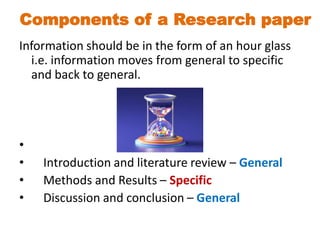
Information should be in the form of an hour glass
i.e. information moves from general to specific
and back to general.
•
• Introduction and literature review – General
• Methods and Results – Specific
• Discussion and conclusion – General
1) Title :
• 10-12 words long, descriptive terms and
phrases
• keep it simple, brief and attractive with use of
active verbs instead of noun based complex
phrases.
• use appropriate descriptive words which may
be used as key words by readers
• Avoid abbreviations and jargon
2) Authors and their affiliations :
• Includes names and addresses of all authors and date of
submission.
• The person who writes the manuscript and has
contributed the maximum to the research is considered
as the first author. Most important position.
• The second important position is the last person in the
list. This is the position of name of the guide, boss or the
person who gave the idea and funds for the project.
• Name and addresses of the institute where the author
works and their e mail addresses.
3. Abstract :
• This is the concise single paragraph summary of the
work enabling the reader to comprehend the
underlying principles behind the study, the general
methodology used in the study, relevant results and
important inferences and new questions.
• 200-300 words.
• Different types : Descriptive, Informative
Structured
• Purpose of study, brief description of methodology,
results or statistical analysis and important conclusions.
• Should be written in past tense.
• Background information should be limited to one or
two sentences.
• Focus should be on summarization of results.
4. Key words and abbreviations :
• Key word is a descriptive used as a reference point for
finding other words or information.
• Should reflect the specificity of the paper
• It should include all essential words from the title and
abstract .
• Additional key words from the txt can be added if one feels
that they are relevant.
• All key words should be written in lower cases except
abbreviations and proper names and should be separated
by semi colons and end in a full stop.
• No. of key words could range from 5-8.
• Avoid uncommon abbreviations.
5. Introduction:
• A good introduction should be tripartite i.e. comprised of three
parts- a general presentation of the problem, followed by the
precise plan of the project and stating of one’s own objective.
• Begin with solid opening sentence, which rouses the interest of
the readers.
• Second part needs to have a lucid, focused statement which
argues about the research topic and should be supported by the
evidences presented in the paper.
• Justification and need to investigate the particular topic should
be highlighted.
• Past tense should be used to refer to established facts since the
paper will be submitted only after the completion of the work.
6. Materials and Methods :
• Exact design and methodology
• Should include information regarding special
chemicals, instruments etc.
• Detail procedure should be given if special
methods are used.
7. Results:
• most variable part of research paper
• presentation of numerical data
• Inclusion of tables and graphs of the analyzed
data is desirable.
• Explanation regarding results together.
8. Discussion
• Elaboration and explanation of the findings by relevant
literature review
• Link the discussion back to introduction.
• the topic can be expanded in the conclusion in line with
the hour glass principle.
9. Conclusion:
• may be restricted to one or two paragraphs.
• recommendations for future directions that the research
could take and suggestions of improvements to be made in
the research design emphasizing the influence of any faults
on the results can also be made.
10. Acknowledgement
to express gratitude to all people who have helped
with the project.
11. Bibliography
Research paper is incomplete without the list of
references.
12. Tables and figures.

Dissemination of data.pptx

  • 1.
    DISSEMINATION OF DATA Dr. MadhuraMukadam Associate Professor, Dept. of Zoology, Gogate Jogalekar College, Ratnagiri Dt. 21.12.2019
  • 2.
    • Process ofspreading the findings obtained from research study. • This technique is used for the purpose are: Publication in peer reviewed journals Dissertation Thesis Report Oral presentation Poster presentation
  • 3.
    Application of knowledgegained by research 1) Basic Research: curiosity driven. foundation for applied research exploratory, descriptive or explanatory type of research Innovations in different fields. 2) Applied Research: development of technology and techniques Addresses problems. Formulates hypothesis, collects data, analyses and interprets the same for specifying alternatives. Also called as decisional research and has commercial potential
  • 4.
    • Applied Researchis of 2 types : 1) Problem solving research specific issue or problem in any field 2) Problem oriented research focussed on problems faced in general by a larger community. 3) Translational research the main objective is to translate findings in fundamental research into medical practice. This is relatively new field of research which integrates basic science and clinical research.
  • 5.
    Scientific writing ‘7 c’sRule ( Mary Jaspers, 2007) Clear Correct Complete Concise Conformable Consistent
  • 6.
    Components of aResearch paper Information should be in the form of an hour glass i.e. information moves from general to specific and back to general. • • Introduction and literature review – General • Methods and Results – Specific • Discussion and conclusion – General
  • 7.
    1) Title : •10-12 words long, descriptive terms and phrases • keep it simple, brief and attractive with use of active verbs instead of noun based complex phrases. • use appropriate descriptive words which may be used as key words by readers • Avoid abbreviations and jargon
  • 8.
    2) Authors andtheir affiliations : • Includes names and addresses of all authors and date of submission. • The person who writes the manuscript and has contributed the maximum to the research is considered as the first author. Most important position. • The second important position is the last person in the list. This is the position of name of the guide, boss or the person who gave the idea and funds for the project. • Name and addresses of the institute where the author works and their e mail addresses.
  • 9.
    3. Abstract : •This is the concise single paragraph summary of the work enabling the reader to comprehend the underlying principles behind the study, the general methodology used in the study, relevant results and important inferences and new questions. • 200-300 words. • Different types : Descriptive, Informative Structured • Purpose of study, brief description of methodology, results or statistical analysis and important conclusions. • Should be written in past tense. • Background information should be limited to one or two sentences. • Focus should be on summarization of results.
  • 10.
    4. Key wordsand abbreviations : • Key word is a descriptive used as a reference point for finding other words or information. • Should reflect the specificity of the paper • It should include all essential words from the title and abstract . • Additional key words from the txt can be added if one feels that they are relevant. • All key words should be written in lower cases except abbreviations and proper names and should be separated by semi colons and end in a full stop. • No. of key words could range from 5-8. • Avoid uncommon abbreviations.
  • 11.
    5. Introduction: • Agood introduction should be tripartite i.e. comprised of three parts- a general presentation of the problem, followed by the precise plan of the project and stating of one’s own objective. • Begin with solid opening sentence, which rouses the interest of the readers. • Second part needs to have a lucid, focused statement which argues about the research topic and should be supported by the evidences presented in the paper. • Justification and need to investigate the particular topic should be highlighted. • Past tense should be used to refer to established facts since the paper will be submitted only after the completion of the work.
  • 12.
    6. Materials andMethods : • Exact design and methodology • Should include information regarding special chemicals, instruments etc. • Detail procedure should be given if special methods are used.
  • 13.
    7. Results: • mostvariable part of research paper • presentation of numerical data • Inclusion of tables and graphs of the analyzed data is desirable. • Explanation regarding results together.
  • 14.
    8. Discussion • Elaborationand explanation of the findings by relevant literature review • Link the discussion back to introduction. • the topic can be expanded in the conclusion in line with the hour glass principle. 9. Conclusion: • may be restricted to one or two paragraphs. • recommendations for future directions that the research could take and suggestions of improvements to be made in the research design emphasizing the influence of any faults on the results can also be made.
  • 15.
    10. Acknowledgement to expressgratitude to all people who have helped with the project. 11. Bibliography Research paper is incomplete without the list of references. 12. Tables and figures.