Dr A K Bhartiya
Department of Social Work
University of Lucknow
Email: bhartiya.ak@gmail.com
A research report is a precise
presentation of the work done by a
researcher while investigating a
particular problem and whether the
study is conducted by an individual
researcher or by an Institution.
The findings of the study should be reported for
several reasons. These are :-
 People learn more about the area of study,
 The discipline gets enriched with new
knowledge and theories,
 Researcher and practitioners in the field can
apply, test and retest the findings already
arrived it,
 Other researchers can refer to the findings and
utilize the findings for further research,
 Findings can be utilized and implemented by
the policy makers or those who had sponsored
the project.
The entire research report is mainly divided
into three major divisions :-
 The Beginning,
 The Main Body, and
 The End
 Cover or Title Page
 Second Cover
 Preface
 Acknowledgement
 Contents
 List of Tables
 List of Figures
 Glossary
 List of Abbriviations
 Introduction
 Review of Literature
 Design of the Study
 Analysis and Interpretation of Data
 Main Findings and Conclusion
 Summary
 Bibliography and References
 Appendices
 Title of the Topic,
 Relationship of the Report to a Degree, Course,
or Organizational Requirement,
 Name of Researcher,
 Name of Supervisor,
 Name of the Institution where the report is
submitted, and
 The Date of Submission
Awareness of Urban Couples About Female
Foeticide : A Social Work Intervention Study
Sponsored by:
Ministry of Social Justice and Empowerment
Director
Dr A K Bhartiya
Asst Professor
Department of Social Work
University of Lucknow
December, 2013
A Preface should include the reason why the topic
was selected by the researcher. It may explain
the history, scope, methodology and the
researcher’s opinion about the study.
The Preface and acknowledgement can be in
continuation or written separately. This page
follows the inner title page. It records
acknowledgement with sincerity for the
unusual help received form other to conduct
the study. The acknowledgement should be
non-emotional and simple.
A table of content indicates the logical division of
the report into various sections and
subsections. In other word, the table of contents
presents in itemized form, the beginning, the
main body and the end of the report. It should
also indicate the page reference for each
chapter or section and sub-section on the right
hand side of the table.
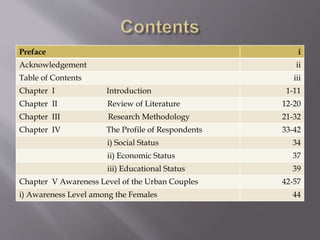
Preface i
Acknowledgement ii
Table of Contents iii
Chapter I Introduction 1-11
Chapter II Review of Literature 12-20
Chapter III Research Methodology 21-32
Chapter IV The Profile of Respondents 33-42
i) Social Status 34
ii) Economic Status 37
iii) Educational Status 39
Chapter V Awareness Level of the Urban Couples 42-57
i) Awareness Level among the Females 44
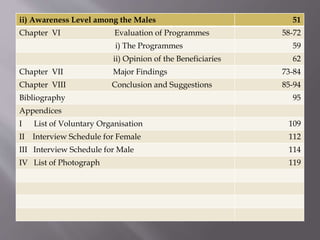
ii) Awareness Level among the Males 51
Chapter VI Evaluation of Programmes 58-72
i) The Programmes 59
ii) Opinion of the Beneficiaries 62
Chapter VII Major Findings 73-84
Chapter VIII Conclusion and Suggestions 85-94
Bibliography 95
Appendices
I List of Voluntary Organisation 109
II Interview Schedule for Female 112
III Interview Schedule for Male 114
IV List of Photograph 119
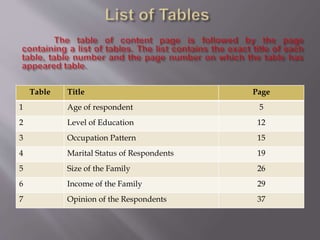
Table Title Page
1 Age of respondent 5
2 Level of Education 12
3 Occupation Pattern 15
4 Marital Status of Respondents 19
5 Size of the Family 26
6 Income of the Family 29
7 Opinion of the Respondents 37
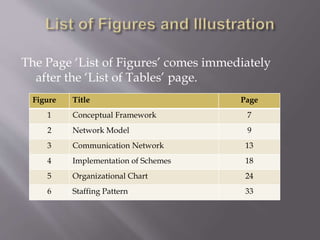
The Page ‘List of Figures’ comes immediately
after the ‘List of Tables’ page.
Figure Title Page
1 Conceptual Framework 7
2 Network Model 9
3 Communication Network 13
4 Implementation of Schemes 18
5 Organizational Chart 24
6 Staffing Pattern 33
A Glossary is a short dictionary, explaining the
technical terms and phrases which are used
with special connotation by the author. Entries
of the technical termed are made in
alphabetical order. A Glossary may appear in
the introductory pages although it usually
comes after the bibliography.
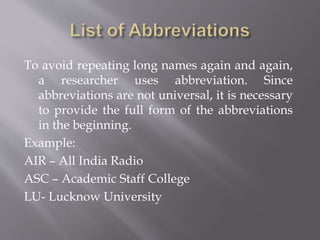
To avoid repeating long names again and again,
a researcher uses abbreviation. Since
abbreviations are not universal, it is necessary
to provide the full form of the abbreviations
in the beginning.
Example:
AIR – All India Radio
ASC – Academic Staff College
LU- Lucknow University
The report should be very concise, unambiguous, and
creatively presented. The presentation should be
simple, direct and in short sentences.
In the case of citations, only the last name of the author is
used and in all cases academic and allied titles like Dr.,
Prof., Mr., Mrs., etc. should be avoided.
Special care should be taken while using quantitative
terms in a report. No sentences should begin with
numerical like ‘20 students’, instead should start as
“Twenty students’. Commas should be used when
numbers exceed three digits- 10,233 or 468,798.
Language, grammar and usage are very important in
research report.
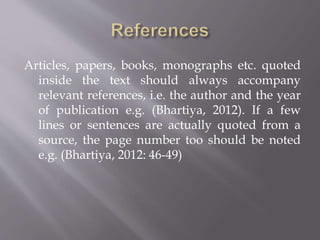
Articles, papers, books, monographs etc. quoted
inside the text should always accompany
relevant references, i.e. the author and the year
of publication e.g. (Bhartiya, 2012). If a few
lines or sentences are actually quoted from a
source, the page number too should be noted
e.g. (Bhartiya, 2012: 46-49)
List of some important Abbreviations used in
Footnotes and Bibliography.
Research reports present both bibliographies and
references.
A Bibliography is a list of titles- books, research
reports, articles, etc. that may or may not have
been referred to in the text of the research
report.
References include only such studies, books or
papers that have been actually referred to in
the text of the research report.
There are mainly two style manuals detailing
general form and style for research reports.
Thee are: -
 American Psychological Association,
Publication Manual, 3rd ed. Washington DC:
American Psychological Association, 1983.
 The Chicago Manual of Style, 13th rev. ed.,
Chicago University of Chicago Press, 1982.
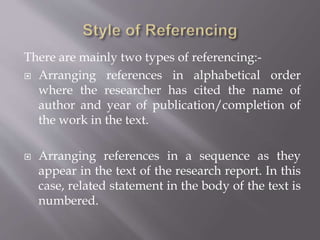
There are mainly two types of referencing:-
 Arranging references in alphabetical order
where the researcher has cited the name of
author and year of publication/completion of
the work in the text.
 Arranging references in a sequence as they
appear in the text of the research report. In this
case, related statement in the body of the text is
numbered.
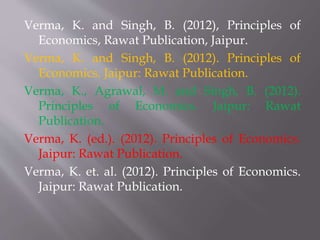
Verma, K. and Singh, B. (2012), Principles of
Economics, Rawat Publication, Jaipur.
Verma, K. and Singh, B. (2012). Principles of
Economics. Jaipur: Rawat Publication.
Verma, K., Agrawal, M. and Singh, B. (2012).
Principles of Economics. Jaipur: Rawat
Publication.
Verma, K. (ed.). (2012). Principles of Economics.
Jaipur: Rawat Publication.
Verma, K. et. al. (2012). Principles of Economics.
Jaipur: Rawat Publication.
Appendices present the raw data, the true copy of
the tools used in the study, important statistical
calculation, photographs and charts not used
inside the text. These are serially like Appendix
1, Appendix 2, Appendix 3, or Appendix I,
Appendix II, Appendix III, or Appendix A,
Appendix B, Appendix C.
A Research / Report Writing

A Research / Report Writing

  • 1.
    Dr A KBhartiya Department of Social Work University of Lucknow Email: bhartiya.ak@gmail.com
  • 2.
    A research reportis a precise presentation of the work done by a researcher while investigating a particular problem and whether the study is conducted by an individual researcher or by an Institution.
  • 3.
    The findings ofthe study should be reported for several reasons. These are :-  People learn more about the area of study,  The discipline gets enriched with new knowledge and theories,  Researcher and practitioners in the field can apply, test and retest the findings already arrived it,  Other researchers can refer to the findings and utilize the findings for further research,  Findings can be utilized and implemented by the policy makers or those who had sponsored the project.
  • 4.
    The entire researchreport is mainly divided into three major divisions :-  The Beginning,  The Main Body, and  The End
  • 5.
     Cover orTitle Page  Second Cover  Preface  Acknowledgement  Contents  List of Tables  List of Figures  Glossary  List of Abbriviations
  • 6.
     Introduction  Reviewof Literature  Design of the Study  Analysis and Interpretation of Data  Main Findings and Conclusion  Summary
  • 7.
     Bibliography andReferences  Appendices
  • 8.
     Title ofthe Topic,  Relationship of the Report to a Degree, Course, or Organizational Requirement,  Name of Researcher,  Name of Supervisor,  Name of the Institution where the report is submitted, and  The Date of Submission
  • 9.
    Awareness of UrbanCouples About Female Foeticide : A Social Work Intervention Study Sponsored by: Ministry of Social Justice and Empowerment Director Dr A K Bhartiya Asst Professor Department of Social Work University of Lucknow December, 2013
  • 10.
    A Preface shouldinclude the reason why the topic was selected by the researcher. It may explain the history, scope, methodology and the researcher’s opinion about the study. The Preface and acknowledgement can be in continuation or written separately. This page follows the inner title page. It records acknowledgement with sincerity for the unusual help received form other to conduct the study. The acknowledgement should be non-emotional and simple.
  • 11.
    A table ofcontent indicates the logical division of the report into various sections and subsections. In other word, the table of contents presents in itemized form, the beginning, the main body and the end of the report. It should also indicate the page reference for each chapter or section and sub-section on the right hand side of the table.
  • 12.
    Preface i Acknowledgement ii Tableof Contents iii Chapter I Introduction 1-11 Chapter II Review of Literature 12-20 Chapter III Research Methodology 21-32 Chapter IV The Profile of Respondents 33-42 i) Social Status 34 ii) Economic Status 37 iii) Educational Status 39 Chapter V Awareness Level of the Urban Couples 42-57 i) Awareness Level among the Females 44
  • 13.
    ii) Awareness Levelamong the Males 51 Chapter VI Evaluation of Programmes 58-72 i) The Programmes 59 ii) Opinion of the Beneficiaries 62 Chapter VII Major Findings 73-84 Chapter VIII Conclusion and Suggestions 85-94 Bibliography 95 Appendices I List of Voluntary Organisation 109 II Interview Schedule for Female 112 III Interview Schedule for Male 114 IV List of Photograph 119
  • 14.
    Table Title Page 1Age of respondent 5 2 Level of Education 12 3 Occupation Pattern 15 4 Marital Status of Respondents 19 5 Size of the Family 26 6 Income of the Family 29 7 Opinion of the Respondents 37
  • 15.
    The Page ‘Listof Figures’ comes immediately after the ‘List of Tables’ page. Figure Title Page 1 Conceptual Framework 7 2 Network Model 9 3 Communication Network 13 4 Implementation of Schemes 18 5 Organizational Chart 24 6 Staffing Pattern 33
  • 16.
    A Glossary isa short dictionary, explaining the technical terms and phrases which are used with special connotation by the author. Entries of the technical termed are made in alphabetical order. A Glossary may appear in the introductory pages although it usually comes after the bibliography.
  • 17.
    To avoid repeatinglong names again and again, a researcher uses abbreviation. Since abbreviations are not universal, it is necessary to provide the full form of the abbreviations in the beginning. Example: AIR – All India Radio ASC – Academic Staff College LU- Lucknow University
  • 18.
    The report shouldbe very concise, unambiguous, and creatively presented. The presentation should be simple, direct and in short sentences. In the case of citations, only the last name of the author is used and in all cases academic and allied titles like Dr., Prof., Mr., Mrs., etc. should be avoided. Special care should be taken while using quantitative terms in a report. No sentences should begin with numerical like ‘20 students’, instead should start as “Twenty students’. Commas should be used when numbers exceed three digits- 10,233 or 468,798. Language, grammar and usage are very important in research report.
  • 19.
    Articles, papers, books,monographs etc. quoted inside the text should always accompany relevant references, i.e. the author and the year of publication e.g. (Bhartiya, 2012). If a few lines or sentences are actually quoted from a source, the page number too should be noted e.g. (Bhartiya, 2012: 46-49)
  • 20.
    List of someimportant Abbreviations used in Footnotes and Bibliography.
  • 21.
    Research reports presentboth bibliographies and references. A Bibliography is a list of titles- books, research reports, articles, etc. that may or may not have been referred to in the text of the research report. References include only such studies, books or papers that have been actually referred to in the text of the research report.
  • 22.
    There are mainlytwo style manuals detailing general form and style for research reports. Thee are: -  American Psychological Association, Publication Manual, 3rd ed. Washington DC: American Psychological Association, 1983.  The Chicago Manual of Style, 13th rev. ed., Chicago University of Chicago Press, 1982.
  • 23.
    There are mainlytwo types of referencing:-  Arranging references in alphabetical order where the researcher has cited the name of author and year of publication/completion of the work in the text.  Arranging references in a sequence as they appear in the text of the research report. In this case, related statement in the body of the text is numbered.
  • 24.
    Verma, K. andSingh, B. (2012), Principles of Economics, Rawat Publication, Jaipur. Verma, K. and Singh, B. (2012). Principles of Economics. Jaipur: Rawat Publication. Verma, K., Agrawal, M. and Singh, B. (2012). Principles of Economics. Jaipur: Rawat Publication. Verma, K. (ed.). (2012). Principles of Economics. Jaipur: Rawat Publication. Verma, K. et. al. (2012). Principles of Economics. Jaipur: Rawat Publication.
  • 25.
    Appendices present theraw data, the true copy of the tools used in the study, important statistical calculation, photographs and charts not used inside the text. These are serially like Appendix 1, Appendix 2, Appendix 3, or Appendix I, Appendix II, Appendix III, or Appendix A, Appendix B, Appendix C.