Dissection of frog/toad
By
Wodrick Philemon Bukuku
Dip. ED, BSc ED (Biol & Chem), MSc BC
Sunday, July 28, 2019 Msalato Girls Secondary School 1
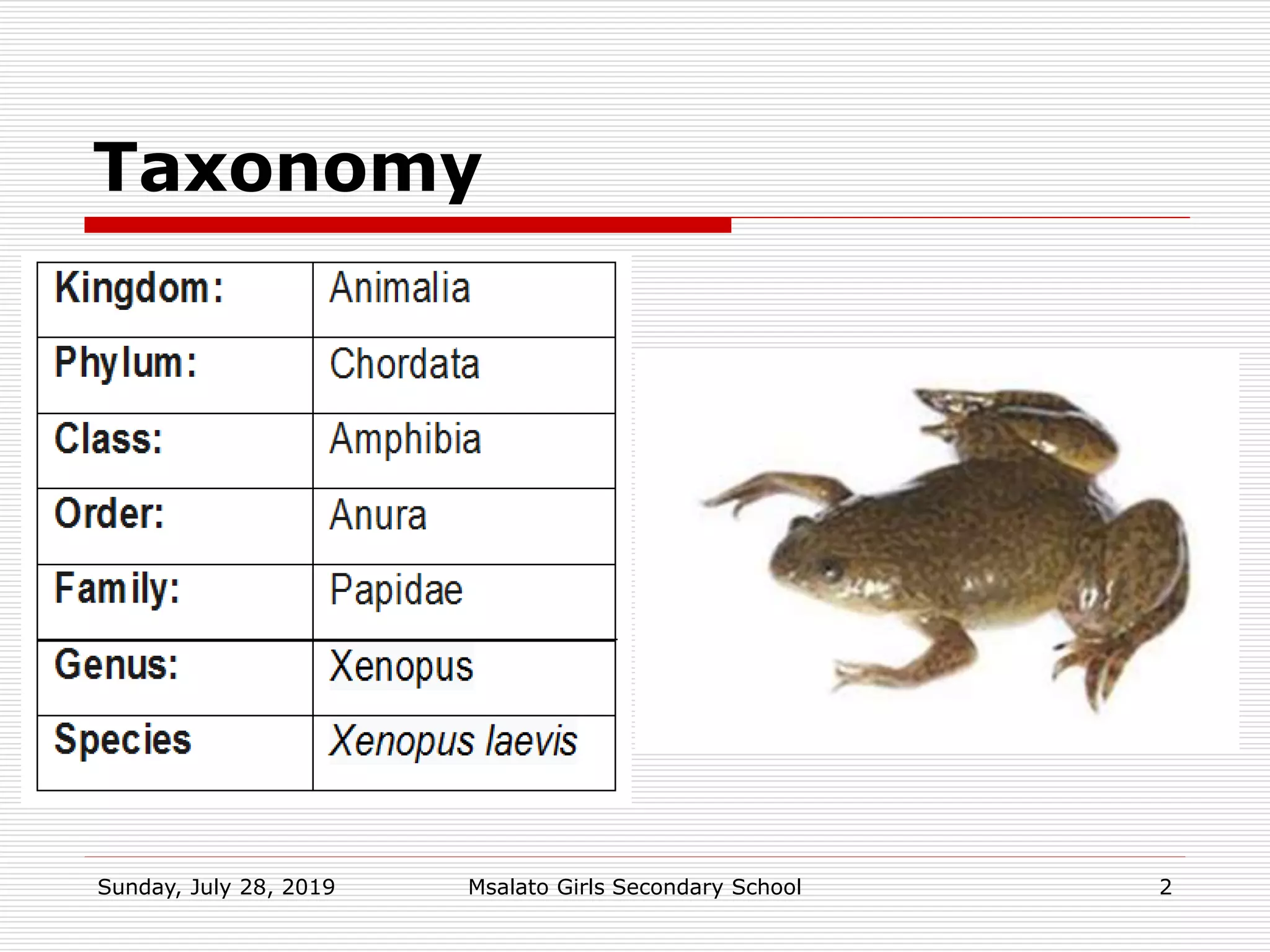
Taxonomy
Sunday, July 28, 2019 Msalato Girls Secondary School 2
External features that distinguish
male and female frogs:
a)The male Frogs
 Males are smaller than females of the
same species.
 Males are more vocal than females,
especially during the mating season.
 The male cloaca is less visible to the
exterior than the female cloaca
 Males are usually brighter than
females in colourations
Sunday, July 28, 2019 Msalato Girls Secondary School 3
 The forelegs are thicker in males than
in females
 Males have nuptial pads
b) The female frogs
 The female cloaca is more visible to
the exterior than the male cloaca.
 The females frogs are less brighter
than males in colourations.
 The forelegs are thinner in females
than in males.
 The Male frogs have nuptial pads but
not the females.
Sunday, July 28, 2019 Msalato Girls Secondary School 4
Internal features that distinguish
male and female frogs:
a) In the male frogs
 presence of the male reproductive
system which consists of the
testicles in which sperms are
produced sperms
Sunday, July 28, 2019 Msalato Girls Secondary School 5
b) Female Frogs
 Presence of the ovaries and oviduct
 The external opening of the
reproductive system is the cloaca,
which can be easily observed at the
underside of the female.
Sunday, July 28, 2019 Msalato Girls Secondary School 6
Adaptation of the frogs in its
habitat
1. They have a double life i.e. live on
land (terrestrial) and water
 Frogs start their lives as aquatic
tadpoles with gills to breathe. As
tadpoles grow into frogs, lungs
replace the gills and allow frogs to
breathe on land
2. Frogs have webbed feet that allow
them to move through the water
more efficiently.Sunday, July 28, 2019 Msalato Girls Secondary School 7
3. Their strong hind legs help them to
swim and leap more efficiently.
4. They have excellent vision to allow
them to see in poor conditions, such
as muddy water and night time
5. A frog's skin is covered with
protective mucus to keep it from
drying out.
6. They undergo incomplete
metamorphosis, this help them to
avoid competition for resources with
other animal species
Sunday, July 28, 2019 Msalato Girls Secondary School 8
7. Their skin possess poisonous glands
to defend themselves against
predator
8. The female lay a large number of
eggs which are fertilized male’s
sperm during breeding seasons to
ensure their survival
Sunday, July 28, 2019 Msalato Girls Secondary School 9
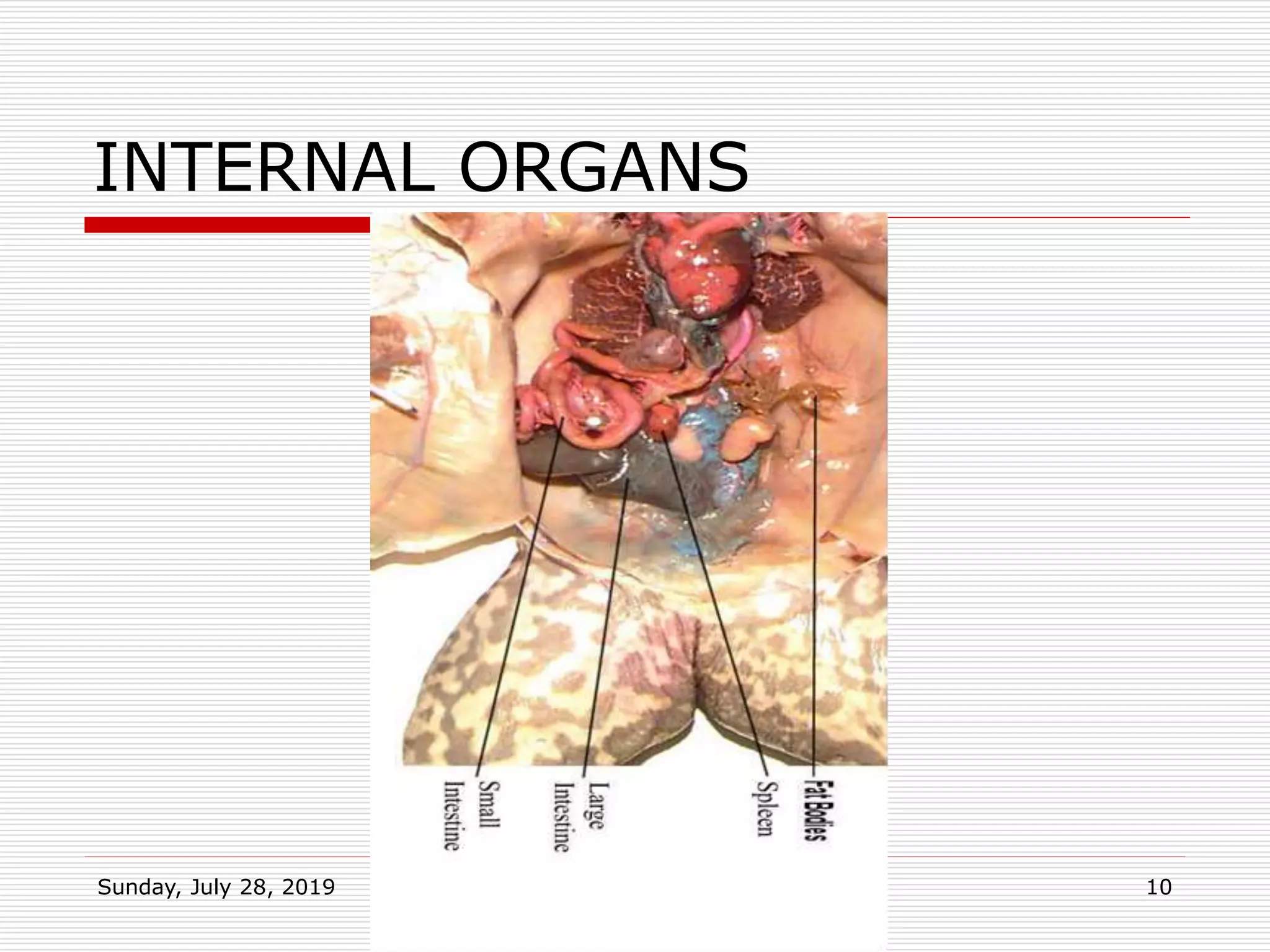
INTERNAL ORGANS
Sunday, July 28, 2019 Msalato Girls Secondary School 10
Functions of the Internal
organs of a frog:
1. Stomach
 Stores food and mixes it with
enzymes to begin digestion.
2. Small Intestine
 This is the principal organ of digestion
and absorption of digested food.
Sunday, July 28, 2019 Msalato Girls Secondary School 11
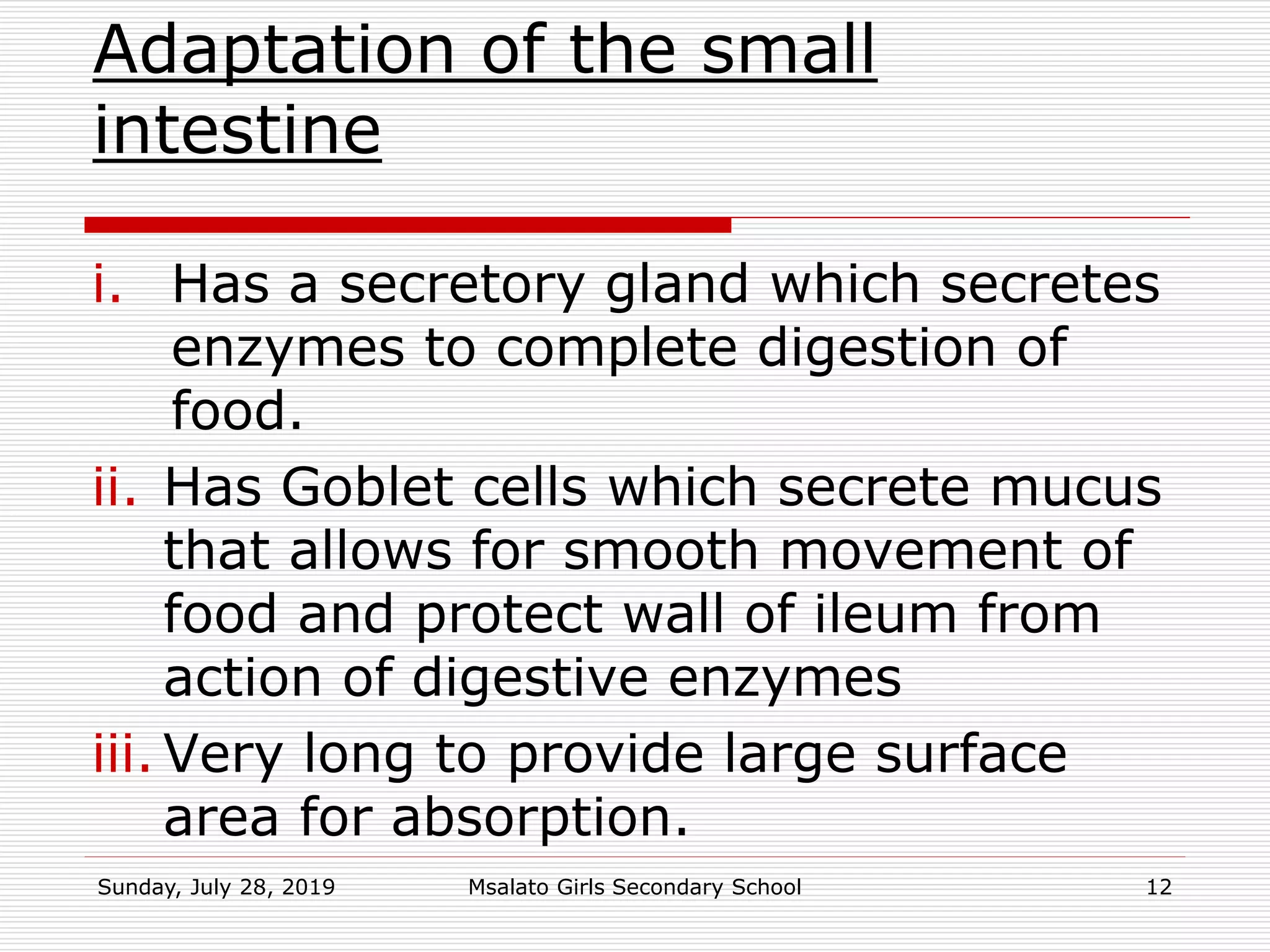
Adaptation of the small
intestine
i. Has a secretory gland which secretes
enzymes to complete digestion of
food.
ii. Has Goblet cells which secrete mucus
that allows for smooth movement of
food and protect wall of ileum from
action of digestive enzymes
iii. Very long to provide large surface
area for absorption.
Sunday, July 28, 2019 Msalato Girls Secondary School 12
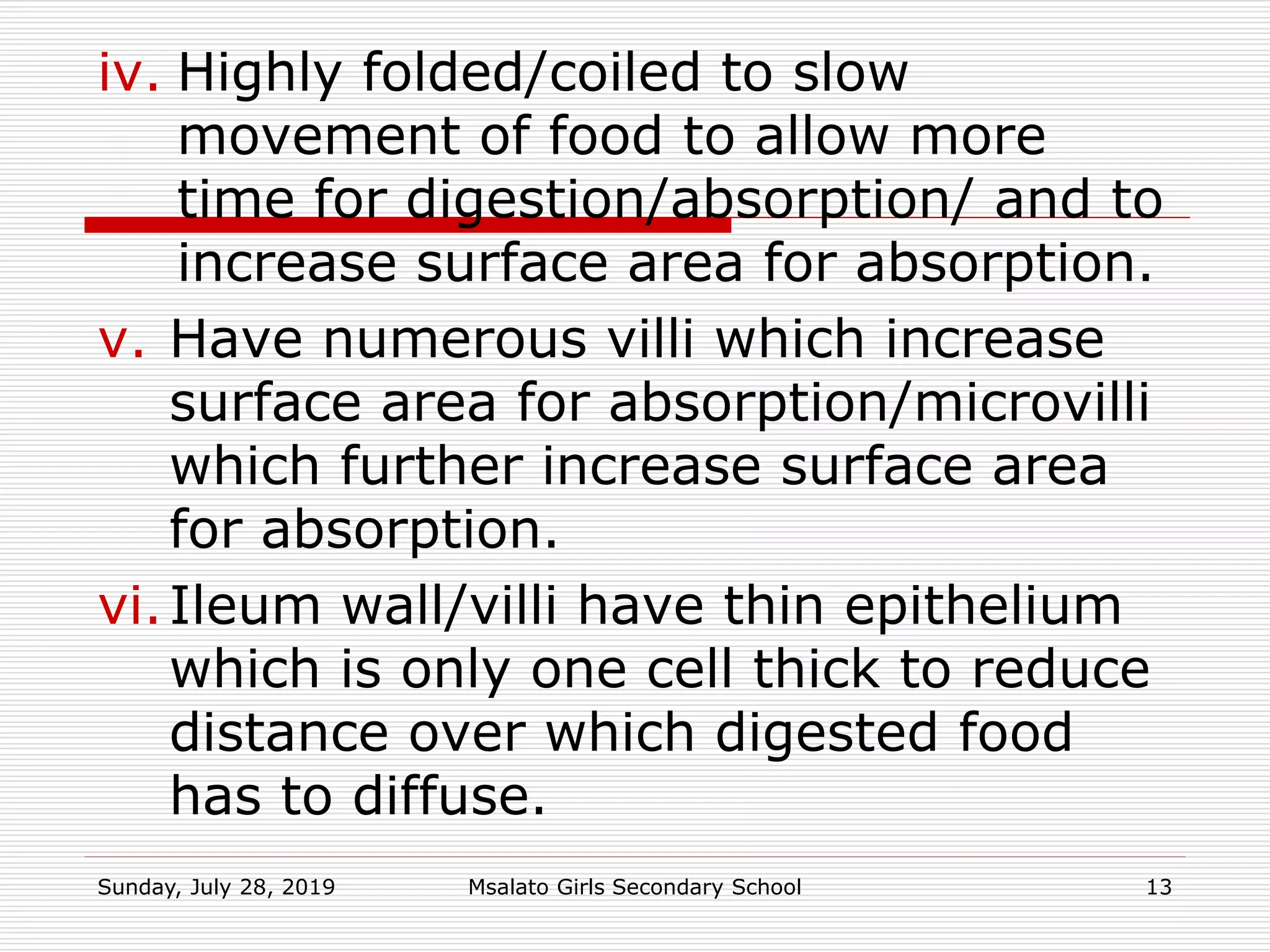
iv. Highly folded/coiled to slow
movement of food to allow more
time for digestion/absorption/ and to
increase surface area for absorption.
v. Have numerous villi which increase
surface area for absorption/microvilli
which further increase surface area
for absorption.
vi.Ileum wall/villi have thin epithelium
which is only one cell thick to reduce
distance over which digested food
has to diffuse.
Sunday, July 28, 2019 Msalato Girls Secondary School 13
iv. Villi are highly vascularised/have a
rich network of blood capillaries for
rapid transport from small intestines
and maintain a steep concentration
gradient for rapid absorption.
v. Villi have lacteals for absorption of
fatty acids and glycerol
vi.Cells of ileum wall have a large count
of mitochondria to release energy for
active uptake of some food
substances across the epithelium.
Sunday, July 28, 2019 Msalato Girls Secondary School 14
3. Duodenum;
 This is the anterior (front) part of the
small intestine into which food passes
from the stomach
4. Pancreas
 This is the gland which secretes
digestive enzymes into the
duodenum.
5. Gall Bladder: is the sac which stores
bile.
Sunday, July 28, 2019 Msalato Girls Secondary School 15
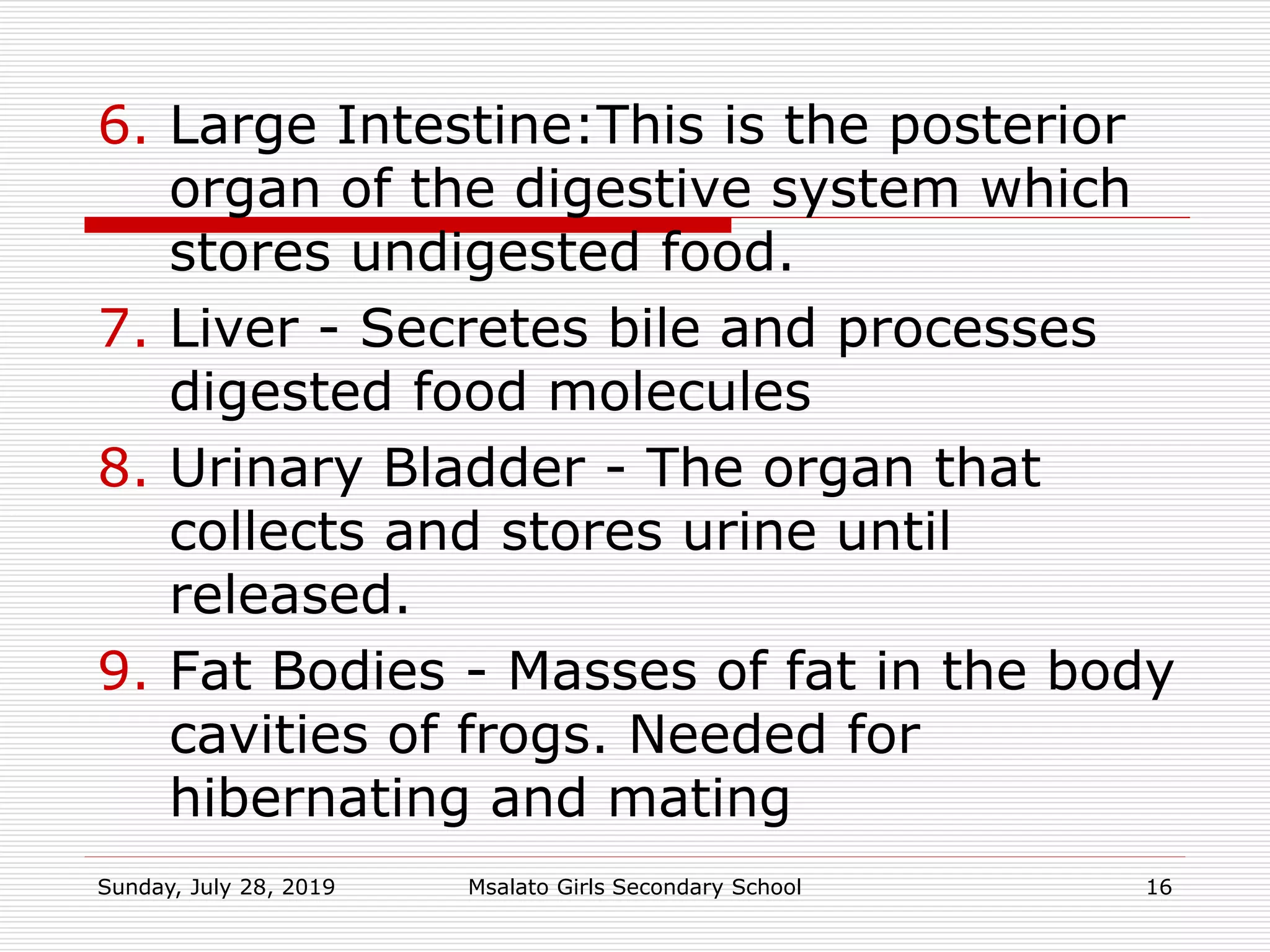
6. Large Intestine:This is the posterior
organ of the digestive system which
stores undigested food.
7. Liver - Secretes bile and processes
digested food molecules
8. Urinary Bladder - The organ that
collects and stores urine until
released.
9. Fat Bodies - Masses of fat in the body
cavities of frogs. Needed for
hibernating and mating
Sunday, July 28, 2019 Msalato Girls Secondary School 16
10.Spleen: Organ in the frog’s
circulatory system that makes,
stores, and destroys blood cells.
11. Cloaca: Organ through which the
products of the frogs digestive and
urogenital system pass when
discharged from the body
12. Oesophagus; Esophagus is the
tube that connects the mouth and the
stomach in a frog
13.The cloaca:This is the opening
through which undigested food,
urine, eggs, and sperm are passed
Sunday, July 28, 2019 Msalato Girls Secondary School 17
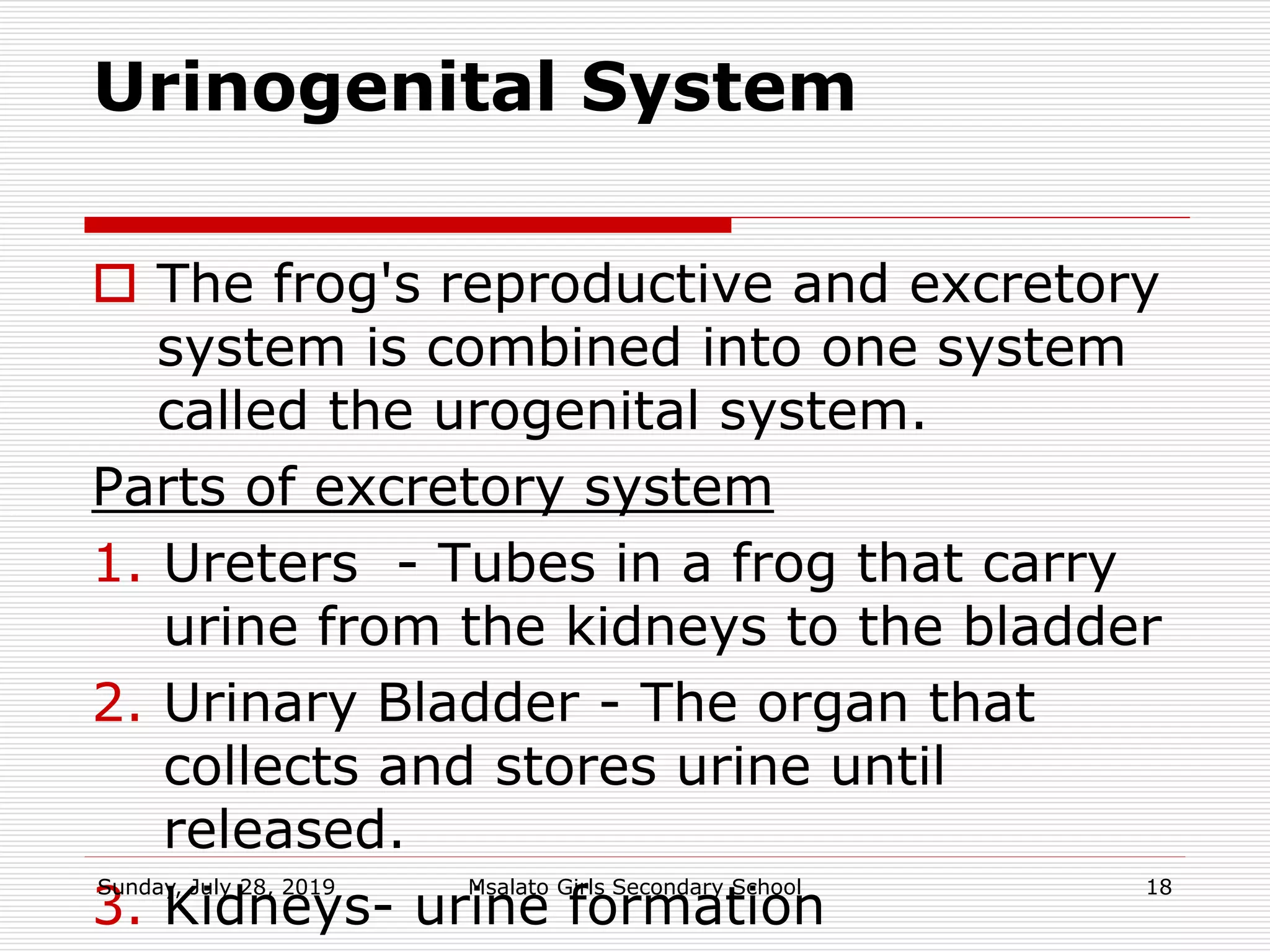
Urinogenital System
 The frog's reproductive and excretory
system is combined into one system
called the urogenital system.
Parts of excretory system
1. Ureters - Tubes in a frog that carry
urine from the kidneys to the bladder
2. Urinary Bladder - The organ that
collects and stores urine until
released.
3. Kidneys- urine formation
Sunday, July 28, 2019 Msalato Girls Secondary School 18
4. Adrenal gland – production of
hormone
Sunday, July 28, 2019 Msalato Girls Secondary School 19
Functions of parts of
reproductive System
1. Ova or Eggs - Female sex cell or
gametes
2. Fat Bodies - The fat bodies are
needed for hibernating,
metamorphosis and for mating.
 These are areas in the body
containing stored energy.
Sunday, July 28, 2019 Msalato Girls Secondary School 20
Functions of parts of the
female reproductive system
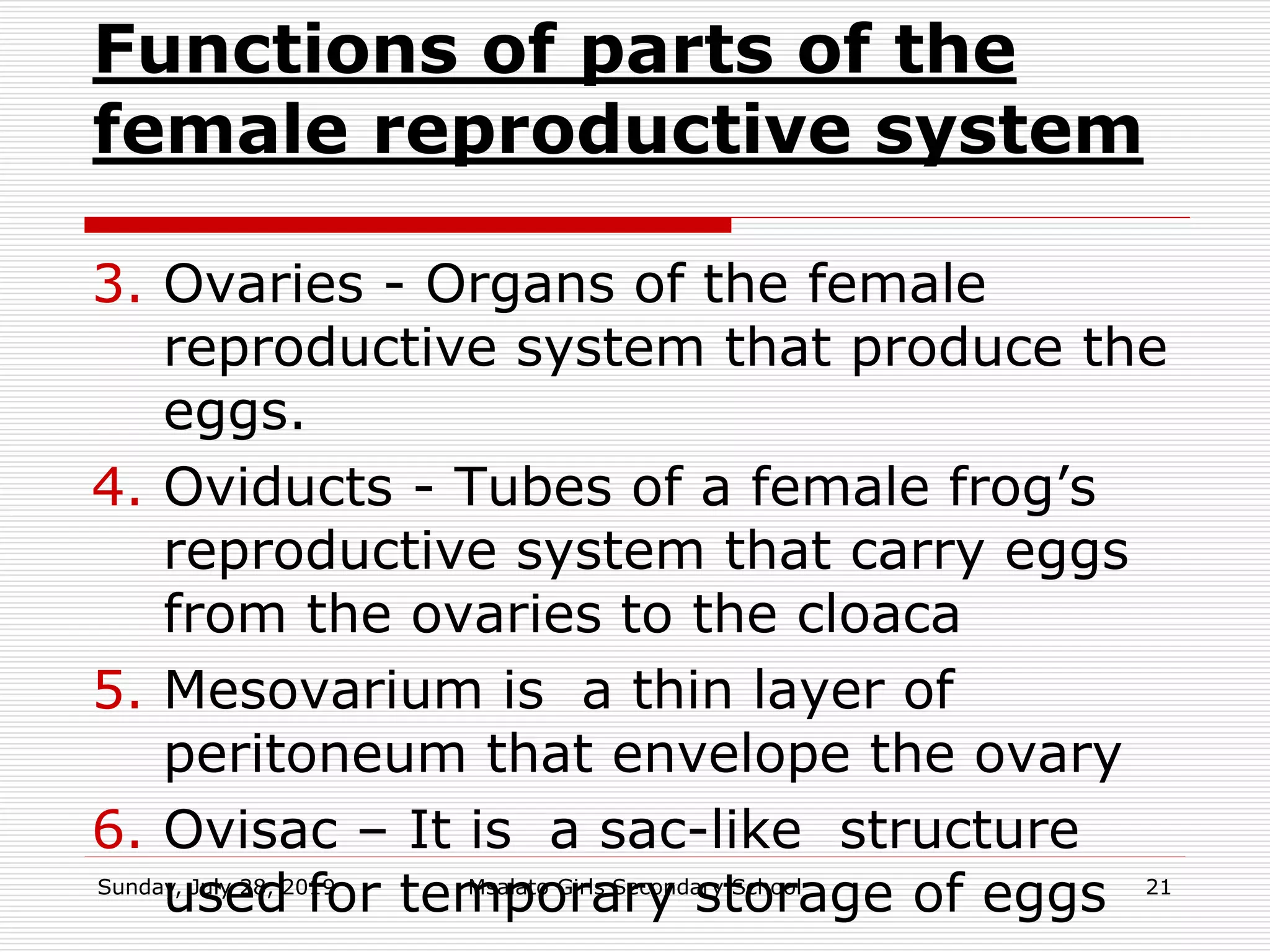
3. Ovaries - Organs of the female
reproductive system that produce the
eggs.
4. Oviducts - Tubes of a female frog’s
reproductive system that carry eggs
from the ovaries to the cloaca
5. Mesovarium is a thin layer of
peritoneum that envelope the ovary
6. Ovisac – It is a sac-like structure
used for temporary storage of eggsSunday, July 28, 2019 Msalato Girls Secondary School 21
Functions of parts of the
male reproductive system
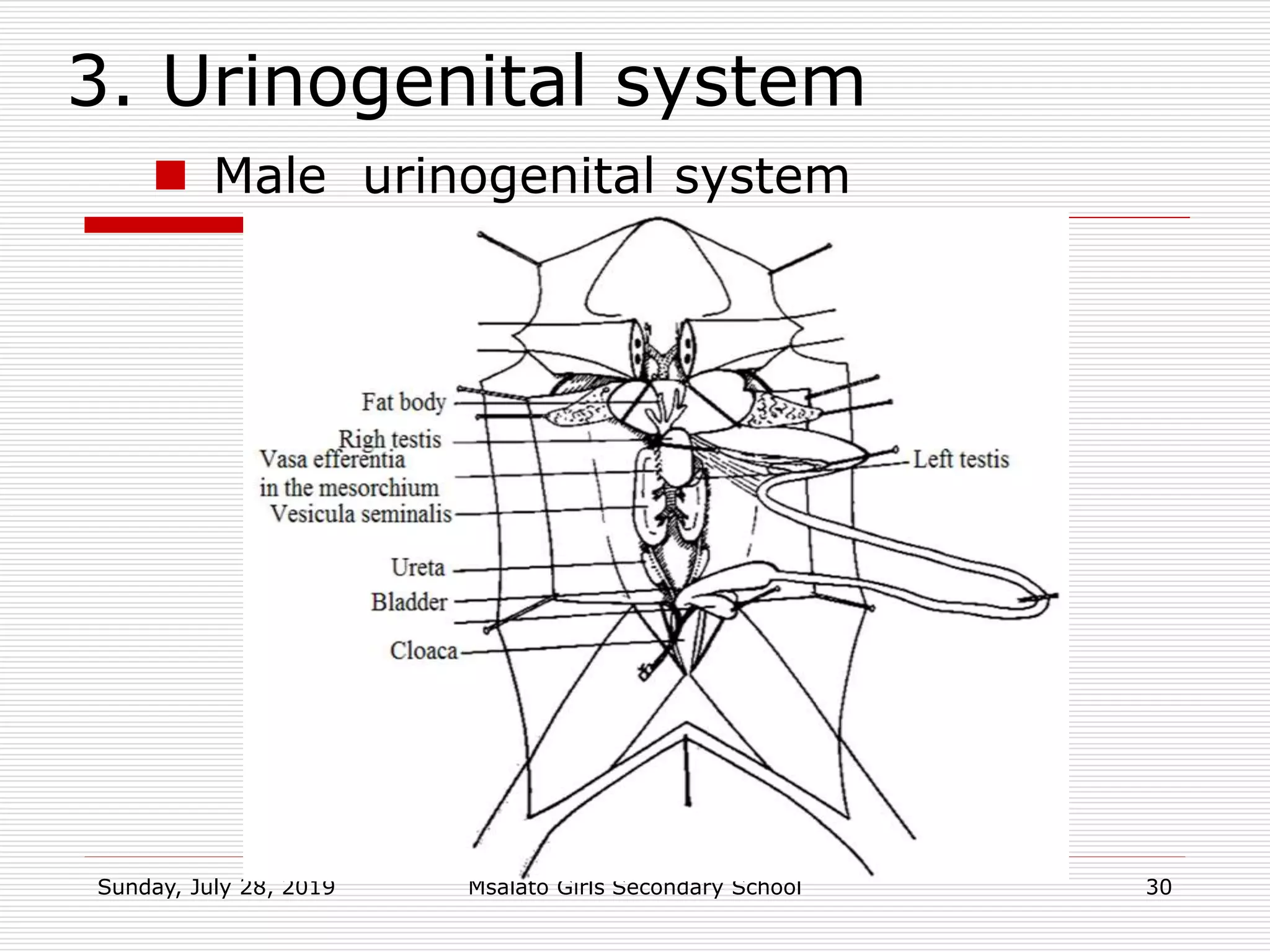
1. Testes - Male sex organs that
produce sex cells (sperm).
2. Vesicula seminalis (Seminal Vesicles)
- Enlarged distal sections of the male
frog’s urinary ducts that collect
sperm prior to entry into the cloaca
3. Mesorchium is the capsule of the
testes in male frog that offer
protection
Sunday, July 28, 2019 Msalato Girls Secondary School 22
4. Vasa efferentia- The vasa efferentia
arise from each testis and enter the
kidney to open in the Bidder's Canal
NB:
 Bidder's canal is present inside kidney
of frog. It receives sperms from
testes via a number of vasa
efferentia.
Sunday, July 28, 2019 Msalato Girls Secondary School 23
Guideline for marking the
dissection work
 Display your dissection correctly
and leave it for assessment
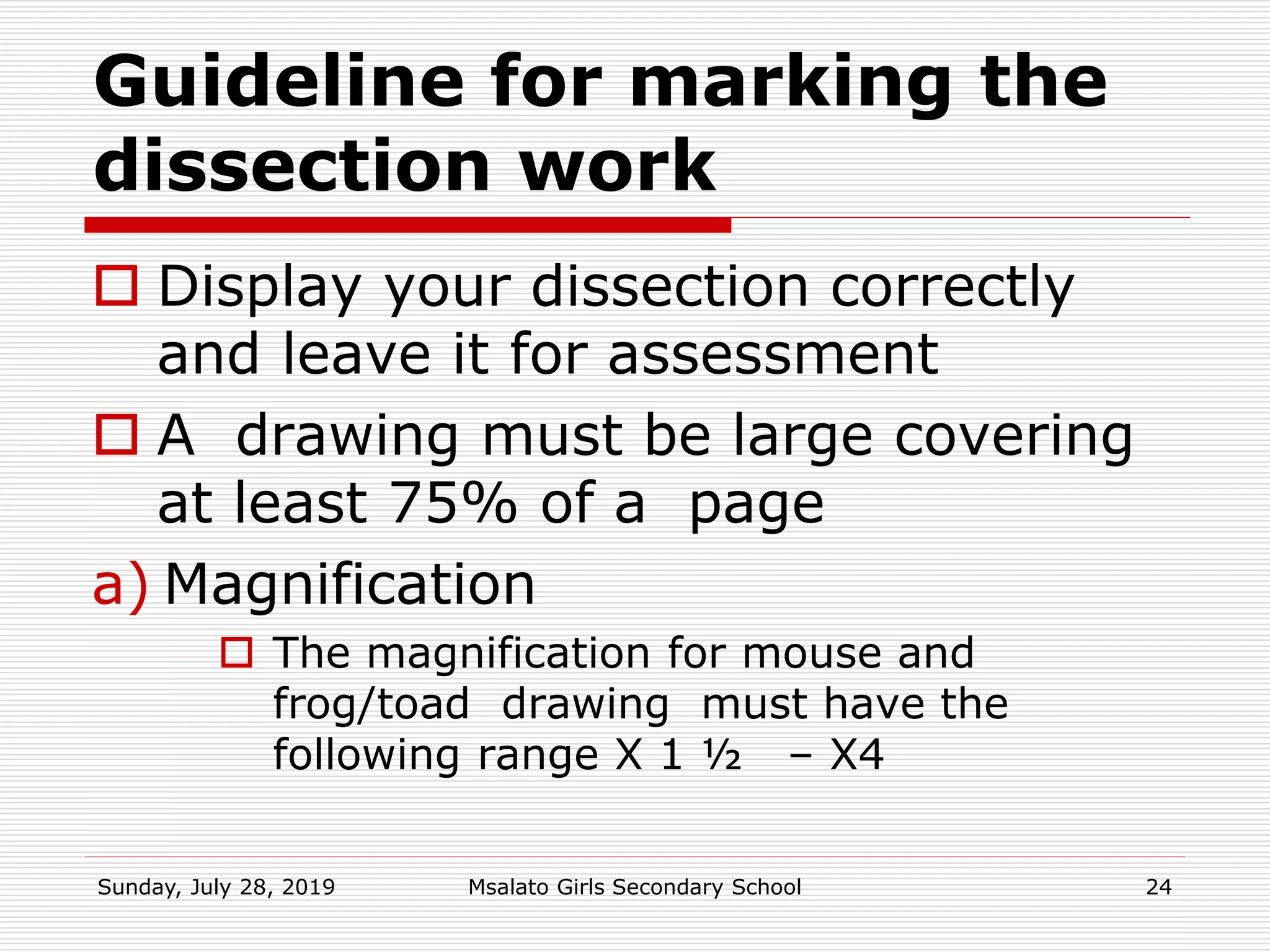
 A drawing must be large covering
at least 75% of a page
a) Magnification
 The magnification for mouse and
frog/toad drawing must have the
following range X 1 ½ – X4
Sunday, July 28, 2019 Msalato Girls Secondary School 24
 Note that:
𝑀𝑎𝑔𝑛𝑖𝑓𝑖𝑐𝑎𝑡𝑖𝑜𝑛
𝑙𝑒𝑛𝑔𝑡ℎ 𝑜𝑓 𝑡ℎ𝑒 𝑑𝑟𝑎𝑤𝑖𝑛𝑔 𝑜𝑓 𝑎𝑛 𝑜𝑏𝑗𝑒𝑐𝑡
𝑎𝑐𝑡𝑢𝑎𝑙 𝑙𝑒𝑛𝑔𝑡ℎ 𝑜𝑓 𝑡ℎ𝑒 𝑟𝑒𝑎𝑙 𝑜𝑏𝑗𝑒𝑐𝑡
Sunday, July 28, 2019 Msalato Girls Secondary School 25
b) The drawing must be neat and well
labeled
c) There must be title
d) Neatness of your dissection work
Sunday, July 28, 2019 Msalato Girls Secondary School 26
The dissection display
Assignment
 Using dissection guide book draw a
large and well labelled diagram of the
following systems
1. Viscera general
2. Digestive system
Sunday, July 28, 2019 Msalato Girls Secondary School 27
2. Digestive system
 Male digestive system
Sunday, July 28, 2019 Msalato Girls Secondary School 28
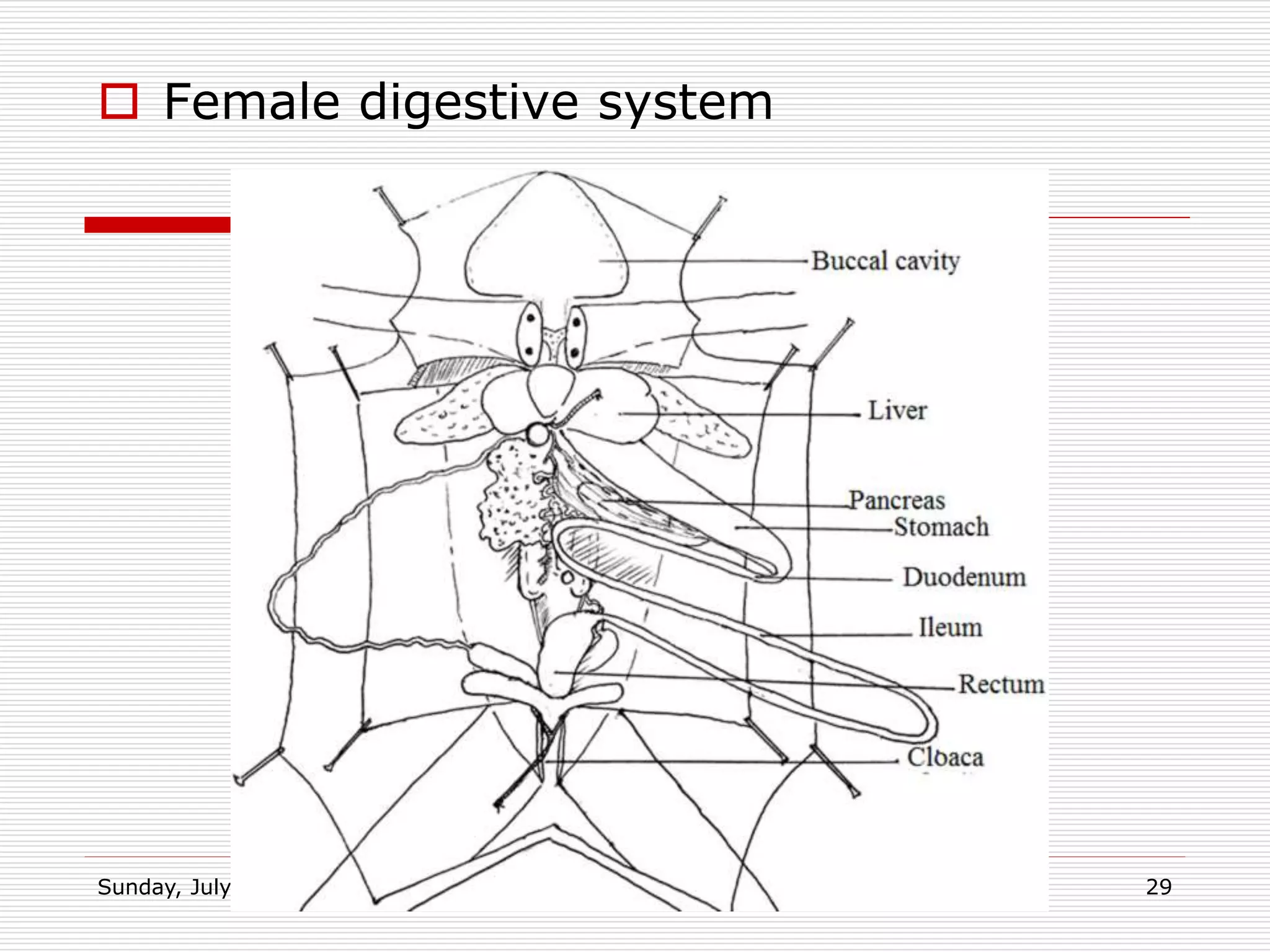
 Female digestive system
Sunday, July 28, 2019 Msalato Girls Secondary School 29
3. Urinogenital system
Sunday, July 28, 2019 Msalato Girls Secondary School 30
 Male urinogenital system
 Female urinogenital system
Sunday, July 28, 2019 Msalato Girls Secondary School 31
Nervous system
Sunday, July 28, 2019 Msalato Girls Secondary School 32

Dissection of frog toad _updated notes

  • 1.
    Dissection of frog/toad By WodrickPhilemon Bukuku Dip. ED, BSc ED (Biol & Chem), MSc BC Sunday, July 28, 2019 Msalato Girls Secondary School 1
  • 2.
    Taxonomy Sunday, July 28,2019 Msalato Girls Secondary School 2
  • 3.
    External features thatdistinguish male and female frogs: a)The male Frogs  Males are smaller than females of the same species.  Males are more vocal than females, especially during the mating season.  The male cloaca is less visible to the exterior than the female cloaca  Males are usually brighter than females in colourations Sunday, July 28, 2019 Msalato Girls Secondary School 3
  • 4.
     The forelegsare thicker in males than in females  Males have nuptial pads b) The female frogs  The female cloaca is more visible to the exterior than the male cloaca.  The females frogs are less brighter than males in colourations.  The forelegs are thinner in females than in males.  The Male frogs have nuptial pads but not the females. Sunday, July 28, 2019 Msalato Girls Secondary School 4
  • 5.
    Internal features thatdistinguish male and female frogs: a) In the male frogs  presence of the male reproductive system which consists of the testicles in which sperms are produced sperms Sunday, July 28, 2019 Msalato Girls Secondary School 5
  • 6.
    b) Female Frogs Presence of the ovaries and oviduct  The external opening of the reproductive system is the cloaca, which can be easily observed at the underside of the female. Sunday, July 28, 2019 Msalato Girls Secondary School 6
  • 7.
    Adaptation of thefrogs in its habitat 1. They have a double life i.e. live on land (terrestrial) and water  Frogs start their lives as aquatic tadpoles with gills to breathe. As tadpoles grow into frogs, lungs replace the gills and allow frogs to breathe on land 2. Frogs have webbed feet that allow them to move through the water more efficiently.Sunday, July 28, 2019 Msalato Girls Secondary School 7
  • 8.
    3. Their stronghind legs help them to swim and leap more efficiently. 4. They have excellent vision to allow them to see in poor conditions, such as muddy water and night time 5. A frog's skin is covered with protective mucus to keep it from drying out. 6. They undergo incomplete metamorphosis, this help them to avoid competition for resources with other animal species Sunday, July 28, 2019 Msalato Girls Secondary School 8
  • 9.
    7. Their skinpossess poisonous glands to defend themselves against predator 8. The female lay a large number of eggs which are fertilized male’s sperm during breeding seasons to ensure their survival Sunday, July 28, 2019 Msalato Girls Secondary School 9
  • 10.
    INTERNAL ORGANS Sunday, July28, 2019 Msalato Girls Secondary School 10
  • 11.
    Functions of theInternal organs of a frog: 1. Stomach  Stores food and mixes it with enzymes to begin digestion. 2. Small Intestine  This is the principal organ of digestion and absorption of digested food. Sunday, July 28, 2019 Msalato Girls Secondary School 11
  • 12.
    Adaptation of thesmall intestine i. Has a secretory gland which secretes enzymes to complete digestion of food. ii. Has Goblet cells which secrete mucus that allows for smooth movement of food and protect wall of ileum from action of digestive enzymes iii. Very long to provide large surface area for absorption. Sunday, July 28, 2019 Msalato Girls Secondary School 12
  • 13.
    iv. Highly folded/coiledto slow movement of food to allow more time for digestion/absorption/ and to increase surface area for absorption. v. Have numerous villi which increase surface area for absorption/microvilli which further increase surface area for absorption. vi.Ileum wall/villi have thin epithelium which is only one cell thick to reduce distance over which digested food has to diffuse. Sunday, July 28, 2019 Msalato Girls Secondary School 13
  • 14.
    iv. Villi arehighly vascularised/have a rich network of blood capillaries for rapid transport from small intestines and maintain a steep concentration gradient for rapid absorption. v. Villi have lacteals for absorption of fatty acids and glycerol vi.Cells of ileum wall have a large count of mitochondria to release energy for active uptake of some food substances across the epithelium. Sunday, July 28, 2019 Msalato Girls Secondary School 14
  • 15.
    3. Duodenum;  Thisis the anterior (front) part of the small intestine into which food passes from the stomach 4. Pancreas  This is the gland which secretes digestive enzymes into the duodenum. 5. Gall Bladder: is the sac which stores bile. Sunday, July 28, 2019 Msalato Girls Secondary School 15
  • 16.
    6. Large Intestine:Thisis the posterior organ of the digestive system which stores undigested food. 7. Liver - Secretes bile and processes digested food molecules 8. Urinary Bladder - The organ that collects and stores urine until released. 9. Fat Bodies - Masses of fat in the body cavities of frogs. Needed for hibernating and mating Sunday, July 28, 2019 Msalato Girls Secondary School 16
  • 17.
    10.Spleen: Organ inthe frog’s circulatory system that makes, stores, and destroys blood cells. 11. Cloaca: Organ through which the products of the frogs digestive and urogenital system pass when discharged from the body 12. Oesophagus; Esophagus is the tube that connects the mouth and the stomach in a frog 13.The cloaca:This is the opening through which undigested food, urine, eggs, and sperm are passed Sunday, July 28, 2019 Msalato Girls Secondary School 17
  • 18.
    Urinogenital System  Thefrog's reproductive and excretory system is combined into one system called the urogenital system. Parts of excretory system 1. Ureters - Tubes in a frog that carry urine from the kidneys to the bladder 2. Urinary Bladder - The organ that collects and stores urine until released. 3. Kidneys- urine formation Sunday, July 28, 2019 Msalato Girls Secondary School 18
  • 19.
    4. Adrenal gland– production of hormone Sunday, July 28, 2019 Msalato Girls Secondary School 19
  • 20.
    Functions of partsof reproductive System 1. Ova or Eggs - Female sex cell or gametes 2. Fat Bodies - The fat bodies are needed for hibernating, metamorphosis and for mating.  These are areas in the body containing stored energy. Sunday, July 28, 2019 Msalato Girls Secondary School 20
  • 21.
    Functions of partsof the female reproductive system 3. Ovaries - Organs of the female reproductive system that produce the eggs. 4. Oviducts - Tubes of a female frog’s reproductive system that carry eggs from the ovaries to the cloaca 5. Mesovarium is a thin layer of peritoneum that envelope the ovary 6. Ovisac – It is a sac-like structure used for temporary storage of eggsSunday, July 28, 2019 Msalato Girls Secondary School 21
  • 22.
    Functions of partsof the male reproductive system 1. Testes - Male sex organs that produce sex cells (sperm). 2. Vesicula seminalis (Seminal Vesicles) - Enlarged distal sections of the male frog’s urinary ducts that collect sperm prior to entry into the cloaca 3. Mesorchium is the capsule of the testes in male frog that offer protection Sunday, July 28, 2019 Msalato Girls Secondary School 22
  • 23.
    4. Vasa efferentia-The vasa efferentia arise from each testis and enter the kidney to open in the Bidder's Canal NB:  Bidder's canal is present inside kidney of frog. It receives sperms from testes via a number of vasa efferentia. Sunday, July 28, 2019 Msalato Girls Secondary School 23
  • 24.
    Guideline for markingthe dissection work  Display your dissection correctly and leave it for assessment  A drawing must be large covering at least 75% of a page a) Magnification  The magnification for mouse and frog/toad drawing must have the following range X 1 ½ – X4 Sunday, July 28, 2019 Msalato Girls Secondary School 24
  • 25.
     Note that: 𝑀𝑎𝑔𝑛𝑖𝑓𝑖𝑐𝑎𝑡𝑖𝑜𝑛 𝑙𝑒𝑛𝑔𝑡ℎ𝑜𝑓 𝑡ℎ𝑒 𝑑𝑟𝑎𝑤𝑖𝑛𝑔 𝑜𝑓 𝑎𝑛 𝑜𝑏𝑗𝑒𝑐𝑡 𝑎𝑐𝑡𝑢𝑎𝑙 𝑙𝑒𝑛𝑔𝑡ℎ 𝑜𝑓 𝑡ℎ𝑒 𝑟𝑒𝑎𝑙 𝑜𝑏𝑗𝑒𝑐𝑡 Sunday, July 28, 2019 Msalato Girls Secondary School 25
  • 26.
    b) The drawingmust be neat and well labeled c) There must be title d) Neatness of your dissection work Sunday, July 28, 2019 Msalato Girls Secondary School 26
  • 27.
    The dissection display Assignment Using dissection guide book draw a large and well labelled diagram of the following systems 1. Viscera general 2. Digestive system Sunday, July 28, 2019 Msalato Girls Secondary School 27
  • 28.
    2. Digestive system Male digestive system Sunday, July 28, 2019 Msalato Girls Secondary School 28
  • 29.
     Female digestivesystem Sunday, July 28, 2019 Msalato Girls Secondary School 29
  • 30.
    3. Urinogenital system Sunday,July 28, 2019 Msalato Girls Secondary School 30  Male urinogenital system
  • 31.
     Female urinogenitalsystem Sunday, July 28, 2019 Msalato Girls Secondary School 31
  • 32.
    Nervous system Sunday, July28, 2019 Msalato Girls Secondary School 32