Disruptive Innovation

   Clayton M. Christensen, Jerome H.
Grossman, M. D., and Jason Hwang, M.D.
The Innovator’s Prescription: A Disruptive
 Solution for Health Care (New York, NY:
           McGraw-Hill, 2009).
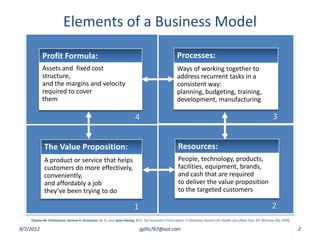
Elements of a Business Model

           Profit Formula:                                                                            Processes:
           Assets and fixed cost                                                                      Ways of working together to
           structure,                                                                                 address recurrent tasks in a
           and the margins and velocity                                                               consistent way:
           required to cover                                                                          planning, budgeting, training,
           them                                                                                       development, manufacturing

                                                                          4                                                                                            3


            The Value Proposition:                                                                     Resources:
            A product or service that helps                                                            People, technology, products,
            customers do more effectively,                                                             facilities, equipment, brands,
            conveniently,                                                                              and cash that are required
            and affordably a job                                                                       to deliver the value proposition
            they’ve been trying to do                                                                  to the targeted customers

                                                                         1                                                                                            2
    Clayton M. Christensen, Jerome H. Grossman, M. D., and Jason Hwang, M.D. The Innovator’s Prescription: A Disruptive Solution for Health Care (New York, NY: McGraw-Hill, 2009).

9/7/2012                                                                     jgillis767@aol.com                                                                                       2
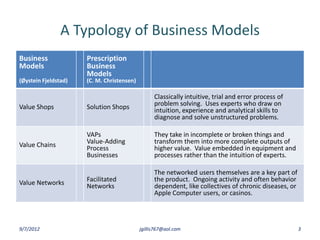
A Typology of Business Models
Business              Prescription
Models                Business
                      Models
(Øystein Fjeldstad)   (C. M. Christensen)

                                                  Classically intuitive, trial and error process of
Value Shops           Solution Shops              problem solving. Uses experts who draw on
                                                  intuition, experience and analytical skills to
                                                  diagnose and solve unstructured problems.

                      VAPs                        They take in incomplete or broken things and
Value Chains          Value-Adding                transform them into more complete outputs of
                      Process                     higher value. Value embedded in equipment and
                      Businesses                  processes rather than the intuition of experts.

                                                  The networked users themselves are a key part of
Value Networks        Facilitated                 the product. Ongoing activity and often behavior
                      Networks                    dependent, like collectives of chronic diseases, or
                                                  Apple Computer users, or casinos.


9/7/2012                                    jgillis767@aol.com                                          3
A Typology of Business Models
Business              Prescription
Models                Business
                      Models
(Øystein Fjeldstad)   (C. M. Christensen)


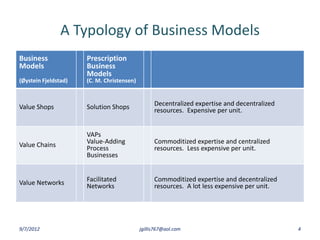
Value Shops           Solution Shops              Decentralized expertise and decentralized
                                                  resources. Expensive per unit.


                      VAPs
Value Chains          Value-Adding                Commoditized expertise and centralized
                      Process                     resources. Less expensive per unit.
                      Businesses


Value Networks        Facilitated                 Commoditized expertise and decentralized
                      Networks                    resources. A lot less expensive per unit.


9/7/2012                                    jgillis767@aol.com                                4
Type of Business Model
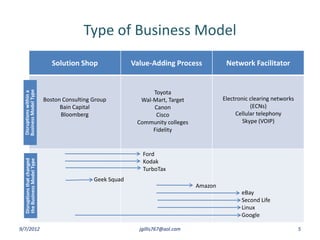
                                Solution Shop               Value-Adding Process             Network Facilitator
  Business Model Type


                                                                  Toyota
  Disruptions within a


                             Boston Consulting Group          Wal-Mart, Target              Electronic clearing networks
                                   Bain Capital                   Canon                                (ECNs)
                                   Bloomberg                       Cisco                         Cellular telephony
                                                             Community colleges                     Skype (VOIP)
                                                                  Fidelity


                                                               Ford
  Disruptions that changed
  the Business Model Type


                                                               Kodak
                                                               TurboTax
                                               Geek Squad
                                                                                   Amazon
                                                                                                   eBay
                                                                                                   Second Life
                                                                                                   Linux
                                                                                                   Google

9/7/2012                                                      jgillis767@aol.com                                           5
Elements of Disruptive Innovation
                                                                        Disruption
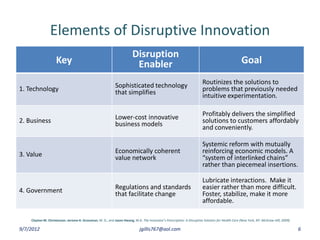
                    Key                                                  Enabler                                                                 Goal

                                                            Sophisticated technology                                   Routinizes the solutions to
1. Technology                                               that simplifies                                            problems that previously needed
                                                                                                                       intuitive experimentation.


                                                            Lower-cost innovative                                      Profitably delivers the simplified
2. Business                                                 business models                                            solutions to customers affordably
                                                                                                                       and conveniently.

                                                                                                                       Systemic reform with mutually
3. Value                                                    Economically coherent                                      reinforcing economic models. A
                                                            value network                                              “system of interlinked chains”
                                                                                                                       rather than piecemeal insertions.

                                                                                                                       Lubricate interactions. Make it
4. Government                                               Regulations and standards                                  easier rather than more difficult.
                                                            that facilitate change                                     Foster, stabilize, make it more
                                                                                                                       affordable.

    Clayton M. Christensen, Jerome H. Grossman, M. D., and Jason Hwang, M.D. The Innovator’s Prescription: A Disruptive Solution for Health Care (New York, NY: McGraw-Hill, 2009).

9/7/2012                                                                     jgillis767@aol.com                                                                                       6
The Cycles of Theory
      Building in Management
      Research

      Paul R. Carlile
      School of Management                           Copyright ©
      Boston University                              Working papers are in draft form.
      Boston, MA 02215                                This working paper is distributed
      carlile@bu.edu                                 for purposes of comment and
                                                     discussion only.
      Clayton M. Christensen
      Harvard Business School
      Boston, MA 02163
      cchristensen@hbs.edu


                                                                     October 27, 2004
                                                                       Version 5.0
9/7/2012                        jgillis767@aol.com                                    7
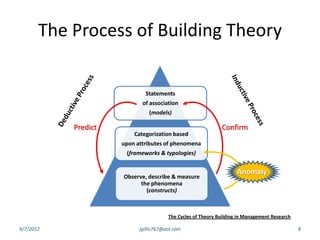
The Process of Building Theory


                             Statements
                            of association
                               (models)

           Predict                                           Confirm
                         Categorization based
                     upon attributes of phenomena
                      (frameworks & typologies)


                                                                    Anomaly
                     Observe, describe & measure
                           the phenomena
                             (constructs)


                                       The Cycles of Theory Building in Management Research

9/7/2012                   jgillis767@aol.com                                                 8
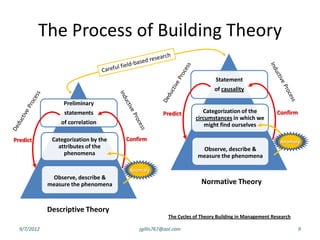
The Process of Building Theory

                                                                          Statement
                                                                         of causality

                  Preliminary
                  statements                        Predict         Categorization of the           Confirm
                                                                 circumstances in which we
                 of correlation                                      might find ourselves

Predict       Categorization by the   Confirm                                                        Anomaly
                attributes of the                                  Observe, describe &
                  phenomena                                       measure the phenomena

                                       Anomaly
              Observe, describe &
             measure the phenomena                                  Normative Theory


             Descriptive Theory
                                                      The Cycles of Theory Building in Management Research

  9/7/2012                                jgillis767@aol.com                                                  9
Veritas


9/7/2012   jgillis767@aol.com   10

Disruptive Innovation AB

  • 1.
    Disruptive Innovation Clayton M. Christensen, Jerome H. Grossman, M. D., and Jason Hwang, M.D. The Innovator’s Prescription: A Disruptive Solution for Health Care (New York, NY: McGraw-Hill, 2009).
  • 2.
    Elements of aBusiness Model Profit Formula: Processes: Assets and fixed cost Ways of working together to structure, address recurrent tasks in a and the margins and velocity consistent way: required to cover planning, budgeting, training, them development, manufacturing 4 3 The Value Proposition: Resources: A product or service that helps People, technology, products, customers do more effectively, facilities, equipment, brands, conveniently, and cash that are required and affordably a job to deliver the value proposition they’ve been trying to do to the targeted customers 1 2 Clayton M. Christensen, Jerome H. Grossman, M. D., and Jason Hwang, M.D. The Innovator’s Prescription: A Disruptive Solution for Health Care (New York, NY: McGraw-Hill, 2009). 9/7/2012 jgillis767@aol.com 2
  • 3.
    A Typology ofBusiness Models Business Prescription Models Business Models (Øystein Fjeldstad) (C. M. Christensen) Classically intuitive, trial and error process of Value Shops Solution Shops problem solving. Uses experts who draw on intuition, experience and analytical skills to diagnose and solve unstructured problems. VAPs They take in incomplete or broken things and Value Chains Value-Adding transform them into more complete outputs of Process higher value. Value embedded in equipment and Businesses processes rather than the intuition of experts. The networked users themselves are a key part of Value Networks Facilitated the product. Ongoing activity and often behavior Networks dependent, like collectives of chronic diseases, or Apple Computer users, or casinos. 9/7/2012 jgillis767@aol.com 3
  • 4.
    A Typology ofBusiness Models Business Prescription Models Business Models (Øystein Fjeldstad) (C. M. Christensen) Value Shops Solution Shops Decentralized expertise and decentralized resources. Expensive per unit. VAPs Value Chains Value-Adding Commoditized expertise and centralized Process resources. Less expensive per unit. Businesses Value Networks Facilitated Commoditized expertise and decentralized Networks resources. A lot less expensive per unit. 9/7/2012 jgillis767@aol.com 4
  • 5.
    Type of BusinessModel Solution Shop Value-Adding Process Network Facilitator Business Model Type Toyota Disruptions within a Boston Consulting Group Wal-Mart, Target Electronic clearing networks Bain Capital Canon (ECNs) Bloomberg Cisco Cellular telephony Community colleges Skype (VOIP) Fidelity Ford Disruptions that changed the Business Model Type Kodak TurboTax Geek Squad Amazon eBay Second Life Linux Google 9/7/2012 jgillis767@aol.com 5
  • 6.
    Elements of DisruptiveInnovation Disruption Key Enabler Goal Sophisticated technology Routinizes the solutions to 1. Technology that simplifies problems that previously needed intuitive experimentation. Lower-cost innovative Profitably delivers the simplified 2. Business business models solutions to customers affordably and conveniently. Systemic reform with mutually 3. Value Economically coherent reinforcing economic models. A value network “system of interlinked chains” rather than piecemeal insertions. Lubricate interactions. Make it 4. Government Regulations and standards easier rather than more difficult. that facilitate change Foster, stabilize, make it more affordable. Clayton M. Christensen, Jerome H. Grossman, M. D., and Jason Hwang, M.D. The Innovator’s Prescription: A Disruptive Solution for Health Care (New York, NY: McGraw-Hill, 2009). 9/7/2012 jgillis767@aol.com 6
  • 7.
    The Cycles ofTheory Building in Management Research Paul R. Carlile School of Management Copyright © Boston University Working papers are in draft form. Boston, MA 02215 This working paper is distributed carlile@bu.edu for purposes of comment and discussion only. Clayton M. Christensen Harvard Business School Boston, MA 02163 cchristensen@hbs.edu October 27, 2004 Version 5.0 9/7/2012 jgillis767@aol.com 7
  • 8.
    The Process ofBuilding Theory Statements of association (models) Predict Confirm Categorization based upon attributes of phenomena (frameworks & typologies) Anomaly Observe, describe & measure the phenomena (constructs) The Cycles of Theory Building in Management Research 9/7/2012 jgillis767@aol.com 8
  • 9.
    The Process ofBuilding Theory Statement of causality Preliminary statements Predict Categorization of the Confirm circumstances in which we of correlation might find ourselves Predict Categorization by the Confirm Anomaly attributes of the Observe, describe & phenomena measure the phenomena Anomaly Observe, describe & measure the phenomena Normative Theory Descriptive Theory The Cycles of Theory Building in Management Research 9/7/2012 jgillis767@aol.com 9
  • 10.
    Veritas 9/7/2012 jgillis767@aol.com 10