



WHAT IS A
‘POLYSERVICE’
NETWORK?
MARTIN GEDDES
FOUNDER & PRINCIPAL
MARTIN GEDDES CONSULTING LTD
November 2015
2Introduction to network quality
The issue of quality in networks has been long being troublesome, resulting in endless
deferral. For example, issue after issue of CCITT coloured books in the 1980s and 1990s had
sections about quality marked ‘for further study’. Those issues remain unresolved to this day!
It was a hard issue for the pioneers to deal with ‘quality’ and ‘QoS’ as the underlying
mathematics was insufficient to support their ambitions. We have now filled in a significant
part of the missing mathematical foundations. The culmination of that work is the ∆Q
framework.
As a by-product of this framework, a new approach to sharing quality has become possible:
a polyservice network. We believe that this is a significant conceptual and practical advance.
However, we have (until now) lacked industry standard terminology to describe it.
This short presentation introduces the idea of a polyservice network, and contrasts it with
pre-existing approaches to ‘priority QoS’.
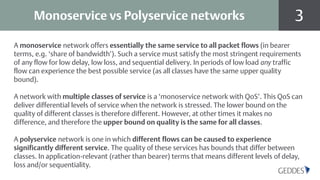
3Monoservice vs Polyservice networks
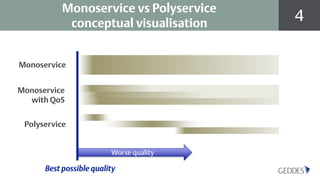
A monoservice network offers essentially the same service to all packet flows (in bearer
terms, e.g. ‘share of bandwidth’). Such a service must satisfy the most stringent requirements
of any flow for low delay, low loss, and sequential delivery. In periods of low load any traffic
flow can experience the best possible service (as all classes have the same upper quality
bound).
A network with multiple classes of service is a ‘monoservice network with QoS’. This QoS can
deliver differential levels of service when the network is stressed. The lower bound on the
quality of different classes is therefore different. However, at other times it makes no
difference, and therefore the upper bound on quality is the same for all classes.
A polyservice network is one in which different flows can be caused to experience
significantly different service. The quality of these services has bounds that differ between
classes. In application-relevant (rather than bearer) terms that means different levels of delay,
loss and/or sequentiality.
4
Monoservice vs Polyservice
conceptual visualisation
Monoservice
Monoservice
with QoS
Polyservice
Best possible quality
Worse quality
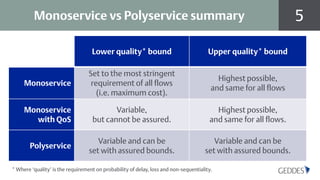
5Monoservice vs Polyservice summary
Lower quality* bound Upper quality* bound
Monoservice
Set to the most stringent
requirement of all flows
(i.e. maximum cost).
Highest possible,
and same for all flows
Monoservice
with QoS
Variable,
but cannot be assured.
Highest possible,
and same for all flows.
Polyservice
Variable and can be
set with assured bounds.
Variable and can be
set with assured bounds.
* Where ‘quality’ is the requirement on probability of delay, loss and non-sequentiality.
6
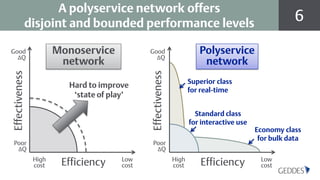
A polyservice network offers
disjoint and bounded performance levels
Monoservice
network
Polyservice
network
Efficiency
Effectiveness
Good
ΔQ
Poor
ΔQ
High
cost
Low
cost EfficiencyEffectiveness
Good
ΔQ
Poor
ΔQ
High
cost
Low
cost
Hard to improve
‘state of play’
Economy class
for bulk data
Superior class
for real-time
Standard class
for interactive use
7
June 2009 - V 0.4
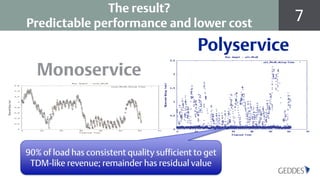
Monoservice
Polyservice
90% of load has consistent quality sufficient to get
TDM-like revenue; remainder has residual value
The result?
Predictable performance and lower cost
8
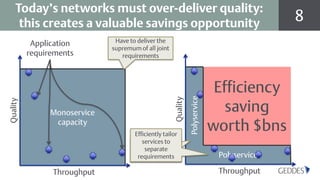
Efficiency
saving
worth $bns
Polyservice
Polyservice
Monoservice
capacity
Today’s networks must over-deliver quality:
this creates a valuable savings opportunity
Throughput
Quality
Throughput
Quality
Application
requirements
Have to deliver the
supremum of all joint
requirements
Efficiently tailor
services to
requirements
Efficiently tailor
services to
separate
requirements
9
Thank you
Martin Geddes
mail@martingeddes.com

What is a 'polyservice' network?

  • 1.
    WHAT IS A ‘POLYSERVICE’ NETWORK? MARTINGEDDES FOUNDER & PRINCIPAL MARTIN GEDDES CONSULTING LTD November 2015
  • 2.
    2Introduction to networkquality The issue of quality in networks has been long being troublesome, resulting in endless deferral. For example, issue after issue of CCITT coloured books in the 1980s and 1990s had sections about quality marked ‘for further study’. Those issues remain unresolved to this day! It was a hard issue for the pioneers to deal with ‘quality’ and ‘QoS’ as the underlying mathematics was insufficient to support their ambitions. We have now filled in a significant part of the missing mathematical foundations. The culmination of that work is the ∆Q framework. As a by-product of this framework, a new approach to sharing quality has become possible: a polyservice network. We believe that this is a significant conceptual and practical advance. However, we have (until now) lacked industry standard terminology to describe it. This short presentation introduces the idea of a polyservice network, and contrasts it with pre-existing approaches to ‘priority QoS’.
  • 3.
    3Monoservice vs Polyservicenetworks A monoservice network offers essentially the same service to all packet flows (in bearer terms, e.g. ‘share of bandwidth’). Such a service must satisfy the most stringent requirements of any flow for low delay, low loss, and sequential delivery. In periods of low load any traffic flow can experience the best possible service (as all classes have the same upper quality bound). A network with multiple classes of service is a ‘monoservice network with QoS’. This QoS can deliver differential levels of service when the network is stressed. The lower bound on the quality of different classes is therefore different. However, at other times it makes no difference, and therefore the upper bound on quality is the same for all classes. A polyservice network is one in which different flows can be caused to experience significantly different service. The quality of these services has bounds that differ between classes. In application-relevant (rather than bearer) terms that means different levels of delay, loss and/or sequentiality.
  • 4.
    4 Monoservice vs Polyservice conceptualvisualisation Monoservice Monoservice with QoS Polyservice Best possible quality Worse quality
  • 5.
    5Monoservice vs Polyservicesummary Lower quality* bound Upper quality* bound Monoservice Set to the most stringent requirement of all flows (i.e. maximum cost). Highest possible, and same for all flows Monoservice with QoS Variable, but cannot be assured. Highest possible, and same for all flows. Polyservice Variable and can be set with assured bounds. Variable and can be set with assured bounds. * Where ‘quality’ is the requirement on probability of delay, loss and non-sequentiality.
  • 6.
    6 A polyservice networkoffers disjoint and bounded performance levels Monoservice network Polyservice network Efficiency Effectiveness Good ΔQ Poor ΔQ High cost Low cost EfficiencyEffectiveness Good ΔQ Poor ΔQ High cost Low cost Hard to improve ‘state of play’ Economy class for bulk data Superior class for real-time Standard class for interactive use
  • 7.
    7 June 2009 -V 0.4 Monoservice Polyservice 90% of load has consistent quality sufficient to get TDM-like revenue; remainder has residual value The result? Predictable performance and lower cost
  • 8.
    8 Efficiency saving worth $bns Polyservice Polyservice Monoservice capacity Today’s networksmust over-deliver quality: this creates a valuable savings opportunity Throughput Quality Throughput Quality Application requirements Have to deliver the supremum of all joint requirements Efficiently tailor services to requirements Efficiently tailor services to separate requirements
  • 9.