UTS CRICOS PROVIDER CODE: 00099F
DEVELOPING RESILIENT
AGENCY IN LEARNING:
USE OF CLARA FOR FIRST YEAR SCIENCE STUDENTS WITH COACHING SUPPORT
uts.edu.au
Alison Beavis, Andy Leigh, Peter Meier (Science), Georgina Barratt-See (HELPS)
Ruth Crick (School of Education & CIC), Simon Buckingham Shum (CIC),
and a team of our CLARA Student Mentors
http://utscic.edu.au/projects/uts-projects/science-learning-power
UTS First Year Experience Forum
23 Sept. 2015
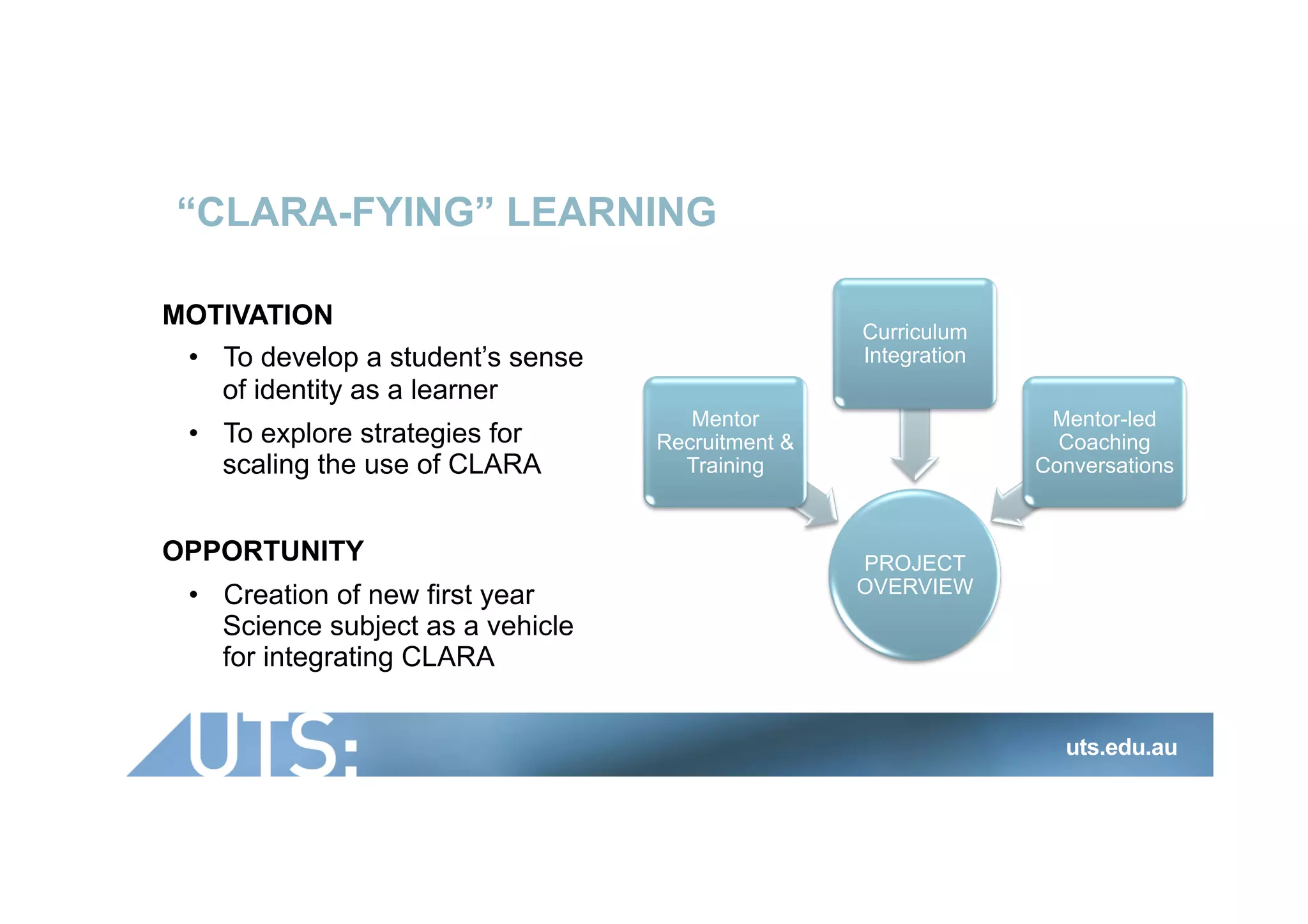
“CLARA-FYING” LEARNING
MOTIVATION
•  To develop a student’s sense
of identity as a learner
•  To explore strategies for
scaling the use of CLARA
OPPORTUNITY
•  Creation of new first year
Science subject as a vehicle
for integrating CLARA
uts.edu.au
PROJECT
OVERVIEW
Mentor
Recruitment &
Training
Curriculum
Integration
Mentor-led
Coaching
Conversations
COLLABORATION
uts.edu.au
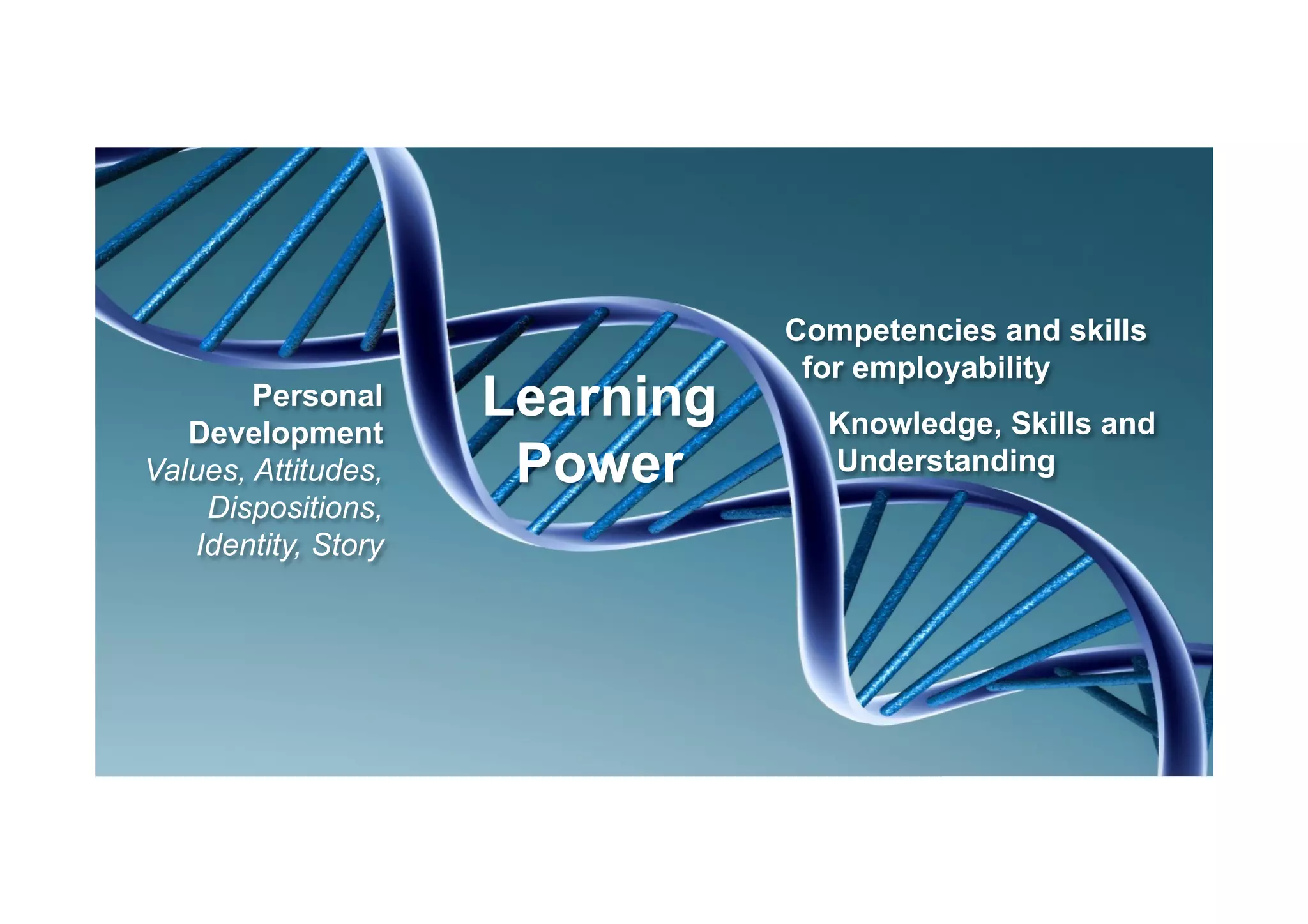
Personal
Development
Values, Attitudes,
Dispositions,
Identity, Story
Learning
Power
Competencies and skills
for employability
Knowledge, Skills and
Understanding
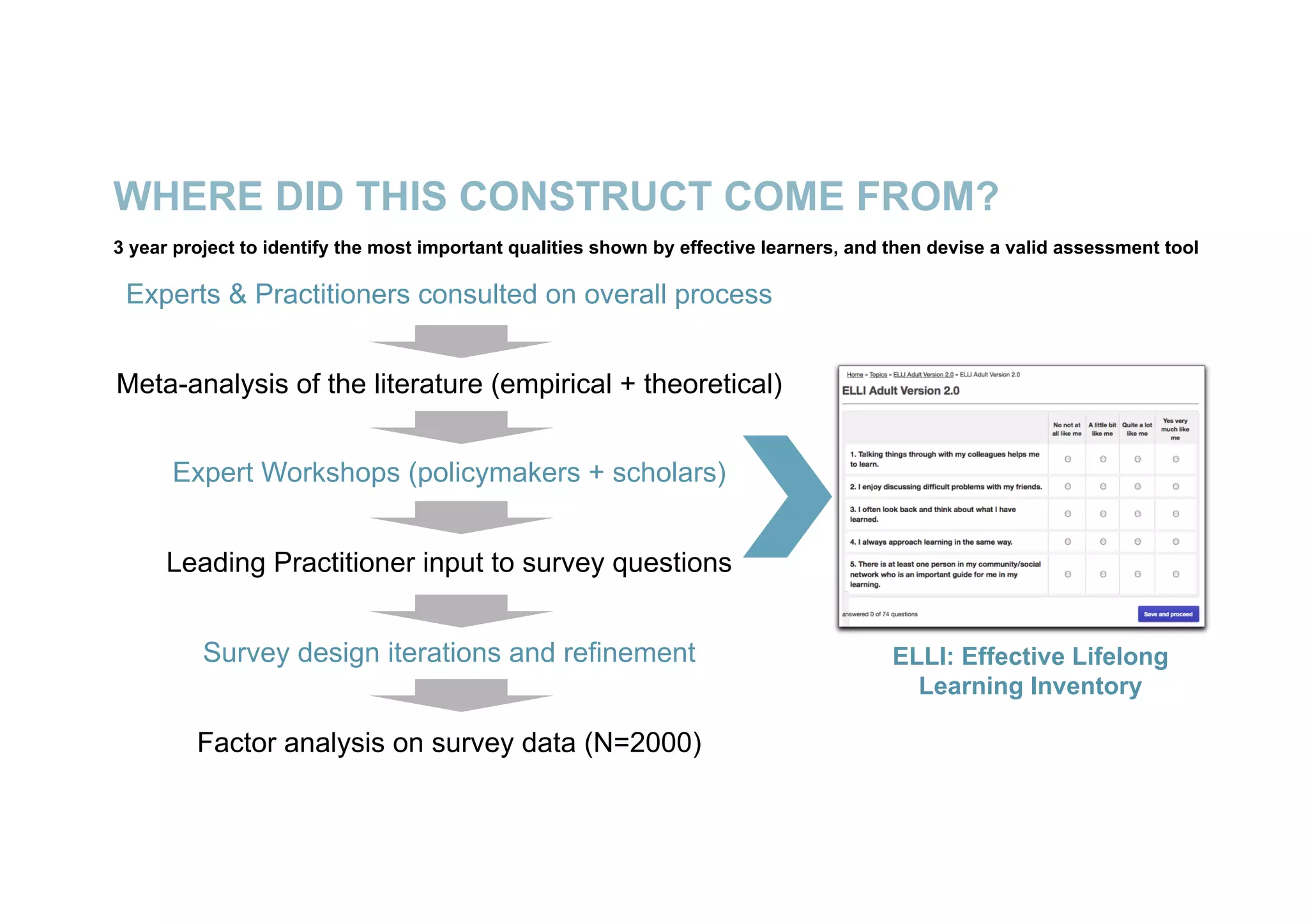
WHERE DID THIS CONSTRUCT COME FROM?
3 year project to identify the most important qualities shown by effective learners, and then devise a valid assessment tool
Experts & Practitioners consulted on overall process
Meta-analysis of the literature (empirical + theoretical)
Expert Workshops (policymakers + scholars)
Leading Practitioner input to survey questions
Survey design iterations and refinement
Factor analysis on survey data (N=2000)
Seven factors identified
ELLI: Effective Lifelong
Learning Inventory
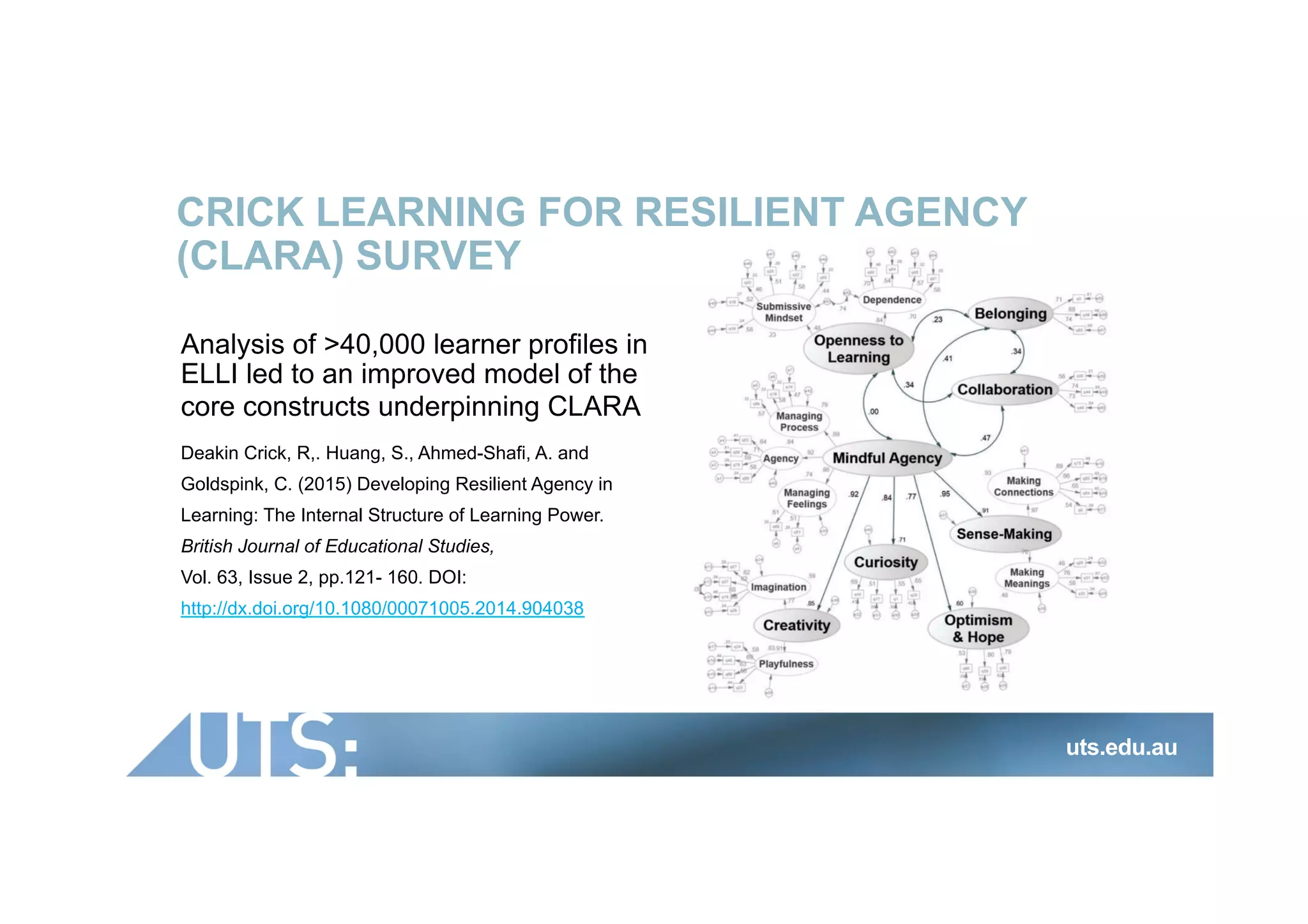
CRICK LEARNING FOR RESILIENT AGENCY
(CLARA) SURVEY
Analysis of >40,000 learner profiles in
ELLI led to an improved model of the
core constructs underpinning CLARA
Deakin Crick, R,. Huang, S., Ahmed-Shafi, A. and
Goldspink, C. (2015) Developing Resilient Agency in
Learning: The Internal Structure of Learning Power.
British Journal of Educational Studies,
Vol. 63, Issue 2, pp.121- 160. DOI:
http://dx.doi.org/10.1080/00071005.2014.904038
uts.edu.au
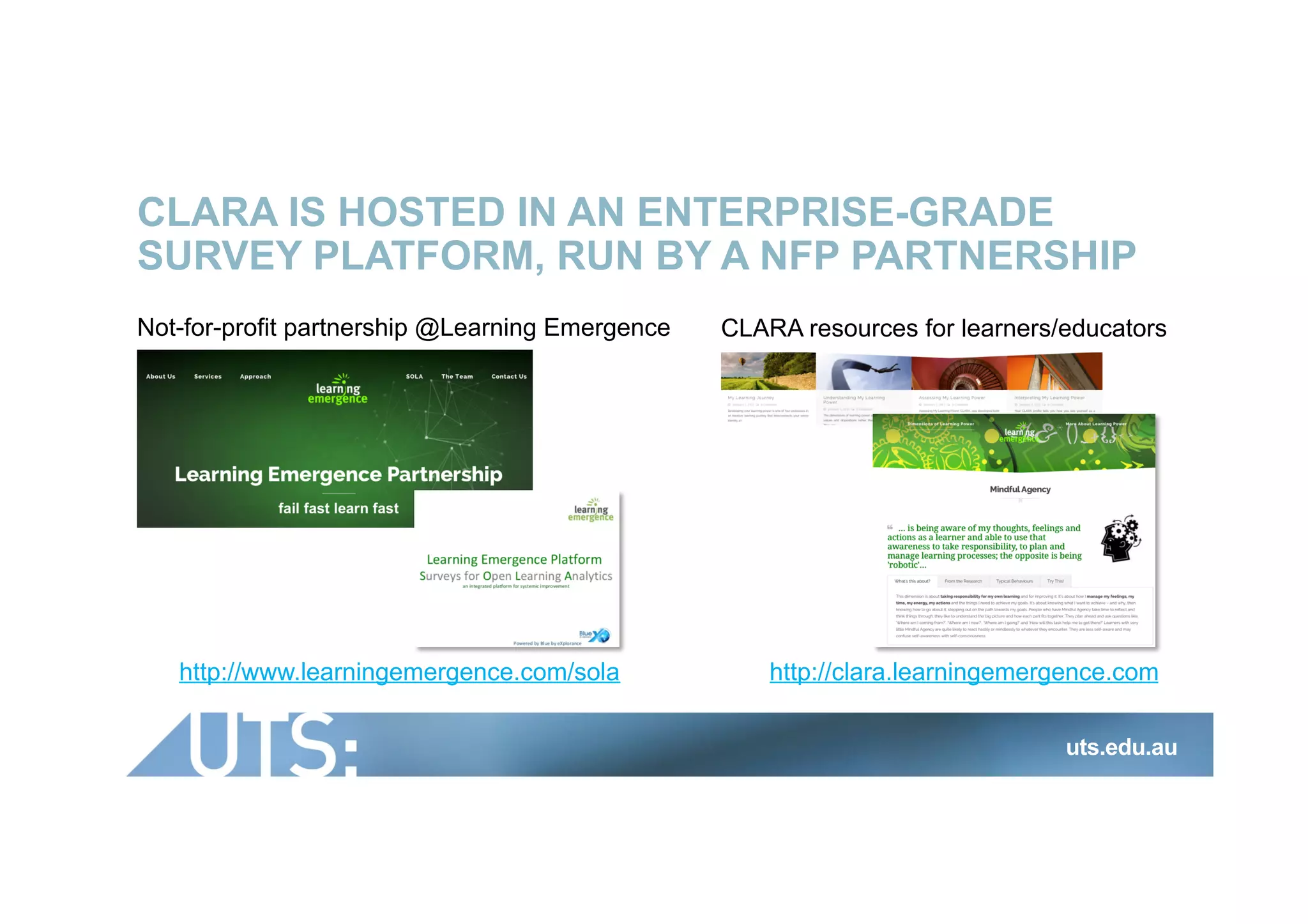
CLARA IS HOSTED IN AN ENTERPRISE-GRADE
SURVEY PLATFORM, RUN BY A NFP PARTNERSHIP
uts.edu.au
http://www.learningemergence.com/sola
Not-for-profit partnership @Learning Emergence CLARA resources for learners/educators
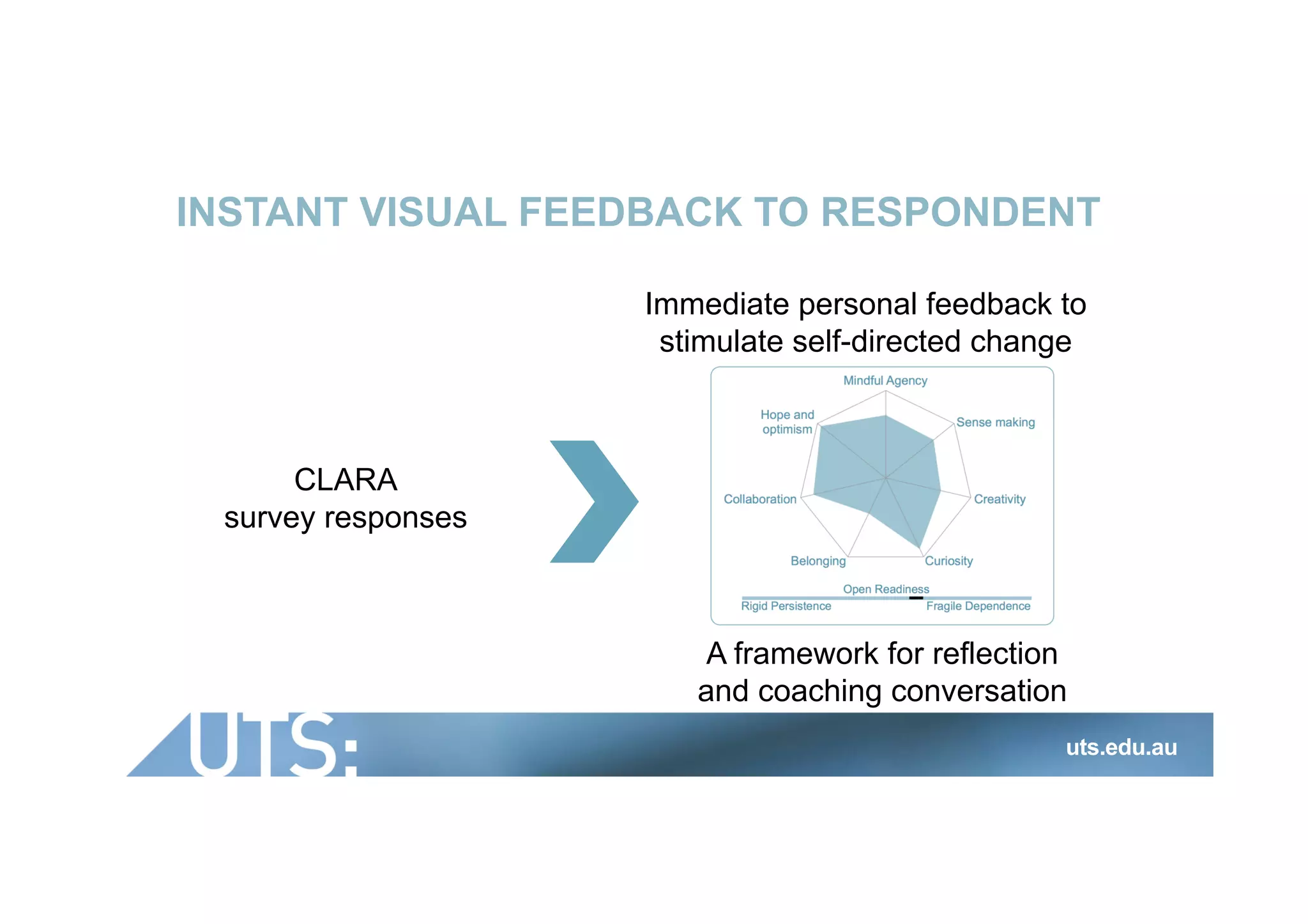
INSTANT VISUAL FEEDBACK TO RESPONDENT
uts.edu.au
Immediate personal feedback to
stimulate self-directed change
A framework for reflection
and coaching conversation
CLARA
survey responses
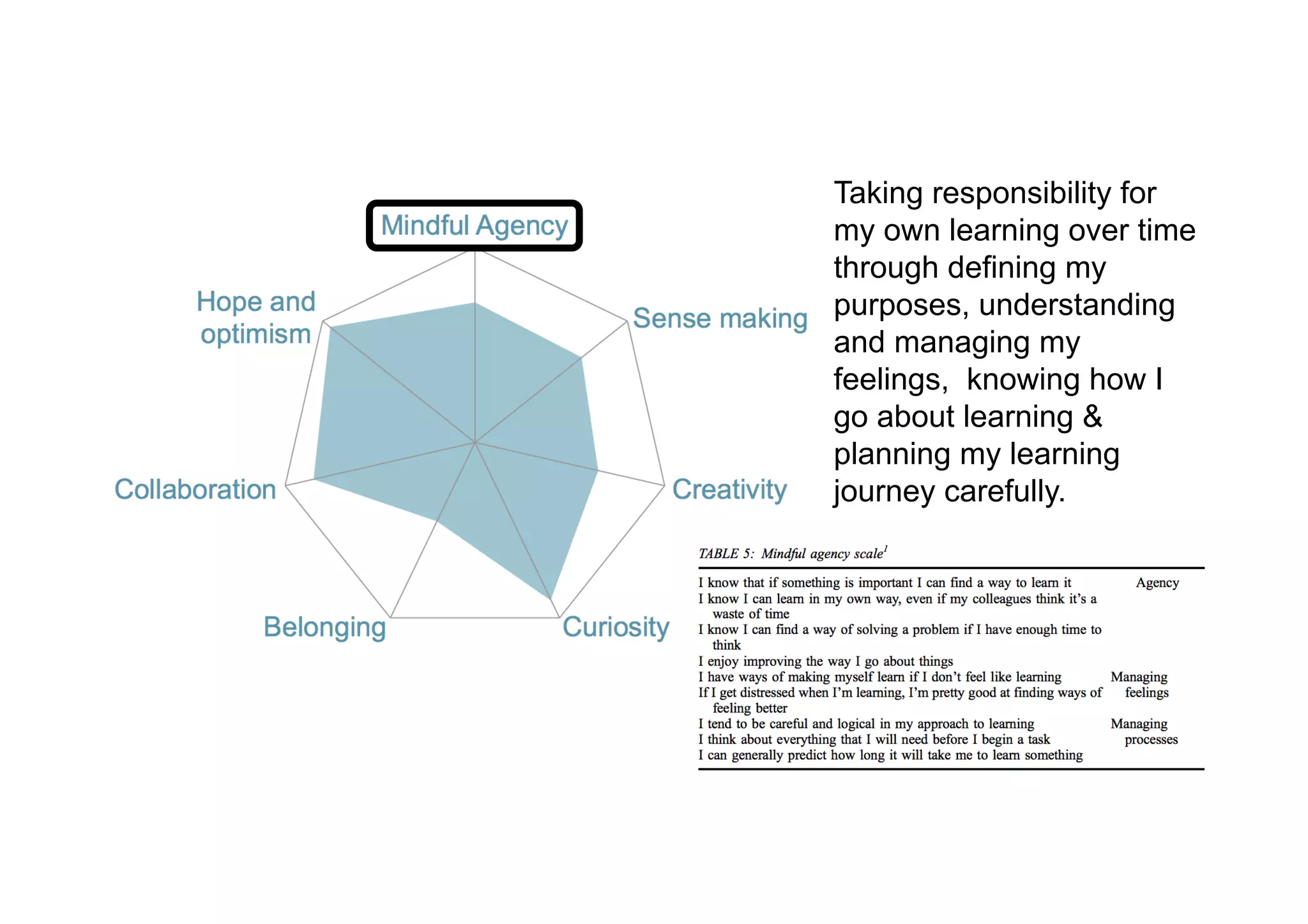
Taking responsibility for
my own learning over time
through defining my
purposes, understanding
and managing my
feelings, knowing how I
go about learning &
planning my learning
journey carefully.
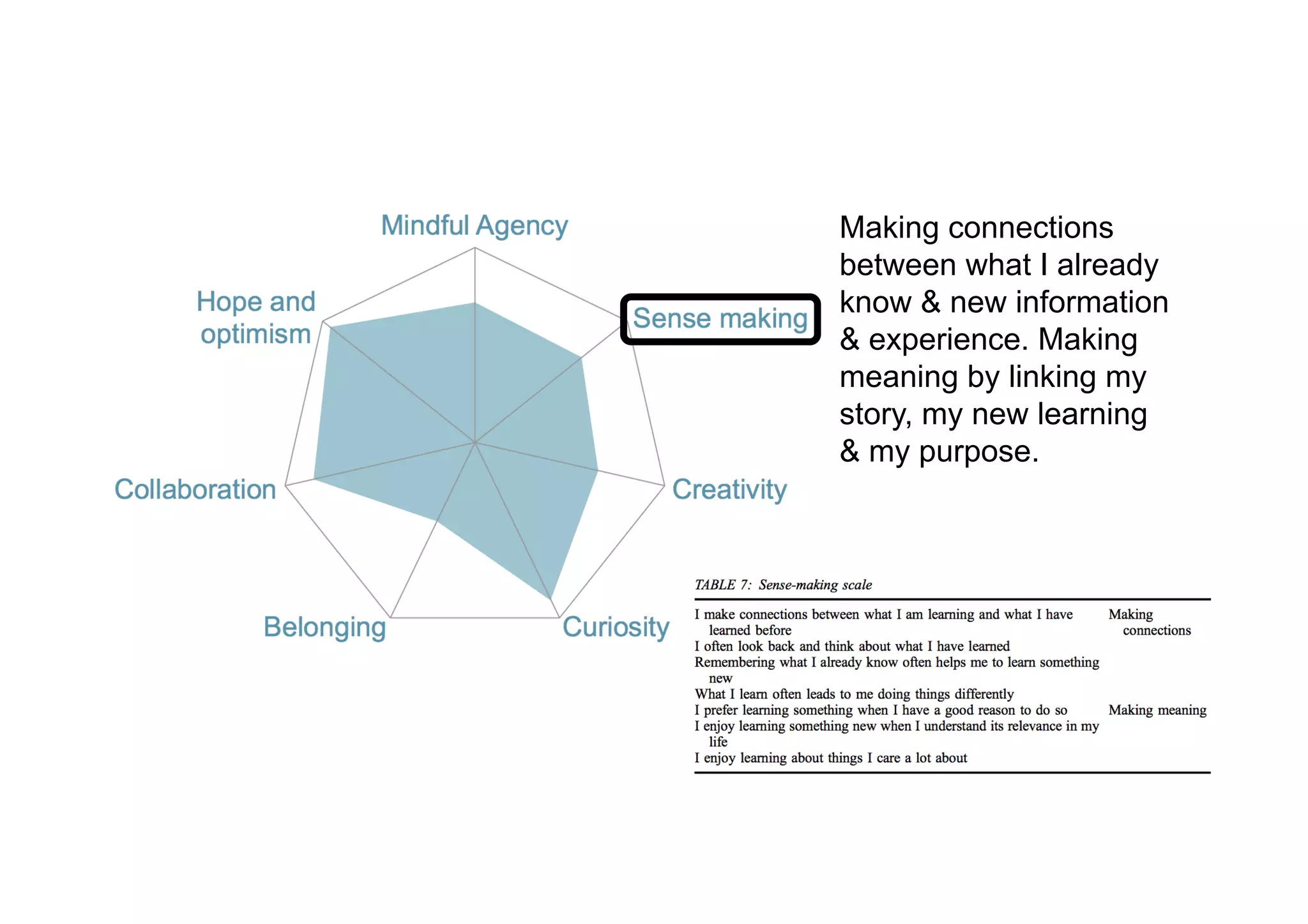
Making connections
between what I already
know & new information
& experience. Making
meaning by linking my
story, my new learning
& my purpose.
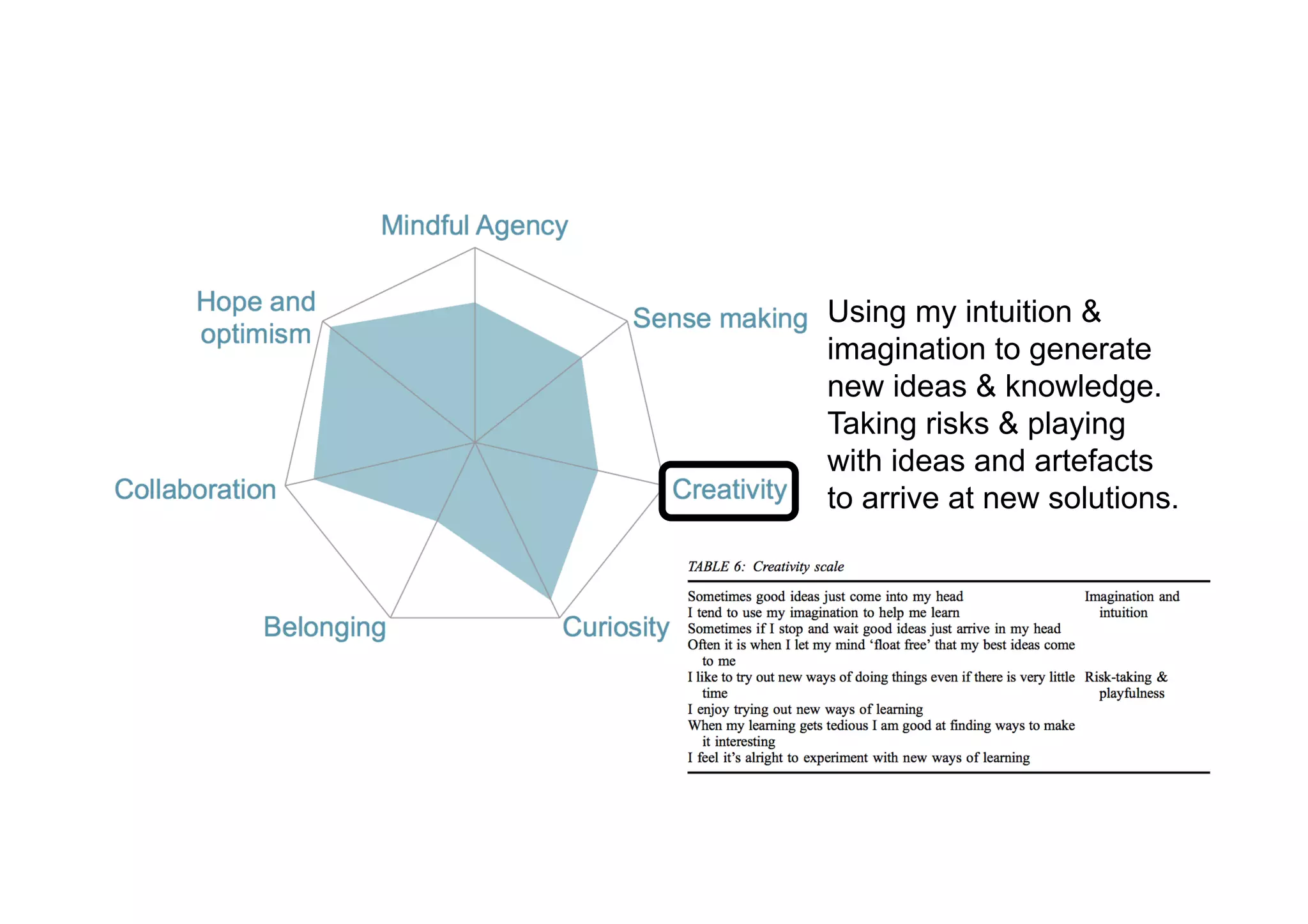
Using my intuition &
imagination to generate
new ideas & knowledge.
Taking risks & playing
with ideas and artefacts
to arrive at new solutions.
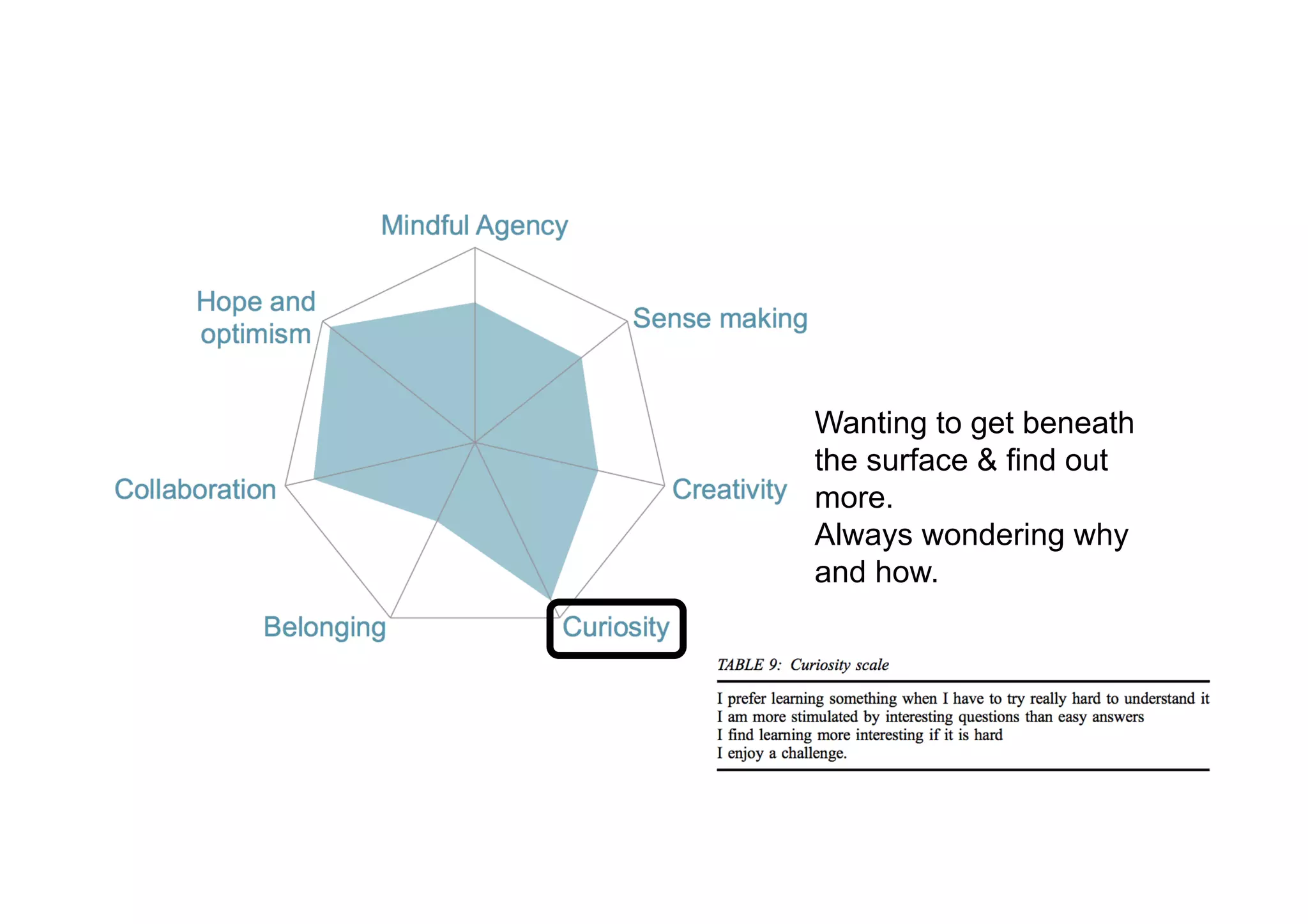
Wanting to get beneath
the surface & find out
more.
Always wondering why
and how.
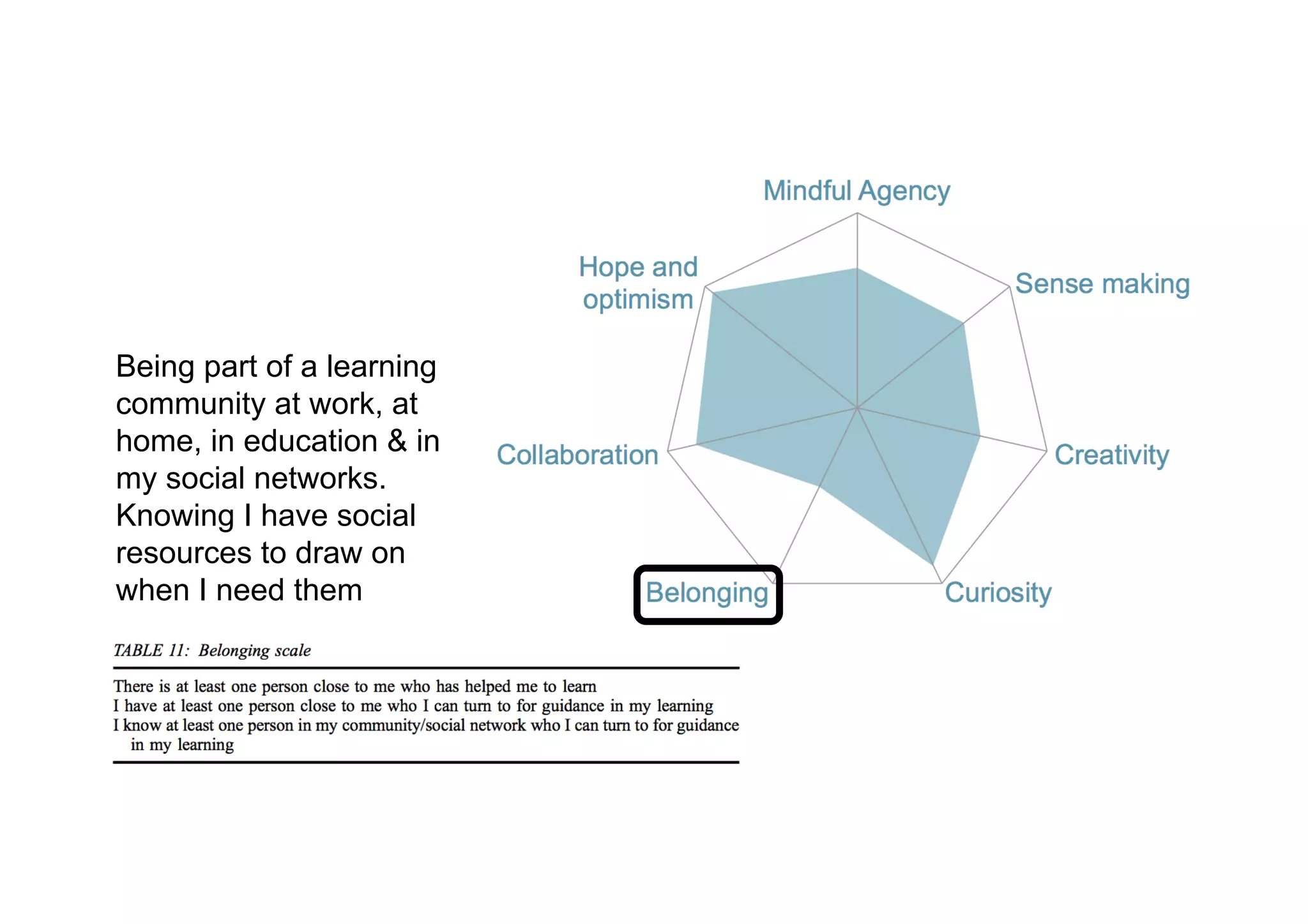
Being part of a learning
community at work, at
home, in education & in
my social networks.
Knowing I have social
resources to draw on
when I need them
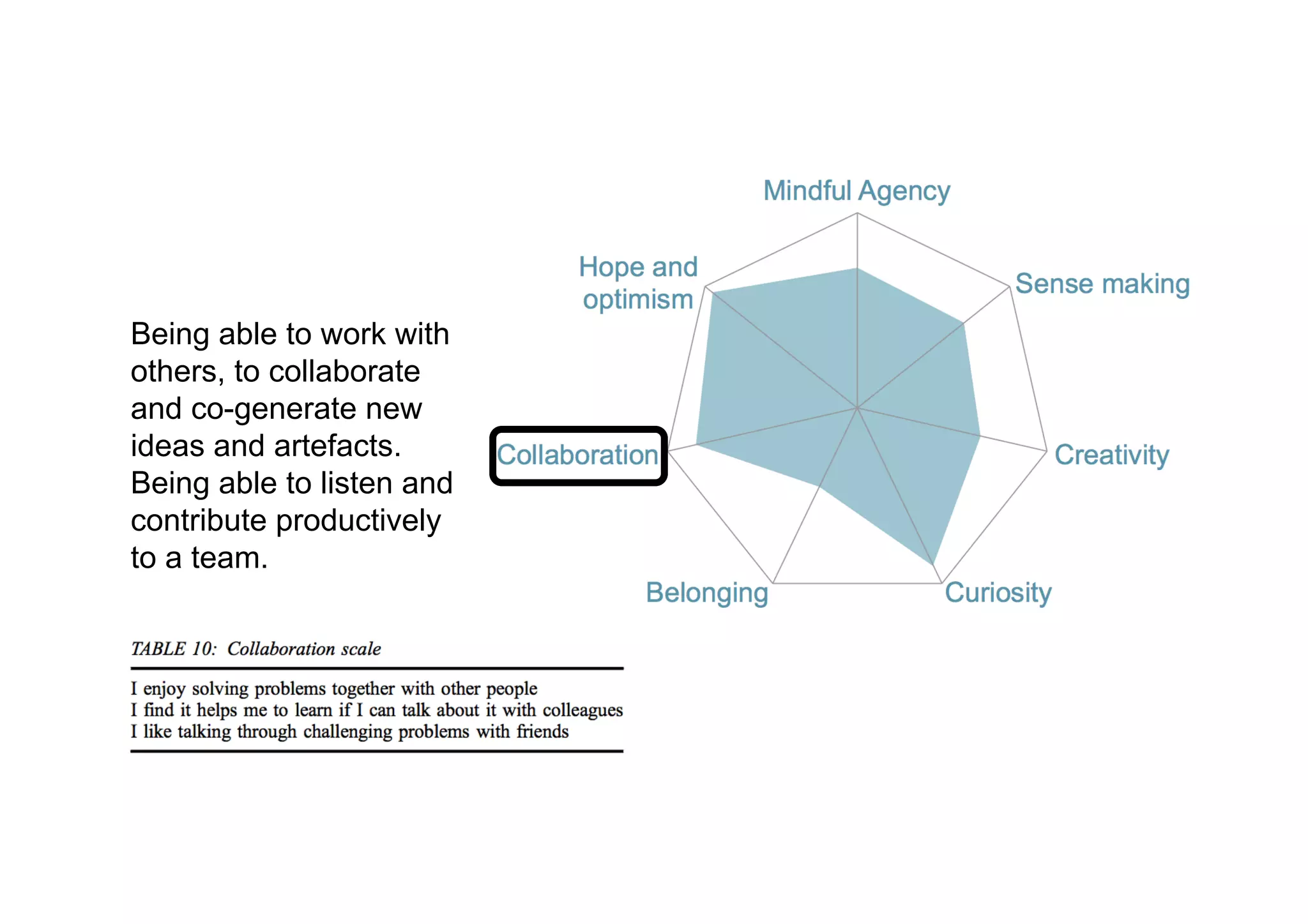
Being able to work with
others, to collaborate
and co-generate new
ideas and artefacts.
Being able to listen and
contribute productively
to a team.
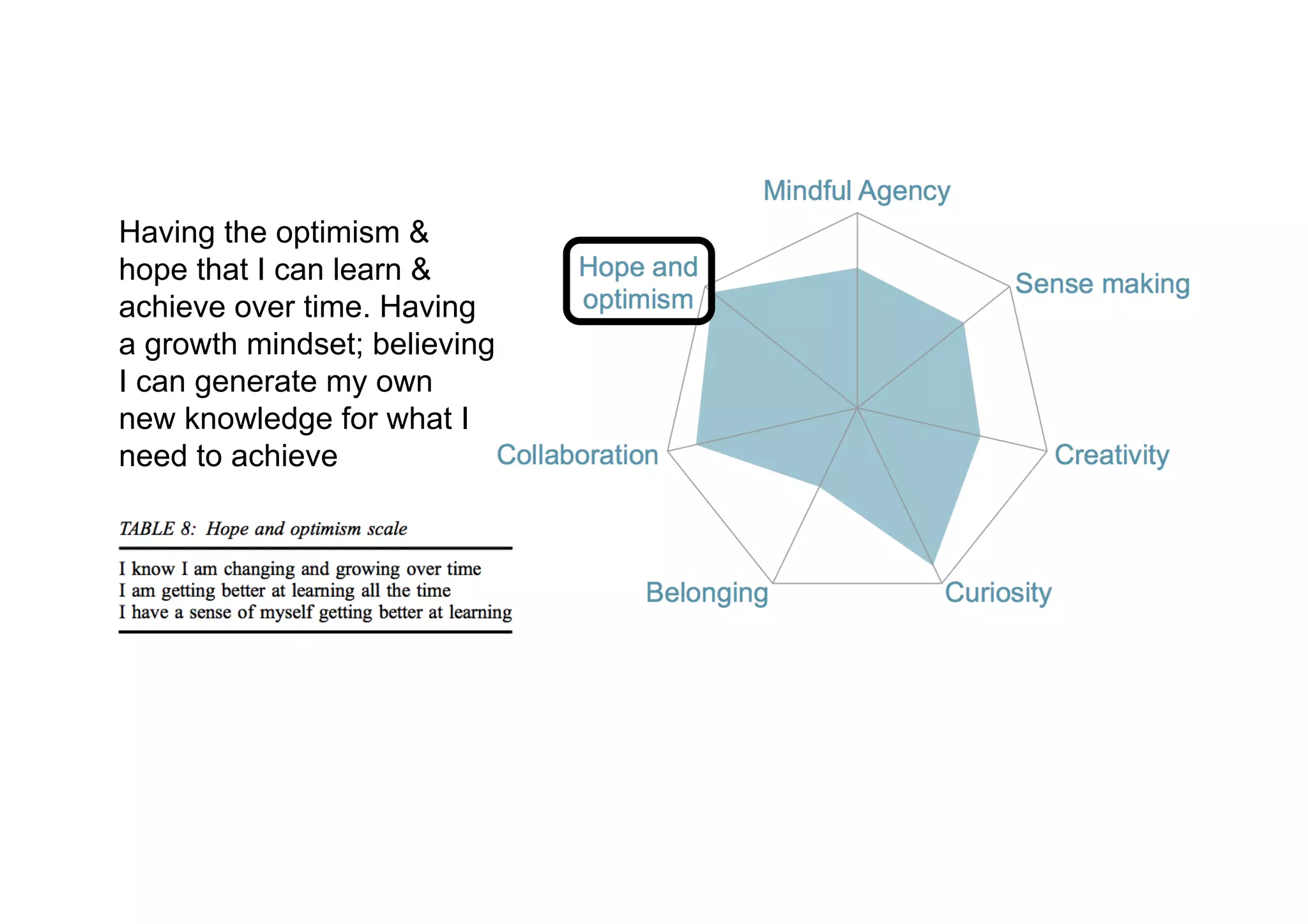
Having the optimism &
hope that I can learn &
achieve over time. Having
a growth mindset; believing
I can generate my own
new knowledge for what I
need to achieve
1
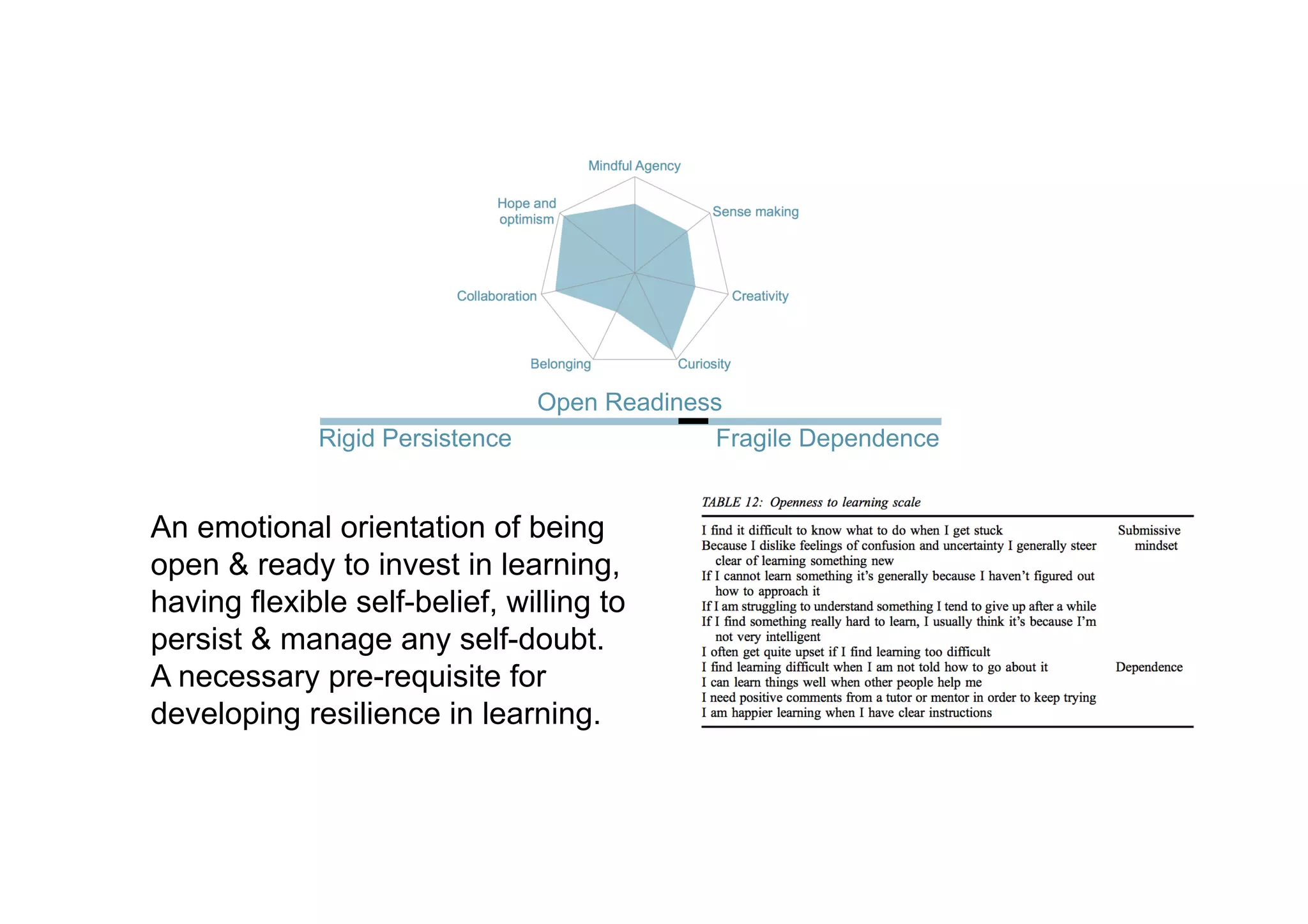
Open Readiness
Rigid Persistence Fragile Dependence
An emotional orientation of being
open & ready to invest in learning,
having flexible self-belief, willing to
persist & manage any self-doubt.
A necessary pre-requisite for
developing resilience in learning.
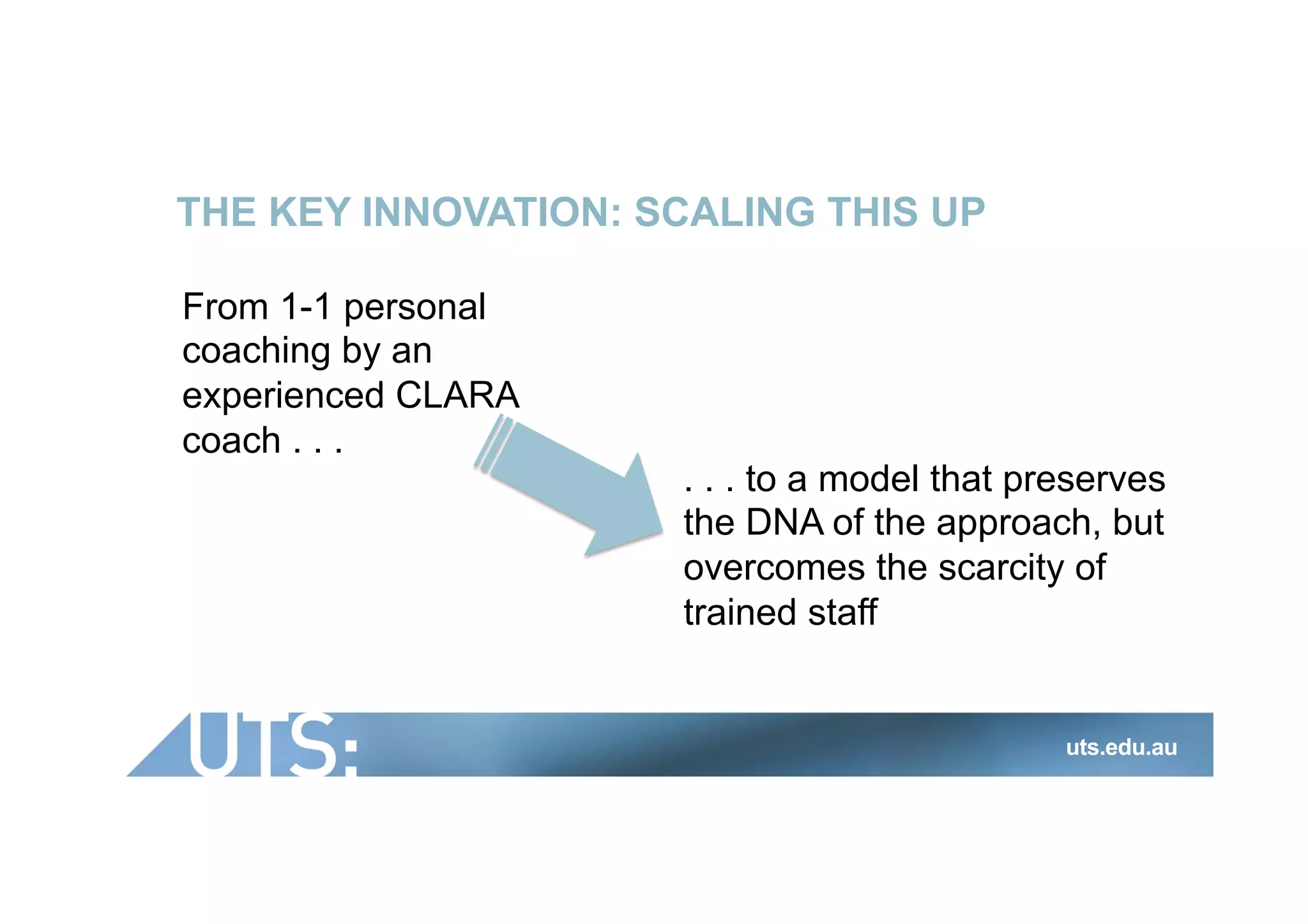
THE KEY INNOVATION: SCALING THIS UP
From 1-1 personal
coaching by an
experienced CLARA
coach . . .
uts.edu.au
. . . to a model that preserves
the DNA of the approach, but
overcomes the scarcity of
trained staff
FICTIONAL LEARNING POWER PROFILES
Scaling up CLARA (700-1100 students)
•  1-to-1 coaching not possible
•  Group coaching = potentially confronting
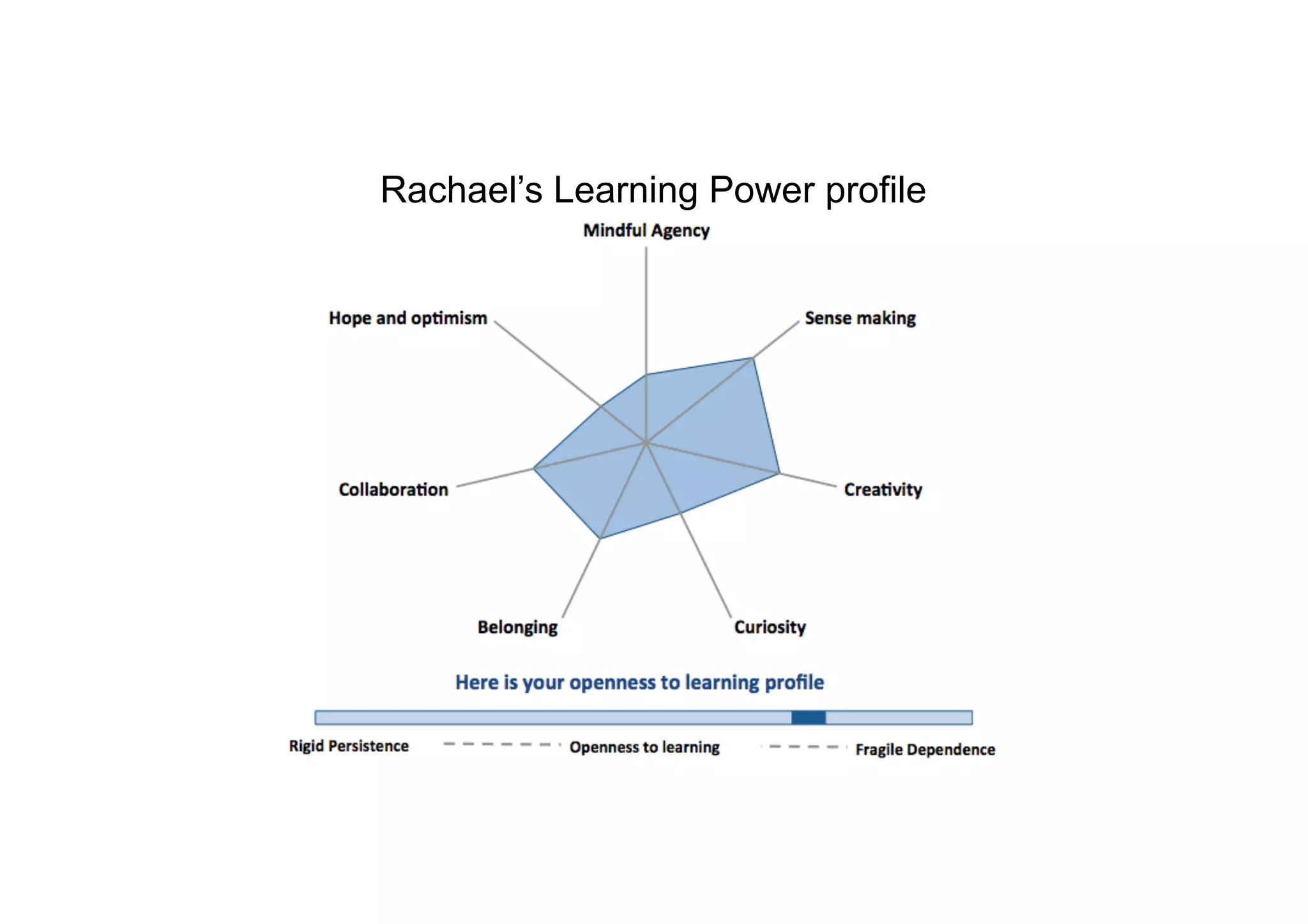
•  Authentic fictional profiles less personal
•  Based on real people (or archetypes)
uts.edu.au
uts.edu.au
Rachael’s Learning Power profile
uts.edu.au
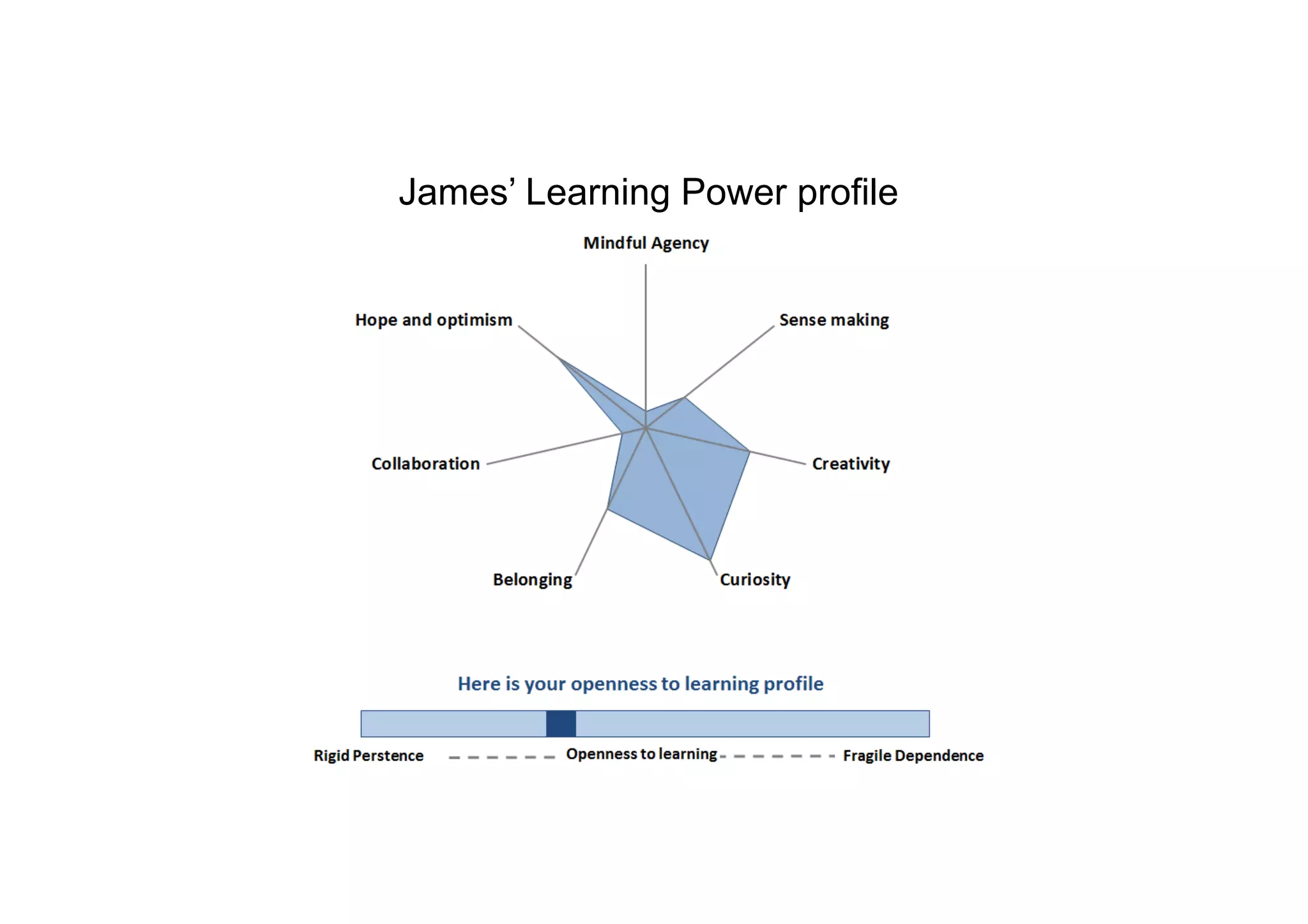
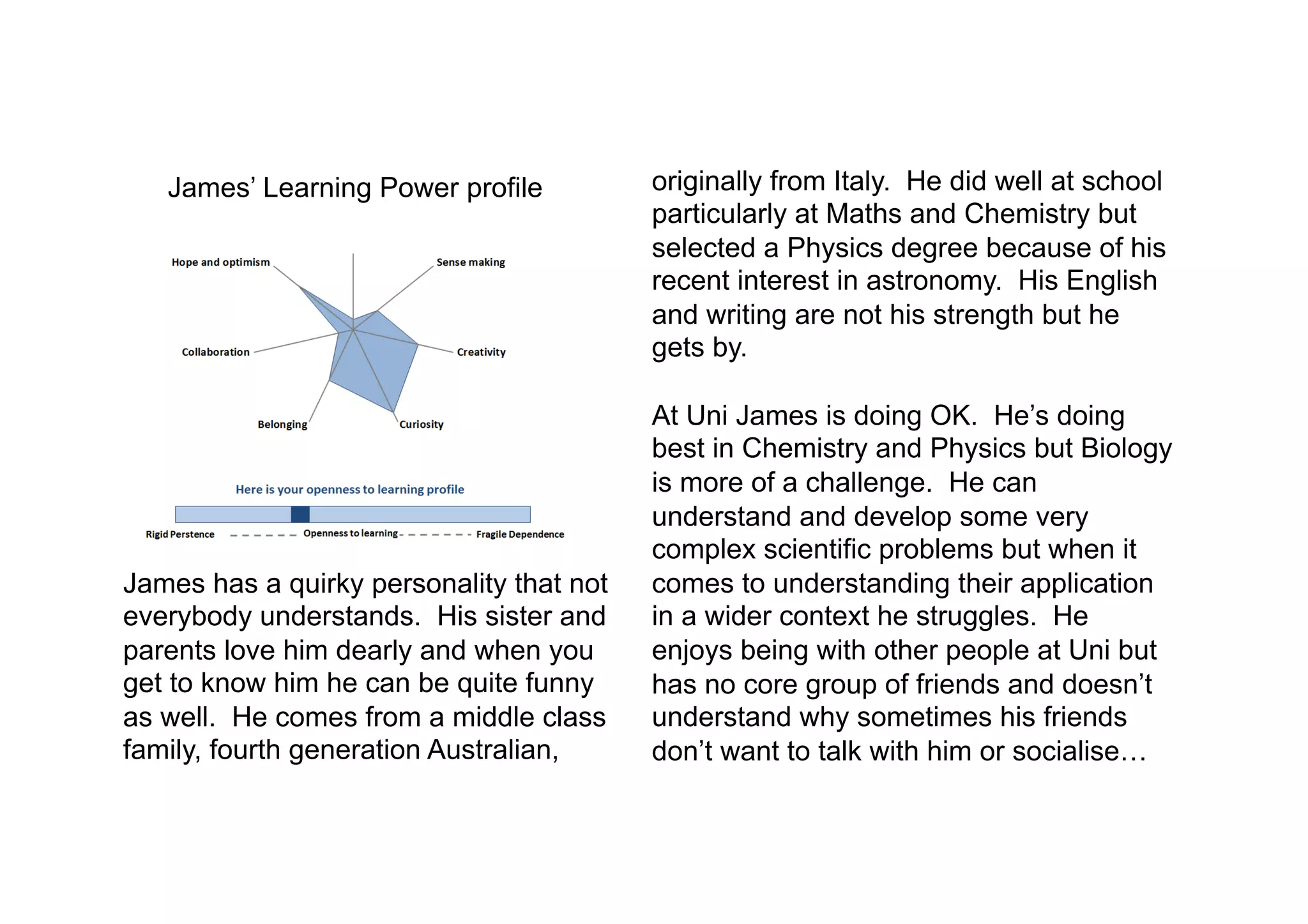
James’ Learning Power profile
uts.edu.au
James’ Learning Power profile
James has a quirky personality that not
everybody understands. His sister and
parents love him dearly and when you
get to know him he can be quite funny
as well. He comes from a middle class
family, fourth generation Australian,
originally from Italy. He did well at school
particularly at Maths and Chemistry but
selected a Physics degree because of his
recent interest in astronomy. His English
and writing are not his strength but he
gets by.
At Uni James is doing OK. He’s doing
best in Chemistry and Physics but Biology
is more of a challenge. He can
understand and develop some very
complex scientific problems but when it
comes to understanding their application
in a wider context he struggles. He
enjoys being with other people at Uni but
has no core group of friends and doesn’t
understand why sometimes his friends
don’t want to talk with him or socialise…
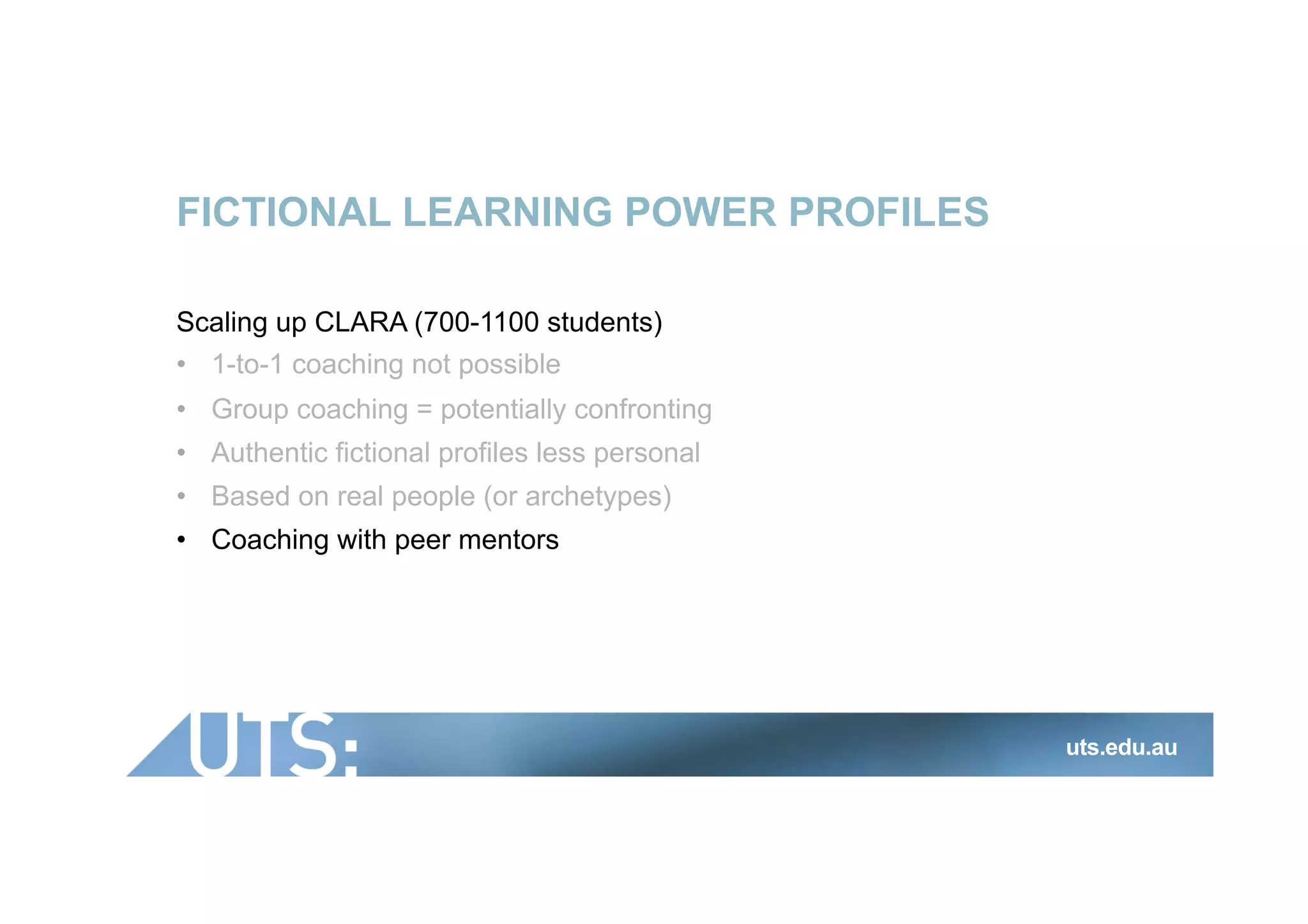
FICTIONAL LEARNING POWER PROFILES
Scaling up CLARA (700-1100 students)
•  1-to-1 coaching not possible
•  Group coaching = potentially confronting
•  Authentic fictional profiles less personal
•  Based on real people (or archetypes)
•  Coaching with peer mentors
uts.edu.au
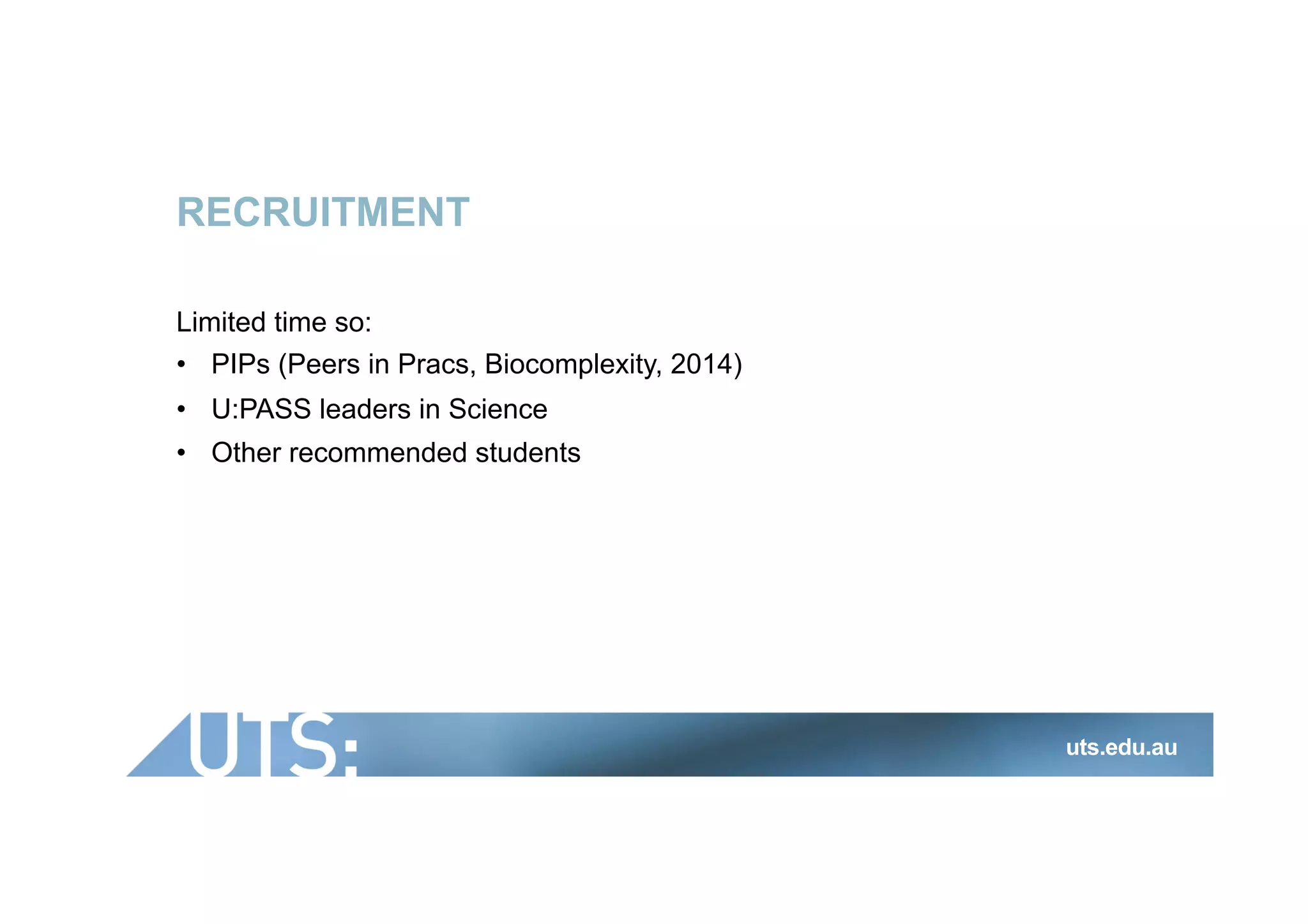
RECRUITMENT
Limited time so:
•  PIPs (Peers in Pracs, Biocomplexity, 2014)
•  U:PASS leaders in Science
•  Other recommended students
uts.edu.au
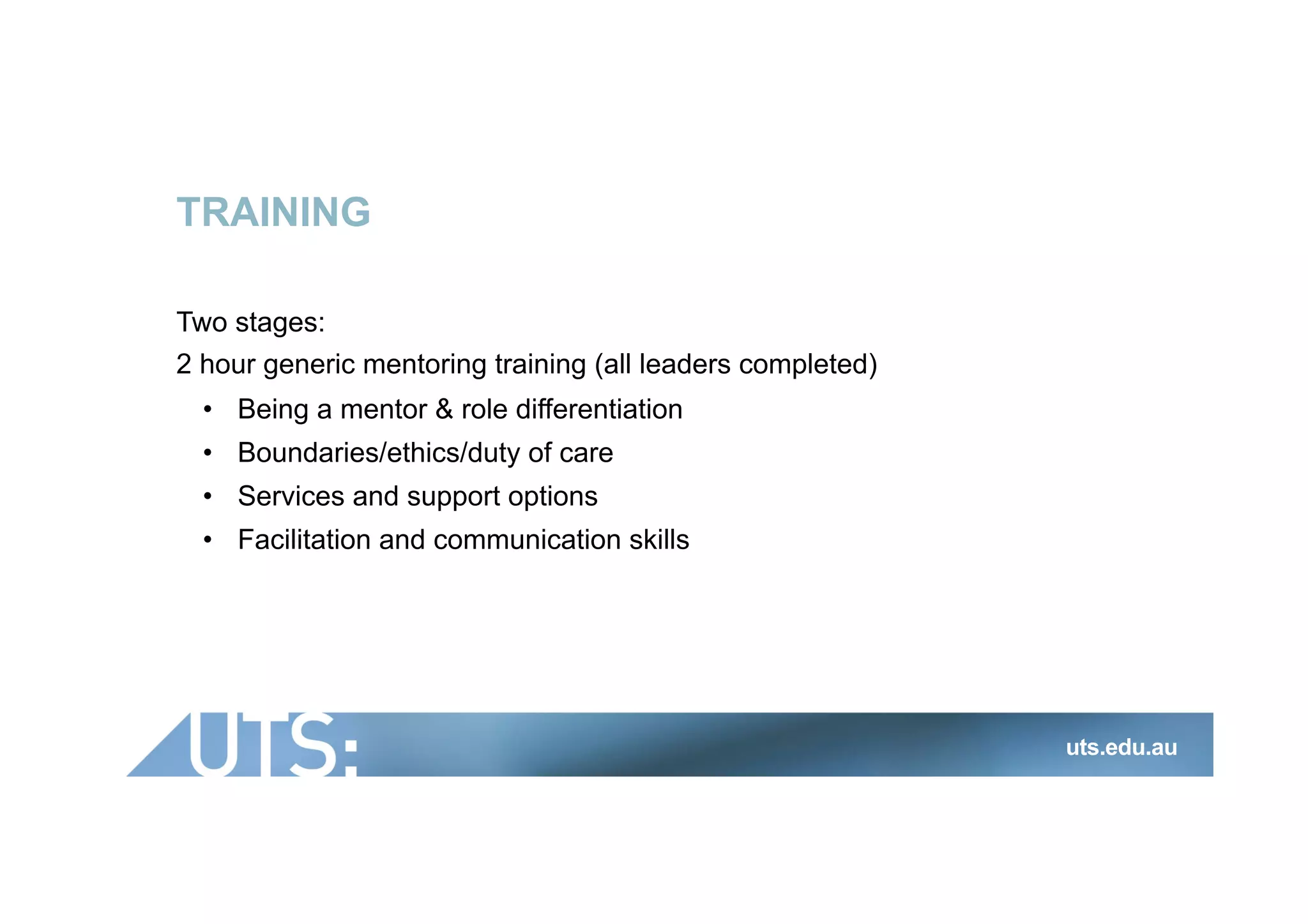
TRAINING
Two stages:
2 hour generic mentoring training (all leaders completed)
•  Being a mentor & role differentiation
•  Boundaries/ethics/duty of care
•  Services and support options
•  Facilitation and communication skills
uts.edu.au
TRAINING – STAGE 2
4 hour CLARA specific training
•  What is CLARA?
•  CLARA in Principles of Scientific Practice (PSP)
•  Spider diagrams & interpreting profiles
•  Group coaching principles
•  Fictional profile interpretation – workshop strategies
•  Practice coaching sessions
uts.edu.au
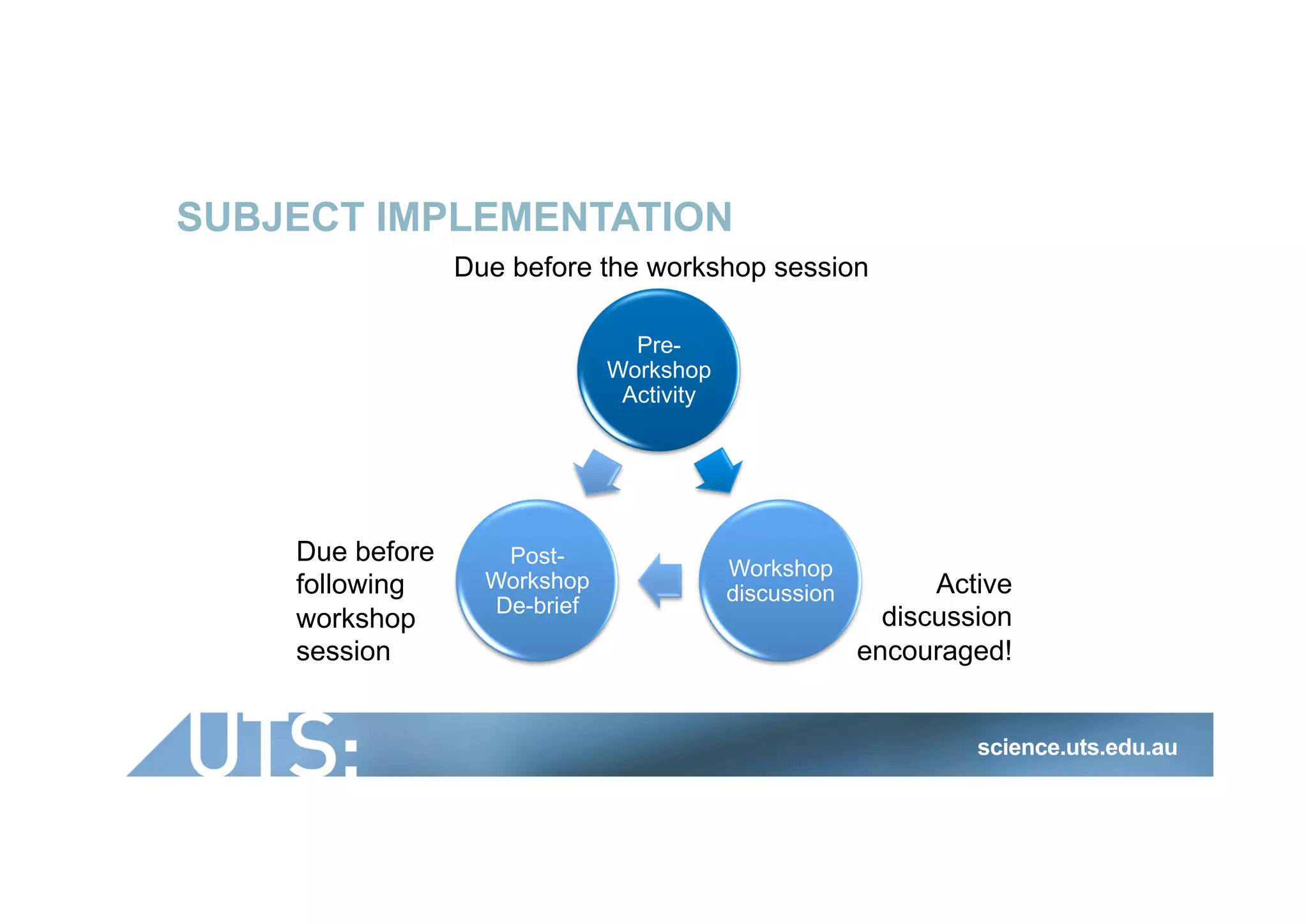
SUBJECT IMPLEMENTATION
science.uts.edu.au
Pre-
Workshop
Activity
Workshop
discussion
Post-
Workshop
De-brief
Due before the workshop session
Active
discussion
encouraged!
Due before
following
workshop
session
Week n
Pre-
workshop
Activity
Workshop
Discussion
Post-
workshop
Activity
science.uts.edu.au
Week n+1
Pre-
workshop
Activity
Workshop
Discussion
Post-
workshop
Activity
Week n+2
Pre-
workshop
Activity
Workshop
Discussion
Post-
workshop
Activity
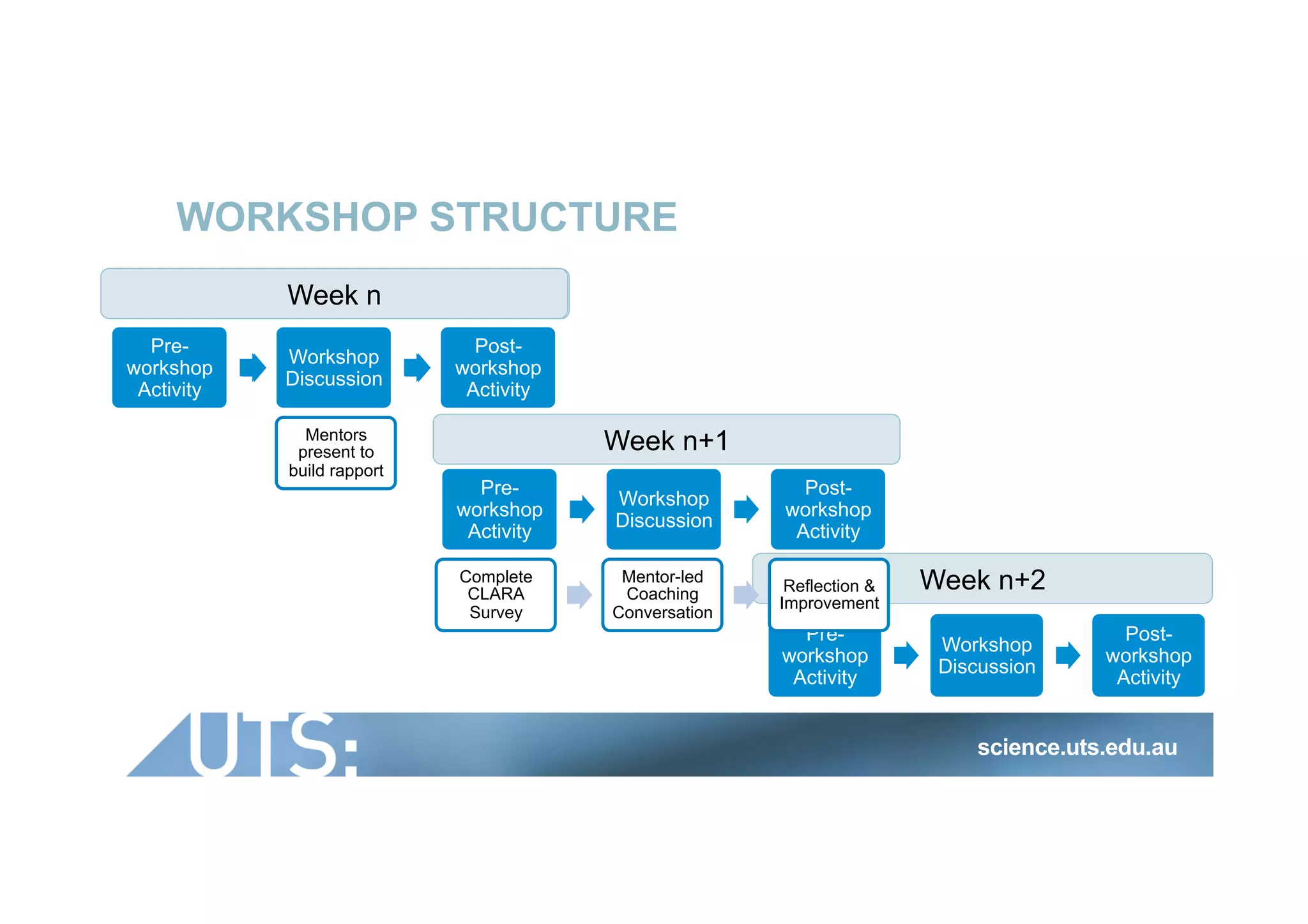
WORKSHOP STRUCTURE
Complete
CLARA
Survey
Mentor-led
Coaching
Conversation
Reflection &
Improvement
Week n
Pre-
workshop
Activity
Workshop
Discussion
Post-
workshop
Activity
Mentors
present to
build rapport
OUTCOMES TO DATE
•  Importance of:
•  Scaffolding
•  Location for group mentoring conversation
•  De-brief with mentors
•  Safety nets and handoffs for mentors
•  Mentor perspective
uts.edu.au
HANDS-ON EXERCISE
WITH OUR CLARA
MENTORS. . .
uts.edu.au
http://utscic.edu.au/projects/uts-projects/science-learning-power
uts.edu.au

Developing Resilient Agency in Learning

  • 1.
    UTS CRICOS PROVIDERCODE: 00099F DEVELOPING RESILIENT AGENCY IN LEARNING: USE OF CLARA FOR FIRST YEAR SCIENCE STUDENTS WITH COACHING SUPPORT uts.edu.au Alison Beavis, Andy Leigh, Peter Meier (Science), Georgina Barratt-See (HELPS) Ruth Crick (School of Education & CIC), Simon Buckingham Shum (CIC), and a team of our CLARA Student Mentors http://utscic.edu.au/projects/uts-projects/science-learning-power UTS First Year Experience Forum 23 Sept. 2015
  • 2.
    “CLARA-FYING” LEARNING MOTIVATION •  Todevelop a student’s sense of identity as a learner •  To explore strategies for scaling the use of CLARA OPPORTUNITY •  Creation of new first year Science subject as a vehicle for integrating CLARA uts.edu.au PROJECT OVERVIEW Mentor Recruitment & Training Curriculum Integration Mentor-led Coaching Conversations
  • 3.
  • 4.
    Personal Development Values, Attitudes, Dispositions, Identity, Story Learning Power Competenciesand skills for employability Knowledge, Skills and Understanding
  • 5.
    WHERE DID THISCONSTRUCT COME FROM? 3 year project to identify the most important qualities shown by effective learners, and then devise a valid assessment tool Experts & Practitioners consulted on overall process Meta-analysis of the literature (empirical + theoretical) Expert Workshops (policymakers + scholars) Leading Practitioner input to survey questions Survey design iterations and refinement Factor analysis on survey data (N=2000) Seven factors identified ELLI: Effective Lifelong Learning Inventory
  • 6.
    CRICK LEARNING FORRESILIENT AGENCY (CLARA) SURVEY Analysis of >40,000 learner profiles in ELLI led to an improved model of the core constructs underpinning CLARA Deakin Crick, R,. Huang, S., Ahmed-Shafi, A. and Goldspink, C. (2015) Developing Resilient Agency in Learning: The Internal Structure of Learning Power. British Journal of Educational Studies, Vol. 63, Issue 2, pp.121- 160. DOI: http://dx.doi.org/10.1080/00071005.2014.904038 uts.edu.au
  • 7.
    CLARA IS HOSTEDIN AN ENTERPRISE-GRADE SURVEY PLATFORM, RUN BY A NFP PARTNERSHIP uts.edu.au http://www.learningemergence.com/sola Not-for-profit partnership @Learning Emergence CLARA resources for learners/educators
  • 8.
    INSTANT VISUAL FEEDBACKTO RESPONDENT uts.edu.au Immediate personal feedback to stimulate self-directed change A framework for reflection and coaching conversation CLARA survey responses
  • 9.
    Taking responsibility for myown learning over time through defining my purposes, understanding and managing my feelings, knowing how I go about learning & planning my learning journey carefully.
  • 10.
    Making connections between whatI already know & new information & experience. Making meaning by linking my story, my new learning & my purpose.
  • 11.
    Using my intuition& imagination to generate new ideas & knowledge. Taking risks & playing with ideas and artefacts to arrive at new solutions.
  • 12.
    Wanting to getbeneath the surface & find out more. Always wondering why and how.
  • 13.
    Being part ofa learning community at work, at home, in education & in my social networks. Knowing I have social resources to draw on when I need them
  • 14.
    Being able towork with others, to collaborate and co-generate new ideas and artefacts. Being able to listen and contribute productively to a team.
  • 15.
    Having the optimism& hope that I can learn & achieve over time. Having a growth mindset; believing I can generate my own new knowledge for what I need to achieve
  • 16.
    1 Open Readiness Rigid PersistenceFragile Dependence An emotional orientation of being open & ready to invest in learning, having flexible self-belief, willing to persist & manage any self-doubt. A necessary pre-requisite for developing resilience in learning.
  • 17.
    THE KEY INNOVATION:SCALING THIS UP From 1-1 personal coaching by an experienced CLARA coach . . . uts.edu.au . . . to a model that preserves the DNA of the approach, but overcomes the scarcity of trained staff
  • 18.
    FICTIONAL LEARNING POWERPROFILES Scaling up CLARA (700-1100 students) •  1-to-1 coaching not possible •  Group coaching = potentially confronting •  Authentic fictional profiles less personal •  Based on real people (or archetypes) uts.edu.au
  • 19.
  • 20.
  • 21.
    uts.edu.au James’ Learning Powerprofile James has a quirky personality that not everybody understands. His sister and parents love him dearly and when you get to know him he can be quite funny as well. He comes from a middle class family, fourth generation Australian, originally from Italy. He did well at school particularly at Maths and Chemistry but selected a Physics degree because of his recent interest in astronomy. His English and writing are not his strength but he gets by. At Uni James is doing OK. He’s doing best in Chemistry and Physics but Biology is more of a challenge. He can understand and develop some very complex scientific problems but when it comes to understanding their application in a wider context he struggles. He enjoys being with other people at Uni but has no core group of friends and doesn’t understand why sometimes his friends don’t want to talk with him or socialise…
  • 22.
    FICTIONAL LEARNING POWERPROFILES Scaling up CLARA (700-1100 students) •  1-to-1 coaching not possible •  Group coaching = potentially confronting •  Authentic fictional profiles less personal •  Based on real people (or archetypes) •  Coaching with peer mentors uts.edu.au
  • 23.
    RECRUITMENT Limited time so: • PIPs (Peers in Pracs, Biocomplexity, 2014) •  U:PASS leaders in Science •  Other recommended students uts.edu.au
  • 24.
    TRAINING Two stages: 2 hourgeneric mentoring training (all leaders completed) •  Being a mentor & role differentiation •  Boundaries/ethics/duty of care •  Services and support options •  Facilitation and communication skills uts.edu.au
  • 25.
    TRAINING – STAGE2 4 hour CLARA specific training •  What is CLARA? •  CLARA in Principles of Scientific Practice (PSP) •  Spider diagrams & interpreting profiles •  Group coaching principles •  Fictional profile interpretation – workshop strategies •  Practice coaching sessions uts.edu.au
  • 26.
    SUBJECT IMPLEMENTATION science.uts.edu.au Pre- Workshop Activity Workshop discussion Post- Workshop De-brief Due beforethe workshop session Active discussion encouraged! Due before following workshop session
  • 27.
    Week n Pre- workshop Activity Workshop Discussion Post- workshop Activity science.uts.edu.au Week n+1 Pre- workshop Activity Workshop Discussion Post- workshop Activity Weekn+2 Pre- workshop Activity Workshop Discussion Post- workshop Activity WORKSHOP STRUCTURE Complete CLARA Survey Mentor-led Coaching Conversation Reflection & Improvement Week n Pre- workshop Activity Workshop Discussion Post- workshop Activity Mentors present to build rapport
  • 28.
    OUTCOMES TO DATE • Importance of: •  Scaffolding •  Location for group mentoring conversation •  De-brief with mentors •  Safety nets and handoffs for mentors •  Mentor perspective uts.edu.au
  • 29.
    HANDS-ON EXERCISE WITH OURCLARA MENTORS. . . uts.edu.au
  • 30.