A DIFFERENT CASE FOR BLENDED
          LEARNING


                                            Sean P. Kennedy
                     Senior Strategic Relationship Manager
                                Harvard Business Publishing
BLENDED LEARNING ADOPTION IS INCREASING


In a survey by the Masie Center, 50% of organizations
reported reductions in face-to-face training. 51%
reported increases in e-learning and virtual
classroom/webinars.

Cost reduction is a primary driver
 Instructor fees
 Travel costs
 Opportunity costs
EXCLUSIVE FOCUS ON COST SAVINGS IS A MISSED OPPORTUNITY


Re-design of learning initiatives represents an
opportunity to increase their effectiveness
  Support development of complex skills over time
  Connect learning to work
  Drive behavior change

Positioning learning as strategic investment
 Exclusive focus on cost reinforces perception of
  learning as “overhead”
 Increasing the top line on cost/benefit creates
  greater organizational impact
LEARNING DOESN’T HAPPEN IN ONE SHOT


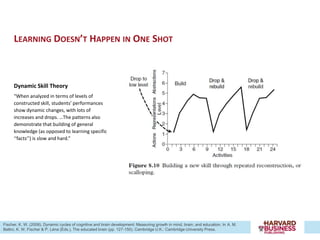
     Dynamic Skill Theory
     “When analyzed in terms of levels of
     constructed skill, students’ performances
     show dynamic changes, with lots of
     increases and drops. …The patterns also
     demonstrate that building of general
     knowledge (as opposed to learning specific
     ‘‘facts’’) is slow and hard.”


Fischer, K. W. (2008). Dynamic cycles of cognitive and brain development: Measuring growth in mind, brain, and education. In A. M.
Battro, K. W. Fischer & P. Léna (Eds.), The educated brain (pp. 127-150). Cambridge U.K.: Cambridge University Press.
PERFORMANCE LAGS POTENTIAL


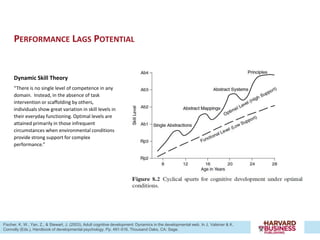
      Dynamic Skill Theory
      “There is no single level of competence in any
      domain. Instead, in the absence of task
      intervention or scaffolding by others,
      individuals show great variation in skill levels in
      their everyday functioning. Optimal levels are
      attained primarily in those infrequent
      circumstances when environmental conditions
      provide strong support for complex
      performance.”


Fischer, K. W., Yan, Z., & Stewart, J. (2003). Adult cognitive development: Dynamics in the developmental web. In J. Valsiner & K.
Connolly (Eds.), Handbook of developmental psychology. Pp. 491-516. Thousand Oaks, CA: Sage.
HOPE IS NOT A TRANSFER STRATEGY


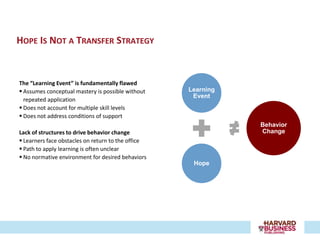
The “Learning Event” is fundamentally flawed
 Assumes conceptual mastery is possible without    Learning
                                                     Event
  repeated application
 Does not account for multiple skill levels
 Does not address conditions of support
                                                               Behavior
Lack of structures to drive behavior change                    Change
 Learners face obstacles on return to the office
 Path to apply learning is often unclear
 No normative environment for desired behaviors
                                                     Hope
TRANSITION FROM EVENT TO PROCESS


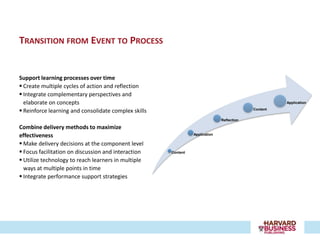
Support learning processes over time
 Create multiple cycles of action and reflection
 Integrate complementary perspectives and
  elaborate on concepts                                                                              Application

 Reinforce learning and consolidate complex skills                                        Content


                                                                              Reflection

Combine delivery methods to maximize
effectiveness                                                   Application

 Make delivery decisions at the component level
 Focus facilitation on discussion and interaction    Content

 Utilize technology to reach learners in multiple
  ways at multiple points in time
 Integrate performance support strategies
CONNECT WORK AND LEARNING


 Structure learning around work
  Strategic initiatives
  Key business processes
  Role transitions

 Bridge the transfer gap
  Goal setting
  Application tools
  Action learning teams
SEIZE THE OPPORTUNITY

The traditional approach is a “burning platform”
 Use the demand for cost and time savings as an opening
  to transform leader development

Pilot new approaches
 Target pivotal audiences and strategic needs
 Integrate multiple delivery modes
 Test new interventions and technologies

Re-position leader development as strategic investment
 Move beyond cost to impact
 Align programs to key initiatives
 Connect to talent strategy
 Build metrics scorecards
MORE INFORMATION:

Sean Kennedy
skennedy@harvardbusiness.org


10

A Different Case for Blended Learning

  • 1.
    A DIFFERENT CASEFOR BLENDED LEARNING Sean P. Kennedy Senior Strategic Relationship Manager Harvard Business Publishing
  • 2.
    BLENDED LEARNING ADOPTIONIS INCREASING In a survey by the Masie Center, 50% of organizations reported reductions in face-to-face training. 51% reported increases in e-learning and virtual classroom/webinars. Cost reduction is a primary driver  Instructor fees  Travel costs  Opportunity costs
  • 3.
    EXCLUSIVE FOCUS ONCOST SAVINGS IS A MISSED OPPORTUNITY Re-design of learning initiatives represents an opportunity to increase their effectiveness  Support development of complex skills over time  Connect learning to work  Drive behavior change Positioning learning as strategic investment  Exclusive focus on cost reinforces perception of learning as “overhead”  Increasing the top line on cost/benefit creates greater organizational impact
  • 4.
    LEARNING DOESN’T HAPPENIN ONE SHOT Dynamic Skill Theory “When analyzed in terms of levels of constructed skill, students’ performances show dynamic changes, with lots of increases and drops. …The patterns also demonstrate that building of general knowledge (as opposed to learning specific ‘‘facts’’) is slow and hard.” Fischer, K. W. (2008). Dynamic cycles of cognitive and brain development: Measuring growth in mind, brain, and education. In A. M. Battro, K. W. Fischer & P. Léna (Eds.), The educated brain (pp. 127-150). Cambridge U.K.: Cambridge University Press.
  • 5.
    PERFORMANCE LAGS POTENTIAL Dynamic Skill Theory “There is no single level of competence in any domain. Instead, in the absence of task intervention or scaffolding by others, individuals show great variation in skill levels in their everyday functioning. Optimal levels are attained primarily in those infrequent circumstances when environmental conditions provide strong support for complex performance.” Fischer, K. W., Yan, Z., & Stewart, J. (2003). Adult cognitive development: Dynamics in the developmental web. In J. Valsiner & K. Connolly (Eds.), Handbook of developmental psychology. Pp. 491-516. Thousand Oaks, CA: Sage.
  • 6.
    HOPE IS NOTA TRANSFER STRATEGY The “Learning Event” is fundamentally flawed  Assumes conceptual mastery is possible without Learning Event repeated application  Does not account for multiple skill levels  Does not address conditions of support Behavior Lack of structures to drive behavior change Change  Learners face obstacles on return to the office  Path to apply learning is often unclear  No normative environment for desired behaviors Hope
  • 7.
    TRANSITION FROM EVENTTO PROCESS Support learning processes over time  Create multiple cycles of action and reflection  Integrate complementary perspectives and elaborate on concepts Application  Reinforce learning and consolidate complex skills Content Reflection Combine delivery methods to maximize effectiveness Application  Make delivery decisions at the component level  Focus facilitation on discussion and interaction Content  Utilize technology to reach learners in multiple ways at multiple points in time  Integrate performance support strategies
  • 8.
    CONNECT WORK ANDLEARNING Structure learning around work  Strategic initiatives  Key business processes  Role transitions Bridge the transfer gap  Goal setting  Application tools  Action learning teams
  • 9.
    SEIZE THE OPPORTUNITY Thetraditional approach is a “burning platform”  Use the demand for cost and time savings as an opening to transform leader development Pilot new approaches  Target pivotal audiences and strategic needs  Integrate multiple delivery modes  Test new interventions and technologies Re-position leader development as strategic investment  Move beyond cost to impact  Align programs to key initiatives  Connect to talent strategy  Build metrics scorecards
  • 10.