Disposal
Task You are a resident in a medium sized town and your community needs to decide what system of  waste disposal  your town should have once the current landfill is full (which will be in two years). You have looked into the choices and they include:
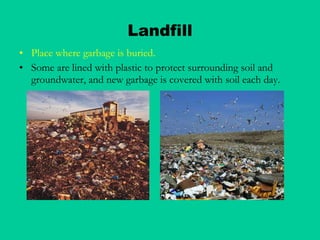
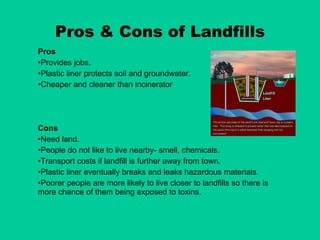
Landfill Place where garbage is buried. Some are lined with plastic to protect surrounding soil and groundwater, and new garbage is covered with soil each day.
Pros & Cons of Landfills Pros Provides jobs. Plastic liner protects soil and groundwater. Cheaper and cleaner than incinerator Cons Need land. People do not like to live nearby- smell, chemicals. Transport costs if landfill is further away from town. Plastic liner eventually breaks and leaks hazardous materials. Poorer people are more likely to live closer to landfills so there is more chance of them being exposed to toxins.
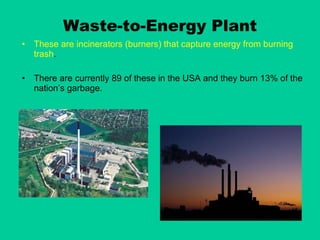
Waste-to-Energy Plant These are incinerators (burners) that capture energy from burning trash . There are currently 89 of these in the USA and they burn 13% of the nation’s garbage.
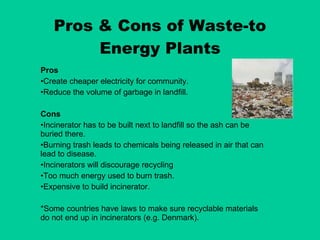
Pros & Cons of Waste-to Energy Plants Pros Create cheaper electricity for community. Reduce the volume of garbage in landfill. Cons Incinerator has to be built next to landfill so the ash can be buried there. Burning trash leads to chemicals being released in air that can lead to disease. Incinerators will discourage recycling Too much energy used to burn trash. Expensive to build incinerator. *Some countries have laws to make sure recyclable materials do not end up in incinerators (e.g. Denmark).
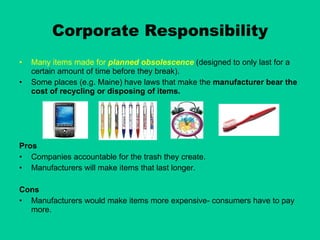
Corporate Responsibility Many items made for  planned obsolescence   (designed to only last for a certain amount of time before they break). Some places (e.g. Maine) have laws that make the  manufacturer bear the cost of recycling or disposing of items. Pros Companies accountable for the trash they create. Manufacturers will make items that last longer. Cons Manufacturers would make items more expensive- consumers have to pay more.
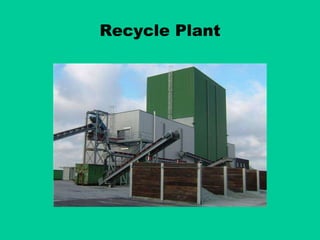
Recycle Plant
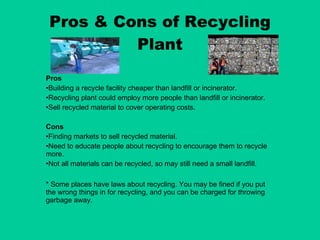
Pros & Cons of Recycling Plant Pros Building a recycle facility cheaper than landfill or incinerator. Recycling plant could employ more people than landfill or incinerator. Sell recycled material to cover operating costs. Cons Finding markets to sell recycled material. Need to educate people about recycling to encourage them to recycle more. Not all materials can be recycled, so may still need a small landfill. * Some places have laws about recycling. You may be fined if you put the wrong things in for recycling, and you can be charged for throwing garbage away.
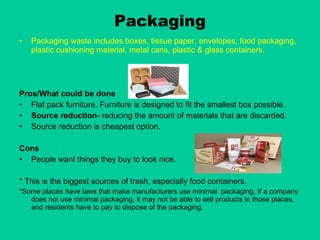
Packaging Packaging waste includes boxes, tissue paper, envelopes, food packaging, plastic cushioning material, metal cans, plastic & glass containers. Pros/What could be done Flat pack furniture. Furniture is designed to fit the smallest box possible. Source reduction-  reducing the amount of materials that are discarded. Source reduction is cheapest option. Cons People want things they buy to look nice. * This is the biggest sources of trash, especially food containers. *Some places have laws that make manufacturers use minimal  packaging. If a company does not use minimal packaging, it may not be able to sell products in those places, and residents have to pay to dispose of the packaging.
Time to decide… ??? 1. In groups of 3 or 4 think about whether you can add any more pros and/ or cons to the disposal systems discussed:  landfill waste to energy plant corporate responsibility recycle depot reduced packaging 2. Discuss and decide  what disposal system would you choose? Give reasons for your answer.  3. Be prepared to share with the class.
Sources Book Buy, Use, Toss? A Closer Look at the Things We buy. Facing the Future, 2010. Images Landfills  In The,  www.ctrecyclingguide.com/ . Retrieved 13 Nov 2010. Landfill  Crosssection,  www.ottawaskeptics.org/the-reali...art%3D70 . Retrieved 13 Nov 2010. Landfill. http://blog.lib.umn.edu/evans391/architecture/Garbage_landfill.jpg  Retrieved 13 Nov 2010. Waste to Energy Plant. Vestforbrænding, the largest  waste -to- energy plant  in Denmark handling more.  www.dbdh.dk/artikel.asp%3Fid%3D4...mid%3D24  Retrieved 13 Nov 2010. Waste to Energy plant. WASTE  TO  ENERGY : The H. C. Ørsted and Avedøre power stations in Copenhagen.  www.mnn.com/earth-matters/energy...n-energy  Retrieved 13 Nov 2010. Handphone. http://www.b2btrade.biz/images2/img476718d97c949.jpg  Retrieved 13 Nov 2010. Alarm clock.  http://www.freewebs.com/marvelouscreations/alarm-clock-CB-1.jpg  Retrieved 13 Nov 2010. Pens  http://www.ssbmetal.com/img/Promotional_Pens.jpg  Retrieved 13 Nov 2010. Toothbrush  http://besttoothbrushs.com/wp-content/uploads/2010/05/Toothbrush.jpg  Retrieved 13 Nov 2010. Recycle Plant  http://www.gpmglass.com/IMG/jpg/Recycling_Plant.jpg  Retrieved 13 Nov 2010. Recycle depot  http://www.banff.ca/Assets/Images/Locals+Images/Environment/Recycling+Depot.jpg  Retrieved 13 Nov 2010. Crushed drink bottles  http://www.smh.com.au/ffximage/2007/07/28/recycling_wideweb__470x312,0.jpg  Retrieved 13 Nov 2010. Packaging  http://www.dfwimprint.com/images/packaging.jpg  Retrieved 13 Nov 2010. Packaging  http://www.greatlittlebox.com/files/Image/Products/Protective%20Packaging%20Picture.jpg  Retrieved 13 Nov 2010.
Has this lesson made you more thoughtful about where your trash goes? In what way? Who do you think should be responsible for disposing of hard- to- recycle products or those not designed to last long? Consumers? Manufacturers? Governments? How could efficient waste management reduce the need for extracting natural resources to make new products? Researchers have found out that we often throw out very different kinds and amounts of trash than we think we do. Why might we have a distorted image of our trash? How could people become more aware about the trash they create? You have heard of the popular waste management strategy of “ reduce, reuse, recycle. ” Why do you think the words are listed in that order? Questions to Think About:

Disposal pp

  • 1.
  • 2.
    Task You area resident in a medium sized town and your community needs to decide what system of waste disposal your town should have once the current landfill is full (which will be in two years). You have looked into the choices and they include:
  • 3.
    Landfill Place wheregarbage is buried. Some are lined with plastic to protect surrounding soil and groundwater, and new garbage is covered with soil each day.
  • 4.
    Pros & Consof Landfills Pros Provides jobs. Plastic liner protects soil and groundwater. Cheaper and cleaner than incinerator Cons Need land. People do not like to live nearby- smell, chemicals. Transport costs if landfill is further away from town. Plastic liner eventually breaks and leaks hazardous materials. Poorer people are more likely to live closer to landfills so there is more chance of them being exposed to toxins.
  • 5.
    Waste-to-Energy Plant Theseare incinerators (burners) that capture energy from burning trash . There are currently 89 of these in the USA and they burn 13% of the nation’s garbage.
  • 6.
    Pros & Consof Waste-to Energy Plants Pros Create cheaper electricity for community. Reduce the volume of garbage in landfill. Cons Incinerator has to be built next to landfill so the ash can be buried there. Burning trash leads to chemicals being released in air that can lead to disease. Incinerators will discourage recycling Too much energy used to burn trash. Expensive to build incinerator. *Some countries have laws to make sure recyclable materials do not end up in incinerators (e.g. Denmark).
  • 7.
    Corporate Responsibility Manyitems made for planned obsolescence (designed to only last for a certain amount of time before they break). Some places (e.g. Maine) have laws that make the manufacturer bear the cost of recycling or disposing of items. Pros Companies accountable for the trash they create. Manufacturers will make items that last longer. Cons Manufacturers would make items more expensive- consumers have to pay more.
  • 8.
  • 9.
    Pros & Consof Recycling Plant Pros Building a recycle facility cheaper than landfill or incinerator. Recycling plant could employ more people than landfill or incinerator. Sell recycled material to cover operating costs. Cons Finding markets to sell recycled material. Need to educate people about recycling to encourage them to recycle more. Not all materials can be recycled, so may still need a small landfill. * Some places have laws about recycling. You may be fined if you put the wrong things in for recycling, and you can be charged for throwing garbage away.
  • 10.
    Packaging Packaging wasteincludes boxes, tissue paper, envelopes, food packaging, plastic cushioning material, metal cans, plastic & glass containers. Pros/What could be done Flat pack furniture. Furniture is designed to fit the smallest box possible. Source reduction- reducing the amount of materials that are discarded. Source reduction is cheapest option. Cons People want things they buy to look nice. * This is the biggest sources of trash, especially food containers. *Some places have laws that make manufacturers use minimal packaging. If a company does not use minimal packaging, it may not be able to sell products in those places, and residents have to pay to dispose of the packaging.
  • 11.
    Time to decide…??? 1. In groups of 3 or 4 think about whether you can add any more pros and/ or cons to the disposal systems discussed: landfill waste to energy plant corporate responsibility recycle depot reduced packaging 2. Discuss and decide what disposal system would you choose? Give reasons for your answer. 3. Be prepared to share with the class.
  • 12.
    Sources Book Buy,Use, Toss? A Closer Look at the Things We buy. Facing the Future, 2010. Images Landfills In The, www.ctrecyclingguide.com/ . Retrieved 13 Nov 2010. Landfill Crosssection, www.ottawaskeptics.org/the-reali...art%3D70 . Retrieved 13 Nov 2010. Landfill. http://blog.lib.umn.edu/evans391/architecture/Garbage_landfill.jpg Retrieved 13 Nov 2010. Waste to Energy Plant. Vestforbrænding, the largest waste -to- energy plant in Denmark handling more. www.dbdh.dk/artikel.asp%3Fid%3D4...mid%3D24 Retrieved 13 Nov 2010. Waste to Energy plant. WASTE TO ENERGY : The H. C. Ørsted and Avedøre power stations in Copenhagen. www.mnn.com/earth-matters/energy...n-energy Retrieved 13 Nov 2010. Handphone. http://www.b2btrade.biz/images2/img476718d97c949.jpg Retrieved 13 Nov 2010. Alarm clock. http://www.freewebs.com/marvelouscreations/alarm-clock-CB-1.jpg Retrieved 13 Nov 2010. Pens http://www.ssbmetal.com/img/Promotional_Pens.jpg Retrieved 13 Nov 2010. Toothbrush http://besttoothbrushs.com/wp-content/uploads/2010/05/Toothbrush.jpg Retrieved 13 Nov 2010. Recycle Plant http://www.gpmglass.com/IMG/jpg/Recycling_Plant.jpg Retrieved 13 Nov 2010. Recycle depot http://www.banff.ca/Assets/Images/Locals+Images/Environment/Recycling+Depot.jpg Retrieved 13 Nov 2010. Crushed drink bottles http://www.smh.com.au/ffximage/2007/07/28/recycling_wideweb__470x312,0.jpg Retrieved 13 Nov 2010. Packaging http://www.dfwimprint.com/images/packaging.jpg Retrieved 13 Nov 2010. Packaging http://www.greatlittlebox.com/files/Image/Products/Protective%20Packaging%20Picture.jpg Retrieved 13 Nov 2010.
  • 13.
    Has this lessonmade you more thoughtful about where your trash goes? In what way? Who do you think should be responsible for disposing of hard- to- recycle products or those not designed to last long? Consumers? Manufacturers? Governments? How could efficient waste management reduce the need for extracting natural resources to make new products? Researchers have found out that we often throw out very different kinds and amounts of trash than we think we do. Why might we have a distorted image of our trash? How could people become more aware about the trash they create? You have heard of the popular waste management strategy of “ reduce, reuse, recycle. ” Why do you think the words are listed in that order? Questions to Think About: