The Role of Procedural Memory in
Adult Second Language Acquisition
CogSci 2014
Katherine A. Brill-Schuetz
& Kara Morgan-Short
July 25, 2014
Adult L2 Development
• Adult second language (L2) learners have
shown varying degrees of development
and final attainment (Newport, 1990; DeKeyser, 2000; White
& Genesee, 1996; Clashen & Felser, 2006)
• This variation may be due to differences in
cognitive abilities (Ehrman & Oxford, 1995)
• The effect of these differences on L2
development may depend on learning
context (Ellis, 1993; Robinson 1997, 2001)
Procedural Memory in L2 Development
• Theory posits an important role for
procedural memory in L2 development
• Declarative/Procedural Model (Ullman, 2001, 2004, 2005)
• L2: as proficiency increases, there is a potential
shift of certain grammar processing to procedural
memory
• Skill Acquisition Theory of L2 (DeKeyser, 2007)
• Procedural memory has significant role in final
stages (proceduralization and automatization)
Empirical Support
• Procedural memory has been shown to
play a role in L2 development
• High scores on measures of procedural
memory correlated to success in learning an
artificial morphophonological rule (Ettlinger, Bradlow
& Wong, 2010)
• Procedural memory correlated with successful
learning of an artificial language in implicit
training conditions (Carpenter, 2008; Morgan-Short, Faretta-
Stutenberg, Brill-Schuetz, Carpenter, Wong, 2014)
Aptitude Treatment Interaction
• Role of procedural memory may be
affected by learning context
• An aptitude-treatment interaction (ATI)
suggests tasks will differentially recruit
cognitive abilities (Cronbach, 1957, 1975)
• Ability Differentiation Hypothesis - important
to match L2 learners to conditions of practice
that favor their cognitive strengths (Robinson, 2007)
Motivation and Goals
• Investigate role of procedural memory in L2
development
• Multiple measures of procedural memory
• Implicit and explicit training conditions
• Investigate ATI involving procedural memory
Predictions/Hypotheses
• The role of procedural memory changes
depending on learning context
• Prediction: Participants with stronger
procedural memory will show higher levels of
proficiency at final assessment, particularly
under implicit training conditions
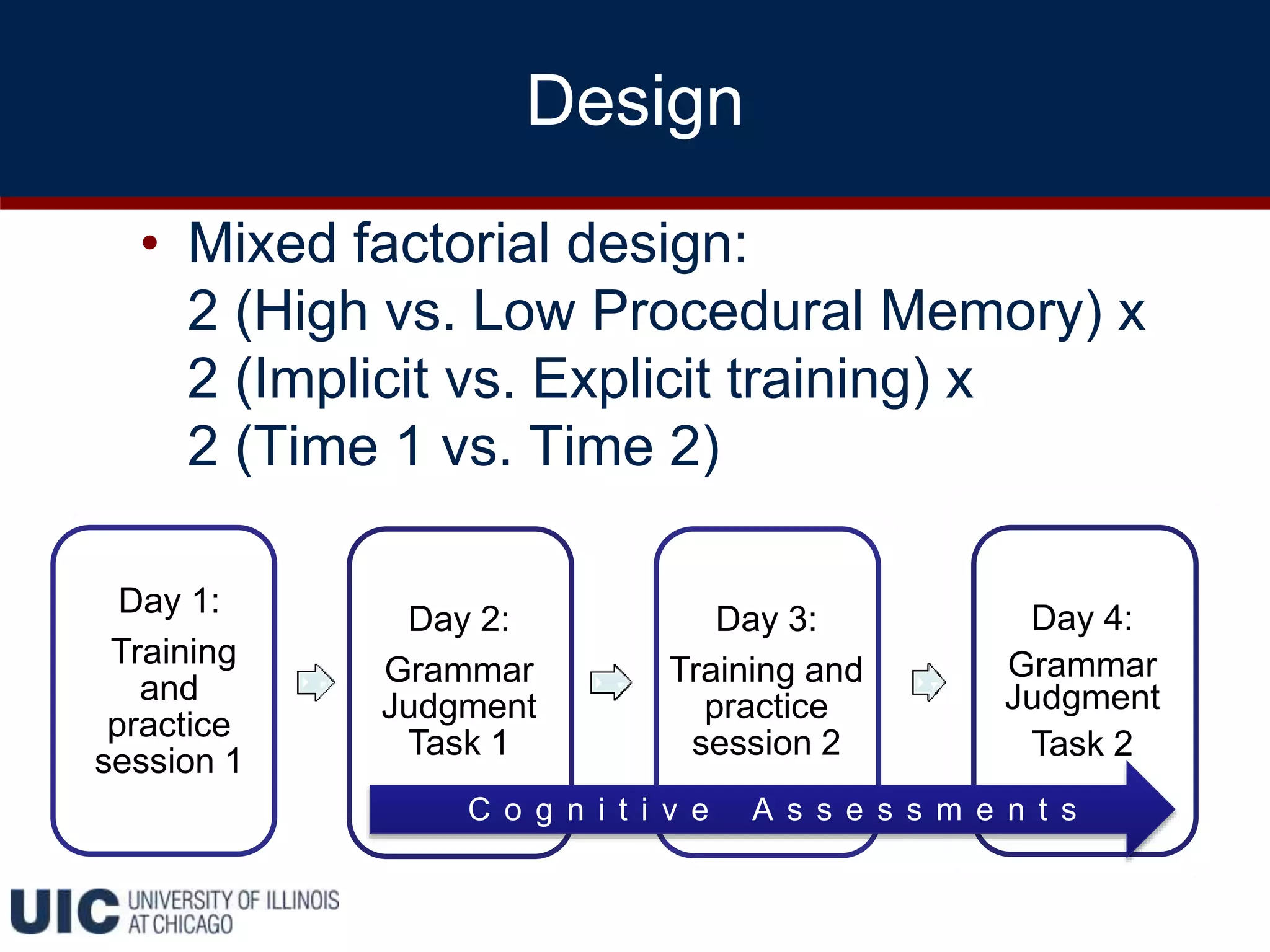
Design
• Mixed factorial design:
2 (High vs. Low Procedural Memory) x
2 (Implicit vs. Explicit training) x
2 (Time 1 vs. Time 2)
Day 1:
Training
and
practice
session 1
Day 2:
Grammar
Judgment
Task 1
Day 3:
Training and
practice
session 2
Day 4:
Grammar
Judgment
Task 2
C o g n i t i v e A s s e s s m e n t s
Experimental Design: Methods
• Participants:
• 26 (16 female) participants recruited from
psychology subject pool and were paid
participants
• Age 18-30 years old
• All native English speakers with no cognitive,
learning or hearing impairments
• Varied experience with L2
Methods: Artificial Language
• Brocanto2
• Syntactically productive, based on universal
requirements of natural languages
• 4 nouns, 2 adjectives, 2 articles, 4 verbs, 2 adverbs
• Follows a different word order than English
• Example:
• Blom neimo lu neep li praz noyka
• Blom square the neep the switches vertically
• “The square blom switches vertically with the neep.”
Methods: Artificial Language
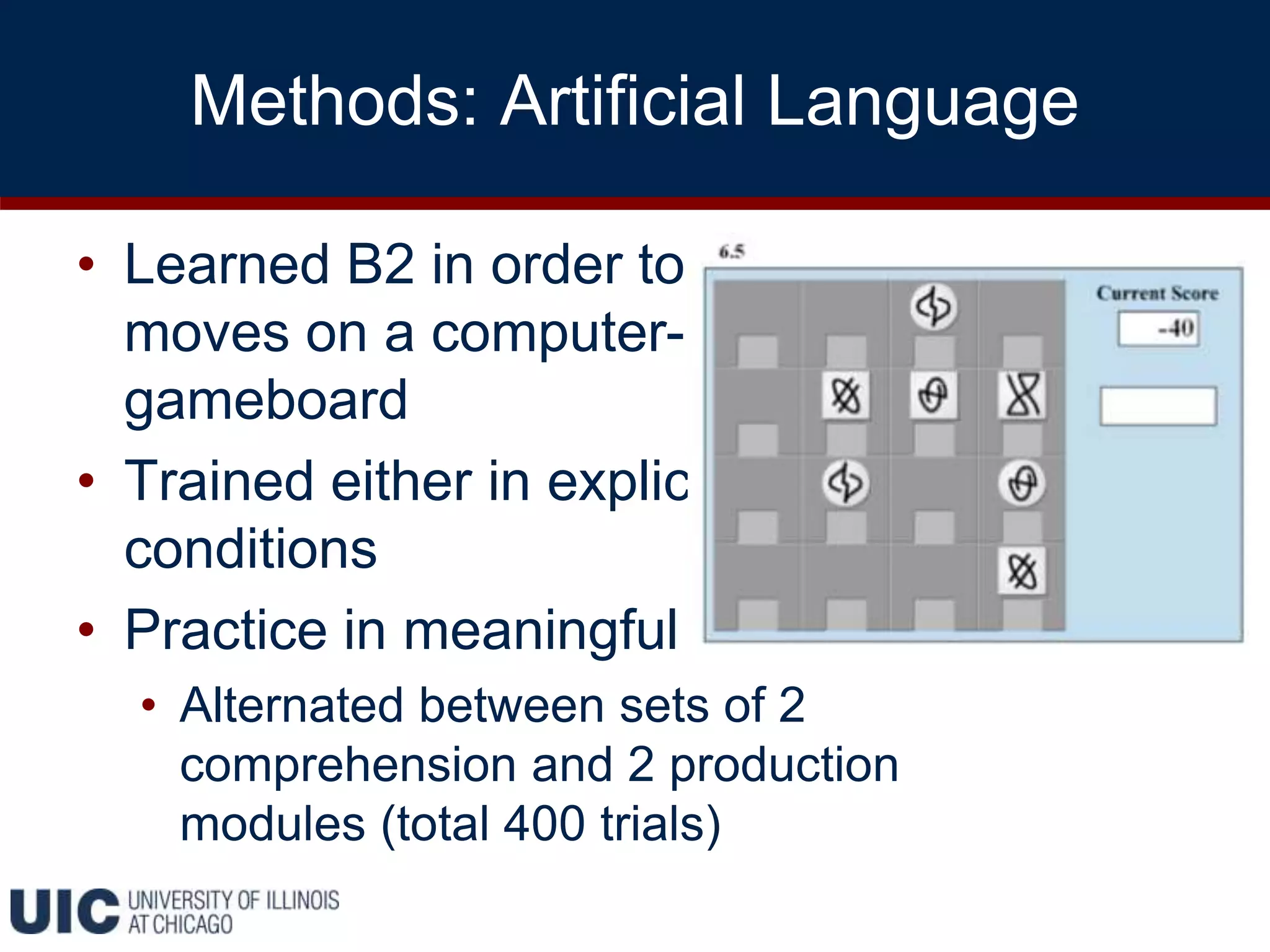
• Learned B2 in order to make game
moves on a computer-based
gameboard
• Trained either in explicit or implicit
conditions
• Practice in meaningful context
• Alternated between sets of 2
comprehension and 2 production
modules (total 400 trials)
Grammar and
Cognitive Assessments
• Grammaticality Judgment Task:
• 120 novel sentences, half correct and half
violation
• Administered at Time 1 and Time 2
• Procedural Memory:
• Alternating Serial Response Task (Howard &
Howard, 1997)
• Weather Prediction Task (Knowlton, Squire, & Gluck,
1994)
Results
• Participants performed significantly better
at later stages of learning when compared
to early stages
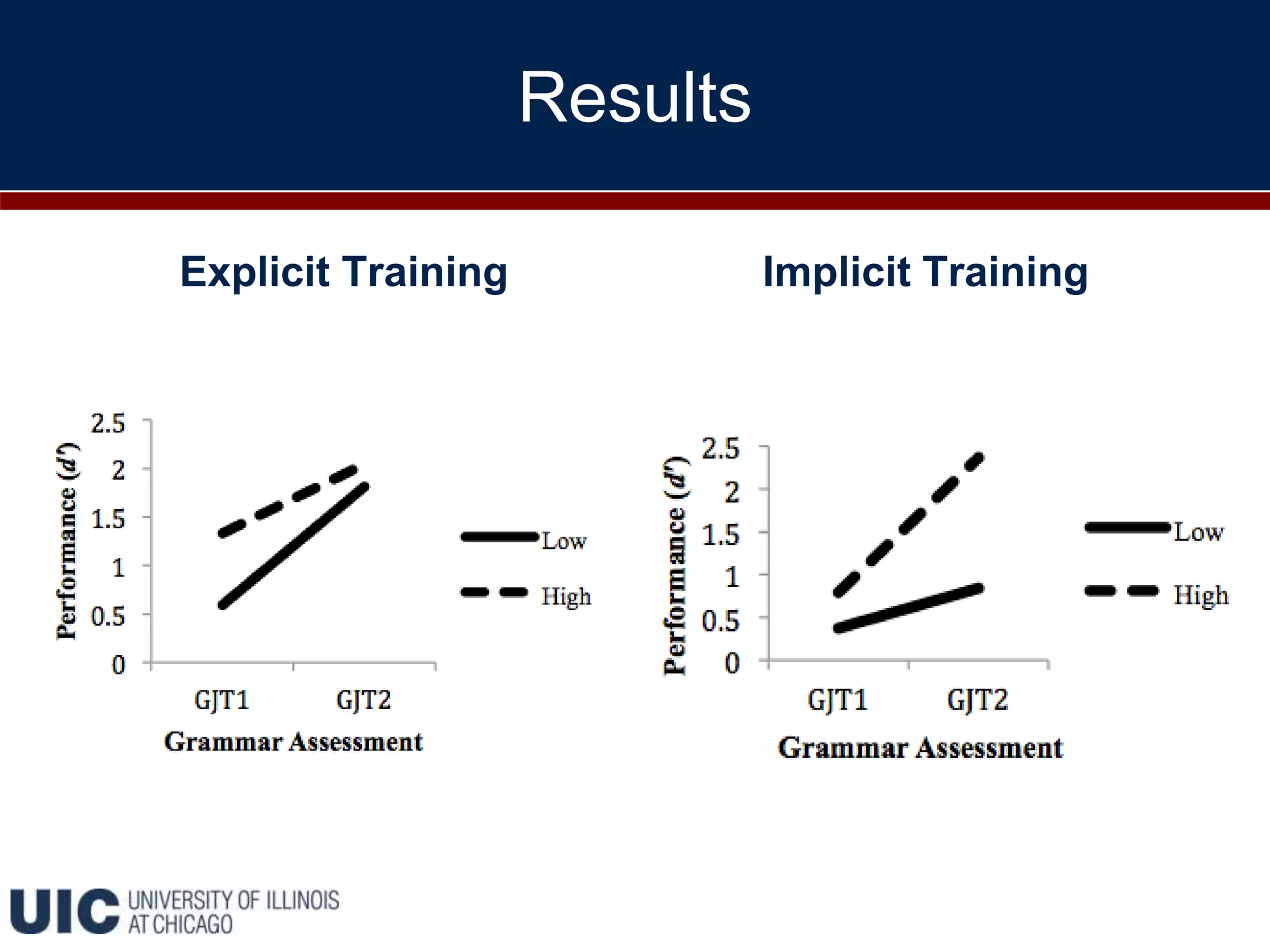
Results
Explicit Training Implicit Training
Implicit Explicit
Discussion
• High procedural memory performed better
overall (p = .06)
• Greatest difference in performance was in
implicit training condition at Time 2
• Consistent with predictions
Discussion
• Consistent with previous studies
• Supports theories in regards to procedural
memory involvement (DeKeyser, 2007; Ullman, 2001,
2004, 2005)
• Suggests there may be an ATI in L2
learning (Cronbach, 1957, 1975; Robinson, 2007)
Conclusions/Implications
• Provides evidence for procedural memory
as an individual difference in L2 learning
• L2 learning may be enhanced by matching
a training condition to specific cognitive
strengths (Ability Differentiation Hypothesis)
• L2 training conditions may differ in task
demands such that cognitive abilities are
recruited differentially across learning
contexts, as well as over time
Thank you!
• Special Thanks to:
• CogSLA Lab members
• Sam Cralli
• Namrata Shah
• Karla Cabrera-Perez
• Fatima Saeed
• Allison Lee
Questions?

CogSci2014-kbs-2

  • 1.
    The Role ofProcedural Memory in Adult Second Language Acquisition CogSci 2014 Katherine A. Brill-Schuetz & Kara Morgan-Short July 25, 2014
  • 2.
    Adult L2 Development •Adult second language (L2) learners have shown varying degrees of development and final attainment (Newport, 1990; DeKeyser, 2000; White & Genesee, 1996; Clashen & Felser, 2006) • This variation may be due to differences in cognitive abilities (Ehrman & Oxford, 1995) • The effect of these differences on L2 development may depend on learning context (Ellis, 1993; Robinson 1997, 2001)
  • 3.
    Procedural Memory inL2 Development • Theory posits an important role for procedural memory in L2 development • Declarative/Procedural Model (Ullman, 2001, 2004, 2005) • L2: as proficiency increases, there is a potential shift of certain grammar processing to procedural memory • Skill Acquisition Theory of L2 (DeKeyser, 2007) • Procedural memory has significant role in final stages (proceduralization and automatization)
  • 4.
    Empirical Support • Proceduralmemory has been shown to play a role in L2 development • High scores on measures of procedural memory correlated to success in learning an artificial morphophonological rule (Ettlinger, Bradlow & Wong, 2010) • Procedural memory correlated with successful learning of an artificial language in implicit training conditions (Carpenter, 2008; Morgan-Short, Faretta- Stutenberg, Brill-Schuetz, Carpenter, Wong, 2014)
  • 5.
    Aptitude Treatment Interaction •Role of procedural memory may be affected by learning context • An aptitude-treatment interaction (ATI) suggests tasks will differentially recruit cognitive abilities (Cronbach, 1957, 1975) • Ability Differentiation Hypothesis - important to match L2 learners to conditions of practice that favor their cognitive strengths (Robinson, 2007)
  • 6.
    Motivation and Goals •Investigate role of procedural memory in L2 development • Multiple measures of procedural memory • Implicit and explicit training conditions • Investigate ATI involving procedural memory
  • 7.
    Predictions/Hypotheses • The roleof procedural memory changes depending on learning context • Prediction: Participants with stronger procedural memory will show higher levels of proficiency at final assessment, particularly under implicit training conditions
  • 8.
    Design • Mixed factorialdesign: 2 (High vs. Low Procedural Memory) x 2 (Implicit vs. Explicit training) x 2 (Time 1 vs. Time 2) Day 1: Training and practice session 1 Day 2: Grammar Judgment Task 1 Day 3: Training and practice session 2 Day 4: Grammar Judgment Task 2 C o g n i t i v e A s s e s s m e n t s
  • 9.
    Experimental Design: Methods •Participants: • 26 (16 female) participants recruited from psychology subject pool and were paid participants • Age 18-30 years old • All native English speakers with no cognitive, learning or hearing impairments • Varied experience with L2
  • 10.
    Methods: Artificial Language •Brocanto2 • Syntactically productive, based on universal requirements of natural languages • 4 nouns, 2 adjectives, 2 articles, 4 verbs, 2 adverbs • Follows a different word order than English • Example: • Blom neimo lu neep li praz noyka • Blom square the neep the switches vertically • “The square blom switches vertically with the neep.”
  • 11.
    Methods: Artificial Language •Learned B2 in order to make game moves on a computer-based gameboard • Trained either in explicit or implicit conditions • Practice in meaningful context • Alternated between sets of 2 comprehension and 2 production modules (total 400 trials)
  • 12.
    Grammar and Cognitive Assessments •Grammaticality Judgment Task: • 120 novel sentences, half correct and half violation • Administered at Time 1 and Time 2 • Procedural Memory: • Alternating Serial Response Task (Howard & Howard, 1997) • Weather Prediction Task (Knowlton, Squire, & Gluck, 1994)
  • 13.
    Results • Participants performedsignificantly better at later stages of learning when compared to early stages
  • 14.
    Results Explicit Training ImplicitTraining Implicit Explicit
  • 15.
    Discussion • High proceduralmemory performed better overall (p = .06) • Greatest difference in performance was in implicit training condition at Time 2 • Consistent with predictions
  • 16.
    Discussion • Consistent withprevious studies • Supports theories in regards to procedural memory involvement (DeKeyser, 2007; Ullman, 2001, 2004, 2005) • Suggests there may be an ATI in L2 learning (Cronbach, 1957, 1975; Robinson, 2007)
  • 17.
    Conclusions/Implications • Provides evidencefor procedural memory as an individual difference in L2 learning • L2 learning may be enhanced by matching a training condition to specific cognitive strengths (Ability Differentiation Hypothesis) • L2 training conditions may differ in task demands such that cognitive abilities are recruited differentially across learning contexts, as well as over time
  • 18.
    Thank you! • SpecialThanks to: • CogSLA Lab members • Sam Cralli • Namrata Shah • Karla Cabrera-Perez • Fatima Saeed • Allison Lee
  • 19.