Introduction to Activity Theory Stephanie Gokhman HCDE 501: May 17, 2011 6:00pm Mary Gates 074 University of Washington
Today's readings Kaptelinin & Nardi "Do we need theory in interaction design?" Kaptelinin & Nardi "Activity Theory in a Nutshell" Winsor "Using Texts to Manage Continuity and Change in an Activity System"
Refresher:  Why do we need theory in HCI? “ The value of any theory is not “whether the theory or framework provides an objective representation of reality”, but rather how well a theory can shape an object of study, highlighting relevant issues.  In other words, a classification scheme is only useful to the point that it provides relevant insights about the objects it is applied to.”   Barthelmess and Anderson Ways to approach understanding a phenomena (analytical power) Ways to find patterns across interactions (inferential power) Ways to describe phenomena (descriptive power) Ways to present phenomena (rhetorical power)
Kaptelinin & Nardi "Do We Need Theory in Interaction Design?" Postcognitivist perspective on interaction design (cognitivist view was "limited") Ethnomethodology (Garfinkel and Sacks, who "distrusted" theory)      Subjects are experts in their field
Why these theories? Activity Theory... Actor-Network Theory... Distributed Cognition... etc ? Minimizes the complexities of ethnography by providing focus Maps reality to theoretical constructs
Kaptelinin & Nardi "Activity Theory in a Nutshell" "Separately hydrogen and oxygen are flammable but together they make water"
Kaptelinin & Nardi "Activity Theory in a Nutshell" Origins of Activity Theory Developed from Vygotsky & Leont'ev in the 1920s Vygotsky's Cultural & Historical Perspective: the mind exists within a human who exists in the world Leont'ev claims that you cannot pull apart human activity from the sociocultural context within which the activity is conducted Leont'ev: activities, actions, operations AT came to the West in the 1950s through Engestrom, "mediating artifacts" AT first used in HCI in the 1990s
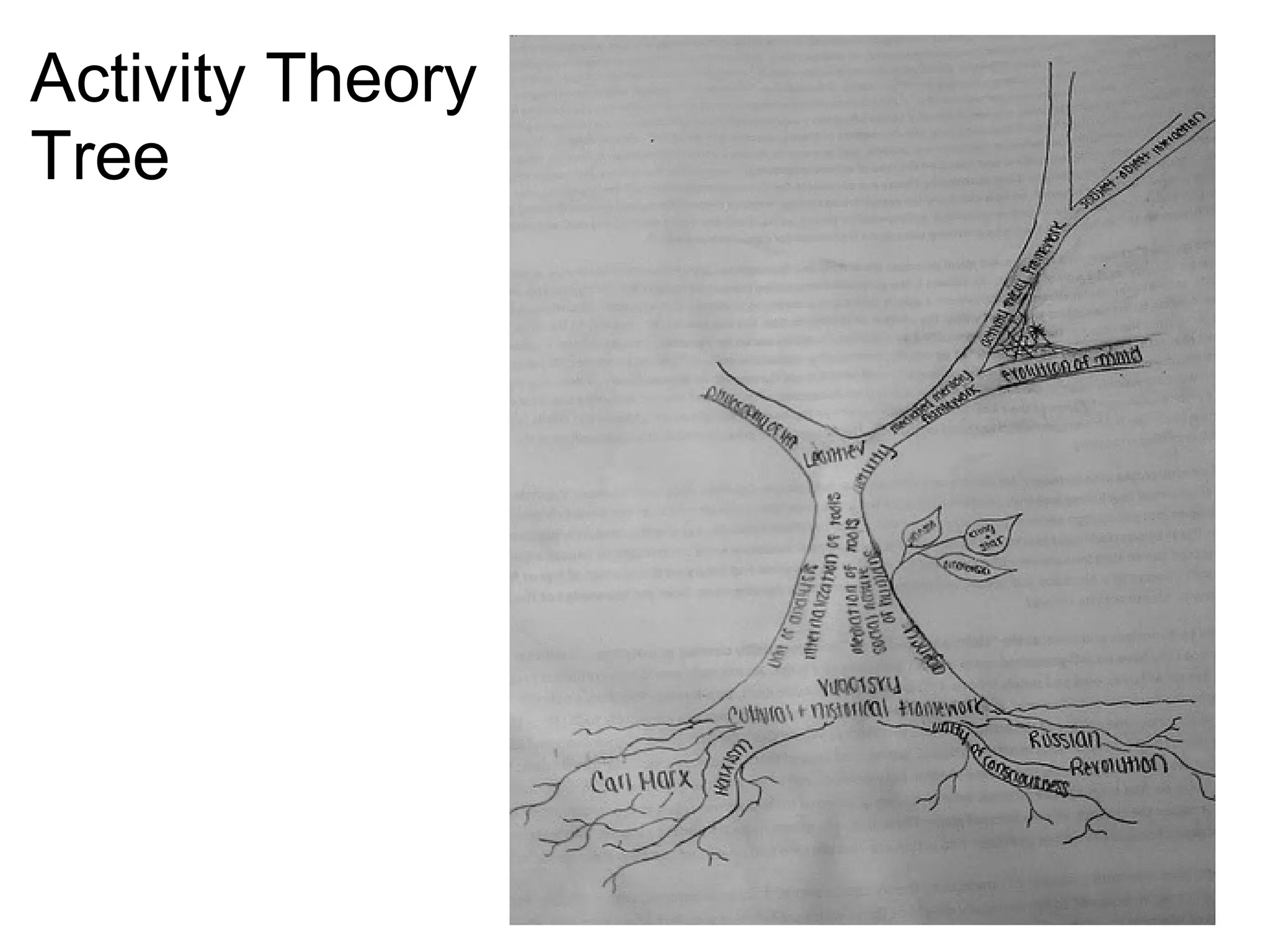
Activity Theory  Tree
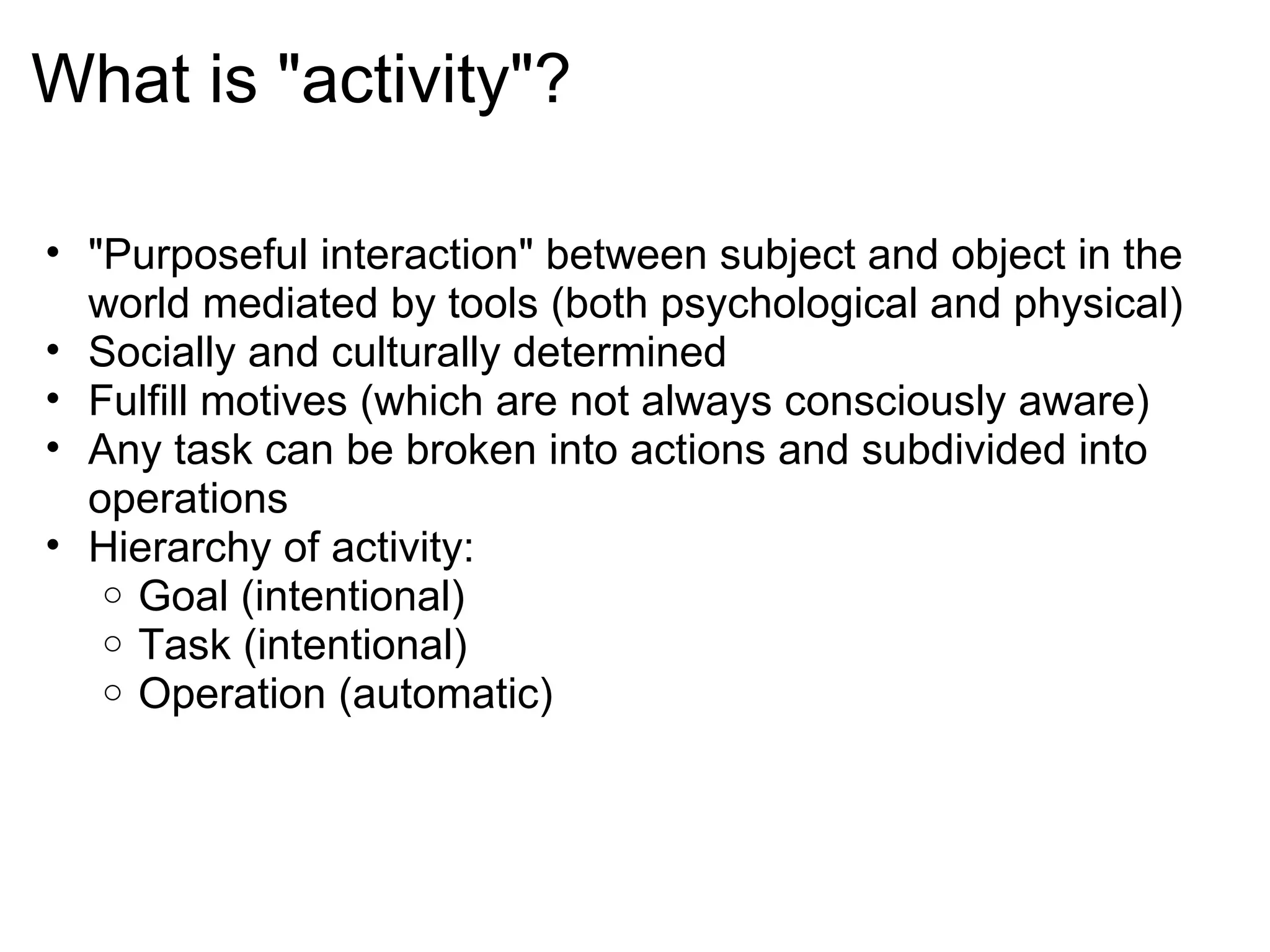
What is "activity"? "Purposeful interaction" between subject and object in the world mediated by tools (both psychological and physical) Socially and culturally determined Fulfill motives (which are not always consciously aware) Any task can be broken into actions and subdivided into operations Hierarchy of activity: Goal (intentional) Task (intentional) Operation (automatic)
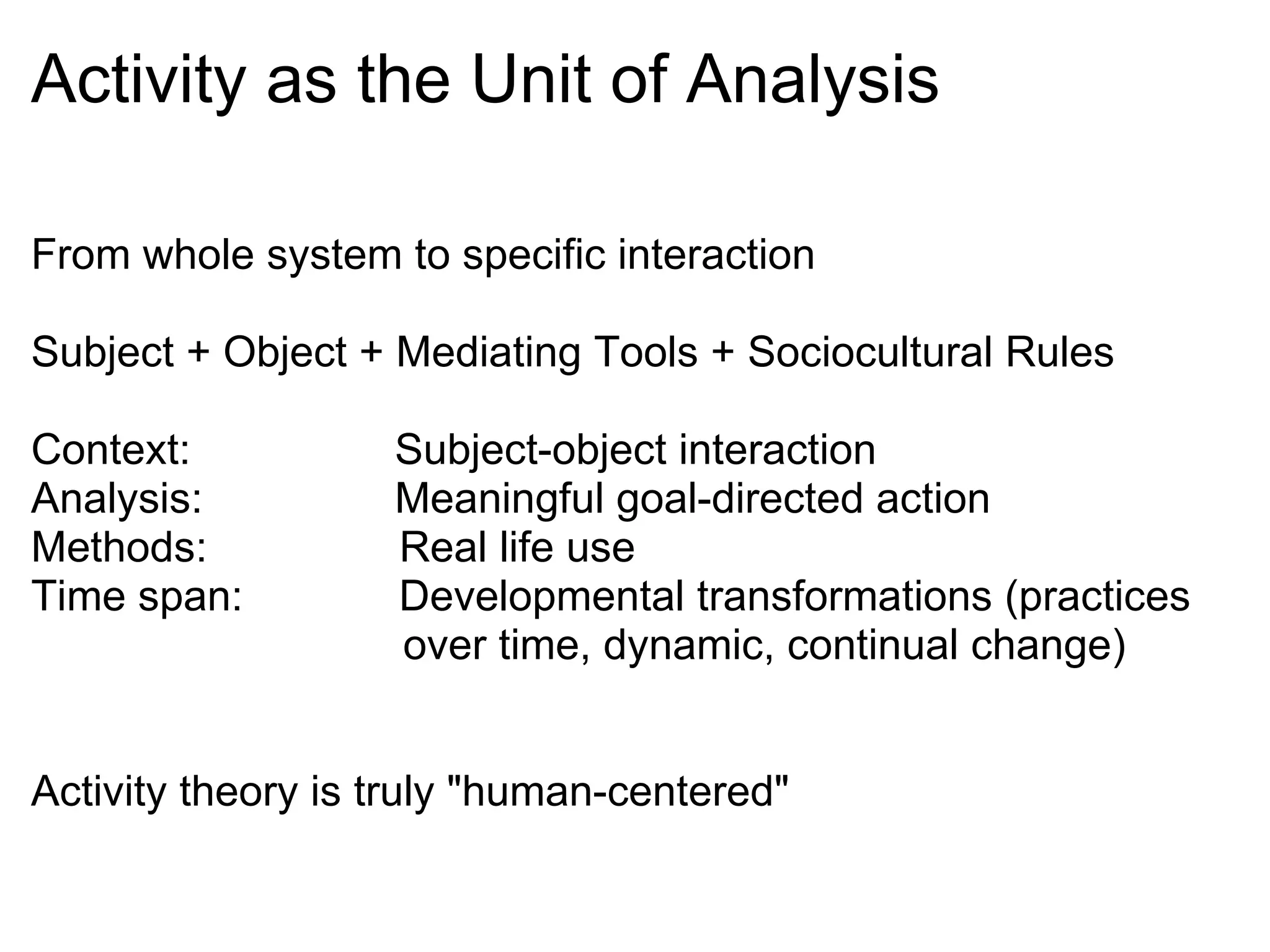
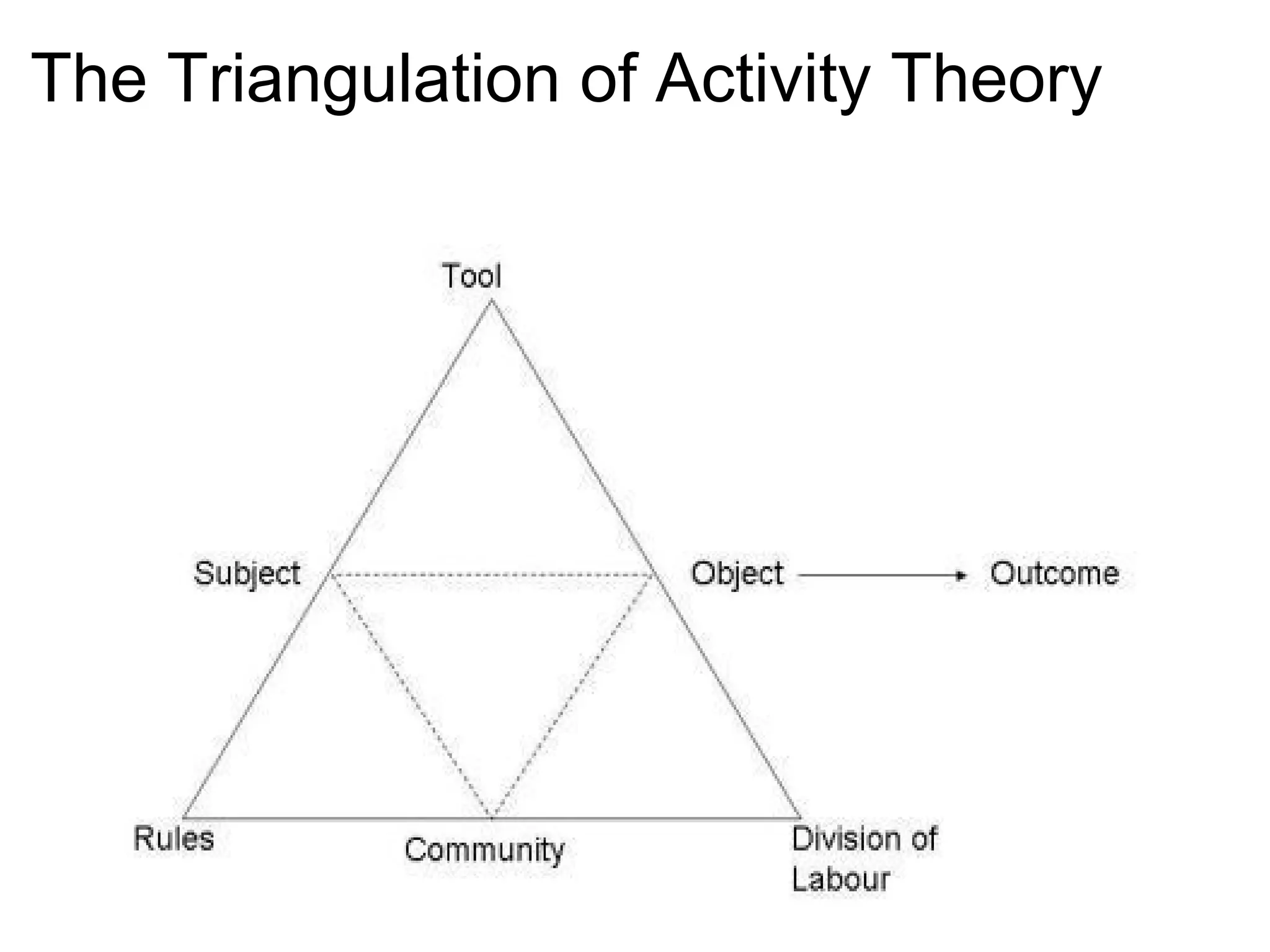
Activity as the Unit of Analysis From whole system to specific interaction Subject + Object + Mediating Tools + Sociocultural Rules Context:                 Subject-object interaction Analysis:                Meaningful goal-directed action Methods:                Real life use Time span:             Developmental transformations (practices                                  over time, dynamic, continual change) Activity theory is truly "human-centered"
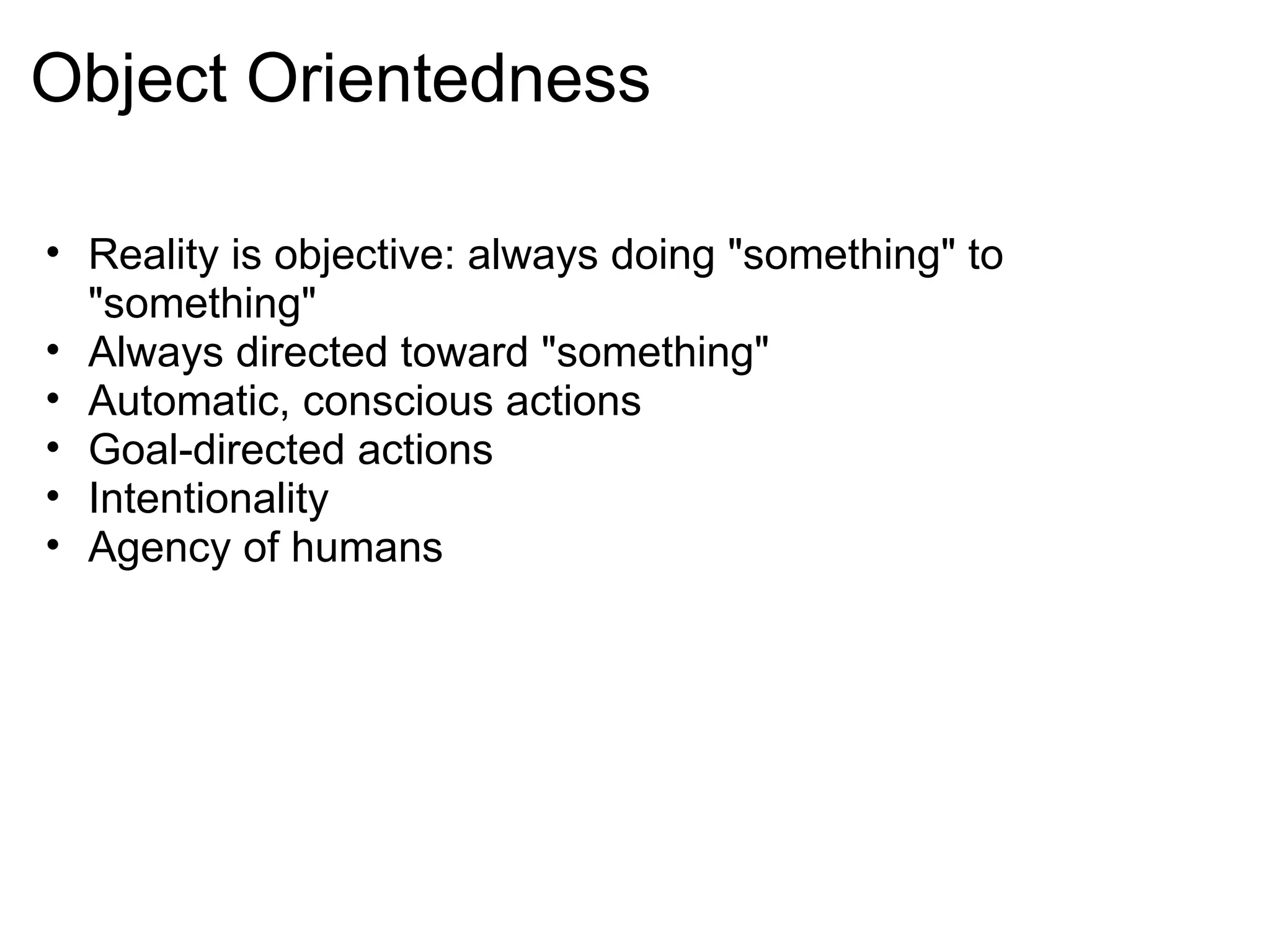
Object Orientedness Reality is objective: always doing "something" to "something" Always directed toward "something" Automatic, conscious actions Goal-directed actions Intentionality Agency of humans
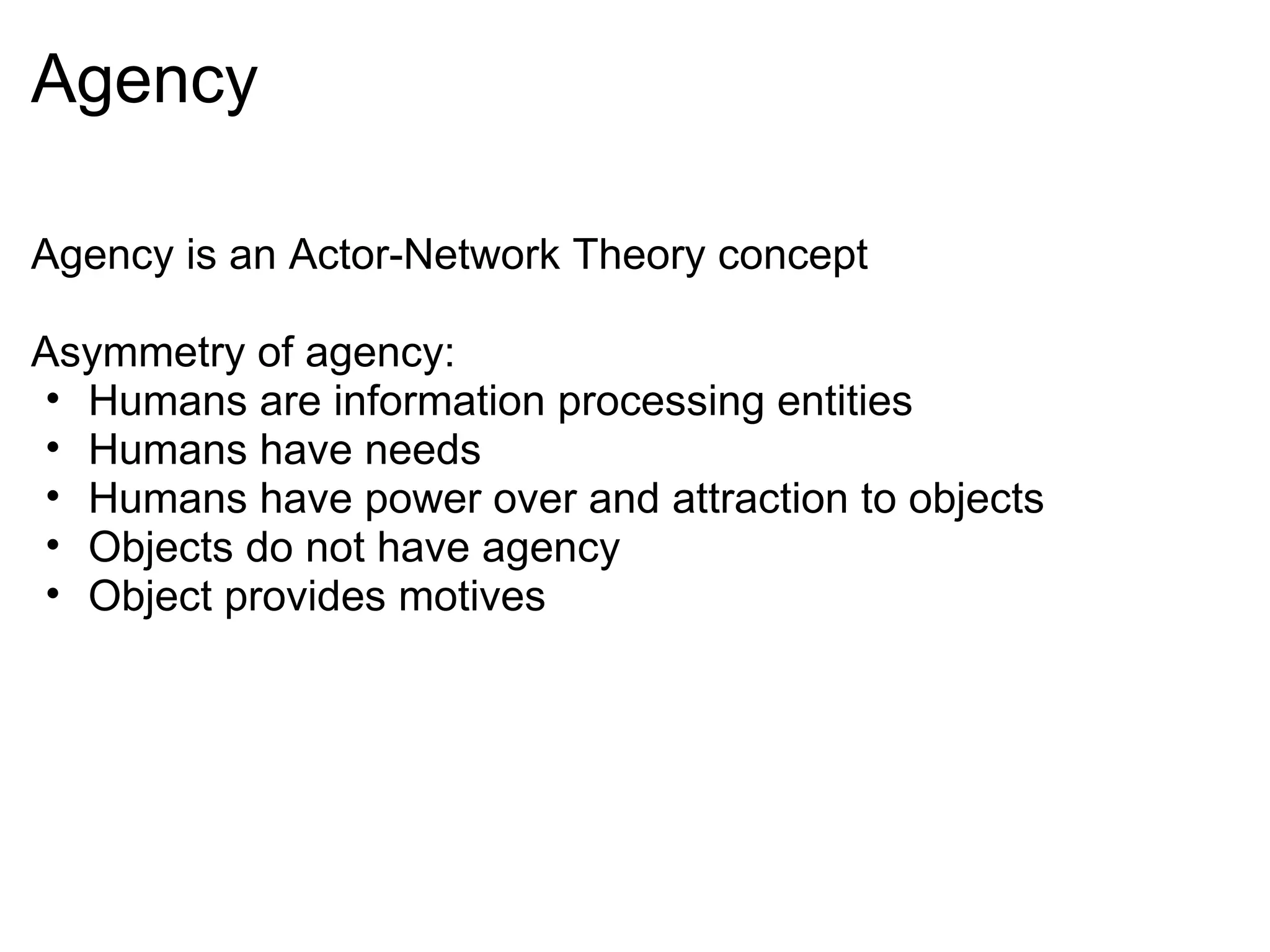
Agency Agency is an Actor-Network Theory concept Asymmetry of agency:  Humans are information processing entities Humans have needs Humans have power over and attraction to objects Objects do not have agency Object provides motives
Contrast with Actor-Network Theory Agency of non-humans Symmetry between human and non-human "Actants": both humans and non-humans Material-semiotic: maps things and concepts into a network Intermediaries vs mediators
Mediation & Mediating Tools Tools shape the way a human interacts with an object Use of tools reflects previous societal attempts at solving similar problems knowledge of how the tool should be used convergence of internal and external Mediating tools are also changed by the interaction as activity occurs Mediating tools have been changed through previous interactions
Internalization/Externalization Transformation of physical action into mental processing Example: mental modeling With repetition, goal-directed activities become operationalized/internalized When an internal activity needs to be manipulated it is generally externalized (especially in collaboration)
The Triangulation of Activity Theory
Activity Theory & Distributed Cognition Differences: In DCog, Less vocabulary and less constructs (requires more descriptive work)  In DCog, more flexibility in unit of analysis In DCog, cognition is foreground In AT, cognitive processes are underlying In DCog, all elements are actors contributing to the cognitive process In AT, needs/motivation/goals belong to the subject and are only possessed by living things
Activity Theory & Distributed Cognition Similarities Common intellectual history (cognition) Began appearing in HCI at the same time w Hutchins / Engestrom Emphasize social, cultural and historical context "Unity of Consciousness": the human mind is intrinsically related to the outside world The social nature of the human mind (deeply influenced by cultural/historical) More comparison next lecture...
How can we apply Activity Theory in HCI? What are the main things AT does for HCI? Demonstrates context Demonstrates usefulness and limitations of tools Technology... ... is also embedded in meaningful context  just like humans ... is more than information processing and exists at several levels of operation ... facilitates and constrains activity ... supports human goals ... is used and built based on social rules
How can we apply Activity Theory in HCI? Physical:       operation of a device as a physical object Handling:       logical structure of interaction Subject-object directed:       How objects are related to reality
Winsor "Using Text to Manage Continuity and Change in an Activity System" Activity Theory in practice: Enthographic approach w/ interviews on n=4 group of engineers in cooperative engineering department Documents serve as common objects/"illusion of stability" Uses AT to demonstrate regulation in the creation of documents does not exist as a hierarchy but instead shared negotiation serving the self interests of those involved AT serves "to ask us where regulation (and genre) come from" AT provides triangulation at a particular moment in time, representing a stable reality despite that reality is in a state of constant change
Activity: Become an AT Analyst! Working Alone: Pick out an activity or two that you captured in your field notes that could be looked at through the lens of Activity Theory. Plot out who are the actors, what is the object, what is the mediating tool, what is the context, what is the goal, etc. Then, Working Together: Select the most appropriate activity of the collective activities from the previous exercise. Flesh out how you would talk about this activity. Include discussion of technology affordances and constraints as well as internalization/externalization. For the week:  Post to Go-Post: Activity and some notes, questions
Questions? Stephanie Gokhman [email_address]

Introduction to Activity Theory in HCI

  • 1.
    Introduction to ActivityTheory Stephanie Gokhman HCDE 501: May 17, 2011 6:00pm Mary Gates 074 University of Washington
  • 2.
    Today's readings Kaptelinin& Nardi "Do we need theory in interaction design?" Kaptelinin & Nardi "Activity Theory in a Nutshell" Winsor "Using Texts to Manage Continuity and Change in an Activity System"
  • 3.
    Refresher:  Why dowe need theory in HCI? “ The value of any theory is not “whether the theory or framework provides an objective representation of reality”, but rather how well a theory can shape an object of study, highlighting relevant issues.  In other words, a classification scheme is only useful to the point that it provides relevant insights about the objects it is applied to.”   Barthelmess and Anderson Ways to approach understanding a phenomena (analytical power) Ways to find patterns across interactions (inferential power) Ways to describe phenomena (descriptive power) Ways to present phenomena (rhetorical power)
  • 4.
    Kaptelinin & Nardi"Do We Need Theory in Interaction Design?" Postcognitivist perspective on interaction design (cognitivist view was "limited") Ethnomethodology (Garfinkel and Sacks, who "distrusted" theory)     Subjects are experts in their field
  • 5.
    Why these theories?Activity Theory... Actor-Network Theory... Distributed Cognition... etc ? Minimizes the complexities of ethnography by providing focus Maps reality to theoretical constructs
  • 6.
    Kaptelinin & Nardi"Activity Theory in a Nutshell" "Separately hydrogen and oxygen are flammable but together they make water"
  • 7.
    Kaptelinin & Nardi"Activity Theory in a Nutshell" Origins of Activity Theory Developed from Vygotsky & Leont'ev in the 1920s Vygotsky's Cultural & Historical Perspective: the mind exists within a human who exists in the world Leont'ev claims that you cannot pull apart human activity from the sociocultural context within which the activity is conducted Leont'ev: activities, actions, operations AT came to the West in the 1950s through Engestrom, "mediating artifacts" AT first used in HCI in the 1990s
  • 8.
  • 9.
    What is "activity"?"Purposeful interaction" between subject and object in the world mediated by tools (both psychological and physical) Socially and culturally determined Fulfill motives (which are not always consciously aware) Any task can be broken into actions and subdivided into operations Hierarchy of activity: Goal (intentional) Task (intentional) Operation (automatic)
  • 10.
    Activity as theUnit of Analysis From whole system to specific interaction Subject + Object + Mediating Tools + Sociocultural Rules Context:                 Subject-object interaction Analysis:                Meaningful goal-directed action Methods:                Real life use Time span:             Developmental transformations (practices                                  over time, dynamic, continual change) Activity theory is truly "human-centered"
  • 11.
    Object Orientedness Realityis objective: always doing "something" to "something" Always directed toward "something" Automatic, conscious actions Goal-directed actions Intentionality Agency of humans
  • 12.
    Agency Agency isan Actor-Network Theory concept Asymmetry of agency:  Humans are information processing entities Humans have needs Humans have power over and attraction to objects Objects do not have agency Object provides motives
  • 13.
    Contrast with Actor-NetworkTheory Agency of non-humans Symmetry between human and non-human "Actants": both humans and non-humans Material-semiotic: maps things and concepts into a network Intermediaries vs mediators
  • 14.
    Mediation & MediatingTools Tools shape the way a human interacts with an object Use of tools reflects previous societal attempts at solving similar problems knowledge of how the tool should be used convergence of internal and external Mediating tools are also changed by the interaction as activity occurs Mediating tools have been changed through previous interactions
  • 15.
    Internalization/Externalization Transformation ofphysical action into mental processing Example: mental modeling With repetition, goal-directed activities become operationalized/internalized When an internal activity needs to be manipulated it is generally externalized (especially in collaboration)
  • 16.
    The Triangulation ofActivity Theory
  • 17.
    Activity Theory &Distributed Cognition Differences: In DCog, Less vocabulary and less constructs (requires more descriptive work)  In DCog, more flexibility in unit of analysis In DCog, cognition is foreground In AT, cognitive processes are underlying In DCog, all elements are actors contributing to the cognitive process In AT, needs/motivation/goals belong to the subject and are only possessed by living things
  • 18.
    Activity Theory &Distributed Cognition Similarities Common intellectual history (cognition) Began appearing in HCI at the same time w Hutchins / Engestrom Emphasize social, cultural and historical context "Unity of Consciousness": the human mind is intrinsically related to the outside world The social nature of the human mind (deeply influenced by cultural/historical) More comparison next lecture...
  • 19.
    How can weapply Activity Theory in HCI? What are the main things AT does for HCI? Demonstrates context Demonstrates usefulness and limitations of tools Technology... ... is also embedded in meaningful context  just like humans ... is more than information processing and exists at several levels of operation ... facilitates and constrains activity ... supports human goals ... is used and built based on social rules
  • 20.
    How can weapply Activity Theory in HCI? Physical:      operation of a device as a physical object Handling:       logical structure of interaction Subject-object directed:       How objects are related to reality
  • 21.
    Winsor "Using Textto Manage Continuity and Change in an Activity System" Activity Theory in practice: Enthographic approach w/ interviews on n=4 group of engineers in cooperative engineering department Documents serve as common objects/"illusion of stability" Uses AT to demonstrate regulation in the creation of documents does not exist as a hierarchy but instead shared negotiation serving the self interests of those involved AT serves "to ask us where regulation (and genre) come from" AT provides triangulation at a particular moment in time, representing a stable reality despite that reality is in a state of constant change
  • 22.
    Activity: Become an ATAnalyst! Working Alone: Pick out an activity or two that you captured in your field notes that could be looked at through the lens of Activity Theory. Plot out who are the actors, what is the object, what is the mediating tool, what is the context, what is the goal, etc. Then, Working Together: Select the most appropriate activity of the collective activities from the previous exercise. Flesh out how you would talk about this activity. Include discussion of technology affordances and constraints as well as internalization/externalization. For the week:  Post to Go-Post: Activity and some notes, questions
  • 23.