1
Basic discrete structures
• Discrete math =
– study of the discrete structures used to represent discrete
objects
• Many discrete structures are built using sets
– Sets = collection of objects
Examples of discrete structures built with the help of sets:
• Combinations
• Relations
• Graphs
CS 441 Discrete mathematics for CS M. Hauskrecht
CS 441 Discrete MathematicsforCS
Lecture 7
Sets and set operations
Milos Hauskrecht
milos@cs.pitt.edu
5329 Sennott Square
CS 441 Discrete mathematics for CS M. Hauskrecht
2
Representing sets
Representing a set by:
1) Listing (enumerating) the members of the set.
2) Definition by property, using the set builder notation
{x| x has property P}.
Example:
• Even integers between 50 and 63.
1) E = {50, 52, 54, 56, 58, 60, 62}
2) E = {x| 50 <= x < 63, x is an eveninteger}
If enumeration of the members is hard we often use ellipses.
Example: a set of integers between 1 and 100
• A= {1,2,3 …, 100}
CS 441 Discrete mathematics for CS M. Hauskrecht
Set
• Definition: A set is a (unordered) collection of objects. These
objects are sometimes called elements or members of the set.
(Cantor's naive definition)
• Examples:
– Vowels in the English alphabet
V = { a, e, i, o, u }
– First sevenprime numbers.
X = { 2, 3, 5, 7, 11, 13, 17 }
CS 441 Discrete mathematics for CS M. Hauskrecht
3
Russell’s paradox
Cantor's naive definition of sets leads to Russell's paradox:
• Let S = { x | x  x },
is a set of sets that are not members of themselves.
• Question: Where does the set S belong to?
– Is S  S or S  S?
• Cases
– S  S ?: S does not satisfy the condition so it must hold that
S  S (or S  S does not hold)
– S  S ?: S is included in the set S and hence S  S does not
hold
• A paradox: we cannot decide if S belongs to S or not
• Russell’s answer: theory of types – used for sets of sets
CS 441 Discrete mathematics for CS M. Hauskrecht
Important sets in discrete math
• Natural numbers:
– N = {0,1,2,3, …}
• Integers
– Z = {…, -2,-1,0,1,2, …}
• Positive integers
– Z+ = {1,2, 3.…}
• Rational numbers
– Q = {p/q | p  Z, q  Z, q  0}
• Real numbers
– R
CS 441 Discrete mathematics for CS M. Hauskrecht
4
Special sets
• Special sets:
– The universal set is denoted by U: the set of all objects
under the consideration.
– The empty set is denoted as  or { }.
CS 441 Discrete mathematics for CS M. Hauskrecht
Equality
Definition: Two sets are equal if and only if they have the same
elements.
Example:
• {1,2,3} = {3,1,2} = {1,2,1,3,2}
Note: Duplicates don't contribute anything new to a set, so remove
them. The order of the elements in a set doesn't contribute
anything new.
Example: Are {1,2,3,4} and {1,2,2,4} equal?
No!
CS 441 Discrete mathematics for CS M. Hauskrecht
5
A Subset
• Definition: A set A is said to be a subset of B if and only if
every element of A is also an element of B. We use A  B to
indicate A is a subset of B.
U
B
A
• Alternate way to define A is a subset of B:
x (x  A)  (x  B)
CS 441 Discrete mathematics for CS M. Hauskrecht
Venn diagrams
• A set can be visualized using Venn Diagrams:
– V={ A, B, C }
U
A
B
C
CS 441 Discrete mathematics for CS M. Hauskrecht
6
Subset properties
Theorem: S  S
• Any set S is a subset of itself
Proof:
• the definition of a subset says: all elements of a set A must be
also elements of B: x (x  A  x  B).
• Applying this to S we get:
• x (x  S  x  S) which is trivially True
• End of proof
Note on equivalence:
• Two sets are equal if each is a subset of the other set.
CS 441 Discrete mathematics for CS M. Hauskrecht
Empty set/Subset properties
Theorem   S
• Empty set is a subset of any set.
Proof:
• Recall the definition of a subset: all elements of a set A must be
also elements of B: x (x  A  x  B).
• We must show the following implication holds for any S
x (x    x  S)
• Since the empty set does not contain any element, x  is
always False
• Then the implication is always True.
End of proof
CS 441 Discrete mathematics for CS M. Hauskrecht
7
A proper subset
Definition: A set A is said to be a proper subset of B if and only
if A  B and A  B. We denote that A is a proper subset of B
with the notation A  B.
U
B
A
Example: A={1,2,3} B ={1,2,3,4,5}
Is: A  B ? Yes.
CS 441 Discrete mathematics for CS M. Hauskrecht
A proper subset
Definition: A set A is said to be a proper subset of B if and only
if A  B and A  B. We denote that A is a proper subset of B
with the notation A  B.
U
B
A
CS 441 Discrete mathematics for CS M. Hauskrecht
8
Infinite set
Definition: A set is infinite if it is not finite.
Examples:
• The set of natural numbers is an infinite set.
• N = {1, 2, 3, ... }
• The set of reals is an infinite set.
CS 441 Discrete mathematics for CS M. Hauskrecht
Cardinality
Definition: Let S be a set. If there are exactly n distinct elements
in S, where n is a nonnegative integer, we say S is a finite set
and that n is the cardinality of S. The cardinality of S is
denoted by | S |.
Examples:
• V={1 2 3 4 5}
| V | = 5
• A={1,2,3,4, …, 20}
|A| =20
• |  | = 0
CS 441 Discrete mathematics for CS M. Hauskrecht
9
Power set
• P( {1} ) = { , {1} }
• |P({1})| = 2
• Assume {1,2}
• P( {1,2} ) = { , {1}, {2}, {1,2} }
• |P({1,2} )| =4
• Assume {1,2,3}
• P({1,2,3}) = {, {1}, {2}, {3}, {1,2}, {1,3}, {2,3}, {1,2,3} }
• |P({1,2,3} | = 8
• If S is a set with |S| = n then | P(S) | = ?
CS 441 Discrete mathematics for CS M. Hauskrecht
Power set
Definition: Given a set S, the power set of S is the set of all subsets
of S. The power set is denoted by P(S).
Examples:
• Assume an empty set 
• What is the power set of  ? P() = {  }
• What is the cardinality of P() ? | P() | = 1.
• Assume set {1}
• P( {1} ) = { , {1} }
• |P({1})| = 2
CS 441 Discrete mathematics for CS M. Hauskrecht
10
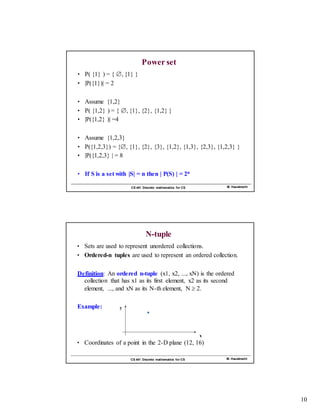
N-tuple
• Sets are used to represent unordered collections.
• Ordered-n tuples are used to represent an ordered collection.
Definition: An ordered n-tuple (x1, x2, ..., xN) is the ordered
collection that has x1 as its first element, x2 as its second
element, ..., and xN as its N-th element, N  2.
Example: y
x
• Coordinates of a point in the 2-D plane (12, 16)
CS 441 Discrete mathematics for CS M. Hauskrecht
Power set
• P( {1} ) = { , {1} }
• |P({1})| = 2
• Assume {1,2}
• P( {1,2} ) = { , {1}, {2}, {1,2} }
• |P({1,2} )| =4
• Assume {1,2,3}
• P({1,2,3}) = {, {1}, {2}, {3}, {1,2}, {1,3}, {2,3}, {1,2,3} }
• |P({1,2,3} | = 8
• If S is a set with |S| = n then | P(S) | = 2n
CS 441 Discrete mathematics for CS M. Hauskrecht
11
Cardinality of the Cartesian product
• |S x T| = |S| * |T|.
Example:
• A= {John, Peter, Mike}
• B ={Jane, Ann, Laura}
• A x B= {(John, Jane),(John, Ann) , (John, Laura), (Peter, Jane),
(Peter, Ann) , (Peter, Laura) , (Mike, Jane) , (Mike, Ann) ,
(Mike, Laura)}
• |A x B| = 9
• |A|=3, |B|=3  |A| |B|= 9
Definition: A subset of the Cartesian product A x B is called a
relation from the set A to the set B.
CS 441 Discrete mathematics for CS M. Hauskrecht
Cartesian product
Definition: Let S and T be sets. The Cartesian product of S and
T, denoted by S x T, is the set of all ordered pairs (s,t), where s
 S and t  T. Hence,
• S x T = { (s,t) | s  S  t  T}.
Examples:
• S = {1,2} and T = {a,b,c}
• S x T = { (1,a), (1,b), (1,c), (2,a), (2,b), (2,c) }
• T x S = { (a,1), (a, 2), (b,1), (b,2), (c,1), (c,2) }
• Note: S x T  T x S !!!!
CS 441 Discrete mathematics for CS M. Hauskrecht
12

Set operations
Definition: Let A and B be sets. The intersection of A and B,
denoted by A  B, is the set that contains those elements that are
in both A and B.
• Alternate: A  B = { x | x  A  x  B }.
U B
A
Example:
• A = {1,2,3,6} B = { 2, 4, 6, 9}
• A  B = { 2, 6 }
CS 441 Discrete mathematics for CS M. Hauskrecht
Set operations
Definition: Let A and B be sets. The union of A and B, denoted
by A  B, is the set that contains those elements that are either in
A or in B, or in both.
• Alternate: A  B = { x | x  A  x  B }.
U B
A
• Example:
• A = {1,2,3,6} B = { 2,4,6,9}
• A  B = { 1,2,3,4,6,9}
CS 441 Discrete mathematics for CS M. Hauskrecht
13
Cardinality of the set union
Cardinality of the set union.
• |A B| = |A| + |B| - |A  B|
U B
A
• Why this formula?
CS 441 Discrete mathematics for CS M. Hauskrecht
Disjoint sets
Definition: Two sets are called disjoint if their intersection is
empty.
• Alternate: A and B are disjoint if and only if A B = .
U B A
Example:
• A={1,2,3,6} B={4,7,8} Are these disjoint?
• Yes.
• A  B =

CS 441 Discrete mathematics for CS M. Hauskrecht
14
Set difference
Definition: Let A and B be sets. The difference of A and B,
denoted by A - B, is the set containing those elements that are in
A but not in B. The difference of A and B is also called the
complement of B with respect to A.
• Alternate: A - B = { x | x  A  x  B }.
U B
A
Example: A= {1,2,3,5,7} B = {1,5,6,8}
• A - B ={2,3,7}
CS 441 Discrete mathematics for CS M. Hauskrecht
Cardinality of the set union
Cardinality of the set union.
• |A B| = |A| + |B| - |A  B|
U B
A
• Why this formula? Correct for an over-count.
• More general rule:
– The principle of inclusion and exclusion.
CS 441 Discrete mathematics for CS M. Hauskrecht

Class7 converted

  • 1.
    1 Basic discrete structures •Discrete math = – study of the discrete structures used to represent discrete objects • Many discrete structures are built using sets – Sets = collection of objects Examples of discrete structures built with the help of sets: • Combinations • Relations • Graphs CS 441 Discrete mathematics for CS M. Hauskrecht CS 441 Discrete MathematicsforCS Lecture 7 Sets and set operations Milos Hauskrecht milos@cs.pitt.edu 5329 Sennott Square CS 441 Discrete mathematics for CS M. Hauskrecht
  • 2.
    2 Representing sets Representing aset by: 1) Listing (enumerating) the members of the set. 2) Definition by property, using the set builder notation {x| x has property P}. Example: • Even integers between 50 and 63. 1) E = {50, 52, 54, 56, 58, 60, 62} 2) E = {x| 50 <= x < 63, x is an eveninteger} If enumeration of the members is hard we often use ellipses. Example: a set of integers between 1 and 100 • A= {1,2,3 …, 100} CS 441 Discrete mathematics for CS M. Hauskrecht Set • Definition: A set is a (unordered) collection of objects. These objects are sometimes called elements or members of the set. (Cantor's naive definition) • Examples: – Vowels in the English alphabet V = { a, e, i, o, u } – First sevenprime numbers. X = { 2, 3, 5, 7, 11, 13, 17 } CS 441 Discrete mathematics for CS M. Hauskrecht
  • 3.
    3 Russell’s paradox Cantor's naivedefinition of sets leads to Russell's paradox: • Let S = { x | x  x }, is a set of sets that are not members of themselves. • Question: Where does the set S belong to? – Is S  S or S  S? • Cases – S  S ?: S does not satisfy the condition so it must hold that S  S (or S  S does not hold) – S  S ?: S is included in the set S and hence S  S does not hold • A paradox: we cannot decide if S belongs to S or not • Russell’s answer: theory of types – used for sets of sets CS 441 Discrete mathematics for CS M. Hauskrecht Important sets in discrete math • Natural numbers: – N = {0,1,2,3, …} • Integers – Z = {…, -2,-1,0,1,2, …} • Positive integers – Z+ = {1,2, 3.…} • Rational numbers – Q = {p/q | p  Z, q  Z, q  0} • Real numbers – R CS 441 Discrete mathematics for CS M. Hauskrecht
  • 4.
    4 Special sets • Specialsets: – The universal set is denoted by U: the set of all objects under the consideration. – The empty set is denoted as  or { }. CS 441 Discrete mathematics for CS M. Hauskrecht Equality Definition: Two sets are equal if and only if they have the same elements. Example: • {1,2,3} = {3,1,2} = {1,2,1,3,2} Note: Duplicates don't contribute anything new to a set, so remove them. The order of the elements in a set doesn't contribute anything new. Example: Are {1,2,3,4} and {1,2,2,4} equal? No! CS 441 Discrete mathematics for CS M. Hauskrecht
  • 5.
    5 A Subset • Definition:A set A is said to be a subset of B if and only if every element of A is also an element of B. We use A  B to indicate A is a subset of B. U B A • Alternate way to define A is a subset of B: x (x  A)  (x  B) CS 441 Discrete mathematics for CS M. Hauskrecht Venn diagrams • A set can be visualized using Venn Diagrams: – V={ A, B, C } U A B C CS 441 Discrete mathematics for CS M. Hauskrecht
  • 6.
    6 Subset properties Theorem: S S • Any set S is a subset of itself Proof: • the definition of a subset says: all elements of a set A must be also elements of B: x (x  A  x  B). • Applying this to S we get: • x (x  S  x  S) which is trivially True • End of proof Note on equivalence: • Two sets are equal if each is a subset of the other set. CS 441 Discrete mathematics for CS M. Hauskrecht Empty set/Subset properties Theorem   S • Empty set is a subset of any set. Proof: • Recall the definition of a subset: all elements of a set A must be also elements of B: x (x  A  x  B). • We must show the following implication holds for any S x (x    x  S) • Since the empty set does not contain any element, x  is always False • Then the implication is always True. End of proof CS 441 Discrete mathematics for CS M. Hauskrecht
  • 7.
    7 A proper subset Definition:A set A is said to be a proper subset of B if and only if A  B and A  B. We denote that A is a proper subset of B with the notation A  B. U B A Example: A={1,2,3} B ={1,2,3,4,5} Is: A  B ? Yes. CS 441 Discrete mathematics for CS M. Hauskrecht A proper subset Definition: A set A is said to be a proper subset of B if and only if A  B and A  B. We denote that A is a proper subset of B with the notation A  B. U B A CS 441 Discrete mathematics for CS M. Hauskrecht
  • 8.
    8 Infinite set Definition: Aset is infinite if it is not finite. Examples: • The set of natural numbers is an infinite set. • N = {1, 2, 3, ... } • The set of reals is an infinite set. CS 441 Discrete mathematics for CS M. Hauskrecht Cardinality Definition: Let S be a set. If there are exactly n distinct elements in S, where n is a nonnegative integer, we say S is a finite set and that n is the cardinality of S. The cardinality of S is denoted by | S |. Examples: • V={1 2 3 4 5} | V | = 5 • A={1,2,3,4, …, 20} |A| =20 • |  | = 0 CS 441 Discrete mathematics for CS M. Hauskrecht
  • 9.
    9 Power set • P({1} ) = { , {1} } • |P({1})| = 2 • Assume {1,2} • P( {1,2} ) = { , {1}, {2}, {1,2} } • |P({1,2} )| =4 • Assume {1,2,3} • P({1,2,3}) = {, {1}, {2}, {3}, {1,2}, {1,3}, {2,3}, {1,2,3} } • |P({1,2,3} | = 8 • If S is a set with |S| = n then | P(S) | = ? CS 441 Discrete mathematics for CS M. Hauskrecht Power set Definition: Given a set S, the power set of S is the set of all subsets of S. The power set is denoted by P(S). Examples: • Assume an empty set  • What is the power set of  ? P() = {  } • What is the cardinality of P() ? | P() | = 1. • Assume set {1} • P( {1} ) = { , {1} } • |P({1})| = 2 CS 441 Discrete mathematics for CS M. Hauskrecht
  • 10.
    10 N-tuple • Sets areused to represent unordered collections. • Ordered-n tuples are used to represent an ordered collection. Definition: An ordered n-tuple (x1, x2, ..., xN) is the ordered collection that has x1 as its first element, x2 as its second element, ..., and xN as its N-th element, N  2. Example: y x • Coordinates of a point in the 2-D plane (12, 16) CS 441 Discrete mathematics for CS M. Hauskrecht Power set • P( {1} ) = { , {1} } • |P({1})| = 2 • Assume {1,2} • P( {1,2} ) = { , {1}, {2}, {1,2} } • |P({1,2} )| =4 • Assume {1,2,3} • P({1,2,3}) = {, {1}, {2}, {3}, {1,2}, {1,3}, {2,3}, {1,2,3} } • |P({1,2,3} | = 8 • If S is a set with |S| = n then | P(S) | = 2n CS 441 Discrete mathematics for CS M. Hauskrecht
  • 11.
    11 Cardinality of theCartesian product • |S x T| = |S| * |T|. Example: • A= {John, Peter, Mike} • B ={Jane, Ann, Laura} • A x B= {(John, Jane),(John, Ann) , (John, Laura), (Peter, Jane), (Peter, Ann) , (Peter, Laura) , (Mike, Jane) , (Mike, Ann) , (Mike, Laura)} • |A x B| = 9 • |A|=3, |B|=3  |A| |B|= 9 Definition: A subset of the Cartesian product A x B is called a relation from the set A to the set B. CS 441 Discrete mathematics for CS M. Hauskrecht Cartesian product Definition: Let S and T be sets. The Cartesian product of S and T, denoted by S x T, is the set of all ordered pairs (s,t), where s  S and t  T. Hence, • S x T = { (s,t) | s  S  t  T}. Examples: • S = {1,2} and T = {a,b,c} • S x T = { (1,a), (1,b), (1,c), (2,a), (2,b), (2,c) } • T x S = { (a,1), (a, 2), (b,1), (b,2), (c,1), (c,2) } • Note: S x T  T x S !!!! CS 441 Discrete mathematics for CS M. Hauskrecht
  • 12.
    12  Set operations Definition: LetA and B be sets. The intersection of A and B, denoted by A  B, is the set that contains those elements that are in both A and B. • Alternate: A  B = { x | x  A  x  B }. U B A Example: • A = {1,2,3,6} B = { 2, 4, 6, 9} • A  B = { 2, 6 } CS 441 Discrete mathematics for CS M. Hauskrecht Set operations Definition: Let A and B be sets. The union of A and B, denoted by A  B, is the set that contains those elements that are either in A or in B, or in both. • Alternate: A  B = { x | x  A  x  B }. U B A • Example: • A = {1,2,3,6} B = { 2,4,6,9} • A  B = { 1,2,3,4,6,9} CS 441 Discrete mathematics for CS M. Hauskrecht
  • 13.
    13 Cardinality of theset union Cardinality of the set union. • |A B| = |A| + |B| - |A  B| U B A • Why this formula? CS 441 Discrete mathematics for CS M. Hauskrecht Disjoint sets Definition: Two sets are called disjoint if their intersection is empty. • Alternate: A and B are disjoint if and only if A B = . U B A Example: • A={1,2,3,6} B={4,7,8} Are these disjoint? • Yes. • A  B =  CS 441 Discrete mathematics for CS M. Hauskrecht
  • 14.
    14 Set difference Definition: LetA and B be sets. The difference of A and B, denoted by A - B, is the set containing those elements that are in A but not in B. The difference of A and B is also called the complement of B with respect to A. • Alternate: A - B = { x | x  A  x  B }. U B A Example: A= {1,2,3,5,7} B = {1,5,6,8} • A - B ={2,3,7} CS 441 Discrete mathematics for CS M. Hauskrecht Cardinality of the set union Cardinality of the set union. • |A B| = |A| + |B| - |A  B| U B A • Why this formula? Correct for an over-count. • More general rule: – The principle of inclusion and exclusion. CS 441 Discrete mathematics for CS M. Hauskrecht