Set
Theory
T- 1-855-694-8886
Email- info@iTutor.com
By iTutor.com
What is a set?
 Sets are used to define the concepts of relations and functions.
The study of geometry, sequences, probability, etc. requires the
knowledge of sets.
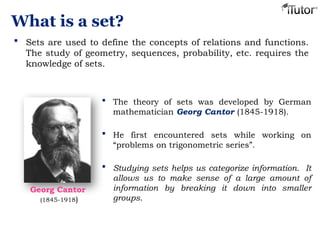
 The theory of sets was developed by German
mathematician Georg Cantor (1845-1918).
 He first encountered sets while working on
“problems on trigonometric series”.
 Studying sets helps us categorize information. It
allows us to make sense of a large amount of
information by breaking it down into smaller
groups.
Georg Cantor
(1845-1918)
Definition: A set is any collection of objects specified in such
a way that we can determine whether a given object is or is
not in the collection.
 In other words A set is a collection of objects.
 These objects are called elements or members of the set.
 The symbol for element is  .
 For example, if you define the set as all the fruit found in
my refrigerator, then apple and orange would be elements
or members of that set.
 The following points are noted while writing a set.
 Sets are usually denoted by capital letters A, B, S, etc.
 The elements of a set are usually denoted by small letters a,
b, t, u, etc
Examples:
 A = {a, b, d, 2, 4}
 B = {math, religion, literature, computer science}
 C = {}
Sets
 Sets can be well defined.
 A well defined set is a set whose contents are clearly
determined. The set defined as “colors” would not be
well defined while “the set of colors in a standard box of
eight crayons” is well defined.
 Other ways to denote sets
 Ellipses
 N = {0, 1, 2, 3, 4. . .}
(set of natural numbers)
 Z = {. . ., -3, -2, -1, 0, 1, 2, 3,. . .}
(set of integers)
 E = {0, 2, 4, 6. . .}
(set of even natural numbers)
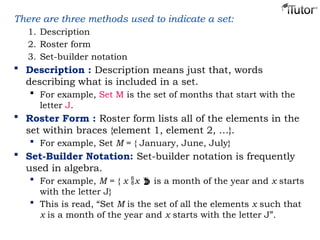
There are three methods used to indicate a set:
1. Description
2. Roster form
3. Set-builder notation
 Description : Description means just that, words
describing what is included in a set.
 For example, Set M is the set of months that start with the
letter J.
 Roster Form : Roster form lists all of the elements in the
set within braces {element 1, element 2, …}.
 For example, Set M = { January, June, July}
 Set-Builder Notation: Set-builder notation is frequently
used in algebra.
 For example, M = { x x  is a month of the year and x starts
with the letter J}
 This is read, “Set M is the set of all the elements x such that
x is a month of the year and x starts with the letter J”.
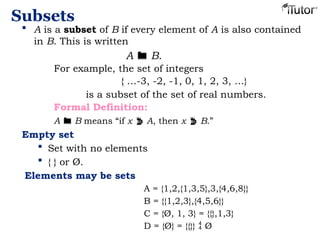
Subsets
 A is a subset of B if every element of A is also contained
in B. This is written
A  B.
For example, the set of integers
{ …-3, -2, -1, 0, 1, 2, 3, …}
is a subset of the set of real numbers.
Formal Definition:
A  B means “if x  A, then x  B.”
Empty set
 Set with no elements
 { } or Ø.
Elements may be sets
A = {1,2,{1,3,5},3,{4,6,8}}
B = {{1,2,3},{4,5,6}}
C = {Ø, 1, 3} = {{},1,3}
D = {Ø} = {{}}  Ø
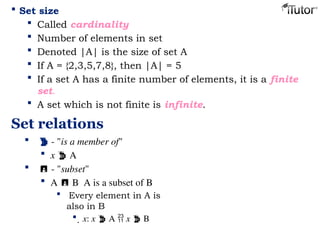
 Set size
 Called cardinality
 Number of elements in set
 Denoted |A| is the size of set A
 If A = {2,3,5,7,8}, then |A| = 5
 If a set A has a finite number of elements, it is a finite
set.
 A set which is not finite is infinite.
Set relations
  - "is a member of"
 x  A
  - "subset"
 A  B A is a subset of B
 Every element in A is
also in B
 x: x  A  x  B
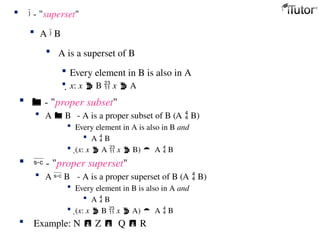
  - "proper subset"
 A  B - A is a proper subset of B (A  B)
 Every element in A is also in B and
 A  B
 (x: x  A  x  B) A  B
  - "proper superset"
 A  B - A is a proper superset of B (A  B)
 Every element in B is also in A and
 A  B
 (x: x  B  x  A) A  B
 Example: N  Z Q  R
  - "superset"
 A  B
 A is a superset of B
 Every element in B is also in A
 x: x  B  x  A
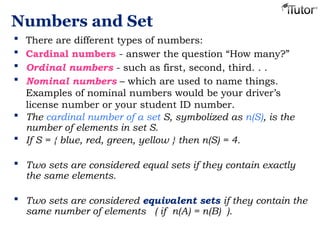
Numbers and Set
 There are different types of numbers:
 Cardinal numbers - answer the question “How many?”
 Ordinal numbers - such as first, second, third. . .
 Nominal numbers – which are used to name things.
Examples of nominal numbers would be your driver’s
license number or your student ID number.
 The cardinal number of a set S, symbolized as n(S), is the
number of elements in set S.
 If S = { blue, red, green, yellow } then n(S) = 4.
 Two sets are considered equal sets if they contain exactly
the same elements.
 Two sets are considered equivalent sets if they contain the
same number of elements ( if n(A) = n(B) ).
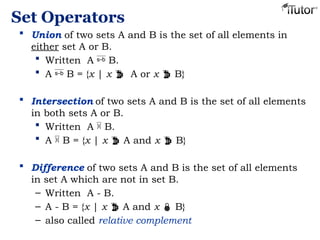
Set Operators
 Union of two sets A and B is the set of all elements in
either set A or B.
 Written A  B.
 A  B = {x | x  A or x  B}
 Intersection of two sets A and B is the set of all elements
in both sets A or B.
 Written A  B.
 A  B = {x | x  A and x  B}
 Difference of two sets A and B is the set of all elements
in set A which are not in set B.
– Written A - B.
– A - B = {x | x  A and x  B}
– also called relative complement
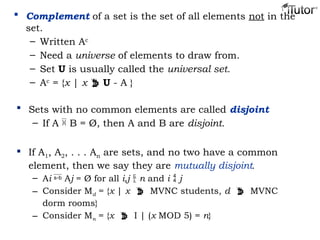
 Complement of a set is the set of all elements not in the
set.
– Written Ac
– Need a universe of elements to draw from.
– Set U is usually called the universal set.
– Ac
= {x | x  U - A }
 Sets with no common elements are called disjoint
– If A  B = Ø, then A and B are disjoint.
 If A1, A2, . . . An are sets, and no two have a common
element, then we say they are mutually disjoint.
– Ai  Aj = Ø for all i,j  n and i  j
– Consider Md = {x | x  MVNC students, d  MVNC
dorm rooms}
– Consider Mn = {x  I | (x MOD 5) = n}
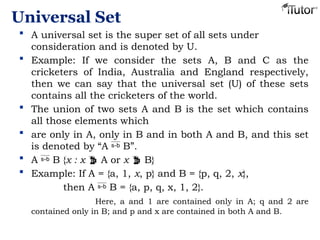
Universal Set
 A universal set is the super set of all sets under
consideration and is denoted by U.
 Example: If we consider the sets A, B and C as the
cricketers of India, Australia and England respectively,
then we can say that the universal set (U) of these sets
contains all the cricketers of the world.
 The union of two sets A and B is the set which contains
all those elements which
 are only in A, only in B and in both A and B, and this set
is denoted by “A  B”.
 A  B {x : x  A or x  B}
 Example: If A = {a, 1, x, p} and B = {p, q, 2, x},
then A  B = {a, p, q, x, 1, 2}.
Here, a and 1 are contained only in A; q and 2 are
contained only in B; and p and x are contained in both A and B.
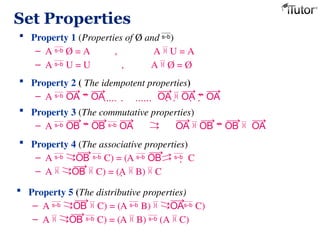
Set Properties
 Property 1 (Properties of Ø and )
– A  Ø = A , A  U = A
– A U = U , A  Ø = Ø
 Property 2 ( The idempotent properties)
– A                 
    
 Property 3 (The commutative properties)
– A  
 Property 4 (The associative properties)
– A C) = (A   C
– A C) = (A  B) C
 Property 5 (The distributive properties)
– A C) = (A B) C)
– A  C) = (A  B)  (A  C)
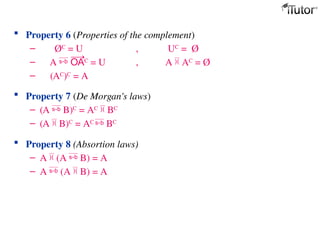
 Property 6 (Properties of the complement)
– ØC
= U , UC
= Ø
– A C
= U , A  AC
= Ø
– (AC)C = A
 Property 7 (De Morgan's laws)
– (A  B)C
= AC
 BC
– (A  B)C
= AC
 BC
 Property 8 (Absortion laws)
– A  (A  B) = A
– A  (A  B) = A
The End
Call us for more
information:
www.iTutor.com
1-855-694-8886
Visit

Set theory. lesson. probability and statistics

  • 1.
  • 2.
    What is aset?  Sets are used to define the concepts of relations and functions. The study of geometry, sequences, probability, etc. requires the knowledge of sets.  The theory of sets was developed by German mathematician Georg Cantor (1845-1918).  He first encountered sets while working on “problems on trigonometric series”.  Studying sets helps us categorize information. It allows us to make sense of a large amount of information by breaking it down into smaller groups. Georg Cantor (1845-1918)
  • 3.
    Definition: A setis any collection of objects specified in such a way that we can determine whether a given object is or is not in the collection.  In other words A set is a collection of objects.  These objects are called elements or members of the set.  The symbol for element is  .  For example, if you define the set as all the fruit found in my refrigerator, then apple and orange would be elements or members of that set.  The following points are noted while writing a set.  Sets are usually denoted by capital letters A, B, S, etc.  The elements of a set are usually denoted by small letters a, b, t, u, etc Examples:  A = {a, b, d, 2, 4}  B = {math, religion, literature, computer science}  C = {}
  • 4.
    Sets  Sets canbe well defined.  A well defined set is a set whose contents are clearly determined. The set defined as “colors” would not be well defined while “the set of colors in a standard box of eight crayons” is well defined.  Other ways to denote sets  Ellipses  N = {0, 1, 2, 3, 4. . .} (set of natural numbers)  Z = {. . ., -3, -2, -1, 0, 1, 2, 3,. . .} (set of integers)  E = {0, 2, 4, 6. . .} (set of even natural numbers)
  • 5.
    There are threemethods used to indicate a set: 1. Description 2. Roster form 3. Set-builder notation  Description : Description means just that, words describing what is included in a set.  For example, Set M is the set of months that start with the letter J.  Roster Form : Roster form lists all of the elements in the set within braces {element 1, element 2, …}.  For example, Set M = { January, June, July}  Set-Builder Notation: Set-builder notation is frequently used in algebra.  For example, M = { x x  is a month of the year and x starts with the letter J}  This is read, “Set M is the set of all the elements x such that x is a month of the year and x starts with the letter J”.
  • 6.
    Subsets  A isa subset of B if every element of A is also contained in B. This is written A  B. For example, the set of integers { …-3, -2, -1, 0, 1, 2, 3, …} is a subset of the set of real numbers. Formal Definition: A  B means “if x  A, then x  B.” Empty set  Set with no elements  { } or Ø. Elements may be sets A = {1,2,{1,3,5},3,{4,6,8}} B = {{1,2,3},{4,5,6}} C = {Ø, 1, 3} = {{},1,3} D = {Ø} = {{}}  Ø
  • 7.
     Set size Called cardinality  Number of elements in set  Denoted |A| is the size of set A  If A = {2,3,5,7,8}, then |A| = 5  If a set A has a finite number of elements, it is a finite set.  A set which is not finite is infinite. Set relations   - "is a member of"  x  A   - "subset"  A  B A is a subset of B  Every element in A is also in B  x: x  A  x  B
  • 8.
      -"proper subset"  A  B - A is a proper subset of B (A  B)  Every element in A is also in B and  A  B  (x: x  A  x  B) A  B   - "proper superset"  A  B - A is a proper superset of B (A  B)  Every element in B is also in A and  A  B  (x: x  B  x  A) A  B  Example: N  Z Q  R   - "superset"  A  B  A is a superset of B  Every element in B is also in A  x: x  B  x  A
  • 9.
    Numbers and Set There are different types of numbers:  Cardinal numbers - answer the question “How many?”  Ordinal numbers - such as first, second, third. . .  Nominal numbers – which are used to name things. Examples of nominal numbers would be your driver’s license number or your student ID number.  The cardinal number of a set S, symbolized as n(S), is the number of elements in set S.  If S = { blue, red, green, yellow } then n(S) = 4.  Two sets are considered equal sets if they contain exactly the same elements.  Two sets are considered equivalent sets if they contain the same number of elements ( if n(A) = n(B) ).
  • 10.
    Set Operators  Unionof two sets A and B is the set of all elements in either set A or B.  Written A  B.  A  B = {x | x  A or x  B}  Intersection of two sets A and B is the set of all elements in both sets A or B.  Written A  B.  A  B = {x | x  A and x  B}  Difference of two sets A and B is the set of all elements in set A which are not in set B. – Written A - B. – A - B = {x | x  A and x  B} – also called relative complement
  • 11.
     Complement ofa set is the set of all elements not in the set. – Written Ac – Need a universe of elements to draw from. – Set U is usually called the universal set. – Ac = {x | x  U - A }  Sets with no common elements are called disjoint – If A  B = Ø, then A and B are disjoint.  If A1, A2, . . . An are sets, and no two have a common element, then we say they are mutually disjoint. – Ai  Aj = Ø for all i,j  n and i  j – Consider Md = {x | x  MVNC students, d  MVNC dorm rooms} – Consider Mn = {x  I | (x MOD 5) = n}
  • 12.
    Universal Set  Auniversal set is the super set of all sets under consideration and is denoted by U.  Example: If we consider the sets A, B and C as the cricketers of India, Australia and England respectively, then we can say that the universal set (U) of these sets contains all the cricketers of the world.  The union of two sets A and B is the set which contains all those elements which  are only in A, only in B and in both A and B, and this set is denoted by “A  B”.  A  B {x : x  A or x  B}  Example: If A = {a, 1, x, p} and B = {p, q, 2, x}, then A  B = {a, p, q, x, 1, 2}. Here, a and 1 are contained only in A; q and 2 are contained only in B; and p and x are contained in both A and B.
  • 13.
    Set Properties  Property1 (Properties of Ø and ) – A  Ø = A , A  U = A – A U = U , A  Ø = Ø  Property 2 ( The idempotent properties) – A                        Property 3 (The commutative properties) – A    Property 4 (The associative properties) – A C) = (A   C – A C) = (A  B) C  Property 5 (The distributive properties) – A C) = (A B) C) – A  C) = (A  B)  (A  C)
  • 14.
     Property 6(Properties of the complement) – ØC = U , UC = Ø – A C = U , A  AC = Ø – (AC)C = A  Property 7 (De Morgan's laws) – (A  B)C = AC  BC – (A  B)C = AC  BC  Property 8 (Absortion laws) – A  (A  B) = A – A  (A  B) = A
  • 15.
    The End Call usfor more information: www.iTutor.com 1-855-694-8886 Visit