DISCOVERING our REALITY BY  JOI MARSHALL
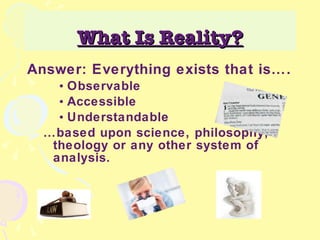
What Is Reality? Answer: Everything exists that is…. Observable Accessible Understandable … based upon science, philosophy, theology or any other system of analysis.
4 Terms You Need to Know Cognitions : These are the smallest units of awareness. They are sometimes referred to as "stimulli"  and are based upon our 5 senses. Environment : those things that are actually there around us.  Reality : this is your mental interpretation of your environment.  Perception : this is the process we experience that creates a reality from an environment.
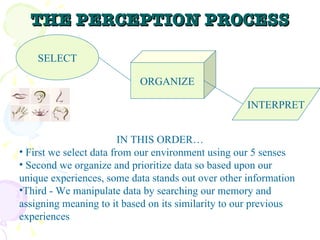
THE PERCEPTION PROCESS SELECT INTERPRET ORGANIZE IN THIS ORDER… First we select data from our environment using our 5 senses Second we organize and prioritize data so based upon our unique experiences, some data stands out over other information Third - We manipulate data by searching our memory and assigning meaning to it based on its similarity to our previous experiences
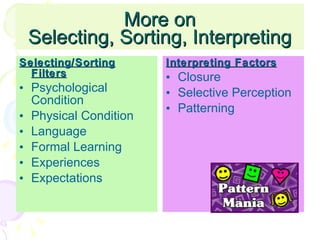
More on Selecting, Sorting, Interpreting Selecting/Sorting Filters Psychological Condition Physical Condition Language Formal Learning Experiences Expectations Interpreting Factors Closure Selective Perception Patterning
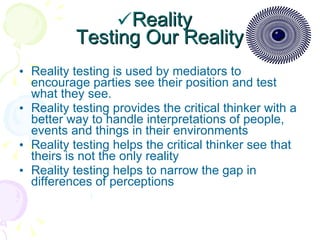
Reality  Testing Our Reality Reality testing is used by mediators to encourage parties see their position and test what they see. Reality testing provides the critical thinker with a better way to handle interpretations of people, events and things in their environments Reality testing helps the critical thinker see that theirs is not the only reality Reality testing helps to narrow the gap in differences of perceptions
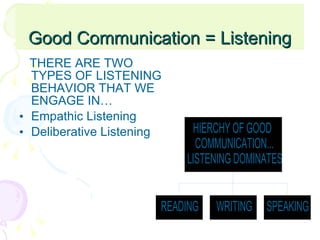
Good Communication = Listening THERE ARE TWO TYPES OF LISTENING BEHAVIOR THAT WE ENGAGE IN… Empathic Listening Deliberative Listening
EMPATHIC LISTENING… The ability to recreate another person’s perspective An attempt to “emotionally” understand the reality of others Is an active process that takes energy and commitment Often confused with “sympathy” Total empathy is impossible to achieve
DELIBERATIVE LISTENING… An attempt to hear information, analyze, draw conclusions and recall it at a later time Easiest type of listening, due to being reinforced educationally Good for gathering information and content Not useful for narrowing differences in opposing realities
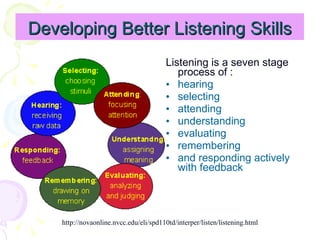
Developing Better Listening Skills Listening is a seven stage process of : hearing selecting attending understanding evaluating remembering and responding actively with feedback http://novaonline.nvcc.edu/eli/spd110td/interper/listen/listening.html
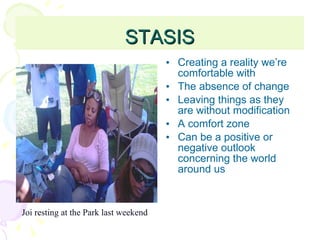
STASIS Creating a reality we’re comfortable with The absence of change Leaving things as they are without modification A comfort zone Can be a positive or negative outlook concerning the world around us Joi resting at the Park last weekend
the END

Discovering realty jmm

  • 1.
    DISCOVERING our REALITYBY JOI MARSHALL
  • 2.
    What Is Reality?Answer: Everything exists that is…. Observable Accessible Understandable … based upon science, philosophy, theology or any other system of analysis.
  • 3.
    4 Terms YouNeed to Know Cognitions : These are the smallest units of awareness. They are sometimes referred to as "stimulli" and are based upon our 5 senses. Environment : those things that are actually there around us. Reality : this is your mental interpretation of your environment. Perception : this is the process we experience that creates a reality from an environment.
  • 4.
    THE PERCEPTION PROCESSSELECT INTERPRET ORGANIZE IN THIS ORDER… First we select data from our environment using our 5 senses Second we organize and prioritize data so based upon our unique experiences, some data stands out over other information Third - We manipulate data by searching our memory and assigning meaning to it based on its similarity to our previous experiences
  • 5.
    More on Selecting,Sorting, Interpreting Selecting/Sorting Filters Psychological Condition Physical Condition Language Formal Learning Experiences Expectations Interpreting Factors Closure Selective Perception Patterning
  • 6.
    Reality TestingOur Reality Reality testing is used by mediators to encourage parties see their position and test what they see. Reality testing provides the critical thinker with a better way to handle interpretations of people, events and things in their environments Reality testing helps the critical thinker see that theirs is not the only reality Reality testing helps to narrow the gap in differences of perceptions
  • 7.
    Good Communication =Listening THERE ARE TWO TYPES OF LISTENING BEHAVIOR THAT WE ENGAGE IN… Empathic Listening Deliberative Listening
  • 8.
    EMPATHIC LISTENING… Theability to recreate another person’s perspective An attempt to “emotionally” understand the reality of others Is an active process that takes energy and commitment Often confused with “sympathy” Total empathy is impossible to achieve
  • 9.
    DELIBERATIVE LISTENING… Anattempt to hear information, analyze, draw conclusions and recall it at a later time Easiest type of listening, due to being reinforced educationally Good for gathering information and content Not useful for narrowing differences in opposing realities
  • 10.
    Developing Better ListeningSkills Listening is a seven stage process of : hearing selecting attending understanding evaluating remembering and responding actively with feedback http://novaonline.nvcc.edu/eli/spd110td/interper/listen/listening.html
  • 11.
    STASIS Creating areality we’re comfortable with The absence of change Leaving things as they are without modification A comfort zone Can be a positive or negative outlook concerning the world around us Joi resting at the Park last weekend
  • 12.