Discovering our realities
How we use the perception process to
create realities about people, events, and
things in our environment.
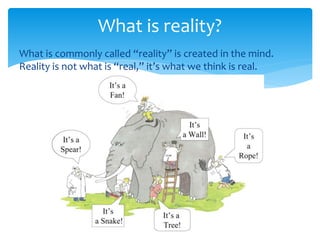
What is commonly called “reality” is created in the mind.
Reality is not what is “real,” it’s what we think is real.
What is reality?
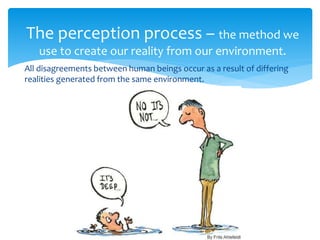
All disagreements between human beings occur as a result of differing
realities generated from the same environment.
The perception process – the method we
use to create our reality from our environment.
1. Select data from the environment
We use five senses (sight, smell, hearing, feeling, taste).
2. Organize and prioritize the information
Organization is based on our experiences. They are
unique.
3. Interpreting the data
We search our memory and assign meaning to the data
based on its similarity to our previous experiences.
3 steps in the perception process:
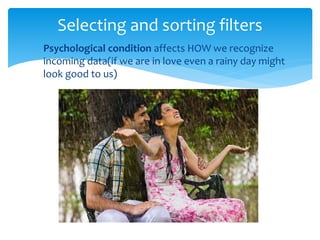
Psychological condition affects HOW we recognize
incoming data(if we are in love even a rainy day might
look good to us)
Selecting and sorting filters
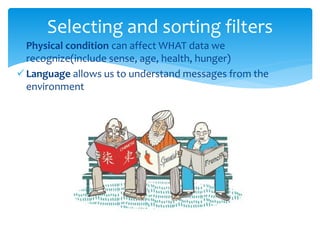
Physical condition can affect WHAT data we
recognize(include sense, age, health, hunger)
Language allows us to understand messages from the
environment
Selecting and sorting filters
Formal learning shapes how we view our
environment
Experiences are our first hand learning activities
Expectations are perceptions that we expect to
conform to what we already believe the actual event
is. Influenced by: culture, social roles, gender roles.
Selecting and sorting filters
Closure is the mind’s imperative to make sense
out of its environment, even when only a
limited amount of data is available.
Selective perception takes place when we use
only some of the cognitions to interpret the
environment.
Pattering is the attempt to keep new
perception in line with past ones.
Factors that influence how we
interpret data
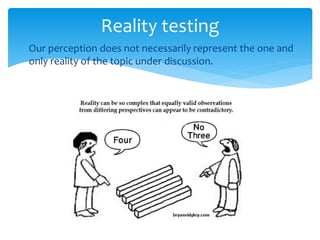
 Our perception does not necessarily represent the one and
only reality of the topic under discussion.
Reality testing
 One goal of the argumentative process is to narrow
the differences in perceptions between individuals.
 Sharing and comparing our realities with those of
others can help reduce distortions and differences
among the many realities you have created.
Reality testing
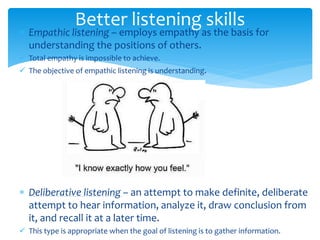
 Empathic listening – employs empathy as the basis for
understanding the positions of others.
 Total empathy is impossible to achieve.
 The objective of empathic listening is understanding.
 Deliberative listening – an attempt to make definite, deliberate
attempt to hear information, analyze it, draw conclusion from
it, and recall it at a later time.
 This type is appropriate when the goal of listening is to gather information.
Better listening skills
 Is the absence of change in one or more of our
realities for some extended period of time.
 While experiencing stasis, we feel physically and
emotionally content.
 Stasis can be referred to as a person’s personal
comfort zone.
Stasis=“at rest”
 Communicating Critical Thinking by Jack Sterk and Jim
Marteney
Sources:

Discovering our realities

  • 1.
    Discovering our realities Howwe use the perception process to create realities about people, events, and things in our environment.
  • 2.
    What is commonlycalled “reality” is created in the mind. Reality is not what is “real,” it’s what we think is real. What is reality?
  • 3.
    All disagreements betweenhuman beings occur as a result of differing realities generated from the same environment. The perception process – the method we use to create our reality from our environment.
  • 4.
    1. Select datafrom the environment We use five senses (sight, smell, hearing, feeling, taste). 2. Organize and prioritize the information Organization is based on our experiences. They are unique. 3. Interpreting the data We search our memory and assign meaning to the data based on its similarity to our previous experiences. 3 steps in the perception process:
  • 5.
    Psychological condition affectsHOW we recognize incoming data(if we are in love even a rainy day might look good to us) Selecting and sorting filters
  • 6.
    Physical condition canaffect WHAT data we recognize(include sense, age, health, hunger) Language allows us to understand messages from the environment Selecting and sorting filters
  • 7.
    Formal learning shapeshow we view our environment Experiences are our first hand learning activities Expectations are perceptions that we expect to conform to what we already believe the actual event is. Influenced by: culture, social roles, gender roles. Selecting and sorting filters
  • 8.
    Closure is themind’s imperative to make sense out of its environment, even when only a limited amount of data is available. Selective perception takes place when we use only some of the cognitions to interpret the environment. Pattering is the attempt to keep new perception in line with past ones. Factors that influence how we interpret data
  • 9.
     Our perceptiondoes not necessarily represent the one and only reality of the topic under discussion. Reality testing
  • 10.
     One goalof the argumentative process is to narrow the differences in perceptions between individuals.  Sharing and comparing our realities with those of others can help reduce distortions and differences among the many realities you have created. Reality testing
  • 11.
     Empathic listening– employs empathy as the basis for understanding the positions of others.  Total empathy is impossible to achieve.  The objective of empathic listening is understanding.  Deliberative listening – an attempt to make definite, deliberate attempt to hear information, analyze it, draw conclusion from it, and recall it at a later time.  This type is appropriate when the goal of listening is to gather information. Better listening skills
  • 12.
     Is theabsence of change in one or more of our realities for some extended period of time.  While experiencing stasis, we feel physically and emotionally content.  Stasis can be referred to as a person’s personal comfort zone. Stasis=“at rest”
  • 13.
     Communicating CriticalThinking by Jack Sterk and Jim Marteney Sources: