DISCOURSE MARKERS
Result
Reason
Purpose
Contrast
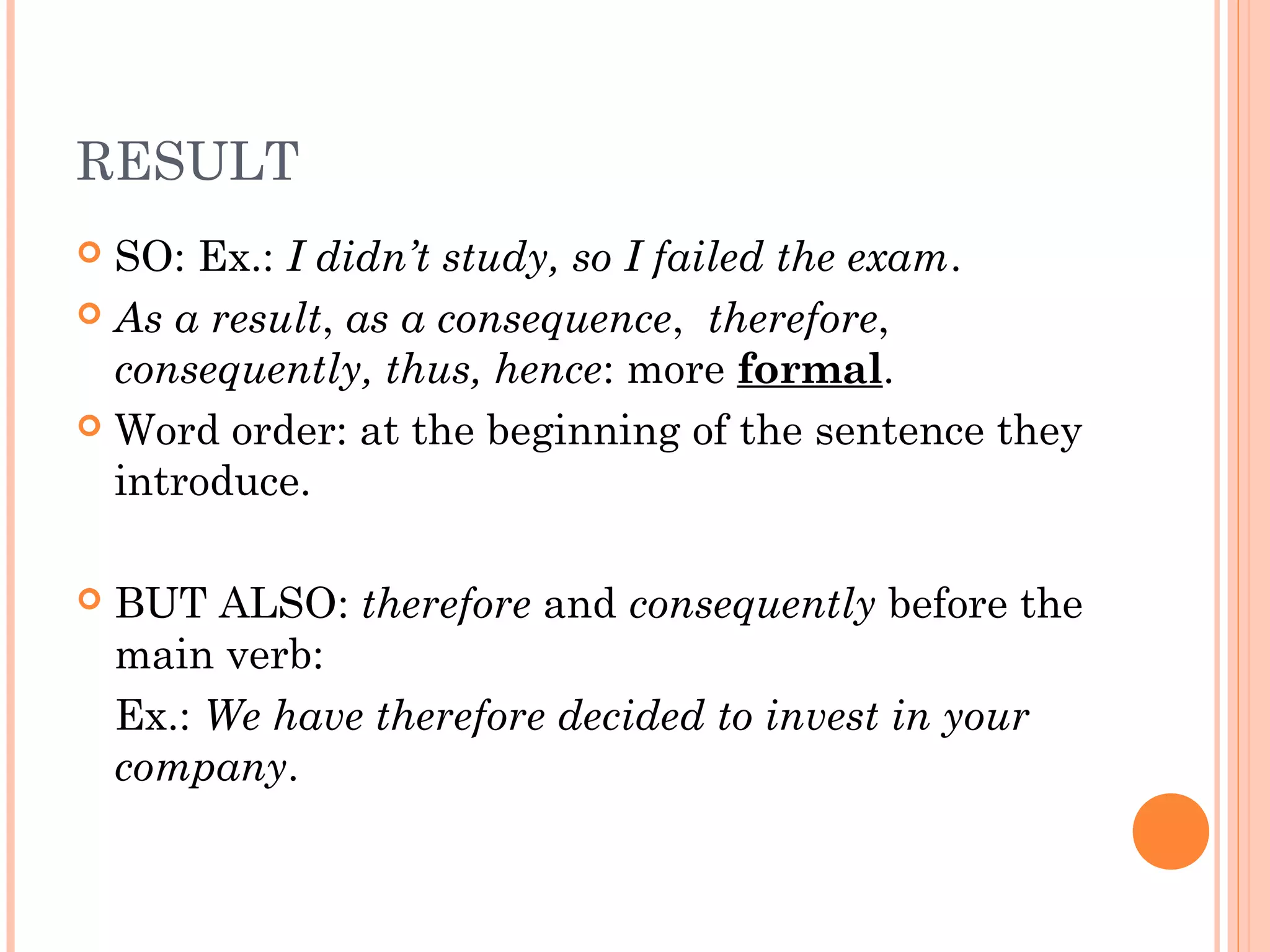
RESULT
 SO: Ex.: I didn’t study, so I failed the exam.
 As a result, as a consequence, therefore,
  consequently, thus, hence: more formal.
 Word order: at the beginning of the sentence they
  introduce.

   BUT ALSO: therefore and consequently before the
    main verb:
    Ex.: We have therefore decided to invest in your
    company.
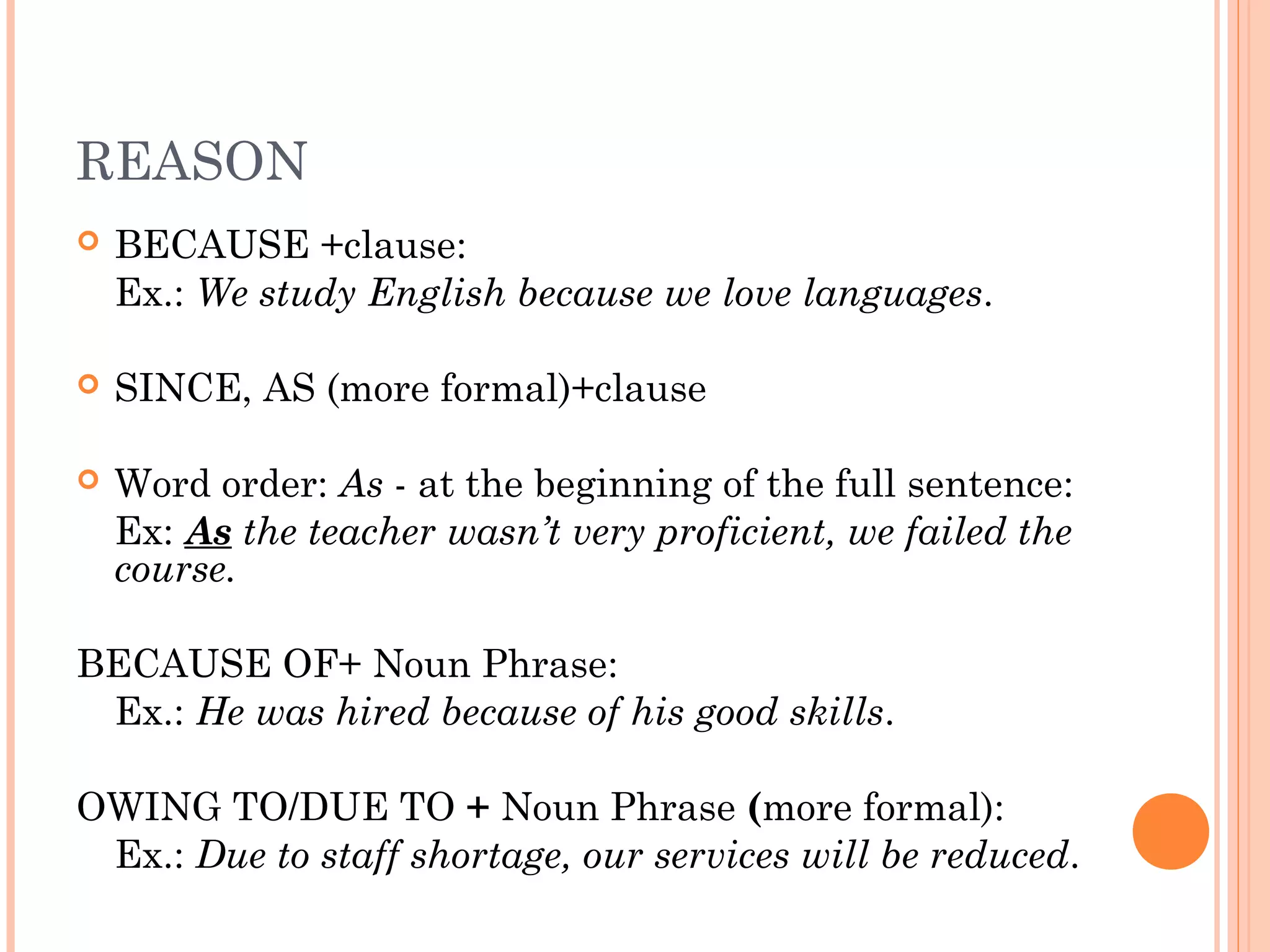
REASON
   BECAUSE +clause:
    Ex.: We study English because we love languages.

   SINCE, AS (more formal)+clause

   Word order: As - at the beginning of the full sentence:
    Ex: As the teacher wasn’t very proficient, we failed the
    course.

BECAUSE OF+ Noun Phrase:
 Ex.: He was hired because of his good skills.

OWING TO/DUE TO + Noun Phrase (more formal):
 Ex.: Due to staff shortage, our services will be reduced.
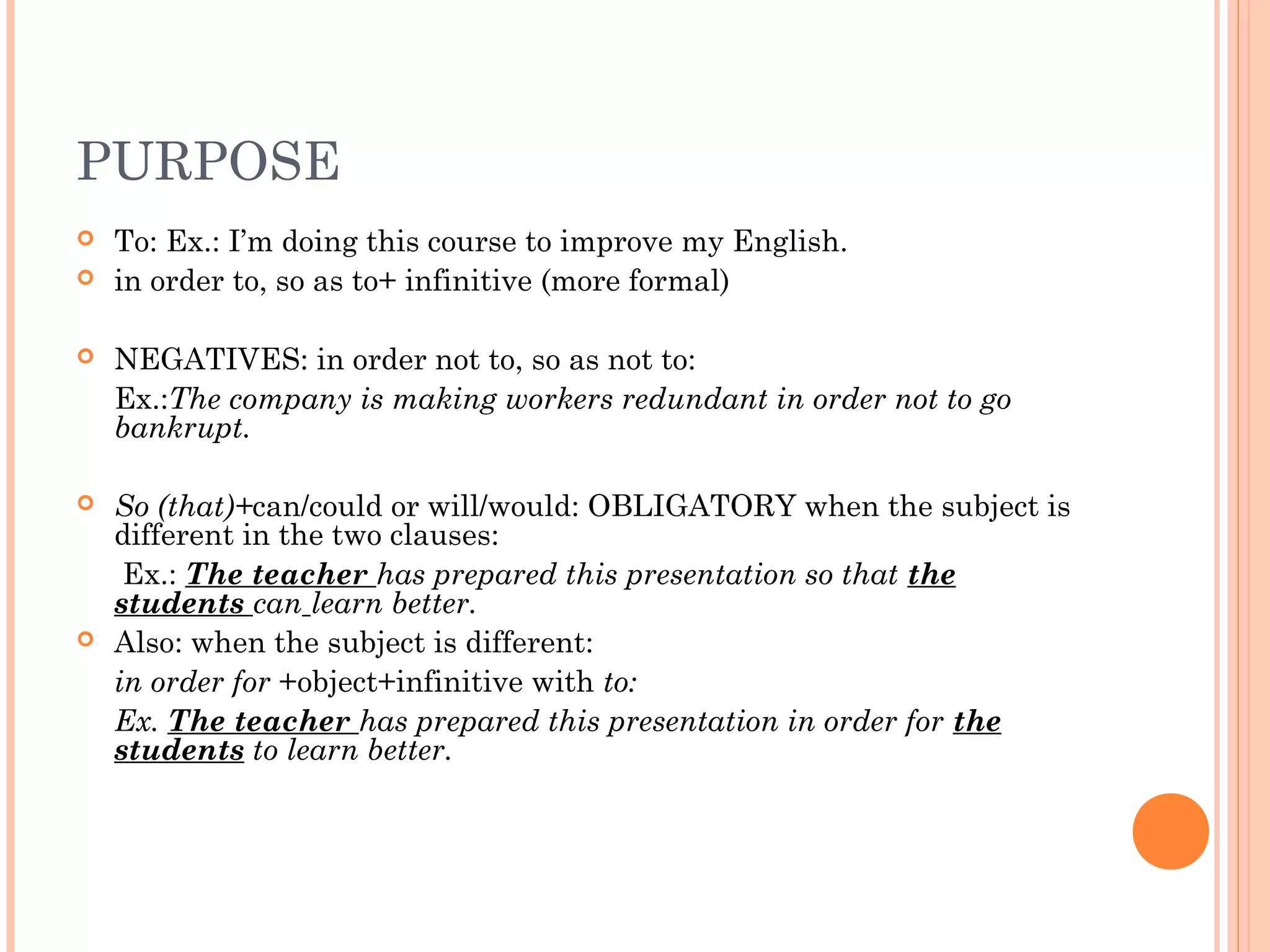
PURPOSE
   To: Ex.: I’m doing this course to improve my English.
   in order to, so as to+ infinitive (more formal)

   NEGATIVES: in order not to, so as not to:
    Ex.:The company is making workers redundant in order not to go
    bankrupt.

   So (that)+can/could or will/would: OBLIGATORY when the subject is
    different in the two clauses:
     Ex.: The teacher has prepared this presentation so that the
    students can learn better.
   Also: when the subject is different:
    in order for +object+infinitive with to:
    Ex. The teacher has prepared this presentation in order for the
    students to learn better.
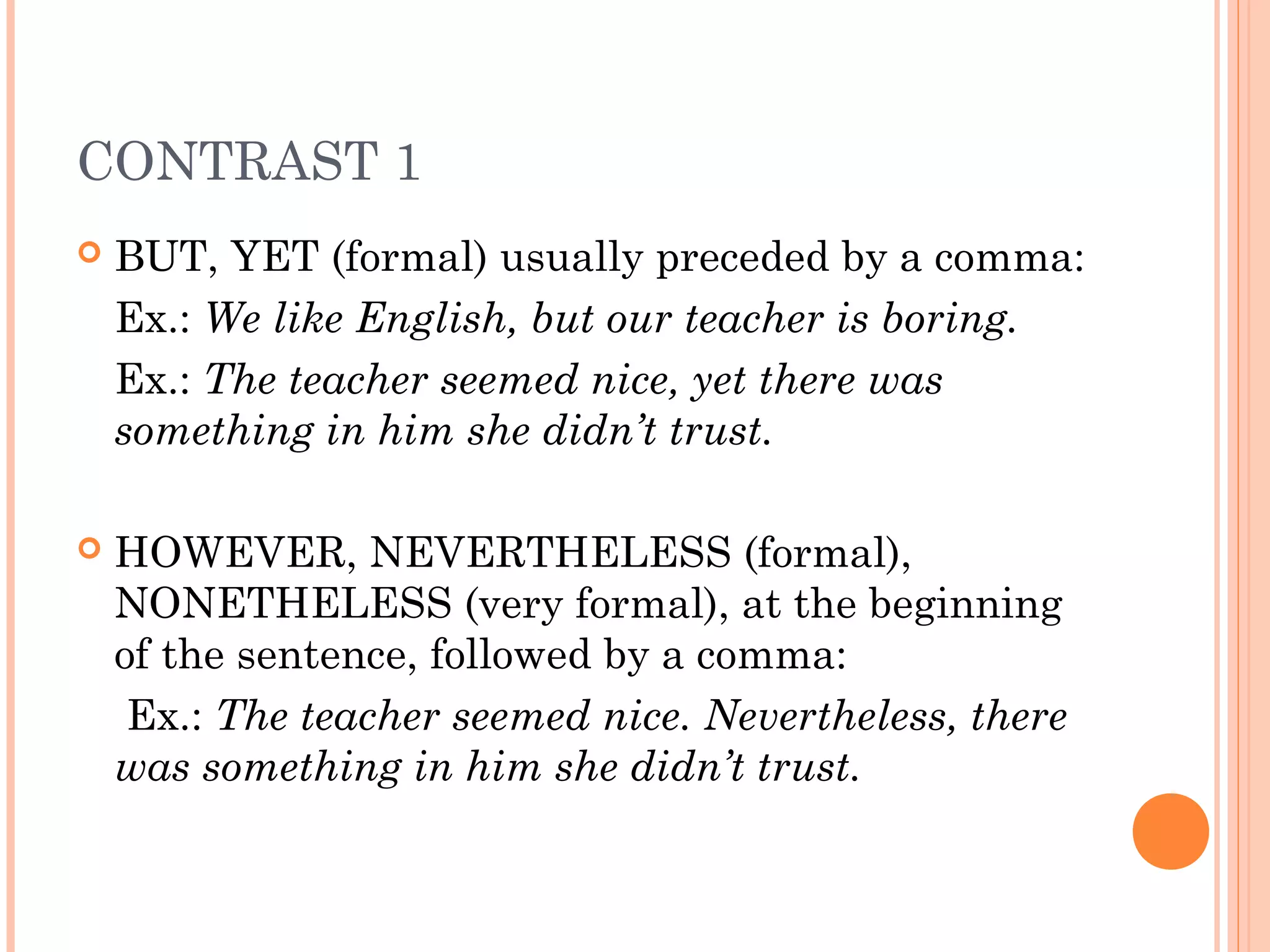
CONTRAST 1
   BUT, YET (formal) usually preceded by a comma:
    Ex.: We like English, but our teacher is boring.
    Ex.: The teacher seemed nice, yet there was
    something in him she didn’t trust.

   HOWEVER, NEVERTHELESS (formal),
    NONETHELESS (very formal), at the beginning
    of the sentence, followed by a comma:
     Ex.: The teacher seemed nice. Nevertheless, there
    was something in him she didn’t trust.
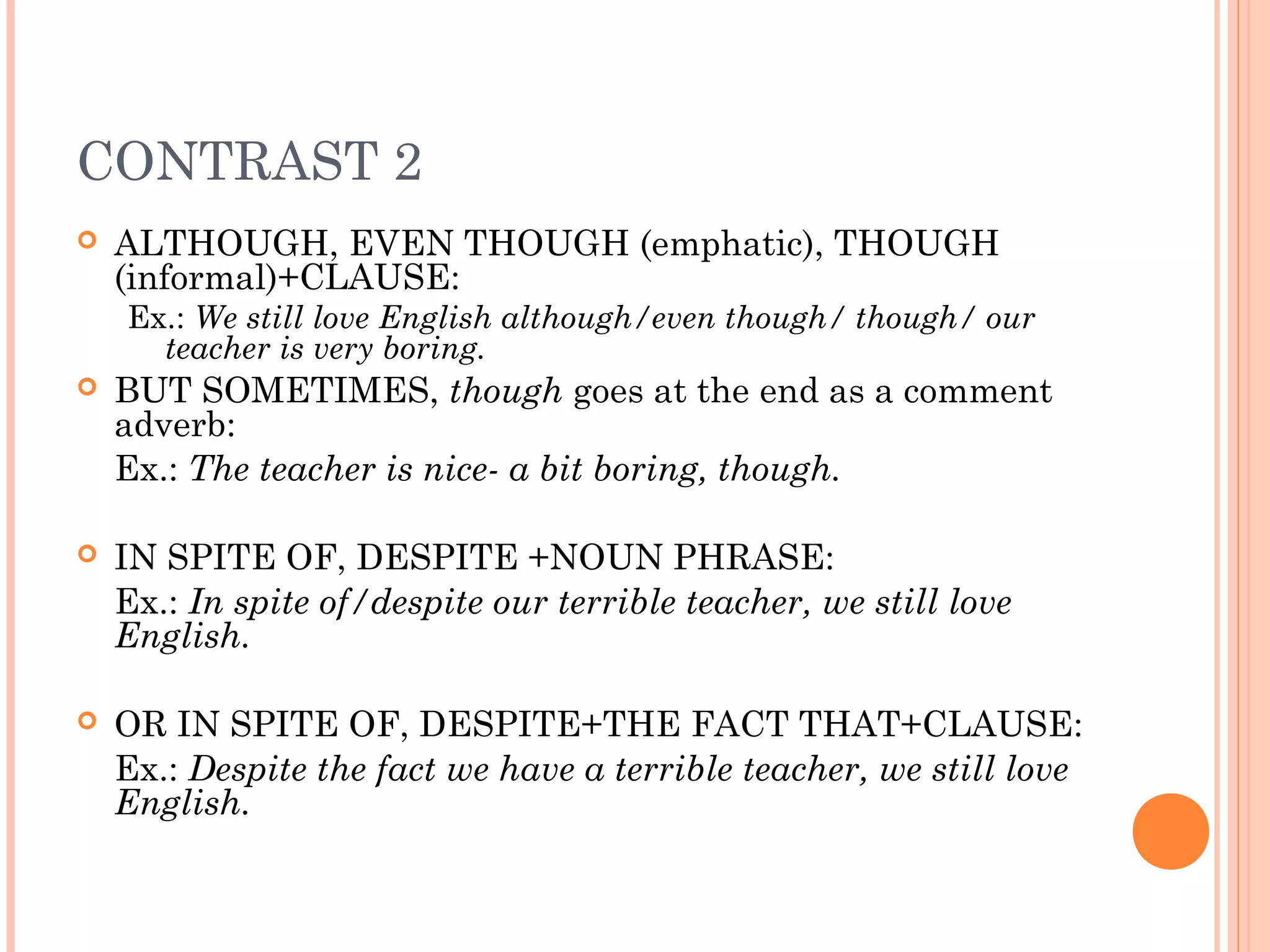
CONTRAST 2
   ALTHOUGH, EVEN THOUGH (emphatic), THOUGH
    (informal)+CLAUSE:
    Ex.: We still love English although/even though/ though/ our
      teacher is very boring.
   BUT SOMETIMES, though goes at the end as a comment
    adverb:
    Ex.: The teacher is nice- a bit boring, though.

   IN SPITE OF, DESPITE +NOUN PHRASE:
    Ex.: In spite of/despite our terrible teacher, we still love
    English.

   OR IN SPITE OF, DESPITE+THE FACT THAT+CLAUSE:
    Ex.: Despite the fact we have a terrible teacher, we still love
    English.

Discourse markers

  • 1.
  • 2.
    RESULT  SO: Ex.:I didn’t study, so I failed the exam.  As a result, as a consequence, therefore, consequently, thus, hence: more formal.  Word order: at the beginning of the sentence they introduce.  BUT ALSO: therefore and consequently before the main verb: Ex.: We have therefore decided to invest in your company.
  • 3.
    REASON  BECAUSE +clause: Ex.: We study English because we love languages.  SINCE, AS (more formal)+clause  Word order: As - at the beginning of the full sentence: Ex: As the teacher wasn’t very proficient, we failed the course. BECAUSE OF+ Noun Phrase: Ex.: He was hired because of his good skills. OWING TO/DUE TO + Noun Phrase (more formal): Ex.: Due to staff shortage, our services will be reduced.
  • 4.
    PURPOSE  To: Ex.: I’m doing this course to improve my English.  in order to, so as to+ infinitive (more formal)  NEGATIVES: in order not to, so as not to: Ex.:The company is making workers redundant in order not to go bankrupt.  So (that)+can/could or will/would: OBLIGATORY when the subject is different in the two clauses: Ex.: The teacher has prepared this presentation so that the students can learn better.  Also: when the subject is different: in order for +object+infinitive with to: Ex. The teacher has prepared this presentation in order for the students to learn better.
  • 5.
    CONTRAST 1  BUT, YET (formal) usually preceded by a comma: Ex.: We like English, but our teacher is boring. Ex.: The teacher seemed nice, yet there was something in him she didn’t trust.  HOWEVER, NEVERTHELESS (formal), NONETHELESS (very formal), at the beginning of the sentence, followed by a comma: Ex.: The teacher seemed nice. Nevertheless, there was something in him she didn’t trust.
  • 6.
    CONTRAST 2  ALTHOUGH, EVEN THOUGH (emphatic), THOUGH (informal)+CLAUSE: Ex.: We still love English although/even though/ though/ our teacher is very boring.  BUT SOMETIMES, though goes at the end as a comment adverb: Ex.: The teacher is nice- a bit boring, though.  IN SPITE OF, DESPITE +NOUN PHRASE: Ex.: In spite of/despite our terrible teacher, we still love English.  OR IN SPITE OF, DESPITE+THE FACT THAT+CLAUSE: Ex.: Despite the fact we have a terrible teacher, we still love English.