•1.Focus on linguistic practices in
school.
•2.Topics of discourse in school
settings:
•a. Classroom interaction as
cultural practice.
•b.Classroom discourse and
literacy development.
•c.Discourse study of second
language development.
•3.Classroom discourse as
learning.
Math
1.Teacher: Who can tell
Carter what group one does,
when they’re done
with their number book.
2.Hai: I know
3.Teacher: Hai?
4.Hai: Um . . after you
finish your workbook,
you get something quiet
to do
Griffin&Shy
continued
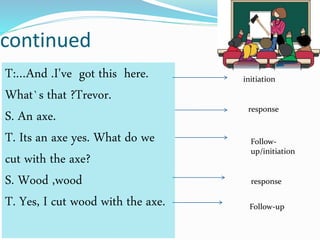
T:…And .I've got this here.
What`s that ?Trevor.
S. An axe.
T. Its an axe yes. What do we
cut with the axe?
S. Wood ,wood
T. Yes, I cut wood with the axe.
initiation
response
Follow-
up/initiation
response
Follow-up
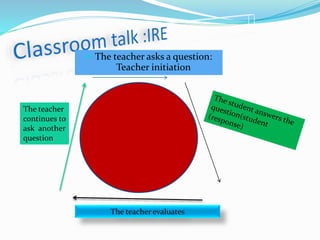
 The teacher asks a question:
Teacher initiation
The teacher evaluates
The teacher
continues to
ask another
question
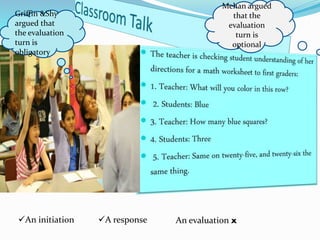
An initiation A response An evaluation x
Mehan argued
that the
evaluation
turn is
optional
Griffin &Shy
argued that
the evaluation
turn is
obligatory
continued
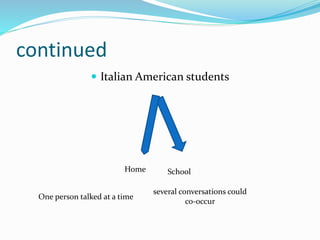
 Italian American students
Home School
One person talked at a time
several conversations could
co-occur
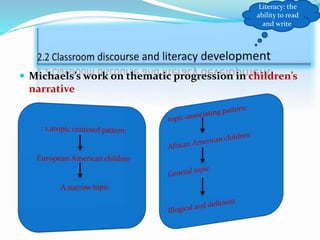
Literacy: the
ability to read
and write
 Michaels’s work on thematic progression in children’s
narrative
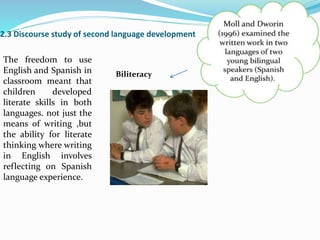
2.3 Discourse study of second language development
Biliteracy
The freedom to use
English and Spanish in
classroom meant that
children developed
literate skills in both
languages. not just the
means of writing ,but
the ability for literate
thinking where writing
in English involves
reflecting on Spanish
language experience.
Student's cognition theory
 Student's cognition :the way they are thinking.
 Students are sponge they are essentially taking in every
thing round them both socially and environmentally
and internalizing that into cognitive or their way of
thinking.
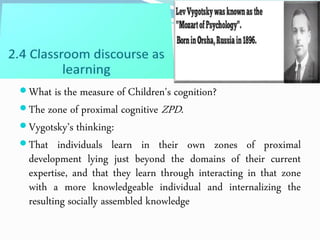
What is the measure of Children's cognition?
The zone of proximal cognitive ZPD.
Vygotsky’s thinking:
That individuals learn in their own zones of proximal
development lying just beyond the domains of their current
expertise, and that they learn through interacting in that zone
with a more knowledgeable individual and internalizing the
resulting socially assembled knowledge
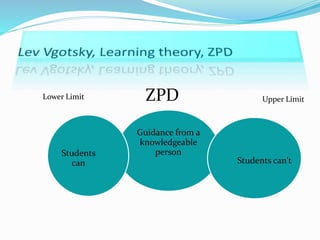
Guidance from a
knowledgeable
person
Students can't
Students
can
ZPDLower Limit Upper Limit
Classroom has its own special
culture
Why it's difficult to generalize about classroom discourse?
Discourse analysis

Discourse analysis

  • 2.
    •1.Focus on linguisticpractices in school. •2.Topics of discourse in school settings: •a. Classroom interaction as cultural practice. •b.Classroom discourse and literacy development. •c.Discourse study of second language development. •3.Classroom discourse as learning.
  • 6.
    Math 1.Teacher: Who cantell Carter what group one does, when they’re done with their number book. 2.Hai: I know 3.Teacher: Hai? 4.Hai: Um . . after you finish your workbook, you get something quiet to do Griffin&Shy
  • 7.
    continued T:…And .I've gotthis here. What`s that ?Trevor. S. An axe. T. Its an axe yes. What do we cut with the axe? S. Wood ,wood T. Yes, I cut wood with the axe. initiation response Follow- up/initiation response Follow-up
  • 8.
     The teacherasks a question: Teacher initiation The teacher evaluates The teacher continues to ask another question
  • 9.
    An initiation Aresponse An evaluation x Mehan argued that the evaluation turn is optional Griffin &Shy argued that the evaluation turn is obligatory
  • 11.
    continued  Italian Americanstudents Home School One person talked at a time several conversations could co-occur
  • 12.
    Literacy: the ability toread and write  Michaels’s work on thematic progression in children’s narrative
  • 14.
    2.3 Discourse studyof second language development Biliteracy The freedom to use English and Spanish in classroom meant that children developed literate skills in both languages. not just the means of writing ,but the ability for literate thinking where writing in English involves reflecting on Spanish language experience.
  • 15.
    Student's cognition theory Student's cognition :the way they are thinking.  Students are sponge they are essentially taking in every thing round them both socially and environmentally and internalizing that into cognitive or their way of thinking.
  • 16.
    What is themeasure of Children's cognition? The zone of proximal cognitive ZPD. Vygotsky’s thinking: That individuals learn in their own zones of proximal development lying just beyond the domains of their current expertise, and that they learn through interacting in that zone with a more knowledgeable individual and internalizing the resulting socially assembled knowledge
  • 17.
    Guidance from a knowledgeable person Studentscan't Students can ZPDLower Limit Upper Limit
  • 18.
    Classroom has itsown special culture Why it's difficult to generalize about classroom discourse?