



© ILX Group
AGILE
A Fresh Perspective
© ILX Group
Housekeeping
© ILX Group
Agile Project
Management
© ILX Group
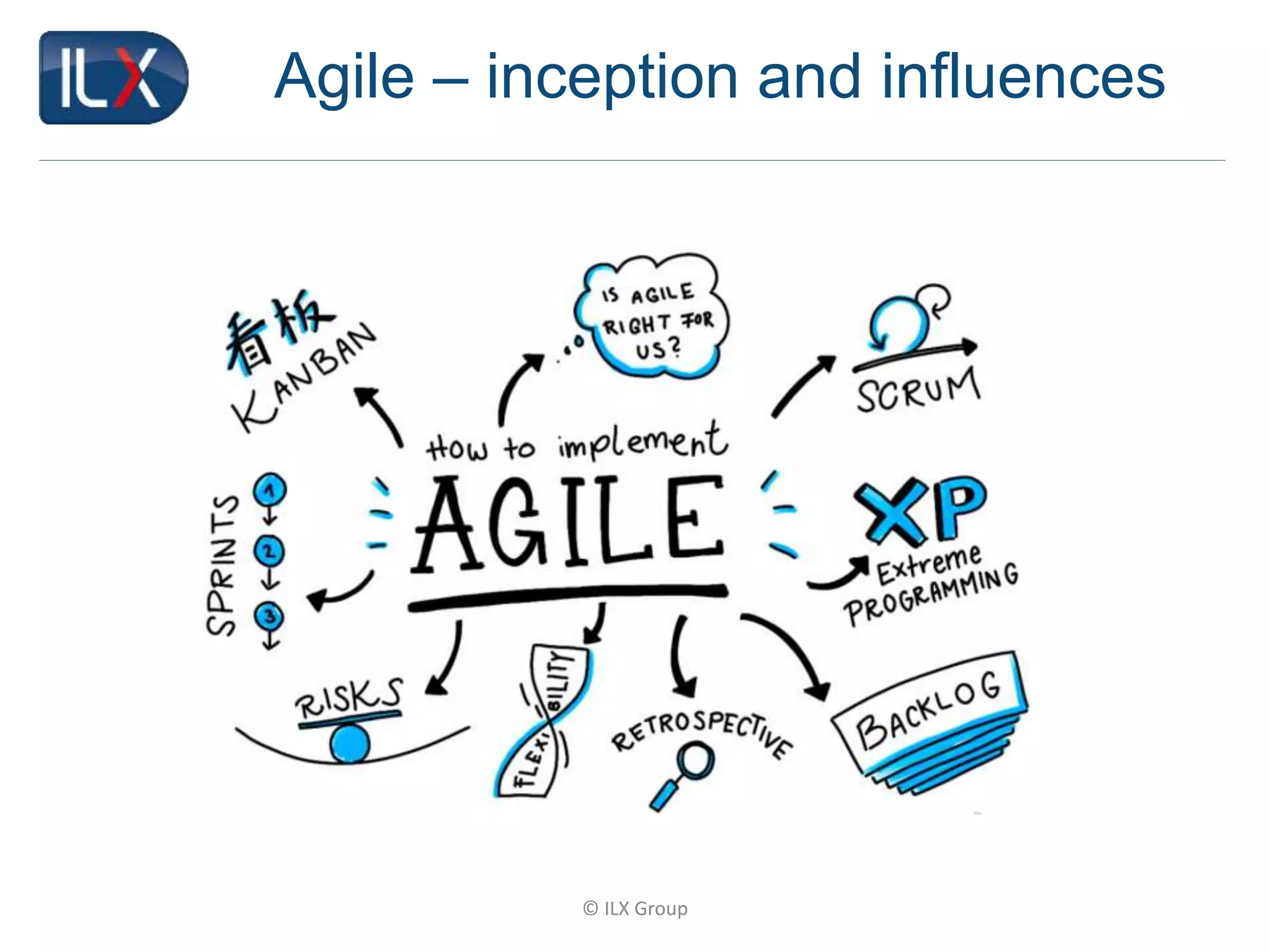
Agile – inception and influences
© ILX Group
Core agile principles
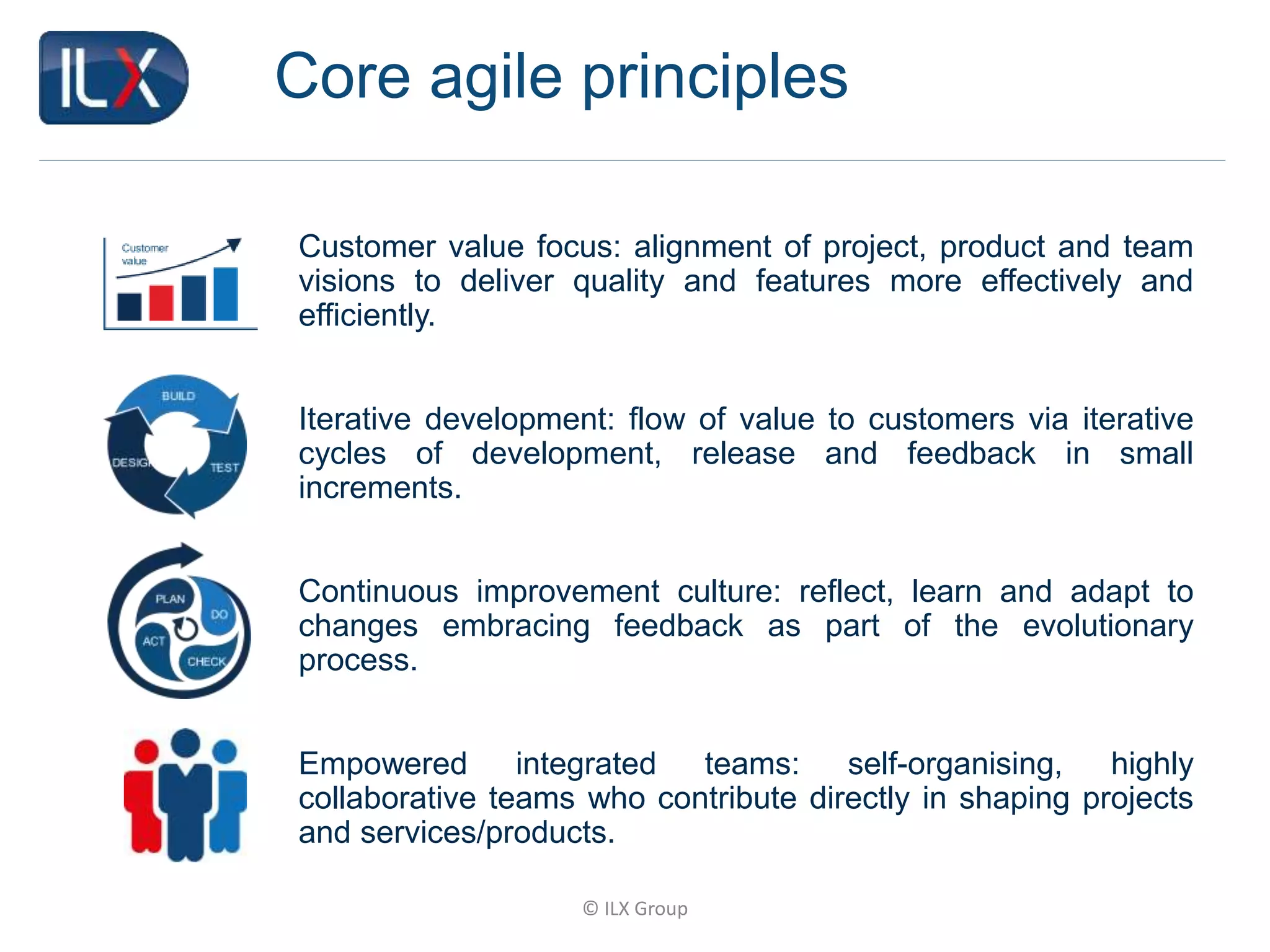
Customer value focus: alignment of project, product and team
visions to deliver quality and features more effectively and
efficiently.
Iterative development: flow of value to customers via iterative
cycles of development, release and feedback in small
increments.
Continuous improvement culture: reflect, learn and adapt to
changes embracing feedback as part of the evolutionary
process.
Empowered integrated teams: self-organising, highly
collaborative teams who contribute directly in shaping projects
and services/products.
© ILX Group
The agile lifecycle
© ILX Group
The approach to variables
© ILX Group
Elements of incremental delivery
Frequent communication
and team ownership
Incremental
Delivery
Dynamic product
requirements
Iterative project planning
Functional incremental
product
Continuous
testing/evaluation
Continuous
feedback
© ILX Group
Insights
Agile project management
© ILX Group
Agile – 2018 key statistics (1)
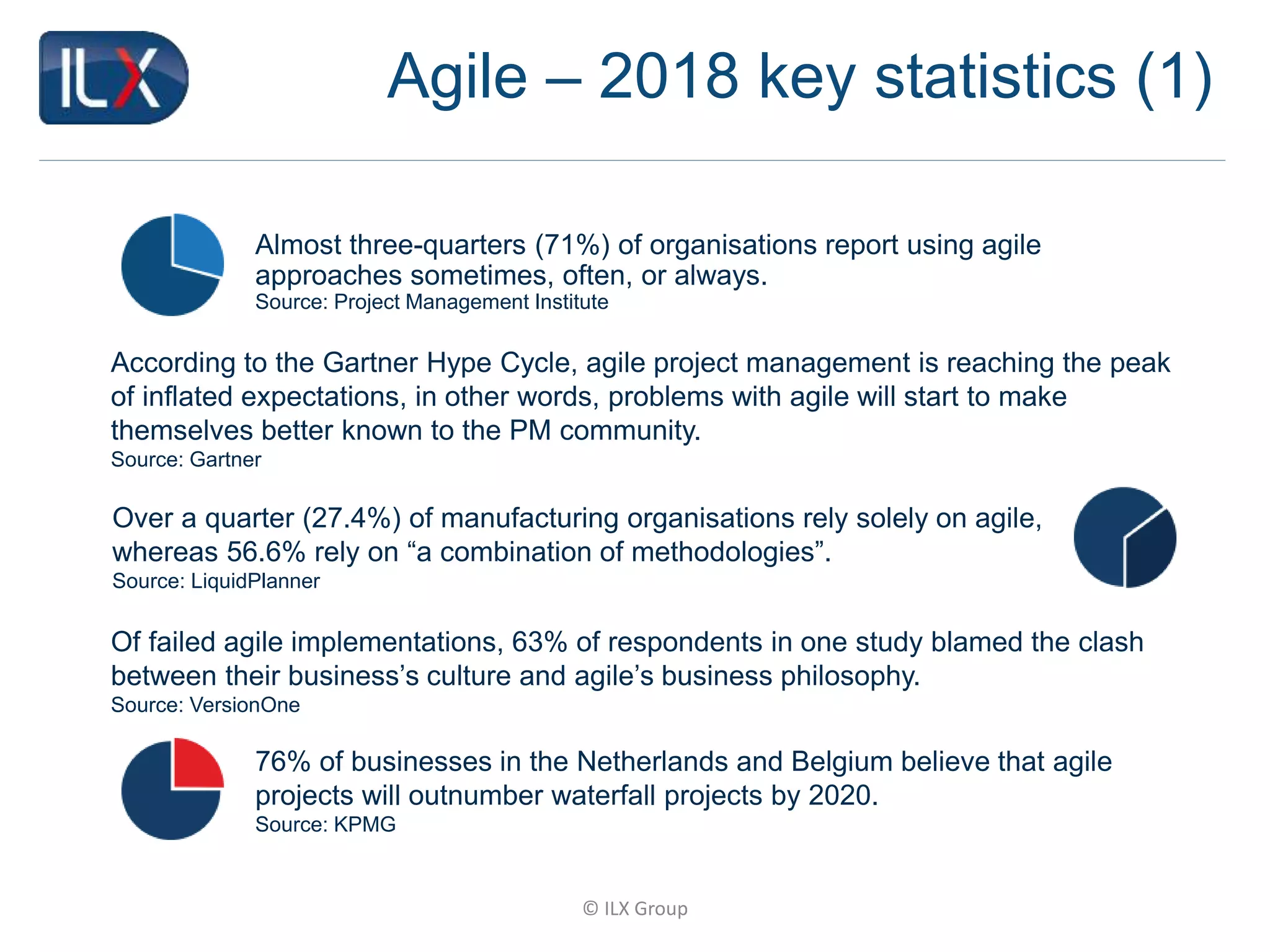
Almost three-quarters (71%) of organisations report using agile
approaches sometimes, often, or always.
Source: Project Management Institute
According to the Gartner Hype Cycle, agile project management is reaching the peak
of inflated expectations, in other words, problems with agile will start to make
themselves better known to the PM community.
Source: Gartner
Of failed agile implementations, 63% of respondents in one study blamed the clash
between their business’s culture and agile’s business philosophy.
Source: VersionOne
76% of businesses in the Netherlands and Belgium believe that agile
projects will outnumber waterfall projects by 2020.
Source: KPMG
Over a quarter (27.4%) of manufacturing organisations rely solely on agile,
whereas 56.6% rely on “a combination of methodologies”.
Source: LiquidPlanner
© ILX Group
Agile – 2018 key statistics (2)
Agile projects are 28% more successful than traditional projects.
Source: PwC
Of communications service providers (CSPs) that have adopted
bimodal IT, 93% rely on Agile project management methodologies.
Source: Gartner
50% of team members are motivated more by team success than
by the company’s (27%) or individual’s (23%) personal goals.
Source: Atlassian
By 2030, artificial intelligence will automate 80% of routine Agile
work.
Source: Smarter with Gartner
v
© ILX Group
Agile case studies
© ILX Group
Agile case study – Google
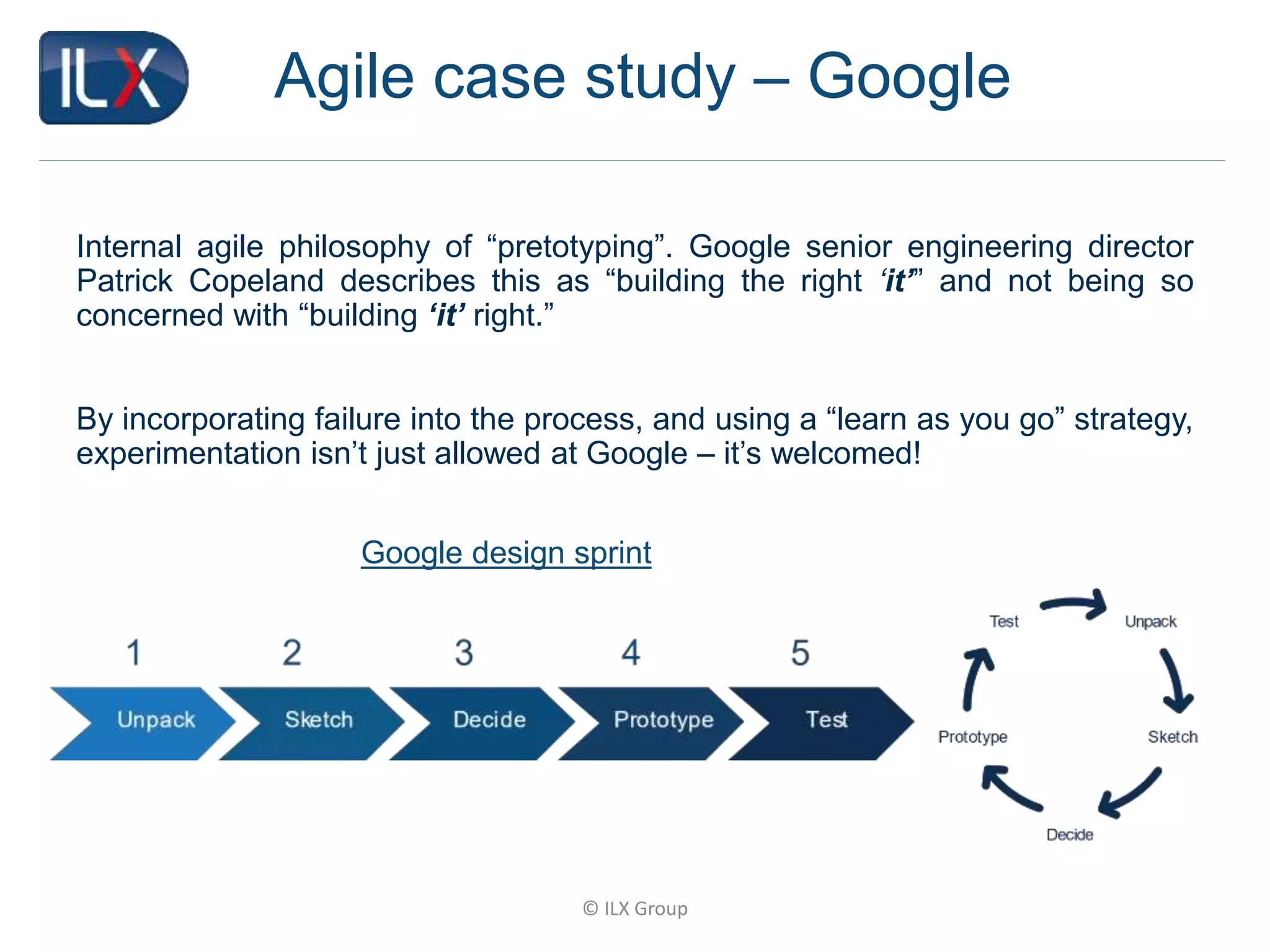
Internal agile philosophy of “pretotyping”. Google senior engineering director
Patrick Copeland describes this as “building the right ‘it’” and not being so
concerned with “building ‘it’ right.”
By incorporating failure into the process, and using a “learn as you go” strategy,
experimentation isn’t just allowed at Google – it’s welcomed!
Google design sprint
© ILX Group
Agile case study – IBM
© ILX Group
Agile case study – Spotify
© ILX Group
Agile case study – Valve
© ILX Group
Conclusions
© ILX Group
Conclusions
Agree product requirements
before delivery
Document, and report on, each
phase of the project in detail
Greater confidence on project
product impact
Benefits of agility arise in
component parts of the project
© ILX Group
Conclusions cont.
Evolution in development through
streamlined comms and feedback loops
Flatter management structures – more
focused documentation/reporting
Empowered teams enables faster
decision making and change control
© ILX Group
Q&A
© ILX Group
Agile Process
Improvement
© ILX Group
Agenda
• Continuous process improvement
• Process improvement the Agile way
• Conclusions and Q&A
© ILX Group
PART 1
Introduction to continuous process improvement
© ILX Group
Why continuous improvement?
Complex processes
Customer demands
New technologies
Regulations
Competition
Organisational change
Process
performance
challenges
© ILX Group
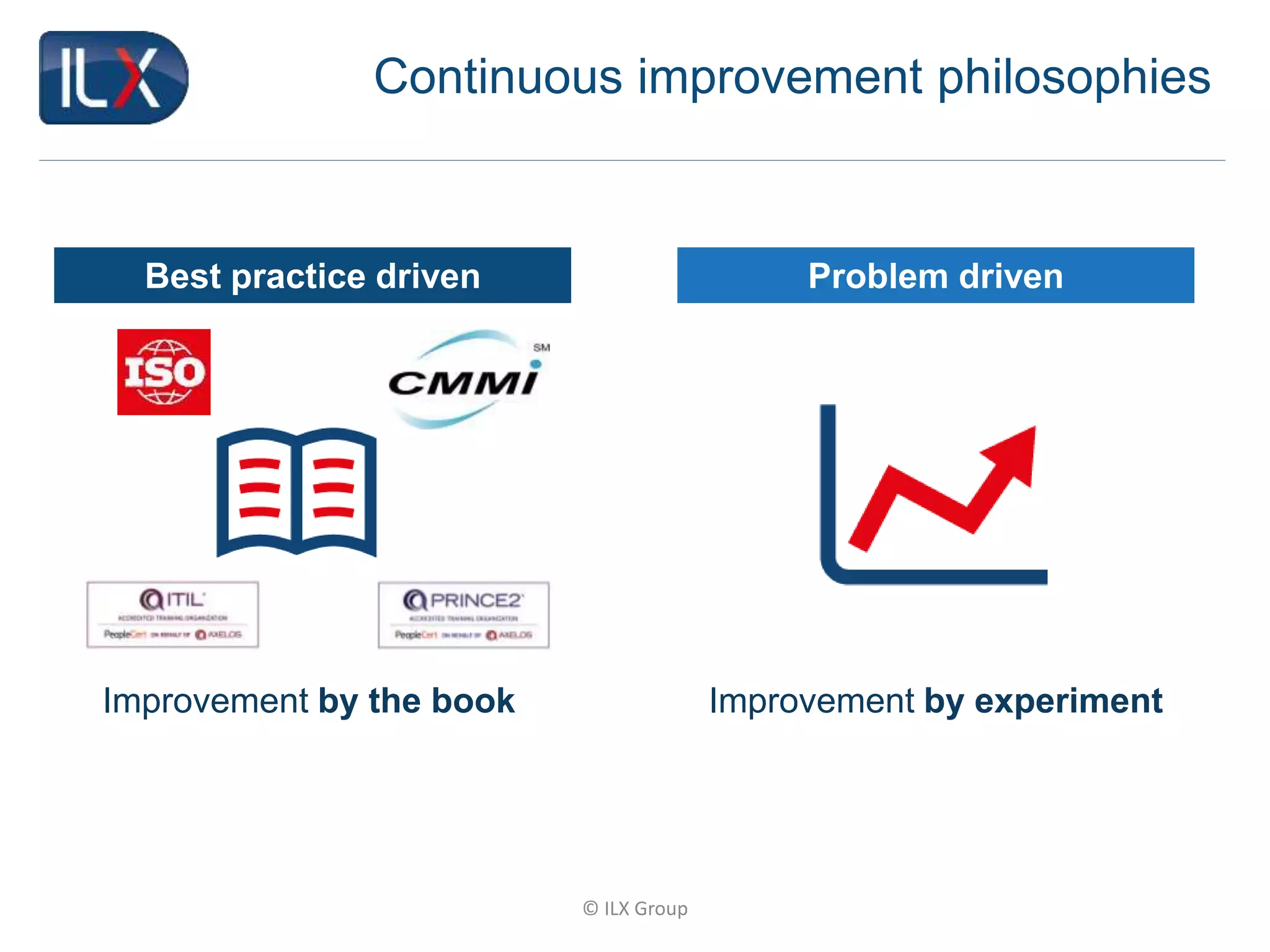
Continuous improvement philosophies
Improvement by the book
Best practice driven
Improvement by experiment
Problem driven
© ILX Group
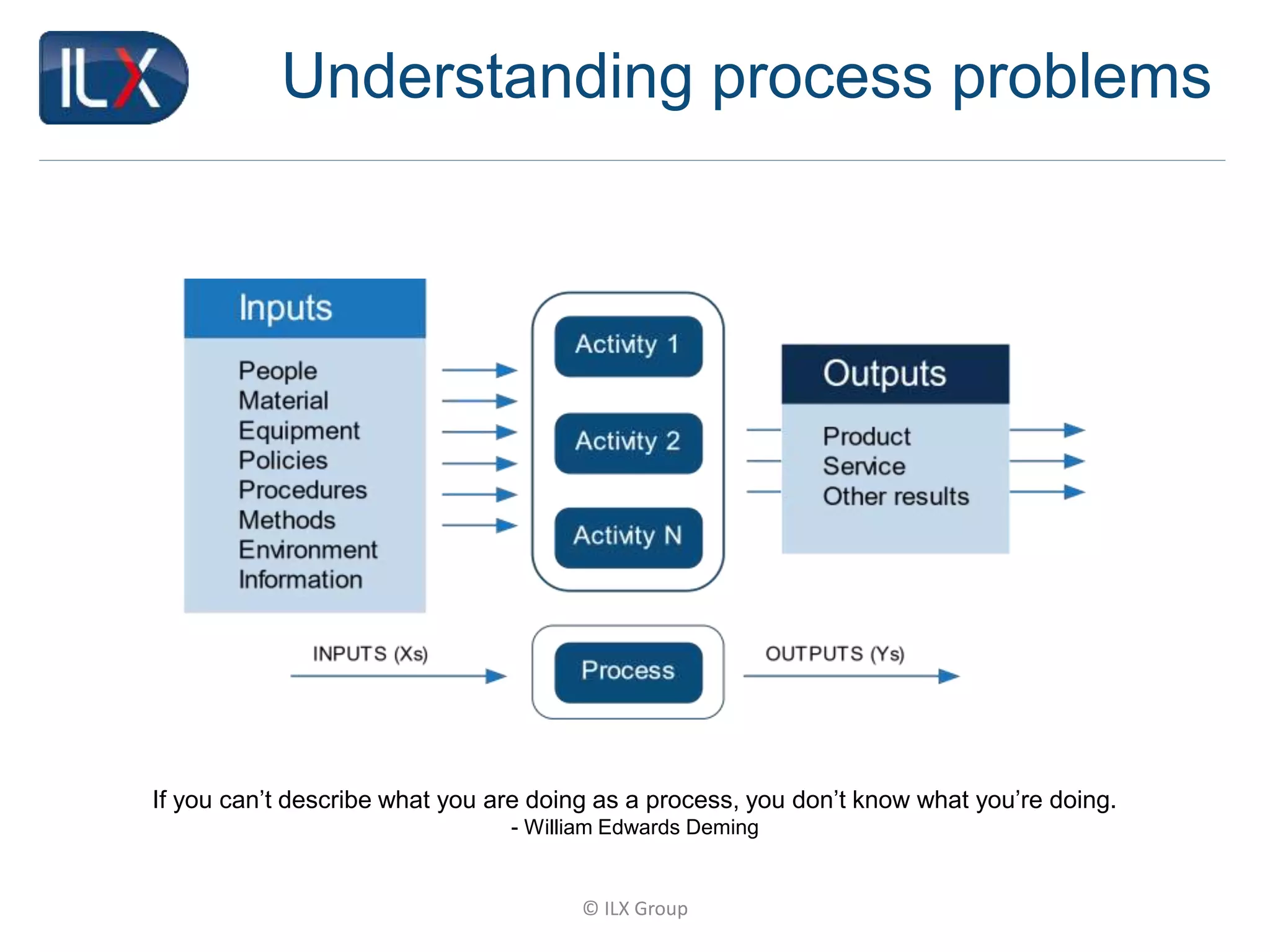
Understanding process problems
If you can’t describe what you are doing as a process, you don’t know what you’re doing.
- William Edwards Deming
© ILX Group
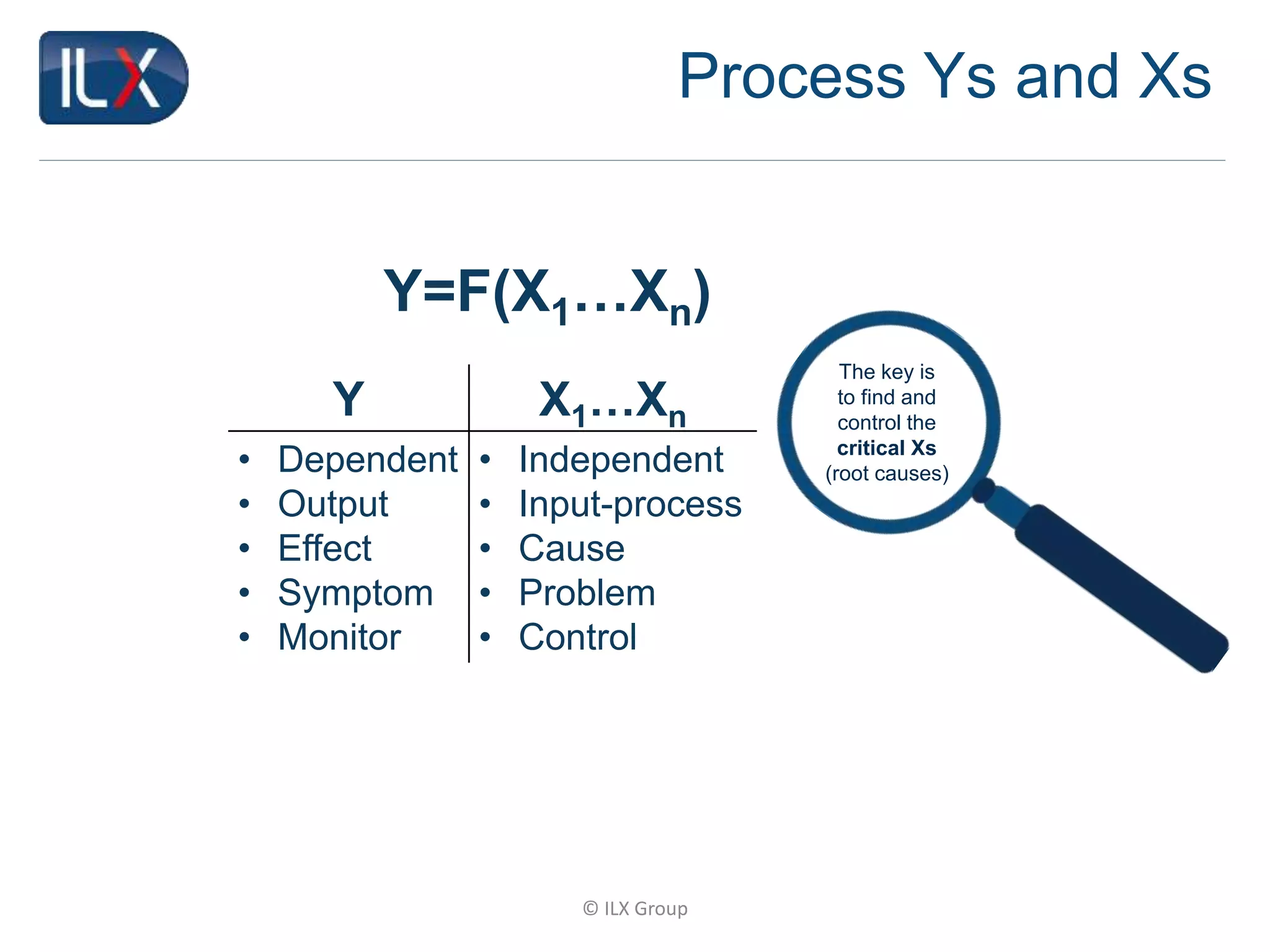
Y X1…Xn
• Dependent
• Output
• Effect
• Symptom
• Monitor
• Independent
• Input-process
• Cause
• Problem
• Control
Y=F(X1…Xn)
Process Ys and Xs
The key is
to find and
control the
critical Xs
(root causes)
© ILX Group
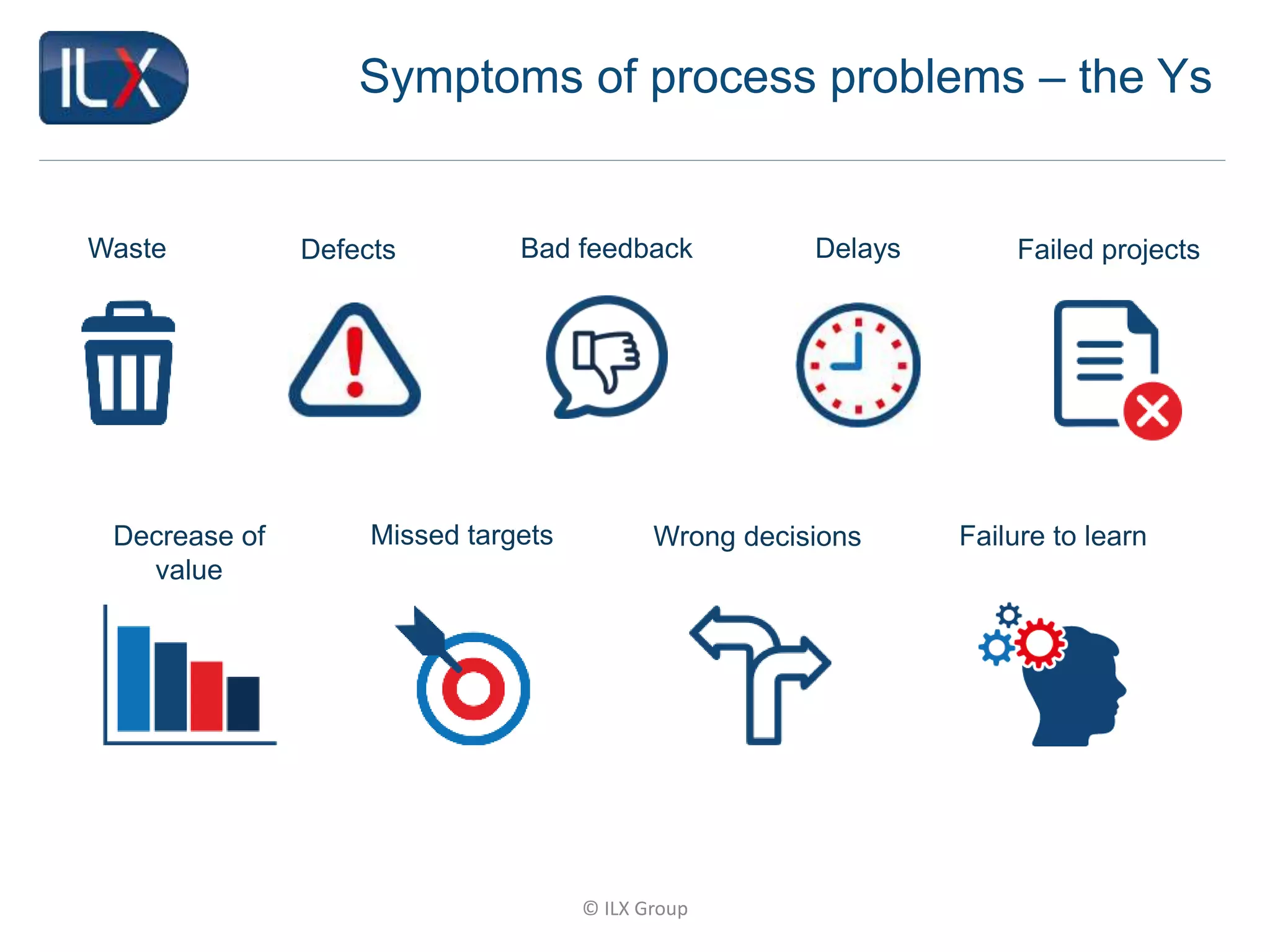
Waste Defects Bad feedback Delays Failed projects
Decrease of
value
Missed targets Wrong decisions Failure to learn
Symptoms of process problems – the Ys
© ILX Group
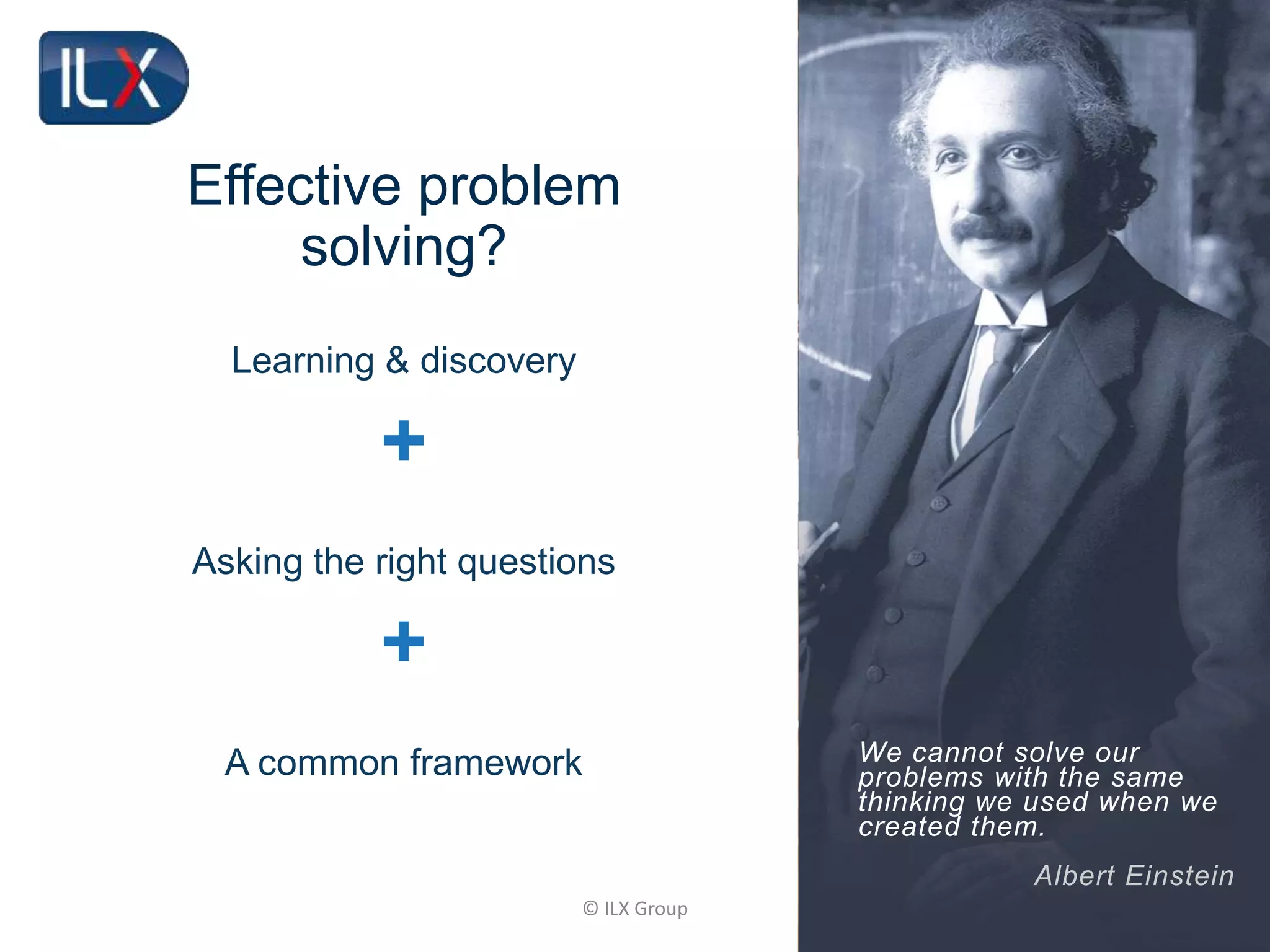
Effective problem
solving?
We cannot solve our
problems with the same
thinking we used when we
created them.
Albert Einstein
Learning & discovery
+
Asking the right questions
+
A common framework
© ILX Group
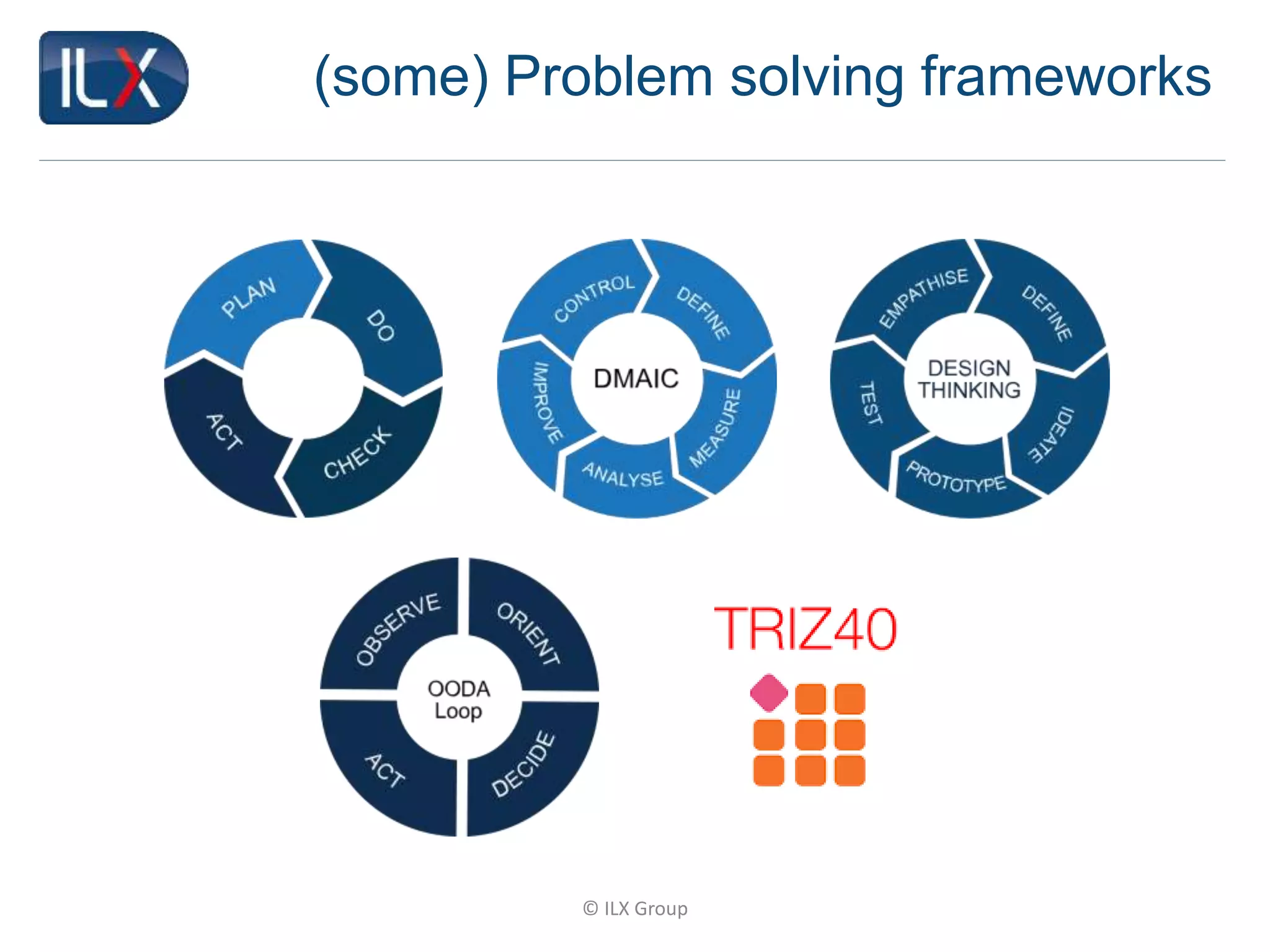
(some) Problem solving frameworks
© ILX Group
Successful change?
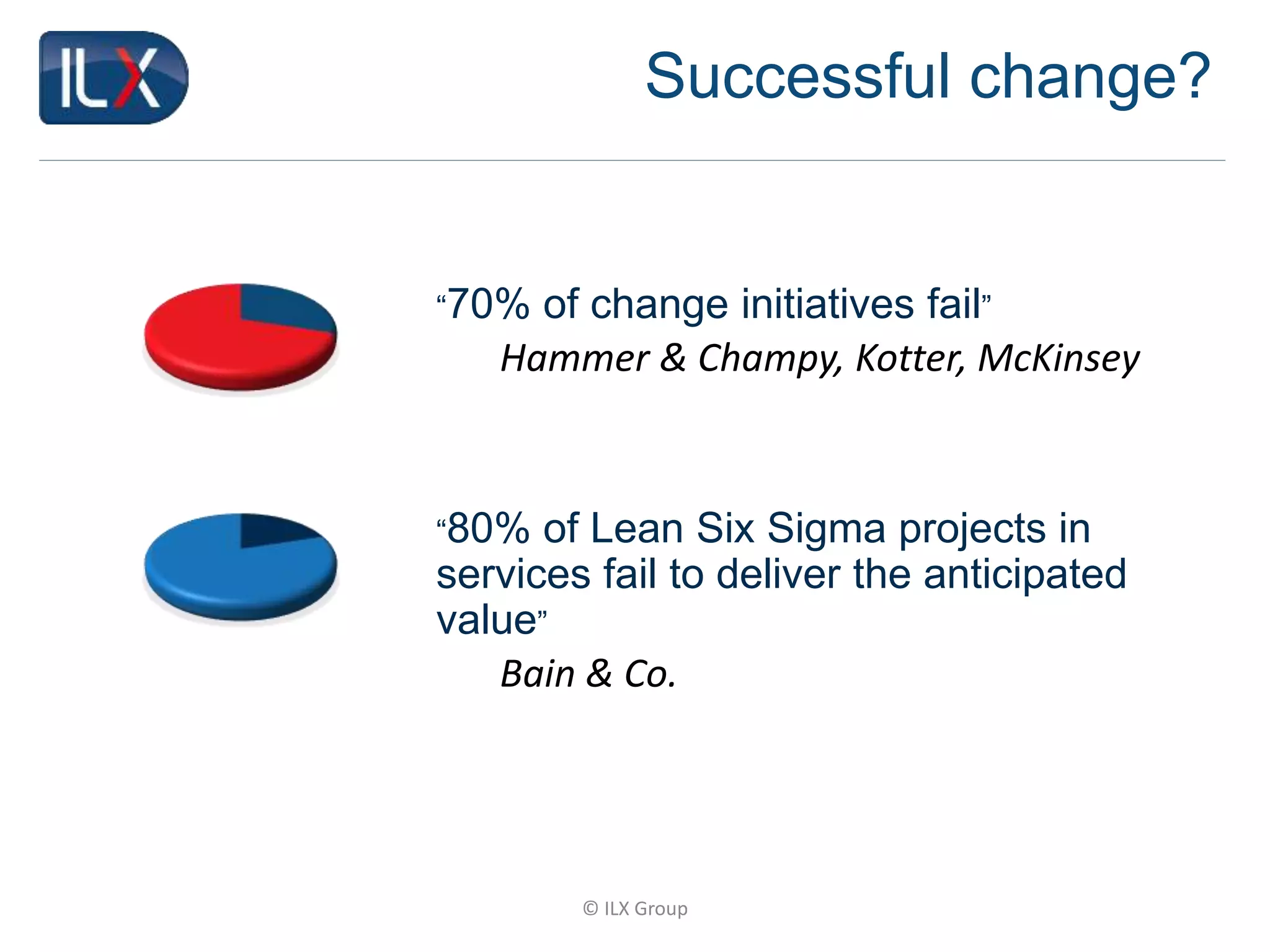
“70% of change initiatives fail”
Hammer & Champy, Kotter, McKinsey
“80% of Lean Six Sigma projects in
services fail to deliver the anticipated
value”
Bain & Co.
3
1
© DWF LLP 2019 | Classification:
Public / Internal / Confidential / Highly
Confidential <delete as appropriate>
© ILX Group
PART 2
AGILE Process Improvement
© ILX Group
Why agile process improvement?
• High failure rate of traditional improvement
projects
• Change does not always “stick”
• Improvement projects run out of steam
before they can demonstrate benefits
• Processes become a moving target for
Improvement teams
• Agile facilitates communication and
remove barriers
© ILX Group
What is agile process improvement?
• A value-based and collaborative approach
to continuous improvement
• An effective framework to implement
change projects the “agile way”
• A combination of flexible agile practices
with powerful problem-solving tools
• A way to accelerate the cultural
transformation toward continuous service
improvement
© ILX Group
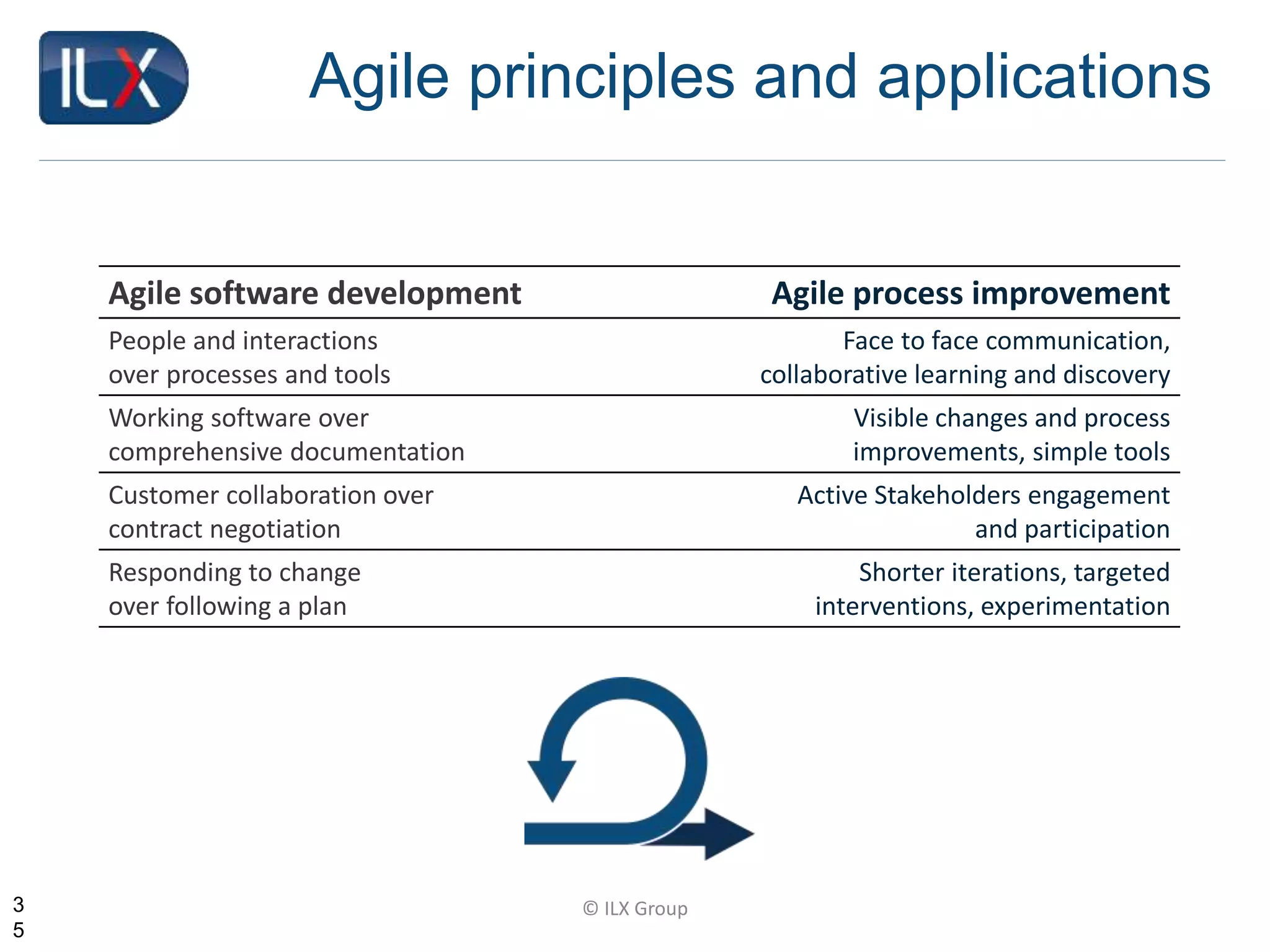
Agile principles and applications
3
5
Agile software development Agile process improvement
People and interactions
over processes and tools
Face to face communication,
collaborative learning and discovery
Working software over
comprehensive documentation
Visible changes and process
improvements, simple tools
Customer collaboration over
contract negotiation
Active Stakeholders engagement
and participation
Responding to change
over following a plan
Shorter iterations, targeted
interventions, experimentation
© ILX Group
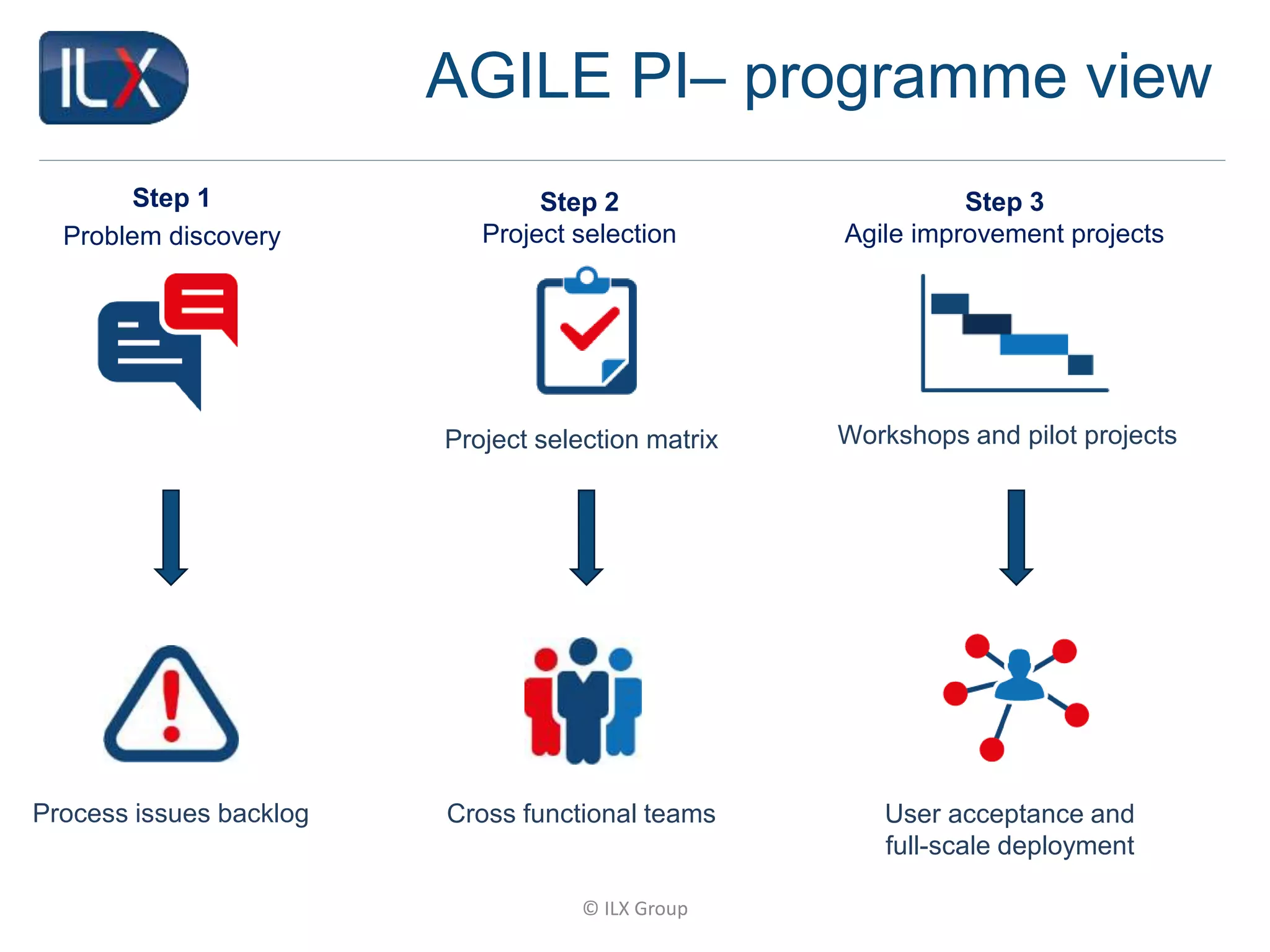
AGILE PI– programme view
Process issues backlog
Step 1
Problem discovery
Project selection matrix
Step 2
Project selection
Cross functional teams
Workshops and pilot projects
Step 3
Agile improvement projects
User acceptance and
full-scale deployment
© ILX Group
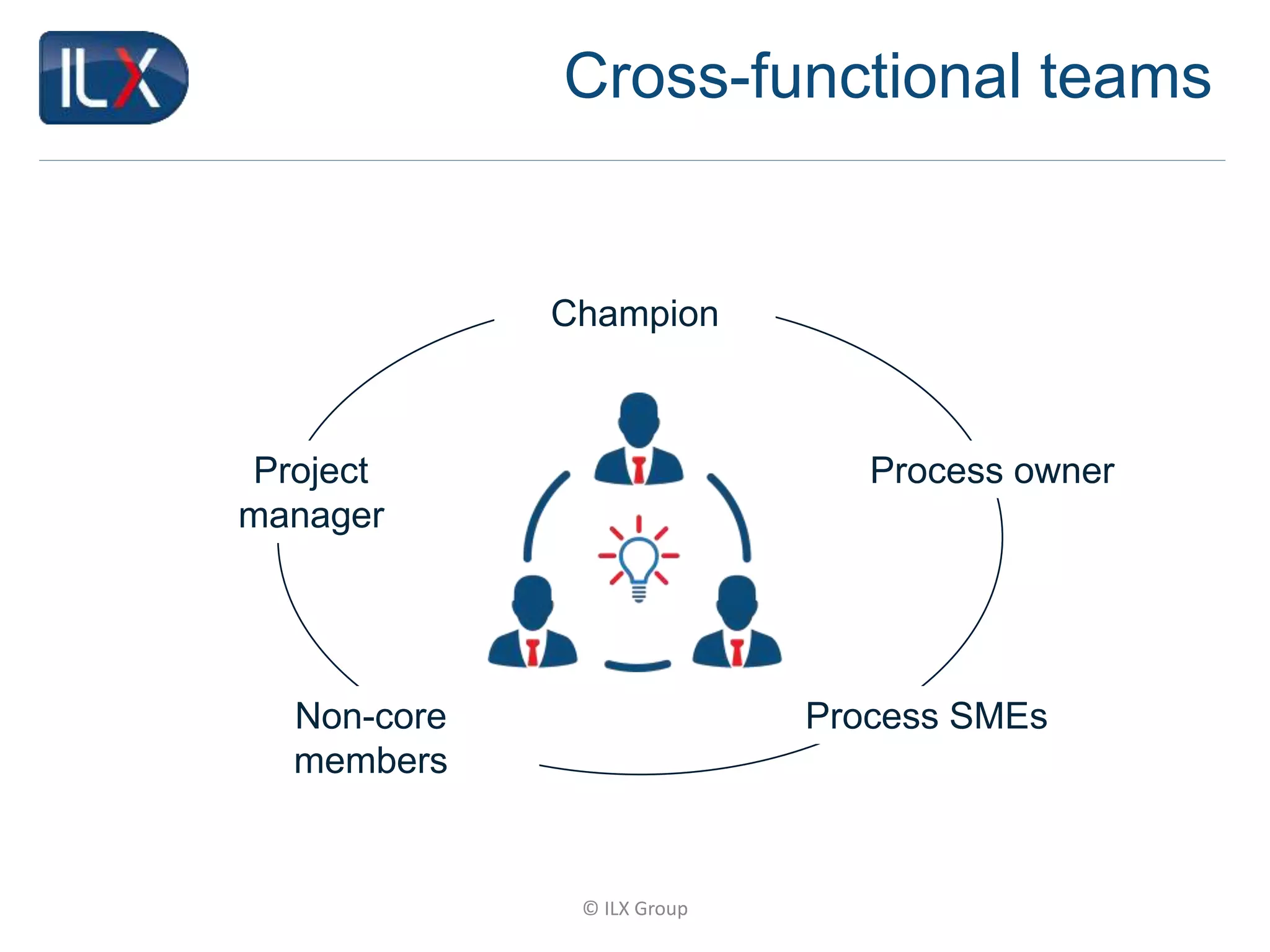
Cross-functional teams
Champion
Project
manager
Process owner
Process SMEsNon-core
members
© ILX Group
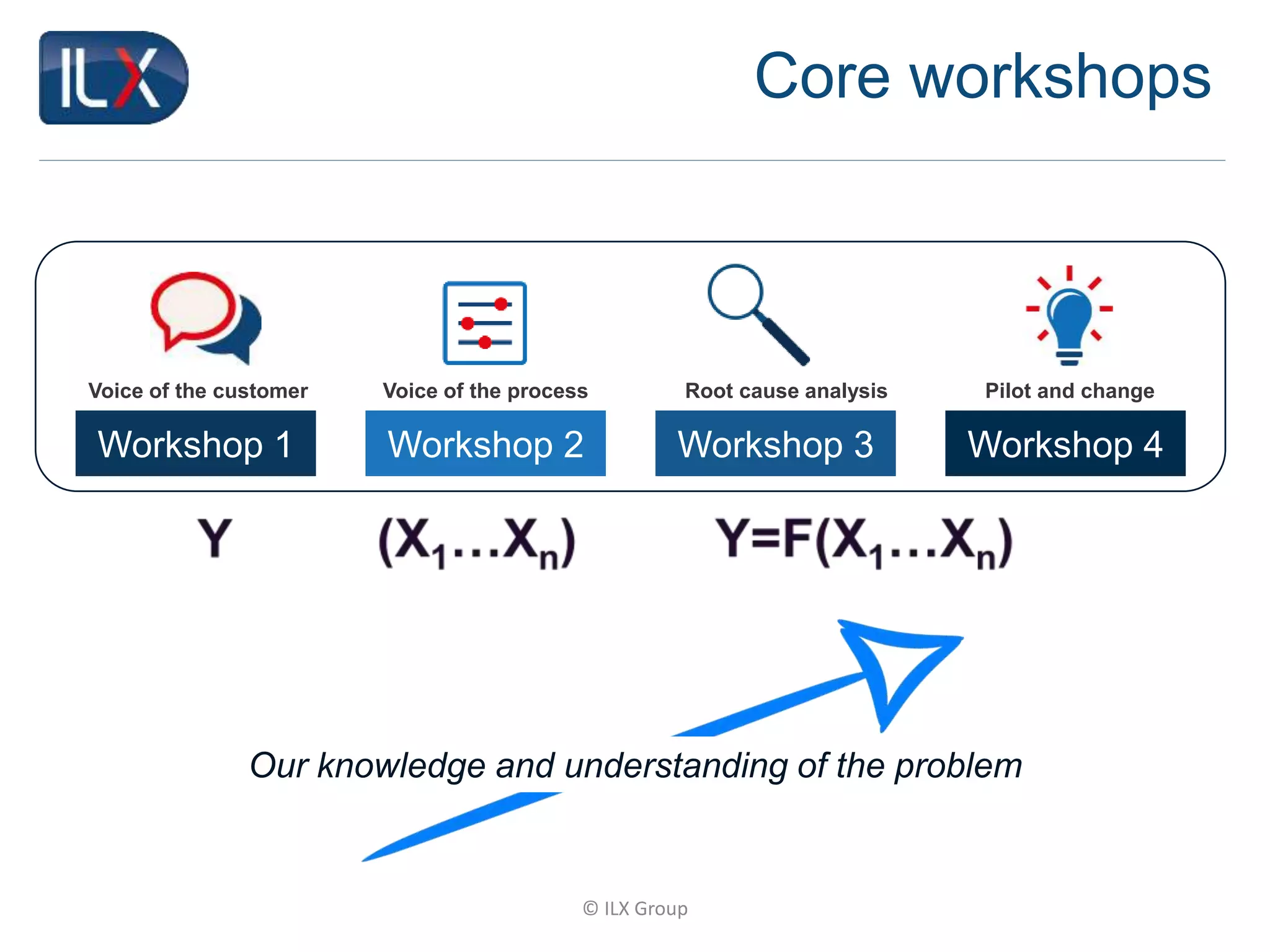
Core workshops
Voice of the customer Voice of the process Root cause analysis Pilot and change
Workshop 1 Workshop 2 Workshop 3 Workshop 4
Our knowledge and understanding of the problem
© ILX Group
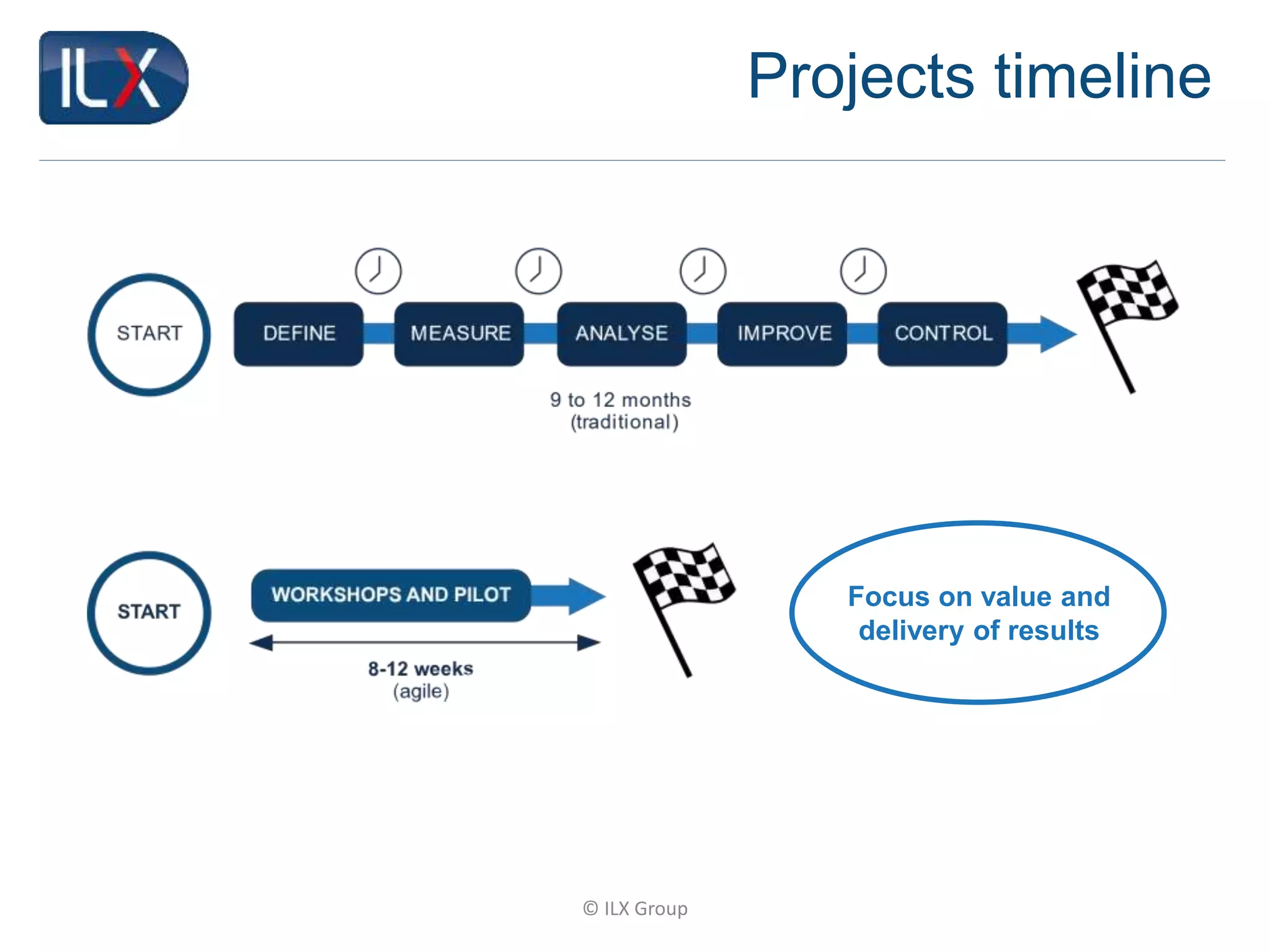
Projects timeline
Focus on value and
delivery of results
© ILX Group
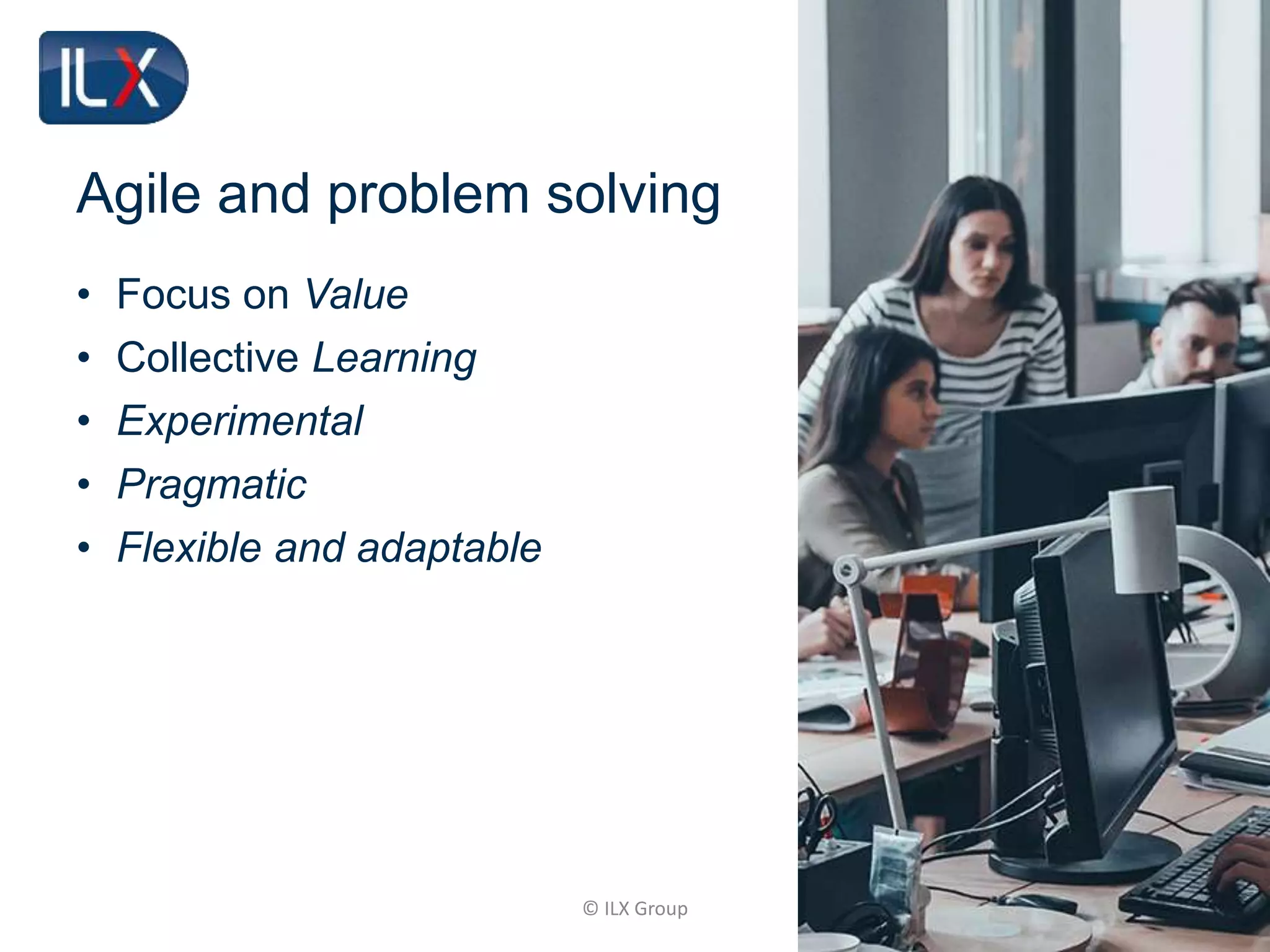
Agile and problem solving
• Focus on Value
• Collective Learning
• Experimental
• Pragmatic
• Flexible and adaptable
© ILX Group
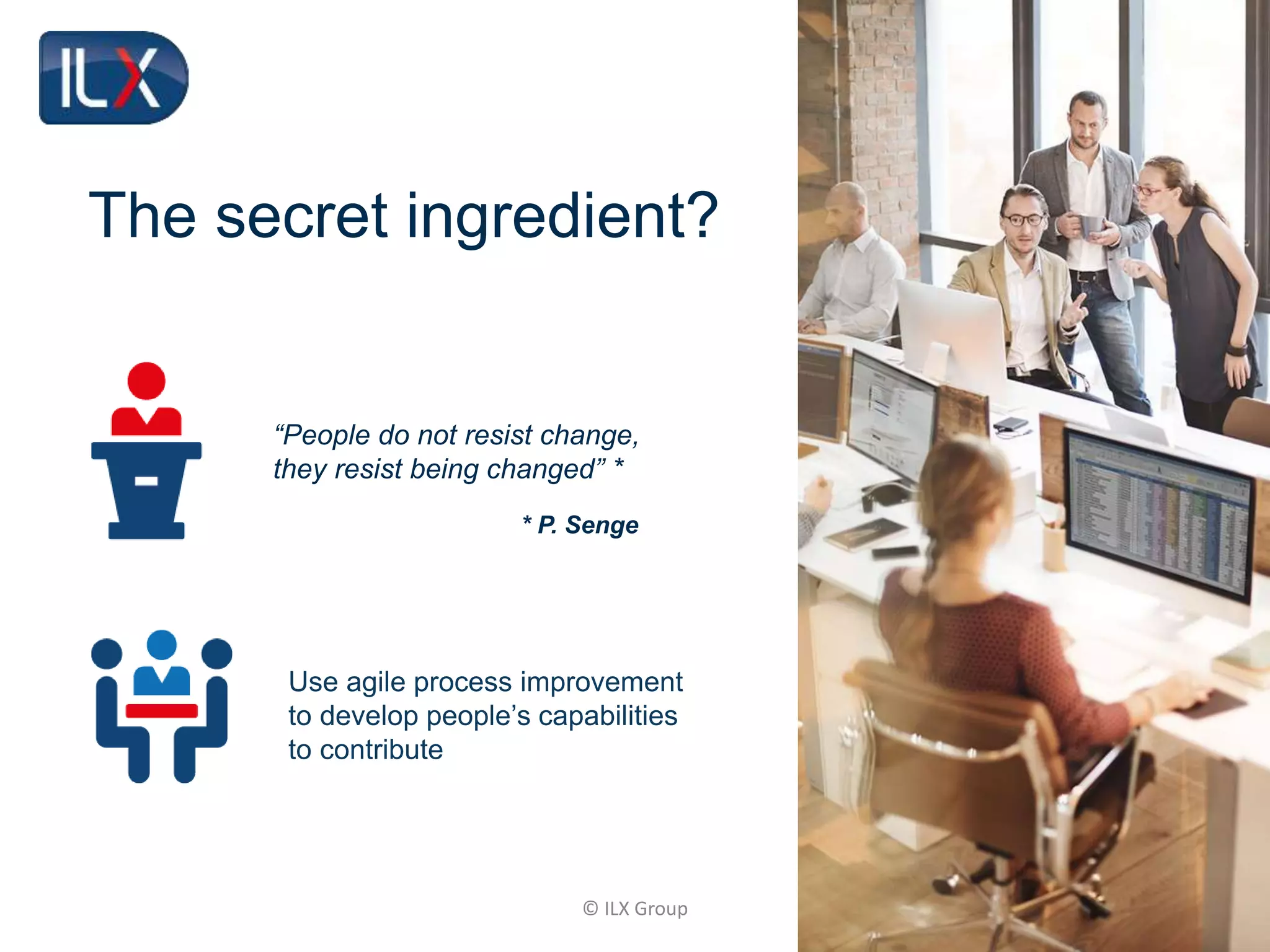
The secret ingredient?
Use agile process improvement
to develop people’s capabilities
to contribute
“People do not resist change,
they resist being changed” *
* P. Senge
© ILX Group
Key takeaways
Agile PI accelerates the ROI on your
quality and improvement initiatives
Introduce change incrementally (no
end-to-end process re-engineering)
Develop internal skills to drive
continuous improvement
Reinforce a culture of Experimentation
and Problem Solving
© ILX Group
Q&A
© ILX Group
A question for the audience
“What, in your experience,
are the main reasons for
failure in change and
improvement initiatives?”
© ILX Group
THANK YOU

Agile: a fresh perspective

  • 1.
    © ILX Group AGILE AFresh Perspective
  • 2.
  • 3.
    © ILX Group AgileProject Management
  • 4.
    © ILX Group Agile– inception and influences
  • 5.
    © ILX Group Coreagile principles Customer value focus: alignment of project, product and team visions to deliver quality and features more effectively and efficiently. Iterative development: flow of value to customers via iterative cycles of development, release and feedback in small increments. Continuous improvement culture: reflect, learn and adapt to changes embracing feedback as part of the evolutionary process. Empowered integrated teams: self-organising, highly collaborative teams who contribute directly in shaping projects and services/products.
  • 6.
    © ILX Group Theagile lifecycle
  • 7.
    © ILX Group Theapproach to variables
  • 8.
    © ILX Group Elementsof incremental delivery Frequent communication and team ownership Incremental Delivery Dynamic product requirements Iterative project planning Functional incremental product Continuous testing/evaluation Continuous feedback
  • 9.
    © ILX Group Insights Agileproject management
  • 10.
    © ILX Group Agile– 2018 key statistics (1) Almost three-quarters (71%) of organisations report using agile approaches sometimes, often, or always. Source: Project Management Institute According to the Gartner Hype Cycle, agile project management is reaching the peak of inflated expectations, in other words, problems with agile will start to make themselves better known to the PM community. Source: Gartner Of failed agile implementations, 63% of respondents in one study blamed the clash between their business’s culture and agile’s business philosophy. Source: VersionOne 76% of businesses in the Netherlands and Belgium believe that agile projects will outnumber waterfall projects by 2020. Source: KPMG Over a quarter (27.4%) of manufacturing organisations rely solely on agile, whereas 56.6% rely on “a combination of methodologies”. Source: LiquidPlanner
  • 11.
    © ILX Group Agile– 2018 key statistics (2) Agile projects are 28% more successful than traditional projects. Source: PwC Of communications service providers (CSPs) that have adopted bimodal IT, 93% rely on Agile project management methodologies. Source: Gartner 50% of team members are motivated more by team success than by the company’s (27%) or individual’s (23%) personal goals. Source: Atlassian By 2030, artificial intelligence will automate 80% of routine Agile work. Source: Smarter with Gartner v
  • 12.
    © ILX Group Agilecase studies
  • 13.
    © ILX Group Agilecase study – Google Internal agile philosophy of “pretotyping”. Google senior engineering director Patrick Copeland describes this as “building the right ‘it’” and not being so concerned with “building ‘it’ right.” By incorporating failure into the process, and using a “learn as you go” strategy, experimentation isn’t just allowed at Google – it’s welcomed! Google design sprint
  • 14.
    © ILX Group Agilecase study – IBM
  • 15.
    © ILX Group Agilecase study – Spotify
  • 16.
    © ILX Group Agilecase study – Valve
  • 17.
  • 18.
    © ILX Group Conclusions Agreeproduct requirements before delivery Document, and report on, each phase of the project in detail Greater confidence on project product impact Benefits of agility arise in component parts of the project
  • 19.
    © ILX Group Conclusionscont. Evolution in development through streamlined comms and feedback loops Flatter management structures – more focused documentation/reporting Empowered teams enables faster decision making and change control
  • 20.
  • 21.
    © ILX Group AgileProcess Improvement
  • 22.
    © ILX Group Agenda •Continuous process improvement • Process improvement the Agile way • Conclusions and Q&A
  • 23.
    © ILX Group PART1 Introduction to continuous process improvement
  • 24.
    © ILX Group Whycontinuous improvement? Complex processes Customer demands New technologies Regulations Competition Organisational change Process performance challenges
  • 25.
    © ILX Group Continuousimprovement philosophies Improvement by the book Best practice driven Improvement by experiment Problem driven
  • 26.
    © ILX Group Understandingprocess problems If you can’t describe what you are doing as a process, you don’t know what you’re doing. - William Edwards Deming
  • 27.
    © ILX Group YX1…Xn • Dependent • Output • Effect • Symptom • Monitor • Independent • Input-process • Cause • Problem • Control Y=F(X1…Xn) Process Ys and Xs The key is to find and control the critical Xs (root causes)
  • 28.
    © ILX Group WasteDefects Bad feedback Delays Failed projects Decrease of value Missed targets Wrong decisions Failure to learn Symptoms of process problems – the Ys
  • 29.
    © ILX Group Effectiveproblem solving? We cannot solve our problems with the same thinking we used when we created them. Albert Einstein Learning & discovery + Asking the right questions + A common framework
  • 30.
    © ILX Group (some)Problem solving frameworks
  • 31.
    © ILX Group Successfulchange? “70% of change initiatives fail” Hammer & Champy, Kotter, McKinsey “80% of Lean Six Sigma projects in services fail to deliver the anticipated value” Bain & Co. 3 1 © DWF LLP 2019 | Classification: Public / Internal / Confidential / Highly Confidential <delete as appropriate>
  • 32.
    © ILX Group PART2 AGILE Process Improvement
  • 33.
    © ILX Group Whyagile process improvement? • High failure rate of traditional improvement projects • Change does not always “stick” • Improvement projects run out of steam before they can demonstrate benefits • Processes become a moving target for Improvement teams • Agile facilitates communication and remove barriers
  • 34.
    © ILX Group Whatis agile process improvement? • A value-based and collaborative approach to continuous improvement • An effective framework to implement change projects the “agile way” • A combination of flexible agile practices with powerful problem-solving tools • A way to accelerate the cultural transformation toward continuous service improvement
  • 35.
    © ILX Group Agileprinciples and applications 3 5 Agile software development Agile process improvement People and interactions over processes and tools Face to face communication, collaborative learning and discovery Working software over comprehensive documentation Visible changes and process improvements, simple tools Customer collaboration over contract negotiation Active Stakeholders engagement and participation Responding to change over following a plan Shorter iterations, targeted interventions, experimentation
  • 36.
    © ILX Group AGILEPI– programme view Process issues backlog Step 1 Problem discovery Project selection matrix Step 2 Project selection Cross functional teams Workshops and pilot projects Step 3 Agile improvement projects User acceptance and full-scale deployment
  • 37.
    © ILX Group Cross-functionalteams Champion Project manager Process owner Process SMEsNon-core members
  • 38.
    © ILX Group Coreworkshops Voice of the customer Voice of the process Root cause analysis Pilot and change Workshop 1 Workshop 2 Workshop 3 Workshop 4 Our knowledge and understanding of the problem
  • 39.
    © ILX Group Projectstimeline Focus on value and delivery of results
  • 40.
    © ILX Group Agileand problem solving • Focus on Value • Collective Learning • Experimental • Pragmatic • Flexible and adaptable
  • 41.
    © ILX Group Thesecret ingredient? Use agile process improvement to develop people’s capabilities to contribute “People do not resist change, they resist being changed” * * P. Senge
  • 42.
    © ILX Group Keytakeaways Agile PI accelerates the ROI on your quality and improvement initiatives Introduce change incrementally (no end-to-end process re-engineering) Develop internal skills to drive continuous improvement Reinforce a culture of Experimentation and Problem Solving
  • 43.
  • 44.
    © ILX Group Aquestion for the audience “What, in your experience, are the main reasons for failure in change and improvement initiatives?”
  • 45.

Editor's Notes

  • #5 A philosophy that has evolved by incorporating within it numerous project management, product development and continuous improvement best practices and methods, including (but not limited to) Adaptive Software Development (ASD), Dynamic Systems Development Methodology (DSDM), Extreme Programming (XP), Feature-Driven Development (FDD), Kanban, Kaizen, Lean, and Scrum.
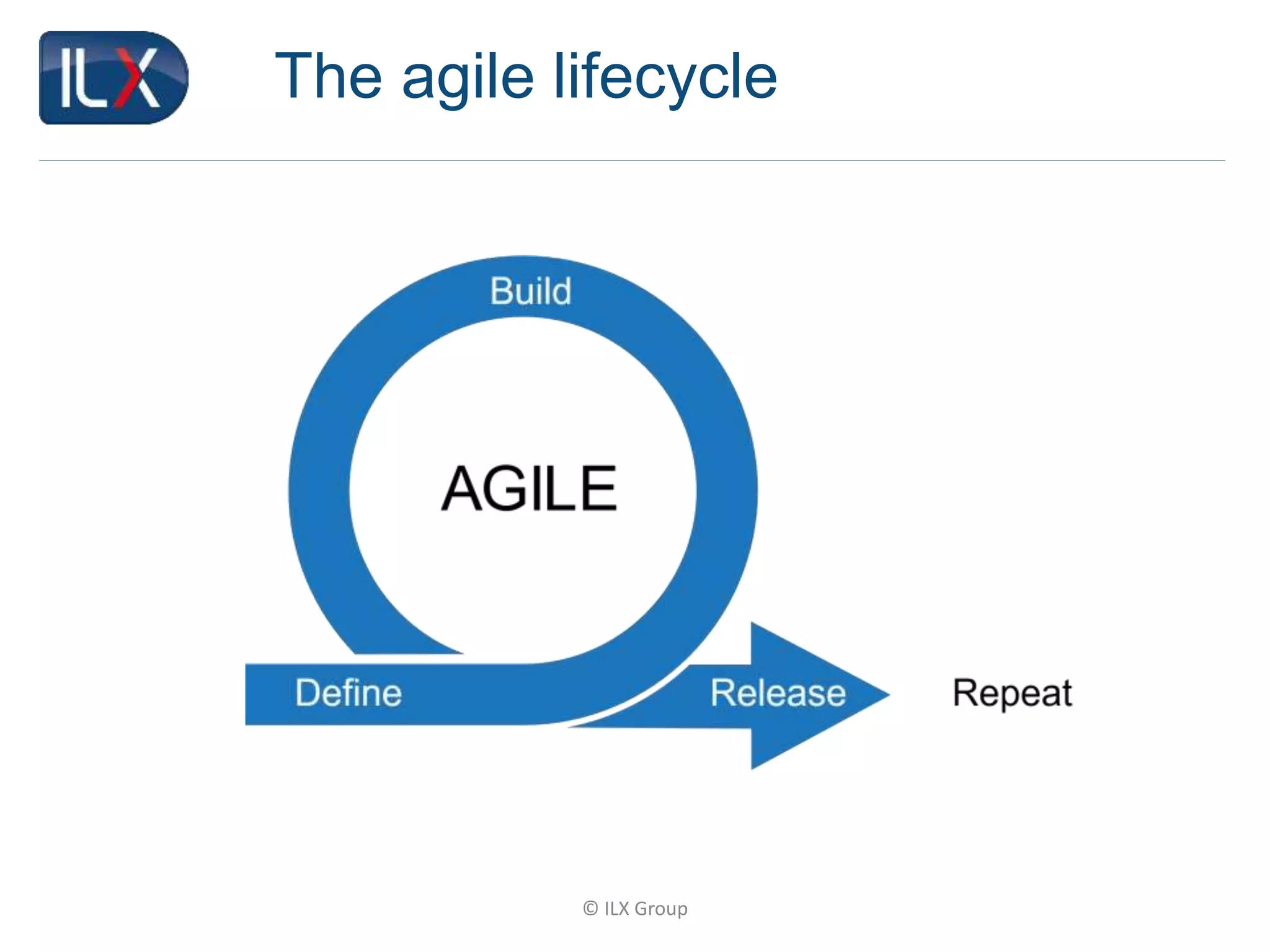
  • #7 The style of working in agile projects has requirements and solutions that evolve through adaptive planning, evolutionary development and delivery within a timeboxed, iterative approach. To define requirements agile uses the MOSCOW prioritisation technique and user stories to create: PRL (Prioritised Requirements List) that the project needs to address, indicating their priority with respect to meeting the objectives of the project and the needs of the business. MVP (Most Viable Product) / MUST (Minimum Usable Subset) or a “worst case” basic deliverable to gather feedback and improve on.
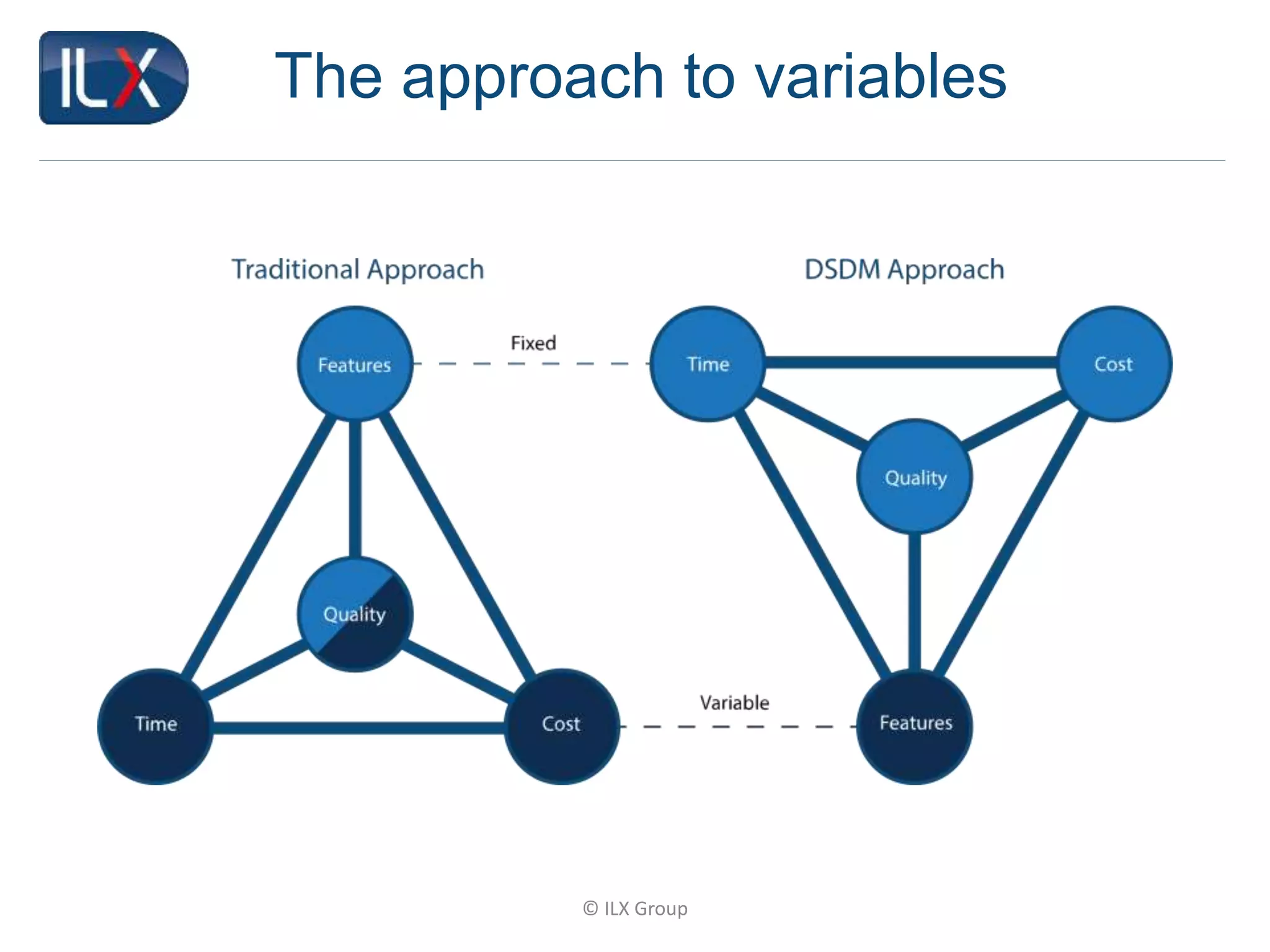
  • #8 The traditional (waterfall) approach provides clear understanding and prior agreement of features before project delivery begins, often subject to many unforeseen changes leading to significant re-planning and budget alterations throughout the lifecycle. However, it allows for greater confidence in terms of the project product impact on external interfaces and dependencies. The DSDM (agile) approach allows the project product to evolve throughout the lifecycle, particularly useful in creative environments, very unique projects and new ventures with tighter control on time and cost, or greater constraints around them. Using MOSCOW, PRL and MVP/MUST achieves variable features without affecting overall quality. However, less predictability of final outputs may lead to difficulty in securing funds and stakeholder commitment.
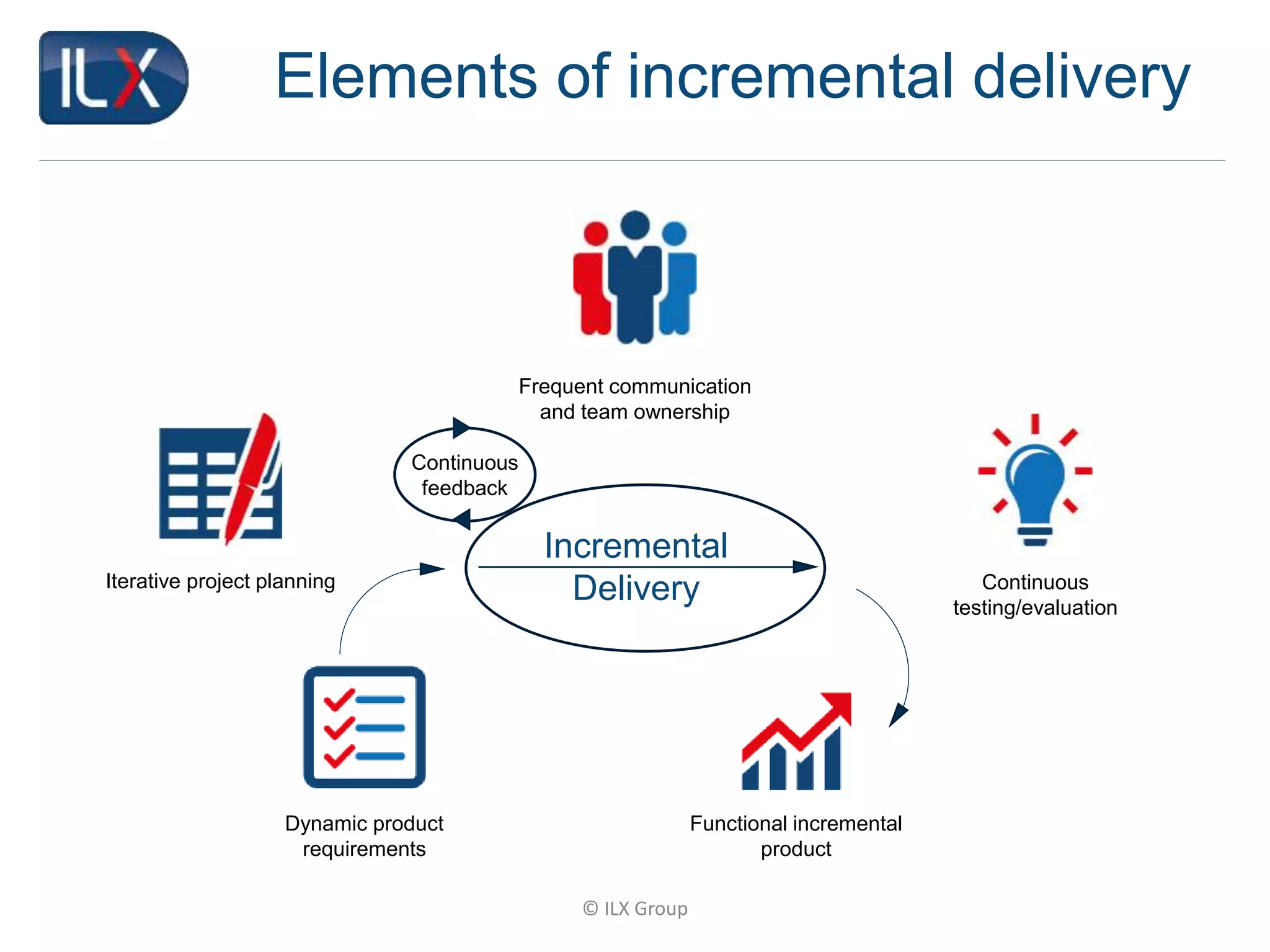
  • #9 Feedback is solicited frequently, as and when needed, to collaborate, and speed up the development process through sharing of ideas. This continuous feedback, communication and collaboration between empowered, self-organising, cross-functional teams leads to rapid and flexible responses to change thus creating a functional incremental product with dynamic requirements. Agile emphasises sustained, quick and dynamic development of customer ready product features, rather than initial project planning and analysis of requirements. Therefore, companies with more organic/flatter structures, increasingly more common, also have found that Agile is the perfect fit for them, because empowered team members can make certain decisions on their own, which increases the speed of the development significantly.
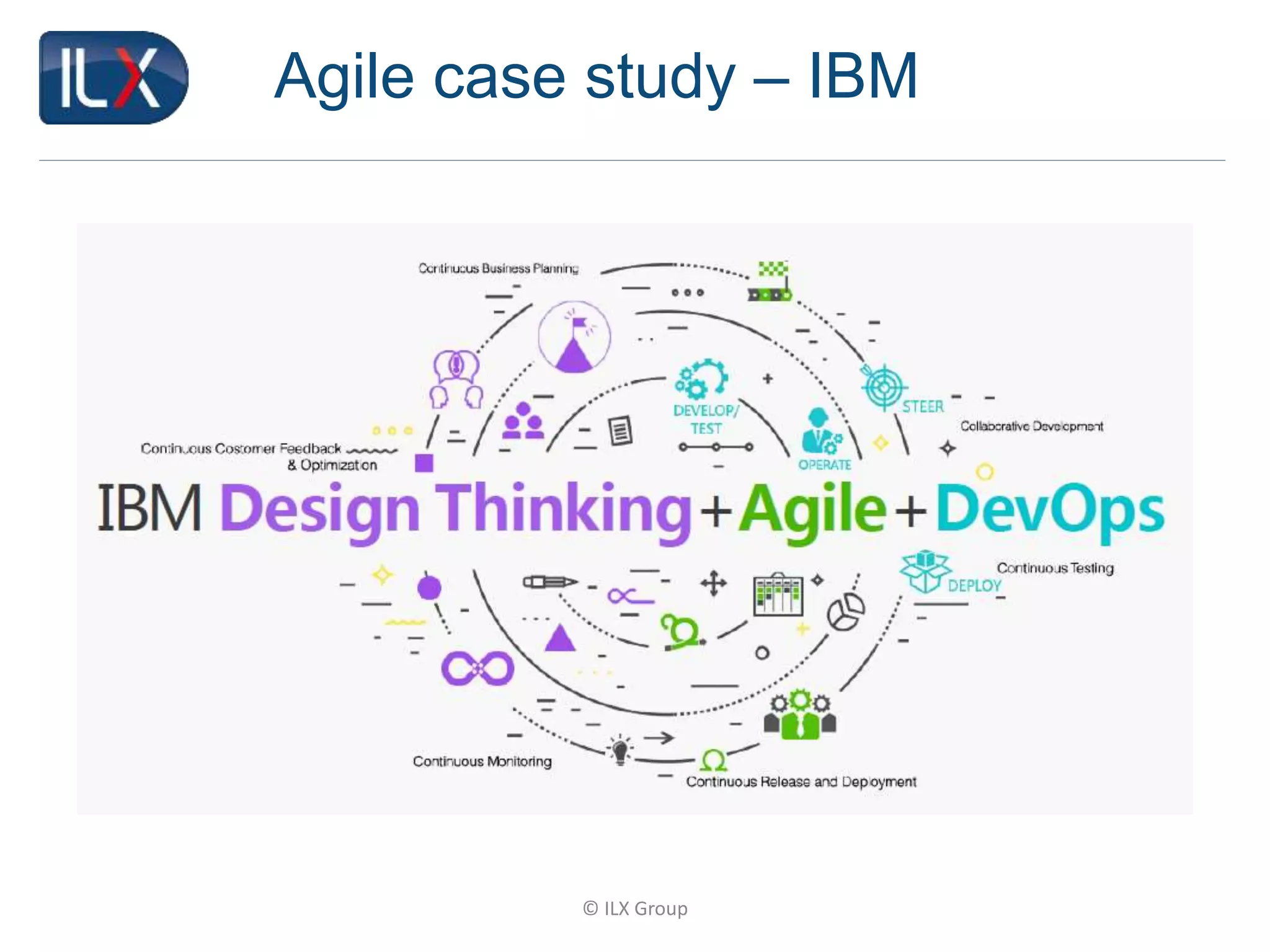
  • #13 Since maturing around 1990 to reaching the peak of inflated expectations now, agile best practices are becoming clearer with insightful case studies such as those of Google, Spotify, IBM and Valve amongst others, available for scrutiny. Overall, successful tailoring and implementation of agile philosophy has consistently enabled transformative organisational changes that last, innovative business models that shape the way to the future, provide a significant edge over competitors and/or allows smoother navigation of new, exciting unexplored territory. Other notables organisations successfully using agile currently in the spotlight include: Amazon, Netflix, Microsoft, CISCO, AT&T, Hertz, 3M, BT, LEGO, National Bank of Canada, SIEMENS, Swedbank, Mitsubishi, Toyota and SONY.
  • #14 Google senior engineering director Patrick Copeland says Google’s workplace culture involves “thinking of failure as part of the process.” and “embracing failure is a good thing to do” because of the data that comes out of it and what that data can be used to create in the future. Google experiments with new products that have yet to be released as well as those already in existence to enable the greatest room for growth and creativity. One agile principle crucial to implementing pretotyping, and one that Copeland stresses is absolutely being done at Google is: “The best architectures, requirements, and designs emerge from self-organizing teams.” Development teams at Google are given the ability to make changes quickly so that failures are instantly addressed, rapid iterations are met, and teams are empowered.
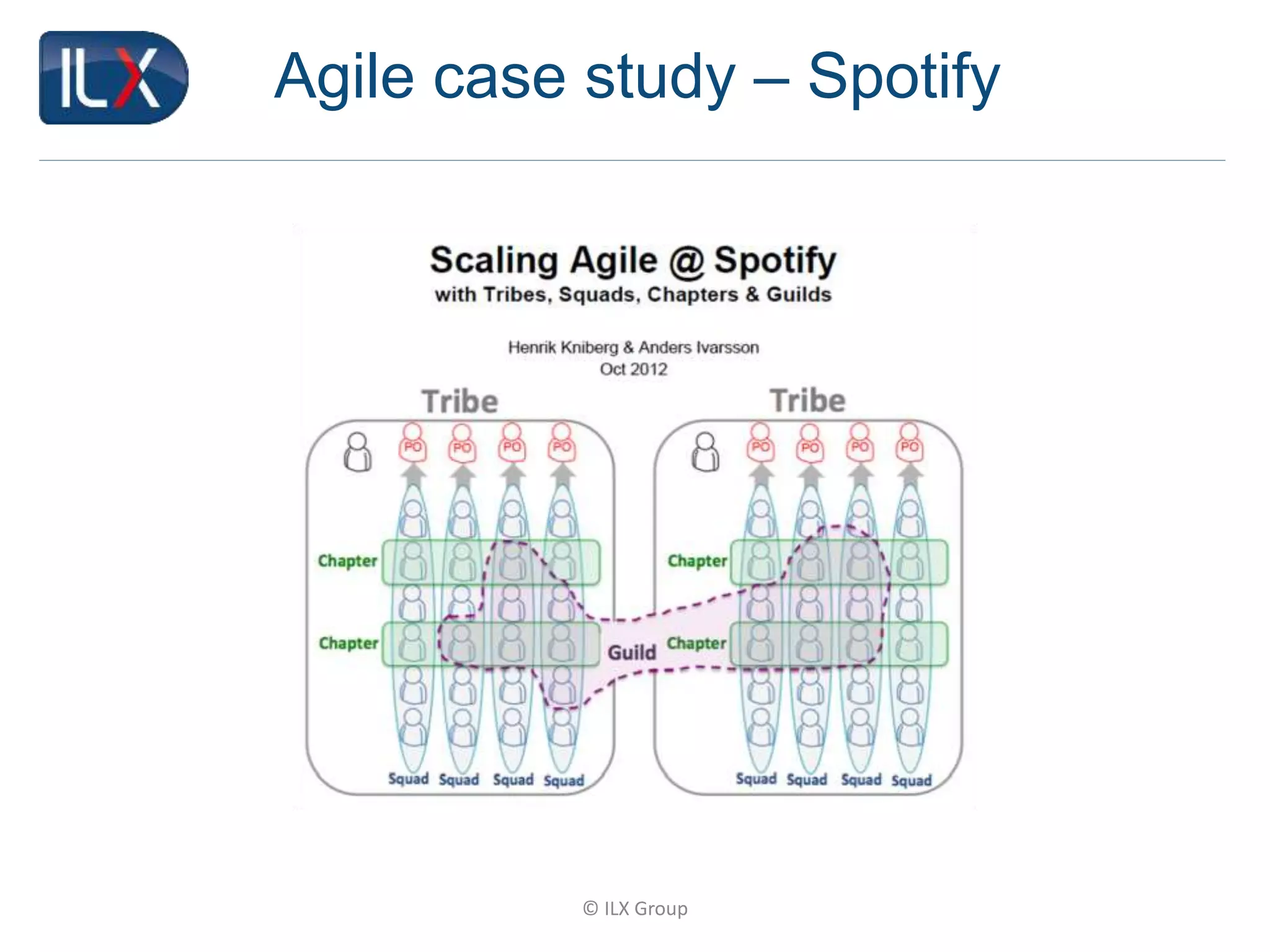
  • #16 Spotify implements agile in a fascinating way, consisting of a number of different types of teams (trios, chapters, squads, tribes, guilds and alliances) that interact with each other, all contributing towards the development and improvement of products. Squads consist of 6-12 people that are autonomous, self-organizing and self-managing, each squad has a mission to accomplish and is free to choose their agile methodologies (or mix them up), applying the Most Viable Product (MVP) technique. Squads have an Agile Coach that help improve their way of working. There is a Product Owner who defines the vision of the feature area. The agile coach conducts retrospectives while sprint planning meetings are kept optional. Each squad has direct contact with stakeholders.
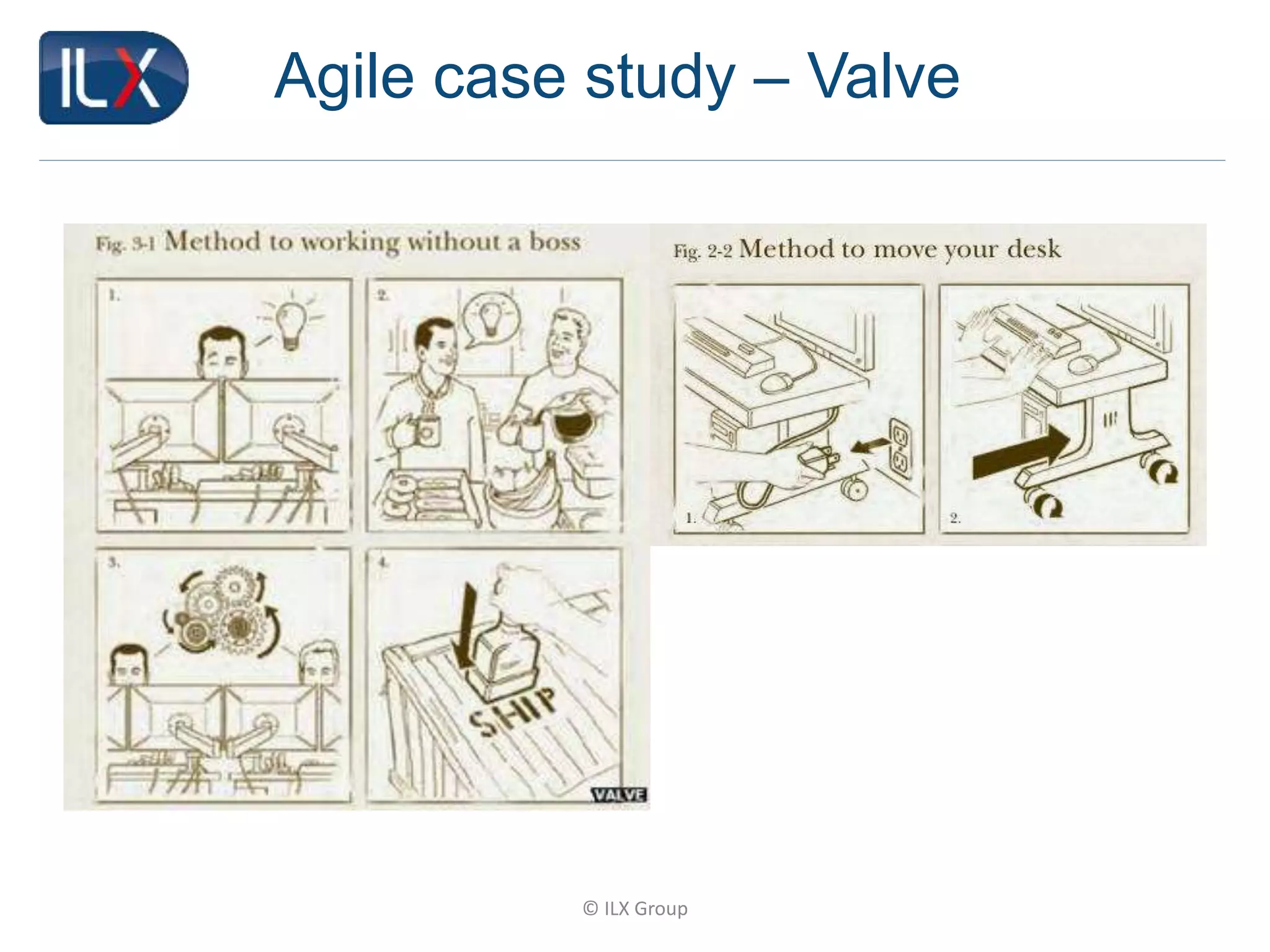
  • #17 Founded in 1996 by former Microsoft employees Gabe Newell and Mike Harrington, Valve is a private firm and claims to make a lot of money: according to the handbook, which is almost completely visual, its profitability per employee is higher than Google, Amazon, or Microsoft. They have tailored agile to the very extreme, with a complete boss-free culture, teams have total freedom to work on what they want, discussing with colleagues and leaders to agree together what to do then iteratively develop, test and release. As employees choose projects they want to work on, Valve changes their investment and focus based on this movement, often on a very large scale, where practically the whole organisation focuses on one project for years.
  • #19 Pure agile is not for every environment, the construction industry, worth $10.6 trillion (2017), is highly technical and heavily regulated, therefore it would be more beneficial to mix waterfall and agile, ensuring: Prior agreement of product requirements before delivery. Every phase of the project is documented and reported on in detail. Greater confidence in terms of the project product impact on external interfaces and dependencies. Benefits of agility arise in the process of developing the component products that make up the final project product.
  • #20 Pure agile has been most successful in dynamic, fast moving environments. Notable examples include the software, game and music industries, worth $456, $138 and $43 billion (2017-2018) respectively. Due to their high-tech and creative nature, pure agile is a perfect fit here as it ensures: Project product evolves throughout development via streamlined communication and feedback loops. Flatter management structures, lighter and more focused documentation and reporting. Empowered teams that make decisions and frequent communication with business/customer enables faster decision making and change control.
  • #29 Epirus Digital – All rights reserved