





TheAgileAnalyst
Presented by Arlen Bankston
Making Agile Methods Work for You
Arlen Bankston
• Managing Partner & Co-Founder of
LitheSpeed, LLC
• 18 years in the industry, 12 doing Agile
• Lean Six Sigma Master Black Belt
• Helped to lead numerous enterprise Agile
adoptions
• Background in user experience, interaction
design & process analysis
Who Am I?
2
Let’s explore…
• Why you should care about Agile
• What BAs do in an Agile team
• How to succeed in an Agile team
3
“Agile analysis”
is an evolutionary and collaborative
process where team members and project
stakeholders work together on a just-in-
time basis to understand the domain,
identify what needs to be built, estimate
cost, prioritize functionality, and produce
custom-fit, low waste artifacts as needed.
What is “Agile Analysis?”
4
WhyYouShouldCare
AboutAgile
Agility is important to BAs because:
1. It is Inevitable
2. You are Needed
3. It’s more Fun and Rewarding
4. It’s a Career Builder
4 Reasons to Care About Agile
6
It is
Inevitable
Waterfall-style software development
became an industry standard because the
US Department of Defense made it a
requirement.
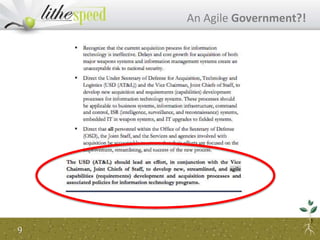
It led to things like this…
How It All Started
8
An Agile Government?!
9
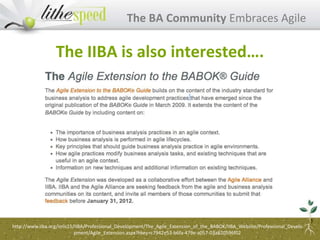
The BA Community Embraces Agile
The IIBA is also interested….
http://www.iiba.org/imis15/IIBA/Professional_Development/The_Agile_Extension_of_the_BABOK/IIBA_Website/Professional_Develo
pment/Agile_Extension.aspx?hkey=c7942e53-b6fa-479e-a057-03a820596f02
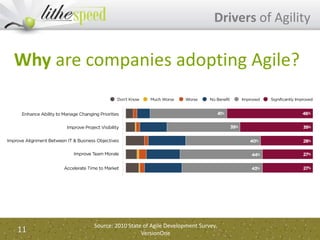
Drivers of Agility
11
Source: 2010 State of Agile Development Survey,
VersionOne
Why are companies adopting Agile?
You are
Needed
• Agile methods were crafted
largely by developers, and
described from their
perspective.
• This left analysts, testers,
designers, tech writers, PMs,
middle managers and others
wondering where they fit in.
The Origin Conundrum
13
• These specialized roles have been fleshing out their
places in an Agile world for the past decade.
Causes for concern…
• Many teams outrun the PO
after 4-6 sprints
• Inconsistent and poorly
considered requirements are
common
• Agile products often lack true
design excellence
• Many teams lack business
process knowledge
What Gaps Need to be Filled?
14
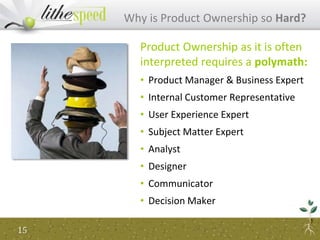
Why is Product Ownership so Hard?
Product Ownership as it is often
interpreted requires a polymath:
• Product Manager & Business Expert
• Internal Customer Representative
• User Experience Expert
• Subject Matter Expert
• Analyst
• Designer
• Communicator
• Decision Maker
15
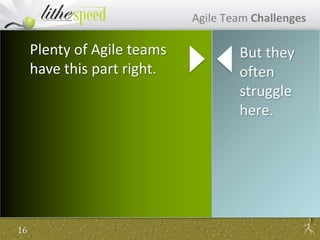
16
Ideation
Market Trends
Prototypes
Focus Groups
User Experience
Basic Workflows
Vision
Business Outcomes
Release Timing and Goals
Product Architecture
Epics and Features
Maturation
User Story Decomposition
User Story Maturation
Acceptance Criteria
Test Cases
Dependencies
Story Mapping
Prioritization
Epic Estimation
Backlog Development
Execution
Sprint Planning
Sprint Estimation
Daily Standups
Software Development
Testing
Burndowns
Documentation
Product Demos
Retrospectives
Current Sprint~2 Sprints Ahead>4 Sprints Ahead
Marketing/Sales, Product
Management, Product
Owners, Architects
Product Owners,
Architects, Dev Leads, QA
Leads, UX/Analysts
Leads, UX/Analysts, Dev
Team Members
Agile Team Challenges
Plenty of Agile teams
have this part right.
But they
often
struggle
here.
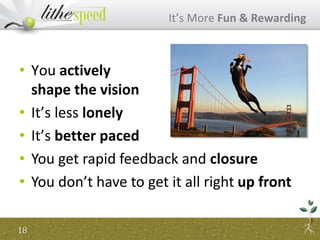
It’s more
Fun & Rewarding
• You actively
shape the vision
• It’s less lonely
• It’s better paced
It’s More Fun & Rewarding
18
• You get rapid feedback and closure
• You don’t have to get it all right up front
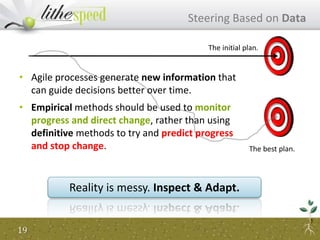
Reality is messy. Inspect & Adapt.
The initial plan.
The best plan.
• Agile processes generate new information that
can guide decisions better over time.
• Empirical methods should be used to monitor
progress and direct change, rather than using
definitive methods to try and predict progress
and stop change.
19
Steering Based on Data
Waiting for Feedback…
20
It’s a
Career Builder
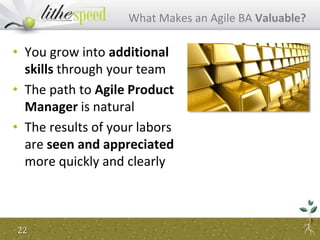
• You grow into additional
skills through your team
• The path to Agile Product
Manager is natural
• The results of your labors
are seen and appreciated
more quickly and clearly
What Makes an Agile BA Valuable?
22
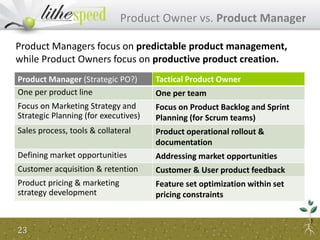
Product Owner vs. Product Manager
23
Product Managers focus on predictable product management,
while Product Owners focus on productive product creation.
Product Manager (Strategic PO?) Tactical Product Owner
One per product line One per team
Focus on Marketing Strategy and
Strategic Planning (for executives)
Focus on Product Backlog and Sprint
Planning (for Scrum teams)
Sales process, tools & collateral Product operational rollout &
documentation
Defining market opportunities Addressing market opportunities
Customer acquisition & retention Customer & User product feedback
Product pricing & marketing
strategy development
Feature set optimization within set
pricing constraints
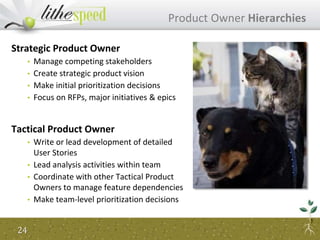
Product Owner Hierarchies
Strategic Product Owner
• Manage competing stakeholders
• Create strategic product vision
• Make initial prioritization decisions
• Focus on RFPs, major initiatives & epics
Tactical Product Owner
• Write or lead development of detailed
User Stories
• Lead analysis activities within team
• Coordinate with other Tactical Product
Owners to manage feature dependencies
• Make team-level prioritization decisions
24
WhatAnalystsDo
OnAgileTeams
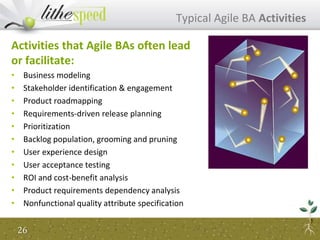
Activities that Agile BAs often lead
or facilitate:
• Business modeling
• Stakeholder identification & engagement
• Product roadmapping
• Requirements-driven release planning
• Prioritization
• Backlog population, grooming and pruning
• User experience design
• User acceptance testing
• ROI and cost-benefit analysis
• Product requirements dependency analysis
• Nonfunctional quality attribute specification
Typical Agile BA Activities
26
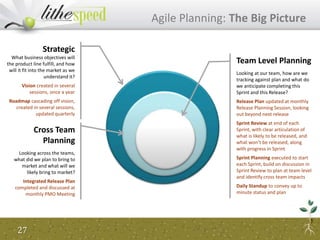
Agile Planning: The Big Picture
Cross Team
Planning
Looking across the teams,
what did we plan to bring to
market and what will we
likely bring to market?
Integrated Release Plan
completed and discussed at
monthly PMO Meeting
Strategic
What business objectives will
the product line fulfill, and how
will it fit into the market as we
understand it?
Vision created in several
sessions, once a year
Roadmap cascading off vision,
created in several sessions,
updated quarterly
Team Level Planning
Looking at our team, how are we
tracking against plan and what do
we anticipate completing this
Sprint and this Release?
Release Plan updated at monthly
Release Planning Session, looking
out beyond next release
Sprint Review at end of each
Sprint, with clear articulation of
what is likely to be released, and
what won’t be released, along
with progress in Sprint
Sprint Planning executed to start
each Sprint, build on discussion in
Sprint Review to plan at team level
and identify cross team impacts
Daily Standup to convey up to
minute status and plan
27
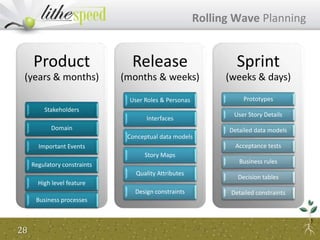
Product
(years & months)
Stakeholders
Domain
Important Events
Regulatory constraints
High level feature
Business processes
Release
(months & weeks)
User Roles & Personas
Interfaces
Conceptual data models
Story Maps
Quality Attributes
Design constraints
Sprint
(weeks & days)
Prototypes
User Story Details
Detailed data models
Acceptance tests
Business rules
Decision tables
Detailed constraints
Rolling Wave Planning
28
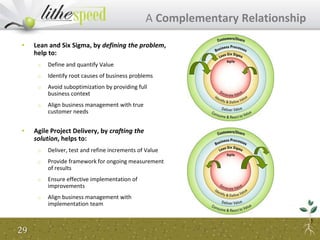
• Lean and Six Sigma, by defining the problem,
help to:
o Define and quantify Value
o Identify root causes of business problems
o Avoid suboptimization by providing full
business context
o Align business management with true
customer needs
• Agile Project Delivery, by crafting the
solution, helps to:
o Deliver, test and refine increments of Value
o Provide framework for ongoing measurement
of results
o Ensure effective implementation of
improvements
o Align business management with
implementation team
A Complementary Relationship
29
HowtoSucceed
OnanAgileTeam
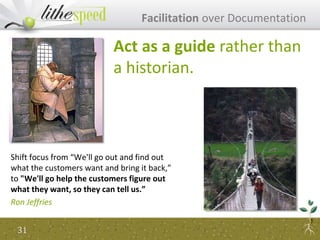
Shift focus from “We'll go out and find out
what the customers want and bring it back,”
to "We'll go help the customers figure out
what they want, so they can tell us.”
Ron Jeffries
Facilitation over Documentation
Act as a guide rather than
a historian.
31
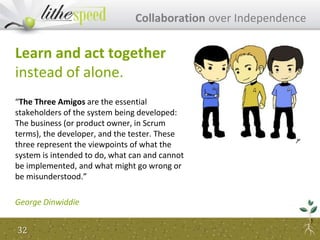
Learn and act together
instead of alone.
“The Three Amigos are the essential
stakeholders of the system being developed:
The business (or product owner, in Scrum
terms), the developer, and the tester. These
three represent the viewpoints of what the
system is intended to do, what can and cannot
be implemented, and what might go wrong or
be misunderstood.”
George Dinwiddie
Collaboration over Independence
32
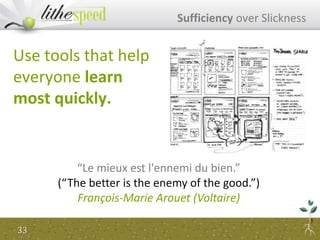
Sufficiency over Slickness
Use tools that help
everyone learn
most quickly.
“Le mieux est l'ennemi du bien.”
(“The better is the enemy of the good.”)
François-Marie Arouet (Voltaire)
33
Questions?
Contact Me
Arlen Bankston
arlen.bankston@lithespeed.com
703-745-9125
35
If you want to further discuss this presentation or the
methods referenced within, please feel free to contact me:

The Agile Analyst: Making Agile Methods Work for You

  • 1.
    TheAgileAnalyst Presented by ArlenBankston Making Agile Methods Work for You
  • 2.
    Arlen Bankston • ManagingPartner & Co-Founder of LitheSpeed, LLC • 18 years in the industry, 12 doing Agile • Lean Six Sigma Master Black Belt • Helped to lead numerous enterprise Agile adoptions • Background in user experience, interaction design & process analysis Who Am I? 2
  • 3.
    Let’s explore… • Whyyou should care about Agile • What BAs do in an Agile team • How to succeed in an Agile team 3
  • 4.
    “Agile analysis” is anevolutionary and collaborative process where team members and project stakeholders work together on a just-in- time basis to understand the domain, identify what needs to be built, estimate cost, prioritize functionality, and produce custom-fit, low waste artifacts as needed. What is “Agile Analysis?” 4
  • 5.
  • 6.
    Agility is importantto BAs because: 1. It is Inevitable 2. You are Needed 3. It’s more Fun and Rewarding 4. It’s a Career Builder 4 Reasons to Care About Agile 6
  • 7.
  • 8.
    Waterfall-style software development becamean industry standard because the US Department of Defense made it a requirement. It led to things like this… How It All Started 8
  • 9.
  • 10.
    The BA CommunityEmbraces Agile The IIBA is also interested…. http://www.iiba.org/imis15/IIBA/Professional_Development/The_Agile_Extension_of_the_BABOK/IIBA_Website/Professional_Develo pment/Agile_Extension.aspx?hkey=c7942e53-b6fa-479e-a057-03a820596f02
  • 11.
    Drivers of Agility 11 Source:2010 State of Agile Development Survey, VersionOne Why are companies adopting Agile?
  • 12.
  • 13.
    • Agile methodswere crafted largely by developers, and described from their perspective. • This left analysts, testers, designers, tech writers, PMs, middle managers and others wondering where they fit in. The Origin Conundrum 13 • These specialized roles have been fleshing out their places in an Agile world for the past decade.
  • 14.
    Causes for concern… •Many teams outrun the PO after 4-6 sprints • Inconsistent and poorly considered requirements are common • Agile products often lack true design excellence • Many teams lack business process knowledge What Gaps Need to be Filled? 14
  • 15.
    Why is ProductOwnership so Hard? Product Ownership as it is often interpreted requires a polymath: • Product Manager & Business Expert • Internal Customer Representative • User Experience Expert • Subject Matter Expert • Analyst • Designer • Communicator • Decision Maker 15
  • 16.
    16 Ideation Market Trends Prototypes Focus Groups UserExperience Basic Workflows Vision Business Outcomes Release Timing and Goals Product Architecture Epics and Features Maturation User Story Decomposition User Story Maturation Acceptance Criteria Test Cases Dependencies Story Mapping Prioritization Epic Estimation Backlog Development Execution Sprint Planning Sprint Estimation Daily Standups Software Development Testing Burndowns Documentation Product Demos Retrospectives Current Sprint~2 Sprints Ahead>4 Sprints Ahead Marketing/Sales, Product Management, Product Owners, Architects Product Owners, Architects, Dev Leads, QA Leads, UX/Analysts Leads, UX/Analysts, Dev Team Members Agile Team Challenges Plenty of Agile teams have this part right. But they often struggle here.
  • 17.
  • 18.
    • You actively shapethe vision • It’s less lonely • It’s better paced It’s More Fun & Rewarding 18 • You get rapid feedback and closure • You don’t have to get it all right up front
  • 19.
    Reality is messy.Inspect & Adapt. The initial plan. The best plan. • Agile processes generate new information that can guide decisions better over time. • Empirical methods should be used to monitor progress and direct change, rather than using definitive methods to try and predict progress and stop change. 19 Steering Based on Data
  • 20.
  • 21.
  • 22.
    • You growinto additional skills through your team • The path to Agile Product Manager is natural • The results of your labors are seen and appreciated more quickly and clearly What Makes an Agile BA Valuable? 22
  • 23.
    Product Owner vs.Product Manager 23 Product Managers focus on predictable product management, while Product Owners focus on productive product creation. Product Manager (Strategic PO?) Tactical Product Owner One per product line One per team Focus on Marketing Strategy and Strategic Planning (for executives) Focus on Product Backlog and Sprint Planning (for Scrum teams) Sales process, tools & collateral Product operational rollout & documentation Defining market opportunities Addressing market opportunities Customer acquisition & retention Customer & User product feedback Product pricing & marketing strategy development Feature set optimization within set pricing constraints
  • 24.
    Product Owner Hierarchies StrategicProduct Owner • Manage competing stakeholders • Create strategic product vision • Make initial prioritization decisions • Focus on RFPs, major initiatives & epics Tactical Product Owner • Write or lead development of detailed User Stories • Lead analysis activities within team • Coordinate with other Tactical Product Owners to manage feature dependencies • Make team-level prioritization decisions 24
  • 25.
  • 26.
    Activities that AgileBAs often lead or facilitate: • Business modeling • Stakeholder identification & engagement • Product roadmapping • Requirements-driven release planning • Prioritization • Backlog population, grooming and pruning • User experience design • User acceptance testing • ROI and cost-benefit analysis • Product requirements dependency analysis • Nonfunctional quality attribute specification Typical Agile BA Activities 26
  • 27.
    Agile Planning: TheBig Picture Cross Team Planning Looking across the teams, what did we plan to bring to market and what will we likely bring to market? Integrated Release Plan completed and discussed at monthly PMO Meeting Strategic What business objectives will the product line fulfill, and how will it fit into the market as we understand it? Vision created in several sessions, once a year Roadmap cascading off vision, created in several sessions, updated quarterly Team Level Planning Looking at our team, how are we tracking against plan and what do we anticipate completing this Sprint and this Release? Release Plan updated at monthly Release Planning Session, looking out beyond next release Sprint Review at end of each Sprint, with clear articulation of what is likely to be released, and what won’t be released, along with progress in Sprint Sprint Planning executed to start each Sprint, build on discussion in Sprint Review to plan at team level and identify cross team impacts Daily Standup to convey up to minute status and plan 27
  • 28.
    Product (years & months) Stakeholders Domain ImportantEvents Regulatory constraints High level feature Business processes Release (months & weeks) User Roles & Personas Interfaces Conceptual data models Story Maps Quality Attributes Design constraints Sprint (weeks & days) Prototypes User Story Details Detailed data models Acceptance tests Business rules Decision tables Detailed constraints Rolling Wave Planning 28
  • 29.
    • Lean andSix Sigma, by defining the problem, help to: o Define and quantify Value o Identify root causes of business problems o Avoid suboptimization by providing full business context o Align business management with true customer needs • Agile Project Delivery, by crafting the solution, helps to: o Deliver, test and refine increments of Value o Provide framework for ongoing measurement of results o Ensure effective implementation of improvements o Align business management with implementation team A Complementary Relationship 29
  • 30.
  • 31.
    Shift focus from“We'll go out and find out what the customers want and bring it back,” to "We'll go help the customers figure out what they want, so they can tell us.” Ron Jeffries Facilitation over Documentation Act as a guide rather than a historian. 31
  • 32.
    Learn and acttogether instead of alone. “The Three Amigos are the essential stakeholders of the system being developed: The business (or product owner, in Scrum terms), the developer, and the tester. These three represent the viewpoints of what the system is intended to do, what can and cannot be implemented, and what might go wrong or be misunderstood.” George Dinwiddie Collaboration over Independence 32
  • 33.
    Sufficiency over Slickness Usetools that help everyone learn most quickly. “Le mieux est l'ennemi du bien.” (“The better is the enemy of the good.”) François-Marie Arouet (Voltaire) 33
  • 34.
  • 35.
    Contact Me Arlen Bankston arlen.bankston@lithespeed.com 703-745-9125 35 Ifyou want to further discuss this presentation or the methods referenced within, please feel free to contact me: