Disc herniation
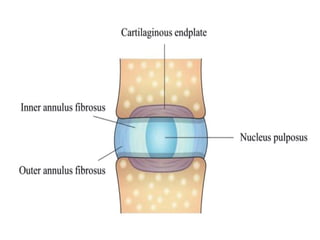
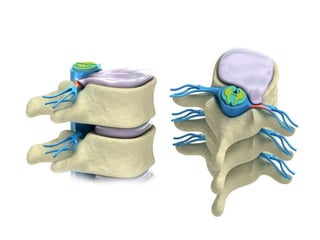
• Disc herniation occurs when part or all the
nucleus pulposus protrudes through the
annulus fibrous.
• The most common cause of disc herniation is a
degenerative process in which, as humans age,
the nucleus pulposus becomes less hydrated
and weakens.
• This process will lead to a progressive disc
herniation that can cause symptoms.
• The second most common cause of disc
herniation is trauma.
• Other causes include connective tissue
disorders and congenital disorders such as
short pedicles.
• Disc herniation is most common in the lumbar
spine, followed by the cervical spine.
• There is a higher rate of disc herniation in the
lumbar and cervical spine due to the
biomechanical forces in the flexible part of
the spine.
• The thoracic spine has a lower rate of disc
herniation
• The localized back pain is a combination of the
herniated disc pressure on the longitudinal
ligament, and chemical irritation due to local
inflammation.
History and Physical
• The patient will likely recall an inciting injury, often
due to lifting or twisting.
• pain can be described as sharp or burning. There is
often radiation of the pain in the distribution of the
compressed nerve root.
• Numbness and tingling, as well as decreased
sensation along the path of the nerve root, may also
occur.
• In more severe cases, weakness or a feeling of
instability while ambulating may be endorsed.
Cervical Spine
• History
• In the cervical spine, the C6-7 is the most
common herniation disc that causes
symptoms, mostly radiculopathy
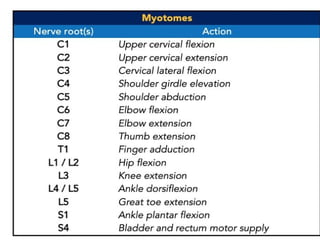
• C5 Nerve - neck, shoulder, and scapula pain, lateral arm numbness, and weakness
during shoulder abduction, external rotation, elbow flexion, and forearm
supination. The reflexes affected are the biceps and brachioradialis.
• C6 Nerve - neck, shoulder, scapula, and lateral arm, forearm, and hand pain, along
with lateral forearm, thumb, and index finger numbness. Weakness during shoulder
abduction, external rotation, elbow flexion, and forearm supination and pronation
is common. The reflexes affected are the biceps and brachioradialis.
• C7 Nerve - neck, shoulder, middle finger pain are standard, along with the index,
middle finger, and palm numbness. Weakness on the elbow and wrist are common,
along with weakness during radial extension, forearm pronation, and wrist flexion
may occur. The reflex affected is the triceps.
• C8 Nerve - neck, shoulder, and medial forearm pain, with numbness on the medial
forearm and medial hand. Weakness is common during finger extension, wrist
(ulnar) extension, distal finger flexion, extension, abduction, and adduction, along
with distal thumb flexion. No reflexes are affected.
• T1 Nerve - pain is common in the neck, medial arm, and forearm, whereas
numbness is common on the anterior arm and medial forearm. Weakness can
occur during thumb abduction, distal thumb flexion, finger abduction, and
adduction. No reflexes are affected.
Lumber disc herniation
• L1 Nerve - pain and sensory loss are common in the inguinal region. Hip flexion weakness
is rare, and no stretch reflex is affected.
• L2-L3-L4 Nerves - back pain radiating into the anterior thigh and medial lower leg;
sensory loss to the anterior thigh and sometimes medial lower leg; hip flexion and
adduction weakness, knee extension weakness; decreased patellar reflex.
• L5 Nerve - back, radiating into buttock, lateral thigh, lateral calf, and dorsum foot, great
toe; sensory loss on the lateral calf, weakness on hip abduction, knee flexion, foot
dorsiflexion, toe extension and flexion, foot inversion and eversion; decreased
semitendinosus/semimembranosus reflex.
• S1 Nerve - back, radiating into buttock, lateral or posterior thigh, posterior calf, lateral or
plantar foot; sensory loss on the posterior calf, lateral or plantar aspect of foot; weakness
on hip extension, knee flexion, Medial buttock, perineal, and perianal region; weakness
may be minimal, with urinary and fecal incontinence as well as sexual dysfunction.
• S2-S4 Nerves - sacral or buttock pain radiating into the posterior aspect of the leg or the
perineum; sensory deficit on the medial buttock, perineal, and perianal region; absent
bulbocavernosus, anal wink reflex.
Evaluation
• Over 85% of patients with symptoms associated with an acute herniated
disc will resolve within 8 to 12 weeks without any specific treatments.
• X-rays: If x-rays show an acute fracture, it needs to be further
investigated using a computed tomogram (CT) scan or magnetic
resonance imaging (MRI).
• CT Scan: It is the preferred study to visualize bony structures in the
spine. It can also show calcified herniated discs. In the patients that have
non-MRI comparable implanted devices, CT myelography can be
performed to visualize herniated disc.
• MRI: It is the preferred and most sensitive study to visualize herniated
disc. MRI findings will help surgeons and other providers plan procedural
care if it is indicated.
• Nerve conduction studies
Management
Conservative Treatments
NSAIDs and physical therapy are first-line treatment
modalities. it is not recommended to start physical
therapy until symptoms have lasted for at least three
weeks.
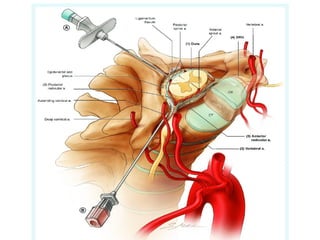
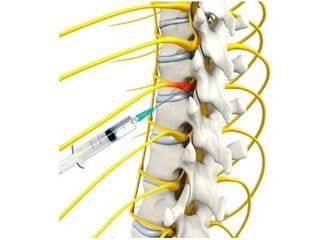
Translaminar epidural injections and selective nerve
root blocks are the second-line modalities for patients
unresponsive to conservative management and who
have had symptoms for at least four to six weeks. T
Surgical Treatments
• Surgical procedures for a herniated disc include
laminectomies with discectomies depending
on the cervical or lumbar area.
• Also, a patient with a herniated disc in the
cervical spine can be managed via an anterior
approach that requires anterior cervical
decompression and fusion.
• An artificial disk replacement option can be
considered.
• Chemonucleolysis is a treatment for
herniated disc. It consists of a non-invasive
procedure whose objective is to reduce or
eradicate the patient's pain by applying gelled
ethanol to the intervertebral discs that are
damaged.
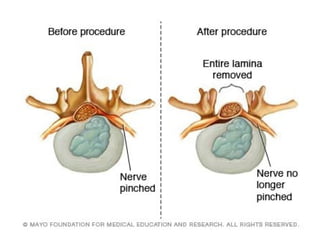
• Laminectomy is usually done for back or neck
pain that continues after medical treatment.
Or it's done when the pain is accompanied by
symptoms of spinal cord or nerve damage.
• This includes numbness or weakness in the
arms or legs. Loss of bowel or bladder control
from pressure in the cervical or lumbar spine
also usually needs surgery.
• Complications of a herniated disc include the
development of chronic back pain.
Furthermore, untreated cases of disc
herniation, albeit rare, can lead to lasting
nerve damage in severe nerve root
compression.
Disc herniation and its management .pptx

Disc herniation and its management .pptx

  • 1.
  • 3.
    • Disc herniationoccurs when part or all the nucleus pulposus protrudes through the annulus fibrous. • The most common cause of disc herniation is a degenerative process in which, as humans age, the nucleus pulposus becomes less hydrated and weakens. • This process will lead to a progressive disc herniation that can cause symptoms.
  • 4.
    • The secondmost common cause of disc herniation is trauma. • Other causes include connective tissue disorders and congenital disorders such as short pedicles.
  • 5.
    • Disc herniationis most common in the lumbar spine, followed by the cervical spine. • There is a higher rate of disc herniation in the lumbar and cervical spine due to the biomechanical forces in the flexible part of the spine. • The thoracic spine has a lower rate of disc herniation
  • 6.
    • The localizedback pain is a combination of the herniated disc pressure on the longitudinal ligament, and chemical irritation due to local inflammation.
  • 8.
    History and Physical •The patient will likely recall an inciting injury, often due to lifting or twisting. • pain can be described as sharp or burning. There is often radiation of the pain in the distribution of the compressed nerve root. • Numbness and tingling, as well as decreased sensation along the path of the nerve root, may also occur. • In more severe cases, weakness or a feeling of instability while ambulating may be endorsed.
  • 10.
    Cervical Spine • History •In the cervical spine, the C6-7 is the most common herniation disc that causes symptoms, mostly radiculopathy
  • 11.
    • C5 Nerve- neck, shoulder, and scapula pain, lateral arm numbness, and weakness during shoulder abduction, external rotation, elbow flexion, and forearm supination. The reflexes affected are the biceps and brachioradialis. • C6 Nerve - neck, shoulder, scapula, and lateral arm, forearm, and hand pain, along with lateral forearm, thumb, and index finger numbness. Weakness during shoulder abduction, external rotation, elbow flexion, and forearm supination and pronation is common. The reflexes affected are the biceps and brachioradialis. • C7 Nerve - neck, shoulder, middle finger pain are standard, along with the index, middle finger, and palm numbness. Weakness on the elbow and wrist are common, along with weakness during radial extension, forearm pronation, and wrist flexion may occur. The reflex affected is the triceps. • C8 Nerve - neck, shoulder, and medial forearm pain, with numbness on the medial forearm and medial hand. Weakness is common during finger extension, wrist (ulnar) extension, distal finger flexion, extension, abduction, and adduction, along with distal thumb flexion. No reflexes are affected. • T1 Nerve - pain is common in the neck, medial arm, and forearm, whereas numbness is common on the anterior arm and medial forearm. Weakness can occur during thumb abduction, distal thumb flexion, finger abduction, and adduction. No reflexes are affected.
  • 12.
    Lumber disc herniation •L1 Nerve - pain and sensory loss are common in the inguinal region. Hip flexion weakness is rare, and no stretch reflex is affected. • L2-L3-L4 Nerves - back pain radiating into the anterior thigh and medial lower leg; sensory loss to the anterior thigh and sometimes medial lower leg; hip flexion and adduction weakness, knee extension weakness; decreased patellar reflex. • L5 Nerve - back, radiating into buttock, lateral thigh, lateral calf, and dorsum foot, great toe; sensory loss on the lateral calf, weakness on hip abduction, knee flexion, foot dorsiflexion, toe extension and flexion, foot inversion and eversion; decreased semitendinosus/semimembranosus reflex. • S1 Nerve - back, radiating into buttock, lateral or posterior thigh, posterior calf, lateral or plantar foot; sensory loss on the posterior calf, lateral or plantar aspect of foot; weakness on hip extension, knee flexion, Medial buttock, perineal, and perianal region; weakness may be minimal, with urinary and fecal incontinence as well as sexual dysfunction. • S2-S4 Nerves - sacral or buttock pain radiating into the posterior aspect of the leg or the perineum; sensory deficit on the medial buttock, perineal, and perianal region; absent bulbocavernosus, anal wink reflex.
  • 13.
    Evaluation • Over 85%of patients with symptoms associated with an acute herniated disc will resolve within 8 to 12 weeks without any specific treatments. • X-rays: If x-rays show an acute fracture, it needs to be further investigated using a computed tomogram (CT) scan or magnetic resonance imaging (MRI). • CT Scan: It is the preferred study to visualize bony structures in the spine. It can also show calcified herniated discs. In the patients that have non-MRI comparable implanted devices, CT myelography can be performed to visualize herniated disc. • MRI: It is the preferred and most sensitive study to visualize herniated disc. MRI findings will help surgeons and other providers plan procedural care if it is indicated. • Nerve conduction studies
  • 14.
    Management Conservative Treatments NSAIDs andphysical therapy are first-line treatment modalities. it is not recommended to start physical therapy until symptoms have lasted for at least three weeks. Translaminar epidural injections and selective nerve root blocks are the second-line modalities for patients unresponsive to conservative management and who have had symptoms for at least four to six weeks. T
  • 17.
    Surgical Treatments • Surgicalprocedures for a herniated disc include laminectomies with discectomies depending on the cervical or lumbar area. • Also, a patient with a herniated disc in the cervical spine can be managed via an anterior approach that requires anterior cervical decompression and fusion. • An artificial disk replacement option can be considered.
  • 18.
    • Chemonucleolysis isa treatment for herniated disc. It consists of a non-invasive procedure whose objective is to reduce or eradicate the patient's pain by applying gelled ethanol to the intervertebral discs that are damaged.
  • 19.
    • Laminectomy isusually done for back or neck pain that continues after medical treatment. Or it's done when the pain is accompanied by symptoms of spinal cord or nerve damage. • This includes numbness or weakness in the arms or legs. Loss of bowel or bladder control from pressure in the cervical or lumbar spine also usually needs surgery.
  • 21.
    • Complications ofa herniated disc include the development of chronic back pain. Furthermore, untreated cases of disc herniation, albeit rare, can lead to lasting nerve damage in severe nerve root compression.