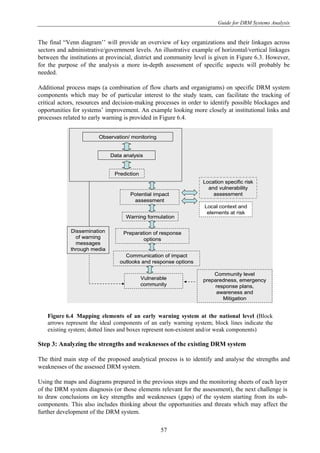
DISASTER RISK MANAGEMENT
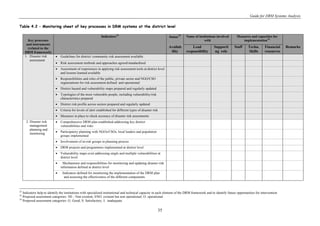
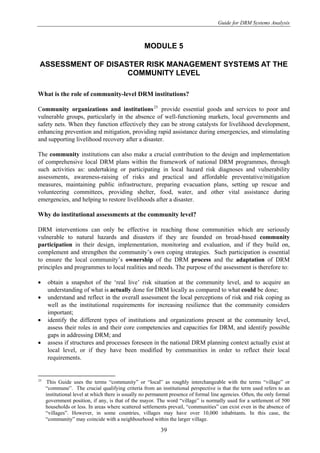
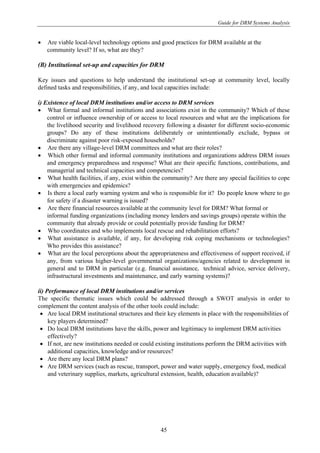
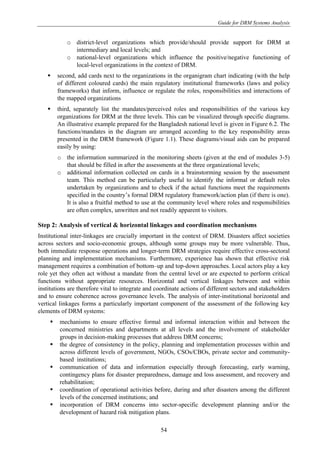
SYSTEMS ANALYSIS
A guide book
Guide for DRM Systems Analysis
INSTITUTIONS FOR DISASTER
RISK MANAGEMENT
DISASTER RISK MANAGEMENT
SYSTEMS ANALYSIS
Prepared By:
Stephan Baas
Selvaraju Ramasamy
Jenny Dey DePryck
Federica Battista
ENVIRONMENT, CLIMATE CHANGE AND BIOENERGY DIVISION
FOOD AND AGRICULTURE ORGANISATION OF THE UNITED NATIONS
ROME, JANUARY 2008
ii
Guide for DRM Systems Analysis
FOREWORD
With mounting international concern at the rising frequency and severity of natural hazards and
disasters, in part due to factors related to climate change, there is increased impetus in many
countries to put in place policy, legal, technical, financial and institutional measures that will reduce
the destructive effects on the lives and livelihoods of individuals and communities. These concerns
were intensively debated during the World Conference on Disaster Reduction, held in Kobe, Hyogo
Prefecture, Japan, 18-22 January 2005. The Hyogo Framework for Action (HFA), adopted by the
Conference, seeks the outcome of “The substantial reduction of disaster losses, in lives and in the
social, economic and environmental assets of communities and countries”. In order to achieve the
stated outcome by 2015, the HFA emphasises a shift from reactive emergency relief (which
nonetheless remains important) to pro-active disaster risk reduction (DRR) in the pre-disaster stages
by strengthening prevention, mitigation and preparedness. A related approach that is gaining
widespread support is that of disaster risk management (DRM) which combines, through a
management perspective, the concept of prevention, mitigation and preparedness with response.
The effective implementation of both DRR and DRM systems is contingent on sound institutional
capacities by key actors at different levels of government, the private sector and civil society as well
as effective coordination between these actors and levels. These challenges were given emphatic
recognition by the HFA’s second strategic goal: “the development and strengthening of institutions,
mechanisms and capacities at all levels, in particular at the community level, that can systematically
contribute to building resilience to hazards”.
More recently, in the context of increasing climate variability and climate change, there is increasing
recognition for the benefits from closely linking Disaster Risk Management and Climate Change
Adaptation efforts at different scales. The workshop on “Climate Related Risks and Extreme Events”
held in June 2007 in Cairo by the United Nations Framework Convention on Climate Change
(UNFCCC) in the context of the Nairobi Work Programme (NWP) on impacts, vulnerability and
adaptation to climate change recognised this crucial link. It recommended, inter alia, to identify and
promote institutional mechanisms and processes for better coordinated actions related to climate risk
and impact management, including those related to extreme events (DRR).
FAO’s field experiences with DRM, supported by normative studies, revealed that there are few
practical tools available to guide the analysis of national, district and local institutional systems for
DRM and to conceptualize and provide demand-responsive capacity-building thereafter. The lack of
tools to understand institutional responses and coordination mechanisms is of particular concern.
This Guide attempts to fill this gap by providing a set of tools that have been developed and tested in
various FAO field projects for DRM.
The methods and tools proposed in this guide are generic, and can be adapted to different types of
natural hazards, sectoral issues, geographical areas, country-specific conditions and institutional
settings. However, in view of FAO’s mandate and experience, some practical illustrations are given
of the application of these tools to the agricultural sector in developing countries. In order to
strengthen FAO’s assistance to governments and other concerned organizations in undertaking
diagnostic assessments of DRM institutional systems as a first step in a capacity-building process, we
would welcome feedback on this Guide from readers and users with a view to improving future
versions.
Peter Holmgren
Director, Environment, Climate Change and Bioenergy Division, FAO
iii
Guide for DRM Systems Analysis
ACKNOWLEDGEMENTS
We are grateful to the many people who have contributed directly or indirectly to the preparation
of this Guide.
The first draft was prepared by the Asian Disaster Preparedness Center, Bangkok, under a Letter
of Agreement with FAO. The draft was subsequently reviewed and discussed at a workshop held
in FAO, Rome, in December 2006, after which ADPC amended it incorporating the participants’
comments and guidance. Finally some sections of the second version were fine-tuned or
rewritten by a small team comprising Stephan Baas, Selvaraju Ramasamy, Jennie Dey de Pryck
and Federica Battista taking into account the participants’ comments and guidance.
The Guide draws heavily on the field experience of FAO in developing and strengthening the
institutional capacities of DRM systems in a number of Asian and Caribbean countries. Illustrations
of participatory rural appraisal exercises used during field assessments of community-level DRM
systems in several countries enrich the text with the experiences of many rural people who are highly
vulnerable to natural hazard risk.
In addition to Stephan Baas who conceived and technically supervised the preparation of this Guide,
we are grateful to Genevieve Braun, Marta Bruno, Eve Crowley, Olivier Dubois, Florence Egal,
Shantana Halder, Jan Johnson, Angee Lee, Simon Mack, Dalia Mattioni, Hans Meliczek, Pamela
Pozarny, Peter Reid, Florence Rolle, Laura Sciannimonaco, Nicole Steyer, and Sylvi WabbesCanotti
for providing constructive comments on and inputs to the earlier drafts of the Guide.
The production of the Guide was made possible through financial contributions from FAO’s Rural
Institutions and Participation Service (SDAR) and the FAO Inter-Departmental Working Group on
Disaster Risk Management (Reha Paia)
iv
Guide for DRM Systems Analysis
CONTENTS
FOREWORD ............................................................................................................................. iii
ACKNOWLEDGEMENTS...........................................................................................................iv
CONTENTS ...............................................................................................................................v
ACRONYMS ..............................................................................................................................vi
INTRODUCTION...........................................................................................................................1
MODULE 1: DEFINITIONS AND CONCEPTUAL FRAMEWORK .................................4
MODULE 2: PLANNING AN INSTITUTIONAL ASSESSMENT OF DISASTER
RISK MANAGEMENT SYSTEMS ................................................................13
MODULE 3 ASSESSMENT OF DISASTER RISK MANAGEMENT SYSTEMS
AT THE NATIONAL LEVEL.........................................................................20
MODULE 4: ASSESSMENT OF DISASTER RISK MANAGEMENT SYSTEMS
AT THE DISTRICT LEVEL...........................................................................30
MODULE 5 ASSESSMENT OF DISASTER RISK MANAGEMENT SYSTEMS
AT THE COMMUNITY LEVEL....................................................................39
MODULE 6 ANALYSING AND INTERPRETING THE DATA......................................52
REFERENCES .............................................................................................................................63
ANNEX I TOOLS AND METHODS FOR INSTITUTIONAL ASSESSMENTS........64
A) Tools and methods for community profiling .................................................64
B) Tools and methods for analysing vertical and horizontal linkages ................65
ANNEX II DISASTER-RELATED TERMS AND DEFINITIONS................................66
v
Guide for DRM Systems Analysis
ACRONYMS
AEZ Agro-Ecological Zone
CCA Common Country Assessment
CRED Centre for Research on the Epidemiology of Disasters
CBDRM Community-Based Disaster Risk Management
CBO Community-Based Organization
CIG Common Interest Groups
CSO Civil Society Organization
DCP District Contingency Plans
DRM Disaster Risk Management
DRMC Disaster Risk Management Cycle
DRMF Disaster Risk Management Framework
DRR Disaster Risk Reduction
EWS Early Warning Systems
FAO Food and Agriculture Organization of the United Nations
FEWSNET Famine Early Warning System (FEWS) Network
FPMIS Field Project Management Information System
GIEWS Global Information and Early Warning System
HFA Hyogo Framework for Action
IFRC International Federation of Red Cross and Red Crescent Societies
INGO International non-Governmental Organisations
MFIS Micro-Financing Organisations
MoU Memorandum of Understanding
NDMA National Disaster Management Agency
NDMB National Disaster Management Bureau
NDMC National Disaster Management Centre
NDMO National Disaster Management Office
NGO Non-Governmental Organization
NHMS National Hydro-Meteorological Services
NMAs National Meteorological Agencies
NWP Nairobi Work Programme on impacts, vulnerability and adaptation
PRA Participatory Rural Appraisal
SDAR Rural Institutions and Participation Services
SLAF Sustainable Livelihoods Analytical Framework
UAS User’s Association
UNDAF United Nations Development Assistance Framework
UNFCCC United Nations Framework Convention for Climate Change
UN/ISDR United Nations International Strategy for Disaster Reduction
VDC Village Development Committee
WCDR World Conference on Disaster Reduction
WFP World Food Programme
vi
Guide for DRM Systems Analysis
INTRODUCTION
Background
The world has witnessed an alarming increase in the frequency and severity of disasters: 240 million
people, on average, were affected by natural disasters world-wide each year between 2000 and 2005.
During each of these six years, these disasters claimed an average of 80,000 lives and caused damage
of an estimated US$ 80 billion.1
Disaster losses are rising throughout the world due to a number of
factors that include:
•
•
•
•
more frequent extreme weather events associated with increasing climate variability and
change;
agricultural production systems that increase risk (e.g. heavy reliance on irrigated crops
resulting in aquifer depletion and salinization, or unsustainable pasture/livestock or bio-fuel
production on land that was formerly and more appropriately covered in forest);
population growth combined with demographic change and movements leading, for instance,
to unplanned urbanization, growing demand for food, industrial goods and services; and
increasing pressure on (and over-exploitation of) natural resources.
Higher living standards and more extravagant life styles in the more prosperous nations also result in
very high economic losses when disasters strike. While better emergency response systems will save
lives and properties, many of these losses can be avoided – or reduced – if appropriate policies and
programmes are instituted to address the root causes and set in place mitigation, preparedness and
response mechanisms that are effectively integrated into overall development planning.
These issues were called into public scrutiny and exhaustively debated during the World Conference
on Disaster Reduction (WCDR) in Kobe, Hyogo, Japan (January 2005). Governments, UN agencies
and Civil Society Organizations (CSOs) present in Kobe insisted on the need to move from theory to
concrete action in disaster risk reduction. Strongly endorsing the Conference’s recommendations, the
UN General Assembly Resolution RES-59-212 (March 2005) on “International Cooperation on
Humanitarian Assistance in the Field of Natural Disasters, from Relief to Development” called upon
all States to implement the Hyogo Framework for Action (HFA), and requested the international
community to continue assisting developing countries in their efforts to adopt appropriate measures
to mitigate the effects of natural disasters, and to integrate disaster risk reduction (DRR) strategies
into development planning. This represents a paradigm shift from a heavy preoccupation with
reactive emergency relief (which nonetheless remains important) to pro-active DRR before a hazard
can turn into a disaster.
The second of the three strategic goals of the HFA is “the development and strengthening of
institutions, mechanisms and capacities at all levels, in particular at the community level, that can
systematically contribute to building resilience to hazards”.2
A particular challenge in meeting this
objective is to acquire a sound understanding of existing institutional capacities, possible gaps and
the comparative strengths of different actors at different levels as a basis for mobilizing the
1
CRED. March 2007. The data source - EM-DAT, does not include victims of conflict, epidemics and insect
infestations. For more on disaster statistics and issues relating to disaster data: www.em-dat.net
2
The other strategic goals are: (a) The more effective integration of disaster risk considerations into sustainable
development policies, planning and programming at all levels, with a special emphasis on disaster prevention,
mitigation, preparedness and vulnerability reduction; and (c) the systematic incorporation of risk reduction
approaches into the design and implementation of emergency preparedness, response and recovery programmes in
the reconstruction of affected communities.
1
Guide for DRM Systems Analysis
participation of local organizations, together with higher level institutions, in the design and
implementation of locally relevant DRR strategies.
In order to build institutions that are better prepared for, resilient to and able to cope with hazards, it
is useful to enrich the concept and practice of disaster risk reduction (DRR) used in the HFA which
focuses on pre-disaster stages (prevention, mitigation and preparedness) by placing them within the
broader concept and practice of disaster risk management (DRM) which combines (through a
management perspective) prevention, mitigation and preparedness with response.3
Recent studies4
and projects of FAO show that in spite of the considerable documentation available
on DRM, there are few practical tools to guide the analysis of national, district and local institutions
and systems for DRM, and to conceptualize and provide demand-responsive capacity-building
thereafter. The lack of tools to analyse the institutional capacities of community-based organizations
to participate effectively in the design and implementation of local DRM strategies as well as in the
continuous management of hazard threats and/or disaster situations before, during and after their
occurrence is of particular concern. To address this gap, in 2003 FAO launched a programme
focusing on the role of local institutions in natural disaster risk management. The programme
combines and mutually reinforces normative and operational, field-based activities to assist countries
in their efforts to shift from reactive emergency relief operations towards better planned, long-term
disaster risk prevention and preparedness strategies including, where appropriate, their integration
into on-going agricultural development work. The approach is premised on (i) a sound understanding
of existing institutional capacities, possible gaps and the comparative strengths of different actors in
DRM at different levels, and (ii) effective coordination between key stakeholders in the design and
implementation of demand-responsive projects and programmes that address, in a sustainable way,
the root causes of vulnerability of local stakeholders to natural hazards. FAO’s key entry points
build on the following closely inter-connected questions:
(i) what institutional structures, mechanisms and processes are driving national DRM
programmes in the agriculture, forestry and fisheries sectors?
(ii) what technical capacities, tools, methods and approaches are available within existing
institutional structures to operationalize DRM at national and local levels (that is,
assessing comparative strengths as to who could do what best)?
(iii) what existing good practices (of either indigenous and/or scientific origin) are actually
applied at local level to strengthen community resilience against climatic and other
natural hazards, and what are the potential technology gaps (including access to
technologies) at local level?
Purpose and scope of the Guide
This Guide provides a set of tools to assess existing structures and capacities of national, district and
local institutions with responsibilities for DRM in order to improve the effectiveness of DRM
systems and the integration of DRM concerns into development planning, with particular reference to
disaster-prone areas and vulnerable sectors and population groups. The strategic use of the Guide is
expected to enhance understanding of the strengths, weaknesses, opportunities and threats facing
existing DRM institutional structures and their implications for on-going institutional change
processes. It will also highlight the complex institutional linkages among various actors and sectors
at different levels. Finally, it will help identify gaps within the existing DRM institutions and/or
3
Definitions of DRR and DRM are given in Module 1.
4
FAO. 2004. The role of local institutions in reducing vulnerability to recurrent natural disasters and in sustainable
livelihoods development. Consolidated report on case studies and workshop findings and recommendations. Rural
Institutions and Participation Service (SDAR). Rome.
2
Guide for DRM Systems Analysis
systems including sectoral line agencies that are often responsible for implementing the technical
aspects of DRM (e.g. agriculture, water and health sectors).5
The assessment and analysis process outlined in the Guide is thus a first step towards strengthening
existing DRM systems. The major areas of application are:
• Strengthening institutional and technical capacities for DRM at national and/or decentralized
levels;
• Integrating key aspects of DRM in emergency rehabilitation programmes;
• Designing and promoting Community-Based Disaster Risk Management (CBDRM);
• Operationalizing the paradigm shift from reactive emergency relief to pro-active DRM; and
• Mainstreaming DRM into development and sectoral planning (e.g. agriculture).
The Guide focuses on risks associated with natural hazards of hydro-meteorological (floods, tropical
storms, droughts) and geological (earthquake, tsunami, volcanic activity) origin. Users interested in
the management of other types of hazard risk are encouraged to adapt the general concepts, tools and
methods to their own situations.
Target/user group for the Guide
The target/user group includes technical staff of: national and local government departments/agencies,
multi- and bi-lateral development agencies, NGOs/CSOs/CBOs, and national and international DRM
practitioners engaged in designing and/or evaluating national and/or decentralized DRM systems in
specific countries/regions. Investment project formulation missions concerned to include institutional
aspects in national risk profiling are also likely to find the Guide useful. While the Guide briefly
covers definitions and concepts of DRM, sustainable livelihoods and DRM institutional systems,
users with some prior knowledge of these concepts and practical experience in working with DRM
institutional systems in developing countries are likely to find the Guide more meaningful.
How to use the Guide
The modular form of the Guide covers the sequential steps to undertake a comprehensive
institutional assessment of DRM systems across administrative levels and sectors. If, however, the
assessment has a predefined sector- or hazard-specific focus, DRM practitioners as well as other
interested development professionals including NGO/CSO/CBO staff, disaster managers and policy
makers, may prefer to select certain modules only and/or adjust the tools and checklists to sector- or
hazard-specific issues.
5
In this context, DRM institutional systems are understood as the combination of institutional structures, practices
and processes (who does what and how?).
3
Guide for DRM Systems Analysis
MODULE 1
DEFINITIONS AND CONCEPTUAL FRAMEWORK
The approaches and methods for DRM institutional assessments outlined in this Guide build on and
combine elements of two conceptual frameworks: the Disaster Risk Management framework that
distinguishes the different phases of the disaster management cycle (pre-disaster, response and post-
disaster phases including the links to regular development activities) and the Sustainable Livelihoods
(SL) framework which puts people, their livelihood assets and vulnerabilities, as well as the policy
and institutional context that impinges on these, at the centre of analysis.
The purpose of this module is to:
1. Provide basic definitions of terms used in this Guide;
2. Introduce the key elements of disaster risk management; and
3. Introduce the sustainable livelihoods framework and highlight the key linkages between
vulnerability, disasters, livelihoods and institutions.
Hazards and disasters: some basic definitions
Disasters of all kinds happen when hazards seriously affect communities and households and destroy,
temporarily or for many years, the livelihood security of their members. A disaster results from the
combination of hazard risk conditions, societal vulnerability, and the limited capacities of households
or communities to reduce the potential negative impacts of the hazard. The recognition of
vulnerability as a key element in the risk context has also been accompanied by growing interest in
understanding and enhancing the positive capacities of people to cope with the impact of hazards.
The existence or absence of appropriate socio-economic and institutional systems to mitigate or
respond rapidly to hazards determine a society’s or a community’s susceptibility or resilience to the
impacts of hazards. In other words, the coping capacities ensured by these systems translate directly
into enhanced resilience.
T
This Guide adopts the ISDR terminology which distinguishes disaster risk management from disaster
risk reduction:
o Disaster Risk Reduction (DRR) refers to the conceptual framework of elements
considered with the possibilities to minimize vulnerabilities and disaster risks throughout a
society, to avoid (prevention) or to limit (mitigation and preparedness) the adverse impacts
of hazards, within the broad context of sustainable development.6
o Disaster Risk Management (DRM) includes but goes beyond DRR by adding a
management perspective that combines prevention, mitigation and preparedness with
response.
The term Disaster Risk Management (DRM) is used in this Guide when referring to legal,
institutional and policy frameworks and administrative mechanisms and procedures related to the
management of both risk (ex ante) and disasters (ex post), therefore including also the emergency
management elements. The term Disaster Risk Reduction (DRR) is used to refer to those
programmes and practices which are specifically targeted at avoiding (prevention) or limiting
6
Sustainable development is defined as “Development that meets the needs of the present without compromising
the ability of future generations to meet their own needs”. UN Department of Economic and Social Affairs,
Division for Sustainable Development (available at www.un.org/esa/sustdev).
4
Guide for DRM Systems Analysis
(mitigation and preparedness) the adverse impacts of hazards, within the broad context of sustainable
development.
Box 1.1 Basic Definitions
Hazard: A potentially damaging physical event, phenomenon or human activity that may cause the
loss of life or injury, property damage, social and economic disruption or environmental degradation.
Natural hazards can be classified according to their geological (earthquake, tsunamis, volcanic
activity), hydro-meteorological (floods, tropical storms, drought) or biological (epidemic diseases)
origin. Hazards can be induced by human processes (climate change, fire, mining of non-renewable
resources, environmental degradation, and technological hazards.) Hazards can be single, sequential or
combined in their origin and effects.
Disaster: A serious disruption of the functioning of a community or a society causing widespread
human, material, economic or environmental losses which exceed the ability of the affected
community or society to cope using its own resources. A disaster is a function of the risk process. It
results from the combination of hazards, conditions of vulnerability and insufficient capacity or
measures to reduce the potential negative consequences of risk.
Risk: The probability of harmful consequences, or expected losses (deaths, injuries, property,
livelihoods, economic activity disrupted or environment damaged) resulting from interactions between
natural or human-induced hazards and vulnerable conditions.
Vulnerability: The conditions determined by physical, social, economic and environmental factors or
processes, which increase the susceptibility of a community to the impact of hazards.
Resilience: The capacity of a system, community or society potentially exposed to hazards to adapt,
by resisting or changing in order to reach and maintain an acceptable level of functioning and
structure. This is determined by the degree to which the social system is capable of organizing itself to
increase its capacity for learning from past disasters for better future protection and to improve risk
reduction measures.
Definitions from ISDR Terminology version 2007 (www.unisdr.org/terminology)
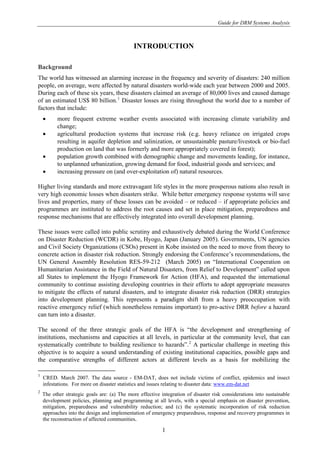
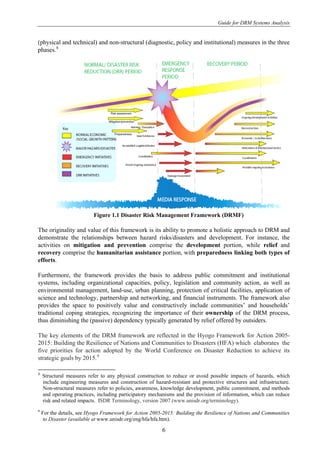
The Disaster Risk Management framework
The purpose of Disaster Risk Management is to reduce the underlying factors of risk and to prepare
for and initiate an immediate response should disaster hit. The Disaster Risk Management (DRM)
framework, illustrated in Figure 1.1, distinguishes, conceptually, the different phases of the DRM
cycle: pre-disaster, response and post-disaster.
DRM actions in the pre-disaster phase are aimed at strengthening the capacities and resilience of
households and communities to protect their lives and livelihoods, through measures to avoid
(prevention) or limit (mitigation) adverse effects of hazards and to provide timely and reliable hazard
forecasts. In the response phase, communities and relief agencies focus on saving lives and property.
In the post-disaster phase, the focus is on recovery and rehabilitation. In reality, the shift between
these phases is fluid, in particular, between the stages in which communities move from
rehabilitation to development, integrating aspects of hazard mitigation into their developmental
activities. The elements of the framework7
- further elaborated in Box 1.2 - include both structural
7
Disaster Risk Management Cycle (DRMC) Diagram (TorqAid; http://www.torqaid.com/default.asp).
5
Guide for DRM Systems Analysis
(physical and technical) and non-structural (diagnostic, policy and institutional) measures in the three
phases.8
Risk assessment
Mitigation/prevention
Preparedness
Risk assessment
Mitigation/prevention
Preparedness
Figure 1.1 Disaster Risk Management Framework (DRMF)
The originality and value of this framework is its ability to promote a holistic approach to DRM and
demonstrate the relationships between hazard risks/disasters and development. For instance, the
activities on mitigation and prevention comprise the development portion, while relief and
recovery comprise the humanitarian assistance portion, with preparedness linking both types of
efforts.
Furthermore, the framework provides the basis to address public commitment and institutional
systems, including organizational capacities, policy, legislation and community action, as well as
environmental management, land-use, urban planning, protection of critical facilities, application of
science and technology, partnership and networking, and financial instruments. The framework also
provides the space to positively value and constructively include communities’ and households’
traditional coping strategies, recognizing the importance of their ownership of the DRM process,
thus diminishing the (passive) dependency typically generated by relief offered by outsiders.
The key elements of the DRM framework are reflected in the Hyogo Framework for Action 2005-
2015: Building the Resilience of Nations and Communities to Disasters (HFA) which elaborates the
five priorities for action adopted by the World Conference on Disaster Reduction to achieve its
strategic goals by 2015.9
8
Structural measures refer to any physical construction to reduce or avoid possible impacts of hazards, which
include engineering measures and construction of hazard-resistant and protective structures and infrastructure.
Non-structural measures refer to policies, awareness, knowledge development, public commitment, and methods
and operating practices, including participatory mechanisms and the provision of information, which can reduce
risk and related impacts. ISDR Terminology, version 2007 (www.unisdr.org/terminology).
9
For the details, see Hyogo Framework for Action 2005-2015: Building the Resilience of Nations and Communities
to Disaster (available at www.unisdr.org/eng/hfa/hfa.htm).
6
Guide for DRM Systems Analysis
Ongoing assistance – Continued assistance until a certain level of recovery
Recovery - Actions taken after a disaster with a view to restoring infrastructure and services
Reconstruction - Actions taken after a disaster to ensure resettlement/relocation
Economic & social recovery – Measures taken to normalise the economy and societal living
Ongoing development activities – Continued actions of development programmes
Risk assessment - Diagnostic process to identify new risks that communities may again face
Post-disaster
Evacuation - temporary mass departure of people and property from threatened locations
Saving people and livelihoods – Protection of people and livelihoods during emergency
Immediate assistance – Provision of assistance during or immediately after disaster
Assessing damage and loss – Information about impact on assets and loss to production
Disaster response
Ongoing development activities – Ongoing DRM aspects in development programmes
Risk assessment – Diagnostic process to identify the risks that a community faces
Prevention - Activities to avoid the adverse impact of hazards
Mitigation – Structural/non-structural measures undertaken to limit the adverse impact
Preparedness - Activities and measures taken in advance to ensure effective response
Early warning - Provision of timely and effective information to avoid or reduce risk
Pre-disaster
Box 1.2 Elements of Disaster Risk Management (DRM) framework
The HFA priorities for action are to:
1. Ensure that disaster risk reduction is a national and a local priority with a strong institutional
basis for implementation.
2. Identify, assess and monitor disaster risks and enhance early warning.
3. Use knowledge, innovation and education to build a culture of safety and resilience at all
levels.
4. Reduce the underlying risk factors.
5. Strengthen disaster preparedness for effective response at all levels.
The HFA priorities for action are used in this Guide as the framework for organizing the major
findings of the DRM system analysis, identifying gaps and strengths and developing the
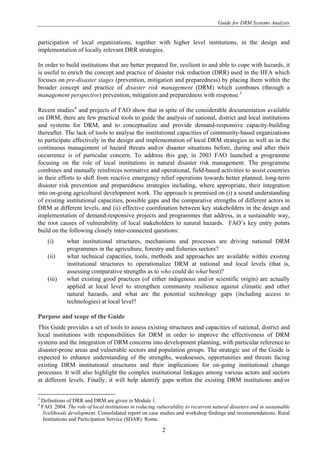
recommendations (see module 6). The expected outcome, strategic goals and priorities for action of
the HFA are presented in Figure 1.2. 10
Why is it important to analyze DRM systems?
The sound analysis of DRM systems will make a crucial contribution to assessing, and strengthening
the institutional capacities needed for achieving the HFA strategic goals and the five priorities for
action which are all closely linked to the broader context of sustainable development. The strengths
or weaknesses of existing DRM systems can favour or threaten development progress. The close link
between DRM and development and the integral role of DRM within development are illustrated by
the following examples:
10
Taken from UN/ISDR. 2007. Words into Action: a guide for implementing the Hyogo Framework. Geneva.
7
Guide for DRM Systems Analysis
Figure 1.2 Summary of the Hyogo Framework for Action 2005-2015: Building the resilience of nations and communities to disasters (HFA) (Source: UNISDR -
http://www.unisdr.org/eng/hfa/hfa.htm)
8
Guide for DRM Systems Analysis
• Natural disasters set back development gains: the destruction of infrastructure and erosion of
livelihoods are direct outcomes of disasters. Disasters cause significant pressures on national
and household budgets diverting investments aiming to reduce poverty and hunger and provide
access to basic services.
• Unsustainable development increases disaster risk: unplanned urbanization, environmental
degradation and inappropriate land use are key factors contributing to the increase in natural
hazards and loss of lives and assets when hazards turn into disasters. For example, the
destruction of forests can increase the risk of devastating mud slides during heavy rains and
storms.
• Disaster losses may be considerably reduced by integrating DRM practices in development
programmes: development policies and programmes can make a vital difference to reducing
vulnerability and risk by: a) strengthening institutions and mechanisms for DRM; b) assisting
vulnerable groups to build assets, diversify income-generating activities and strengthen
community-based self-help institutions; and c) adopting DRM practices and principles in
sectoral development and post-disaster rehabilitation plans.
• Special long-term interventions may be needed to increase the coping capacities of the poorest
and most vulnerable: while an entire community may be vulnerable to a particular hazard (e.g.
drought, flood, hurricane), the poorer population groups are likely to be at greater risk of the
hazard turning into a disaster. Their meagre assets, heavy dependence on their labour for
survival, limited opportunity for migration/evacuation and little or no access to insurance and
credit contribute to their vulnerability. Development policies and programmes that assist poor
men, women and youth to build livelihood assets, diversify income-generating activities,
improve human capacities (health, nutritional status, education, technical skills), and strengthen
community-based self-help organizations, can make a major contribution to reducing
vulnerability and risk, and improving the coping strategies of the poorest.
• Improved technologies can help prevent or mitigate damage caused by natural hazards:
various methods of water control, for example, can reduce the danger of flood damage, or help
humans, animals and plants survive drought. Improved crops varieties that are drought- or
flood-tolerant and/or disease- and pest-resistant can make the difference between crop failure
and an acceptable harvest. Improved or zero tillage methods and soil conservation techniques
can increase production in unfavourable agro-ecological areas, halting environmental
degradation and ensuring greater sustainability. Development programmes need to get these
DRM technologies into the hands of farmers in vulnerable communities.
• Disasters may become opportunities for building back better development practices: relief
associated with enhancing development in the post-disaster, recovery and rehabilitation periods,
has a strong multiplier effect. It represents the difference between giving a person a fish, and
teaching her/him how to fish. This means that s/he will be more independent and self-
sufficient in the future, and thus, in terms of the cyclical nature of the DRM framework, will be
better able to strengthen her/his resilience to future hazards.
Disaster risk, vulnerability and livelihoods
Disaster risk is usually described as a function of the hazard and the vulnerability context, including
the resilience (coping capacity) of the societal system under threat. Communities and households
may be exposed to different forms of vulnerability11
that include:
11
This list of different forms of vulnerability and the definitions given in Box 1.3 are taken from FAO. 2005. Rapid
guide for missions: Analysing local institutions and livelihoods, by A. Carloni., Rural Institutions and Participation
Service. Rome, page 3, box 3. While this DRM Guide focuses on vulnerability to natural hazards, in line with
9
Guide for DRM Systems Analysis
• Weather-related shocks and natural calamities: drought, earthquakes, hurricanes, tidal
waves, floods, heavy snow, early frost, extreme heat or cold waves
• Pest and disease epidemics: insect attacks, predators and diseases affecting crops, animals
and people
• Economic shocks: drastic changes in the national or local economy and its insertion in the
world economy, affecting prices, markets, employment and purchasing power
• Civil strife: war, armed conflict, failed states, displacement, destruction of lives and property
• Seasonal stresses: hungry season food insecurity
• Environmental stresses: land degradation, soil erosion, bush fires, pollution
• Idiosyncratic shocks: illness or death in family, job loss or theft of personal property
• Structural vulnerability: lack of voice or power to make claims
Vulnerability to the various types of natural hazards is not homogeneous across geographical areas or
within communities. Some communities and some households within given communities will be
more vulnerable than others.
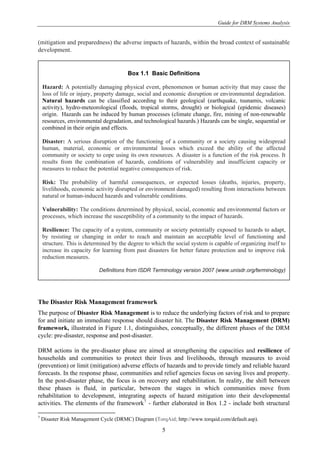
The Sustainable Livelihoods (SL) framework (Fig.1.3) provides an insightful analytical approach
to help identify which types of households are likely to be particularly vulnerable. This is
accomplished through the analysis of the inter-relationships between shocks, vulnerabilities and
households’ bundles of assets and coping strategies, within the context of on-going policy,
institutional and development processes. The SL framework puts households and their livelihoods at
the centre of analysis, assuming that they are continuously influenced by potential threats of shocks
and/or disasters.
Box 1.3 Definitions
A household is a group of people who eat from a common pot, and share a common stake in
perpetuating and improving their socio-economic status from one generation to the next.
A livelihood comprises the capabilities, assets (including both material and social resources) and
activities required for a means of living. A livelihood is sustainable when it can cope with and
recover from stresses and shocks and maintain its capabilities and assets both now and in the future,
while not undermining the natural resource base.
In the SL framework, vulnerabilities, of all kinds, and institutions form core parts of the overall
context within which development processes. The different bundles of assets of different households,
social groups and communities and the institutional contexts ultimately determine the capacities of
these households, social groups and communities to cope with disasters before, during and after their
occurrence.
The SL framework adapted to DRM, represents a cause-effect model for understanding the
situations that poor households face, depending on the relationships between household assets, the
vulnerability context and institutional processes which shape their lives. For instance, while some
hazards may affect all members of a community to a similar degree (e.g. a hurricane or heavy snow),
richer households with greater assets may have the means to adopt more effective coping strategies
that can prevent a hazard turning into a disaster. Furthermore, the framework’s focus on the
institutional context describes how effective community and higher level institutions can cushion the
effects of a disaster on poor households, mobilizing community or outside action for the benefit of
the most vulnerable.
FAO’s mandate, the assessment processes described could be adapted to the other types of vulnerability mentioned
in the bullet points. However, it should be stressed that this DRM Guide is not designed to assess institutional
structures underlying economic shocks, civil strife and seasonal stresses.
10
Guide for DRM Systems Analysis
Enabling
institutions,
laws and
policies
Natural
Hazards
& Shocks
Natural
Human
Financial
Physical
Social
Influence
Disabling
institutions,
laws and
policies
Strengthened
risk coping
& livelihood
strategies
Weakened
risk coping &
livelihood
strategies
Positive
DRM &
livelihood
outcomes
Negative
DRM and
livelihood
outcomes
Asset depletion, undermined coping strategies and livelihoods
Asset accumulation, , enhanced coping strategies & livelihoods
I
Im
mp
pa
ac
ct
ts
s
Increased exposure to disaster risk
R
Re
es
si
il
li
ie
en
nc
ce
e
Reduced exposure to disaster risk
HH -assets
Hazard Vulnerability context Coping strategies
Figure 1.3 Sustainable Livelihoods framework adapted to DRM
The important point is that the “capitals” are to some extent fungible. Thus, the rich pastoralist
household would be more resilient to disaster if it could draw on financial reserves to buy food and
restock, or enable educated/skilled household members to migrate temporarily for employment in
another area. The poor pastoralist household may have no assets other than its dead animals, and the
disaster could result in a huge and un-surmountable tragedy.
A livelihood perspective suggests that households with a larger bundle of assets will be more resilient
to a hazard than a relatively asset-less household. It is not just the amount of any one asset that
counts – for example, in the event of a livestock disease epidemic, a rich pastoralist household could
also lose its entire herd just as a poor household.
Box 1.4 Livelihoods and resilience
While the linkages between the DRM and the SL frameworks are complex, they highlight a number
of key factors that determine the degree of vulnerability of different socio-economic groups to
disaster situations, as evidenced by the following examples:
• Natural resources provide key livelihood assets and security, especially in rural areas
• Disasters reduce household livelihood assets to different degrees depending on the asset and
type of disaster and lead to livelihood insecurity (and may result in death or injury)
• Policies and institutions influence household livelihood assets positively or negatively
• Policies and institutions can increase or decrease vulnerability to disaster
11
Guide for DRM Systems Analysis
• Enabling institutions and diversified household assets widen livelihood options
• Asset ownership decreases vulnerability and increases ability to withstand disaster impacts
• Livelihood outcomes depend on policies, institutions, processes and livelihood strategies
• Livelihood outcomes influence the ability to preserve and accumulate household assets
Policies and institutions are thus key factors that influence access by different population groups to
assets and DRM technology, livelihood options and coping strategies as well as key services to
reduce the loss of lives and property in the aftermath of a disaster.
Box 1.5 Definition of institutions
The use of the term “institutions” in this Guide refers to rules and social norms as well as to the
organizations that facilitate the coordination of human action.
The two components of “institutions” are the “rules of the game” (norms, values, traditions and
legislation which determine how people are supposed to act/behave), and the “actors” (organizations)
and their capacities that operate according to these rules. Both dimensions need to be addressed in an
institutional analysis. Institutions include formal institutions and membership organizations:
Formal organizations - government institutes, organizations, bureaus, extension agencies
Formal membership organizations - cooperatives and registered groups
Informal organizations - exchange labour groups or rotating savings groups
Political institutions - parliament, law and order or political parties
Economic institutions - markets, private companies, banks, land rights or the tax system
Social-cultural institutions - kinship, marriage, inheritance, religion or draught oxen sharing
•
•
•
•
•
•
The crucial role of institutions
Institutions play a key role in operationalizing the different phases of the DRM framework and
mediating the link between development, DRM and humanitarian actions. Without institutions, there
would be no action and DRM would remain a concept on paper.
For example, during the mitigation/prevention phase, a variety of institutional actors including the
public sector technical ministries and agencies (e.g. agriculture, forestry, fisheries, health, education,
local government), international organizations, professional bodies, NGOs and other civil society
organizations, operate important programmes to build up livelihood assets, improve household
production and incomes, and enhance resilience and risk coping strategies. In the relief stage, for
instance, these various organizations focus on “save and rescue” operations, and meeting basic needs
such as shelter, food and water. In the rehabilitation stage, their aim is to prevent further erosion of
productive assets or coping strategies and to help households re-establish their livelihoods.
Specialized DRM focal point ministries/agencies are expected to play a vital role in coordinating
these many activities and ensuring their relevance to medium- and long-term development objectives
and activities. In this context, sound analyses and understanding of the role of formal and informal
organizations in natural DRM, their institutional and technical capacities (including strengths and
weaknesses), best operational and technical practices, and comparative strengths in coordinating and
promoting vertical and horizontal linkages are required. A particular challenge for governments and
development agencies is to build up strong local capacities, and mobilize public and private sector
and civil society organizations at different levels to participate actively, according to their
comparative advantages, in the design and implementation of locally relevant DRM strategies.
12
Guide for DRM Systems Analysis
MODULE 2
PLANNING AN INSTITUTIONAL ASSESSMENT OF DISASTER RISK
MANAGEMENT SYSTEMS
This module gives an overview of the interrelated steps of planning, conducting and analysing the
results of an institutional assessment of DRM systems. Complementary diagnostic studies at
national, provincial/district, and local levels to obtain the basic primary data for the assessment are
also discussed. The module suggests who should do what and where during the assessment process.
The proposed sequence should be followed in a flexible way and adapted to location- or study-
specific circumstances, as needed.
How to plan and organize the institutional assessment?
It is recommended that the institutional assessment be planned in three phases:
1. Getting started: the preparatory phase
(a) initial preparations and literature review
(b) inception meeting and field work planning meetings
2. Field work
(c) diagnostic study at the national level
(d) diagnostic study at the district level
(e) diagnostic study at the local level
(f) linkages and coordination among and between institutions
(g) sector-specific diagnosis
3. Data analysis, report writing and wrap-up meeting(s)
(h) data analysis and report writing
(i) wrap-up meetings with in-country stakeholders
(j) consolidating the final report
1. Getting started: the preparatory phase
(a) Initial preparations and literature review: Before starting the assessment it is essential that the
study team is familiar with the key concepts and terminology related to disaster risk management,
institutional development, and sustainable livelihoods (module 1). Other steps to be taken before data
collection in the field include:
o Desktop research on national hazard profiling
o Review of existing national (or relevant regional) risk and vulnerability maps
o Collection and review of background information on existing national DRM institutional
structures, mandates, policies, laws and disaster codes, DRM-related projects, relevant
agricultural sector strategies and programmes12
o Collection and review of studies on the socio-economic, cultural and traditional/
community-based institutional system(s) prevalent in the vulnerable areas, including
information on local disaster risk coping strategies13
o Collection of information on national, regional and local focal point organizations
12
An organigram of the national DRM institutional set-up is very useful for this purpose and may be requested from
the responsible national authority or downloaded from international institutions’ websites (UN/ISDR, World
Bank, UNDP).
13
These are often available from national and international NGOs with a strong field presence in areas chronically
exposed to natural hazards.
13
Guide for DRM Systems Analysis
o Collection and review of relevant corporate and regional/country strategy documents and
the main DRM-related programmes and projects of concerned international and national
development organizations and NGOs operating in the country
These activities may require three to five working days depending on the existing knowledge of the
assessment team and its working experience in DRM and institutional analysis. The most suitable
entry points to start the desk review are:
o The UNISDR website: www.unisdr.org/eng/country-inform/introduction.htm, which
provides basic data on country profiles, maps on disaster and hazard profiles, country
reports on DRM (not always up to date) and official contact points
o The International Disaster Database managed by CRED (www.em-dat.net)
o The websites of national DRM focal points and ministries
(b) Inception meeting and field work planning meetings: The first step is to organize an inception
meeting with the key government officials who are responsible for the overall coordination of the
country’s DRM systems as well as those officials with sectoral responsibilities for DRM. In
countries where coordination between the national authority for DRM and sectoral ministries/line
departments is still weak the presence of representatives of the latter institutions at the inception
meeting might help strengthen this coordination. Otherwise there may be a need for separate
meetings, particularly if the assessment has a sector-specific focus. The purpose of the inception
meeting is to:
o Obtain government support and commitment at the senior decision-making level
o Convey the government’s overall policy orientation/guidance for the assessment
o Agree on key issues to be addressed during the assessment process
o Agree on the disaster prone-areas to be covered by the assessment
The key participants in the inception meeting should include:
o The DRM focal points and/or officials with decision-making power related to DRM
policies, strategies and programmes (e.g. from the National Disaster Management Office,
Council and/or Bureau)
o Representatives of key INGOs and national NGOs/civil society organizations active in
DRM and, if appropriate, any relevant private sector organizations14
Representatives of the following organizations/agencies should be invited as appropriate:
o Ministry of Local Government, particularly units representing disaster-prone districts
o Ministries/technical departments of vulnerable sectors (e.g. agriculture, livestock,
fisheries, forestry, infrastructure/public works, water resources, health, education)
o Ministries of Planning and Finance (if appropriate)
o National research institutions (if appropriate)
o INGOs, NGOs/CSOs and Private sector organizations (if appropriate)
o UN/bilateral development and relief organizations (if appropriate)
The inception meeting should, inter alia, explicitly:
• Discuss the key features of the national hazard context and identify the major strengths and
weaknesses of the overall DRM policies and institutional structure that may require in-depth
analysis during the assessment
• Agree on the level of counterpart support and the names of counterpart officials from the
coordinating and sectoral ministries including their participation, if possible, in the field
work, and allocate financial resources/logistical support (e.g. transport) as needed
14
The IFRC (International Federation of Red Cross and Red Crescent Societies), for example, is a valuable source
of information and an experienced player in emergency preparedness and response in many countries.
14
Guide for DRM Systems Analysis
• Identify other key national/international governmental, inter-governmental or NGO/CSO
organizations involved in DRM at various levels
• Select the pilot disaster-prone provinces/districts/villages for the field studies
• Discuss other policy or resource-related topics, depending on the specific situation
Given the number of topics to cover, it would be helpful if the inception meeting could be scheduled
for half a day. Since it will not be possible to cover all these topics in sufficient depth in one session,
it will be necessary to schedule follow-up meetings with some of the participants to flesh out the
details, and to undertake the detailed planning for the field work. As the inception meeting proceeds,
it would be advisable for the chair/facilitator to set up one or more smaller technical group meetings
on specific topics, so as to be able to move forward on the main agenda. It may be useful to invite
representatives of international development and relief organizations to these meetings.
Field work planning meetings: Following the broad lines of agreement reached at the inception
meeting, it will be essential for the assessment team to hold a series of planning meetings with the
local counterparts and interpreters for the field work in order to:
• identify and select other field staff/assistants if necessary
• undertake the detailed planning of the field work programme and itinerary
• make logistical arrangement for the field visits
• agree on the participatory tools and methods to be used
• agree on and fine-tune the key questions and related indicators for the institutional
assessment at the national, district and local levels
It would also be useful to start planning how to undertake the data analysis and envisaging what
logistical/technical support might be needed.
2. Field work
(c) Diagnostic study at the national level: It is recommended that the first diagnostic study be
undertaken at the national level, as this will provide an understanding of the overall DRM
framework, policy objectives, technologies, institutional structures and existing DRM coordination
mechanisms before moving to decentralized levels, where the institutional structures and
coordinating mechanisms may be less developed or effective. A series of group-based brainstorming
sessions and interviews on the key issues should be planned and conducted at the national level with
representatives of the most relevant organizations identified at the inception meeting. If the
inception meeting concluded that particular sectors were especially vulnerable, the ministries and
departments responsible for these sectors are likely to be the key entry points for the assessment. The
detailed description about who should be contacted and what should be looked for is described in
module 3.
(d) Diagnostic study at the district level: Key informant interviews/brainstorming sessions/informal
meetings should be conducted at provincial/state/district level to explore key issues identified in the
inception meeting and other issues that might only emerge at this level. The purpose is to assess the
formal and informal institutional systems available at intermediary levels, their roles, strengths,
weaknesses and comparative advantages for implementing DRM programmes. The process should
contribute constructively to the selection of villages/communities to be visited during the local-level
diagnostic study. The detailed description about who should be contacted and what should be looked
for is presented in module 4.
(e) Diagnostic study at the local level: The fifth step during the assessment process involves
community-level field work in the selected villages identified through the national- and intermediary-
level consultations. This community-level study involves two steps:
15
Guide for DRM Systems Analysis
(i) community profiling
(ii) community-level institutional assessments.
The community profiling is an essential step before undertaking the local-level institutional
assessment as it provides a basic understanding of the study context, key socio-economic parameters
including production and livelihood systems, and the overall vulnerability characteristics of the
villages/communities and the specific hazards faced.
One-day field visits may be conducted in 3 to 5 villages depending on time availability. It is
important to decide in advance on the participatory methods and tools with which to start the study
and employ other participatory and rapid rural appraisal methods and tools depending on the need
and the information requirements. It is advisable not to ask the volunteers participating in the study
to devote more than half a day to these exercises and discussions, and to plan group and individual
sessions accordingly throughout the day. The more detailed description about who should be
contacted and what should be looked for is presented in module 5.
(f) Linkages and coordination among and between institutional levels: The issues of coordination,
communication and collaborative linkages between institutional levels constitute a crucial topic to be
addressed in the overall assessment. Key questions to identify strengths and weaknesses of vertical
and horizontal linkages and proposals for improvement should be incorporated into the studies at
each level.
A specific session to discuss these issues across levels and with a variety of key stakeholders is
essential. The best moment to call such a joint stakeholder meeting to discuss vertical and horizontal
coordination, communication flow and integration of DRM issues between levels, is once the raw
data from the individual levels have been screened and some hypotheses drawn to serve as a basis for
discussion. While the primary roles and functions that DRM organizations have or should have at the
national, district and community levels will be covered in more depth in modules 3-5, an example of
key roles and functions of each level are given in Table 2.1 in order to provide the basis for
comparing the complementary contributions of each level.
(g) Sector-specific diagnosis: Many DRM functions overlap/coincide with the mandates of sectoral
ministries or agencies. For instance, Ministries of Agriculture and/or Water Resources often address
DRM-related challenges such as sustainable water and soils management, and sustainable natural
resource management. It is therefore crucial that the assessment also takes account of these sectoral
ministries’ DRM-related mandates and programmes and the specific sectoral issues. These aspects
need to be carefully analyzed to understand how coordination mechanisms with the formal DRM
system are set up and function is equally important. By way of illustration, this Guide provides some
insights into the issues in the agricultural sector with a view to highlighting the disaster risks inherent
in agriculture, and the roles and contributions which agriculture should make to a fully functioning
DRM system. It is important to stress that a sector-specific diagnosis should be integrated with the
analyses of the national DRM system and institutional structures.
3. Data analysis, report writing and wrap-up meeting(s)
(h) Data analysis and report writing: A draft report dealing with the overall findings and
recommendations should be prepared for presentation during a wrap-up meeting with representatives
of the national government organizations, NGOs and donor organizations. One possible approach to
analysing, integrating and structuring the findings from the field studies is described in Module 6. At
least three to four days will be needed for the analysis and report-writing.
16
Guide for DRM Systems Analysis
Table 2.1 Primary roles and functions of various organizations15
at different levels by DRM elements (illustrative example)
Pre-disaster Disaster/emergency Post-disaster
Level Actors Prevention Mitigation Preparedness Response Recovery Development
International International
agencies
Raise awareness on
DRM
Ensure quality in donor
funded infrastructure
projects
Treat DRM as an
inclusive activity
Mobilize financial
aid as grants and
long-term loans
Fund Food For Work and
rehabilitation programmes
Mainstream DRM activities
in development planning
National National
government
Establish early-warning
systems, infrastructure,
legal and policy
framework for DRM
Promulgate
construction code and
safety regulations
Prepare national
disaster relief plan
Declare a disaster
and state of
emergency
Set up emergency and
recovery fund
Prepare Codes of Conduct in
relief and development.
Province/
district/
municipality
Provincial
government
Set local administration
rules;Provide incentives
for promotion of risk-
reducing technology
Promote multi-sectoral,
integrated approaches in
DRM
Provide agro-
ecological data for
national disaster
relief plan
Coordinate and
mediate actions
between national and
local levels
Implement Food For
Work or other
rehabilitation
programmes
Protect infrastructure;
promote risk-reducing
technologies
Technical line
agencies &
research
institutions
Develop risk reducing-
technologies
Test risk-reducing
technologies and sector-
specific forecast
systems
Prepare sectoral risk
management and
response plans
Assist in needs
assessment and
distribution of sector
specific inputs
Promote sector specific
recovery processes
Develop risk-reducing
technologies
Intermediary-level
NGOs
Provide training to local
NGOs
Undertake watershed/
river basin planning
Provide skills
training to local
NGOs
Mediate between
national & local level
Set up rehab. projects to
restore lost assets
Promote local institutional
development
Local government Develop local disaster
prevention plan
Undertake watershed/
river basin planning
Prepare evacuation
and contingency
plans
Provide shelter to
displaced households
Set up rehabilitation
projects for public goods
Prepare local risk maps and
disseminate information
Community Local leaders/
representatives
Plan/implement
awareness-raising
campaigns
Solicit external
technical assistance on
DRM
Carry out awareness-
raising campaigns
Act as advisory focal
points
Promote improved
technologies
Facilitate links and
coordination between
organizations
Local emergency
committees
Undertake hazard risk
diagnosis
Undertake household
vulnerability
assessments
Prepare evacuation
plans
Deploy search and
rescue teams
Deploy food aid
committees/teams
Advise how to reduce local
vulnerability
Local-level NGOs Provide training to local
CBOs
Undertake household
vulnerability
assessments
Conduct awareness
raising campaigns
Deploy trainers on
hygiene & health
Provide psychological
counselling & support
Define local priorities to
reduce vulnerability
Micro-financial
Intermediaries
Undertake hazard risk
diagnosis
Promote mitigation
practices
Spread risk across
portfolio
Undertake client
damage assessments
Arrange loan rescheduling
and other special activities
Integrate DRM in
development activities
Community- based
organizations
Undertake hazard risk
diagnosis
Maintain public
infrastructure
Construct infra-
structure to protect
property
Tap customary
solidarity networks
Mobilize communities for
joint action
Provide moral support and
advice
15
The roles and functions described in this table are only indicative.
17
Guide for DRM Systems Analysis
(i) Wrap-up meetings: A single or separate wrap-up meetings should be organized with the
intermediary- and national-level organizations to share the team’s indicative findings and to discuss
the implications of the findings and recommendations with national stakeholders. A separate wrap-up
meeting may also be held with national-level project partners and donor agency representatives. The
decision as to whether to hold joint or separate meetings with different stakeholder and interest
groups will need to be taken in the light of local circumstances and sensitivities.
(j) Consolidating the final report: Final meetings before completing the assessment report may be
required with the national DRM focal points to clarify facts and interpretations of the team’s findings
and the feasibility of the proposed recommendations.
In conclusion, the various steps outlined above are summarized in Box 2.1 in order to highlight the
logical sequence of these steps and the coherence of the approach.
18
Guide for DRM Systems Analysis
Box 2.1 Flow chart for a diagnostic study of DRM institutional systems
Step 4: Provincial/regional/district institutional profile
9 Hold meetings/brain storming sessions with administrative officials
9 Interview selected district government/county/municipality officials
9 Discuss with district NGOs / Civil society organizations
9 Interview cooperative society and agri-business consortium officials
9 Interview private sector staff (e.g. input suppliers, traders, transporters)
Step 5: Community profile and local institutions
9 Hold key informant interviews with local institutional representatives
9 Hold group meetings with community representatives, religious leaders,
farmers’/producers’ groups and associations
9 Conduct PRAs and focus group meetings in selected villages
9 Undertake community profiling and local institutional assessments
9 Assess opportunities to and constraints to proactive DRM
Step 1: Initial preparations and literature review
9 Collect and analyse information about the national hazard context and existing DRM systems
9 Identify key DRM project design/implementation questions and national, district and local focal points
9 Collect and review country strategy documents, mandates, policies, DRM project reports etc.
Step 6: Data analysis and draft reporting
9 Integrate and structure the findings
9 Assess disaster risk perception in different institutions and communities
9 Assess the relevance of on-going DRM initiatives for local communities
9 Evaluate existing DRM systems, structures, roles, and policies and their implications for different institutional
levels
9 Undertake gap analysis (institutional and technical ) to identify areas that need further attention
9 Assess the opportunities, limitations and constraints to establishing linkages within the agricultural sector
9 Assess the comparative operational and technical strengths in the different phases of DRM
9 Prepare a draft report dealing with the overall findings and preliminary recommendations
Step 7: Wrap-up meeting with in-country stakeholders and report finalization
9 Discuss findings, recommendations and implications
9 Identify and agree on future directions and the way forward
9 Review the requirements for implementing the follow up
9 Finalize the report and its recommendations
Step 3: National-level institutional profile
9 Hold separate brain storming meetings with DRM focal points
9 Interview representatives of relevant ministries and departments
9 Discuss with representatives of international and national NGOs
9 Interview representatives of national research and training institutes
Cross-cutting
Step
2:
Sector-specific
linkages
and
coordination
Assess
linkages
of
DRM
systems
with
sectors
(eg.
agriculture/livestock/fishery/water
resources/health
ministries
and
departments)
at
various
levels;
Assess
existing
operational
and
technical
practices
in
sector-specific
DRM
systems,
identify
institutions
that
are
best
placed
to
act
on
and
coordinate
specific
aspects
of
DRM
Cross-cutting
Step
1:
Assessing
horizontal
and
vertical
linkages
and
coordination
Assess
communication
mechanisms
and
channels,
DRM
planning
at
and
between
institutions,
flow
of
early
warning
messages,
technical
exchange
and
collaboration,
coordination
and
implementation
at
various
DRM
phases,
awareness-raising
strategies
Step 2: Inception meeting and field work planning meetings
9 Discuss the key features of the national hazard context
9 Agree on focal points at the national, district and local levels
9 Assess relevance of on-going DRM programmes
9 Select disaster-prone, vulnerable districts and villages for the field work
9 Identify key international, national organizations or NGOs/CSOs involved in
DRM at various levels
9 Plan for village visits and sequence of activities
9 Agree on counterpart and logistical support for the assessment
19
Guide for DRM Systems Analysis
MODULE 3
ASSESSMENT OF DISASTER RISK MANAGEMENT SYSTEMS AT THE
NATIONAL LEVEL
What is the role of national DRM institutions?
National DRM systems and institutions are the driving forces to plan, implement, monitor and
evaluate DRM processes and products within a country and to ensure coordination among all
stakeholders involved in any phase of DRM. In addition, they play a pivotal role in integrating DRM
efforts into development policies and programmes in order to reduce the vulnerability of rural
livelihoods to natural hazards. The national DRM institutions develop policy frameworks, disaster
management plans and codes of conduct in relief and development; they guide and assist in
developing early warning systems, and in declaring states/phases of emergency during disasters; and
they lead the communication with the general public and sectoral agencies at different levels.
The existence (as a basic requirement) and coordinating role of DRM institutions are essential,
though not sufficient, to ensure that DRM systems are functional and operational. Equally important
are the formal links with sectoral line agencies which have complementary sectoral responsibilities
for DRM, and thus need to integrate DRM aspects into their regular development work. Although
there is a growing emphasis on disaster risk reduction in most developing countries, the mandate of
the national DRM institutions usually focuses on coordination of and advocacy for prevention and
mitigation strategies. The ultimate implementation of prevention and mitigation actions and the direct
responsibility for the emergency response, however, remain the task of the sectoral line agencies.
Therefore, depending on the topical entry point of the assessment, relevant sectoral agencies should
be included in the analysis. Agriculture is used to illustrate sector-specific issues, questions, demands
and challenges in the context of DRM.
Why do institutional assessments at the national level?
The purpose of a national-level institutional assessment is to provide insights, guidance and check-
lists to assist DRM practitioners to:
• better understand the strengths and weaknesses of existing DRM policies, legal frameworks,
codes of conduct, institutional structures and the coordination mechanisms among them,
including national DRM focal point ministries, other concerned sectoral ministries, research
organizations and/or NGOs and CSOs;
• assess the availability, appropriateness and effectiveness of key DRM instruments, the degree
to which these are actually used/promoted by the institutions at the national level, and how
DRM programmes and services are communicated and promoted at decentralized levels;
• undertake more in-depth assessments of technical capacities in countries that are undergoing
processes of organizational restructuring to better support a shift from reactive emergency
relief operations towards long-term disaster risk prevention, mitigation and preparedness
strategies;
• contribute to the development of an effective and coherent national DRM policy in order to
guide the development of complementary district and local DRM strategies and plans; and
• identify the tangible institutional attributes (policies, organizational mandates and structures,
and the supporting instruments such as finance, logistical support, technologies) and intangible
attributes (attitudes, perceptions and underlying motivating factors) that determine the success
of DRM programmes.
20
Guide for DRM Systems Analysis
How to initiate the assessment?
The success of any institutional assessment depends on the “right” institutional entry point. Thus, it is
important at the outset to identify the national focal point which will host the assessment process and
the most relevant partner organizations. In most cases, the entry point is likely to be the National
Disaster Management Office (NDMO), if there is one, or the lead institution with the mandate for
DRM.16
The agency17
responsible for developing, interpreting and disseminating early warning
information must also be involved from the outset of the assessment. In a subsequent step, selected
sectoral ministries such as Ministries of Agriculture, Water, Environment or Health as well as
selected multi-sectoral ministries/agencies such as Ministries for Rural or Local Development,
Finance and Planning should be involved.
Box 3.1 How to select suitable institutional entry points
9 What are the scope, purpose and specific objectives of the assessment?
9 Does the assessment have a pre-determined hazard focus (e.g. hurricane preparedness or
drought mitigation)?
9 Has the assessment a sectoral focus? If the focus is still to be determined, which sector(s)
are of key relevance with regard to the objectives of the assessment?
9 Does the assessment have a pre-determined focus on certain phases of the DRM
framework? e.g. preparedness, mitigation, relief, reconstruction, rehabilitation,
mainstreaming etc.?
9 Which institutions have the mandates and/or responsibility for implementing the DRM
system, including overall coordination and sectoral responsibilities?
9 Which ministries/institutions and technical agencies are designated as national focal points
for aspects of DRM-related activities?
Other Ministries such as Labour and Social Welfare, the Interior, Public Works, Relief and
Rehabilitation, or Defence often provide focal point functions for DRM and should thus also be
consulted on selected aspects of DRM, as appropriate.
The institutional entry point will also depend on the specific purpose of the analysis and its relevance
to or focus on a particular sector. For instance, if there are key pre-determined elements relating to
emergency health issues, the Ministry of Health would be the ideal entry point.
Building on the outcome of the inception meeting (see Module 2), it will be necessary to deepen the
technical discussions with national-level DRM institutions. Three basic methodologies are
recommended for the initial assessment at national level:
•
•
Semi-structured interviews with selected key informants/key resource persons
Multi-stakeholder brainstorming sessions
16
The title of the focal point institution responsible for coordinating all DRM issues at national level varies from
country to country. Some commonly used titles include: the National Disaster Management Office (NDMO),
the National Disaster Management Authority (NDMA), the National Disaster Management Centre (NDMC), the
National Disaster Management Bureau (NDMB) or the National Emergency Management Agency (NDMA).
These offices/authorities are often hosted by the Ministry of Interior (or Home Affairs) although in some
countries other ministries perform this lead role such as the Ministry of Civil Defence, the Ministry of Disaster
Management or the Ministry of Relief and Rehabilitation. In other cases, the focal point unit reports directly to
the Head of Government.
17 In most countries National Meteorological Agencies (NMA) and National Hydro-Meteorological Services
(NHMS) are the focal points for all types of early warning systems and the dissemination of early warning
information and alerts.
21
Guide for DRM Systems Analysis
In-depth topical group discussions.
•
Usually group work produces more filtered, “socially controlled” and thus more neutral and broadly
accepted findings and recommendations. Individual interviews tend to provide more in-depth
insights and critical reflections, with the risk, however, of only reflecting one viewpoint. Therefore
triangulation in the use of the three methods is strongly recommended.
Before initiating any meetings, it is essential to prepare a detailed check-list of specific questions
applicable to the particular ministries/departments and line agencies. Given the great variety of
contexts and country-specific circumstances, this Guide does not prescribe a single method or
interview schedule but recommends the use/adaptation of the analytical categories, generic
questions and indicators presented in Tables 3.1 and 3.2 to identify situation-specific issues for
discussion and design appropriate interview guidelines and questions. Thus, these tables should
not be used as ready-prepared questionnaires.
The assessment team needs to bear in mind that key informants may have very limited time. The
team should therefore invite such busy informants only to those events and/or focus on those
questions most relevant to them. This is particularly important the higher the informants are
positioned within the national DRM system. A careful interim analysis of the national-level
findings is also crucial since these “set the scene” for the subsequent analysis of the DRM
organizational structures, institutional mechanisms and processes at the decentralized levels.
Specific issues to address at the national level
Table 3.1 provides a set of key issues regarding different aspects of organizational structures and
a checklist of institutional mechanisms to help guide the assessment of the national DRM
structures and their functioning. These broad issues can be complemented by sector-specific
issues, depending on the focus of the assessment. Examples from the agricultural sector are
given in Box 3.3.
Box 3.2 Steps for conducting data collection at the national level
The following steps for conducting the data collection at the national level are indicative, and should
be amended or sequenced differently according to specific situations.
1. Organize a joint brainstorming session with representatives of key national stakeholder
organizations, including government, research and training institutions, producer
organizations/cooperatives, and NGOs/CSOs to gain the “big picture” and assess the critical
issues, strengths and weaknesses, as well as areas of potentially conflicting information or
taboos. The card method is a useful tool in brainstorming sessions to collect initial perceptions.
Participants are asked to fill out cards (one idea per card) which are then arranged in categories
or groups of ideas on a board or table. A variant on this method would be to display Table 3.1
with the first column of the matrix filled out with the key questions, leaving the second and third
columns blank. The group would then fill in these two blank columns during a facilitated
brainstorming process which would attempt to address the issues in a structured way. This
exercise could, in this way, stimulate in-depth discussion and country-specific fine-tuning of the
matrix.
2. Analyse the outcome of the brainstorming session. Identify further information needs/gaps and
useful informants/stakeholders for individual follow-up meetings. The number of interviews will
depend on the time available for the assessment.
3. Conduct semi-structured interviews with selected DRM government officials and other relevant
stakeholders in order to gain a deeper understanding of some of the topics raised in the
brainstorming session.
4. Initiate as a final step and cross-checking mechanism a technical group discussion (2-3 hours)
with selected invitees, to try and resolve conflicts over perceived facts and widely divergent
viewpoints and fill the remaining information gaps. Such a meeting requires careful preparation;
the key issues to be discussed should be presented in the form of working hypotheses.
5. Throughout the process, cross-check or clarify facts, hypotheses and recommendations found in
key publications such as strategy documents, leaflets, pamphlets, annual reports, financial
statements or, if available, reports documenting experiences of and lessons learned from
previous disasters.
Keeping track of the information as the assessment proceeds
Table 3.2 complements Table 3.1 by adding a more specific set of DRM-related technical topics and
issues. However, its main purpose is to serve as an aide-mémoire for monitoring outcomes and
findings from the brainstorming sessions, group discussions and interviews, and identifying gaps for
future exploration and analysis. The Table should be filled in at the end of the national assessment.
Similar tables should also be filled out after completing the district- and community-level
assessments (see modules 4 and 5). All three tables will serve as valuable inputs to the overall
analysis and formulation of recommendations (see module 6).
22
Guide for DRM Systems Analysis
Table 3.1 Key generic issues on national institutional capacity for DRM
Key issues Related organizational
structures “where to look”
Indicators and/or relevant
institutional mechanisms or processes
What are the
existing DRM
policies and legal
frameworks?
• Specialized DRM Ministry
• Intergovernmental
Committee on Disaster
Management
• National Disaster
Management Advisory
Board/Forum
• National Disaster
Management Office
• National Platform for
Disaster Risk Management
• National Disaster
Management
Council/Committee
• Sectoral government
agencies
• Formal DRM legal framework, related acts or
government decrees, disaster codes, safety
standards, standing orders for DRM/DRR and/or
emergency response
• DRM national policy frameworks, vision or
strategy documents
• Sectoral DRM mandates specified; sectoral DRM
policy papers/strategies in place
• A national DRM implementation strategy (such as
DRM cycle management) and/or plan of action
exists
• Plan of action for emergency response and/or plan
of action for DRM are available/regularly updated
• Formal guidelines with criteria and triggers to
declare emergency situations exist
• Formal guidelines exist to promote community
drills and simulation exercises
What
organizational
structures are
currently in place
to implement DRM
throughout the
country?
• National Disaster
Management Committees
and Operations Centres
• National Disaster
Management Office
• National Early Warning
(EW) Agency
• Meteorological/Hydrometeor
ological Service
• Sectoral line agencies
involved in DRM
• DRM training centres
• Research institutions
• National civil protection
• INGOs, NGOs and CSOs
• DRR/DRM operations and training centres in place
• Multidisciplinary strategic management task force
for disaster management (also DRR) in place at all
/some levels
• Multidisciplinary task force for disaster response
mandated and in place
• DRM frameworks mainstreamed in the line
ministry’s activities, task forces in place
• National EW and emergency communication
systems in place
• Rescue teams in place
• Roles and responsibilities of INGOs, NGOs and
CSOs in DRM and emergency response defined
What are the
operational
capacities of the
formal DRM
system (during
different phases of
the DRM process)?
• National Disaster
Management Office
• Sectoral line ministries
• Comprehensive Disaster
Management Programme (if
any)
• National Meteorological and
Hydrometeorological
agencies
• Disaster Management
Coordination Centres
• National level specialized
DRM groups or task force
• Government, INGO, NGO
training centres
• UN agencies and national
platforms
• INGOs, NGOs and CSOs
• Size of budget and number of people formally
employed in DRM at the different levels
• Frequency and timing (within DRM cycle) of
meetings of the key National Disaster Management
bodies
• National training programmes and training centres
for DRM (operational budgets and staffing levels)
exist
• Training materials available in local language(s)
• EWS in place (and operational at which levels?)
• Response operation centres properly equipped for
emergency
• Centres and/or task forces (TFs) have clearly
written mandates and responsibilities
• DRM task forces exist in sectoral line agencies
• TF managers at all levels know content of DRM
policies, standing orders and responsibilities
• A formal communication centre exists and
provides information & exchange
• EW messages reach local DRM teams/populations
• DRM info/materials available and disseminated
• Organization of test/mock exercises
23
Guide for DRM Systems Analysis
Key issues Related organizational Indicators and/or relevant
structures “where to look” institutional mechanisms or processes
• Trained people available for emergency needs
assessment
What are the
coordination
mechanisms within
the national DRM
system? What are
the roles and
responsibilities of
sectoral line
agencies, NGOs
and the private
sector for DRM?
• Sectoral line
ministries/agencies
• Interdisciplinary disaster
management advisory
forum/groups at various
levels
• Coordination
committees/groups
• INGOs, NGOs and CSOs
• ISDR national platform
• Mandates and responsibilities for all types of key
stakeholders /organizations for DRM defined
• Integrated, cross-sectoral DRM plans at various
levels exist
• Sectoral DRM action plans make reference to other
sectors
• Institutionalized linkages/MoUs between
government agencies, research and training
institutions, and NGOs exist
• Existence of DRM core groups/task forces in line
agencies
• Regular meetings of DRM coordination
committees
• Work plan for DRM committee in place
• Job descriptions include DRM-related tasks
What are the
mechanisms for
regional and
international co-
operation on DRM
and/or emergency
response?
• National DRM organization
or decision-making body
• National platform
• UN System Coordinator
• ISDR platform
• IFRC
• Country participates in/leads regional DRM
programmes
• Study tours and exchanges with other countries
• On-going international programmes on DRM
• Investment projects with risk reduction
components
• Established linkages with the UN ISDR system
• Flash appeals submitted to donor countries
• Regional agreements for DRM standardization,
planning and implementation (“fire” management)
• National emergency coordination committee/
unit/centre coordinates national/ international
emergency assistance
What resources are
allocated for
DRM?
• National budget allocation
mechanism
• Administrative and finance
section responsible for DRM
• DRM thematic projects and
budgets
• Sector-specific projects and
budgets
• Humanitarian assistance
projects of donor agencies,
INGOs, NGOs
• DRM institutions receive finance for regular
operation and maintenance
• DRM institutions implement donor-funded projects
• Budgets are committed to key activities under the
DRM national action plan
• Development programmes with DRM components
exist
• Size of budget and number of people formally
employed in DRM at the different levels
Is there a link
between DRM and
development
planning?
• Integrated DRM/emergency
coordination groups
• Sectoral development line
agencies
• NGOs
• Country or trust fund
programmes/projects
• Institutional arrangements have been transformed
from emergency response to also include DRM
• Development programmes with a DRM
component/element exist
24
Guide for DRM Systems Analysis
Interim study “products” at the national level
Interim “products” to be obtained from the national-level study as inputs for the overall assessment
include:
Box 3.3 Examples of agricultural sector-specific issues at the national level
Crop agriculture
• History of disaster impacts, estimates of crop damage and loss
• DRM activities carried out by the Ministry and/or Department of Agriculture or relevant
agencies, with adequate financial resources
• Government policy on food security, crop production and diversification, crop protection,
horticultural development, and DRM in the agricultural sector.
• Formal institutions/NGOs/civil society at the national level involved in specific activities in
promoting DRM in the agricultural sector
• Public sector DRM institutions/NGOs involved in interpreting EWS messages and
communicating these to the farmers
• Details of DRM planning, contingency crop planning, relief and rehabilitation plans, the main
actors, gaps, constraints and integration of mitigation/preparedness components into DRM
planning in the agricultural sector
o Contingency crop plans – drought, flood, saline-tolerant crop varieties, famine reserve
crops
o Rain water harvesting systems – watershed management, farm ponds, canal re-excavation
o Crop diversification, alternate enterprises, mixed, integrated farming systems etc.
o Soil reclamation, drainage systems, erosion control structures etc.
o Weather/climate forecast, responsive alternate management strategies
o Communication of short-, medium- and long-lead forecasts to farmers
o Innovative post-harvest operations, seed banks
o Integrated pest and disease management practices
o Tank rehabilitation, flood proofing, embankments etc.
• Integration of livelihood development strategies into DRM planning for agriculture
• Challenges or constraints in implementing DRM programmes and projects in the agricultural
sector
• Technical capacity of specialized core groups, DRM focal points in the Ministry and/or
Department of Agriculture and/or extension unit (training attended, experience etc.)
Livestock
• Disasters affecting livestock and estimates of damage and loss
• DRM activities carried out by livestock institutions
• Government policy for the animal husbandry sector and its relevance to DRM
• Formal institutions/NGOs at the national level involved in DRM
• Status of integration of disaster mitigation/preparedness concerns into DRM planning in the
livestock sector
• Contingency plan – fodder provision, fodder banks, livestock shelter, vaccination centres,
community poultry hatching centres
• Challenges or constraints in implementing DRM programmes and projects in the livestock
sector
S h d k i i i i l d h i l i d h d f ff i
9 National hazard profile
9 Multi-hazard vulnerability map
9 Summary chart of the different organizations involved in DRM at the national level,
indicating briefly their different mandates, roles and responsibilities
9 Strengths and weaknesses diagram (SWOT chart) of the national-level DRM system
9 Filled-in monitoring sheet
25
Guide for DRM Systems Analysis
Table 3.2 Monitoring sheet of key processes in DRM systems at the national level
Status
19
Name of institutions involved
with
Measures & capacities for
implementation20
Key processes
and instruments
(related to the
DRM framework)
Indicators18
Availab
i-lity
Lead
responsibility
Support
role
Staff Techn.
skills
financial
resources
Remarks
• Guidelines for undertaking a disaster risk assessment available
• Disaster risk assessment methods and approaches agreed/standardized
• Assessment of past experiences/lessons learned in applying risk assessment
tools available
• Responsibilities and roles of the organizations responsible for risk assessment
defined and operational
• National-level hazard-specific and multi-hazard risk and vulnerability maps
drawn up
• Measures in place to check accuracy of disaster risk assessments
• Procedures for consolidation, classification and analysis of disaster risk
information established, with criteria for levels of alert
1. Disaster risk
assessment
• National disaster risk profiles across sectors consolidated/disseminated
• Comprehensive national (i.e. country-wide) DRM plan addressing specific and
multiple vulnerabilities and risks
• Major national/sub-national disaster risks and risk areas defined
• Representatives of the most at-risk groups consulted in the planning process
• Vulnerability maps exist addressing single and multiple vulnerabilities
• Indicators defined for monitoring the implementation of the DRM plan and
assessing the effectiveness of the different components
• Existence of DRR and/or DRM projects and programmes
• Mechanisms and responsibilities for planning,, monitoring and updating early
warning and disaster risk information defined
2. Disaster risk
management
planning and
monitoring
• Risk prevention and mitigation aspects (building back better) included in
recovery and rehabilitation projects/plans
• Assessments of past experiences of disaster mitigation actions disseminated
3. Disaster
mitigation and
prevention
• Mandates and responsibilities of sectoral agencies for prevention specified in
existing development and/or DRM plans
18
Indicators help to identify the institutions with specialized institutional and technical capacity in each element of the DRM framework and to identify future opportunities for intervention
19
Proposed assessment categories: NE - Non existent; ENO: existent but non operational; O: operational
20
Proposed assessment categories: G: Good; S: Satisfactory; I: Inadequate
26
Guide for DRM Systems Analysis
Status
19
Name of institutions involved
with
Measures & capacities for
implementation20
Key processes Indicators18
and instruments
(related to the
DRM framework) Availab
i-lity
Lead
responsibility
Support
role
Staff Techn.
skills
financial Remarks
resources
• Funding mechanisms and resources available for prevention / mitigation
• Prevention and mitigation technologies and standards exist at national level and
applied/reinforced through sectoral line agencies
• Knowledge within lead agencies about available prevention and mitigation
technologies or where to access them
• DRM elements incorporated into on-going development programmes and sectoral
action plans
• Prioritization of DRM activities within development programmes, and allocation
of adequate funding and human resources
• DRM incorporated into sectoral development plans (e.g. agriculture, including
dissemination of technologies to reduce impact of natural hazards such as water
control, soil management, environmentally sustainable cultivation practices)
4. Mainstreaming
DRM into
development
planning
• Mechanisms for scaling up good practices and lessons learned
• Mechanisms for risk assessments, incorporation of early warning
information/alerts and communication of the risk to districts
• Mechanisms to communicate the above risk information to relevant
ministries/departments
5. Awareness
raising and
dissemination
of risk
information
• Mechanisms to disseminate risk information rapidly to the public through mass
media, local alert systems, with support from specialized agencies and
information networks
• Country’s national early warning focal point/institutions established, with
adequate budgets and human resources
• Mechanism to link with international Early Warning Systems exist
• Mechanism to link with sectoral ministries, departments and emergency centres,
• Mechanism to ensure rapid dissemination of early warning information
throughout the country at district and local levels exist
• Sector-specific impact warning systems, indicators and alert criteria, and
risk/disaster management plans prepared
6. National early
warning
systems
• Mechanisms to translate early warning information into local languages exist
• National-level DRM plans foresee and mandate concrete preparedness activities
by hazard type
• Sector-specific preparedness plans in place
7. Preparedness
• Directory available of the names, contact addresses and phone numbers, roles and
responsibilities of all key national players
27
Guide for DRM Systems Analysis
Status
19
Name of institutions involved
with
Measures & capacities for
implementation20
Key processes Indicators18
and instruments
(related to the
DRM framework) Availab
i-lity
Lead
responsibility
Support
role
Staff Techn.
skills
financial Remarks
resources
• Resources and relief assistance/technical support that can be quickly mobilized
(national, international, regional, NGO agencies) identified and listed with contact
points and contact details
• Rescue organizations established and equipped with infrastructure and equipment
to save lives and property
• Shelters, high grounds and facilities to protect lives and livelihood assets
available (in collaboration with district/local level officials)
• Functionality of warehouses and emergency food storage facilities checked
• Basic stocks of relief materials (drinking water, foods tents and blankets)
permanently available in hazard-prone districts (centrally monitored & equipped)
• Logistical arrangements planned – transport, fuel, water etc
• Emergency health teams defined and ready
• Relief provision standards exist for most vulnerable people (children, elderly,
disabled, women, the very poor)
• Criteria for different levels of alert and for evacuation established
• Procedures/criteria to identify evacuation routes (in collaboration with
district/local- level officials) established
• Practice evacuation exercises carried out and procedures agreed
• Emergency communication systems at different levels to ensure rapid evacuation
(pre- and post-disaster) and/or relief, as needed, in place
• Hazard monitoring system installed/implemented to ensure rapid response
(evacuation, relief, as needed)
• Reliable alarm system in place to alert concerned officials to initiate emergency
response and further evacuation as needed
• Relevant service providers and recovery operations mandated and linked through
EW/information network
• Coordination committee/senior official of the national coordinating authority and
relevant sectoral ministries nominated to form emergency committee when
needed
8. Providing
immediate
response and/or
relief assistance
• High level of government assisted in past emergency situations to solve problems,
ensure adequate funding and logistical support
• Declaration of emergency status exists as basis for calling for
international/regional relief and technical assistance (UN, governments, INGOs)
28
Guide for DRM Systems Analysis
Status
19
Name of institutions involved
with
Measures & capacities for
implementation20
Key processes Indicators18
and instruments
(related to the
DRM framework) Availab
i-lity
Lead
responsibility
Support
role
Staff Techn.
skills
financial Remarks
resources
• Monitoring of relief/assistance operations to ensure the aid reaches those in need
and prevent diversion of aid to others
• Instruments, standards and processes for impact/damage/loss assessment, and
needs for food, shelter, water, medicines, hospitalization etc. established
• Sectoral and cross-sectoral teams designated and trained
9. Assessing
damage and
loss
• Standardized reporting formats and analysis methods in place
• Mechanisms exist and responsibilities defined for the design of integrated
response and recovery measures/plans
• Coordination mechanisms for national/international response and recovery
efforts established/operational
• Arrangements for repair/reconstruction of infrastructure (e.g. roads, bridges
wells, schools and other key buildings) and services (e.g. health, education,
agricultural extension and provision of inputs) in place
• Guidelines exist for “building back better”
• Criteria for selection of people to be resettled/analysis of their skills and
opportunities for gainful employment established
• Assessments and information on transient livelihood options for those displaced
temporarily or on a long-term basis available
• National emergency and reconstruction fund exists
10.Reconstruction
of settlements,
infrastructure,
and services
• Standards/criteria to decide length of emergency assistance exist
• Mechanism to prepare plans for rehabilitation and economic recovery exist
• National funding mechanisms promoting rehabilitation exist
• Evidence of provision of key production inputs needed for livelihood recovery
e.g. fishing boats and equipment, farming implements, seeds and fertilizers
• Role of micro-financing institutions in rehabilitation defined
• Plans to re-build area-specific livelihoods in rehabilitation programmes exist
• Guidelines for local institutions and informal groups to help affected communities
exist
11.Rehabilitation,
economic and
social recovery
• DRM elements incorporated into livelihood restoration/development programmes
to build resilience to future hazards
29
Guide for DRM Systems Analysis
MODULE 4
ASSESSMENT OF DISASTER RISK MANAGEMENT SYSTEMS AT THE
DISTRICT LEVEL
What is the role of district-level DRM institutions?
District-level21
institutions play a major role in coordinating and mediating actions between the
national and local levels. In addition to their responsibilities for local administration, these
institutions generally implement disaster mitigation, preparedness, response, recovery and livelihood
development programmes and projects, some of which may be planned and supervised by national
institutions. In particular, district-level DRM institutions are often responsible for preparing risk
maps and vulnerability profiles, developing and implementing contingency plans, supplying essential
inputs, proposing and supporting livelihood diversification, disseminating early warning messages,
preparing immediate needs assessments and providing relief.
Why do institutional assessments at the district level?
The purpose of an institutional assessment at the district level is to:
• identify the strengths and weaknesses of the intermediary-level institutions within the
country’s DRM system, with particular attention to the effective design and implementation
of locally relevant DRM practices;
• identify specific gaps in institutional structures, roles and capacities in order to design
measures to strengthen the existing DRM system at the provincial/district/municipality level,
improve linkages with vulnerable sectors (e.g. agriculture, water resources and health), and
reinforce vertical and horizontal coordination among different actors;
• analyse the different (and sometimes conflicting) interests and perceptions regarding DRM of
all players, including government officials, politicians, elected council representatives,
traditional leaders, private sector entrepreneurs, NGOs and civil society organizations; and
• identify the tangible institutional attributes (policies, organizational mandates and structures),
supporting instruments (such as finance, logistical support and technologies) and intangible
attributes (attitudes, perceptions and underlying motivating factors) that determine the
success of DRM programmes at district level.
How to initiate the assessment?
The assessment process at the district level should start by deciding on whom to contact. The
indicative contacts for collecting relevant information are:
9 Representatives of the district focal point agency for DRM and members of the district and sub-
district DRM committees;
9 District-level sectoral department heads and/or their representatives (e.g. agriculture, water
resources, health, education and public works departments);
9 Representatives of district-level extension, research and training institutions;
21
The term “district” is used to refer to the operationally most important (from a local perspective) intermediary
institutional layer between the national and local levels. Most often this is the “district” level. However,
depending on the specific country context, it may also be the “province”, “state”, or “municipality”. In countries
with separate state or provincial governments, methods discussed in module 3 for the national-level assessment
may also be applicable.
30
Guide for DRM Systems Analysis
9 Professional staff in relevant district-level development projects;
9 Representatives of NGOs and CSOs;
9 District-level representatives of producer organizations, cooperatives and financial institutions;
and
9 Private sector produce traders, input suppliers, media and transporters.
The following steps may be useful in assessing provincial-, district- or municipal-level DRM
institutions. Since there is usually a wide range of stakeholders involved in DRM at the district level,
a series of well prepared semi-structured interviews with either groups or representatives of different
stakeholder agencies is an effective way of capturing in depth and possibly diverse opinions and
insights. An important aim of the analysis is to compare the perspectives of the different
stakeholders. The organizational steps proposed in Box 4.1 are only indicative and may need to be
adapted to different situations.
o Hold a group meeting with key stakeholders to (i) obtain their support and commitment; (ii)
identify the key elements of the district-level DRM strategy; and (iii) agree on the main issues to
be addressed at the district level.
o Building on the outcome of this meeting, prepare check lists of questions and tools applicable to
the different district-level institutions, using as resource materials the questions/issues given in
Tables 4.1 and 4.2. Sector-specific questions should also be prepared as appropriate (see, for
example, the questions related to the agricultural sector given in Box 4.2). Conduct a series of
interviews/group meetings with selected stakeholders using these questions and tools.
o If major issues of concern or controversy emerge during this process, the assessment team will
need to call and moderate a technical meeting with the interested and concerned parties in order
to seek clarifications of facts and the rationales of the various standpoints.
o Before holding a final stakeholder wrap-up meeting (i) prepare a summary chart of the different
organizations involved in DRM at the district level, indicating briefly their different mandates,
roles and responsibilities and the nature of the coordinating mechanism; and (ii) a visual
presentation that summarizes the study’s findings regarding the strengths and weaknesses of the
existing institutional systems, including coordinating mechanisms, available resources, staffing
levels and expertise, and opportunities for improvement.
Present your draft findings for review and comments at a wrap-up meeting with key stakeholders to
gain verification or correction of your interim findings and conclusions.
Box 4.1 Steps for conducting data collection at the district level
Announce your mission in time including a request for a stakeholder meeting early on. Upon arrival
make an initial courtesy visit to the head of the local DRM focal point agency to provide a short
briefing and invite the agency’s assistance.
Specific issues to address at the district level
(a) Understanding the district hazard and vulnerability profile. This would include a clear
understanding of the types of hazards and disasters undermining development and livelihood
security, and the frequency and seasonality of occurrence. District risk and vulnerability maps as well
as Agro-Ecological Zone (AEZ) maps or seasonal hazard calendars, if available, are ideal tools for
this purpose. It is also crucial to understand the predominant socio-economic patterns, natural
resource endowments, livelihood activities and the location and risk profiles of the most vulnerable
groups (or sectors), and to link this information to the hazard exposure maps. The criteria used for
defining hazard risks and vulnerability at district level will need to take into account the socio-
31
Guide for DRM Systems Analysis
economic and institutional factors increasing vulnerability to hazards. Information about the impacts
of past disasters, responses taken and lessons learned is equally important.
(b) Analysing the institutional set-up, its effectiveness and the horizontal/vertical coordination
mechanisms for DRM. The team members need to understand precisely who the key actors are for
DRM at the district level. They also need to know which technologies, tools and methods, rules and
regulations (decrees, standards, laws and standing orders) and human resources are available for risk
and vulnerability analysis, risk prevention and impact mitigation, early warning, contingency
planning, risk management planning and emergency response. It is imperative to understand if and
how the responsibilities for all these tasks are shared and coordinated both horizontally and
vertically. An assessment of the district-level financial mechanisms and budget levels for DRM is
also crucial.
(c) Assessing the mechanisms for reaching vulnerable communities and households and the
linkages to the community and the national levels. As the district serves as an intermediary
between the national and community levels, it is important to assess the effectiveness and
appropriateness of its roles and responsibilities in this regard. Key issues to check include, for
instance, the existence of specific modalities, guidelines, norms and policies at the district level to
translate national DRM policies into district-specific plans or strategies. The quality of plans and
strategies developed at the district level could be a good indicator of district-level technical
capacities. The district-level knowledge of the vulnerability characteristics of the different socio-
economic categories of the population in the district, and existing plans or mechanisms to assist
them, are also valid indicators of a responsible district-level role in DRM. The existence of district
policies to promote Community-based Disaster Risk Management (CBDRM) could also serve as an
indicator of the effectiveness of the district in fulfilling its intermediary role. Finally, it is crucial to
understand which functions the district- level agencies and organizations actually fulfil and what
resources and equipment are available for them in emergency situations either to act as
intermediaries between the national- and local-level DRM mechanisms or even to play the
coordinating role.
Keeping track of the information as the assessment proceeds
Table 4.2, which serves as an aide-mémoire for monitoring outcomes and findings from the
brainstorming sessions, group discussions and interviews, and identifying gaps for future exploration
and analysis, should be filled in at the end of the district-level assessment. Together with the similar
tables filled out after completing the national- and community-level assessments (see modules 3 and
5), the Table will provide valuable inputs to the overall analysis and formulation of recommendations
(see module 6).
32
Guide for DRM Systems Analysis
Table 4.1 Selected key questions for district officials, NGOs, CSOs/CBOs, local leaders and the private sector
District officials NGOs and civil society organizations (CSO) Local leaders
(elected and traditional)
Private sector representatives
• What DRM activities are carried out by which type of
district level institutions (e.g. prevention, mitigation,
preparedness, response, recovery and reconstruction)?
• Are there sectoral or cross-sectoral DRM and/or
contingency plans available?
• What challenges does your organization face in
implementing DRM programmes? What obstacles
undermine effective functions?
• What are the DRM priorities at the district level?
• Which institutions (if any) provide DRM training at
district level? How relevant and effective is the training,
and how could it be improved?
• What aspects of institutional strengthening do you see as
most important for DRM at the district level?
• How does the district mobilize resources for DRM? e.g.
national or district sources, local taxes, donors/relief
agencies, others? What sort of problems (if any) are
encountered in obtaining adequate funding, and how could
these be solved/reduced?
• What technical, financial and logistical support does the
district receive from the national level? How effective is
vertical and horizontal coordination?
• What are the sources of early warning (EW) messages at
the district level? Are they generated at the national or
district level? How can the EW system be improved? Who
is responsible for interpreting and communicating EW
messages, or giving the alert in case of an emergency?
• How can the most vulnerable be reached? Are
participatory approaches applied by your organization in
poverty alleviation and/or DRM?
• What DRM activities are carried out by
NGOs and CSOs? e.g. prevention,
mitigation, preparedness, response,
recovery and reconstruction, CBDRM?
• What is the role of NGOs/CSOs in DRM
decision-making/planning bodies? Do they
participate in district DRM committees or
have active roles in implementing
government-led DRM plans?
• What are the DRM priorities at the district
level from NGO and CSO perspectives?
• Which rural/urban groups are the most
vulnerable; how can they be best reached?
• Are there any DRM coordination
mechanisms operating among the NGOs
and CSOs involved in DRM? How effective
are these mechanisms as well as their
relations with the public sector DRM
organizations, and how could they be
improved?
• What is your opinion about the performance
of Govt systems in implementing DRM?
• What are the sources of NGO and CSO
funding for DRM activities? How adequate
are these? How could they be increased?
• In which respects and how could the
services of NGOs and CSOs for DRM be
further strengthened?
• What types of local
leadership exist at district
level and what are their
roles in DRM?
• What are the DRM
priorities at district level?
• Which urban/rural
population groups are the
most vulnerable? Why?
• Do local leaders have
any comparative
advantages in
implementing DRM
programmes compared
with Government
organizations, NGOs and
CSOs?
• What is your opinion
about the performance of
government and NGO
and CSO organizations
in implementing DRM
programmes?
• How do locally elected
bodies coordinate/
interact with DRM
activities undertaken by
government agencies,
NGOs and CSOs?
• Does the private sector participate
in the District DRM Committee?
• What is the role of private sector
organizations in DRM ? examples
: prevention/mitigation (e.g,
diversify livelihoods through
markets, input supply and
services,
telephones/communications);
preparedness ( gathering
information for EW systems,
stocking food and production
inputs etc); response, and the
recovery/rehabilitation phases
(stocking/quick procurement and
delivery of food, seeds,
agricultural and fishing
equipment, veterinary products);
reconstruction (roads, bridges,
shelter, market facilities, transport
systems, stores, schools, health
centres etc)?
• Does the government provide
contracts to the private sector for
reconstruction? What are the pros
and cons?
• Are there problems in acquiring
the materials for reconstruction?
How can they be solved?
• Does the private sector provide
financial instruments for risk
management or lend money/goods
and at what interest rates?
33
Guide for DRM Systems Analysis
Interim study “products” at the district level
Interim “products” to be obtained from the district-level study as inputs for the overall assessment
include:
Box. 4.2 List of issues in the agricultural sector at the district level
Vulnerability context
• Agro-ecological/geographical areas at risk, history of impacts, damage and loss estimates;
• Livelihood groups at risk (farmers, livestock herders, fisherfolk, rural poor, indigenous
peoples, women, children, elderly, disabled)
• Sub-sectors most at risk (e.g. crop agriculture, fishing, pastoralism)
• Risk maps pertaining to agriculture and allied sector
DRM plans, activities and technical capacity in agriculture
• DRM activities carried out in agriculture and allied sectors
• Formal agricultural extension, livestock and fishery departments’ involvement in DRM
activities
• Preparation of early warning messages, forecast bulletins and impact outlooks for farmers,
livestock herders and fisherfolk
• Existence of contingency plans in agriculture and allied sector agencies
• Examples of integration of DRM activities in district agriculture and allied sector plans
• Livelihood development strategies in agriculture and allied sectors
• Role of vulnerable groups in preparing agricultural sector DRM plan
• Challenges and constraints faced by agricultural sector agencies in implementing DRM
programmes
• Types of institutional strengthening within agricultural sector agencies considered most
important for effective overall DRM programme implementation
• Involvement in DRM of agri-business consortiums, seed producers’ associations, growers’
associations, water users’ associations, irrigators’ groups
• Existence of formal infrastructural facilities related to DRM in agriculture
coordinated/supported from the district level such as
o Crop agriculture: warehouse, seed storage, community threshing floor, community nursery,
village water storage structures, percolation ponds, check dams, community wells, etc.
o Livestock: Fodder storage facilities, livestock shelters, community cattle herding, community
poultry hatching centres, community grazing land and cattle/poultry feed storage facilities
Monitoring & Evaluation system
• Existence of and gaps in monitoring of impacts of disasters on different population groups,
and on the rural economy
• Regular assessment of disaster damage and loss in agriculture and allied sectors and
robustness of the methods
• Monitoring indicators for evaluating the DRM projects at the district level
• Existing channels of information exchange about the disasters, coordination and
communication to the farmers, herders, and fisherfolk
9 District hazard profile and multi-hazard vulnerability map at district level
9 Summary chart (Venn diagram) of the different organizations involved in DRM at the district
level, indicating briefly their different mandates, roles, responsibilities and degree of interaction
9 Strengths and weaknesses diagram (SWOT chart) of the district-level DRM systems
9 Filled-in monitoring sheet
34
Guide for DRM Systems Analysis
Table 4.2 – Monitoring sheet of key processes in DRM systems at the district level
Status
23
Name of institutions involved
with
Measures and capacities for
implementation24
Key processes
and instruments
(related to the
DRM framework)
Indicators22
Availab
ility
Lead
responsibility
Supporti
ng role
Staff Techn.
Skills
Financial
resources
Remarks
• Guidelines for district/ community risk assessment available
• Risk assessment methods and approaches agreed/standardized
• Assessment of experiences in applying risk assessment tools at district level
and lessons learned available
• Responsibilities and roles of the public, private sector and NGO/CSO
organizations for risk assessment defined and operational
• District hazard and vulnerability maps prepared and regularly updated
• Typologies of the most vulnerable people, including vulnerability/risk
characteristics prepared
• District risk profile across sectors prepared and regularly updated
• Criteria for levels of alert established for different types of disaster risk
1. Disaster risk
assessment
• Measures in place to check accuracy of disaster risk assessments
• Comprehensive DRM plan established addressing key district
vulnerabilities and risks
• Participatory planning with NGOs/CSOs, local leaders and population
groups implemented
• Involvement of at-risk groups in planning process
• DRM projects and programmes implemented at district level
• Vulnerability maps exist addressing single and multiple vulnerabilities at
district level
• Mechanisms and responsibilities for monitoring and updating disaster risk
information defined at district level
2. Disaster risk
management
planning and
monitoring
• Indicators defined for monitoring the implementation of the DRM plan
and assessing the effectiveness of the different components
22
Indicators help to identify the institutions with specialized institutional and technical capacity in each element of the DRM framework and to identify future opportunities for intervention
23
Proposed assessment categories: NE - Non existent; ENO: existent but non operational; O: operational
24
Proposed assessment categories: G: Good; S: Satisfactory; I: inadequate
35
Guide for DRM Systems Analysis
Status
23
Name of institutions involved
with
Measures and capacities for
implementation24
Indicators22
Key processes
and instruments
(related to the
DRM framework)
Availab
ility
Lead
responsibility
Supporti
ng role
Staff Techn.
Skills
Financial Remarks
resources
• Past experiences of disaster mitigation at the district level and lessons
learned analysed/disseminated
• Community participation in mitigation takes place
• Prevention and mitigation technologies and standards received from the
national level and applied/reinforced through sectoral line agencies
• Mandates and responsibilities of sectoral agencies for prevention
specified in existing development and/or DRM plans
• Funding mechanisms and resources available for prevention/mitigation
3. Disaster
mitigation and
prevention
• District DRM committees exist and their roles are clearly defined
• DRM incorporated in district development plan
• Linkages with other sectors (e.g. agriculture) defined in the plan
• Plans to institutionalize new DRM techniques exist/operational
• Mechanisms for scaling up good DRM practices and lessons learned in
place
• Institutional mechanisms for coordination and collaboration exist at the
district level
• District-level resource mobilization mechanisms exist
• District-level budget for DRM and development-related activities
allocated
• Collaborative DRM and development –related activities with government,
NGOs/CSOs, private sector, local leaders in place
4. Mainstreaming
DRM into
development
planning
• Specialized funding for local leaders for DRM and development–related
activities and accountability mechanisms in place
• Mechanism for awareness-raising at district level operational
• Mechanisms in place to communicate the risk information to concerned
departments/organizations (including NGOs/CSOs)
5. Awareness-
raising and
dissemination
of risk
information • Dissemination of risk information in local languages to the public by
specialized media, networks etc.
36
Guide for DRM Systems Analysis
Status
23
Name of institutions involved
with
Measures and capacities for
implementation24
Indicators22
Key processes
and instruments
(related to the
DRM framework)
Availab
ility
Lead
responsibility
Supporti
ng role
Staff Techn.
Skills
Financial Remarks
resources
• National early warning messages received at the district level
• Early warning dissemination mechanism exists at the district level
• Systems to ensure outreach of EWS to the most vulnerable people in
place
• Dissemination strategy and mechanisms of early warning defined
• Indigenous knowledge incorporated in EW systems
• Mechanisms to prepare sector-specific impact outlooks and risk
management plans exist, and plans prepared
• Mechanisms to translate sector-specific outlook and risk management
plans into locally understandable languages exist
6. National early
warning
systems
• Monitoring networks at district level set up (e.g. rain gauges, river water
levels)
• Regular mock and evacuation exercises conducted at the district level
• Directory of the names, contact details, roles and responsibilities of key
district-level DRM officials/players available
7. Preparedness
• District Contingency Plans (DCP) available
• Representatives of NGOs/CSOs participate in preparing/implementing the
DCP
• Sector-specific preparedness plans exist
• Emergency communication systems at the district level
• Rescue teams available at the district level
• Evacuation routes identified and local level people informed
• Role of NGOs/CSOs and local leaders in evacuation defined
• Rescue institutions exist and equipped with
infrastructure/equipment/transport
• Shelters and high grounds available to save lives and livelihoods
• Warehouses for emergency food and other supplies available in the
district
• Clean water supplies available in the district
37
Guide for DRM Systems Analysis
Status
23
Name of institutions involved
with
Measures and capacities for
implementation24
Indicators22
Key processes
and instruments
(related to the
DRM framework)
Availab
ility
Lead
responsibility
Supporti
ng role
Staff Techn.
Skills
Financial Remarks
resources
• Response and support agencies’ contact details documented at the district
level
• Relevant service providers and recovery operations exist
• Emergency health teams established
• Relief provision standards exist for disaster-affected people
• Information on transient livelihood options available
• Directions given to local institutions and informal groups to help affected
communities
• Micro-financing institutions exist at the district level
8. Providing
immediate
response and/or
relief assistance
• Plans to improve livelihood assets exist
• Damage and loss assessment teams available at the district level
• Sectoral and cross-sectoral team members designated and trained for loss
estimation, using national instruments, standards and processes
9. Assessing
damage and loss
• Standardized reporting formats and analysis methods available
• Mechanisms to implement reconstruction programmes at the district level
(trained staff, equipment, materials, funds, transport) exist
• Reconstruction and resettlement plan exists at the district level
• Integrated response and recovery measures available
10 Reconstruction
of settlements,
infrastructure and
services
• Coordination mechanisms for response and recovery exist at the district
level (with links to the national level as needed)
• Rehabilitation plan available at the district level
• Plans for immediate economic recovery after the disasters prepared
• Long-term development programmes exist
• DRM elements incorporated into on-going development programmes
11 Rehabilitation,
economic and
social recovery
• DRM elements incorporated into sector-specific development
programmes
38
Guide for DRM Systems Analysis
MODULE 5
ASSESSMENT OF DISASTER RISK MANAGEMENT SYSTEMS AT THE
COMMUNITY LEVEL
What is the role of community-level DRM institutions?
Community organizations and institutions25
provide essential goods and services to poor and
vulnerable groups, particularly in the absence of well-functioning markets, local governments and
safety nets. When they function effectively they can be strong catalysts for livelihood development,
enhancing prevention and mitigation, providing rapid assistance during emergencies, and stimulating
and supporting livelihood recovery after a disaster.
The community institutions can also make a crucial contribution to the design and implementation
of comprehensive local DRM plans within the framework of national DRM programmes, through
such activities as: undertaking or participating in local hazard risk diagnoses and vulnerability
assessments, awareness-raising of risks and practical and affordable preventative/mitigation
measures, maintaining public infrastructure, preparing evacuation plans, setting up rescue and
volunteering committees, providing shelter, food, water, and other vital assistance during
emergencies, and helping to restore livelihoods after a disaster.
Why do institutional assessments at the community level?
DRM interventions can only be effective in reaching those communities which are seriously
vulnerable to natural hazards and disasters if they are founded on broad-based community
participation in their design, implementation, monitoring and evaluation, and if they build on,
complement and strengthen the community’s own coping strategies. Such participation is essential
to ensure the local community’s ownership of the DRM process and the adaptation of DRM
principles and programmes to local realities and needs. The purpose of the assessment is therefore to:
•
•
•
•
obtain a snapshot of the ‘real live’ risk situation at the community level, and to acquire an
understanding of what is actually done for DRM locally as compared to what could be done;
understand and reflect in the overall assessment the local perceptions of risk and risk coping as
well as the institutional requirements for increasing resilience that the community considers
important;
identify the different types of institutions and organizations present at the community level,
assess their roles in and their core competencies and capacities for DRM, and identify possible
gaps in addressing DRM; and
assess if structures and processes foreseen in the national DRM planning context actually exist at
local level, or if they have been modified by communities in order to reflect their local
requirements.
This Guide uses the terms “community” or “local” as roughly interchangeable with the terms “village” or
“commune”. The crucial qualifying criteria from an institutional perspective is that the term used refers to an
institutional level at which there is usually no permanent presence of formal line agencies. Often, the only formal
government position, if any, is that of the mayor. The word “village” is normally used for a settlement of 500
households or less. In areas where scattered settlements prevail, “communities” can exist even in the absence of
“villages”. However, in some countries, villages may have over 10,000 inhabitants. In this case, the
“community” may coincide with a neighbourhood within the larger village.
25
39
Guide for DRM Systems Analysis
What are community institutions?
Community institutions are the rules that govern intangible institutions like kinship, marriage,
inheritance and sharing of oxen at community level as well as organizations that operate at
community level and are controlled by their members. The expression “community-based
organization” (CBO) is a generic term applied to all organizations controlled by a community. As
can be seen in Box 5.1, there are various types of community-based organizations.26
Village development committees (VDCs) are organizations of collective governance of a village
with responsibility for development. Collective governance of a community implies a set of accepted
endogenous rules, i.e. the institutions of the community, and an organization responsible for the
application of the rules and for organizing collective action relevant to all the members of the
community.
Common interest groups (CIGs) are organizations of some members of the community who come
together to achieve a common purpose.
Users associations (UAs) are CIGs established to operate and maintain a facility constructed with
public and/or private funds, with resources mobilized from the members of the association.
Micro-finance institutions (MFIs) are community-level CIGs specialized in savings, lending and
other financial services.
Box 5.1 Community-based organizations (CBOs)
Disaster management professionals tend to pay more attention to relatively formal, visible
organizations, such as those described in Box 5.1, as they are relatively easy to identify and usually
have fairly clearly stated objectives. But institutions often overlap – informal, unstructured social or
socio-cultural institutions, such as caste, kinship, gender, age grades or informal norms or traditions,
may also influence the rules of formal, structured organizations.
How to initiate the assessment?
The diagnostic studies should be conducted in a limited number (2-3) of selected
communities/villages. The assessment process at community level should start by identifying the
most relevant community organizations, representatives of vulnerable groups and other key
informants in the selected villages. The indicative community-level organizations and contacts for
collecting relevant information on and for DRM are:
9 Village leaders (traditional/modern, hereditary/elected/appointed) with administrative,
ceremonial, political and/or religious functions
9 Leaders of different hamlets or sectors within larger villages
9 Representatives of vulnerable groups, orphans, pastoralists, migrants and indigenous ethnic
minorities, with due attention to gender issues
9 Local shopkeepers, traders, input sellers, produce buyers, transporters, etc.
9 Local-level disaster management committees and volunteers
9 Leaders of community-based organizations (CBOs) such as village elders, village development
committees, farmers’ groups, women’s groups, youth groups, producer groups, agri-business
consortiums and marketing associations
9 Representatives of village cooperatives and micro-finance institutions
26
Definitions taken from FAO. 2005. Rapid guide for missions: Analysing local institutions and livelihoods, by A.
Carloni. Rural Institutions and Participation Service. Rome, page 22.
40
Guide for DRM Systems Analysis
9 Key informants on relevant sectors (local school teachers, medical/health workers, traditional
birth attendants, contact farmers, etc.)
9 Local government officials working at the community level
9 Elected community representatives in municipal councils
9 Representatives of research organizations, local NGOs and CSOs active in the community
9 Representatives of development or DRM projects active in the community
The diagnostic studies at community/village level are different in nature from the studies at higher
levels as they should be based on Participatory Rural Appraisal (PRA) methodologies, and be
interactive and flexible in their use of methods. The sequential steps proposed in Box 5.2 may be
useful in planning the diagnostic studies.
Box 5.2 Recommended steps for data collection at the community level
1. Select 2–3 villages and inform the village leaders/key informants well before the scheduled
visits to invite their participation/collaboration, and agree on how the time of the visit (1 day per
village) would be spent. It may be advisable for a team member to make a brief preparatory
visit (depending on distances) or this could be done by a member of the national or district focal
point units either directly or through local contacts.
2. Prepare before arrival in the villages a list of local institutions relevant to DRM, drawing on
information obtained in the district-level meetings (the list could then be confirmed or amended
during the community-level work). Decide on the tools and methods for the community
profiling and local institutional assessment.
3. Initiate the field visit by making a brief plan with the village leaders and representatives of key
community organizations. Then conduct a village walk before holding small focus group
discussions using a range of PRA tools with 2-3 different groups of community members to
understand the community development situation, its hazard exposure, DRM- related actions
and institutional profile. One stakeholder group could be exclusively composed of women in
order to capture an unbiased gender perspective on the issues. The following tools are suggested
to catalyse the discussions in these focus groups:
• hazard risk and vulnerability map of the village, including areas under hazard threat. Use
the map to discuss which assets are under threat by which hazard, where evacuation routes
or safety platforms are located, which groups are the most vulnerable and what mechanisms
exist, if any, to help them in disaster situations;
• seasonal calendar to discuss and link key livelihood activities (cropping/livestock/other key
income-generating activities) with hazard risk occurrence/exposure and existing coping
strategies;
• Venn diagram to assess and understand the roles of key community organizations and their
relative importance for the village, assess their actual vis à vis their potential role in DRM,
discuss and compare the importance and capacities of local organizations for livelihood
development and DRM;
• a simple SWOT analysis chart (pre-prepared on flip chart paper with leading questions) to
assess the functionality of the local DRM system. What works well? What coping strategies
exist? Where are the perceived gaps? What could be strengthened? What opportunities
exist? What threatens the functioning of the local DRM system?
• other optional PRA tools to obtain additional information/details may include group
discussions, ranking exercises to assess priorities, and seasonal calendars.
4. Conduct a synthesis session (village meeting) with all stakeholder groups to present and discuss
the team’s findings, and to build consensus on priorities and key recommendations.
41
Guide for DRM Systems Analysis
The steps proposed in Box 5.2 are indicative, and may need to be adapted to different types of
communities and situations. To the extent possible, the analysis should aim to compare the
perspectives of different stakeholder groups.27
A list of indicative key thematic areas and related
questions which can be addressed while applying specific PRA tools is given below:
Questions and tools for addressing specific issues at the community level
(A) Vulnerability context 28
: Key issues and questions to help assess the vulnerability context
include:
i) Assessing the overall vulnerability context
•
•
•
•
What is the size of the population? How is it distributed? How many households are there in the
village, by ethnic group if relevant?
How often do hazards/disasters hit the community? Is the incidence growing?
What are the main causes of vulnerability?
What are the local perceptions of the risk of natural hazards/disasters differentiated, if
appropriate, by socio-economic category or geographical location?
A village walk and village/community mapping: (for a description of the methodology see
Annex I) are simple, but most appropriate tools for assessing the vulnerability context. These
tools also help “break the ice”, gain the community’s confidence and obtain an overall picture of
the village situation and its hazard profile. During the exercises a range of topics can be
discussed and mapped. These discussions should also be used to fine-tune specific questions
concerning the local institutions that should be addressed in more depth later through a Venn
diagram and/or SWOT exercise.
Figure 5.1 Village mapping with key informants and community representatives
27
Although communities comprise different socio-economic groups – sometimes with conflicting interests – there is unlikely to
be time during this exercise to undertake a carefully managed participatory local institutional assessment involving all
concerned stakeholders. The assessment at community level should, nevertheless, try to obtain the views of a variety of
stakeholder groups, particularly the most vulnerable who are often excluded in traditional, top-down DRM institutional
assessments. This can be achieved by dividing the assessment team members among several small working groups.
28
The assessment of the vulnerability context is not meant to be a fully-fledged vulnerability assessment, for which many other
tools exist. In this context it is only necessary to understand the main patterns of vulnerability as a basis for the DRM
institutional analysis.
42
Guide for DRM Systems Analysis
ii) Hazard exposure of the most vulnerable groups
• Which are the main vulnerable households/peoples in the community and where are they located?
• Where do the different ethnic groups live? If possible, where are female-headed households29
located?
• To which natural hazards are they particularly vulnerable and why?
iii) Hazard exposure of livelihood assets
•
•
•
•
•
What are the main natural resources and productive assets (e.g. land, water, pasture, trees, tree
nurseries, fish ponds, animal shelters, machinery, irrigation systems, wells, inputs/fodder/food
storage facilities etc.) and where are they located within the community’s geographical area?
Are they available to the community only or are they also used by others (government, multi-
national corporations, and local private sector companies)? Which groups in the community have
access to them, which groups do not and why?
To what degree are the resources and/or productive assets exposed to hazard impacts
(differentiated by hazard)?
Figure 5.2 Hazard vulnerability map of pilot DRM village, Ludbur, Grenada (2007)
iv) Disaster preparedness, rescue and emergency response infrastructure and facilities
What community infrastructure and equipment (e.g. schools, stores, wells, boats, fire fighting
equipment, power station, hospital or health clinics) are available to save lives and livelihoods
during a disaster and/or to provide temporary shelter and emergency supplies? Where are they
located (see, for example, Figure 5.2)?
What formal and informal community facilities are available for DRM?
29
In areas devastated by HIV/ADS, for example, it may also be advisable to differentiate households headed by
children or elderly relatives.
43
Guide for DRM Systems Analysis
o Crop agriculture: warehouses, seed storage, community threshing floor, community
nursery, village water storage structures, percolation ponds, check dams, community wells
etc.
o Livestock: Fodder storage facilities, livestock shelters, community cattle herding,
community poultry hatching centres, community grazing land and cattle/poultry feed storage
facilities
o Fisheries: Fish storage facilities, local markets, fingerling production units, fishing nets,
protection nets
How are above facilities maintained?
•
Seasonal calendars (see Figure 5.3) are valuable PRA tools to assess seasonal vulnerability patterns and
the hazard implications. They can be used in community meetings to help identify the key hazard risks
facing the community and to stimulate and focus discussions on existing and potential local coping
strategies, for example, in the context of seasonal planning of concrete agricultural and livelihood-related
activities.
Cropping calendar Juye, Shandong, P.R.China
Key
Crops
Jan Feb Mar Apr May Jun July Aug Sept Oct Nov Dec
Cotton
Wheat
Corn
Soybean
Rice
Seasonal calendar of natural hazards Juye, Shandong, P.R.China
Hazard
risks
Jan Feb Mar Apr
Ma
y
Jun July Aug Sept Oct Nov Dec
Flood
Drought
Hot wind
Hailstorm
Strong
wind
Figure 5.3 Example of a seasonal cropping calendar combined with a hazard threat calendar
(Shandong, China)
v) Seasonal vulnerability hazard risk planning
When do hazards occur?
•
•
•
Do hazards coincide with peak working seasons ?
Do hazards threaten peak production periods or the harvest?
vi) Local coping mechanisms and adaptation strategies
• What coping strategies exist for each hazard type?
• Which organizations/institutions, if any, support existing coping strategies or promote new
strategies? Who has access to/uses these supporting services?
44
Guide for DRM Systems Analysis
• Are viable local-level technology options and good practices for DRM available at the
community level? If so, what are they?
(B) Institutional set-up and capacities for DRM
Key issues and questions to help understand the institutional set-up at community level, locally
defined tasks and responsibilities, if any, and local capacities include:
i) Existence of local DRM institutions and/or access to DRM services
• What formal and informal institutions and associations exist in the community? Which of these
control or influence ownership of or access to local resources and what are the implications for
the livelihood security and livelihood recovery following a disaster for different socio-economic
groups? Do any of these institutions deliberately or unintentionally exclude, bypass or
discriminate against poor risk-exposed households?
• Are there any village-level DRM committees and what are their roles?
• Which other formal and informal community institutions and organizations address DRM issues
and emergency preparedness and response? What are their specific functions, contributions, and
managerial and technical capacities and competencies?
• What health facilities, if any, exist within the community? Are there any special facilities to cope
with emergencies and epidemics?
• Is there a local early warning system and who is responsible for it? Do people know where to go
for safety if a disaster warning is issued?
• Are there financial resources available at the community level for DRM? What formal or
informal funding organizations (including money lenders and savings groups) operate within the
community that already provide or could potentially provide funding for DRM?
• Who coordinates and who implements local rescue and rehabilitation efforts?
• What assistance is available, if any, for developing risk coping mechanisms or technologies?
Who provides this assistance?
• What are the local perceptions about the appropriateness and effectiveness of support received, if
any, from various higher-level governmental organizations/agencies related to development in
general and to DRM in particular (e.g. financial assistance, technical advice, service delivery,
infrastructural investments and maintenance, and early warning systems)?
ii) Performance of local DRM institutions and/or services
The specific thematic issues which could be addressed through a SWOT analysis in order to
complement the content analysis of the other tools could include:
• Are local DRM institutional structures and their key elements in place with the responsibilities of
key players determined?
• Do local DRM institutions have the skills, power and legitimacy to implement DRM activities
effectively?
• If not, are new institutions needed or could existing institutions perform the DRM activities with
additional capacities, knowledge and/or resources?
• Are there any local DRM plans?
• Are DRM services (such as rescue, transport, power and water supply, emergency food, medical
and veterinary supplies, markets, agricultural extension, health, education available)?
45
Guide for DRM Systems Analysis
A Venn diagram is an easy, practical tool which is most effective in addressing institutional
and organizational issues, including structure, capacities, coordination and linkages.
Figure 5.4 Example of a Venn diagram illustrating a family’s interactions with the
pastoral community institutions in Jianshe Township, North Western China
iii) Options for improved community-level DRM institutions
• How satisfied are local people with the existing DRM-related service providers?
• Are there alternative service providers available which the villagers think could offer more
effective DRM services?
• Which local institutions would be the best entry point(s) for DRM interventions? Which of these
do poor households trust most?
• What kind of support (capacity-building, equipment, finance, awareness-raising) would key local
institutions require in order to implement a DRM programme?
• Does the community participate in any on-going development projects that could facilitate the
community’s implementation of a DRM programme?
Keeping track of the information as the assessment proceeds
Table 5.2, which provides a checklist for monitoring outcomes and findings from the various PRA
sessions and interviews with key informants, should be filled in at the end of the community-level
assessment. The Table will complement those filled out after completing the national- and district-
level assessments (see modules 3 and 4) to provide valuable inputs to the overall analysis and
formulation of recommendations (see module 6).
46
Guide for DRM Systems Analysis
A SWOT analysis (strengths, weaknesses, opportunities and threats) is a useful tool to discuss
and assess four main categories of issues: What goes well? Where are the perceived gaps, and
what should be strengthened? What opportunities exist and which threats influence the
functionality of the local DRM system? The outcomes from a SWOT analysis can be seen from
Table 5.1, which presents a summary of a strengths and weaknesses assessment carried out with
herders in rural Mongolia.
The SWOT methodology helped the assessment team and the herders themselves to identify and
summarize the herders’ perceptions and opinions about the roles and responsibilities of local
actors in DRM as well as their perceptions and views about higher-level actors and actions.
Figure 5.5 Conducting a risk-related SWOT analysis with a herders’ group in Mongolia
Interim study “products” at the community level
Interim “products” to be obtained from the community-level study as inputs for the overall
assessment include:
9 Community hazard profile
9 Multi-hazard vulnerability map at the community level
9 Summary chart (Venn diagram) of the different organizations involved in DRM at the
community level, indicating briefly their different mandates, roles and responsibilities
9 Strengths and weaknesses diagram (SWOT chart) of the community-level DRM system(s)
9 Filled-in monitoring sheet
47
Guide for DRM Systems Analysis
Table 5.1 Summary table of a strengths and weaknesses assessment with herders in rural Mongolia.
What is done (or not done) in
Main
actors normal year preparing for zud responding to zud recovering from zud
Herders
- normal (medium
level) winter
preparation;
- ordinary (if
needed)
cooperation with
other actors;
- timely marketing
of produce
- identify additional needs to
enhance preparedness;
- agree with neighbours a joint
livestock evacuation plan;
- seek assistance from other
sources;
- enhance household preparation;
- increase marketing of live animals
and carcass meat;
- share irrigated fields for hay
growing (in Tarialan, Uvs)
- give food
supplements to
exhausted animals;
- move large and
unproductive
livestock to distant
otor;
- escape from the zud
area;
- receive restocking
package;
- wealthier and
experienced
herders may look
for loans;
- engage in cropping
as additional
source of livihood
and improved feed
making;
Herders
groups
(Khot ail)
- labour pooling
for joint herding;
- some incidental
joint marketing;
- move large and unproductive
animals to distant otor;
- undertake joint stocking of
salt/minerals and shelter repair;
- undertake joint buying of small
amounts of local hay;
- share transportation
for distant movement;
- share herding tasks
(leave small livestock
with other herders
and take large stock
to remote areas);
- no reasonable ideas
specified
Local
cooperative
- private business
groups produce
hay for sale;
- local shops retail
commodities;
- buy some fodder for sale to
members;
- sell goods to members on credit
for reimbursement after they sell
their cashmere;
- no definite plans and
specific targets
identified
- no definite and
viable strategies
exist
Bag
(equivalent to
community
level)
- provide regular
and lawful
administration;
- make regular reports on the risk
of disaster to the sum
administration;
- encourage herders and local
organizations to improve their
preparation;
- ensure timely
information flow on
disasters and needs
- ensure fair distribution
of external assistance
and relief
- organize restocking
scheme, if
applicable;
Sum
(district)
- provide regular
and lawful
administration;
- implements
policies relevant
to local
conditions;
- announce relevant weather
forecasts to bags and herders
- talk to bags and neigbouring sums
on escape plans to otors;
- inform and request the aimag for
potential assistance;
- mobilize local
resources for grazing
to avoid mass
emergency escape;
- receive external
inputs for
distribution;
- initiate bag-level
restocking
Aimag
(province)
- provide regular
and lawful
administration;
- implements
policies relevant
to local
conditions;
- provide general
directives;
- develop a disaster mitigation plan
for the aimag and sums;
- inform the central government of
the risk of disasters;
- contact international and national
NGOs and initiative groups for
assistance and aid;
- mobilize reserves
locally available or
provided as aid ;
- improve service
delivery to areas in
need;
- restock;
- adopt life
improvement
measures, like jobs,
cropping and
others;
- external support
(NGOs and others)
for local measures;
National
Government
- formulate
policies and
laws;
- provide
administration;
- provide general
directives;
-
- prepare site-specific plans to
mitigate likely disasters;
- request international donor
support in anticipation of
potential disasters;
- make arrangements with national
and international donors for
assistance and aid;
- mobilize national
financial and physical
reserves;
- re-fill the reserves;
- distribute reserves
(pasture, fodder etc)
to assist disaster-
stricken
communities;
- initiate poverty
reducing measures
with national and
international
support;
- Implement
nationwide relief
projects and
programmes;
NGOs
- implement
legally-permitted
DRM activities.
- check on the ground conditions;
- identify areas and communities at
risk;
- prepare to deliver assistance if
needed.
- provide assistance to
eligible target groups.
- Implement small
short-term pilot
exercises for target
groups;
Legend: zud= extreme cold otor=summer mobility for animal fattening
48
Guide for DRM Systems Analysis
Table 5.2 Monitoring sheet of key processes in DRM systems at the community level
Status
31
Name of institutions involved
with
Measures and capacities for
implementation32
Key processes
and instruments
(related to the
DRM framework)
Indicators30
Availability Lead
responsibility
Supporting
role
Staff Techn.
Skills
Financial
resources
Remarks
• Local communities have been involved in risk assessment
exercises
• Community hazard and vulnerability maps prepared and
regularly updated
• Livelihood profiles of vulnerable groups identified
1. Disaster risk
assessment
• Livelihood assets at risk identified
• Community DRM committee and volunteers exist
• Community DRM plan addressing major hazards exists
• At-risk groups involved in the planning process
2. Disaster risk
management
planning and
monitoring
• Hazards monitoring technology available and procedures defined
• Disaster risk reduction practices are carried out at village level
(e.g. water harvesting)
• Community/village is included in district hazard-/sector-specific
mitigation plans
• Advisory services on disaster mitigation are available at
community/village level
3. Disaster
mitigation and
prevention
• Community-based DRM methods are practised and understood
properly by CBOs/CSOs and the community members
• Awareness-raising campaigns undertaken at village level
• Local media programmes targeted to DRM awareness-raising
prepared/disseminated
• Community is aware of alert signals for different types of
disasters
4. Awareness
raising and
dissemination of
risk information
• Mechanisms exist to communicate hazard risk to community level
30
Indicators help to identify the institutions with specialized institutional and technical capacity in each element of the DRM framework and to identify future opportunities for intervention
31
Proposed assessment categories: NE - Non existent; ENO: existent but non operational; O: operational
32
Proposed assessment categories: G: Good; S: Satisfactory; I: inadequate
49
Guide for DRM Systems Analysis
Status
31
Name of institutions involved
with
Measures and capacities for
implementation32
Indicators30
Key processes
and instruments
(related to the
DRM framework)
Availability Lead
responsibility
Supporting
role
Staff Techn.
Skills
Financial Remarks
resources
• Community-based awareness approaches implemented (field days,
orientation meetings, folk songs, dramas, demonstration rallies,
exchange visits etc.)
• Early warning messages are received at the community level
• Mechanisms exist to communicate hazard risk to the community
• Systems to ensure outreach of EWS to the most vulnerable people
in place (including, if relevant, translation of messages into local
languages)
5. Community
level early warning
systems
• Indigenous knowledge incorporated in EW systems (e.g. local
calendars, local measures, almanac etc.)
• Community preparedness plan exists
• Roles and responsibilities allocated and directory of the names and
inventories of equipment for use during emergency available
• Shelters and high grounds available to save lives and livelihoods
• Warehouses for emergency food and other supplies available in the
area
• Volunteers trained to provide support in case of emergency
• Evacuation routes identified and local people informed
6. Preparedness
• Regular mock evacuation exercises conducted at community level
• Social capital networks to support neighbours and relatives exist
• Search and rescue teams available at the community level
• Mechanisms/procedures for community-level emergency food
distribution exist
• Mechanisms/procedures for organizing emergency shelter in
place
• Emergency relief has been targeted to the most vulnerable
households
7. Providing
immediate
response and/or
relief assistance
• Community mechanism to coordinate the response in place
50
Guide for DRM Systems Analysis
Status
31
Name of institutions involved
with
Measures and capacities for
implementation32
Indicators30
Key processes
and instruments
(related to the
DRM framework)
Availability Lead
responsibility
Supporting
role
Staff Techn.
Skills
Financial Remarks
resources
• Damage and loss assessment teams consulted with community
representatives
8. Assessing
damage and loss
• Damage and loss assessments include vulnerability and
livelihood profiles
• Community rehabilitation plans exist (formulated with
community consultation)
• Reconstruction, resettlement and sector rehabilitation take into
consideration “building back better” principles
• Rehabilitation plans take into consideration local livelihood
strategies
9. Reconstruction
of settlements,
infrastructure and
services
• Community has benefited from national compensation schemes
• Community has benefited from international assistance for
rehabilitation
• Mechanism to prepare plans for rehabilitation and economic
recovery exist
• Funding mechanisms supporting rehabilitation exist
• Evidence of provision of key production inputs needed for
livelihood recovery (e.g. fishing boats and equipment, farming
implements, seeds and fertilizers)
10. Rehabilitation,
economic and
social recovery
• Micro-financing institutions contribute to rehabilitation
• Plans to re-build area-specific livelihoods exist
• Guidelines for local institutions and informal groups to help
affected communities exist
• DRM elements incorporated into livelihood
restoration/development programmes to build resilience to future
hazards
51
Guide for DRM Systems Analysis
MODULE 6
ANALYSING AND INTERPRETING THE DATA
The purpose of this module is to outline a number of possible steps and tools to analyse and
synthesize the information collected during the assessment to make it available in a form that
facilitates decision-making about institutional reform and/or capacity-building. The focus is on the
analysis of institutional and organizational structures and capacities for disaster risk management
(DRM) at various levels of governance, including the vertical/horizontal and formal/informal
linkages.
The proposed approach builds on FAO’s experience in applying the sustainable livelihoods
framework to the analysis of local institutions33
and in developing capacity-building projects for
DRM in agricultural institutions. Reference is also made to the Hyogo Framework for Action and
other recent work undertaken by a number of international organizations in developing indicators to
monitor progress in mainstreaming DRM into development planning.
The working definition of “institutions” used in this Guide includes both the “rules of the game”
(laws, policies, processes, formal and informal norms, and rules and procedures) and organizations,
the “players of the game”.
The suggested steps for final data consolidation and analysis include:
ƒ Mapping the DRM institutional arrangements;
ƒ Analysing the coordination mechanisms and vertical-horizontal linkages;
ƒ Assessing the DRM system’s strengths and weaknesses and progress in relation to the
implementation of the Hyogo Framework for Action (HFA); and
ƒ Presenting the main findings and recommendations.
The proposed flow of analysis illustrated in Figure 6.1 starts from the local-level vulnerability
context applying a bottom-up perspective.
Step 1: Mapping the national DRM organizational arrangements
Previous modules have highlighted the importance of institutions for DRM across government levels
and identified key aspects to be considered for analysis The objective of the proposed analytical
mapping exercise is to obtain a complete picture about the key organizations, their responsibilities
and the regulatory frameworks which shape the DRM system and its functionality.34
Key formal and
informal organizations to consider are those that:
ƒ have lead responsibility for major DRM functions (see the monitoring sheets given in modules
3-5);
ƒ have a mandate to improve livelihood assets, particularly of the poor, thus reducing exposure to
hazard risk;
ƒ are likely to promote policy reform and/or innovations in DRM practices; and
33
FAO. 2003. Local institutions and livelihoods: Guidelines for Analysis by N. Messer and P. Townsley. Rome;
FAO. 2005. Rapid Guide for Missions; analyzing local institutions and livelihoods, by A. Carloni. Rome.
34
Some institutions might be relevant in all cases but others will vary according to the sectoral and hazard focus of
the study. For example, water users’ associations and water resources departments are highly relevant for
drought management while fishermen’s associations and policies for coastal management are relevant for DRM
programmes related to the management of tropical storms.
52
Guide for DRM Systems Analysis
ƒ represent the interests of major stakeholders and/or have the capacities to deliver key services
to these stakeholders.
Extension services, CBOs, Search & Rescue teams, Water users’ associations,
Producers’ organizations, Cooperatives, Forest/Fire brigades, Financial institutions (...)
VULNERABILITY CONTEXT
Overall Regulatory Framework
(DRM, Agriculture, Fishery, Forestry and Natural Resource Management Laws and Policies)
Sectoral Ministries &
Specialized Agencies
with DRM mandate
National-level DRM
Focal point/agency
Specialized supporting
organizations & bureaus
District
Administration District-level DRM
Focal point
District-level line
Departments
District DRM Coordination Mechanism
National DRM Coordination Mechanism
Local
Coping strategies
Local DRM Coordination Mechanism
35
Figure 6.1 A general pattern to present a DRM system
To obtain the full picture of institutions involved in DRM, it is useful to combine and arrange the
data collected at the three levels on the existing institutional structure into a single comprehensive
organigram. This is best done in a flexible way using a card method. A suggested sequence of steps
to prepare the consolidated chart is to:
ƒ first, draw cards (one organization per card) and organize the cards showing the different:
o local organizations which provide/should provide DRM services to support local
coping strategies and practices;
35
The figure presents an illustrative example. The actual organizations and linkages will be country- and context-
specific.
53
Guide for DRM Systems Analysis
o district-level organizations which provide/should provide support for DRM at
intermediary and local levels; and
o national-level organizations which influence the positive/negative functioning of
local-level organizations in the context of DRM.
ƒ second, add cards next to the organizations in the organigram chart indicating (with the help
of different coloured cards) the main regulatory institutional frameworks (laws and policy
frameworks) that inform, influence or regulate the roles, responsibilities and interactions of
the mapped organizations
ƒ third, separately list the mandates/perceived roles and responsibilities of the various key
organizations for DRM at the three levels. This can be visualized through specific diagrams.
An illustrative example prepared for the Bangladesh national level is given in Figure 6.2. The
functions/mandates in the diagram are arranged according to the key responsibility areas
presented in the DRM framework (Figure 1.1). These diagrams/visual aids can be prepared
easily by using:
o the information summarized in the monitoring sheets (given at the end of modules 3-5)
that should be filled in after the assessments at the three organizational levels;
o additional information collected on cards in a brainstorming session by the assessment
team. This method can be particularly useful to identify the informal or default roles
undertaken by organizations and to check if the actual functions meet the requirements
specified in the country’s formal DRM regulatory framework/action plan (if there is one).
It is also a fruitful method to use at the community level where roles and responsibilities
are often complex, unwritten and not readily apparent to visitors.
Step 2: Analysis of vertical & horizontal linkages and coordination mechanisms
Institutional inter-linkages are crucially important in the context of DRM. Disasters affect societies
across sectors and socio-economic groups, although some groups may be more vulnerable. Thus,
both immediate response operations and longer-term DRM strategies require effective cross-sectoral
planning and implementation mechanisms. Furthermore, experience has shown that effective risk
management requires a combination of bottom–up and top-down approaches. Local actors play a key
role yet they often act without a mandate from the central level or are expected to perform critical
functions without appropriate resources. Horizontal and vertical linkages between and within
institutions are therefore vital to integrate and coordinate actions of different sectors and stakeholders
and to ensure coherence across governance levels. The analysis of inter-institutional horizontal and
vertical linkages forms a particularly important component of the assessment of the following key
elements of DRM systems:
ƒ mechanisms to ensure effective formal and informal interaction within and between the
concerned ministries and departments at all levels and the involvement of stakeholder
groups in decision-making processes that address DRM concerns;
ƒ the degree of consistency in the policy, planning and implementation processes within and
across different levels of government, NGOs, CSOs/CBOs, private sector and community-
based institutions;
ƒ communication of data and information especially through forecasting, early warning,
contingency plans for disaster preparedness, damage and loss assessment, and recovery and
rehabilitation;
ƒ coordination of operational activities before, during and after disasters among the different
levels of the concerned institutions; and
ƒ incorporation of DRM concerns into sector-specific development planning and/or the
development of hazard risk mitigation plans.
54
Guide for DRM Systems Analysis
HAZARD ANALYSIS
• Disaster Management Bureau (DMB)
• Comprehensive Disaster Management
Programme (CDMP)
• Barind Multipurpose Development
Authority (BMDA)
• INGOs, NGOs, research institutions
VULNERABILITY
ANALYSIS
• Disaster Management
Bureau (DMB)
• Department of Relief
and Rehabilitation
(DRR)
• International and
National NGOs
• Space Application and
Remote Sensing
Organisation (SPARSO)
MITIGATION & PREVENTION
• Bangladesh Water Development
Board (BWDB)
• Disaster Management Committee
(DMCs) at various levels
• Disaster Management Bureau (DMB)
• Ministry of Agriculture
• Ministry of Environment and Forestry
• NGOs & CBOs
TRAINING & AWARENESS
• Disaster Management Bureau (DMB)
• Department of Relief and Rehabilitation (DRR)
• Bangladesh University for Engineering and Technology
(BUET)
• Department of Environment (DoE)
• Sectoral specialized training centres (agriculture,
livestock etc.)
•
PREPAREDNESS
• Ministry of Food and Disaster
management and Relief (NDMR)
• Disaster Management Bureau
(DMB)
• District, Thana, Union level Disaster
Management Committees
• Cyclone Preparedness Programme
• Local political and religious leaders
• Bangladesh Radio and TV
• Mass Communication Department
RESPONSE
• Directorate of Relief and
Rehabilitation (DRR)
• District, Thana and Union level
Disaster Management Committees
• Ministry of Defence
• Ministry of Health and Family Welfare
• Ministry of Agriculture
• Ministry of Fisheries and Livestock
• Ansar and Village Defence Directorate
• Union Parishad Members
• Bangladesh Red Crescent Society
• Police
• NGOs & CBOs
RECOVERY
• Bangladesh Roads and Highways Directorate
• Ministry of Housing and Public Works
• Ministry of Social Welfare
• Ministry of Local Government, Rural Development and
Cooperatives
• Local Government Engineering Department (LGED)
• Bangladesh Rural Development Board (BRDB)
• Rural Electrification Board
• Ministry of Environment and Forests
• NGOs, CBOs, Private Sector
Figure 6.2 Formal DRM Systems in Bangladesh (illustrative example)
Development
Opportunities
Co
m
m
er
cia
l
In
fr
a
s
tr
u
c
tu
re
A
g
r
ic
u
lt
u
r
a
l
W
a
t
e
r
H
o
u
s
i
n
g
D
i
s
t
r
i
b
u
t
i
o
n
T
r
a
n
s
p
o
r
t
W
a
r
e
h
o
u
s
in
g
P
ro
c
u
re
m
e
n
t
R
es
ou
rc
e
A
na
ly
si
s
Require
ment
Analysis
Ne
eds
D
a
m
a
g
e
S
e
a
r
c
h
&
R
e
s
c
u
e S
h
e
lt
e
r
/
P
r
o
t
e
c
t
i
o
n E
v
a
c
u
a
t
i
o
n
s
C
o
m
m
u
n
i
c
a
t
i
o
n
s
P
u
b
l
i
c
R
e
s
p
o
n
s
e
C
o
m
m
u
n
ic
a
t
io
n
s
T
r
a
c
k
in
g
&
W
a
r
n
in
g
In
te
rp
re
ta
tio
n
Tec
hno
logy
Com
mun
icat
ions
Plan
ning
L
o
g
is
tic
P
la
n
n
in
g
R
e
s
o
u
r
c
e
In
v
e
n
to
r
y
A
w
a
r
e
n
e
s
s
S
t
o
c
k
p
i
l
i
n
g
P
r
o
c
e
d
u
r
e
s
Organization
Crop Cycle Adjustment
Building Standards
Land Use Regulation
Engineering
Technical Evaluation
Community Experience
Historical Record
Epidemiologic
Environmental
Agricultural
H
y
d
r
o
l
o
g
i
c
G
e
o
l
o
g
i
c
M
e
t
e
o
r
o
lo
g
ic
M
e
m
o
ry
W
rit
te
n
POLICY FORMULATION AND
COORDINATION
• National Disaster Management
Council
• Inter-Ministerial Disaster Management
Coordination Committee (IMDMCC)
• National Disaster Management
Advisory Committee (NDMAC)
55
Guide for DRM Systems Analysis
Box 6.1 Definitions of horizontal and vertical linkages
Horizontal linkages: refer to the interaction and coordination between the concerned government
departments and ministries at each level and the mechanisms for involving stakeholders and interest
groups in decision-making processes to address DRM concerns.
Vertical linkages: refer to top-down and bottom-up planning, implementation and monitoring
processes and mechanisms in order to ensure appropriate channelling of resources, information and
instructions.
The analysis of linkages can be carried out easily by using the organigram prepared in the previous
analytical step. The exercise will now focus on drawing lines between cards to highlight existing (or
missing),
ƒ cross-sectoral and multi-stakeholder coordination mechanisms
ƒ reporting lines, lines of command and bottom-up planning and feedback processes
ƒ collaborative arrangements
or to add qualitative information on specific links or actors; one could also highlight specific areas of
strengths and/or weaknesses though coloured circles.
Figure 6.3 An illustrative transcription of a card exercise: Vertical/horizontal linkages between
DRM institutions at provincial, district and commune level (Gio My commune, Geo Linh district of
Quang Tri province, Vietnam). Institutions highlighted in red are DRM agencies responsible for
issuing official warnings, coordination and monitoring, mobilising equipments and mitigation
measures; institutions highlighted in green are supporting service agencies; pink are institutions with
field presence; dark frames around actors indicate that they are strong players with high operational
capacities. Solid lines between actors represent strong collaborative/communication linkages; dotted
lines with arrows represent weak linkages; broken lines without arrows represent very weak linkages.
56
Guide for DRM Systems Analysis
The final “Venn diagram’’ will provide an overview of key organizations and their linkages across
sectors and administrative/government levels. An illustrative example of horizontal/vertical linkages
between the institutions at provincial, district and community level is given in Figure 6.3. However,
for the purpose of the analysis a more in-depth assessment of specific aspects will probably be
needed.
Additional process maps (a combination of flow charts and organigrams) on specific DRM system
components which may be of particular interest to the study team, can facilitate the tracking of
critical actors, resources and decision-making processes in order to identify possible blockages and
opportunities for systems’ improvement. An example looking more closely at institutional links and
processes related to early warning is provided in Figure 6.4.
Communication of impact
outlooks and response options
Observation/ monitoring
Warning formulation
Vulnerable
community
Data analysis
Prediction
Location specific risk
and vulnerability
assessment
Community level
preparedness, emergency
response plans,
awareness and
Mitigation
Potential impact
assessment
Preparation of response
options
Local context and
elements at risk
Dissemination
of warning
messages
through media
Communication of impact
outlooks and response options
Observation/ monitoring
Warning formulation
Vulnerable
community
Data analysis
Prediction
Location specific risk
and vulnerability
assessment
Community level
preparedness, emergency
response plans,
awareness and
Mitigation
Potential impact
assessment
Preparation of response
options
Local context and
elements at risk
Dissemination
of warning
messages
through media
Figure 6.4 Mapping elements of an early warning system at the national level (Block
arrows represent the ideal components of an early warning system; block lines indicate the
existing system; dotted lines and boxes represent non-existent and/or weak components)
Step 3: Analyzing the strengths and weaknesses of the existing DRM system
The third main step of the proposed analytical process is to identify and analyse the strengths and
weaknesses of the assessed DRM system.
Using the maps and diagrams prepared in the previous steps and the monitoring sheets of each layer
of the DRM system diagnosis (or those elements relevant for the assessment), the next challenge is
to draw conclusions on key strengths and weaknesses (gaps) of the system starting from its sub-
components. This also includes thinking about the opportunities and threats which may affect the
further development of the DRM system.
57
Guide for DRM Systems Analysis
Capacity issues will be of core importance since any institutional assessment is closely associated
with capacity development. An overview of the DRM system’s (or of specific elements of the
system’s) strengths and weaknesses will automatically flag capacity development needs,
opportunities for change and structural constraints, all of which will ultimately inform the
assessment team’s final conclusions and recommendations.
As a first analytical exercise, the team is encouraged to list individually on cards – based on memory,
the 3-5 most relevant subjectively-perceived strengths and weaknesses of the overall DRM system,
combining their views and impressions of the national, district and community levels.
Table 6.1 can then be used as a framework for documenting more systematically strengths and
weaknesses across thematic areas and system sub-components. This DRM Guide has proposed a
range of specific indicators in Tables 3.2, 4.2 and 5.2 to assess/monitor the existence and
functionality of a range of key aspects of a DRM system. These indicators should be used as a tool
for identifying the strengths and weaknesses (gaps) in this analytical exercise.
Table 6.1 Documenting the DRM system’s strengths, weaknesses, opportunities and threats across
government levels
Thematic
Areas36
SWOT National Level District Level Community Level
S
Disaster risk
W
assessment
O
T
S
W
DRM planning and
monitoring
O
T
S
Disaster
W
O
mitigation and
prevention
T
S
W
O
Mainstreaming
DRM into
development
planning
T
S
W
O
Other thematic
areas as presented
in Tables 3.2, 4.2,
5.2.
T
The findings of the strengths and weaknesses analysis should be integrated/overlaid visually with
the institutional mapping diagram. Points/areas of strength could be marked, for instance, by a green
circle or flag, whereas points/areas of weakness would be marked in red. This will provide a visual
tool to show on what strengths the DRM system can build upon and also to flag where the system
may need support or further development in the future.
36
Adapted from UN/ISDR. 2007. Words into Action: a guide for implementing the Hyogo Framework. New York.
58
Guide for DRM Systems Analysis
It is suggested that the team also documents systematically any findings that provide
opportunities/entry points to further improve the existing DRM system or that appear to be potential
threats to the effective functioning or development of a comprehensive DRM system:
ƒ identified opportunities: provide an indication of the available resources to capitalize on
(people, knowledge, technology) and provide a good basis for the team to formulate its
recommendations, and
ƒ identified threats: usually outline existing risks to the functioning of the system; the team
can implicitly take account of the threats to inform its strategic decisions in terms of how the
recommendations are finally shaped and presented.
Thus, both the opportunities and threats will provide the basis for the team’s formulation of specific
recommendations as part of its overall reporting.
Step 4: Validating the status quo of the existing DRM institutional system
It is suggested that drawing on the documented strengths and weaknesses the assessment team
undertake a qualitative valuation exercise that describes the degree to which the DRM system
(sub)components are in place and functional. This can be carried out separately for each institutional
layer, and subsequently for the overall system. The following set of qualitative statements can
facilitate a qualitative validation of the institutional status quo needed to promote risk reduction and
management (the proposed levels have been adapted and consolidated from several sources).37
Level 1. Little awareness of the DRM issues or motivation to address them: Actions limited to crisis
response. Institutional and organizational structures to address DRM are not or are only partly
in place.
Level 2. Awareness of the importance of DRM issues and willingness to address them: Basic
institutional structures are put in place, however fragmented and their capacity to act
(knowledge and skills, human, material and other resources) remains limited. Interventions
tend to be one-off, piecemeal and short-term.
Level 3.DRM is addressed and is being proactively developed: Basic institutional and organizational
DRM structures and regulations are in place at all levels. Capacities to act exist. Cross-sectoral
coordination mechanisms are limited in scope but not very effective. Practical implementation
measures to establish a coherent DRM system covering national, district and local levels also
remain limited in functional terms.
Level 4. Coherent and integrated DRM system: Structures and capacities for DRM are in place at all
levels including basic cross-sectoral coordination and collaboration. Interventions are
extensive, covering all major aspects of a DRM system, and they are linked to the country’s
long-term development strategy. Interventions are frequent and provide long-term perspectives.
Level 5. A ‘culture of safety’ exists among all stakeholders: DRM is embedded in all relevant policy,
planning, practice, attitudes and behaviour.
In countries where there is still little awareness of DRM issues (Level 1) it might be difficult to
engage directly with government counterparts. In this case, NGOs and research institutions may need
to develop partnerships for advocacy and awareness-raising purposes. Levels 2 and 3 indicate a
relatively supportive institutional environment associated with relevant capacities and technical
skills. Levels 4 and 5 imply that these components of the DRM system are self-sustaining.
37
ISDR. 2007. Words into Action: a guide for implementing the Hyogo Framework; Tearfund. 2005. Mainstreaming
disaster risk reduction: a tool for development organisations; DFID. 2007. DRR Inter-Agency Coordination
Group, Characteristics of a Disaster-Resilient Community: A Guidance Note.
59
Guide for DRM Systems Analysis
Champions and key stakeholders active in DRM systems or components of systems operating at
these levels could make a valuable contribution to efforts to enhance collaboration and partnerships
with the “weak parts” of the system.
Step 5: Assessing the results of the DRM system analysis in the context of monitoring
progress in the implementation of the Hyogo Framework for Action
The Hyogo Framework for Action 2005-2015: Building the Resilience of Nations and Communities
to Disasters (HFA) adopted by the 2005 Conference on Disaster Reduction sets as the objective for
the international community “the substantial reduction of disaster losses, in lives and in the social,
economic and environmental assets of communities and countries”. It also sets out the five “priorities
for action” adopted by the Conference to achieve this objective by 2015 and provides a detailed set of
key activities under each priority for action to be implemented, as appropriate, according to
countries’ circumstances and capacities.38
These priorities for action are to:
1. Ensure that disaster risk reduction is a national and a local priority with a strong institutional
basis for implementation.
2. Identify, assess and monitor disaster risks and enhance early warning.
3. Use knowledge, innovation and education to build a culture of safety and resilience at all
levels.
4. Reduce the underlying risk factors.
5. Strengthen disaster preparedness for effective response at all levels.
Table 6.2, which has been adapted from ISDR work, is designed to facilitate the monitoring of
progress in implementing at national, district and community levels the risk reduction measures
contained in the Hyogo priorities for action. The columns of the table represent the status of progress
in implementing risk reduction measures within governance levels; the rows reflect progress across
governance levels. The ISDR indicators represent targets of what is perceived by ISDR as globally
relevant attributes of a disaster resilient society.
The ISDR indicators are proposed as a reference tool. However, since they are generic and
qualitative by nature, the assessment team may wish to adjust them to reflect country-specific
contexts and the scope of the assessment. For example, in countries with high levels of progress and
relatively good capacities for data collection and monitoring, qualitative indicators could be
combined with the use of quantitative indicators.
In any case, the assessment team must be aware of the fact that levels of progress in achieving the
targets will also vary within a country according to the sector, the hazard and the geographical area.
Early warning systems might, for example, be in place for floods and tropical storms but not for
drought. They might cover coastal but not inland areas or be targeted to urban rather than rural areas.
Furthermore, the level of progress between different geographical areas within a country may be
substantially different, particularly in countries where DRM functions have been decentralized.
38
For more see: http://www.unisdr.org/eng/hfa/hfa.htm
60
Guide for DRM Systems Analysis
61
Table 6.2 Country progress in implementing risk reduction measures39
Thematic
areas
ISDR indicators40
Natio
nal
level
Distri
ct
level
Commu
nity
level
A legal framework for DRM exists with explicit
responsibilities defined for all levels of government.
Multi-sectoral platforms for DRM are operational across
levels.
A national policy framework for DRM exists that requires
plans and activities at all administrative levels.
Institutional
framework41
Adequate resources are available to implement DRM plans at
all administrative levels.
Risk assessments based on hazard data and vulnerability
information are available and include risk assessments for
key sectors.
Systems are in place to monitor, maintain and disseminate
data on key hazards and vulnerabilities.
Early warning systems are in place for all major hazards.
Risk
assessment
and early
warning42
Early warnings reach and serve people at the community
level.
Public awareness strategies for DRM exist and are
implemented with vulnerable communities.
Education43
and
awareness
raising
School curricula include DRM elements and instructors are
trained in DRM.
Environmental protection, natural resource management
(land and water) and climate change policies include DRM
elements.
Sectoral development plans (agriculture, water resources,
health, environment, forestry, tourism, industry etc.) include
DRM elements.
Land-use zoning and plans, building codes and safety
standards exist and include disaster risk-related elements
which are rigorously enforced.
Technology options for DRM are available and applied.
A long-term national programme is in place to protect critical
infrastructure from common natural hazards.
Reducing
risks in key
sectors44
A procedure is in place to assess the disaster risk
implications of major infrastructure and development project
proposals.
An independent assessment of disaster preparedness
capacities and mechanisms has been undertaken and
the responsibility for the implementation of its
recommendations has been assigned and resourced.
Disaster preparedness plans and contingency plans are in
place at all administrative levels, and regular training drills
and rehearsals are held to test and develop disaster response
programmes.
All organizations, personnel and volunteers responsible for
maintaining preparedness are equipped and trained for
effective disaster preparedness and response.
Financial reserves and contingency mechanisms are in place
to support effective response and recovery.
Disaster
preparedness
and
response45
Procedures are in place to document experience during
hazard events and disasters and to undertake post-event
reviews.
39
Proposed assessment categories: G: Good; S: Satisfactory; I: Inadequate; P/NE: Poor/Non Existent
40
Adapted from UN/ISDR. 2007. Words into Action: a guide for implementing the Hyogo Framework.
41
Refers to the Monitoring sheets, section 2.
42
Refers to the Monitoring sheets, sections 1 and 6.
43
Refers to the Monitoring sheets, section 5.
44
Refers to the Monitoring sheets, sections 3 and 4.
45
Refers to the Monitoring sheets, sections 7 to 11.
Guide for DRM Systems Analysis
Step 6: Presentation of findings and recommendations
The analytical steps described above should provide the basis for an analytical discussion in the final
report of the consolidated findings of the assessments undertaken at the three institutional levels and
for formulating the main conclusions and recommendations. These should also be presented in the
final report. As indicated in the introductory chapter, the scope of this Guide covers institutional
assessments related to:
ƒ Mainstreaming DRM into development and sectoral planning (e.g. agriculture)
ƒ Strengthening institutional and technical capacities for DRM at national and/or decentralized
levels (multi-hazard or hazard-specific)
ƒ Integrating key aspects of DRM in emergency rehabilitation programmes
ƒ Designing and promoting Community-based Disaster Risk Management (CBDRM) and/or
livelihood diversification strategies
ƒ Operationalizing the paradigm shift from reactive emergency relief to pro-active DRM
Which ever of the above purposes a specific assessment has, the team will have to prepare a
technical report which includes recommendations. It is self evident that it is impossible to elaborate
within a guide of this nature ways of analysing and presenting all types of findings, since they will be
highly situation- and context-specific. Possible recommendation areas are also numerous and may
include among others: proposals for sector and policy reform, project formulation, and the design of
training and capacity-building programmes. Nonetheless, the generic analytical steps proposed in
this Guide will significantly facilitate the drafting of the technical report and formulation of key
recommendations. More specifically, the SWOT analysis proposed in Table 6.1 can serve as a useful
tool to identify:
ƒ weaknesses which can be translated into capacity development needs and should be reflected in
the recommendations as core issues to be addressed in the follow-up (what needs to be done)
ƒ strengths which inform the recommendations by providing examples of effective coordination,
planning and implementation mechanisms and lessons learned (how to do it)
ƒ opportunities which should be reflected in the recommendations together with an indication of
the available resources to capitalize on (people, knowledge, technology)
ƒ threats which can be either included explicitly in the final report by outlining the risks and
implications associated with the recommendations or they can implicitly inform the team’s
strategic decisions regarding the choice and presentation of its recommendations.
Some issues to take into consideration while preparing the draft recommendations are to:
ƒ consider the drivers as well as the constraints to change
ƒ look for stakeholders and partners for implementation
ƒ consider the inputs and resources needed
ƒ identify champions who can lead the follow-up process
While writing the report the team should keep firmly in mind the fact that institutional studies and
capacity assessments are sensitive processes, often causing scepticism among those assessed.
Furthermore, capacity development needs to be an internally-driven process to succeed. Unless key
governmental institutions fully recognize the need for embarking on such a process of change,
recommendations will not be translated into action. The team should therefore discuss their draft
recommendations with key government counterparts and stakeholders before finalizing them, either
within a multi-stakeholder workshop or by circulating a draft report for subsequent discussion in
bilateral meetings.
62
Guide for DRM Systems Analysis
REFERENCES
Baas, S., Erdenebatar, B. & Swift J. 2001. Pastoral Risk Management for Disaster Prevention and
Preparedness in Central Asia - with special reference to the case of Mongolia; In
Proceedings of the International FAO Asia-Pacific Conference on Early Warning,
Prevention, Preparedness and Management of Disasters in Food and Agriculture, held in
Thailand, May 2001. APDC/01/6.
CRED. March 2007. The data source - EM-DAT, available at www.em-dat.net.
DFID. 2007. DRR Inter-Agency Coordination Group, Characteristics of a Disaster-Resilient
Community: A Guidance Note. London.
FAO. 2003. Local institutions and livelihoods: Guidelines for Analysis by N. Messer and P.
Townsley. Rome.
FAO. 2004. The role of local institutions in reducing vulnerability to recurrent natural disasters and
in sustainable livelihoods development. Consolidated report on case studies and workshop
findings and recommendations. Rural Institutions and Participation Service (SDAR). Rome.
FAO. 2005. Rapid guide for missions: Analysing local institutions and livelihoods, by A. Carloni.
Rural Institutions and Participation Service (SDAR). Rome.
Liu Y. & Baas S. 2001. Strengthening pastoral institutions in North-West China pastoral area to
access improved extension services for risk management and poverty alleviation. (available
at www.fao.org/sd/2001/IN0601_en.htm).
Swift, J. & Baas, S. 2003. Managing Pastoral Risk in Mongolia - A Plan of Action.
ProjectTCP/FAO/MON0066.FAO.Rome. (available at www.fao.org/docrep/009/ ah828e/
ah828e00.htm).
Tearfund. 2005. Mainstreaming disaster risk reduction: a tool for development organisations by S.
La Trobe and I. Davis. Teddington, Middlesex.
UN/ISDR. 2004. Living with Risk: A global review of disaster reduction initiatives. 2004 Version,
Volume 1. Geneva.
UN/ISDR. 2004. Living with Risk: A global review of disaster reduction initiatives. 2004 Version,
Volume II Annexes. Geneva.
UN/ISDR. 2005. Hyogo Framework for Action 2005-2015: Building the Resilience of Nations and
Communities to Disaster (available at www.unisdr.org/eng/hfa/hfa.htm).
UN/ISDR. 2007. Words into Action: a guide for implementing the Hyogo Framework. Geneva.
63
Guide for DRM Systems Analysis
ANNEX I
TOOLS AND METHODS FOR INSTITUTIONAL ASSESSMENTS
A) Tools and methods for community profiling
9 Community history (time line): frequency of shocks and coping mechanisms
9 Vulnerability context: proportion of households which are affected by disasters and reasons
9 Disaster risk assessment: participatory process of determining the nature, scope and magnitude
of negative effects of hazards on a community and its households within a particular time period
o Timeline: narrates the disaster history and significant events that happened in the community
o Hazard and resource map: allows the community to identify graphically the vulnerable
members of the community especially the young, the elderly and the disabled who are put at
special risk by hazards
o Seasonal calendar: seasonal changes and related hazards, diseases, community events and
other hazards related to specific months of a year
o Ranking: analysing problems to know the priorities of a community or the most significant
problems faced by the community
o Transect: walking in the geographical area belonging to a community to get a picture of the
vulnerability of the community and the resources that are available or may be available for
disaster risk management
o Historical transect: graphic presentation of the history of disasters and development in the
community (done by recall)
o Matrix ranking: ranking tools used to prioritise hazards or disaster risks, needs or options
o Household composition: human capital, labour force, migration, education, dependency status
of various socio-economic groups
9 Wealth ranking: typical characteristics of wealth and well-being groups in the community
o Household assets by wealth group (access to land, water and natural resources; livestock
ownership; physical and financial capital)
o Typical livelihood strategies and sources of assets for each wealth group
o Rough estimate of the proportion of households in each wealth category
o Which categories of households are increasing their wealth; staying the same; falling into
poverty (reasons)
9 Focus group meetings: with community people, non-leaders, separate groups of women and
men
o Local resource map: main land types, livelihood activities on each land type, physical
infrastructure (roads, public transportation, irrigated areas, water points, schools, health
posts, nearest market, electricity, banks, agricultural extension etc.)
o Seasonal activity calendar: crops, livestock, forest, off-farm work, marketing,
processing of food and natural products, handicrafts (e.g. leather, textile or metal work),
domestic work, by gender, caste and age
o Vulnerability context: shocks, stresses, proportion of households who are food and
income insecure in an average year, bad year, good year (reasons)
o Problem analysis: Perceived livelihood problems, causes of problems, coping
mechanisms and livelihood opportunities of women and men
o Feedback on project activities and preferred service providers
64
Guide for DRM Systems Analysis
B) Tools and methods for analysing vertical and horizontal linkages
9 Brainstorming sessions
o One day informal brainstorming sessions among the members of the assessment team.
9 Venn diagram
o Venn diagram and/or ‘mental map’ of local institutions, their relative importance and
linkages with higher-level institutions.
9 Colour card exercise
o Relationships and linkages between institutions can be mapped by writing key factors on
cards, sticking the cards onto a wall in a pattern, and drawing lines between cards to show
lines of influence.
o Coloured cards can be used to represent different sectors and their DRM-related activities.
9 Group exercise
o The participants and stakeholders in the assessment may be divided into few groups and
each group given a specific area with the request to present the key linkages within and
between the institutions.
9 Institutional environment mapping
o This is a form of stakeholder analysis which illustrates the relationships between actors at
micro-level, and the relationships between actors in a particular sector.
46
9 Sectoral institutional assessment
o In a sectoral institutional assessment, data are gathered and examined in a tiered analysis,
at the political-structural level, the administrative-systems level, and the technical-sectoral
level, paying particular attention to the institutional dynamics and linkages among sectoral
agencies.
46
“Sectoral Institutional Assessment” has been developed and documented by the World Bank as a diagnostic and
consensus-building approach to design and plan institutional reforms/development or capacity-building measures
as required by sector-specific programmes.
65
Guide for DRM Systems Analysis
ANNEX II
DEFINITIONS OF TERMS AND CONCEPTS
The understanding of vulnerability and disaster as social processes and as the object of social
intervention and control can be enriched by an appreciation of commonly accepted concepts and
expressions associated with disaster risk reduction. The Table below provides an abstract of
definitions issued by the Secretariat of the UN International Strategy for Disaster Reduction
(UN/ISDR). 47
These are a consolidation of definitions proposed by a number of international
organizations and expert consultations convened by UN/ISDR to review concepts and definitions in
order to reach agreement on a common terminology for disaster reduction issues.
Agreement on the dynamics of disaster risks is key to ensuring that disaster risks are addressed in
national sustainable development frameworks and strategies such as those developed in the Common
Country Assessment (CCA) and UN Development Assistance Framework (UNDAF) processes. This
also applies specifically to the development of “frameworks for disaster risk reduction” that are being
promoted and supported by UN/ISDR and UNDP.48
Thus the use of this common terminology
during CCA/UNDAF working group discussions will greatly facilitate shared agreement on ways of
strengthening the various roles and initiatives being promoted for disaster risk reduction at the
country level.
49
DISASTER-RELATED TERMS AND DEFINITIONS
A combination of all the strengths and resources available within a community, society or
organization that can reduce the level of risk, or the effects of a disaster.
Capacity
Capacity may include physical, institutional, social or economic means as well as skilled personal
or collective attributes such as leadership and management. Capacity may also be described as
capability.
Efforts aimed to develop human skills or societal infrastructures within a community or
organization needed to reduce the level of risk.
Capacity
building
In extended understanding, capacity building also includes development of institutional, financial,
political and other resources, such as technology at different levels and sectors of the society.
47
The UN International Strategy for Disaster Reduction (UN/ISDR): As the successor to the 1990-1999 International Decade for
Natural Disaster Reduction (IDNDR), the International Strategy for Disaster Reduction (the Strategy) was adopted by the
United Nations General Assembly to provide a global framework for action to reduce human, social, economic and
environmental losses from natural hazards and related technological and environmental disasters. The Strategy aims at building
disaster resilient communities by promoting increased awareness of the importance of disaster reduction as an integral
component of sustainable development. To implement the Strategy and ensure synergy among different stakeholders in linking
disaster reduction with humanitarian and development activities, the inter-agency secretariat of the UN/ISDR (the Secretariat)
was established in 2000 with the mandate to coordinate disaster reduction strategies and policies within the UN system and
beyond, promote the subject widely and advocate with national platforms.
48
See: UN/ISDR. 2004. Living with Risk: A global review of disaster reduction initiatives. 2004 Version, Volume 1. Geneva.
The “Framework for Disaster Risk Reduction” describes the general context and primary activities of disaster risk reduction
programmes, including the elements necessary for preparing a comprehensive disaster risk reduction (or disaster risk
management) strategy.
49
Definitions are extracted from the longer list available in: UN/ISDR. 2004. Living with Risk: A global review of disaster
reduction initiatives. 2004 Version, Volume II Annexes. Geneva.
66
Guide for DRM Systems Analysis
The means by which people or organisations use available resources and abilities to face adverse
consequences that could lead to a disaster.
Coping
capacity In general, this involves managing resources, both in normal times as well as during crises or
adverse conditions. The strengthening of coping capacities usually builds resilience to withstand
the effects of natural and human-induced hazards.
A serious disruption of the functioning of a community or a society causing widespread human,
material, economic or environmental losses which exceed the ability of the affected community or
society to cope using its own resources.
Disaster
A disaster is a function of the risk process. It results from the combination of hazards, conditions
of vulnerability and insufficient capacity or measures to reduce the potential negative
consequences of risk.
The systematic process of using administrative decisions, organization, operational skills and
capacities to implement policies, strategies and coping capacities of the society and communities to
lessen the impacts of natural hazards and related environmental and technological disasters. This
comprises all forms of activities, including structural and non-structural measures to avoid
(prevention) or to limit (mitigation and preparedness) adverse effects of hazards.
Disaster
risk
management
Disaster
risk
reduction
(disaster
reduction)
The conceptual framework of elements considered with the possibilities to minimize
vulnerabilities and disaster risks throughout a society, to avoid (prevention) or to limit (mitigation
and preparedness) the adverse impacts of hazards, within the broad context of sustainable
development. The disaster risk reduction framework is composed of the following fields of actions:
• Risk awareness and assessment including hazard analysis and vulnerability/capacity
analysis;
• Knowledge development including education, training, research and information;
• Public commitment and institutional frameworks, including organizational, policy,
legislation and community action;
• Application of measures including environmental management, land-use and urban
planning, protection of critical facilities, application of science and technology,
partnership and networking, and financial instruments;
• Early warning systems including forecasting, dissemination of warnings, preparedness
measures and reaction capacities.
The organization and management of resources and responsibilities for dealing with all aspects of
emergencies, in particular preparedness, response and rehabilitation.
Emergency
management
Emergency management involves plans, structures and arrangements established to engage the
normal endeavours of government, voluntary and private agencies in a comprehensive and
coordinated way to respond to the whole spectrum of emergency needs. This is also known as
disaster management.
The provision of timely and effective information, through identified institutions, that allows
individuals exposed to a hazard to take action to avoid or reduce their risk and prepare for effective
response.
Early
warning
Early warning systems include a chain of concerns, namely: understanding and mapping the
hazard; monitoring and forecasting impending events; processing and disseminating
understandable warnings to political authorities and the population, and undertaking appropriate
and timely actions in response to the warnings.
A potentially damaging physical event, phenomenon or human activity that may cause the loss of
life or injury, property damage, social and economic disruption or environmental degradation.
Hazards can include latent conditions that may represent future threats and can have different
origins: natural (geological, hydro-meteorological and biological) or induced by human processes
(environmental degradation and technological hazards). Hazards can be single, sequential or
combined in their origin and effects. Each hazard is characterised by its location, intensity,
frequency and probability.
Hazard
67
Guide for DRM Systems Analysis
Mitigation Structural and non-structural measures undertaken to limit the adverse impact of natural hazards,
environmental degradation and technological hazards.
Preparedness
Activities and measures taken in advance to ensure effective response to the impact of hazards,
including the issuance of timely and effective early warnings and the temporary evacuation of
people and property from threatened locations.
Activities to provide outright avoidance of the adverse impact of hazards and means to minimize
related environmental, technological and biological disasters.
Prevention
Depending on social and technical feasibility and cost/benefit considerations, investing in
preventive measures is justified in areas frequently affected by disasters. In the context of public
awareness and education related to disaster risk reduction, changing attitudes and behaviour
contribute to promoting a "culture of prevention".
Relief/
response
The provision of assistance or intervention during or immediately after a disaster to meet the life
preservation and basic subsistence needs of those people affected. It can be of an immediate, short-
term, or protracted duration.
The capacity of a system, community or society potentially exposed to hazards to adapt, by
resisting or changing in order to reach and maintain an acceptable level of functioning and
structure. This is determined by the degree to which the social system is capable of organizing
itself to increase its capacity for learning from past disasters for better future protection and to
improve risk reduction measures.
Resilience/
resilient
The probability of harmful consequences, or expected losses (deaths, injuries, property,
livelihoods, economic activity disrupted or environment damaged) resulting from interactions
between natural or human-induced hazards and vulnerable conditions.
Conventionally risk is expressed by the notation
Risk = Hazards x Vulnerability. Some disciplines also include the concept of exposure to refer
particularly to the physical aspects of vulnerability.
Risk
Beyond expressing a possibility of physical harm, it is crucial to recognise that risks are inherent
or can be created or exist within social systems. It is important to consider the social contexts in
which risks occur and that people therefore do not necessarily share the same perceptions of risk
and their underlying causes.
A methodology to determine the nature and extent of risk by analysing potential hazards and
evaluating existing conditions of vulnerability that could pose a potential threat or harm to people,
property, livelihoods and the environment on which they depend.
Risk
assessment/
analysis
The process of conducting a risk assessment is based on a review of both the technical features of
hazards such as their location, intensity, frequency and probability; and also the analysis of the
physical, social, economic and environmental dimensions of vulnerability and exposure, while
taking particular account of the coping capabilities pertinent to the risk scenarios.
Vulnerability
The conditions determined by physical, social, economic and environmental factors or processes,
which increase the susceptibility of a community to the impact of hazards.
For positive factors, which increase the ability of people to cope with hazards, see definition of
capacity.
68

Disaster risk-management

  • 1.
    DISASTER RISK MANAGEMENT SYSTEMSANALYSIS A guide book
  • 2.
    Guide for DRMSystems Analysis INSTITUTIONS FOR DISASTER RISK MANAGEMENT DISASTER RISK MANAGEMENT SYSTEMS ANALYSIS Prepared By: Stephan Baas Selvaraju Ramasamy Jenny Dey DePryck Federica Battista ENVIRONMENT, CLIMATE CHANGE AND BIOENERGY DIVISION FOOD AND AGRICULTURE ORGANISATION OF THE UNITED NATIONS ROME, JANUARY 2008 ii
  • 3.
    Guide for DRMSystems Analysis FOREWORD With mounting international concern at the rising frequency and severity of natural hazards and disasters, in part due to factors related to climate change, there is increased impetus in many countries to put in place policy, legal, technical, financial and institutional measures that will reduce the destructive effects on the lives and livelihoods of individuals and communities. These concerns were intensively debated during the World Conference on Disaster Reduction, held in Kobe, Hyogo Prefecture, Japan, 18-22 January 2005. The Hyogo Framework for Action (HFA), adopted by the Conference, seeks the outcome of “The substantial reduction of disaster losses, in lives and in the social, economic and environmental assets of communities and countries”. In order to achieve the stated outcome by 2015, the HFA emphasises a shift from reactive emergency relief (which nonetheless remains important) to pro-active disaster risk reduction (DRR) in the pre-disaster stages by strengthening prevention, mitigation and preparedness. A related approach that is gaining widespread support is that of disaster risk management (DRM) which combines, through a management perspective, the concept of prevention, mitigation and preparedness with response. The effective implementation of both DRR and DRM systems is contingent on sound institutional capacities by key actors at different levels of government, the private sector and civil society as well as effective coordination between these actors and levels. These challenges were given emphatic recognition by the HFA’s second strategic goal: “the development and strengthening of institutions, mechanisms and capacities at all levels, in particular at the community level, that can systematically contribute to building resilience to hazards”. More recently, in the context of increasing climate variability and climate change, there is increasing recognition for the benefits from closely linking Disaster Risk Management and Climate Change Adaptation efforts at different scales. The workshop on “Climate Related Risks and Extreme Events” held in June 2007 in Cairo by the United Nations Framework Convention on Climate Change (UNFCCC) in the context of the Nairobi Work Programme (NWP) on impacts, vulnerability and adaptation to climate change recognised this crucial link. It recommended, inter alia, to identify and promote institutional mechanisms and processes for better coordinated actions related to climate risk and impact management, including those related to extreme events (DRR). FAO’s field experiences with DRM, supported by normative studies, revealed that there are few practical tools available to guide the analysis of national, district and local institutional systems for DRM and to conceptualize and provide demand-responsive capacity-building thereafter. The lack of tools to understand institutional responses and coordination mechanisms is of particular concern. This Guide attempts to fill this gap by providing a set of tools that have been developed and tested in various FAO field projects for DRM. The methods and tools proposed in this guide are generic, and can be adapted to different types of natural hazards, sectoral issues, geographical areas, country-specific conditions and institutional settings. However, in view of FAO’s mandate and experience, some practical illustrations are given of the application of these tools to the agricultural sector in developing countries. In order to strengthen FAO’s assistance to governments and other concerned organizations in undertaking diagnostic assessments of DRM institutional systems as a first step in a capacity-building process, we would welcome feedback on this Guide from readers and users with a view to improving future versions. Peter Holmgren Director, Environment, Climate Change and Bioenergy Division, FAO iii
  • 4.
    Guide for DRMSystems Analysis ACKNOWLEDGEMENTS We are grateful to the many people who have contributed directly or indirectly to the preparation of this Guide. The first draft was prepared by the Asian Disaster Preparedness Center, Bangkok, under a Letter of Agreement with FAO. The draft was subsequently reviewed and discussed at a workshop held in FAO, Rome, in December 2006, after which ADPC amended it incorporating the participants’ comments and guidance. Finally some sections of the second version were fine-tuned or rewritten by a small team comprising Stephan Baas, Selvaraju Ramasamy, Jennie Dey de Pryck and Federica Battista taking into account the participants’ comments and guidance. The Guide draws heavily on the field experience of FAO in developing and strengthening the institutional capacities of DRM systems in a number of Asian and Caribbean countries. Illustrations of participatory rural appraisal exercises used during field assessments of community-level DRM systems in several countries enrich the text with the experiences of many rural people who are highly vulnerable to natural hazard risk. In addition to Stephan Baas who conceived and technically supervised the preparation of this Guide, we are grateful to Genevieve Braun, Marta Bruno, Eve Crowley, Olivier Dubois, Florence Egal, Shantana Halder, Jan Johnson, Angee Lee, Simon Mack, Dalia Mattioni, Hans Meliczek, Pamela Pozarny, Peter Reid, Florence Rolle, Laura Sciannimonaco, Nicole Steyer, and Sylvi WabbesCanotti for providing constructive comments on and inputs to the earlier drafts of the Guide. The production of the Guide was made possible through financial contributions from FAO’s Rural Institutions and Participation Service (SDAR) and the FAO Inter-Departmental Working Group on Disaster Risk Management (Reha Paia) iv
  • 5.
    Guide for DRMSystems Analysis CONTENTS FOREWORD ............................................................................................................................. iii ACKNOWLEDGEMENTS...........................................................................................................iv CONTENTS ...............................................................................................................................v ACRONYMS ..............................................................................................................................vi INTRODUCTION...........................................................................................................................1 MODULE 1: DEFINITIONS AND CONCEPTUAL FRAMEWORK .................................4 MODULE 2: PLANNING AN INSTITUTIONAL ASSESSMENT OF DISASTER RISK MANAGEMENT SYSTEMS ................................................................13 MODULE 3 ASSESSMENT OF DISASTER RISK MANAGEMENT SYSTEMS AT THE NATIONAL LEVEL.........................................................................20 MODULE 4: ASSESSMENT OF DISASTER RISK MANAGEMENT SYSTEMS AT THE DISTRICT LEVEL...........................................................................30 MODULE 5 ASSESSMENT OF DISASTER RISK MANAGEMENT SYSTEMS AT THE COMMUNITY LEVEL....................................................................39 MODULE 6 ANALYSING AND INTERPRETING THE DATA......................................52 REFERENCES .............................................................................................................................63 ANNEX I TOOLS AND METHODS FOR INSTITUTIONAL ASSESSMENTS........64 A) Tools and methods for community profiling .................................................64 B) Tools and methods for analysing vertical and horizontal linkages ................65 ANNEX II DISASTER-RELATED TERMS AND DEFINITIONS................................66 v
  • 6.
    Guide for DRMSystems Analysis ACRONYMS AEZ Agro-Ecological Zone CCA Common Country Assessment CRED Centre for Research on the Epidemiology of Disasters CBDRM Community-Based Disaster Risk Management CBO Community-Based Organization CIG Common Interest Groups CSO Civil Society Organization DCP District Contingency Plans DRM Disaster Risk Management DRMC Disaster Risk Management Cycle DRMF Disaster Risk Management Framework DRR Disaster Risk Reduction EWS Early Warning Systems FAO Food and Agriculture Organization of the United Nations FEWSNET Famine Early Warning System (FEWS) Network FPMIS Field Project Management Information System GIEWS Global Information and Early Warning System HFA Hyogo Framework for Action IFRC International Federation of Red Cross and Red Crescent Societies INGO International non-Governmental Organisations MFIS Micro-Financing Organisations MoU Memorandum of Understanding NDMA National Disaster Management Agency NDMB National Disaster Management Bureau NDMC National Disaster Management Centre NDMO National Disaster Management Office NGO Non-Governmental Organization NHMS National Hydro-Meteorological Services NMAs National Meteorological Agencies NWP Nairobi Work Programme on impacts, vulnerability and adaptation PRA Participatory Rural Appraisal SDAR Rural Institutions and Participation Services SLAF Sustainable Livelihoods Analytical Framework UAS User’s Association UNDAF United Nations Development Assistance Framework UNFCCC United Nations Framework Convention for Climate Change UN/ISDR United Nations International Strategy for Disaster Reduction VDC Village Development Committee WCDR World Conference on Disaster Reduction WFP World Food Programme vi
  • 7.
    Guide for DRMSystems Analysis INTRODUCTION Background The world has witnessed an alarming increase in the frequency and severity of disasters: 240 million people, on average, were affected by natural disasters world-wide each year between 2000 and 2005. During each of these six years, these disasters claimed an average of 80,000 lives and caused damage of an estimated US$ 80 billion.1 Disaster losses are rising throughout the world due to a number of factors that include: • • • • more frequent extreme weather events associated with increasing climate variability and change; agricultural production systems that increase risk (e.g. heavy reliance on irrigated crops resulting in aquifer depletion and salinization, or unsustainable pasture/livestock or bio-fuel production on land that was formerly and more appropriately covered in forest); population growth combined with demographic change and movements leading, for instance, to unplanned urbanization, growing demand for food, industrial goods and services; and increasing pressure on (and over-exploitation of) natural resources. Higher living standards and more extravagant life styles in the more prosperous nations also result in very high economic losses when disasters strike. While better emergency response systems will save lives and properties, many of these losses can be avoided – or reduced – if appropriate policies and programmes are instituted to address the root causes and set in place mitigation, preparedness and response mechanisms that are effectively integrated into overall development planning. These issues were called into public scrutiny and exhaustively debated during the World Conference on Disaster Reduction (WCDR) in Kobe, Hyogo, Japan (January 2005). Governments, UN agencies and Civil Society Organizations (CSOs) present in Kobe insisted on the need to move from theory to concrete action in disaster risk reduction. Strongly endorsing the Conference’s recommendations, the UN General Assembly Resolution RES-59-212 (March 2005) on “International Cooperation on Humanitarian Assistance in the Field of Natural Disasters, from Relief to Development” called upon all States to implement the Hyogo Framework for Action (HFA), and requested the international community to continue assisting developing countries in their efforts to adopt appropriate measures to mitigate the effects of natural disasters, and to integrate disaster risk reduction (DRR) strategies into development planning. This represents a paradigm shift from a heavy preoccupation with reactive emergency relief (which nonetheless remains important) to pro-active DRR before a hazard can turn into a disaster. The second of the three strategic goals of the HFA is “the development and strengthening of institutions, mechanisms and capacities at all levels, in particular at the community level, that can systematically contribute to building resilience to hazards”.2 A particular challenge in meeting this objective is to acquire a sound understanding of existing institutional capacities, possible gaps and the comparative strengths of different actors at different levels as a basis for mobilizing the 1 CRED. March 2007. The data source - EM-DAT, does not include victims of conflict, epidemics and insect infestations. For more on disaster statistics and issues relating to disaster data: www.em-dat.net 2 The other strategic goals are: (a) The more effective integration of disaster risk considerations into sustainable development policies, planning and programming at all levels, with a special emphasis on disaster prevention, mitigation, preparedness and vulnerability reduction; and (c) the systematic incorporation of risk reduction approaches into the design and implementation of emergency preparedness, response and recovery programmes in the reconstruction of affected communities. 1
  • 8.
    Guide for DRMSystems Analysis participation of local organizations, together with higher level institutions, in the design and implementation of locally relevant DRR strategies. In order to build institutions that are better prepared for, resilient to and able to cope with hazards, it is useful to enrich the concept and practice of disaster risk reduction (DRR) used in the HFA which focuses on pre-disaster stages (prevention, mitigation and preparedness) by placing them within the broader concept and practice of disaster risk management (DRM) which combines (through a management perspective) prevention, mitigation and preparedness with response.3 Recent studies4 and projects of FAO show that in spite of the considerable documentation available on DRM, there are few practical tools to guide the analysis of national, district and local institutions and systems for DRM, and to conceptualize and provide demand-responsive capacity-building thereafter. The lack of tools to analyse the institutional capacities of community-based organizations to participate effectively in the design and implementation of local DRM strategies as well as in the continuous management of hazard threats and/or disaster situations before, during and after their occurrence is of particular concern. To address this gap, in 2003 FAO launched a programme focusing on the role of local institutions in natural disaster risk management. The programme combines and mutually reinforces normative and operational, field-based activities to assist countries in their efforts to shift from reactive emergency relief operations towards better planned, long-term disaster risk prevention and preparedness strategies including, where appropriate, their integration into on-going agricultural development work. The approach is premised on (i) a sound understanding of existing institutional capacities, possible gaps and the comparative strengths of different actors in DRM at different levels, and (ii) effective coordination between key stakeholders in the design and implementation of demand-responsive projects and programmes that address, in a sustainable way, the root causes of vulnerability of local stakeholders to natural hazards. FAO’s key entry points build on the following closely inter-connected questions: (i) what institutional structures, mechanisms and processes are driving national DRM programmes in the agriculture, forestry and fisheries sectors? (ii) what technical capacities, tools, methods and approaches are available within existing institutional structures to operationalize DRM at national and local levels (that is, assessing comparative strengths as to who could do what best)? (iii) what existing good practices (of either indigenous and/or scientific origin) are actually applied at local level to strengthen community resilience against climatic and other natural hazards, and what are the potential technology gaps (including access to technologies) at local level? Purpose and scope of the Guide This Guide provides a set of tools to assess existing structures and capacities of national, district and local institutions with responsibilities for DRM in order to improve the effectiveness of DRM systems and the integration of DRM concerns into development planning, with particular reference to disaster-prone areas and vulnerable sectors and population groups. The strategic use of the Guide is expected to enhance understanding of the strengths, weaknesses, opportunities and threats facing existing DRM institutional structures and their implications for on-going institutional change processes. It will also highlight the complex institutional linkages among various actors and sectors at different levels. Finally, it will help identify gaps within the existing DRM institutions and/or 3 Definitions of DRR and DRM are given in Module 1. 4 FAO. 2004. The role of local institutions in reducing vulnerability to recurrent natural disasters and in sustainable livelihoods development. Consolidated report on case studies and workshop findings and recommendations. Rural Institutions and Participation Service (SDAR). Rome. 2
  • 9.
    Guide for DRMSystems Analysis systems including sectoral line agencies that are often responsible for implementing the technical aspects of DRM (e.g. agriculture, water and health sectors).5 The assessment and analysis process outlined in the Guide is thus a first step towards strengthening existing DRM systems. The major areas of application are: • Strengthening institutional and technical capacities for DRM at national and/or decentralized levels; • Integrating key aspects of DRM in emergency rehabilitation programmes; • Designing and promoting Community-Based Disaster Risk Management (CBDRM); • Operationalizing the paradigm shift from reactive emergency relief to pro-active DRM; and • Mainstreaming DRM into development and sectoral planning (e.g. agriculture). The Guide focuses on risks associated with natural hazards of hydro-meteorological (floods, tropical storms, droughts) and geological (earthquake, tsunami, volcanic activity) origin. Users interested in the management of other types of hazard risk are encouraged to adapt the general concepts, tools and methods to their own situations. Target/user group for the Guide The target/user group includes technical staff of: national and local government departments/agencies, multi- and bi-lateral development agencies, NGOs/CSOs/CBOs, and national and international DRM practitioners engaged in designing and/or evaluating national and/or decentralized DRM systems in specific countries/regions. Investment project formulation missions concerned to include institutional aspects in national risk profiling are also likely to find the Guide useful. While the Guide briefly covers definitions and concepts of DRM, sustainable livelihoods and DRM institutional systems, users with some prior knowledge of these concepts and practical experience in working with DRM institutional systems in developing countries are likely to find the Guide more meaningful. How to use the Guide The modular form of the Guide covers the sequential steps to undertake a comprehensive institutional assessment of DRM systems across administrative levels and sectors. If, however, the assessment has a predefined sector- or hazard-specific focus, DRM practitioners as well as other interested development professionals including NGO/CSO/CBO staff, disaster managers and policy makers, may prefer to select certain modules only and/or adjust the tools and checklists to sector- or hazard-specific issues. 5 In this context, DRM institutional systems are understood as the combination of institutional structures, practices and processes (who does what and how?). 3
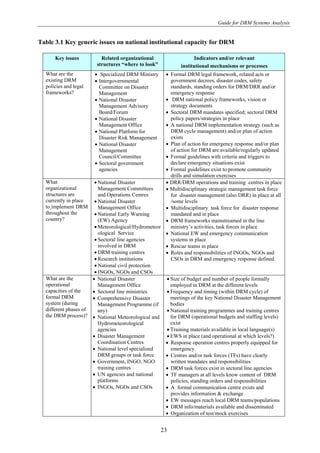
  • 10.
    Guide for DRMSystems Analysis MODULE 1 DEFINITIONS AND CONCEPTUAL FRAMEWORK The approaches and methods for DRM institutional assessments outlined in this Guide build on and combine elements of two conceptual frameworks: the Disaster Risk Management framework that distinguishes the different phases of the disaster management cycle (pre-disaster, response and post- disaster phases including the links to regular development activities) and the Sustainable Livelihoods (SL) framework which puts people, their livelihood assets and vulnerabilities, as well as the policy and institutional context that impinges on these, at the centre of analysis. The purpose of this module is to: 1. Provide basic definitions of terms used in this Guide; 2. Introduce the key elements of disaster risk management; and 3. Introduce the sustainable livelihoods framework and highlight the key linkages between vulnerability, disasters, livelihoods and institutions. Hazards and disasters: some basic definitions Disasters of all kinds happen when hazards seriously affect communities and households and destroy, temporarily or for many years, the livelihood security of their members. A disaster results from the combination of hazard risk conditions, societal vulnerability, and the limited capacities of households or communities to reduce the potential negative impacts of the hazard. The recognition of vulnerability as a key element in the risk context has also been accompanied by growing interest in understanding and enhancing the positive capacities of people to cope with the impact of hazards. The existence or absence of appropriate socio-economic and institutional systems to mitigate or respond rapidly to hazards determine a society’s or a community’s susceptibility or resilience to the impacts of hazards. In other words, the coping capacities ensured by these systems translate directly into enhanced resilience. T This Guide adopts the ISDR terminology which distinguishes disaster risk management from disaster risk reduction: o Disaster Risk Reduction (DRR) refers to the conceptual framework of elements considered with the possibilities to minimize vulnerabilities and disaster risks throughout a society, to avoid (prevention) or to limit (mitigation and preparedness) the adverse impacts of hazards, within the broad context of sustainable development.6 o Disaster Risk Management (DRM) includes but goes beyond DRR by adding a management perspective that combines prevention, mitigation and preparedness with response. The term Disaster Risk Management (DRM) is used in this Guide when referring to legal, institutional and policy frameworks and administrative mechanisms and procedures related to the management of both risk (ex ante) and disasters (ex post), therefore including also the emergency management elements. The term Disaster Risk Reduction (DRR) is used to refer to those programmes and practices which are specifically targeted at avoiding (prevention) or limiting 6 Sustainable development is defined as “Development that meets the needs of the present without compromising the ability of future generations to meet their own needs”. UN Department of Economic and Social Affairs, Division for Sustainable Development (available at www.un.org/esa/sustdev). 4
  • 11.
    Guide for DRMSystems Analysis (mitigation and preparedness) the adverse impacts of hazards, within the broad context of sustainable development. Box 1.1 Basic Definitions Hazard: A potentially damaging physical event, phenomenon or human activity that may cause the loss of life or injury, property damage, social and economic disruption or environmental degradation. Natural hazards can be classified according to their geological (earthquake, tsunamis, volcanic activity), hydro-meteorological (floods, tropical storms, drought) or biological (epidemic diseases) origin. Hazards can be induced by human processes (climate change, fire, mining of non-renewable resources, environmental degradation, and technological hazards.) Hazards can be single, sequential or combined in their origin and effects. Disaster: A serious disruption of the functioning of a community or a society causing widespread human, material, economic or environmental losses which exceed the ability of the affected community or society to cope using its own resources. A disaster is a function of the risk process. It results from the combination of hazards, conditions of vulnerability and insufficient capacity or measures to reduce the potential negative consequences of risk. Risk: The probability of harmful consequences, or expected losses (deaths, injuries, property, livelihoods, economic activity disrupted or environment damaged) resulting from interactions between natural or human-induced hazards and vulnerable conditions. Vulnerability: The conditions determined by physical, social, economic and environmental factors or processes, which increase the susceptibility of a community to the impact of hazards. Resilience: The capacity of a system, community or society potentially exposed to hazards to adapt, by resisting or changing in order to reach and maintain an acceptable level of functioning and structure. This is determined by the degree to which the social system is capable of organizing itself to increase its capacity for learning from past disasters for better future protection and to improve risk reduction measures. Definitions from ISDR Terminology version 2007 (www.unisdr.org/terminology) The Disaster Risk Management framework The purpose of Disaster Risk Management is to reduce the underlying factors of risk and to prepare for and initiate an immediate response should disaster hit. The Disaster Risk Management (DRM) framework, illustrated in Figure 1.1, distinguishes, conceptually, the different phases of the DRM cycle: pre-disaster, response and post-disaster. DRM actions in the pre-disaster phase are aimed at strengthening the capacities and resilience of households and communities to protect their lives and livelihoods, through measures to avoid (prevention) or limit (mitigation) adverse effects of hazards and to provide timely and reliable hazard forecasts. In the response phase, communities and relief agencies focus on saving lives and property. In the post-disaster phase, the focus is on recovery and rehabilitation. In reality, the shift between these phases is fluid, in particular, between the stages in which communities move from rehabilitation to development, integrating aspects of hazard mitigation into their developmental activities. The elements of the framework7 - further elaborated in Box 1.2 - include both structural 7 Disaster Risk Management Cycle (DRMC) Diagram (TorqAid; http://www.torqaid.com/default.asp). 5
  • 12.
    Guide for DRMSystems Analysis (physical and technical) and non-structural (diagnostic, policy and institutional) measures in the three phases.8 Risk assessment Mitigation/prevention Preparedness Risk assessment Mitigation/prevention Preparedness Figure 1.1 Disaster Risk Management Framework (DRMF) The originality and value of this framework is its ability to promote a holistic approach to DRM and demonstrate the relationships between hazard risks/disasters and development. For instance, the activities on mitigation and prevention comprise the development portion, while relief and recovery comprise the humanitarian assistance portion, with preparedness linking both types of efforts. Furthermore, the framework provides the basis to address public commitment and institutional systems, including organizational capacities, policy, legislation and community action, as well as environmental management, land-use, urban planning, protection of critical facilities, application of science and technology, partnership and networking, and financial instruments. The framework also provides the space to positively value and constructively include communities’ and households’ traditional coping strategies, recognizing the importance of their ownership of the DRM process, thus diminishing the (passive) dependency typically generated by relief offered by outsiders. The key elements of the DRM framework are reflected in the Hyogo Framework for Action 2005- 2015: Building the Resilience of Nations and Communities to Disasters (HFA) which elaborates the five priorities for action adopted by the World Conference on Disaster Reduction to achieve its strategic goals by 2015.9 8 Structural measures refer to any physical construction to reduce or avoid possible impacts of hazards, which include engineering measures and construction of hazard-resistant and protective structures and infrastructure. Non-structural measures refer to policies, awareness, knowledge development, public commitment, and methods and operating practices, including participatory mechanisms and the provision of information, which can reduce risk and related impacts. ISDR Terminology, version 2007 (www.unisdr.org/terminology). 9 For the details, see Hyogo Framework for Action 2005-2015: Building the Resilience of Nations and Communities to Disaster (available at www.unisdr.org/eng/hfa/hfa.htm). 6
  • 13.
    Guide for DRMSystems Analysis Ongoing assistance – Continued assistance until a certain level of recovery Recovery - Actions taken after a disaster with a view to restoring infrastructure and services Reconstruction - Actions taken after a disaster to ensure resettlement/relocation Economic & social recovery – Measures taken to normalise the economy and societal living Ongoing development activities – Continued actions of development programmes Risk assessment - Diagnostic process to identify new risks that communities may again face Post-disaster Evacuation - temporary mass departure of people and property from threatened locations Saving people and livelihoods – Protection of people and livelihoods during emergency Immediate assistance – Provision of assistance during or immediately after disaster Assessing damage and loss – Information about impact on assets and loss to production Disaster response Ongoing development activities – Ongoing DRM aspects in development programmes Risk assessment – Diagnostic process to identify the risks that a community faces Prevention - Activities to avoid the adverse impact of hazards Mitigation – Structural/non-structural measures undertaken to limit the adverse impact Preparedness - Activities and measures taken in advance to ensure effective response Early warning - Provision of timely and effective information to avoid or reduce risk Pre-disaster Box 1.2 Elements of Disaster Risk Management (DRM) framework The HFA priorities for action are to: 1. Ensure that disaster risk reduction is a national and a local priority with a strong institutional basis for implementation. 2. Identify, assess and monitor disaster risks and enhance early warning. 3. Use knowledge, innovation and education to build a culture of safety and resilience at all levels. 4. Reduce the underlying risk factors. 5. Strengthen disaster preparedness for effective response at all levels. The HFA priorities for action are used in this Guide as the framework for organizing the major findings of the DRM system analysis, identifying gaps and strengths and developing the recommendations (see module 6). The expected outcome, strategic goals and priorities for action of the HFA are presented in Figure 1.2. 10 Why is it important to analyze DRM systems? The sound analysis of DRM systems will make a crucial contribution to assessing, and strengthening the institutional capacities needed for achieving the HFA strategic goals and the five priorities for action which are all closely linked to the broader context of sustainable development. The strengths or weaknesses of existing DRM systems can favour or threaten development progress. The close link between DRM and development and the integral role of DRM within development are illustrated by the following examples: 10 Taken from UN/ISDR. 2007. Words into Action: a guide for implementing the Hyogo Framework. Geneva. 7
  • 14.
    Guide for DRMSystems Analysis Figure 1.2 Summary of the Hyogo Framework for Action 2005-2015: Building the resilience of nations and communities to disasters (HFA) (Source: UNISDR - http://www.unisdr.org/eng/hfa/hfa.htm) 8
  • 15.
    Guide for DRMSystems Analysis • Natural disasters set back development gains: the destruction of infrastructure and erosion of livelihoods are direct outcomes of disasters. Disasters cause significant pressures on national and household budgets diverting investments aiming to reduce poverty and hunger and provide access to basic services. • Unsustainable development increases disaster risk: unplanned urbanization, environmental degradation and inappropriate land use are key factors contributing to the increase in natural hazards and loss of lives and assets when hazards turn into disasters. For example, the destruction of forests can increase the risk of devastating mud slides during heavy rains and storms. • Disaster losses may be considerably reduced by integrating DRM practices in development programmes: development policies and programmes can make a vital difference to reducing vulnerability and risk by: a) strengthening institutions and mechanisms for DRM; b) assisting vulnerable groups to build assets, diversify income-generating activities and strengthen community-based self-help institutions; and c) adopting DRM practices and principles in sectoral development and post-disaster rehabilitation plans. • Special long-term interventions may be needed to increase the coping capacities of the poorest and most vulnerable: while an entire community may be vulnerable to a particular hazard (e.g. drought, flood, hurricane), the poorer population groups are likely to be at greater risk of the hazard turning into a disaster. Their meagre assets, heavy dependence on their labour for survival, limited opportunity for migration/evacuation and little or no access to insurance and credit contribute to their vulnerability. Development policies and programmes that assist poor men, women and youth to build livelihood assets, diversify income-generating activities, improve human capacities (health, nutritional status, education, technical skills), and strengthen community-based self-help organizations, can make a major contribution to reducing vulnerability and risk, and improving the coping strategies of the poorest. • Improved technologies can help prevent or mitigate damage caused by natural hazards: various methods of water control, for example, can reduce the danger of flood damage, or help humans, animals and plants survive drought. Improved crops varieties that are drought- or flood-tolerant and/or disease- and pest-resistant can make the difference between crop failure and an acceptable harvest. Improved or zero tillage methods and soil conservation techniques can increase production in unfavourable agro-ecological areas, halting environmental degradation and ensuring greater sustainability. Development programmes need to get these DRM technologies into the hands of farmers in vulnerable communities. • Disasters may become opportunities for building back better development practices: relief associated with enhancing development in the post-disaster, recovery and rehabilitation periods, has a strong multiplier effect. It represents the difference between giving a person a fish, and teaching her/him how to fish. This means that s/he will be more independent and self- sufficient in the future, and thus, in terms of the cyclical nature of the DRM framework, will be better able to strengthen her/his resilience to future hazards. Disaster risk, vulnerability and livelihoods Disaster risk is usually described as a function of the hazard and the vulnerability context, including the resilience (coping capacity) of the societal system under threat. Communities and households may be exposed to different forms of vulnerability11 that include: 11 This list of different forms of vulnerability and the definitions given in Box 1.3 are taken from FAO. 2005. Rapid guide for missions: Analysing local institutions and livelihoods, by A. Carloni., Rural Institutions and Participation Service. Rome, page 3, box 3. While this DRM Guide focuses on vulnerability to natural hazards, in line with 9
  • 16.
    Guide for DRMSystems Analysis • Weather-related shocks and natural calamities: drought, earthquakes, hurricanes, tidal waves, floods, heavy snow, early frost, extreme heat or cold waves • Pest and disease epidemics: insect attacks, predators and diseases affecting crops, animals and people • Economic shocks: drastic changes in the national or local economy and its insertion in the world economy, affecting prices, markets, employment and purchasing power • Civil strife: war, armed conflict, failed states, displacement, destruction of lives and property • Seasonal stresses: hungry season food insecurity • Environmental stresses: land degradation, soil erosion, bush fires, pollution • Idiosyncratic shocks: illness or death in family, job loss or theft of personal property • Structural vulnerability: lack of voice or power to make claims Vulnerability to the various types of natural hazards is not homogeneous across geographical areas or within communities. Some communities and some households within given communities will be more vulnerable than others. The Sustainable Livelihoods (SL) framework (Fig.1.3) provides an insightful analytical approach to help identify which types of households are likely to be particularly vulnerable. This is accomplished through the analysis of the inter-relationships between shocks, vulnerabilities and households’ bundles of assets and coping strategies, within the context of on-going policy, institutional and development processes. The SL framework puts households and their livelihoods at the centre of analysis, assuming that they are continuously influenced by potential threats of shocks and/or disasters. Box 1.3 Definitions A household is a group of people who eat from a common pot, and share a common stake in perpetuating and improving their socio-economic status from one generation to the next. A livelihood comprises the capabilities, assets (including both material and social resources) and activities required for a means of living. A livelihood is sustainable when it can cope with and recover from stresses and shocks and maintain its capabilities and assets both now and in the future, while not undermining the natural resource base. In the SL framework, vulnerabilities, of all kinds, and institutions form core parts of the overall context within which development processes. The different bundles of assets of different households, social groups and communities and the institutional contexts ultimately determine the capacities of these households, social groups and communities to cope with disasters before, during and after their occurrence. The SL framework adapted to DRM, represents a cause-effect model for understanding the situations that poor households face, depending on the relationships between household assets, the vulnerability context and institutional processes which shape their lives. For instance, while some hazards may affect all members of a community to a similar degree (e.g. a hurricane or heavy snow), richer households with greater assets may have the means to adopt more effective coping strategies that can prevent a hazard turning into a disaster. Furthermore, the framework’s focus on the institutional context describes how effective community and higher level institutions can cushion the effects of a disaster on poor households, mobilizing community or outside action for the benefit of the most vulnerable. FAO’s mandate, the assessment processes described could be adapted to the other types of vulnerability mentioned in the bullet points. However, it should be stressed that this DRM Guide is not designed to assess institutional structures underlying economic shocks, civil strife and seasonal stresses. 10
  • 17.
    Guide for DRMSystems Analysis Enabling institutions, laws and policies Natural Hazards & Shocks Natural Human Financial Physical Social Influence Disabling institutions, laws and policies Strengthened risk coping & livelihood strategies Weakened risk coping & livelihood strategies Positive DRM & livelihood outcomes Negative DRM and livelihood outcomes Asset depletion, undermined coping strategies and livelihoods Asset accumulation, , enhanced coping strategies & livelihoods I Im mp pa ac ct ts s Increased exposure to disaster risk R Re es si il li ie en nc ce e Reduced exposure to disaster risk HH -assets Hazard Vulnerability context Coping strategies Figure 1.3 Sustainable Livelihoods framework adapted to DRM The important point is that the “capitals” are to some extent fungible. Thus, the rich pastoralist household would be more resilient to disaster if it could draw on financial reserves to buy food and restock, or enable educated/skilled household members to migrate temporarily for employment in another area. The poor pastoralist household may have no assets other than its dead animals, and the disaster could result in a huge and un-surmountable tragedy. A livelihood perspective suggests that households with a larger bundle of assets will be more resilient to a hazard than a relatively asset-less household. It is not just the amount of any one asset that counts – for example, in the event of a livestock disease epidemic, a rich pastoralist household could also lose its entire herd just as a poor household. Box 1.4 Livelihoods and resilience While the linkages between the DRM and the SL frameworks are complex, they highlight a number of key factors that determine the degree of vulnerability of different socio-economic groups to disaster situations, as evidenced by the following examples: • Natural resources provide key livelihood assets and security, especially in rural areas • Disasters reduce household livelihood assets to different degrees depending on the asset and type of disaster and lead to livelihood insecurity (and may result in death or injury) • Policies and institutions influence household livelihood assets positively or negatively • Policies and institutions can increase or decrease vulnerability to disaster 11
  • 18.
    Guide for DRMSystems Analysis • Enabling institutions and diversified household assets widen livelihood options • Asset ownership decreases vulnerability and increases ability to withstand disaster impacts • Livelihood outcomes depend on policies, institutions, processes and livelihood strategies • Livelihood outcomes influence the ability to preserve and accumulate household assets Policies and institutions are thus key factors that influence access by different population groups to assets and DRM technology, livelihood options and coping strategies as well as key services to reduce the loss of lives and property in the aftermath of a disaster. Box 1.5 Definition of institutions The use of the term “institutions” in this Guide refers to rules and social norms as well as to the organizations that facilitate the coordination of human action. The two components of “institutions” are the “rules of the game” (norms, values, traditions and legislation which determine how people are supposed to act/behave), and the “actors” (organizations) and their capacities that operate according to these rules. Both dimensions need to be addressed in an institutional analysis. Institutions include formal institutions and membership organizations: Formal organizations - government institutes, organizations, bureaus, extension agencies Formal membership organizations - cooperatives and registered groups Informal organizations - exchange labour groups or rotating savings groups Political institutions - parliament, law and order or political parties Economic institutions - markets, private companies, banks, land rights or the tax system Social-cultural institutions - kinship, marriage, inheritance, religion or draught oxen sharing • • • • • • The crucial role of institutions Institutions play a key role in operationalizing the different phases of the DRM framework and mediating the link between development, DRM and humanitarian actions. Without institutions, there would be no action and DRM would remain a concept on paper. For example, during the mitigation/prevention phase, a variety of institutional actors including the public sector technical ministries and agencies (e.g. agriculture, forestry, fisheries, health, education, local government), international organizations, professional bodies, NGOs and other civil society organizations, operate important programmes to build up livelihood assets, improve household production and incomes, and enhance resilience and risk coping strategies. In the relief stage, for instance, these various organizations focus on “save and rescue” operations, and meeting basic needs such as shelter, food and water. In the rehabilitation stage, their aim is to prevent further erosion of productive assets or coping strategies and to help households re-establish their livelihoods. Specialized DRM focal point ministries/agencies are expected to play a vital role in coordinating these many activities and ensuring their relevance to medium- and long-term development objectives and activities. In this context, sound analyses and understanding of the role of formal and informal organizations in natural DRM, their institutional and technical capacities (including strengths and weaknesses), best operational and technical practices, and comparative strengths in coordinating and promoting vertical and horizontal linkages are required. A particular challenge for governments and development agencies is to build up strong local capacities, and mobilize public and private sector and civil society organizations at different levels to participate actively, according to their comparative advantages, in the design and implementation of locally relevant DRM strategies. 12
  • 19.
    Guide for DRMSystems Analysis MODULE 2 PLANNING AN INSTITUTIONAL ASSESSMENT OF DISASTER RISK MANAGEMENT SYSTEMS This module gives an overview of the interrelated steps of planning, conducting and analysing the results of an institutional assessment of DRM systems. Complementary diagnostic studies at national, provincial/district, and local levels to obtain the basic primary data for the assessment are also discussed. The module suggests who should do what and where during the assessment process. The proposed sequence should be followed in a flexible way and adapted to location- or study- specific circumstances, as needed. How to plan and organize the institutional assessment? It is recommended that the institutional assessment be planned in three phases: 1. Getting started: the preparatory phase (a) initial preparations and literature review (b) inception meeting and field work planning meetings 2. Field work (c) diagnostic study at the national level (d) diagnostic study at the district level (e) diagnostic study at the local level (f) linkages and coordination among and between institutions (g) sector-specific diagnosis 3. Data analysis, report writing and wrap-up meeting(s) (h) data analysis and report writing (i) wrap-up meetings with in-country stakeholders (j) consolidating the final report 1. Getting started: the preparatory phase (a) Initial preparations and literature review: Before starting the assessment it is essential that the study team is familiar with the key concepts and terminology related to disaster risk management, institutional development, and sustainable livelihoods (module 1). Other steps to be taken before data collection in the field include: o Desktop research on national hazard profiling o Review of existing national (or relevant regional) risk and vulnerability maps o Collection and review of background information on existing national DRM institutional structures, mandates, policies, laws and disaster codes, DRM-related projects, relevant agricultural sector strategies and programmes12 o Collection and review of studies on the socio-economic, cultural and traditional/ community-based institutional system(s) prevalent in the vulnerable areas, including information on local disaster risk coping strategies13 o Collection of information on national, regional and local focal point organizations 12 An organigram of the national DRM institutional set-up is very useful for this purpose and may be requested from the responsible national authority or downloaded from international institutions’ websites (UN/ISDR, World Bank, UNDP). 13 These are often available from national and international NGOs with a strong field presence in areas chronically exposed to natural hazards. 13
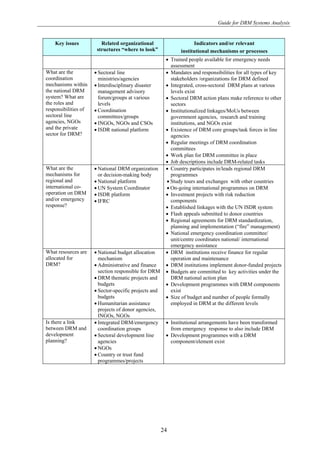
  • 20.
    Guide for DRMSystems Analysis o Collection and review of relevant corporate and regional/country strategy documents and the main DRM-related programmes and projects of concerned international and national development organizations and NGOs operating in the country These activities may require three to five working days depending on the existing knowledge of the assessment team and its working experience in DRM and institutional analysis. The most suitable entry points to start the desk review are: o The UNISDR website: www.unisdr.org/eng/country-inform/introduction.htm, which provides basic data on country profiles, maps on disaster and hazard profiles, country reports on DRM (not always up to date) and official contact points o The International Disaster Database managed by CRED (www.em-dat.net) o The websites of national DRM focal points and ministries (b) Inception meeting and field work planning meetings: The first step is to organize an inception meeting with the key government officials who are responsible for the overall coordination of the country’s DRM systems as well as those officials with sectoral responsibilities for DRM. In countries where coordination between the national authority for DRM and sectoral ministries/line departments is still weak the presence of representatives of the latter institutions at the inception meeting might help strengthen this coordination. Otherwise there may be a need for separate meetings, particularly if the assessment has a sector-specific focus. The purpose of the inception meeting is to: o Obtain government support and commitment at the senior decision-making level o Convey the government’s overall policy orientation/guidance for the assessment o Agree on key issues to be addressed during the assessment process o Agree on the disaster prone-areas to be covered by the assessment The key participants in the inception meeting should include: o The DRM focal points and/or officials with decision-making power related to DRM policies, strategies and programmes (e.g. from the National Disaster Management Office, Council and/or Bureau) o Representatives of key INGOs and national NGOs/civil society organizations active in DRM and, if appropriate, any relevant private sector organizations14 Representatives of the following organizations/agencies should be invited as appropriate: o Ministry of Local Government, particularly units representing disaster-prone districts o Ministries/technical departments of vulnerable sectors (e.g. agriculture, livestock, fisheries, forestry, infrastructure/public works, water resources, health, education) o Ministries of Planning and Finance (if appropriate) o National research institutions (if appropriate) o INGOs, NGOs/CSOs and Private sector organizations (if appropriate) o UN/bilateral development and relief organizations (if appropriate) The inception meeting should, inter alia, explicitly: • Discuss the key features of the national hazard context and identify the major strengths and weaknesses of the overall DRM policies and institutional structure that may require in-depth analysis during the assessment • Agree on the level of counterpart support and the names of counterpart officials from the coordinating and sectoral ministries including their participation, if possible, in the field work, and allocate financial resources/logistical support (e.g. transport) as needed 14 The IFRC (International Federation of Red Cross and Red Crescent Societies), for example, is a valuable source of information and an experienced player in emergency preparedness and response in many countries. 14
  • 21.
    Guide for DRMSystems Analysis • Identify other key national/international governmental, inter-governmental or NGO/CSO organizations involved in DRM at various levels • Select the pilot disaster-prone provinces/districts/villages for the field studies • Discuss other policy or resource-related topics, depending on the specific situation Given the number of topics to cover, it would be helpful if the inception meeting could be scheduled for half a day. Since it will not be possible to cover all these topics in sufficient depth in one session, it will be necessary to schedule follow-up meetings with some of the participants to flesh out the details, and to undertake the detailed planning for the field work. As the inception meeting proceeds, it would be advisable for the chair/facilitator to set up one or more smaller technical group meetings on specific topics, so as to be able to move forward on the main agenda. It may be useful to invite representatives of international development and relief organizations to these meetings. Field work planning meetings: Following the broad lines of agreement reached at the inception meeting, it will be essential for the assessment team to hold a series of planning meetings with the local counterparts and interpreters for the field work in order to: • identify and select other field staff/assistants if necessary • undertake the detailed planning of the field work programme and itinerary • make logistical arrangement for the field visits • agree on the participatory tools and methods to be used • agree on and fine-tune the key questions and related indicators for the institutional assessment at the national, district and local levels It would also be useful to start planning how to undertake the data analysis and envisaging what logistical/technical support might be needed. 2. Field work (c) Diagnostic study at the national level: It is recommended that the first diagnostic study be undertaken at the national level, as this will provide an understanding of the overall DRM framework, policy objectives, technologies, institutional structures and existing DRM coordination mechanisms before moving to decentralized levels, where the institutional structures and coordinating mechanisms may be less developed or effective. A series of group-based brainstorming sessions and interviews on the key issues should be planned and conducted at the national level with representatives of the most relevant organizations identified at the inception meeting. If the inception meeting concluded that particular sectors were especially vulnerable, the ministries and departments responsible for these sectors are likely to be the key entry points for the assessment. The detailed description about who should be contacted and what should be looked for is described in module 3. (d) Diagnostic study at the district level: Key informant interviews/brainstorming sessions/informal meetings should be conducted at provincial/state/district level to explore key issues identified in the inception meeting and other issues that might only emerge at this level. The purpose is to assess the formal and informal institutional systems available at intermediary levels, their roles, strengths, weaknesses and comparative advantages for implementing DRM programmes. The process should contribute constructively to the selection of villages/communities to be visited during the local-level diagnostic study. The detailed description about who should be contacted and what should be looked for is presented in module 4. (e) Diagnostic study at the local level: The fifth step during the assessment process involves community-level field work in the selected villages identified through the national- and intermediary- level consultations. This community-level study involves two steps: 15
  • 22.
    Guide for DRMSystems Analysis (i) community profiling (ii) community-level institutional assessments. The community profiling is an essential step before undertaking the local-level institutional assessment as it provides a basic understanding of the study context, key socio-economic parameters including production and livelihood systems, and the overall vulnerability characteristics of the villages/communities and the specific hazards faced. One-day field visits may be conducted in 3 to 5 villages depending on time availability. It is important to decide in advance on the participatory methods and tools with which to start the study and employ other participatory and rapid rural appraisal methods and tools depending on the need and the information requirements. It is advisable not to ask the volunteers participating in the study to devote more than half a day to these exercises and discussions, and to plan group and individual sessions accordingly throughout the day. The more detailed description about who should be contacted and what should be looked for is presented in module 5. (f) Linkages and coordination among and between institutional levels: The issues of coordination, communication and collaborative linkages between institutional levels constitute a crucial topic to be addressed in the overall assessment. Key questions to identify strengths and weaknesses of vertical and horizontal linkages and proposals for improvement should be incorporated into the studies at each level. A specific session to discuss these issues across levels and with a variety of key stakeholders is essential. The best moment to call such a joint stakeholder meeting to discuss vertical and horizontal coordination, communication flow and integration of DRM issues between levels, is once the raw data from the individual levels have been screened and some hypotheses drawn to serve as a basis for discussion. While the primary roles and functions that DRM organizations have or should have at the national, district and community levels will be covered in more depth in modules 3-5, an example of key roles and functions of each level are given in Table 2.1 in order to provide the basis for comparing the complementary contributions of each level. (g) Sector-specific diagnosis: Many DRM functions overlap/coincide with the mandates of sectoral ministries or agencies. For instance, Ministries of Agriculture and/or Water Resources often address DRM-related challenges such as sustainable water and soils management, and sustainable natural resource management. It is therefore crucial that the assessment also takes account of these sectoral ministries’ DRM-related mandates and programmes and the specific sectoral issues. These aspects need to be carefully analyzed to understand how coordination mechanisms with the formal DRM system are set up and function is equally important. By way of illustration, this Guide provides some insights into the issues in the agricultural sector with a view to highlighting the disaster risks inherent in agriculture, and the roles and contributions which agriculture should make to a fully functioning DRM system. It is important to stress that a sector-specific diagnosis should be integrated with the analyses of the national DRM system and institutional structures. 3. Data analysis, report writing and wrap-up meeting(s) (h) Data analysis and report writing: A draft report dealing with the overall findings and recommendations should be prepared for presentation during a wrap-up meeting with representatives of the national government organizations, NGOs and donor organizations. One possible approach to analysing, integrating and structuring the findings from the field studies is described in Module 6. At least three to four days will be needed for the analysis and report-writing. 16
  • 23.
    Guide for DRMSystems Analysis Table 2.1 Primary roles and functions of various organizations15 at different levels by DRM elements (illustrative example) Pre-disaster Disaster/emergency Post-disaster Level Actors Prevention Mitigation Preparedness Response Recovery Development International International agencies Raise awareness on DRM Ensure quality in donor funded infrastructure projects Treat DRM as an inclusive activity Mobilize financial aid as grants and long-term loans Fund Food For Work and rehabilitation programmes Mainstream DRM activities in development planning National National government Establish early-warning systems, infrastructure, legal and policy framework for DRM Promulgate construction code and safety regulations Prepare national disaster relief plan Declare a disaster and state of emergency Set up emergency and recovery fund Prepare Codes of Conduct in relief and development. Province/ district/ municipality Provincial government Set local administration rules;Provide incentives for promotion of risk- reducing technology Promote multi-sectoral, integrated approaches in DRM Provide agro- ecological data for national disaster relief plan Coordinate and mediate actions between national and local levels Implement Food For Work or other rehabilitation programmes Protect infrastructure; promote risk-reducing technologies Technical line agencies & research institutions Develop risk reducing- technologies Test risk-reducing technologies and sector- specific forecast systems Prepare sectoral risk management and response plans Assist in needs assessment and distribution of sector specific inputs Promote sector specific recovery processes Develop risk-reducing technologies Intermediary-level NGOs Provide training to local NGOs Undertake watershed/ river basin planning Provide skills training to local NGOs Mediate between national & local level Set up rehab. projects to restore lost assets Promote local institutional development Local government Develop local disaster prevention plan Undertake watershed/ river basin planning Prepare evacuation and contingency plans Provide shelter to displaced households Set up rehabilitation projects for public goods Prepare local risk maps and disseminate information Community Local leaders/ representatives Plan/implement awareness-raising campaigns Solicit external technical assistance on DRM Carry out awareness- raising campaigns Act as advisory focal points Promote improved technologies Facilitate links and coordination between organizations Local emergency committees Undertake hazard risk diagnosis Undertake household vulnerability assessments Prepare evacuation plans Deploy search and rescue teams Deploy food aid committees/teams Advise how to reduce local vulnerability Local-level NGOs Provide training to local CBOs Undertake household vulnerability assessments Conduct awareness raising campaigns Deploy trainers on hygiene & health Provide psychological counselling & support Define local priorities to reduce vulnerability Micro-financial Intermediaries Undertake hazard risk diagnosis Promote mitigation practices Spread risk across portfolio Undertake client damage assessments Arrange loan rescheduling and other special activities Integrate DRM in development activities Community- based organizations Undertake hazard risk diagnosis Maintain public infrastructure Construct infra- structure to protect property Tap customary solidarity networks Mobilize communities for joint action Provide moral support and advice 15 The roles and functions described in this table are only indicative. 17
  • 24.
    Guide for DRMSystems Analysis (i) Wrap-up meetings: A single or separate wrap-up meetings should be organized with the intermediary- and national-level organizations to share the team’s indicative findings and to discuss the implications of the findings and recommendations with national stakeholders. A separate wrap-up meeting may also be held with national-level project partners and donor agency representatives. The decision as to whether to hold joint or separate meetings with different stakeholder and interest groups will need to be taken in the light of local circumstances and sensitivities. (j) Consolidating the final report: Final meetings before completing the assessment report may be required with the national DRM focal points to clarify facts and interpretations of the team’s findings and the feasibility of the proposed recommendations. In conclusion, the various steps outlined above are summarized in Box 2.1 in order to highlight the logical sequence of these steps and the coherence of the approach. 18
  • 25.
    Guide for DRMSystems Analysis Box 2.1 Flow chart for a diagnostic study of DRM institutional systems Step 4: Provincial/regional/district institutional profile 9 Hold meetings/brain storming sessions with administrative officials 9 Interview selected district government/county/municipality officials 9 Discuss with district NGOs / Civil society organizations 9 Interview cooperative society and agri-business consortium officials 9 Interview private sector staff (e.g. input suppliers, traders, transporters) Step 5: Community profile and local institutions 9 Hold key informant interviews with local institutional representatives 9 Hold group meetings with community representatives, religious leaders, farmers’/producers’ groups and associations 9 Conduct PRAs and focus group meetings in selected villages 9 Undertake community profiling and local institutional assessments 9 Assess opportunities to and constraints to proactive DRM Step 1: Initial preparations and literature review 9 Collect and analyse information about the national hazard context and existing DRM systems 9 Identify key DRM project design/implementation questions and national, district and local focal points 9 Collect and review country strategy documents, mandates, policies, DRM project reports etc. Step 6: Data analysis and draft reporting 9 Integrate and structure the findings 9 Assess disaster risk perception in different institutions and communities 9 Assess the relevance of on-going DRM initiatives for local communities 9 Evaluate existing DRM systems, structures, roles, and policies and their implications for different institutional levels 9 Undertake gap analysis (institutional and technical ) to identify areas that need further attention 9 Assess the opportunities, limitations and constraints to establishing linkages within the agricultural sector 9 Assess the comparative operational and technical strengths in the different phases of DRM 9 Prepare a draft report dealing with the overall findings and preliminary recommendations Step 7: Wrap-up meeting with in-country stakeholders and report finalization 9 Discuss findings, recommendations and implications 9 Identify and agree on future directions and the way forward 9 Review the requirements for implementing the follow up 9 Finalize the report and its recommendations Step 3: National-level institutional profile 9 Hold separate brain storming meetings with DRM focal points 9 Interview representatives of relevant ministries and departments 9 Discuss with representatives of international and national NGOs 9 Interview representatives of national research and training institutes Cross-cutting Step 2: Sector-specific linkages and coordination Assess linkages of DRM systems with sectors (eg. agriculture/livestock/fishery/water resources/health ministries and departments) at various levels; Assess existing operational and technical practices in sector-specific DRM systems, identify institutions that are best placed to act on and coordinate specific aspects of DRM Cross-cutting Step 1: Assessing horizontal and vertical linkages and coordination Assess communication mechanisms and channels, DRM planning at and between institutions, flow of early warning messages, technical exchange and collaboration, coordination and implementation at various DRM phases, awareness-raising strategies Step 2: Inception meeting and field work planning meetings 9 Discuss the key features of the national hazard context 9 Agree on focal points at the national, district and local levels 9 Assess relevance of on-going DRM programmes 9 Select disaster-prone, vulnerable districts and villages for the field work 9 Identify key international, national organizations or NGOs/CSOs involved in DRM at various levels 9 Plan for village visits and sequence of activities 9 Agree on counterpart and logistical support for the assessment 19
  • 26.
    Guide for DRMSystems Analysis MODULE 3 ASSESSMENT OF DISASTER RISK MANAGEMENT SYSTEMS AT THE NATIONAL LEVEL What is the role of national DRM institutions? National DRM systems and institutions are the driving forces to plan, implement, monitor and evaluate DRM processes and products within a country and to ensure coordination among all stakeholders involved in any phase of DRM. In addition, they play a pivotal role in integrating DRM efforts into development policies and programmes in order to reduce the vulnerability of rural livelihoods to natural hazards. The national DRM institutions develop policy frameworks, disaster management plans and codes of conduct in relief and development; they guide and assist in developing early warning systems, and in declaring states/phases of emergency during disasters; and they lead the communication with the general public and sectoral agencies at different levels. The existence (as a basic requirement) and coordinating role of DRM institutions are essential, though not sufficient, to ensure that DRM systems are functional and operational. Equally important are the formal links with sectoral line agencies which have complementary sectoral responsibilities for DRM, and thus need to integrate DRM aspects into their regular development work. Although there is a growing emphasis on disaster risk reduction in most developing countries, the mandate of the national DRM institutions usually focuses on coordination of and advocacy for prevention and mitigation strategies. The ultimate implementation of prevention and mitigation actions and the direct responsibility for the emergency response, however, remain the task of the sectoral line agencies. Therefore, depending on the topical entry point of the assessment, relevant sectoral agencies should be included in the analysis. Agriculture is used to illustrate sector-specific issues, questions, demands and challenges in the context of DRM. Why do institutional assessments at the national level? The purpose of a national-level institutional assessment is to provide insights, guidance and check- lists to assist DRM practitioners to: • better understand the strengths and weaknesses of existing DRM policies, legal frameworks, codes of conduct, institutional structures and the coordination mechanisms among them, including national DRM focal point ministries, other concerned sectoral ministries, research organizations and/or NGOs and CSOs; • assess the availability, appropriateness and effectiveness of key DRM instruments, the degree to which these are actually used/promoted by the institutions at the national level, and how DRM programmes and services are communicated and promoted at decentralized levels; • undertake more in-depth assessments of technical capacities in countries that are undergoing processes of organizational restructuring to better support a shift from reactive emergency relief operations towards long-term disaster risk prevention, mitigation and preparedness strategies; • contribute to the development of an effective and coherent national DRM policy in order to guide the development of complementary district and local DRM strategies and plans; and • identify the tangible institutional attributes (policies, organizational mandates and structures, and the supporting instruments such as finance, logistical support, technologies) and intangible attributes (attitudes, perceptions and underlying motivating factors) that determine the success of DRM programmes. 20
  • 27.
    Guide for DRMSystems Analysis How to initiate the assessment? The success of any institutional assessment depends on the “right” institutional entry point. Thus, it is important at the outset to identify the national focal point which will host the assessment process and the most relevant partner organizations. In most cases, the entry point is likely to be the National Disaster Management Office (NDMO), if there is one, or the lead institution with the mandate for DRM.16 The agency17 responsible for developing, interpreting and disseminating early warning information must also be involved from the outset of the assessment. In a subsequent step, selected sectoral ministries such as Ministries of Agriculture, Water, Environment or Health as well as selected multi-sectoral ministries/agencies such as Ministries for Rural or Local Development, Finance and Planning should be involved. Box 3.1 How to select suitable institutional entry points 9 What are the scope, purpose and specific objectives of the assessment? 9 Does the assessment have a pre-determined hazard focus (e.g. hurricane preparedness or drought mitigation)? 9 Has the assessment a sectoral focus? If the focus is still to be determined, which sector(s) are of key relevance with regard to the objectives of the assessment? 9 Does the assessment have a pre-determined focus on certain phases of the DRM framework? e.g. preparedness, mitigation, relief, reconstruction, rehabilitation, mainstreaming etc.? 9 Which institutions have the mandates and/or responsibility for implementing the DRM system, including overall coordination and sectoral responsibilities? 9 Which ministries/institutions and technical agencies are designated as national focal points for aspects of DRM-related activities? Other Ministries such as Labour and Social Welfare, the Interior, Public Works, Relief and Rehabilitation, or Defence often provide focal point functions for DRM and should thus also be consulted on selected aspects of DRM, as appropriate. The institutional entry point will also depend on the specific purpose of the analysis and its relevance to or focus on a particular sector. For instance, if there are key pre-determined elements relating to emergency health issues, the Ministry of Health would be the ideal entry point. Building on the outcome of the inception meeting (see Module 2), it will be necessary to deepen the technical discussions with national-level DRM institutions. Three basic methodologies are recommended for the initial assessment at national level: • • Semi-structured interviews with selected key informants/key resource persons Multi-stakeholder brainstorming sessions 16 The title of the focal point institution responsible for coordinating all DRM issues at national level varies from country to country. Some commonly used titles include: the National Disaster Management Office (NDMO), the National Disaster Management Authority (NDMA), the National Disaster Management Centre (NDMC), the National Disaster Management Bureau (NDMB) or the National Emergency Management Agency (NDMA). These offices/authorities are often hosted by the Ministry of Interior (or Home Affairs) although in some countries other ministries perform this lead role such as the Ministry of Civil Defence, the Ministry of Disaster Management or the Ministry of Relief and Rehabilitation. In other cases, the focal point unit reports directly to the Head of Government. 17 In most countries National Meteorological Agencies (NMA) and National Hydro-Meteorological Services (NHMS) are the focal points for all types of early warning systems and the dissemination of early warning information and alerts. 21
  • 28.
    Guide for DRMSystems Analysis In-depth topical group discussions. • Usually group work produces more filtered, “socially controlled” and thus more neutral and broadly accepted findings and recommendations. Individual interviews tend to provide more in-depth insights and critical reflections, with the risk, however, of only reflecting one viewpoint. Therefore triangulation in the use of the three methods is strongly recommended. Before initiating any meetings, it is essential to prepare a detailed check-list of specific questions applicable to the particular ministries/departments and line agencies. Given the great variety of contexts and country-specific circumstances, this Guide does not prescribe a single method or interview schedule but recommends the use/adaptation of the analytical categories, generic questions and indicators presented in Tables 3.1 and 3.2 to identify situation-specific issues for discussion and design appropriate interview guidelines and questions. Thus, these tables should not be used as ready-prepared questionnaires. The assessment team needs to bear in mind that key informants may have very limited time. The team should therefore invite such busy informants only to those events and/or focus on those questions most relevant to them. This is particularly important the higher the informants are positioned within the national DRM system. A careful interim analysis of the national-level findings is also crucial since these “set the scene” for the subsequent analysis of the DRM organizational structures, institutional mechanisms and processes at the decentralized levels. Specific issues to address at the national level Table 3.1 provides a set of key issues regarding different aspects of organizational structures and a checklist of institutional mechanisms to help guide the assessment of the national DRM structures and their functioning. These broad issues can be complemented by sector-specific issues, depending on the focus of the assessment. Examples from the agricultural sector are given in Box 3.3. Box 3.2 Steps for conducting data collection at the national level The following steps for conducting the data collection at the national level are indicative, and should be amended or sequenced differently according to specific situations. 1. Organize a joint brainstorming session with representatives of key national stakeholder organizations, including government, research and training institutions, producer organizations/cooperatives, and NGOs/CSOs to gain the “big picture” and assess the critical issues, strengths and weaknesses, as well as areas of potentially conflicting information or taboos. The card method is a useful tool in brainstorming sessions to collect initial perceptions. Participants are asked to fill out cards (one idea per card) which are then arranged in categories or groups of ideas on a board or table. A variant on this method would be to display Table 3.1 with the first column of the matrix filled out with the key questions, leaving the second and third columns blank. The group would then fill in these two blank columns during a facilitated brainstorming process which would attempt to address the issues in a structured way. This exercise could, in this way, stimulate in-depth discussion and country-specific fine-tuning of the matrix. 2. Analyse the outcome of the brainstorming session. Identify further information needs/gaps and useful informants/stakeholders for individual follow-up meetings. The number of interviews will depend on the time available for the assessment. 3. Conduct semi-structured interviews with selected DRM government officials and other relevant stakeholders in order to gain a deeper understanding of some of the topics raised in the brainstorming session. 4. Initiate as a final step and cross-checking mechanism a technical group discussion (2-3 hours) with selected invitees, to try and resolve conflicts over perceived facts and widely divergent viewpoints and fill the remaining information gaps. Such a meeting requires careful preparation; the key issues to be discussed should be presented in the form of working hypotheses. 5. Throughout the process, cross-check or clarify facts, hypotheses and recommendations found in key publications such as strategy documents, leaflets, pamphlets, annual reports, financial statements or, if available, reports documenting experiences of and lessons learned from previous disasters. Keeping track of the information as the assessment proceeds Table 3.2 complements Table 3.1 by adding a more specific set of DRM-related technical topics and issues. However, its main purpose is to serve as an aide-mémoire for monitoring outcomes and findings from the brainstorming sessions, group discussions and interviews, and identifying gaps for future exploration and analysis. The Table should be filled in at the end of the national assessment. Similar tables should also be filled out after completing the district- and community-level assessments (see modules 4 and 5). All three tables will serve as valuable inputs to the overall analysis and formulation of recommendations (see module 6). 22
  • 29.
    Guide for DRMSystems Analysis Table 3.1 Key generic issues on national institutional capacity for DRM Key issues Related organizational structures “where to look” Indicators and/or relevant institutional mechanisms or processes What are the existing DRM policies and legal frameworks? • Specialized DRM Ministry • Intergovernmental Committee on Disaster Management • National Disaster Management Advisory Board/Forum • National Disaster Management Office • National Platform for Disaster Risk Management • National Disaster Management Council/Committee • Sectoral government agencies • Formal DRM legal framework, related acts or government decrees, disaster codes, safety standards, standing orders for DRM/DRR and/or emergency response • DRM national policy frameworks, vision or strategy documents • Sectoral DRM mandates specified; sectoral DRM policy papers/strategies in place • A national DRM implementation strategy (such as DRM cycle management) and/or plan of action exists • Plan of action for emergency response and/or plan of action for DRM are available/regularly updated • Formal guidelines with criteria and triggers to declare emergency situations exist • Formal guidelines exist to promote community drills and simulation exercises What organizational structures are currently in place to implement DRM throughout the country? • National Disaster Management Committees and Operations Centres • National Disaster Management Office • National Early Warning (EW) Agency • Meteorological/Hydrometeor ological Service • Sectoral line agencies involved in DRM • DRM training centres • Research institutions • National civil protection • INGOs, NGOs and CSOs • DRR/DRM operations and training centres in place • Multidisciplinary strategic management task force for disaster management (also DRR) in place at all /some levels • Multidisciplinary task force for disaster response mandated and in place • DRM frameworks mainstreamed in the line ministry’s activities, task forces in place • National EW and emergency communication systems in place • Rescue teams in place • Roles and responsibilities of INGOs, NGOs and CSOs in DRM and emergency response defined What are the operational capacities of the formal DRM system (during different phases of the DRM process)? • National Disaster Management Office • Sectoral line ministries • Comprehensive Disaster Management Programme (if any) • National Meteorological and Hydrometeorological agencies • Disaster Management Coordination Centres • National level specialized DRM groups or task force • Government, INGO, NGO training centres • UN agencies and national platforms • INGOs, NGOs and CSOs • Size of budget and number of people formally employed in DRM at the different levels • Frequency and timing (within DRM cycle) of meetings of the key National Disaster Management bodies • National training programmes and training centres for DRM (operational budgets and staffing levels) exist • Training materials available in local language(s) • EWS in place (and operational at which levels?) • Response operation centres properly equipped for emergency • Centres and/or task forces (TFs) have clearly written mandates and responsibilities • DRM task forces exist in sectoral line agencies • TF managers at all levels know content of DRM policies, standing orders and responsibilities • A formal communication centre exists and provides information & exchange • EW messages reach local DRM teams/populations • DRM info/materials available and disseminated • Organization of test/mock exercises 23
  • 30.
    Guide for DRMSystems Analysis Key issues Related organizational Indicators and/or relevant structures “where to look” institutional mechanisms or processes • Trained people available for emergency needs assessment What are the coordination mechanisms within the national DRM system? What are the roles and responsibilities of sectoral line agencies, NGOs and the private sector for DRM? • Sectoral line ministries/agencies • Interdisciplinary disaster management advisory forum/groups at various levels • Coordination committees/groups • INGOs, NGOs and CSOs • ISDR national platform • Mandates and responsibilities for all types of key stakeholders /organizations for DRM defined • Integrated, cross-sectoral DRM plans at various levels exist • Sectoral DRM action plans make reference to other sectors • Institutionalized linkages/MoUs between government agencies, research and training institutions, and NGOs exist • Existence of DRM core groups/task forces in line agencies • Regular meetings of DRM coordination committees • Work plan for DRM committee in place • Job descriptions include DRM-related tasks What are the mechanisms for regional and international co- operation on DRM and/or emergency response? • National DRM organization or decision-making body • National platform • UN System Coordinator • ISDR platform • IFRC • Country participates in/leads regional DRM programmes • Study tours and exchanges with other countries • On-going international programmes on DRM • Investment projects with risk reduction components • Established linkages with the UN ISDR system • Flash appeals submitted to donor countries • Regional agreements for DRM standardization, planning and implementation (“fire” management) • National emergency coordination committee/ unit/centre coordinates national/ international emergency assistance What resources are allocated for DRM? • National budget allocation mechanism • Administrative and finance section responsible for DRM • DRM thematic projects and budgets • Sector-specific projects and budgets • Humanitarian assistance projects of donor agencies, INGOs, NGOs • DRM institutions receive finance for regular operation and maintenance • DRM institutions implement donor-funded projects • Budgets are committed to key activities under the DRM national action plan • Development programmes with DRM components exist • Size of budget and number of people formally employed in DRM at the different levels Is there a link between DRM and development planning? • Integrated DRM/emergency coordination groups • Sectoral development line agencies • NGOs • Country or trust fund programmes/projects • Institutional arrangements have been transformed from emergency response to also include DRM • Development programmes with a DRM component/element exist 24
  • 31.
    Guide for DRMSystems Analysis Interim study “products” at the national level Interim “products” to be obtained from the national-level study as inputs for the overall assessment include: Box 3.3 Examples of agricultural sector-specific issues at the national level Crop agriculture • History of disaster impacts, estimates of crop damage and loss • DRM activities carried out by the Ministry and/or Department of Agriculture or relevant agencies, with adequate financial resources • Government policy on food security, crop production and diversification, crop protection, horticultural development, and DRM in the agricultural sector. • Formal institutions/NGOs/civil society at the national level involved in specific activities in promoting DRM in the agricultural sector • Public sector DRM institutions/NGOs involved in interpreting EWS messages and communicating these to the farmers • Details of DRM planning, contingency crop planning, relief and rehabilitation plans, the main actors, gaps, constraints and integration of mitigation/preparedness components into DRM planning in the agricultural sector o Contingency crop plans – drought, flood, saline-tolerant crop varieties, famine reserve crops o Rain water harvesting systems – watershed management, farm ponds, canal re-excavation o Crop diversification, alternate enterprises, mixed, integrated farming systems etc. o Soil reclamation, drainage systems, erosion control structures etc. o Weather/climate forecast, responsive alternate management strategies o Communication of short-, medium- and long-lead forecasts to farmers o Innovative post-harvest operations, seed banks o Integrated pest and disease management practices o Tank rehabilitation, flood proofing, embankments etc. • Integration of livelihood development strategies into DRM planning for agriculture • Challenges or constraints in implementing DRM programmes and projects in the agricultural sector • Technical capacity of specialized core groups, DRM focal points in the Ministry and/or Department of Agriculture and/or extension unit (training attended, experience etc.) Livestock • Disasters affecting livestock and estimates of damage and loss • DRM activities carried out by livestock institutions • Government policy for the animal husbandry sector and its relevance to DRM • Formal institutions/NGOs at the national level involved in DRM • Status of integration of disaster mitigation/preparedness concerns into DRM planning in the livestock sector • Contingency plan – fodder provision, fodder banks, livestock shelter, vaccination centres, community poultry hatching centres • Challenges or constraints in implementing DRM programmes and projects in the livestock sector S h d k i i i i l d h i l i d h d f ff i 9 National hazard profile 9 Multi-hazard vulnerability map 9 Summary chart of the different organizations involved in DRM at the national level, indicating briefly their different mandates, roles and responsibilities 9 Strengths and weaknesses diagram (SWOT chart) of the national-level DRM system 9 Filled-in monitoring sheet 25
  • 32.
    Guide for DRMSystems Analysis Table 3.2 Monitoring sheet of key processes in DRM systems at the national level Status 19 Name of institutions involved with Measures & capacities for implementation20 Key processes and instruments (related to the DRM framework) Indicators18 Availab i-lity Lead responsibility Support role Staff Techn. skills financial resources Remarks • Guidelines for undertaking a disaster risk assessment available • Disaster risk assessment methods and approaches agreed/standardized • Assessment of past experiences/lessons learned in applying risk assessment tools available • Responsibilities and roles of the organizations responsible for risk assessment defined and operational • National-level hazard-specific and multi-hazard risk and vulnerability maps drawn up • Measures in place to check accuracy of disaster risk assessments • Procedures for consolidation, classification and analysis of disaster risk information established, with criteria for levels of alert 1. Disaster risk assessment • National disaster risk profiles across sectors consolidated/disseminated • Comprehensive national (i.e. country-wide) DRM plan addressing specific and multiple vulnerabilities and risks • Major national/sub-national disaster risks and risk areas defined • Representatives of the most at-risk groups consulted in the planning process • Vulnerability maps exist addressing single and multiple vulnerabilities • Indicators defined for monitoring the implementation of the DRM plan and assessing the effectiveness of the different components • Existence of DRR and/or DRM projects and programmes • Mechanisms and responsibilities for planning,, monitoring and updating early warning and disaster risk information defined 2. Disaster risk management planning and monitoring • Risk prevention and mitigation aspects (building back better) included in recovery and rehabilitation projects/plans • Assessments of past experiences of disaster mitigation actions disseminated 3. Disaster mitigation and prevention • Mandates and responsibilities of sectoral agencies for prevention specified in existing development and/or DRM plans 18 Indicators help to identify the institutions with specialized institutional and technical capacity in each element of the DRM framework and to identify future opportunities for intervention 19 Proposed assessment categories: NE - Non existent; ENO: existent but non operational; O: operational 20 Proposed assessment categories: G: Good; S: Satisfactory; I: Inadequate 26
  • 33.
    Guide for DRMSystems Analysis Status 19 Name of institutions involved with Measures & capacities for implementation20 Key processes Indicators18 and instruments (related to the DRM framework) Availab i-lity Lead responsibility Support role Staff Techn. skills financial Remarks resources • Funding mechanisms and resources available for prevention / mitigation • Prevention and mitigation technologies and standards exist at national level and applied/reinforced through sectoral line agencies • Knowledge within lead agencies about available prevention and mitigation technologies or where to access them • DRM elements incorporated into on-going development programmes and sectoral action plans • Prioritization of DRM activities within development programmes, and allocation of adequate funding and human resources • DRM incorporated into sectoral development plans (e.g. agriculture, including dissemination of technologies to reduce impact of natural hazards such as water control, soil management, environmentally sustainable cultivation practices) 4. Mainstreaming DRM into development planning • Mechanisms for scaling up good practices and lessons learned • Mechanisms for risk assessments, incorporation of early warning information/alerts and communication of the risk to districts • Mechanisms to communicate the above risk information to relevant ministries/departments 5. Awareness raising and dissemination of risk information • Mechanisms to disseminate risk information rapidly to the public through mass media, local alert systems, with support from specialized agencies and information networks • Country’s national early warning focal point/institutions established, with adequate budgets and human resources • Mechanism to link with international Early Warning Systems exist • Mechanism to link with sectoral ministries, departments and emergency centres, • Mechanism to ensure rapid dissemination of early warning information throughout the country at district and local levels exist • Sector-specific impact warning systems, indicators and alert criteria, and risk/disaster management plans prepared 6. National early warning systems • Mechanisms to translate early warning information into local languages exist • National-level DRM plans foresee and mandate concrete preparedness activities by hazard type • Sector-specific preparedness plans in place 7. Preparedness • Directory available of the names, contact addresses and phone numbers, roles and responsibilities of all key national players 27
  • 34.
    Guide for DRMSystems Analysis Status 19 Name of institutions involved with Measures & capacities for implementation20 Key processes Indicators18 and instruments (related to the DRM framework) Availab i-lity Lead responsibility Support role Staff Techn. skills financial Remarks resources • Resources and relief assistance/technical support that can be quickly mobilized (national, international, regional, NGO agencies) identified and listed with contact points and contact details • Rescue organizations established and equipped with infrastructure and equipment to save lives and property • Shelters, high grounds and facilities to protect lives and livelihood assets available (in collaboration with district/local level officials) • Functionality of warehouses and emergency food storage facilities checked • Basic stocks of relief materials (drinking water, foods tents and blankets) permanently available in hazard-prone districts (centrally monitored & equipped) • Logistical arrangements planned – transport, fuel, water etc • Emergency health teams defined and ready • Relief provision standards exist for most vulnerable people (children, elderly, disabled, women, the very poor) • Criteria for different levels of alert and for evacuation established • Procedures/criteria to identify evacuation routes (in collaboration with district/local- level officials) established • Practice evacuation exercises carried out and procedures agreed • Emergency communication systems at different levels to ensure rapid evacuation (pre- and post-disaster) and/or relief, as needed, in place • Hazard monitoring system installed/implemented to ensure rapid response (evacuation, relief, as needed) • Reliable alarm system in place to alert concerned officials to initiate emergency response and further evacuation as needed • Relevant service providers and recovery operations mandated and linked through EW/information network • Coordination committee/senior official of the national coordinating authority and relevant sectoral ministries nominated to form emergency committee when needed 8. Providing immediate response and/or relief assistance • High level of government assisted in past emergency situations to solve problems, ensure adequate funding and logistical support • Declaration of emergency status exists as basis for calling for international/regional relief and technical assistance (UN, governments, INGOs) 28
  • 35.
    Guide for DRMSystems Analysis Status 19 Name of institutions involved with Measures & capacities for implementation20 Key processes Indicators18 and instruments (related to the DRM framework) Availab i-lity Lead responsibility Support role Staff Techn. skills financial Remarks resources • Monitoring of relief/assistance operations to ensure the aid reaches those in need and prevent diversion of aid to others • Instruments, standards and processes for impact/damage/loss assessment, and needs for food, shelter, water, medicines, hospitalization etc. established • Sectoral and cross-sectoral teams designated and trained 9. Assessing damage and loss • Standardized reporting formats and analysis methods in place • Mechanisms exist and responsibilities defined for the design of integrated response and recovery measures/plans • Coordination mechanisms for national/international response and recovery efforts established/operational • Arrangements for repair/reconstruction of infrastructure (e.g. roads, bridges wells, schools and other key buildings) and services (e.g. health, education, agricultural extension and provision of inputs) in place • Guidelines exist for “building back better” • Criteria for selection of people to be resettled/analysis of their skills and opportunities for gainful employment established • Assessments and information on transient livelihood options for those displaced temporarily or on a long-term basis available • National emergency and reconstruction fund exists 10.Reconstruction of settlements, infrastructure, and services • Standards/criteria to decide length of emergency assistance exist • Mechanism to prepare plans for rehabilitation and economic recovery exist • National funding mechanisms promoting rehabilitation exist • Evidence of provision of key production inputs needed for livelihood recovery e.g. fishing boats and equipment, farming implements, seeds and fertilizers • Role of micro-financing institutions in rehabilitation defined • Plans to re-build area-specific livelihoods in rehabilitation programmes exist • Guidelines for local institutions and informal groups to help affected communities exist 11.Rehabilitation, economic and social recovery • DRM elements incorporated into livelihood restoration/development programmes to build resilience to future hazards 29
  • 36.
    Guide for DRMSystems Analysis MODULE 4 ASSESSMENT OF DISASTER RISK MANAGEMENT SYSTEMS AT THE DISTRICT LEVEL What is the role of district-level DRM institutions? District-level21 institutions play a major role in coordinating and mediating actions between the national and local levels. In addition to their responsibilities for local administration, these institutions generally implement disaster mitigation, preparedness, response, recovery and livelihood development programmes and projects, some of which may be planned and supervised by national institutions. In particular, district-level DRM institutions are often responsible for preparing risk maps and vulnerability profiles, developing and implementing contingency plans, supplying essential inputs, proposing and supporting livelihood diversification, disseminating early warning messages, preparing immediate needs assessments and providing relief. Why do institutional assessments at the district level? The purpose of an institutional assessment at the district level is to: • identify the strengths and weaknesses of the intermediary-level institutions within the country’s DRM system, with particular attention to the effective design and implementation of locally relevant DRM practices; • identify specific gaps in institutional structures, roles and capacities in order to design measures to strengthen the existing DRM system at the provincial/district/municipality level, improve linkages with vulnerable sectors (e.g. agriculture, water resources and health), and reinforce vertical and horizontal coordination among different actors; • analyse the different (and sometimes conflicting) interests and perceptions regarding DRM of all players, including government officials, politicians, elected council representatives, traditional leaders, private sector entrepreneurs, NGOs and civil society organizations; and • identify the tangible institutional attributes (policies, organizational mandates and structures), supporting instruments (such as finance, logistical support and technologies) and intangible attributes (attitudes, perceptions and underlying motivating factors) that determine the success of DRM programmes at district level. How to initiate the assessment? The assessment process at the district level should start by deciding on whom to contact. The indicative contacts for collecting relevant information are: 9 Representatives of the district focal point agency for DRM and members of the district and sub- district DRM committees; 9 District-level sectoral department heads and/or their representatives (e.g. agriculture, water resources, health, education and public works departments); 9 Representatives of district-level extension, research and training institutions; 21 The term “district” is used to refer to the operationally most important (from a local perspective) intermediary institutional layer between the national and local levels. Most often this is the “district” level. However, depending on the specific country context, it may also be the “province”, “state”, or “municipality”. In countries with separate state or provincial governments, methods discussed in module 3 for the national-level assessment may also be applicable. 30
  • 37.
    Guide for DRMSystems Analysis 9 Professional staff in relevant district-level development projects; 9 Representatives of NGOs and CSOs; 9 District-level representatives of producer organizations, cooperatives and financial institutions; and 9 Private sector produce traders, input suppliers, media and transporters. The following steps may be useful in assessing provincial-, district- or municipal-level DRM institutions. Since there is usually a wide range of stakeholders involved in DRM at the district level, a series of well prepared semi-structured interviews with either groups or representatives of different stakeholder agencies is an effective way of capturing in depth and possibly diverse opinions and insights. An important aim of the analysis is to compare the perspectives of the different stakeholders. The organizational steps proposed in Box 4.1 are only indicative and may need to be adapted to different situations. o Hold a group meeting with key stakeholders to (i) obtain their support and commitment; (ii) identify the key elements of the district-level DRM strategy; and (iii) agree on the main issues to be addressed at the district level. o Building on the outcome of this meeting, prepare check lists of questions and tools applicable to the different district-level institutions, using as resource materials the questions/issues given in Tables 4.1 and 4.2. Sector-specific questions should also be prepared as appropriate (see, for example, the questions related to the agricultural sector given in Box 4.2). Conduct a series of interviews/group meetings with selected stakeholders using these questions and tools. o If major issues of concern or controversy emerge during this process, the assessment team will need to call and moderate a technical meeting with the interested and concerned parties in order to seek clarifications of facts and the rationales of the various standpoints. o Before holding a final stakeholder wrap-up meeting (i) prepare a summary chart of the different organizations involved in DRM at the district level, indicating briefly their different mandates, roles and responsibilities and the nature of the coordinating mechanism; and (ii) a visual presentation that summarizes the study’s findings regarding the strengths and weaknesses of the existing institutional systems, including coordinating mechanisms, available resources, staffing levels and expertise, and opportunities for improvement. Present your draft findings for review and comments at a wrap-up meeting with key stakeholders to gain verification or correction of your interim findings and conclusions. Box 4.1 Steps for conducting data collection at the district level Announce your mission in time including a request for a stakeholder meeting early on. Upon arrival make an initial courtesy visit to the head of the local DRM focal point agency to provide a short briefing and invite the agency’s assistance. Specific issues to address at the district level (a) Understanding the district hazard and vulnerability profile. This would include a clear understanding of the types of hazards and disasters undermining development and livelihood security, and the frequency and seasonality of occurrence. District risk and vulnerability maps as well as Agro-Ecological Zone (AEZ) maps or seasonal hazard calendars, if available, are ideal tools for this purpose. It is also crucial to understand the predominant socio-economic patterns, natural resource endowments, livelihood activities and the location and risk profiles of the most vulnerable groups (or sectors), and to link this information to the hazard exposure maps. The criteria used for defining hazard risks and vulnerability at district level will need to take into account the socio- 31
  • 38.
    Guide for DRMSystems Analysis economic and institutional factors increasing vulnerability to hazards. Information about the impacts of past disasters, responses taken and lessons learned is equally important. (b) Analysing the institutional set-up, its effectiveness and the horizontal/vertical coordination mechanisms for DRM. The team members need to understand precisely who the key actors are for DRM at the district level. They also need to know which technologies, tools and methods, rules and regulations (decrees, standards, laws and standing orders) and human resources are available for risk and vulnerability analysis, risk prevention and impact mitigation, early warning, contingency planning, risk management planning and emergency response. It is imperative to understand if and how the responsibilities for all these tasks are shared and coordinated both horizontally and vertically. An assessment of the district-level financial mechanisms and budget levels for DRM is also crucial. (c) Assessing the mechanisms for reaching vulnerable communities and households and the linkages to the community and the national levels. As the district serves as an intermediary between the national and community levels, it is important to assess the effectiveness and appropriateness of its roles and responsibilities in this regard. Key issues to check include, for instance, the existence of specific modalities, guidelines, norms and policies at the district level to translate national DRM policies into district-specific plans or strategies. The quality of plans and strategies developed at the district level could be a good indicator of district-level technical capacities. The district-level knowledge of the vulnerability characteristics of the different socio- economic categories of the population in the district, and existing plans or mechanisms to assist them, are also valid indicators of a responsible district-level role in DRM. The existence of district policies to promote Community-based Disaster Risk Management (CBDRM) could also serve as an indicator of the effectiveness of the district in fulfilling its intermediary role. Finally, it is crucial to understand which functions the district- level agencies and organizations actually fulfil and what resources and equipment are available for them in emergency situations either to act as intermediaries between the national- and local-level DRM mechanisms or even to play the coordinating role. Keeping track of the information as the assessment proceeds Table 4.2, which serves as an aide-mémoire for monitoring outcomes and findings from the brainstorming sessions, group discussions and interviews, and identifying gaps for future exploration and analysis, should be filled in at the end of the district-level assessment. Together with the similar tables filled out after completing the national- and community-level assessments (see modules 3 and 5), the Table will provide valuable inputs to the overall analysis and formulation of recommendations (see module 6). 32
  • 39.
    Guide for DRMSystems Analysis Table 4.1 Selected key questions for district officials, NGOs, CSOs/CBOs, local leaders and the private sector District officials NGOs and civil society organizations (CSO) Local leaders (elected and traditional) Private sector representatives • What DRM activities are carried out by which type of district level institutions (e.g. prevention, mitigation, preparedness, response, recovery and reconstruction)? • Are there sectoral or cross-sectoral DRM and/or contingency plans available? • What challenges does your organization face in implementing DRM programmes? What obstacles undermine effective functions? • What are the DRM priorities at the district level? • Which institutions (if any) provide DRM training at district level? How relevant and effective is the training, and how could it be improved? • What aspects of institutional strengthening do you see as most important for DRM at the district level? • How does the district mobilize resources for DRM? e.g. national or district sources, local taxes, donors/relief agencies, others? What sort of problems (if any) are encountered in obtaining adequate funding, and how could these be solved/reduced? • What technical, financial and logistical support does the district receive from the national level? How effective is vertical and horizontal coordination? • What are the sources of early warning (EW) messages at the district level? Are they generated at the national or district level? How can the EW system be improved? Who is responsible for interpreting and communicating EW messages, or giving the alert in case of an emergency? • How can the most vulnerable be reached? Are participatory approaches applied by your organization in poverty alleviation and/or DRM? • What DRM activities are carried out by NGOs and CSOs? e.g. prevention, mitigation, preparedness, response, recovery and reconstruction, CBDRM? • What is the role of NGOs/CSOs in DRM decision-making/planning bodies? Do they participate in district DRM committees or have active roles in implementing government-led DRM plans? • What are the DRM priorities at the district level from NGO and CSO perspectives? • Which rural/urban groups are the most vulnerable; how can they be best reached? • Are there any DRM coordination mechanisms operating among the NGOs and CSOs involved in DRM? How effective are these mechanisms as well as their relations with the public sector DRM organizations, and how could they be improved? • What is your opinion about the performance of Govt systems in implementing DRM? • What are the sources of NGO and CSO funding for DRM activities? How adequate are these? How could they be increased? • In which respects and how could the services of NGOs and CSOs for DRM be further strengthened? • What types of local leadership exist at district level and what are their roles in DRM? • What are the DRM priorities at district level? • Which urban/rural population groups are the most vulnerable? Why? • Do local leaders have any comparative advantages in implementing DRM programmes compared with Government organizations, NGOs and CSOs? • What is your opinion about the performance of government and NGO and CSO organizations in implementing DRM programmes? • How do locally elected bodies coordinate/ interact with DRM activities undertaken by government agencies, NGOs and CSOs? • Does the private sector participate in the District DRM Committee? • What is the role of private sector organizations in DRM ? examples : prevention/mitigation (e.g, diversify livelihoods through markets, input supply and services, telephones/communications); preparedness ( gathering information for EW systems, stocking food and production inputs etc); response, and the recovery/rehabilitation phases (stocking/quick procurement and delivery of food, seeds, agricultural and fishing equipment, veterinary products); reconstruction (roads, bridges, shelter, market facilities, transport systems, stores, schools, health centres etc)? • Does the government provide contracts to the private sector for reconstruction? What are the pros and cons? • Are there problems in acquiring the materials for reconstruction? How can they be solved? • Does the private sector provide financial instruments for risk management or lend money/goods and at what interest rates? 33
  • 40.
    Guide for DRMSystems Analysis Interim study “products” at the district level Interim “products” to be obtained from the district-level study as inputs for the overall assessment include: Box. 4.2 List of issues in the agricultural sector at the district level Vulnerability context • Agro-ecological/geographical areas at risk, history of impacts, damage and loss estimates; • Livelihood groups at risk (farmers, livestock herders, fisherfolk, rural poor, indigenous peoples, women, children, elderly, disabled) • Sub-sectors most at risk (e.g. crop agriculture, fishing, pastoralism) • Risk maps pertaining to agriculture and allied sector DRM plans, activities and technical capacity in agriculture • DRM activities carried out in agriculture and allied sectors • Formal agricultural extension, livestock and fishery departments’ involvement in DRM activities • Preparation of early warning messages, forecast bulletins and impact outlooks for farmers, livestock herders and fisherfolk • Existence of contingency plans in agriculture and allied sector agencies • Examples of integration of DRM activities in district agriculture and allied sector plans • Livelihood development strategies in agriculture and allied sectors • Role of vulnerable groups in preparing agricultural sector DRM plan • Challenges and constraints faced by agricultural sector agencies in implementing DRM programmes • Types of institutional strengthening within agricultural sector agencies considered most important for effective overall DRM programme implementation • Involvement in DRM of agri-business consortiums, seed producers’ associations, growers’ associations, water users’ associations, irrigators’ groups • Existence of formal infrastructural facilities related to DRM in agriculture coordinated/supported from the district level such as o Crop agriculture: warehouse, seed storage, community threshing floor, community nursery, village water storage structures, percolation ponds, check dams, community wells, etc. o Livestock: Fodder storage facilities, livestock shelters, community cattle herding, community poultry hatching centres, community grazing land and cattle/poultry feed storage facilities Monitoring & Evaluation system • Existence of and gaps in monitoring of impacts of disasters on different population groups, and on the rural economy • Regular assessment of disaster damage and loss in agriculture and allied sectors and robustness of the methods • Monitoring indicators for evaluating the DRM projects at the district level • Existing channels of information exchange about the disasters, coordination and communication to the farmers, herders, and fisherfolk 9 District hazard profile and multi-hazard vulnerability map at district level 9 Summary chart (Venn diagram) of the different organizations involved in DRM at the district level, indicating briefly their different mandates, roles, responsibilities and degree of interaction 9 Strengths and weaknesses diagram (SWOT chart) of the district-level DRM systems 9 Filled-in monitoring sheet 34
  • 41.
    Guide for DRMSystems Analysis Table 4.2 – Monitoring sheet of key processes in DRM systems at the district level Status 23 Name of institutions involved with Measures and capacities for implementation24 Key processes and instruments (related to the DRM framework) Indicators22 Availab ility Lead responsibility Supporti ng role Staff Techn. Skills Financial resources Remarks • Guidelines for district/ community risk assessment available • Risk assessment methods and approaches agreed/standardized • Assessment of experiences in applying risk assessment tools at district level and lessons learned available • Responsibilities and roles of the public, private sector and NGO/CSO organizations for risk assessment defined and operational • District hazard and vulnerability maps prepared and regularly updated • Typologies of the most vulnerable people, including vulnerability/risk characteristics prepared • District risk profile across sectors prepared and regularly updated • Criteria for levels of alert established for different types of disaster risk 1. Disaster risk assessment • Measures in place to check accuracy of disaster risk assessments • Comprehensive DRM plan established addressing key district vulnerabilities and risks • Participatory planning with NGOs/CSOs, local leaders and population groups implemented • Involvement of at-risk groups in planning process • DRM projects and programmes implemented at district level • Vulnerability maps exist addressing single and multiple vulnerabilities at district level • Mechanisms and responsibilities for monitoring and updating disaster risk information defined at district level 2. Disaster risk management planning and monitoring • Indicators defined for monitoring the implementation of the DRM plan and assessing the effectiveness of the different components 22 Indicators help to identify the institutions with specialized institutional and technical capacity in each element of the DRM framework and to identify future opportunities for intervention 23 Proposed assessment categories: NE - Non existent; ENO: existent but non operational; O: operational 24 Proposed assessment categories: G: Good; S: Satisfactory; I: inadequate 35
  • 42.
    Guide for DRMSystems Analysis Status 23 Name of institutions involved with Measures and capacities for implementation24 Indicators22 Key processes and instruments (related to the DRM framework) Availab ility Lead responsibility Supporti ng role Staff Techn. Skills Financial Remarks resources • Past experiences of disaster mitigation at the district level and lessons learned analysed/disseminated • Community participation in mitigation takes place • Prevention and mitigation technologies and standards received from the national level and applied/reinforced through sectoral line agencies • Mandates and responsibilities of sectoral agencies for prevention specified in existing development and/or DRM plans • Funding mechanisms and resources available for prevention/mitigation 3. Disaster mitigation and prevention • District DRM committees exist and their roles are clearly defined • DRM incorporated in district development plan • Linkages with other sectors (e.g. agriculture) defined in the plan • Plans to institutionalize new DRM techniques exist/operational • Mechanisms for scaling up good DRM practices and lessons learned in place • Institutional mechanisms for coordination and collaboration exist at the district level • District-level resource mobilization mechanisms exist • District-level budget for DRM and development-related activities allocated • Collaborative DRM and development –related activities with government, NGOs/CSOs, private sector, local leaders in place 4. Mainstreaming DRM into development planning • Specialized funding for local leaders for DRM and development–related activities and accountability mechanisms in place • Mechanism for awareness-raising at district level operational • Mechanisms in place to communicate the risk information to concerned departments/organizations (including NGOs/CSOs) 5. Awareness- raising and dissemination of risk information • Dissemination of risk information in local languages to the public by specialized media, networks etc. 36
  • 43.
    Guide for DRMSystems Analysis Status 23 Name of institutions involved with Measures and capacities for implementation24 Indicators22 Key processes and instruments (related to the DRM framework) Availab ility Lead responsibility Supporti ng role Staff Techn. Skills Financial Remarks resources • National early warning messages received at the district level • Early warning dissemination mechanism exists at the district level • Systems to ensure outreach of EWS to the most vulnerable people in place • Dissemination strategy and mechanisms of early warning defined • Indigenous knowledge incorporated in EW systems • Mechanisms to prepare sector-specific impact outlooks and risk management plans exist, and plans prepared • Mechanisms to translate sector-specific outlook and risk management plans into locally understandable languages exist 6. National early warning systems • Monitoring networks at district level set up (e.g. rain gauges, river water levels) • Regular mock and evacuation exercises conducted at the district level • Directory of the names, contact details, roles and responsibilities of key district-level DRM officials/players available 7. Preparedness • District Contingency Plans (DCP) available • Representatives of NGOs/CSOs participate in preparing/implementing the DCP • Sector-specific preparedness plans exist • Emergency communication systems at the district level • Rescue teams available at the district level • Evacuation routes identified and local level people informed • Role of NGOs/CSOs and local leaders in evacuation defined • Rescue institutions exist and equipped with infrastructure/equipment/transport • Shelters and high grounds available to save lives and livelihoods • Warehouses for emergency food and other supplies available in the district • Clean water supplies available in the district 37
  • 44.
    Guide for DRMSystems Analysis Status 23 Name of institutions involved with Measures and capacities for implementation24 Indicators22 Key processes and instruments (related to the DRM framework) Availab ility Lead responsibility Supporti ng role Staff Techn. Skills Financial Remarks resources • Response and support agencies’ contact details documented at the district level • Relevant service providers and recovery operations exist • Emergency health teams established • Relief provision standards exist for disaster-affected people • Information on transient livelihood options available • Directions given to local institutions and informal groups to help affected communities • Micro-financing institutions exist at the district level 8. Providing immediate response and/or relief assistance • Plans to improve livelihood assets exist • Damage and loss assessment teams available at the district level • Sectoral and cross-sectoral team members designated and trained for loss estimation, using national instruments, standards and processes 9. Assessing damage and loss • Standardized reporting formats and analysis methods available • Mechanisms to implement reconstruction programmes at the district level (trained staff, equipment, materials, funds, transport) exist • Reconstruction and resettlement plan exists at the district level • Integrated response and recovery measures available 10 Reconstruction of settlements, infrastructure and services • Coordination mechanisms for response and recovery exist at the district level (with links to the national level as needed) • Rehabilitation plan available at the district level • Plans for immediate economic recovery after the disasters prepared • Long-term development programmes exist • DRM elements incorporated into on-going development programmes 11 Rehabilitation, economic and social recovery • DRM elements incorporated into sector-specific development programmes 38
  • 45.
    Guide for DRMSystems Analysis MODULE 5 ASSESSMENT OF DISASTER RISK MANAGEMENT SYSTEMS AT THE COMMUNITY LEVEL What is the role of community-level DRM institutions? Community organizations and institutions25 provide essential goods and services to poor and vulnerable groups, particularly in the absence of well-functioning markets, local governments and safety nets. When they function effectively they can be strong catalysts for livelihood development, enhancing prevention and mitigation, providing rapid assistance during emergencies, and stimulating and supporting livelihood recovery after a disaster. The community institutions can also make a crucial contribution to the design and implementation of comprehensive local DRM plans within the framework of national DRM programmes, through such activities as: undertaking or participating in local hazard risk diagnoses and vulnerability assessments, awareness-raising of risks and practical and affordable preventative/mitigation measures, maintaining public infrastructure, preparing evacuation plans, setting up rescue and volunteering committees, providing shelter, food, water, and other vital assistance during emergencies, and helping to restore livelihoods after a disaster. Why do institutional assessments at the community level? DRM interventions can only be effective in reaching those communities which are seriously vulnerable to natural hazards and disasters if they are founded on broad-based community participation in their design, implementation, monitoring and evaluation, and if they build on, complement and strengthen the community’s own coping strategies. Such participation is essential to ensure the local community’s ownership of the DRM process and the adaptation of DRM principles and programmes to local realities and needs. The purpose of the assessment is therefore to: • • • • obtain a snapshot of the ‘real live’ risk situation at the community level, and to acquire an understanding of what is actually done for DRM locally as compared to what could be done; understand and reflect in the overall assessment the local perceptions of risk and risk coping as well as the institutional requirements for increasing resilience that the community considers important; identify the different types of institutions and organizations present at the community level, assess their roles in and their core competencies and capacities for DRM, and identify possible gaps in addressing DRM; and assess if structures and processes foreseen in the national DRM planning context actually exist at local level, or if they have been modified by communities in order to reflect their local requirements. This Guide uses the terms “community” or “local” as roughly interchangeable with the terms “village” or “commune”. The crucial qualifying criteria from an institutional perspective is that the term used refers to an institutional level at which there is usually no permanent presence of formal line agencies. Often, the only formal government position, if any, is that of the mayor. The word “village” is normally used for a settlement of 500 households or less. In areas where scattered settlements prevail, “communities” can exist even in the absence of “villages”. However, in some countries, villages may have over 10,000 inhabitants. In this case, the “community” may coincide with a neighbourhood within the larger village. 25 39
  • 46.
    Guide for DRMSystems Analysis What are community institutions? Community institutions are the rules that govern intangible institutions like kinship, marriage, inheritance and sharing of oxen at community level as well as organizations that operate at community level and are controlled by their members. The expression “community-based organization” (CBO) is a generic term applied to all organizations controlled by a community. As can be seen in Box 5.1, there are various types of community-based organizations.26 Village development committees (VDCs) are organizations of collective governance of a village with responsibility for development. Collective governance of a community implies a set of accepted endogenous rules, i.e. the institutions of the community, and an organization responsible for the application of the rules and for organizing collective action relevant to all the members of the community. Common interest groups (CIGs) are organizations of some members of the community who come together to achieve a common purpose. Users associations (UAs) are CIGs established to operate and maintain a facility constructed with public and/or private funds, with resources mobilized from the members of the association. Micro-finance institutions (MFIs) are community-level CIGs specialized in savings, lending and other financial services. Box 5.1 Community-based organizations (CBOs) Disaster management professionals tend to pay more attention to relatively formal, visible organizations, such as those described in Box 5.1, as they are relatively easy to identify and usually have fairly clearly stated objectives. But institutions often overlap – informal, unstructured social or socio-cultural institutions, such as caste, kinship, gender, age grades or informal norms or traditions, may also influence the rules of formal, structured organizations. How to initiate the assessment? The diagnostic studies should be conducted in a limited number (2-3) of selected communities/villages. The assessment process at community level should start by identifying the most relevant community organizations, representatives of vulnerable groups and other key informants in the selected villages. The indicative community-level organizations and contacts for collecting relevant information on and for DRM are: 9 Village leaders (traditional/modern, hereditary/elected/appointed) with administrative, ceremonial, political and/or religious functions 9 Leaders of different hamlets or sectors within larger villages 9 Representatives of vulnerable groups, orphans, pastoralists, migrants and indigenous ethnic minorities, with due attention to gender issues 9 Local shopkeepers, traders, input sellers, produce buyers, transporters, etc. 9 Local-level disaster management committees and volunteers 9 Leaders of community-based organizations (CBOs) such as village elders, village development committees, farmers’ groups, women’s groups, youth groups, producer groups, agri-business consortiums and marketing associations 9 Representatives of village cooperatives and micro-finance institutions 26 Definitions taken from FAO. 2005. Rapid guide for missions: Analysing local institutions and livelihoods, by A. Carloni. Rural Institutions and Participation Service. Rome, page 22. 40
  • 47.
    Guide for DRMSystems Analysis 9 Key informants on relevant sectors (local school teachers, medical/health workers, traditional birth attendants, contact farmers, etc.) 9 Local government officials working at the community level 9 Elected community representatives in municipal councils 9 Representatives of research organizations, local NGOs and CSOs active in the community 9 Representatives of development or DRM projects active in the community The diagnostic studies at community/village level are different in nature from the studies at higher levels as they should be based on Participatory Rural Appraisal (PRA) methodologies, and be interactive and flexible in their use of methods. The sequential steps proposed in Box 5.2 may be useful in planning the diagnostic studies. Box 5.2 Recommended steps for data collection at the community level 1. Select 2–3 villages and inform the village leaders/key informants well before the scheduled visits to invite their participation/collaboration, and agree on how the time of the visit (1 day per village) would be spent. It may be advisable for a team member to make a brief preparatory visit (depending on distances) or this could be done by a member of the national or district focal point units either directly or through local contacts. 2. Prepare before arrival in the villages a list of local institutions relevant to DRM, drawing on information obtained in the district-level meetings (the list could then be confirmed or amended during the community-level work). Decide on the tools and methods for the community profiling and local institutional assessment. 3. Initiate the field visit by making a brief plan with the village leaders and representatives of key community organizations. Then conduct a village walk before holding small focus group discussions using a range of PRA tools with 2-3 different groups of community members to understand the community development situation, its hazard exposure, DRM- related actions and institutional profile. One stakeholder group could be exclusively composed of women in order to capture an unbiased gender perspective on the issues. The following tools are suggested to catalyse the discussions in these focus groups: • hazard risk and vulnerability map of the village, including areas under hazard threat. Use the map to discuss which assets are under threat by which hazard, where evacuation routes or safety platforms are located, which groups are the most vulnerable and what mechanisms exist, if any, to help them in disaster situations; • seasonal calendar to discuss and link key livelihood activities (cropping/livestock/other key income-generating activities) with hazard risk occurrence/exposure and existing coping strategies; • Venn diagram to assess and understand the roles of key community organizations and their relative importance for the village, assess their actual vis à vis their potential role in DRM, discuss and compare the importance and capacities of local organizations for livelihood development and DRM; • a simple SWOT analysis chart (pre-prepared on flip chart paper with leading questions) to assess the functionality of the local DRM system. What works well? What coping strategies exist? Where are the perceived gaps? What could be strengthened? What opportunities exist? What threatens the functioning of the local DRM system? • other optional PRA tools to obtain additional information/details may include group discussions, ranking exercises to assess priorities, and seasonal calendars. 4. Conduct a synthesis session (village meeting) with all stakeholder groups to present and discuss the team’s findings, and to build consensus on priorities and key recommendations. 41
  • 48.
    Guide for DRMSystems Analysis The steps proposed in Box 5.2 are indicative, and may need to be adapted to different types of communities and situations. To the extent possible, the analysis should aim to compare the perspectives of different stakeholder groups.27 A list of indicative key thematic areas and related questions which can be addressed while applying specific PRA tools is given below: Questions and tools for addressing specific issues at the community level (A) Vulnerability context 28 : Key issues and questions to help assess the vulnerability context include: i) Assessing the overall vulnerability context • • • • What is the size of the population? How is it distributed? How many households are there in the village, by ethnic group if relevant? How often do hazards/disasters hit the community? Is the incidence growing? What are the main causes of vulnerability? What are the local perceptions of the risk of natural hazards/disasters differentiated, if appropriate, by socio-economic category or geographical location? A village walk and village/community mapping: (for a description of the methodology see Annex I) are simple, but most appropriate tools for assessing the vulnerability context. These tools also help “break the ice”, gain the community’s confidence and obtain an overall picture of the village situation and its hazard profile. During the exercises a range of topics can be discussed and mapped. These discussions should also be used to fine-tune specific questions concerning the local institutions that should be addressed in more depth later through a Venn diagram and/or SWOT exercise. Figure 5.1 Village mapping with key informants and community representatives 27 Although communities comprise different socio-economic groups – sometimes with conflicting interests – there is unlikely to be time during this exercise to undertake a carefully managed participatory local institutional assessment involving all concerned stakeholders. The assessment at community level should, nevertheless, try to obtain the views of a variety of stakeholder groups, particularly the most vulnerable who are often excluded in traditional, top-down DRM institutional assessments. This can be achieved by dividing the assessment team members among several small working groups. 28 The assessment of the vulnerability context is not meant to be a fully-fledged vulnerability assessment, for which many other tools exist. In this context it is only necessary to understand the main patterns of vulnerability as a basis for the DRM institutional analysis. 42
  • 49.
    Guide for DRMSystems Analysis ii) Hazard exposure of the most vulnerable groups • Which are the main vulnerable households/peoples in the community and where are they located? • Where do the different ethnic groups live? If possible, where are female-headed households29 located? • To which natural hazards are they particularly vulnerable and why? iii) Hazard exposure of livelihood assets • • • • • What are the main natural resources and productive assets (e.g. land, water, pasture, trees, tree nurseries, fish ponds, animal shelters, machinery, irrigation systems, wells, inputs/fodder/food storage facilities etc.) and where are they located within the community’s geographical area? Are they available to the community only or are they also used by others (government, multi- national corporations, and local private sector companies)? Which groups in the community have access to them, which groups do not and why? To what degree are the resources and/or productive assets exposed to hazard impacts (differentiated by hazard)? Figure 5.2 Hazard vulnerability map of pilot DRM village, Ludbur, Grenada (2007) iv) Disaster preparedness, rescue and emergency response infrastructure and facilities What community infrastructure and equipment (e.g. schools, stores, wells, boats, fire fighting equipment, power station, hospital or health clinics) are available to save lives and livelihoods during a disaster and/or to provide temporary shelter and emergency supplies? Where are they located (see, for example, Figure 5.2)? What formal and informal community facilities are available for DRM? 29 In areas devastated by HIV/ADS, for example, it may also be advisable to differentiate households headed by children or elderly relatives. 43
  • 50.
    Guide for DRMSystems Analysis o Crop agriculture: warehouses, seed storage, community threshing floor, community nursery, village water storage structures, percolation ponds, check dams, community wells etc. o Livestock: Fodder storage facilities, livestock shelters, community cattle herding, community poultry hatching centres, community grazing land and cattle/poultry feed storage facilities o Fisheries: Fish storage facilities, local markets, fingerling production units, fishing nets, protection nets How are above facilities maintained? • Seasonal calendars (see Figure 5.3) are valuable PRA tools to assess seasonal vulnerability patterns and the hazard implications. They can be used in community meetings to help identify the key hazard risks facing the community and to stimulate and focus discussions on existing and potential local coping strategies, for example, in the context of seasonal planning of concrete agricultural and livelihood-related activities. Cropping calendar Juye, Shandong, P.R.China Key Crops Jan Feb Mar Apr May Jun July Aug Sept Oct Nov Dec Cotton Wheat Corn Soybean Rice Seasonal calendar of natural hazards Juye, Shandong, P.R.China Hazard risks Jan Feb Mar Apr Ma y Jun July Aug Sept Oct Nov Dec Flood Drought Hot wind Hailstorm Strong wind Figure 5.3 Example of a seasonal cropping calendar combined with a hazard threat calendar (Shandong, China) v) Seasonal vulnerability hazard risk planning When do hazards occur? • • • Do hazards coincide with peak working seasons ? Do hazards threaten peak production periods or the harvest? vi) Local coping mechanisms and adaptation strategies • What coping strategies exist for each hazard type? • Which organizations/institutions, if any, support existing coping strategies or promote new strategies? Who has access to/uses these supporting services? 44
  • 51.
    Guide for DRMSystems Analysis • Are viable local-level technology options and good practices for DRM available at the community level? If so, what are they? (B) Institutional set-up and capacities for DRM Key issues and questions to help understand the institutional set-up at community level, locally defined tasks and responsibilities, if any, and local capacities include: i) Existence of local DRM institutions and/or access to DRM services • What formal and informal institutions and associations exist in the community? Which of these control or influence ownership of or access to local resources and what are the implications for the livelihood security and livelihood recovery following a disaster for different socio-economic groups? Do any of these institutions deliberately or unintentionally exclude, bypass or discriminate against poor risk-exposed households? • Are there any village-level DRM committees and what are their roles? • Which other formal and informal community institutions and organizations address DRM issues and emergency preparedness and response? What are their specific functions, contributions, and managerial and technical capacities and competencies? • What health facilities, if any, exist within the community? Are there any special facilities to cope with emergencies and epidemics? • Is there a local early warning system and who is responsible for it? Do people know where to go for safety if a disaster warning is issued? • Are there financial resources available at the community level for DRM? What formal or informal funding organizations (including money lenders and savings groups) operate within the community that already provide or could potentially provide funding for DRM? • Who coordinates and who implements local rescue and rehabilitation efforts? • What assistance is available, if any, for developing risk coping mechanisms or technologies? Who provides this assistance? • What are the local perceptions about the appropriateness and effectiveness of support received, if any, from various higher-level governmental organizations/agencies related to development in general and to DRM in particular (e.g. financial assistance, technical advice, service delivery, infrastructural investments and maintenance, and early warning systems)? ii) Performance of local DRM institutions and/or services The specific thematic issues which could be addressed through a SWOT analysis in order to complement the content analysis of the other tools could include: • Are local DRM institutional structures and their key elements in place with the responsibilities of key players determined? • Do local DRM institutions have the skills, power and legitimacy to implement DRM activities effectively? • If not, are new institutions needed or could existing institutions perform the DRM activities with additional capacities, knowledge and/or resources? • Are there any local DRM plans? • Are DRM services (such as rescue, transport, power and water supply, emergency food, medical and veterinary supplies, markets, agricultural extension, health, education available)? 45
  • 52.
    Guide for DRMSystems Analysis A Venn diagram is an easy, practical tool which is most effective in addressing institutional and organizational issues, including structure, capacities, coordination and linkages. Figure 5.4 Example of a Venn diagram illustrating a family’s interactions with the pastoral community institutions in Jianshe Township, North Western China iii) Options for improved community-level DRM institutions • How satisfied are local people with the existing DRM-related service providers? • Are there alternative service providers available which the villagers think could offer more effective DRM services? • Which local institutions would be the best entry point(s) for DRM interventions? Which of these do poor households trust most? • What kind of support (capacity-building, equipment, finance, awareness-raising) would key local institutions require in order to implement a DRM programme? • Does the community participate in any on-going development projects that could facilitate the community’s implementation of a DRM programme? Keeping track of the information as the assessment proceeds Table 5.2, which provides a checklist for monitoring outcomes and findings from the various PRA sessions and interviews with key informants, should be filled in at the end of the community-level assessment. The Table will complement those filled out after completing the national- and district- level assessments (see modules 3 and 4) to provide valuable inputs to the overall analysis and formulation of recommendations (see module 6). 46
  • 53.
    Guide for DRMSystems Analysis A SWOT analysis (strengths, weaknesses, opportunities and threats) is a useful tool to discuss and assess four main categories of issues: What goes well? Where are the perceived gaps, and what should be strengthened? What opportunities exist and which threats influence the functionality of the local DRM system? The outcomes from a SWOT analysis can be seen from Table 5.1, which presents a summary of a strengths and weaknesses assessment carried out with herders in rural Mongolia. The SWOT methodology helped the assessment team and the herders themselves to identify and summarize the herders’ perceptions and opinions about the roles and responsibilities of local actors in DRM as well as their perceptions and views about higher-level actors and actions. Figure 5.5 Conducting a risk-related SWOT analysis with a herders’ group in Mongolia Interim study “products” at the community level Interim “products” to be obtained from the community-level study as inputs for the overall assessment include: 9 Community hazard profile 9 Multi-hazard vulnerability map at the community level 9 Summary chart (Venn diagram) of the different organizations involved in DRM at the community level, indicating briefly their different mandates, roles and responsibilities 9 Strengths and weaknesses diagram (SWOT chart) of the community-level DRM system(s) 9 Filled-in monitoring sheet 47
  • 54.
    Guide for DRMSystems Analysis Table 5.1 Summary table of a strengths and weaknesses assessment with herders in rural Mongolia. What is done (or not done) in Main actors normal year preparing for zud responding to zud recovering from zud Herders - normal (medium level) winter preparation; - ordinary (if needed) cooperation with other actors; - timely marketing of produce - identify additional needs to enhance preparedness; - agree with neighbours a joint livestock evacuation plan; - seek assistance from other sources; - enhance household preparation; - increase marketing of live animals and carcass meat; - share irrigated fields for hay growing (in Tarialan, Uvs) - give food supplements to exhausted animals; - move large and unproductive livestock to distant otor; - escape from the zud area; - receive restocking package; - wealthier and experienced herders may look for loans; - engage in cropping as additional source of livihood and improved feed making; Herders groups (Khot ail) - labour pooling for joint herding; - some incidental joint marketing; - move large and unproductive animals to distant otor; - undertake joint stocking of salt/minerals and shelter repair; - undertake joint buying of small amounts of local hay; - share transportation for distant movement; - share herding tasks (leave small livestock with other herders and take large stock to remote areas); - no reasonable ideas specified Local cooperative - private business groups produce hay for sale; - local shops retail commodities; - buy some fodder for sale to members; - sell goods to members on credit for reimbursement after they sell their cashmere; - no definite plans and specific targets identified - no definite and viable strategies exist Bag (equivalent to community level) - provide regular and lawful administration; - make regular reports on the risk of disaster to the sum administration; - encourage herders and local organizations to improve their preparation; - ensure timely information flow on disasters and needs - ensure fair distribution of external assistance and relief - organize restocking scheme, if applicable; Sum (district) - provide regular and lawful administration; - implements policies relevant to local conditions; - announce relevant weather forecasts to bags and herders - talk to bags and neigbouring sums on escape plans to otors; - inform and request the aimag for potential assistance; - mobilize local resources for grazing to avoid mass emergency escape; - receive external inputs for distribution; - initiate bag-level restocking Aimag (province) - provide regular and lawful administration; - implements policies relevant to local conditions; - provide general directives; - develop a disaster mitigation plan for the aimag and sums; - inform the central government of the risk of disasters; - contact international and national NGOs and initiative groups for assistance and aid; - mobilize reserves locally available or provided as aid ; - improve service delivery to areas in need; - restock; - adopt life improvement measures, like jobs, cropping and others; - external support (NGOs and others) for local measures; National Government - formulate policies and laws; - provide administration; - provide general directives; - - prepare site-specific plans to mitigate likely disasters; - request international donor support in anticipation of potential disasters; - make arrangements with national and international donors for assistance and aid; - mobilize national financial and physical reserves; - re-fill the reserves; - distribute reserves (pasture, fodder etc) to assist disaster- stricken communities; - initiate poverty reducing measures with national and international support; - Implement nationwide relief projects and programmes; NGOs - implement legally-permitted DRM activities. - check on the ground conditions; - identify areas and communities at risk; - prepare to deliver assistance if needed. - provide assistance to eligible target groups. - Implement small short-term pilot exercises for target groups; Legend: zud= extreme cold otor=summer mobility for animal fattening 48
  • 55.
    Guide for DRMSystems Analysis Table 5.2 Monitoring sheet of key processes in DRM systems at the community level Status 31 Name of institutions involved with Measures and capacities for implementation32 Key processes and instruments (related to the DRM framework) Indicators30 Availability Lead responsibility Supporting role Staff Techn. Skills Financial resources Remarks • Local communities have been involved in risk assessment exercises • Community hazard and vulnerability maps prepared and regularly updated • Livelihood profiles of vulnerable groups identified 1. Disaster risk assessment • Livelihood assets at risk identified • Community DRM committee and volunteers exist • Community DRM plan addressing major hazards exists • At-risk groups involved in the planning process 2. Disaster risk management planning and monitoring • Hazards monitoring technology available and procedures defined • Disaster risk reduction practices are carried out at village level (e.g. water harvesting) • Community/village is included in district hazard-/sector-specific mitigation plans • Advisory services on disaster mitigation are available at community/village level 3. Disaster mitigation and prevention • Community-based DRM methods are practised and understood properly by CBOs/CSOs and the community members • Awareness-raising campaigns undertaken at village level • Local media programmes targeted to DRM awareness-raising prepared/disseminated • Community is aware of alert signals for different types of disasters 4. Awareness raising and dissemination of risk information • Mechanisms exist to communicate hazard risk to community level 30 Indicators help to identify the institutions with specialized institutional and technical capacity in each element of the DRM framework and to identify future opportunities for intervention 31 Proposed assessment categories: NE - Non existent; ENO: existent but non operational; O: operational 32 Proposed assessment categories: G: Good; S: Satisfactory; I: inadequate 49
  • 56.
    Guide for DRMSystems Analysis Status 31 Name of institutions involved with Measures and capacities for implementation32 Indicators30 Key processes and instruments (related to the DRM framework) Availability Lead responsibility Supporting role Staff Techn. Skills Financial Remarks resources • Community-based awareness approaches implemented (field days, orientation meetings, folk songs, dramas, demonstration rallies, exchange visits etc.) • Early warning messages are received at the community level • Mechanisms exist to communicate hazard risk to the community • Systems to ensure outreach of EWS to the most vulnerable people in place (including, if relevant, translation of messages into local languages) 5. Community level early warning systems • Indigenous knowledge incorporated in EW systems (e.g. local calendars, local measures, almanac etc.) • Community preparedness plan exists • Roles and responsibilities allocated and directory of the names and inventories of equipment for use during emergency available • Shelters and high grounds available to save lives and livelihoods • Warehouses for emergency food and other supplies available in the area • Volunteers trained to provide support in case of emergency • Evacuation routes identified and local people informed 6. Preparedness • Regular mock evacuation exercises conducted at community level • Social capital networks to support neighbours and relatives exist • Search and rescue teams available at the community level • Mechanisms/procedures for community-level emergency food distribution exist • Mechanisms/procedures for organizing emergency shelter in place • Emergency relief has been targeted to the most vulnerable households 7. Providing immediate response and/or relief assistance • Community mechanism to coordinate the response in place 50
  • 57.
    Guide for DRMSystems Analysis Status 31 Name of institutions involved with Measures and capacities for implementation32 Indicators30 Key processes and instruments (related to the DRM framework) Availability Lead responsibility Supporting role Staff Techn. Skills Financial Remarks resources • Damage and loss assessment teams consulted with community representatives 8. Assessing damage and loss • Damage and loss assessments include vulnerability and livelihood profiles • Community rehabilitation plans exist (formulated with community consultation) • Reconstruction, resettlement and sector rehabilitation take into consideration “building back better” principles • Rehabilitation plans take into consideration local livelihood strategies 9. Reconstruction of settlements, infrastructure and services • Community has benefited from national compensation schemes • Community has benefited from international assistance for rehabilitation • Mechanism to prepare plans for rehabilitation and economic recovery exist • Funding mechanisms supporting rehabilitation exist • Evidence of provision of key production inputs needed for livelihood recovery (e.g. fishing boats and equipment, farming implements, seeds and fertilizers) 10. Rehabilitation, economic and social recovery • Micro-financing institutions contribute to rehabilitation • Plans to re-build area-specific livelihoods exist • Guidelines for local institutions and informal groups to help affected communities exist • DRM elements incorporated into livelihood restoration/development programmes to build resilience to future hazards 51
  • 58.
    Guide for DRMSystems Analysis MODULE 6 ANALYSING AND INTERPRETING THE DATA The purpose of this module is to outline a number of possible steps and tools to analyse and synthesize the information collected during the assessment to make it available in a form that facilitates decision-making about institutional reform and/or capacity-building. The focus is on the analysis of institutional and organizational structures and capacities for disaster risk management (DRM) at various levels of governance, including the vertical/horizontal and formal/informal linkages. The proposed approach builds on FAO’s experience in applying the sustainable livelihoods framework to the analysis of local institutions33 and in developing capacity-building projects for DRM in agricultural institutions. Reference is also made to the Hyogo Framework for Action and other recent work undertaken by a number of international organizations in developing indicators to monitor progress in mainstreaming DRM into development planning. The working definition of “institutions” used in this Guide includes both the “rules of the game” (laws, policies, processes, formal and informal norms, and rules and procedures) and organizations, the “players of the game”. The suggested steps for final data consolidation and analysis include: ƒ Mapping the DRM institutional arrangements; ƒ Analysing the coordination mechanisms and vertical-horizontal linkages; ƒ Assessing the DRM system’s strengths and weaknesses and progress in relation to the implementation of the Hyogo Framework for Action (HFA); and ƒ Presenting the main findings and recommendations. The proposed flow of analysis illustrated in Figure 6.1 starts from the local-level vulnerability context applying a bottom-up perspective. Step 1: Mapping the national DRM organizational arrangements Previous modules have highlighted the importance of institutions for DRM across government levels and identified key aspects to be considered for analysis The objective of the proposed analytical mapping exercise is to obtain a complete picture about the key organizations, their responsibilities and the regulatory frameworks which shape the DRM system and its functionality.34 Key formal and informal organizations to consider are those that: ƒ have lead responsibility for major DRM functions (see the monitoring sheets given in modules 3-5); ƒ have a mandate to improve livelihood assets, particularly of the poor, thus reducing exposure to hazard risk; ƒ are likely to promote policy reform and/or innovations in DRM practices; and 33 FAO. 2003. Local institutions and livelihoods: Guidelines for Analysis by N. Messer and P. Townsley. Rome; FAO. 2005. Rapid Guide for Missions; analyzing local institutions and livelihoods, by A. Carloni. Rome. 34 Some institutions might be relevant in all cases but others will vary according to the sectoral and hazard focus of the study. For example, water users’ associations and water resources departments are highly relevant for drought management while fishermen’s associations and policies for coastal management are relevant for DRM programmes related to the management of tropical storms. 52
  • 59.
    Guide for DRMSystems Analysis ƒ represent the interests of major stakeholders and/or have the capacities to deliver key services to these stakeholders. Extension services, CBOs, Search & Rescue teams, Water users’ associations, Producers’ organizations, Cooperatives, Forest/Fire brigades, Financial institutions (...) VULNERABILITY CONTEXT Overall Regulatory Framework (DRM, Agriculture, Fishery, Forestry and Natural Resource Management Laws and Policies) Sectoral Ministries & Specialized Agencies with DRM mandate National-level DRM Focal point/agency Specialized supporting organizations & bureaus District Administration District-level DRM Focal point District-level line Departments District DRM Coordination Mechanism National DRM Coordination Mechanism Local Coping strategies Local DRM Coordination Mechanism 35 Figure 6.1 A general pattern to present a DRM system To obtain the full picture of institutions involved in DRM, it is useful to combine and arrange the data collected at the three levels on the existing institutional structure into a single comprehensive organigram. This is best done in a flexible way using a card method. A suggested sequence of steps to prepare the consolidated chart is to: ƒ first, draw cards (one organization per card) and organize the cards showing the different: o local organizations which provide/should provide DRM services to support local coping strategies and practices; 35 The figure presents an illustrative example. The actual organizations and linkages will be country- and context- specific. 53
  • 60.
    Guide for DRMSystems Analysis o district-level organizations which provide/should provide support for DRM at intermediary and local levels; and o national-level organizations which influence the positive/negative functioning of local-level organizations in the context of DRM. ƒ second, add cards next to the organizations in the organigram chart indicating (with the help of different coloured cards) the main regulatory institutional frameworks (laws and policy frameworks) that inform, influence or regulate the roles, responsibilities and interactions of the mapped organizations ƒ third, separately list the mandates/perceived roles and responsibilities of the various key organizations for DRM at the three levels. This can be visualized through specific diagrams. An illustrative example prepared for the Bangladesh national level is given in Figure 6.2. The functions/mandates in the diagram are arranged according to the key responsibility areas presented in the DRM framework (Figure 1.1). These diagrams/visual aids can be prepared easily by using: o the information summarized in the monitoring sheets (given at the end of modules 3-5) that should be filled in after the assessments at the three organizational levels; o additional information collected on cards in a brainstorming session by the assessment team. This method can be particularly useful to identify the informal or default roles undertaken by organizations and to check if the actual functions meet the requirements specified in the country’s formal DRM regulatory framework/action plan (if there is one). It is also a fruitful method to use at the community level where roles and responsibilities are often complex, unwritten and not readily apparent to visitors. Step 2: Analysis of vertical & horizontal linkages and coordination mechanisms Institutional inter-linkages are crucially important in the context of DRM. Disasters affect societies across sectors and socio-economic groups, although some groups may be more vulnerable. Thus, both immediate response operations and longer-term DRM strategies require effective cross-sectoral planning and implementation mechanisms. Furthermore, experience has shown that effective risk management requires a combination of bottom–up and top-down approaches. Local actors play a key role yet they often act without a mandate from the central level or are expected to perform critical functions without appropriate resources. Horizontal and vertical linkages between and within institutions are therefore vital to integrate and coordinate actions of different sectors and stakeholders and to ensure coherence across governance levels. The analysis of inter-institutional horizontal and vertical linkages forms a particularly important component of the assessment of the following key elements of DRM systems: ƒ mechanisms to ensure effective formal and informal interaction within and between the concerned ministries and departments at all levels and the involvement of stakeholder groups in decision-making processes that address DRM concerns; ƒ the degree of consistency in the policy, planning and implementation processes within and across different levels of government, NGOs, CSOs/CBOs, private sector and community- based institutions; ƒ communication of data and information especially through forecasting, early warning, contingency plans for disaster preparedness, damage and loss assessment, and recovery and rehabilitation; ƒ coordination of operational activities before, during and after disasters among the different levels of the concerned institutions; and ƒ incorporation of DRM concerns into sector-specific development planning and/or the development of hazard risk mitigation plans. 54
  • 61.
    Guide for DRMSystems Analysis HAZARD ANALYSIS • Disaster Management Bureau (DMB) • Comprehensive Disaster Management Programme (CDMP) • Barind Multipurpose Development Authority (BMDA) • INGOs, NGOs, research institutions VULNERABILITY ANALYSIS • Disaster Management Bureau (DMB) • Department of Relief and Rehabilitation (DRR) • International and National NGOs • Space Application and Remote Sensing Organisation (SPARSO) MITIGATION & PREVENTION • Bangladesh Water Development Board (BWDB) • Disaster Management Committee (DMCs) at various levels • Disaster Management Bureau (DMB) • Ministry of Agriculture • Ministry of Environment and Forestry • NGOs & CBOs TRAINING & AWARENESS • Disaster Management Bureau (DMB) • Department of Relief and Rehabilitation (DRR) • Bangladesh University for Engineering and Technology (BUET) • Department of Environment (DoE) • Sectoral specialized training centres (agriculture, livestock etc.) • PREPAREDNESS • Ministry of Food and Disaster management and Relief (NDMR) • Disaster Management Bureau (DMB) • District, Thana, Union level Disaster Management Committees • Cyclone Preparedness Programme • Local political and religious leaders • Bangladesh Radio and TV • Mass Communication Department RESPONSE • Directorate of Relief and Rehabilitation (DRR) • District, Thana and Union level Disaster Management Committees • Ministry of Defence • Ministry of Health and Family Welfare • Ministry of Agriculture • Ministry of Fisheries and Livestock • Ansar and Village Defence Directorate • Union Parishad Members • Bangladesh Red Crescent Society • Police • NGOs & CBOs RECOVERY • Bangladesh Roads and Highways Directorate • Ministry of Housing and Public Works • Ministry of Social Welfare • Ministry of Local Government, Rural Development and Cooperatives • Local Government Engineering Department (LGED) • Bangladesh Rural Development Board (BRDB) • Rural Electrification Board • Ministry of Environment and Forests • NGOs, CBOs, Private Sector Figure 6.2 Formal DRM Systems in Bangladesh (illustrative example) Development Opportunities Co m m er cia l In fr a s tr u c tu re A g r ic u lt u r a l W a t e r H o u s i n g D i s t r i b u t i o n T r a n s p o r t W a r e h o u s in g P ro c u re m e n t R es ou rc e A na ly si s Require ment Analysis Ne eds D a m a g e S e a r c h & R e s c u e S h e lt e r / P r o t e c t i o n E v a c u a t i o n s C o m m u n i c a t i o n s P u b l i c R e s p o n s e C o m m u n ic a t io n s T r a c k in g & W a r n in g In te rp re ta tio n Tec hno logy Com mun icat ions Plan ning L o g is tic P la n n in g R e s o u r c e In v e n to r y A w a r e n e s s S t o c k p i l i n g P r o c e d u r e s Organization Crop Cycle Adjustment Building Standards Land Use Regulation Engineering Technical Evaluation Community Experience Historical Record Epidemiologic Environmental Agricultural H y d r o l o g i c G e o l o g i c M e t e o r o lo g ic M e m o ry W rit te n POLICY FORMULATION AND COORDINATION • National Disaster Management Council • Inter-Ministerial Disaster Management Coordination Committee (IMDMCC) • National Disaster Management Advisory Committee (NDMAC) 55
  • 62.
    Guide for DRMSystems Analysis Box 6.1 Definitions of horizontal and vertical linkages Horizontal linkages: refer to the interaction and coordination between the concerned government departments and ministries at each level and the mechanisms for involving stakeholders and interest groups in decision-making processes to address DRM concerns. Vertical linkages: refer to top-down and bottom-up planning, implementation and monitoring processes and mechanisms in order to ensure appropriate channelling of resources, information and instructions. The analysis of linkages can be carried out easily by using the organigram prepared in the previous analytical step. The exercise will now focus on drawing lines between cards to highlight existing (or missing), ƒ cross-sectoral and multi-stakeholder coordination mechanisms ƒ reporting lines, lines of command and bottom-up planning and feedback processes ƒ collaborative arrangements or to add qualitative information on specific links or actors; one could also highlight specific areas of strengths and/or weaknesses though coloured circles. Figure 6.3 An illustrative transcription of a card exercise: Vertical/horizontal linkages between DRM institutions at provincial, district and commune level (Gio My commune, Geo Linh district of Quang Tri province, Vietnam). Institutions highlighted in red are DRM agencies responsible for issuing official warnings, coordination and monitoring, mobilising equipments and mitigation measures; institutions highlighted in green are supporting service agencies; pink are institutions with field presence; dark frames around actors indicate that they are strong players with high operational capacities. Solid lines between actors represent strong collaborative/communication linkages; dotted lines with arrows represent weak linkages; broken lines without arrows represent very weak linkages. 56
  • 63.
    Guide for DRMSystems Analysis The final “Venn diagram’’ will provide an overview of key organizations and their linkages across sectors and administrative/government levels. An illustrative example of horizontal/vertical linkages between the institutions at provincial, district and community level is given in Figure 6.3. However, for the purpose of the analysis a more in-depth assessment of specific aspects will probably be needed. Additional process maps (a combination of flow charts and organigrams) on specific DRM system components which may be of particular interest to the study team, can facilitate the tracking of critical actors, resources and decision-making processes in order to identify possible blockages and opportunities for systems’ improvement. An example looking more closely at institutional links and processes related to early warning is provided in Figure 6.4. Communication of impact outlooks and response options Observation/ monitoring Warning formulation Vulnerable community Data analysis Prediction Location specific risk and vulnerability assessment Community level preparedness, emergency response plans, awareness and Mitigation Potential impact assessment Preparation of response options Local context and elements at risk Dissemination of warning messages through media Communication of impact outlooks and response options Observation/ monitoring Warning formulation Vulnerable community Data analysis Prediction Location specific risk and vulnerability assessment Community level preparedness, emergency response plans, awareness and Mitigation Potential impact assessment Preparation of response options Local context and elements at risk Dissemination of warning messages through media Figure 6.4 Mapping elements of an early warning system at the national level (Block arrows represent the ideal components of an early warning system; block lines indicate the existing system; dotted lines and boxes represent non-existent and/or weak components) Step 3: Analyzing the strengths and weaknesses of the existing DRM system The third main step of the proposed analytical process is to identify and analyse the strengths and weaknesses of the assessed DRM system. Using the maps and diagrams prepared in the previous steps and the monitoring sheets of each layer of the DRM system diagnosis (or those elements relevant for the assessment), the next challenge is to draw conclusions on key strengths and weaknesses (gaps) of the system starting from its sub- components. This also includes thinking about the opportunities and threats which may affect the further development of the DRM system. 57
  • 64.
    Guide for DRMSystems Analysis Capacity issues will be of core importance since any institutional assessment is closely associated with capacity development. An overview of the DRM system’s (or of specific elements of the system’s) strengths and weaknesses will automatically flag capacity development needs, opportunities for change and structural constraints, all of which will ultimately inform the assessment team’s final conclusions and recommendations. As a first analytical exercise, the team is encouraged to list individually on cards – based on memory, the 3-5 most relevant subjectively-perceived strengths and weaknesses of the overall DRM system, combining their views and impressions of the national, district and community levels. Table 6.1 can then be used as a framework for documenting more systematically strengths and weaknesses across thematic areas and system sub-components. This DRM Guide has proposed a range of specific indicators in Tables 3.2, 4.2 and 5.2 to assess/monitor the existence and functionality of a range of key aspects of a DRM system. These indicators should be used as a tool for identifying the strengths and weaknesses (gaps) in this analytical exercise. Table 6.1 Documenting the DRM system’s strengths, weaknesses, opportunities and threats across government levels Thematic Areas36 SWOT National Level District Level Community Level S Disaster risk W assessment O T S W DRM planning and monitoring O T S Disaster W O mitigation and prevention T S W O Mainstreaming DRM into development planning T S W O Other thematic areas as presented in Tables 3.2, 4.2, 5.2. T The findings of the strengths and weaknesses analysis should be integrated/overlaid visually with the institutional mapping diagram. Points/areas of strength could be marked, for instance, by a green circle or flag, whereas points/areas of weakness would be marked in red. This will provide a visual tool to show on what strengths the DRM system can build upon and also to flag where the system may need support or further development in the future. 36 Adapted from UN/ISDR. 2007. Words into Action: a guide for implementing the Hyogo Framework. New York. 58
  • 65.
    Guide for DRMSystems Analysis It is suggested that the team also documents systematically any findings that provide opportunities/entry points to further improve the existing DRM system or that appear to be potential threats to the effective functioning or development of a comprehensive DRM system: ƒ identified opportunities: provide an indication of the available resources to capitalize on (people, knowledge, technology) and provide a good basis for the team to formulate its recommendations, and ƒ identified threats: usually outline existing risks to the functioning of the system; the team can implicitly take account of the threats to inform its strategic decisions in terms of how the recommendations are finally shaped and presented. Thus, both the opportunities and threats will provide the basis for the team’s formulation of specific recommendations as part of its overall reporting. Step 4: Validating the status quo of the existing DRM institutional system It is suggested that drawing on the documented strengths and weaknesses the assessment team undertake a qualitative valuation exercise that describes the degree to which the DRM system (sub)components are in place and functional. This can be carried out separately for each institutional layer, and subsequently for the overall system. The following set of qualitative statements can facilitate a qualitative validation of the institutional status quo needed to promote risk reduction and management (the proposed levels have been adapted and consolidated from several sources).37 Level 1. Little awareness of the DRM issues or motivation to address them: Actions limited to crisis response. Institutional and organizational structures to address DRM are not or are only partly in place. Level 2. Awareness of the importance of DRM issues and willingness to address them: Basic institutional structures are put in place, however fragmented and their capacity to act (knowledge and skills, human, material and other resources) remains limited. Interventions tend to be one-off, piecemeal and short-term. Level 3.DRM is addressed and is being proactively developed: Basic institutional and organizational DRM structures and regulations are in place at all levels. Capacities to act exist. Cross-sectoral coordination mechanisms are limited in scope but not very effective. Practical implementation measures to establish a coherent DRM system covering national, district and local levels also remain limited in functional terms. Level 4. Coherent and integrated DRM system: Structures and capacities for DRM are in place at all levels including basic cross-sectoral coordination and collaboration. Interventions are extensive, covering all major aspects of a DRM system, and they are linked to the country’s long-term development strategy. Interventions are frequent and provide long-term perspectives. Level 5. A ‘culture of safety’ exists among all stakeholders: DRM is embedded in all relevant policy, planning, practice, attitudes and behaviour. In countries where there is still little awareness of DRM issues (Level 1) it might be difficult to engage directly with government counterparts. In this case, NGOs and research institutions may need to develop partnerships for advocacy and awareness-raising purposes. Levels 2 and 3 indicate a relatively supportive institutional environment associated with relevant capacities and technical skills. Levels 4 and 5 imply that these components of the DRM system are self-sustaining. 37 ISDR. 2007. Words into Action: a guide for implementing the Hyogo Framework; Tearfund. 2005. Mainstreaming disaster risk reduction: a tool for development organisations; DFID. 2007. DRR Inter-Agency Coordination Group, Characteristics of a Disaster-Resilient Community: A Guidance Note. 59
  • 66.
    Guide for DRMSystems Analysis Champions and key stakeholders active in DRM systems or components of systems operating at these levels could make a valuable contribution to efforts to enhance collaboration and partnerships with the “weak parts” of the system. Step 5: Assessing the results of the DRM system analysis in the context of monitoring progress in the implementation of the Hyogo Framework for Action The Hyogo Framework for Action 2005-2015: Building the Resilience of Nations and Communities to Disasters (HFA) adopted by the 2005 Conference on Disaster Reduction sets as the objective for the international community “the substantial reduction of disaster losses, in lives and in the social, economic and environmental assets of communities and countries”. It also sets out the five “priorities for action” adopted by the Conference to achieve this objective by 2015 and provides a detailed set of key activities under each priority for action to be implemented, as appropriate, according to countries’ circumstances and capacities.38 These priorities for action are to: 1. Ensure that disaster risk reduction is a national and a local priority with a strong institutional basis for implementation. 2. Identify, assess and monitor disaster risks and enhance early warning. 3. Use knowledge, innovation and education to build a culture of safety and resilience at all levels. 4. Reduce the underlying risk factors. 5. Strengthen disaster preparedness for effective response at all levels. Table 6.2, which has been adapted from ISDR work, is designed to facilitate the monitoring of progress in implementing at national, district and community levels the risk reduction measures contained in the Hyogo priorities for action. The columns of the table represent the status of progress in implementing risk reduction measures within governance levels; the rows reflect progress across governance levels. The ISDR indicators represent targets of what is perceived by ISDR as globally relevant attributes of a disaster resilient society. The ISDR indicators are proposed as a reference tool. However, since they are generic and qualitative by nature, the assessment team may wish to adjust them to reflect country-specific contexts and the scope of the assessment. For example, in countries with high levels of progress and relatively good capacities for data collection and monitoring, qualitative indicators could be combined with the use of quantitative indicators. In any case, the assessment team must be aware of the fact that levels of progress in achieving the targets will also vary within a country according to the sector, the hazard and the geographical area. Early warning systems might, for example, be in place for floods and tropical storms but not for drought. They might cover coastal but not inland areas or be targeted to urban rather than rural areas. Furthermore, the level of progress between different geographical areas within a country may be substantially different, particularly in countries where DRM functions have been decentralized. 38 For more see: http://www.unisdr.org/eng/hfa/hfa.htm 60
  • 67.
    Guide for DRMSystems Analysis 61 Table 6.2 Country progress in implementing risk reduction measures39 Thematic areas ISDR indicators40 Natio nal level Distri ct level Commu nity level A legal framework for DRM exists with explicit responsibilities defined for all levels of government. Multi-sectoral platforms for DRM are operational across levels. A national policy framework for DRM exists that requires plans and activities at all administrative levels. Institutional framework41 Adequate resources are available to implement DRM plans at all administrative levels. Risk assessments based on hazard data and vulnerability information are available and include risk assessments for key sectors. Systems are in place to monitor, maintain and disseminate data on key hazards and vulnerabilities. Early warning systems are in place for all major hazards. Risk assessment and early warning42 Early warnings reach and serve people at the community level. Public awareness strategies for DRM exist and are implemented with vulnerable communities. Education43 and awareness raising School curricula include DRM elements and instructors are trained in DRM. Environmental protection, natural resource management (land and water) and climate change policies include DRM elements. Sectoral development plans (agriculture, water resources, health, environment, forestry, tourism, industry etc.) include DRM elements. Land-use zoning and plans, building codes and safety standards exist and include disaster risk-related elements which are rigorously enforced. Technology options for DRM are available and applied. A long-term national programme is in place to protect critical infrastructure from common natural hazards. Reducing risks in key sectors44 A procedure is in place to assess the disaster risk implications of major infrastructure and development project proposals. An independent assessment of disaster preparedness capacities and mechanisms has been undertaken and the responsibility for the implementation of its recommendations has been assigned and resourced. Disaster preparedness plans and contingency plans are in place at all administrative levels, and regular training drills and rehearsals are held to test and develop disaster response programmes. All organizations, personnel and volunteers responsible for maintaining preparedness are equipped and trained for effective disaster preparedness and response. Financial reserves and contingency mechanisms are in place to support effective response and recovery. Disaster preparedness and response45 Procedures are in place to document experience during hazard events and disasters and to undertake post-event reviews. 39 Proposed assessment categories: G: Good; S: Satisfactory; I: Inadequate; P/NE: Poor/Non Existent 40 Adapted from UN/ISDR. 2007. Words into Action: a guide for implementing the Hyogo Framework. 41 Refers to the Monitoring sheets, section 2. 42 Refers to the Monitoring sheets, sections 1 and 6. 43 Refers to the Monitoring sheets, section 5. 44 Refers to the Monitoring sheets, sections 3 and 4. 45 Refers to the Monitoring sheets, sections 7 to 11.
  • 68.
    Guide for DRMSystems Analysis Step 6: Presentation of findings and recommendations The analytical steps described above should provide the basis for an analytical discussion in the final report of the consolidated findings of the assessments undertaken at the three institutional levels and for formulating the main conclusions and recommendations. These should also be presented in the final report. As indicated in the introductory chapter, the scope of this Guide covers institutional assessments related to: ƒ Mainstreaming DRM into development and sectoral planning (e.g. agriculture) ƒ Strengthening institutional and technical capacities for DRM at national and/or decentralized levels (multi-hazard or hazard-specific) ƒ Integrating key aspects of DRM in emergency rehabilitation programmes ƒ Designing and promoting Community-based Disaster Risk Management (CBDRM) and/or livelihood diversification strategies ƒ Operationalizing the paradigm shift from reactive emergency relief to pro-active DRM Which ever of the above purposes a specific assessment has, the team will have to prepare a technical report which includes recommendations. It is self evident that it is impossible to elaborate within a guide of this nature ways of analysing and presenting all types of findings, since they will be highly situation- and context-specific. Possible recommendation areas are also numerous and may include among others: proposals for sector and policy reform, project formulation, and the design of training and capacity-building programmes. Nonetheless, the generic analytical steps proposed in this Guide will significantly facilitate the drafting of the technical report and formulation of key recommendations. More specifically, the SWOT analysis proposed in Table 6.1 can serve as a useful tool to identify: ƒ weaknesses which can be translated into capacity development needs and should be reflected in the recommendations as core issues to be addressed in the follow-up (what needs to be done) ƒ strengths which inform the recommendations by providing examples of effective coordination, planning and implementation mechanisms and lessons learned (how to do it) ƒ opportunities which should be reflected in the recommendations together with an indication of the available resources to capitalize on (people, knowledge, technology) ƒ threats which can be either included explicitly in the final report by outlining the risks and implications associated with the recommendations or they can implicitly inform the team’s strategic decisions regarding the choice and presentation of its recommendations. Some issues to take into consideration while preparing the draft recommendations are to: ƒ consider the drivers as well as the constraints to change ƒ look for stakeholders and partners for implementation ƒ consider the inputs and resources needed ƒ identify champions who can lead the follow-up process While writing the report the team should keep firmly in mind the fact that institutional studies and capacity assessments are sensitive processes, often causing scepticism among those assessed. Furthermore, capacity development needs to be an internally-driven process to succeed. Unless key governmental institutions fully recognize the need for embarking on such a process of change, recommendations will not be translated into action. The team should therefore discuss their draft recommendations with key government counterparts and stakeholders before finalizing them, either within a multi-stakeholder workshop or by circulating a draft report for subsequent discussion in bilateral meetings. 62
  • 69.
    Guide for DRMSystems Analysis REFERENCES Baas, S., Erdenebatar, B. & Swift J. 2001. Pastoral Risk Management for Disaster Prevention and Preparedness in Central Asia - with special reference to the case of Mongolia; In Proceedings of the International FAO Asia-Pacific Conference on Early Warning, Prevention, Preparedness and Management of Disasters in Food and Agriculture, held in Thailand, May 2001. APDC/01/6. CRED. March 2007. The data source - EM-DAT, available at www.em-dat.net. DFID. 2007. DRR Inter-Agency Coordination Group, Characteristics of a Disaster-Resilient Community: A Guidance Note. London. FAO. 2003. Local institutions and livelihoods: Guidelines for Analysis by N. Messer and P. Townsley. Rome. FAO. 2004. The role of local institutions in reducing vulnerability to recurrent natural disasters and in sustainable livelihoods development. Consolidated report on case studies and workshop findings and recommendations. Rural Institutions and Participation Service (SDAR). Rome. FAO. 2005. Rapid guide for missions: Analysing local institutions and livelihoods, by A. Carloni. Rural Institutions and Participation Service (SDAR). Rome. Liu Y. & Baas S. 2001. Strengthening pastoral institutions in North-West China pastoral area to access improved extension services for risk management and poverty alleviation. (available at www.fao.org/sd/2001/IN0601_en.htm). Swift, J. & Baas, S. 2003. Managing Pastoral Risk in Mongolia - A Plan of Action. ProjectTCP/FAO/MON0066.FAO.Rome. (available at www.fao.org/docrep/009/ ah828e/ ah828e00.htm). Tearfund. 2005. Mainstreaming disaster risk reduction: a tool for development organisations by S. La Trobe and I. Davis. Teddington, Middlesex. UN/ISDR. 2004. Living with Risk: A global review of disaster reduction initiatives. 2004 Version, Volume 1. Geneva. UN/ISDR. 2004. Living with Risk: A global review of disaster reduction initiatives. 2004 Version, Volume II Annexes. Geneva. UN/ISDR. 2005. Hyogo Framework for Action 2005-2015: Building the Resilience of Nations and Communities to Disaster (available at www.unisdr.org/eng/hfa/hfa.htm). UN/ISDR. 2007. Words into Action: a guide for implementing the Hyogo Framework. Geneva. 63
  • 70.
    Guide for DRMSystems Analysis ANNEX I TOOLS AND METHODS FOR INSTITUTIONAL ASSESSMENTS A) Tools and methods for community profiling 9 Community history (time line): frequency of shocks and coping mechanisms 9 Vulnerability context: proportion of households which are affected by disasters and reasons 9 Disaster risk assessment: participatory process of determining the nature, scope and magnitude of negative effects of hazards on a community and its households within a particular time period o Timeline: narrates the disaster history and significant events that happened in the community o Hazard and resource map: allows the community to identify graphically the vulnerable members of the community especially the young, the elderly and the disabled who are put at special risk by hazards o Seasonal calendar: seasonal changes and related hazards, diseases, community events and other hazards related to specific months of a year o Ranking: analysing problems to know the priorities of a community or the most significant problems faced by the community o Transect: walking in the geographical area belonging to a community to get a picture of the vulnerability of the community and the resources that are available or may be available for disaster risk management o Historical transect: graphic presentation of the history of disasters and development in the community (done by recall) o Matrix ranking: ranking tools used to prioritise hazards or disaster risks, needs or options o Household composition: human capital, labour force, migration, education, dependency status of various socio-economic groups 9 Wealth ranking: typical characteristics of wealth and well-being groups in the community o Household assets by wealth group (access to land, water and natural resources; livestock ownership; physical and financial capital) o Typical livelihood strategies and sources of assets for each wealth group o Rough estimate of the proportion of households in each wealth category o Which categories of households are increasing their wealth; staying the same; falling into poverty (reasons) 9 Focus group meetings: with community people, non-leaders, separate groups of women and men o Local resource map: main land types, livelihood activities on each land type, physical infrastructure (roads, public transportation, irrigated areas, water points, schools, health posts, nearest market, electricity, banks, agricultural extension etc.) o Seasonal activity calendar: crops, livestock, forest, off-farm work, marketing, processing of food and natural products, handicrafts (e.g. leather, textile or metal work), domestic work, by gender, caste and age o Vulnerability context: shocks, stresses, proportion of households who are food and income insecure in an average year, bad year, good year (reasons) o Problem analysis: Perceived livelihood problems, causes of problems, coping mechanisms and livelihood opportunities of women and men o Feedback on project activities and preferred service providers 64
  • 71.
    Guide for DRMSystems Analysis B) Tools and methods for analysing vertical and horizontal linkages 9 Brainstorming sessions o One day informal brainstorming sessions among the members of the assessment team. 9 Venn diagram o Venn diagram and/or ‘mental map’ of local institutions, their relative importance and linkages with higher-level institutions. 9 Colour card exercise o Relationships and linkages between institutions can be mapped by writing key factors on cards, sticking the cards onto a wall in a pattern, and drawing lines between cards to show lines of influence. o Coloured cards can be used to represent different sectors and their DRM-related activities. 9 Group exercise o The participants and stakeholders in the assessment may be divided into few groups and each group given a specific area with the request to present the key linkages within and between the institutions. 9 Institutional environment mapping o This is a form of stakeholder analysis which illustrates the relationships between actors at micro-level, and the relationships between actors in a particular sector. 46 9 Sectoral institutional assessment o In a sectoral institutional assessment, data are gathered and examined in a tiered analysis, at the political-structural level, the administrative-systems level, and the technical-sectoral level, paying particular attention to the institutional dynamics and linkages among sectoral agencies. 46 “Sectoral Institutional Assessment” has been developed and documented by the World Bank as a diagnostic and consensus-building approach to design and plan institutional reforms/development or capacity-building measures as required by sector-specific programmes. 65
  • 72.
    Guide for DRMSystems Analysis ANNEX II DEFINITIONS OF TERMS AND CONCEPTS The understanding of vulnerability and disaster as social processes and as the object of social intervention and control can be enriched by an appreciation of commonly accepted concepts and expressions associated with disaster risk reduction. The Table below provides an abstract of definitions issued by the Secretariat of the UN International Strategy for Disaster Reduction (UN/ISDR). 47 These are a consolidation of definitions proposed by a number of international organizations and expert consultations convened by UN/ISDR to review concepts and definitions in order to reach agreement on a common terminology for disaster reduction issues. Agreement on the dynamics of disaster risks is key to ensuring that disaster risks are addressed in national sustainable development frameworks and strategies such as those developed in the Common Country Assessment (CCA) and UN Development Assistance Framework (UNDAF) processes. This also applies specifically to the development of “frameworks for disaster risk reduction” that are being promoted and supported by UN/ISDR and UNDP.48 Thus the use of this common terminology during CCA/UNDAF working group discussions will greatly facilitate shared agreement on ways of strengthening the various roles and initiatives being promoted for disaster risk reduction at the country level. 49 DISASTER-RELATED TERMS AND DEFINITIONS A combination of all the strengths and resources available within a community, society or organization that can reduce the level of risk, or the effects of a disaster. Capacity Capacity may include physical, institutional, social or economic means as well as skilled personal or collective attributes such as leadership and management. Capacity may also be described as capability. Efforts aimed to develop human skills or societal infrastructures within a community or organization needed to reduce the level of risk. Capacity building In extended understanding, capacity building also includes development of institutional, financial, political and other resources, such as technology at different levels and sectors of the society. 47 The UN International Strategy for Disaster Reduction (UN/ISDR): As the successor to the 1990-1999 International Decade for Natural Disaster Reduction (IDNDR), the International Strategy for Disaster Reduction (the Strategy) was adopted by the United Nations General Assembly to provide a global framework for action to reduce human, social, economic and environmental losses from natural hazards and related technological and environmental disasters. The Strategy aims at building disaster resilient communities by promoting increased awareness of the importance of disaster reduction as an integral component of sustainable development. To implement the Strategy and ensure synergy among different stakeholders in linking disaster reduction with humanitarian and development activities, the inter-agency secretariat of the UN/ISDR (the Secretariat) was established in 2000 with the mandate to coordinate disaster reduction strategies and policies within the UN system and beyond, promote the subject widely and advocate with national platforms. 48 See: UN/ISDR. 2004. Living with Risk: A global review of disaster reduction initiatives. 2004 Version, Volume 1. Geneva. The “Framework for Disaster Risk Reduction” describes the general context and primary activities of disaster risk reduction programmes, including the elements necessary for preparing a comprehensive disaster risk reduction (or disaster risk management) strategy. 49 Definitions are extracted from the longer list available in: UN/ISDR. 2004. Living with Risk: A global review of disaster reduction initiatives. 2004 Version, Volume II Annexes. Geneva. 66
  • 73.
    Guide for DRMSystems Analysis The means by which people or organisations use available resources and abilities to face adverse consequences that could lead to a disaster. Coping capacity In general, this involves managing resources, both in normal times as well as during crises or adverse conditions. The strengthening of coping capacities usually builds resilience to withstand the effects of natural and human-induced hazards. A serious disruption of the functioning of a community or a society causing widespread human, material, economic or environmental losses which exceed the ability of the affected community or society to cope using its own resources. Disaster A disaster is a function of the risk process. It results from the combination of hazards, conditions of vulnerability and insufficient capacity or measures to reduce the potential negative consequences of risk. The systematic process of using administrative decisions, organization, operational skills and capacities to implement policies, strategies and coping capacities of the society and communities to lessen the impacts of natural hazards and related environmental and technological disasters. This comprises all forms of activities, including structural and non-structural measures to avoid (prevention) or to limit (mitigation and preparedness) adverse effects of hazards. Disaster risk management Disaster risk reduction (disaster reduction) The conceptual framework of elements considered with the possibilities to minimize vulnerabilities and disaster risks throughout a society, to avoid (prevention) or to limit (mitigation and preparedness) the adverse impacts of hazards, within the broad context of sustainable development. The disaster risk reduction framework is composed of the following fields of actions: • Risk awareness and assessment including hazard analysis and vulnerability/capacity analysis; • Knowledge development including education, training, research and information; • Public commitment and institutional frameworks, including organizational, policy, legislation and community action; • Application of measures including environmental management, land-use and urban planning, protection of critical facilities, application of science and technology, partnership and networking, and financial instruments; • Early warning systems including forecasting, dissemination of warnings, preparedness measures and reaction capacities. The organization and management of resources and responsibilities for dealing with all aspects of emergencies, in particular preparedness, response and rehabilitation. Emergency management Emergency management involves plans, structures and arrangements established to engage the normal endeavours of government, voluntary and private agencies in a comprehensive and coordinated way to respond to the whole spectrum of emergency needs. This is also known as disaster management. The provision of timely and effective information, through identified institutions, that allows individuals exposed to a hazard to take action to avoid or reduce their risk and prepare for effective response. Early warning Early warning systems include a chain of concerns, namely: understanding and mapping the hazard; monitoring and forecasting impending events; processing and disseminating understandable warnings to political authorities and the population, and undertaking appropriate and timely actions in response to the warnings. A potentially damaging physical event, phenomenon or human activity that may cause the loss of life or injury, property damage, social and economic disruption or environmental degradation. Hazards can include latent conditions that may represent future threats and can have different origins: natural (geological, hydro-meteorological and biological) or induced by human processes (environmental degradation and technological hazards). Hazards can be single, sequential or combined in their origin and effects. Each hazard is characterised by its location, intensity, frequency and probability. Hazard 67
  • 74.
    Guide for DRMSystems Analysis Mitigation Structural and non-structural measures undertaken to limit the adverse impact of natural hazards, environmental degradation and technological hazards. Preparedness Activities and measures taken in advance to ensure effective response to the impact of hazards, including the issuance of timely and effective early warnings and the temporary evacuation of people and property from threatened locations. Activities to provide outright avoidance of the adverse impact of hazards and means to minimize related environmental, technological and biological disasters. Prevention Depending on social and technical feasibility and cost/benefit considerations, investing in preventive measures is justified in areas frequently affected by disasters. In the context of public awareness and education related to disaster risk reduction, changing attitudes and behaviour contribute to promoting a "culture of prevention". Relief/ response The provision of assistance or intervention during or immediately after a disaster to meet the life preservation and basic subsistence needs of those people affected. It can be of an immediate, short- term, or protracted duration. The capacity of a system, community or society potentially exposed to hazards to adapt, by resisting or changing in order to reach and maintain an acceptable level of functioning and structure. This is determined by the degree to which the social system is capable of organizing itself to increase its capacity for learning from past disasters for better future protection and to improve risk reduction measures. Resilience/ resilient The probability of harmful consequences, or expected losses (deaths, injuries, property, livelihoods, economic activity disrupted or environment damaged) resulting from interactions between natural or human-induced hazards and vulnerable conditions. Conventionally risk is expressed by the notation Risk = Hazards x Vulnerability. Some disciplines also include the concept of exposure to refer particularly to the physical aspects of vulnerability. Risk Beyond expressing a possibility of physical harm, it is crucial to recognise that risks are inherent or can be created or exist within social systems. It is important to consider the social contexts in which risks occur and that people therefore do not necessarily share the same perceptions of risk and their underlying causes. A methodology to determine the nature and extent of risk by analysing potential hazards and evaluating existing conditions of vulnerability that could pose a potential threat or harm to people, property, livelihoods and the environment on which they depend. Risk assessment/ analysis The process of conducting a risk assessment is based on a review of both the technical features of hazards such as their location, intensity, frequency and probability; and also the analysis of the physical, social, economic and environmental dimensions of vulnerability and exposure, while taking particular account of the coping capabilities pertinent to the risk scenarios. Vulnerability The conditions determined by physical, social, economic and environmental factors or processes, which increase the susceptibility of a community to the impact of hazards. For positive factors, which increase the ability of people to cope with hazards, see definition of capacity. 68