BDRRM
Planning
Orientation-
Workshop for
BDRRMCs
Introduction to
Philippine Disaster
Risk
Reduction and
Management
System
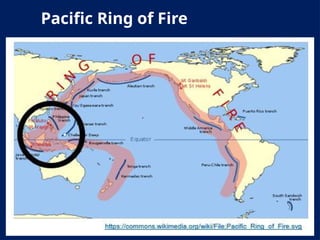
Pacific Ring of Fire
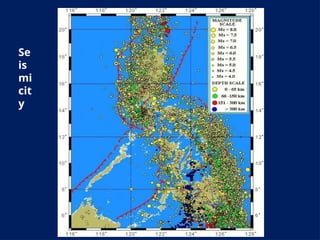
Active Faults and Trenches
Se
is
mi
cit
y
Pacific Typhoon Belt
What is DRRM?
Disaster Risk Reduction and Management
(DRRM): the systematic process of using
administrative directives, organizations, and
operational skills and capacities to implement
strategies, policies and improved coping
capacities in order to lessen the adverse
impacts of hazards and the possibility of
disaster.
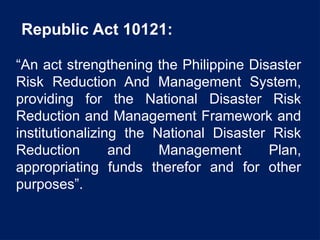
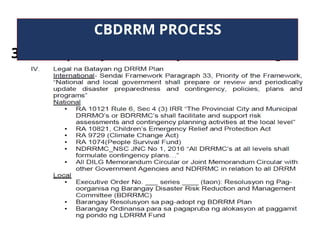
Republic Act 10121:
“An act strengthening the Philippine Disaster
Risk Reduction And Management System,
providing for the National Disaster Risk
Reduction and Management Framework and
institutionalizing the National Disaster Risk
Reduction and Management Plan,
appropriating funds therefor and for other
purposes”.
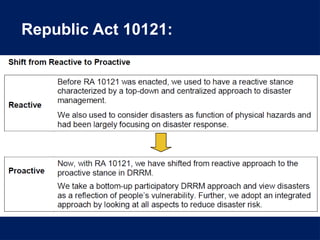
Republic Act 10121:
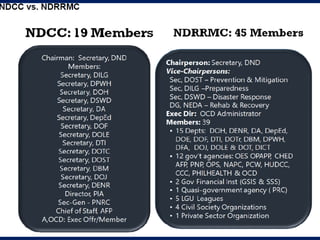
Republic Act 10121:
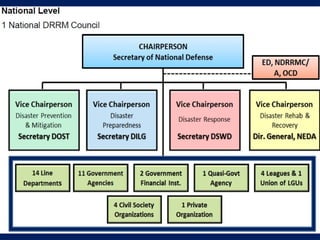
Republic Act 10121:
Republic Act 10121:
Question 1:
Introduction to
Community-based
Disaster Risk
Reduction and
Management
Basic Disaster Concepts
What is Disaster?
Section 3-h of Republic Act 10121 defines disaster as a
serious disruption of the functioning of a community or a
society involving widespread human, material, economic or
environmental losses and impacts, which exceeds the ability
of the affected community or society to cope using its own
resources.
It entails the combination of exposure to hazard, the
vulnerable conditions that are present, and the lack of
capacity or resources for communities to reduce or cope with
the negative sequences of the situation.
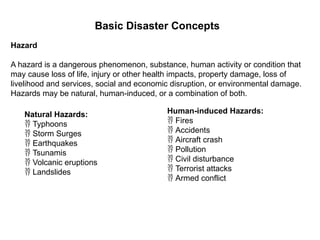
Basic Disaster Concepts
Hazard
A hazard is a dangerous phenomenon, substance, human activity or condition that
may cause loss of life, injury or other health impacts, property damage, loss of
livelihood and services, social and economic disruption, or environmental damage.
Hazards may be natural, human-induced, or a combination of both.
Natural Hazards:
 Typhoons
 Storm Surges
 Earthquakes
 Tsunamis
 Volcanic eruptions
 Landslides
Human-induced Hazards:
 Fires
 Accidents
 Aircraft crash
 Pollution
 Civil disturbance
 Terrorist attacks
 Armed conflict
Vulnerability
Vulnerability refers to the characteristics and circumstances of a
community, system, or asset that make it susceptible to the
damaging effects of a hazard. It explains why people,
livelihoods, and properties located in areas where hazards
occur can suffer damage and loss.
Examples of vulnerability are:
 Poverty
 Attitude of helplessness
 Lack of education
 Lack of knowledge and skills
 Conflicts
 Unsafe housing design and construction
 Poor planning
 Ineffective policies
Exposure
Exposure refers to the degree in which a community is likely to
experience hazard events of different magnitudes.
It pertains to the physical location
e.g. on the foot of a volcano, proximity to a body of water, low-
lying area),
characteristics (type of soil, topography, temperature), and
population density (over population, congestion) of a community
that “exposes” it to hazards.
Capacity
Capacity refers to the ability of the households and
communities to cope when hazards occur. It is the
combination of all the strengths, attributes and
resources available within a community, society or
organization that can be used to achieve agreed goals.
Examples of capacity are:
 Adequate food and income sources
 Permanent and safe housing
 Land ownership
 Family and community support
 Local knowledge and skills
 Responsive and sound policies
Disaster Risk
Disaster risk refers to the potential disaster
losses in lives, health status, livelihood, assets
and services, which could occur to a particular
community or society over some specified
future time period.
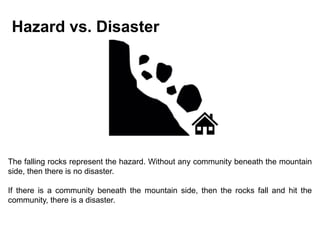
Hazard vs. Disaster
The falling rocks represent the hazard. Without any community beneath the mountain
side, then there is no disaster.
If there is a community beneath the mountain side, then the rocks fall and hit the
community, there is a disaster.
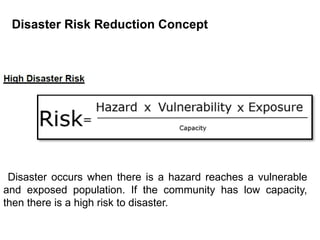
Disaster Risk Reduction Concept
Disaster occurs when there is a hazard reaches a vulnerable
and exposed population. If the community has low capacity,
then there is a high risk to disaster.
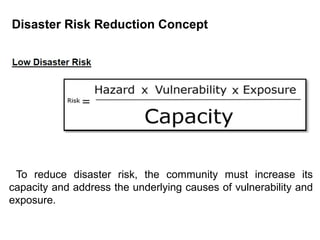
Disaster Risk Reduction Concept
To reduce disaster risk, the community must increase its
capacity and address the underlying causes of vulnerability and
exposure.
Elements at Risk to Disasters
Disaster risk is particularly directed towards these elements:
 Communities, families and individuals
 Facilities and properties like houses, roads, bridges, schools
and hospitals
 Livelihoods and the economy
 Nature and environment
Let us make sure that these elements do not suffer from
disaster impacts.
Natural Disaster
There is no such thing as “natural disaster,”
only natural hazard.
Reducing disaster risk by addressing
vulnerabilities, minimizing exposures and
increasing capacities can be made by humans.
Therefore, there is no natural disaster
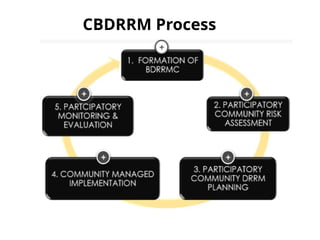
CBDRRM Process
Formation of BDRRMC
This step entails organizing and mobilizing
the officials and key stakeholders of the
barangay to orient, and to form/activate the
Barangay Disaster Risk Reduction and
Management Committee (BDRRMC).
Participatory Community Risk
Assessment
The BDRRMC members should then consult the
people in the community, especially the most
vulnerable sectors, to participate in hazard, risk,
vulnerability, and capacity assessment activities.
Participatory CBDRRM Planning
Having identified, assessed, and analyzed the hazards and
risks in the community; the next step is for the BDRRMC
members to seek the inputs and support of the community
people in developing the Barangay DRRM plan.
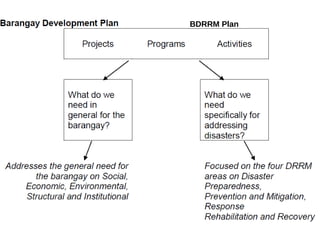
This plan identifies all barangay programs, projects, and
activities (PPAs) to reduce and manage these risks.
The people should be part of the planning process, so that
they could readily cooperate, and provide support in the
implementation of the plan. Such would also ensure the
sustainability of DRRM efforts as it has the support of the
people.
Community-Managed Implementation
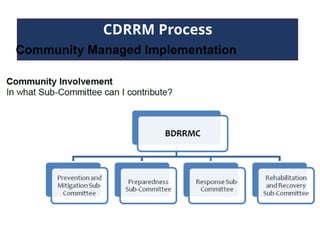
Once the CBDRRM Plan is finalized and approved,
the BDRRMC should again solicit the support and
participation of the people (through membership in
sub-committees) when the plan is implemented.
Participatory Monitoring and
Evaluation
This step, likewise, necessitates the involvement of
community members in keeping track of the
progress of the CBDRRM plan, and in determining
if the planned objectives are being met. Such
would enable the BDRRMC to make corrective or
remedial measures in the plans that are supported
by community residents.
Participatory Monitoring and
Evaluation
This step, likewise, necessitates the involvement of
community members in keeping track of the
progress of the CBDRRM plan, and in determining
if the planned objectives are being met. Such
would enable the BDRRMC to make corrective or
remedial measures in the plans that are supported
by community residents.
1. Formation of Barangay
Disaster Risk Reduction and
Management Committee
CBDRRM PROCESS
1. Formation of BDRRMC
CBDRRM PROCESS
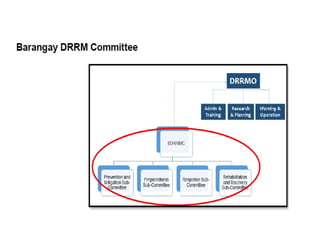
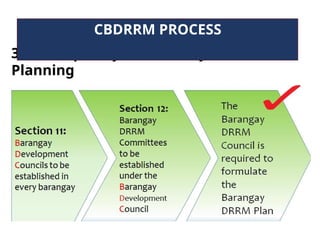
RA 10121 Section 11: Barangay Development
Councils to serve as LDRRMCs Section 12:
Barangay DRRM Committees to be established
under the BDC
BDRRMC
• Responsible for implementing DRRM within the
barangay
• Ensures participation of at least two (2) CSOs
representing vulnerable and marginalized groups
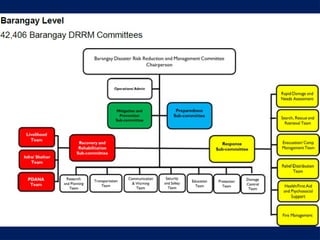
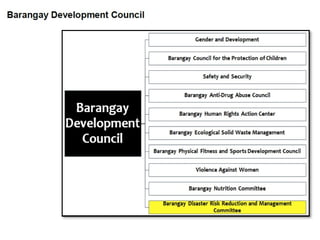
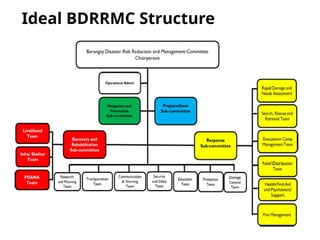
Ideal BDRRMC Structure
Session 2.
Participatory Community Risk
Assessment
CBDRRM PROCESS
2. Participatory Community Risk Assessment
CBDRRM PROCESS
Community Risk Assessment (CRA)
A method to determine the nature and extent of
risks by analyzing potential hazards and
evaluating vulnerability of the communities
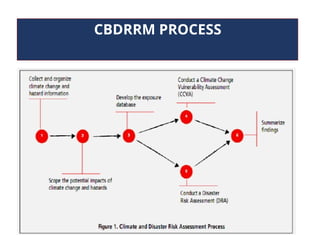
Climate and Disaster Risk Assessment
CBDRRM PROCESS
Community Risk Assessment
CBDRRM PROCESS
Why Conduct CRA?
CRA  Provides baseline data  identifies
appropriate and adequate DRRM measures
Community Risk Assessment
CBDRRM PROCESS
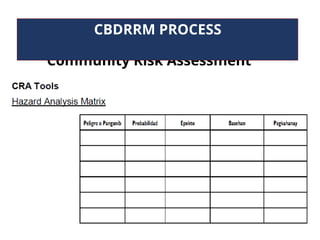
Community Risk Assessment
CBDRRM PROCESS
Hazard Rating
Community Risk Assessment
CBDRRM PROCESS
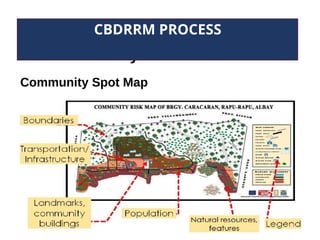
Community Spot Map
Community Risk Assessment
CBDRRM PROCESS
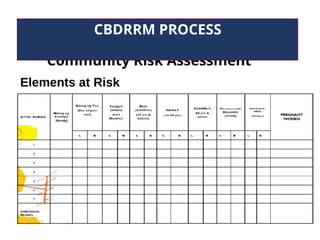
Elements at Risk
Community Risk Assessment
CBDRRM PROCESS
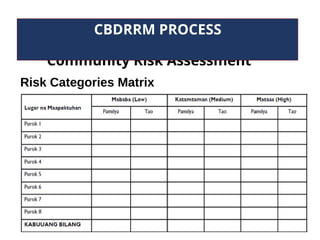
Risk Categories Matrix
Community Risk Assessment
CBDRRM PROCESS
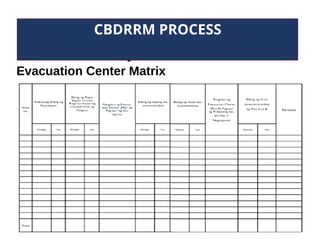
Evacuation Center Matrix
Community Risk Assessment
CBDRRM PROCESS
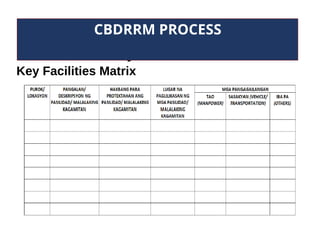
Key Facilities Matrix
Community Risk Assessment
CBDRRM PROCESS
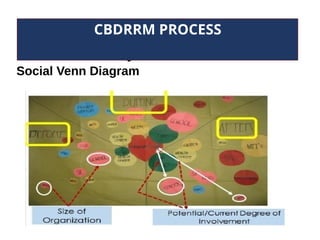
Social Venn Diagram
Community Risk Assessment
CBDRRM PROCESS
Important Points
• CRA allows communities to determine their
own risks and identify the appropriate DRRM
interventions.
• Several CRA tools exist. Choose what is
appropriate for your community.
Session 3.
Participatory Community
DRRM Planning
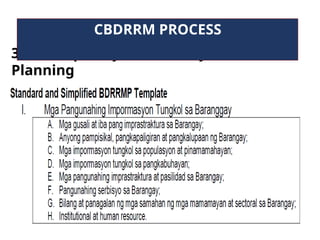
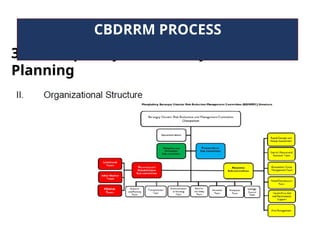
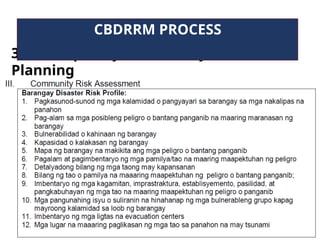
CBDRRM PROCESS
3. Participatory Community DRRM
Planning
CBDRRM PROCESS
Now that initial CRA has been conducted, we
will now proceed to the formulation of our
BDRRM Plan. The results of our CRA are
necessary to come up with an appropriate
DRRM Plan.
3. Participatory Community DRRM
Planning
CBDRRM PROCESS
3. Participatory Community DRRM
Planning
CBDRRM PROCESS
Barangay DRRM Plan
Covers all DRRM programs, projects, and activities
to be undertaken before, during, and after disaster
3. Participatory Community DRRM
Planning
CBDRRM PROCESS
BDRRM Plan
3. Participatory Community DRRM
Planning
CBDRRM PROCESS
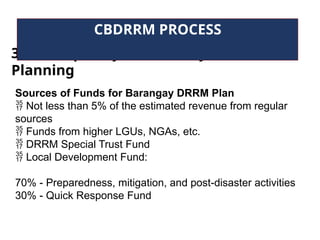
Sources of Funds for Barangay DRRM Plan
 Not less than 5% of the estimated revenue from regular
sources
 Funds from higher LGUs, NGAs, etc.
 DRRM Special Trust Fund
 Local Development Fund:
70% - Preparedness, mitigation, and post-disaster activities
30% - Quick Response Fund
Standard and Simplified
BDRRM Plan
A review
BDRRM Plan
3. Participatory Community DRRM
Planning
CBDRRM PROCESS
3. Participatory Community DRRM
Planning
CBDRRM PROCESS
3. Participatory Community DRRM
Planning
CBDRRM PROCESS
3. Participatory Community DRRM Planning
CBDRRM PROCESS
3. Participatory Community DRRM
Planning
CBDRRM PROCESS
3. Participatory Community DRRM
Planning
CBDRRM PROCESS
Writing the BDRRM Plan The primary responsibility of the
Barangay DRRM Council:
• Extensive and detailed data gathering
• Consultation with officials and community
• BDRRMC officials to consult with relevant local officials and
agencies
• Everyone must bring baseline demographic data obtained
from the barangay
Resource Management- vital in the implementation of PPAs
for DRRM to address the vulnerabilities and needs identified
in the CRA session
3. Participatory Community DRRM
Planning
CBDRRM PROCESS
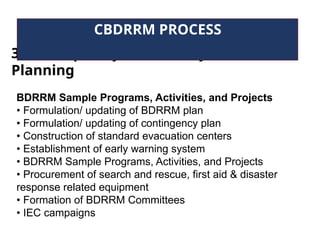
BDRRM Sample Programs, Activities, and Projects
• Formulation/ updating of BDRRM plan
• Formulation/ updating of contingency plan
• Construction of standard evacuation centers
• Establishment of early warning system
• BDRRM Sample Programs, Activities, and Projects
• Procurement of search and rescue, first aid & disaster
response related equipment
• Formation of BDRRM Committees
• IEC campaigns
3. Participatory Community DRRM
Planning
CBDRRM PROCESS
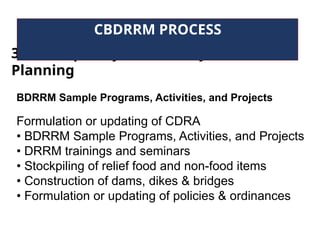
BDRRM Sample Programs, Activities, and Projects
Formulation or updating of CDRA
• BDRRM Sample Programs, Activities, and Projects
• DRRM trainings and seminars
• Stockpiling of relief food and non-food items
• Construction of dams, dikes & bridges
• Formulation or updating of policies & ordinances
3. Participatory Community DRRM
Planning
CBDRRM PROCESS
1. Disaster Prevention and Mitigation
2. Disaster Preparedness
3. Disaster Response
4. Disaster Rehabilitation and Recovery
Disaster Prevention and Mitigation
4 DRRM Thematic Areas
Disaster Prevention
4 DRRM Thematic Areas
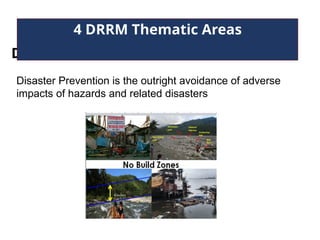
Disaster Prevention is the outright avoidance of adverse
impacts of hazards and related disasters
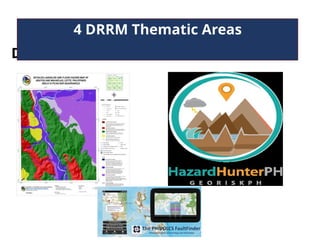
Disaster Prevention Tools
4 DRRM Thematic Areas
Disaster Mitigation
4 DRRM Thematic Areas
The lessening or limitation of the adverse impacts of
hazards and related disasters Kinds of Mitigation
Disaster Mitigation
4 DRRM Thematic Areas
Kinds of Mitigation
Structural/ Engineering Measures
• Seawall
• Embankments
• Floodgates
• Tsunami sensors and Deep-ocean Assessment and
Reporting of Tsunamis System (DARTS),
• Retrofitting of structures
Disaster Mitigation
4 DRRM Thematic Areas
Kinds of Mitigation
Non-Structural/ Non-Engineering Measures
• Community-based maps
• Legislation and land use regulation
• Waste Management
• Mangrove reforestation
Disaster Mitigation
4 DRRM Thematic Areas
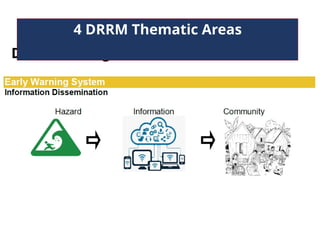
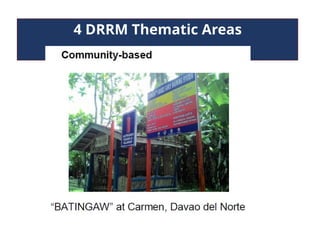
How do we give a warning?
• House-to-house warning
• Text messaging
• Radio/ megaphone
• Community meeting
• Local warning signals
• Posters
4 DRRM Thematic Areas
How do you give warning for people
with special needs?
PWD-inclusive EWS could include:
• Auditory signals/ alarms
• Visual signals with lighting during
nighttime
• Clear and brief announcements
• Text messages
• Door-to-door notification
4 DRRM Thematic Areas
How can you contribute in Disaster
Prevention and Mitigation?
• Help preserve the environment
• Check if your houses are exposed to hazards
• Develop your own localized early warning
system
4 DRRM Thematic Areas
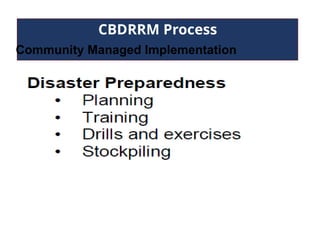
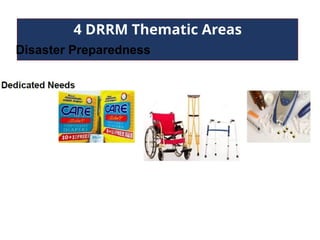
Disaster Preparedness
4 DRRM Thematic Areas
Disaster Preparedness is the knowledge and capacities to
effectively anticipate, respond to, and recover from impacts
of hazards
Disaster Preparedness Examples
• Contingency Planning
• Stockpiling of equipment and supplies
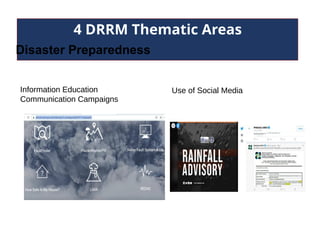
• Information, Education, and Communication Campaigns
• Training and simulation exercises
Disaster Preparedness
4 DRRM Thematic Areas
Training Courses
• Incident Command System
• Community First Responder
• First Aid Training
• Basic Life Support
• Search and Rescue
• Logistics Training
• Contingency Planning
• Climate Change Action Planning
• Mental Health and Psychosocial Support
• Livelihood Training
Disaster Preparedness
4 DRRM Thematic Areas
Disaster Preparedness
4 DRRM Thematic Areas
Disaster Preparedness
4 DRRM Thematic Areas
Disaster Preparedness
Information Education
Communication Campaigns
Use of Social Media
4 DRRM Thematic Areas
Disaster Preparedness
4 DRRM Thematic Areas
Disaster Preparedness
4 DRRM Thematic Areas
Disaster Preparedness
4 DRRM Thematic Areas
Disaster Preparedness
4 DRRM Thematic Areas
Disaster Preparedness
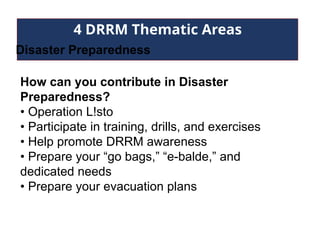
How can you contribute in Disaster
Preparedness?
• Operation L!sto
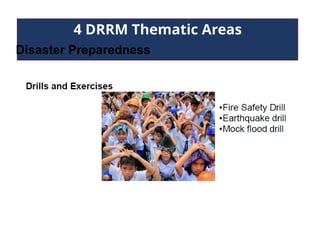
• Participate in training, drills, and exercises
• Help promote DRRM awareness
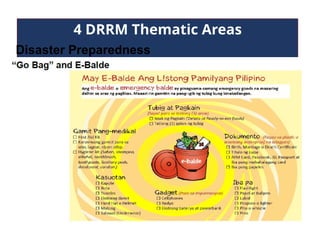
• Prepare your “go bags,” “e-balde,” and
dedicated needs
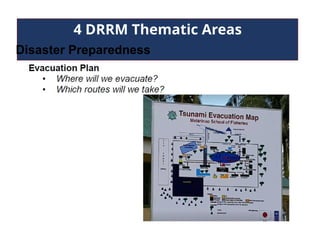
• Prepare your evacuation plans
4 DRRM Thematic Areas
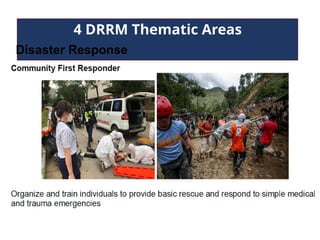
Disaster Response
4 DRRM Thematic Areas
Disaster Response
Disaster Response is the provision of emergency
services and public assistance during or
immediately after a disaster
Roles and Responsibilities
• Barangay Captain
• BDRRMC
• Communities, Families, and Individuals
4 DRRM Thematic Areas
Disaster Response
Community Response: Evacuation
Priorities for Evacuation
• Communities at risk
• Children
• Senior citizens
• PWDs
• Vulnerable sectors
4 DRRM Thematic Areas
Disaster Response
Relief Distribution
Ensure the survival of the affected population by
providing emergency health services, temporary
shelter, food, and non-food items
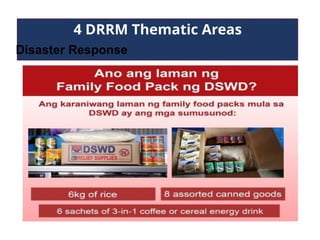
• Provision of Food and Non-Food Items
• Family Food Pack
4 DRRM Thematic Areas
Disaster Response
4 DRRM Thematic Areas
Disaster Response
4 DRRM Thematic Areas
Disaster Response
How can you contribute in Disaster
Response?
• Follow evacuation procedures
• Support in relief distribution
• Mobilize community first responders
• Ensure family and individual safety
4 DRRM Thematic Areas
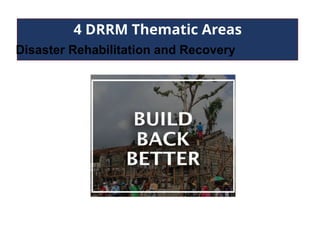
Disaster Rehabilitation and Recovery
4 DRRM Thematic Areas
Disaster Rehabilitation and Recovery
• Restoration of affected communities to their
normal functioning level
• Improvement of facilities, livelihood, and living
conditions
4 DRRM Thematic Areas
Disaster Rehabilitation and Recovery
4 DRRM Thematic Areas
Disaster Rehabilitation and Recovery
Post-Disaster Needs Assessment (PDNA) A multi- sectoral
and multi- disciplinary structured approach for assessing
disaster impacts and prioritizing recovery and reconstruction
needs
Post-Disaster Needs Assessment
1. How will we recover from the disaster?
2. How much will we need?
Role of BDRRMC in PDNA
• Provides community baseline data
• Determines priority rehabilitation and recovery needs for the
barangay
4 DRRM Thematic Areas
Disaster Rehabilitation and Recovery
Priority Sectors
Infrastructure
• power supply
• water supply
• telecommunications
• transportation facilities
Productive
• agriculture
• mining
• tourism
• industry
• trade
• services
Social
• education
• health
• housing
• culture
• nutrition
Cross-sectoral
• government
• economics
• social impact assessment
• environment
4 DRRM Thematic Areas
Disaster Rehabilitation and Recovery
How can you contribute in Disaster Rehabilitation and
Recovery?
• Bayanihan
• Seek mental health and psychosocial support services
• Seek guidance from local authorities
• Ensure safety and protection from health risks when
cleaning your houses
• Participate in community rehabilitation and recovery
CDRRM Process
Session 4.
Community Managed
Implementation
CDRRM Process
Community Managed Implementation
CBDRRM Process
Community Managed Implementation
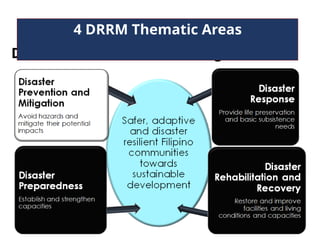
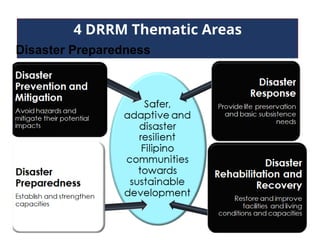
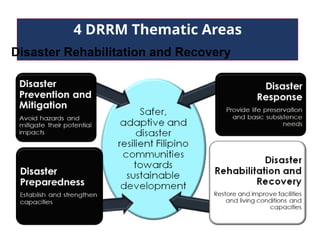
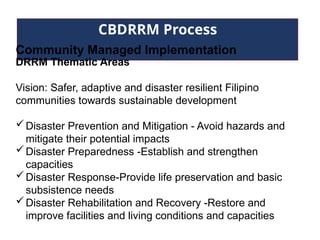
DRRM Thematic Areas
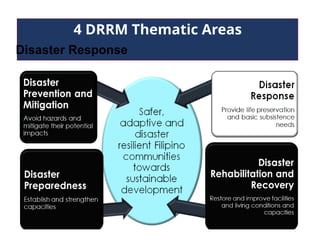
Vision: Safer, adaptive and disaster resilient Filipino
communities towards sustainable development
Disaster Prevention and Mitigation - Avoid hazards and
mitigate their potential impacts
Disaster Preparedness -Establish and strengthen
capacities
Disaster Response-Provide life preservation and basic
subsistence needs
Disaster Rehabilitation and Recovery -Restore and
improve facilities and living conditions and capacities
CBDRRM Process
Community Managed Implementation
CBDRRM Process
Community Managed Implementation
CBDRRM Process
Community Managed Implementation
Disaster Rehabilitation and Recovery
• Post-disaster needs assessment
• Repair of damages
• Review and improvement of policies &
plans
• Resettlement
• Provision of new sources of livelihood
CBDRRM Process
Community Managed Implementation
Who will implement the
Barangay DRRM Plan?
CBDRRM Process
Session 5. Participatory
Monitoring and Evaluation
CBDRRM Process
Participatory Monitoring and Evaluation
What is Monitoring? Monitoring is the process of
gathering information that will determine the progress of
the implementation of the plan to make timely corrective
measures to ensure that progress is maintained according
to schedule.
What is Evaluation? Evaluation is the process of
collecting and analyzing information that will enable the
organization to determine what happened to a particular
plan so that performance can be enhanced.
CBDRRM Process
Participatory Monitoring and Evaluation
Monitoring and Evaluation
• Ensure that the Barangay DRRM Plan is
implemented on time
• Lessons from the past experiences become
input to the plan altogether
• Identify appropriate revisions in the Barangay
DRRM Plan
CBDRRM Process
Participatory Monitoring and Evaluation
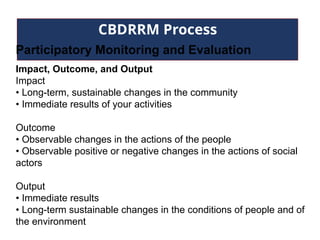
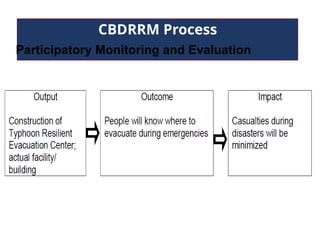
Impact, Outcome, and Output
Impact
• Long-term, sustainable changes in the community
• Immediate results of your activities
Outcome
• Observable changes in the actions of the people
• Observable positive or negative changes in the actions of social
actors
Output
• Immediate results
• Long-term sustainable changes in the conditions of people and of
the environment
CBDRRM Process
Participatory Monitoring and Evaluation
CBDRRM Process
Participatory Monitoring and Evaluation
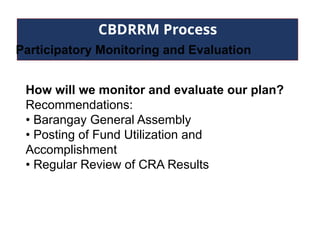
How will we monitor and evaluate our plan?
Recommendations:
• Barangay General Assembly
• Posting of Fund Utilization and
Accomplishment
• Regular Review of CRA Results
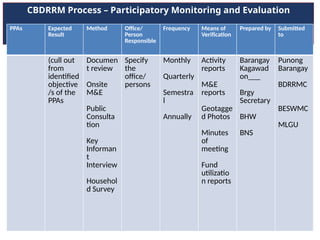
CBDRRM Process – Participatory Monitoring and Evaluation
PPAs Expected
Result
Method Office/
Person
Responsible
Frequency Means of
Verification
Prepared by Submitted
to
(cull out
from
identified
objective
/s of the
PPAs
Documen
t review
Onsite
M&E
Public
Consulta
tion
Key
Informan
t
Interview
Househol
d Survey
Specify
the
office/
persons
Monthly
Quarterly
Semestra
l
Annually
Activity
reports
M&E
reports
Geotagge
d Photos
Minutes
of
meeting
Fund
utilizatio
n reports
Barangay
Kagawad
on___
Brgy
Secretary
BHW
BNS
Punong
Barangay
BDRRMC
BESWMC
MLGU
CBDRRM Process
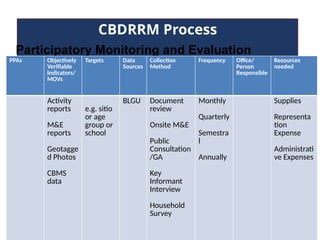
Participatory Monitoring and Evaluation
PPAs Objectively
Verifiable
Indicators/
MOVs
Targets Data
Sources
Collection
Method
Frequency Office/
Person
Responsible
Resources
needed
Activity
reports
M&E
reports
Geotagge
d Photos
CBMS
data
e.g. sitio
or age
group or
school
BLGU Document
review
Onsite M&E
Public
Consultation
/GA
Key
Informant
Interview
Household
Survey
Monthly
Quarterly
Semestra
l
Annually
Supplies
Representa
tion
Expense
Administrati
ve Expenses
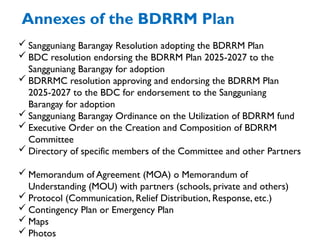
Annexes of the BDRRM Plan
 Sangguniang Barangay Resolution adopting the BDRRM Plan
 BDC resolution endorsing the BDRRM Plan 2025-2027 to the
Sangguniang Barangay for adoption
 BDRRMC resolution approving and endorsing the BDRRM Plan
2025-2027 to the BDC for endorsement to the Sangguniang
Barangay for adoption
 Sangguniang Barangay Ordinance on the Utilization of BDRRM fund
 Executive Order on the Creation and Composition of BDRRM
Committee
 Directory of specific members of the Committee and other Partners
 Memorandum of Agreement (MOA) o Memorandum of
Understanding (MOU) with partners (schools, private and others)
 Protocol (Communication, Relief Distribution, Response, etc.)
 Contingency Plan or Emergency Plan
 Maps
 Photos

2024 CBDRRM Training for BDRRMCs_Plannings.pptx

  • 1.
  • 2.
  • 3.
  • 4.
  • 5.
  • 6.
  • 8.
    What is DRRM? DisasterRisk Reduction and Management (DRRM): the systematic process of using administrative directives, organizations, and operational skills and capacities to implement strategies, policies and improved coping capacities in order to lessen the adverse impacts of hazards and the possibility of disaster.
  • 9.
    Republic Act 10121: “Anact strengthening the Philippine Disaster Risk Reduction And Management System, providing for the National Disaster Risk Reduction and Management Framework and institutionalizing the National Disaster Risk Reduction and Management Plan, appropriating funds therefor and for other purposes”.
  • 10.
  • 12.
  • 13.
  • 14.
  • 18.
  • 19.
  • 20.
    Basic Disaster Concepts Whatis Disaster? Section 3-h of Republic Act 10121 defines disaster as a serious disruption of the functioning of a community or a society involving widespread human, material, economic or environmental losses and impacts, which exceeds the ability of the affected community or society to cope using its own resources. It entails the combination of exposure to hazard, the vulnerable conditions that are present, and the lack of capacity or resources for communities to reduce or cope with the negative sequences of the situation.
  • 21.
    Basic Disaster Concepts Hazard Ahazard is a dangerous phenomenon, substance, human activity or condition that may cause loss of life, injury or other health impacts, property damage, loss of livelihood and services, social and economic disruption, or environmental damage. Hazards may be natural, human-induced, or a combination of both. Natural Hazards:  Typhoons  Storm Surges  Earthquakes  Tsunamis  Volcanic eruptions  Landslides Human-induced Hazards:  Fires  Accidents  Aircraft crash  Pollution  Civil disturbance  Terrorist attacks  Armed conflict
  • 22.
    Vulnerability Vulnerability refers tothe characteristics and circumstances of a community, system, or asset that make it susceptible to the damaging effects of a hazard. It explains why people, livelihoods, and properties located in areas where hazards occur can suffer damage and loss. Examples of vulnerability are:  Poverty  Attitude of helplessness  Lack of education  Lack of knowledge and skills  Conflicts  Unsafe housing design and construction  Poor planning  Ineffective policies
  • 23.
    Exposure Exposure refers tothe degree in which a community is likely to experience hazard events of different magnitudes. It pertains to the physical location e.g. on the foot of a volcano, proximity to a body of water, low- lying area), characteristics (type of soil, topography, temperature), and population density (over population, congestion) of a community that “exposes” it to hazards.
  • 24.
    Capacity Capacity refers tothe ability of the households and communities to cope when hazards occur. It is the combination of all the strengths, attributes and resources available within a community, society or organization that can be used to achieve agreed goals. Examples of capacity are:  Adequate food and income sources  Permanent and safe housing  Land ownership  Family and community support  Local knowledge and skills  Responsive and sound policies
  • 25.
    Disaster Risk Disaster riskrefers to the potential disaster losses in lives, health status, livelihood, assets and services, which could occur to a particular community or society over some specified future time period.
  • 26.
    Hazard vs. Disaster Thefalling rocks represent the hazard. Without any community beneath the mountain side, then there is no disaster. If there is a community beneath the mountain side, then the rocks fall and hit the community, there is a disaster.
  • 27.
    Disaster Risk ReductionConcept Disaster occurs when there is a hazard reaches a vulnerable and exposed population. If the community has low capacity, then there is a high risk to disaster.
  • 28.
    Disaster Risk ReductionConcept To reduce disaster risk, the community must increase its capacity and address the underlying causes of vulnerability and exposure.
  • 29.
    Elements at Riskto Disasters Disaster risk is particularly directed towards these elements:  Communities, families and individuals  Facilities and properties like houses, roads, bridges, schools and hospitals  Livelihoods and the economy  Nature and environment Let us make sure that these elements do not suffer from disaster impacts.
  • 30.
    Natural Disaster There isno such thing as “natural disaster,” only natural hazard. Reducing disaster risk by addressing vulnerabilities, minimizing exposures and increasing capacities can be made by humans. Therefore, there is no natural disaster
  • 31.
  • 32.
    Formation of BDRRMC Thisstep entails organizing and mobilizing the officials and key stakeholders of the barangay to orient, and to form/activate the Barangay Disaster Risk Reduction and Management Committee (BDRRMC).
  • 33.
    Participatory Community Risk Assessment TheBDRRMC members should then consult the people in the community, especially the most vulnerable sectors, to participate in hazard, risk, vulnerability, and capacity assessment activities.
  • 34.
    Participatory CBDRRM Planning Havingidentified, assessed, and analyzed the hazards and risks in the community; the next step is for the BDRRMC members to seek the inputs and support of the community people in developing the Barangay DRRM plan. This plan identifies all barangay programs, projects, and activities (PPAs) to reduce and manage these risks. The people should be part of the planning process, so that they could readily cooperate, and provide support in the implementation of the plan. Such would also ensure the sustainability of DRRM efforts as it has the support of the people.
  • 35.
    Community-Managed Implementation Once theCBDRRM Plan is finalized and approved, the BDRRMC should again solicit the support and participation of the people (through membership in sub-committees) when the plan is implemented.
  • 36.
    Participatory Monitoring and Evaluation Thisstep, likewise, necessitates the involvement of community members in keeping track of the progress of the CBDRRM plan, and in determining if the planned objectives are being met. Such would enable the BDRRMC to make corrective or remedial measures in the plans that are supported by community residents.
  • 37.
    Participatory Monitoring and Evaluation Thisstep, likewise, necessitates the involvement of community members in keeping track of the progress of the CBDRRM plan, and in determining if the planned objectives are being met. Such would enable the BDRRMC to make corrective or remedial measures in the plans that are supported by community residents.
  • 38.
    1. Formation ofBarangay Disaster Risk Reduction and Management Committee CBDRRM PROCESS
  • 39.
    1. Formation ofBDRRMC CBDRRM PROCESS RA 10121 Section 11: Barangay Development Councils to serve as LDRRMCs Section 12: Barangay DRRM Committees to be established under the BDC BDRRMC • Responsible for implementing DRRM within the barangay • Ensures participation of at least two (2) CSOs representing vulnerable and marginalized groups
  • 42.
  • 43.
    Session 2. Participatory CommunityRisk Assessment CBDRRM PROCESS
  • 44.
    2. Participatory CommunityRisk Assessment CBDRRM PROCESS Community Risk Assessment (CRA) A method to determine the nature and extent of risks by analyzing potential hazards and evaluating vulnerability of the communities
  • 45.
    Climate and DisasterRisk Assessment CBDRRM PROCESS
  • 46.
    Community Risk Assessment CBDRRMPROCESS Why Conduct CRA? CRA  Provides baseline data  identifies appropriate and adequate DRRM measures
  • 51.
  • 52.
    Community Risk Assessment CBDRRMPROCESS Hazard Rating
  • 53.
    Community Risk Assessment CBDRRMPROCESS Community Spot Map
  • 54.
    Community Risk Assessment CBDRRMPROCESS Elements at Risk
  • 55.
    Community Risk Assessment CBDRRMPROCESS Risk Categories Matrix
  • 56.
    Community Risk Assessment CBDRRMPROCESS Evacuation Center Matrix
  • 57.
    Community Risk Assessment CBDRRMPROCESS Key Facilities Matrix
  • 58.
    Community Risk Assessment CBDRRMPROCESS Social Venn Diagram
  • 59.
    Community Risk Assessment CBDRRMPROCESS Important Points • CRA allows communities to determine their own risks and identify the appropriate DRRM interventions. • Several CRA tools exist. Choose what is appropriate for your community.
  • 60.
  • 61.
    3. Participatory CommunityDRRM Planning CBDRRM PROCESS Now that initial CRA has been conducted, we will now proceed to the formulation of our BDRRM Plan. The results of our CRA are necessary to come up with an appropriate DRRM Plan.
  • 62.
    3. Participatory CommunityDRRM Planning CBDRRM PROCESS
  • 63.
    3. Participatory CommunityDRRM Planning CBDRRM PROCESS Barangay DRRM Plan Covers all DRRM programs, projects, and activities to be undertaken before, during, and after disaster
  • 64.
    3. Participatory CommunityDRRM Planning CBDRRM PROCESS BDRRM Plan
  • 65.
    3. Participatory CommunityDRRM Planning CBDRRM PROCESS Sources of Funds for Barangay DRRM Plan  Not less than 5% of the estimated revenue from regular sources  Funds from higher LGUs, NGAs, etc.  DRRM Special Trust Fund  Local Development Fund: 70% - Preparedness, mitigation, and post-disaster activities 30% - Quick Response Fund
  • 66.
    Standard and Simplified BDRRMPlan A review BDRRM Plan
  • 67.
    3. Participatory CommunityDRRM Planning CBDRRM PROCESS
  • 68.
    3. Participatory CommunityDRRM Planning CBDRRM PROCESS
  • 69.
    3. Participatory CommunityDRRM Planning CBDRRM PROCESS
  • 70.
    3. Participatory CommunityDRRM Planning CBDRRM PROCESS
  • 71.
    3. Participatory CommunityDRRM Planning CBDRRM PROCESS
  • 72.
    3. Participatory CommunityDRRM Planning CBDRRM PROCESS Writing the BDRRM Plan The primary responsibility of the Barangay DRRM Council: • Extensive and detailed data gathering • Consultation with officials and community • BDRRMC officials to consult with relevant local officials and agencies • Everyone must bring baseline demographic data obtained from the barangay Resource Management- vital in the implementation of PPAs for DRRM to address the vulnerabilities and needs identified in the CRA session
  • 73.
    3. Participatory CommunityDRRM Planning CBDRRM PROCESS BDRRM Sample Programs, Activities, and Projects • Formulation/ updating of BDRRM plan • Formulation/ updating of contingency plan • Construction of standard evacuation centers • Establishment of early warning system • BDRRM Sample Programs, Activities, and Projects • Procurement of search and rescue, first aid & disaster response related equipment • Formation of BDRRM Committees • IEC campaigns
  • 74.
    3. Participatory CommunityDRRM Planning CBDRRM PROCESS BDRRM Sample Programs, Activities, and Projects Formulation or updating of CDRA • BDRRM Sample Programs, Activities, and Projects • DRRM trainings and seminars • Stockpiling of relief food and non-food items • Construction of dams, dikes & bridges • Formulation or updating of policies & ordinances
  • 75.
    3. Participatory CommunityDRRM Planning CBDRRM PROCESS 1. Disaster Prevention and Mitigation 2. Disaster Preparedness 3. Disaster Response 4. Disaster Rehabilitation and Recovery
  • 76.
    Disaster Prevention andMitigation 4 DRRM Thematic Areas
  • 77.
    Disaster Prevention 4 DRRMThematic Areas Disaster Prevention is the outright avoidance of adverse impacts of hazards and related disasters
  • 78.
    Disaster Prevention Tools 4DRRM Thematic Areas
  • 79.
    Disaster Mitigation 4 DRRMThematic Areas The lessening or limitation of the adverse impacts of hazards and related disasters Kinds of Mitigation
  • 80.
    Disaster Mitigation 4 DRRMThematic Areas Kinds of Mitigation Structural/ Engineering Measures • Seawall • Embankments • Floodgates • Tsunami sensors and Deep-ocean Assessment and Reporting of Tsunamis System (DARTS), • Retrofitting of structures
  • 81.
    Disaster Mitigation 4 DRRMThematic Areas Kinds of Mitigation Non-Structural/ Non-Engineering Measures • Community-based maps • Legislation and land use regulation • Waste Management • Mangrove reforestation
  • 82.
  • 84.
    4 DRRM ThematicAreas How do we give a warning? • House-to-house warning • Text messaging • Radio/ megaphone • Community meeting • Local warning signals • Posters
  • 85.
    4 DRRM ThematicAreas How do you give warning for people with special needs? PWD-inclusive EWS could include: • Auditory signals/ alarms • Visual signals with lighting during nighttime • Clear and brief announcements • Text messages • Door-to-door notification
  • 86.
  • 87.
    4 DRRM ThematicAreas How can you contribute in Disaster Prevention and Mitigation? • Help preserve the environment • Check if your houses are exposed to hazards • Develop your own localized early warning system
  • 88.
    4 DRRM ThematicAreas Disaster Preparedness
  • 89.
    4 DRRM ThematicAreas Disaster Preparedness is the knowledge and capacities to effectively anticipate, respond to, and recover from impacts of hazards Disaster Preparedness Examples • Contingency Planning • Stockpiling of equipment and supplies • Information, Education, and Communication Campaigns • Training and simulation exercises Disaster Preparedness
  • 90.
    4 DRRM ThematicAreas Training Courses • Incident Command System • Community First Responder • First Aid Training • Basic Life Support • Search and Rescue • Logistics Training • Contingency Planning • Climate Change Action Planning • Mental Health and Psychosocial Support • Livelihood Training Disaster Preparedness
  • 91.
    4 DRRM ThematicAreas Disaster Preparedness
  • 92.
    4 DRRM ThematicAreas Disaster Preparedness
  • 93.
    4 DRRM ThematicAreas Disaster Preparedness Information Education Communication Campaigns Use of Social Media
  • 94.
    4 DRRM ThematicAreas Disaster Preparedness
  • 95.
    4 DRRM ThematicAreas Disaster Preparedness
  • 96.
    4 DRRM ThematicAreas Disaster Preparedness
  • 97.
    4 DRRM ThematicAreas Disaster Preparedness
  • 98.
    4 DRRM ThematicAreas Disaster Preparedness How can you contribute in Disaster Preparedness? • Operation L!sto • Participate in training, drills, and exercises • Help promote DRRM awareness • Prepare your “go bags,” “e-balde,” and dedicated needs • Prepare your evacuation plans
  • 99.
    4 DRRM ThematicAreas Disaster Response
  • 100.
    4 DRRM ThematicAreas Disaster Response Disaster Response is the provision of emergency services and public assistance during or immediately after a disaster Roles and Responsibilities • Barangay Captain • BDRRMC • Communities, Families, and Individuals
  • 101.
    4 DRRM ThematicAreas Disaster Response Community Response: Evacuation Priorities for Evacuation • Communities at risk • Children • Senior citizens • PWDs • Vulnerable sectors
  • 102.
    4 DRRM ThematicAreas Disaster Response Relief Distribution Ensure the survival of the affected population by providing emergency health services, temporary shelter, food, and non-food items • Provision of Food and Non-Food Items • Family Food Pack
  • 103.
    4 DRRM ThematicAreas Disaster Response
  • 104.
    4 DRRM ThematicAreas Disaster Response
  • 105.
    4 DRRM ThematicAreas Disaster Response How can you contribute in Disaster Response? • Follow evacuation procedures • Support in relief distribution • Mobilize community first responders • Ensure family and individual safety
  • 106.
    4 DRRM ThematicAreas Disaster Rehabilitation and Recovery
  • 107.
    4 DRRM ThematicAreas Disaster Rehabilitation and Recovery Disaster Rehabilitation and Recovery • Restoration of affected communities to their normal functioning level • Improvement of facilities, livelihood, and living conditions
  • 108.
    4 DRRM ThematicAreas Disaster Rehabilitation and Recovery
  • 109.
    4 DRRM ThematicAreas Disaster Rehabilitation and Recovery Post-Disaster Needs Assessment (PDNA) A multi- sectoral and multi- disciplinary structured approach for assessing disaster impacts and prioritizing recovery and reconstruction needs Post-Disaster Needs Assessment 1. How will we recover from the disaster? 2. How much will we need? Role of BDRRMC in PDNA • Provides community baseline data • Determines priority rehabilitation and recovery needs for the barangay
  • 110.
    4 DRRM ThematicAreas Disaster Rehabilitation and Recovery Priority Sectors Infrastructure • power supply • water supply • telecommunications • transportation facilities Productive • agriculture • mining • tourism • industry • trade • services Social • education • health • housing • culture • nutrition Cross-sectoral • government • economics • social impact assessment • environment
  • 111.
    4 DRRM ThematicAreas Disaster Rehabilitation and Recovery How can you contribute in Disaster Rehabilitation and Recovery? • Bayanihan • Seek mental health and psychosocial support services • Seek guidance from local authorities • Ensure safety and protection from health risks when cleaning your houses • Participate in community rehabilitation and recovery
  • 112.
    CDRRM Process Session 4. CommunityManaged Implementation
  • 113.
  • 114.
    CBDRRM Process Community ManagedImplementation DRRM Thematic Areas Vision: Safer, adaptive and disaster resilient Filipino communities towards sustainable development Disaster Prevention and Mitigation - Avoid hazards and mitigate their potential impacts Disaster Preparedness -Establish and strengthen capacities Disaster Response-Provide life preservation and basic subsistence needs Disaster Rehabilitation and Recovery -Restore and improve facilities and living conditions and capacities
  • 115.
  • 116.
  • 117.
    CBDRRM Process Community ManagedImplementation Disaster Rehabilitation and Recovery • Post-disaster needs assessment • Repair of damages • Review and improvement of policies & plans • Resettlement • Provision of new sources of livelihood
  • 118.
    CBDRRM Process Community ManagedImplementation Who will implement the Barangay DRRM Plan?
  • 119.
    CBDRRM Process Session 5.Participatory Monitoring and Evaluation
  • 120.
    CBDRRM Process Participatory Monitoringand Evaluation What is Monitoring? Monitoring is the process of gathering information that will determine the progress of the implementation of the plan to make timely corrective measures to ensure that progress is maintained according to schedule. What is Evaluation? Evaluation is the process of collecting and analyzing information that will enable the organization to determine what happened to a particular plan so that performance can be enhanced.
  • 121.
    CBDRRM Process Participatory Monitoringand Evaluation Monitoring and Evaluation • Ensure that the Barangay DRRM Plan is implemented on time • Lessons from the past experiences become input to the plan altogether • Identify appropriate revisions in the Barangay DRRM Plan
  • 122.
    CBDRRM Process Participatory Monitoringand Evaluation Impact, Outcome, and Output Impact • Long-term, sustainable changes in the community • Immediate results of your activities Outcome • Observable changes in the actions of the people • Observable positive or negative changes in the actions of social actors Output • Immediate results • Long-term sustainable changes in the conditions of people and of the environment
  • 123.
  • 124.
    CBDRRM Process Participatory Monitoringand Evaluation How will we monitor and evaluate our plan? Recommendations: • Barangay General Assembly • Posting of Fund Utilization and Accomplishment • Regular Review of CRA Results
  • 125.
    CBDRRM Process –Participatory Monitoring and Evaluation PPAs Expected Result Method Office/ Person Responsible Frequency Means of Verification Prepared by Submitted to (cull out from identified objective /s of the PPAs Documen t review Onsite M&E Public Consulta tion Key Informan t Interview Househol d Survey Specify the office/ persons Monthly Quarterly Semestra l Annually Activity reports M&E reports Geotagge d Photos Minutes of meeting Fund utilizatio n reports Barangay Kagawad on___ Brgy Secretary BHW BNS Punong Barangay BDRRMC BESWMC MLGU
  • 126.
    CBDRRM Process Participatory Monitoringand Evaluation PPAs Objectively Verifiable Indicators/ MOVs Targets Data Sources Collection Method Frequency Office/ Person Responsible Resources needed Activity reports M&E reports Geotagge d Photos CBMS data e.g. sitio or age group or school BLGU Document review Onsite M&E Public Consultation /GA Key Informant Interview Household Survey Monthly Quarterly Semestra l Annually Supplies Representa tion Expense Administrati ve Expenses
  • 127.
    Annexes of theBDRRM Plan  Sangguniang Barangay Resolution adopting the BDRRM Plan  BDC resolution endorsing the BDRRM Plan 2025-2027 to the Sangguniang Barangay for adoption  BDRRMC resolution approving and endorsing the BDRRM Plan 2025-2027 to the BDC for endorsement to the Sangguniang Barangay for adoption  Sangguniang Barangay Ordinance on the Utilization of BDRRM fund  Executive Order on the Creation and Composition of BDRRM Committee  Directory of specific members of the Committee and other Partners  Memorandum of Agreement (MOA) o Memorandum of Understanding (MOU) with partners (schools, private and others)  Protocol (Communication, Relief Distribution, Response, etc.)  Contingency Plan or Emergency Plan  Maps  Photos

Editor's Notes

  • #38 A. Section 318.The local chief executive shall submit the said executive budget to the sanggunian concerned not later than the sixteenth (16th) of October of the current fiscal year. Disciplinary Actions B. Section 60. Grounds for Disciplinary Actions. - An elective local official may be disciplined, suspended, or removed from office on any of the following grounds: (a) Disloyalty to the Republic of the Philippines; (b) Culpable (Guilty) violation of the Constitution; (c) Dishonesty, oppression, misconduct in office, gross negligence, or dereliction of duty; (d) Commission of any offense involving moral turpitude or an offense punishable by at least prision mayor; (e) Abuse of authority; (f) Unauthorized absence for fifteen (15) consecutive working days, except in the case of members of the sangguniang panlalawigan, sangguniang panlungsod, sangguniang bayan, and sangguniang barangay; (g) Application for, or acquisition of, foreign citizenship or residence or the status of an immigrant of another country; and (h) Such other grounds as may be provided in this Code and other laws. An elective local official may be removed from office on the grounds enumerated above by order of the proper court. C. Section 61. Form and Filing of Administrative Complaints. - A verified complaint against any erring local elective official shall be prepared as follows: (a) A complaint against any elective official of a province, a highly urbanized city, an independent component city or component city shall be filed before the Office of the President; (b) A complaint against any elective official of a municipality shall be filed before the sangguniang panlalawigan whose decision may be appealed to the Office of the President; and (c) A complaint against any elective barangay official shall be filed before the sangguniang panlungsod or sangguniang bayan concerned whose decision shall be final and executory. Section 62. Notice of hearing. - (a) Within seven (7) days after the administrative complaint is filed, the Office of the President or the sanggunian concerned, as the case may be, shall require the respondent to submit his verified answer within fifteen (15) days from receipt thereof, and commence the investigation of the case within ten (10) days after receipt of such answer of the respondent. (b) When the respondent is an elective official of a province or highly urbanized city, such hearing and investigation shall be conducted in the place where he renders or holds office. For all other local elective officials, the venue shall be the place where the sanggunian concerned is located. (c) However, no investigation shall be held within ninety (90) days immediately prior to any local election, and no preventive suspension shall be imposed within the said period. If preventive suspension has been imposed prior to the 90-day period immediately preceding local election, it shall be deemed automatically lifted upon the start of aforesaid period. Section 63. Preventive Suspension. - (a) Preventive suspension may be imposed: (1) By the President, if the respondent is an elective official of a province, a highly urbanized or an independent component city; (2) By the governor, if the respondent is an elective official of a component city or municipality; or (3) By the mayor, if the respondent is an elective official of the barangay. (b) Preventive suspension may be imposed at any time after the issues are joined, when the evidence of guilt is strong, and given the gravity of the offense, there is great probability that the continuance in office of the respondent could influence the witnesses or pose a threat to the safety and integrity of the records and other evidence: Provided, That, any single preventive suspension of local elective officials shall not extend beyond sixty (60) days: Provided, further, That in the event that several administrative cases are filed against an elective official, he cannot be preventively suspended for more than ninety (90) days within a single year on the same ground or grounds existing and known at the time of the first suspension. (c) Upon expiration of the preventive suspension, the suspended elective official shall be deemed reinstated in office without prejudice to the continuation of the proceedings against him, which shall be terminated within one hundred twenty (120) days from the time he was formally notified of the case against him. However, if the delay in the proceedings of the case is due to his fault, neglect, or request, other than the appeal duly filed, the duration of such delay shall not be counted in computing the time of termination of the case. (d) Any abuse of the exercise of the power of preventive suspension shall be penalized as abuse of authority. Section 64. Salary of Respondent Pending Suspension. - The respondent official preventively suspended from office shall receive no salary or compensation during such suspension; but upon subsequent exoneration and reinstatement, he shall be paid full salary or compensation including such emoluments accruing during such suspension. Section 65. Rights of Respondent. - The respondent shall be accorded full opportunity to appear and defend himself in person or by counsel, to confront and cross-examine the witnesses against him, and to require the attendance of witnesses and the production of documentary process of subpoena or subpoena duces tecum. Section 66. Form and Notice of Decision. - (a) The investigation of the case shall be terminated within ninety (90) days from the start thereof. Within thirty (30) days after the end of the investigation, the Office of the President or the sanggunian concerned shall render a decision in writing stating clearly and distinctly the facts and the reasons for such decision. Copies of said decision shall immediately be furnished the respondent and all interested parties. (b) The penalty of suspension shall not exceed the unexpired term of the respondent or a period of six (6) months for every administrative offense, nor shall said penalty be a bar to the candidacy of the respondent so suspended as long as he meets the qualifications required for the office. (c) The penalty of removal from office as a result of an administrative investigation shall be considered a bar to the candidacy of the respondent for any elective position. Section 67. Administrative Appeals. - Decisions in administrative cases may, within thirty (30) days from receipt thereof, be appealed to the following: (a) The sangguniang panlalawigan, in the case of decisions of the sangguniang panlungsod of component cities and the sangguniang bayan; and (b) The Office of the President, in the case of decisions of the sangguniang panlalawigan and the sangguniang panlungsod of highly urbanized cities and independent component cities. Decisions of the Office of the President shall be final and executory. Section 68. Execution Pending Appeal. - An appeal shall not prevent a decision from becoming final or executory. The respondent shall be considered as having been placed under preventive suspension during the pendency of an appeal in the event he wins such appeal. In the event the appeal results in an exoneration, he shall be paid his salary and such other emoluments during the pendency of the appeal.
  • #39 A. Section 318.The local chief executive shall submit the said executive budget to the sanggunian concerned not later than the sixteenth (16th) of October of the current fiscal year. Disciplinary Actions B. Section 60. Grounds for Disciplinary Actions. - An elective local official may be disciplined, suspended, or removed from office on any of the following grounds: (a) Disloyalty to the Republic of the Philippines; (b) Culpable (Guilty) violation of the Constitution; (c) Dishonesty, oppression, misconduct in office, gross negligence, or dereliction of duty; (d) Commission of any offense involving moral turpitude or an offense punishable by at least prision mayor; (e) Abuse of authority; (f) Unauthorized absence for fifteen (15) consecutive working days, except in the case of members of the sangguniang panlalawigan, sangguniang panlungsod, sangguniang bayan, and sangguniang barangay; (g) Application for, or acquisition of, foreign citizenship or residence or the status of an immigrant of another country; and (h) Such other grounds as may be provided in this Code and other laws. An elective local official may be removed from office on the grounds enumerated above by order of the proper court. C. Section 61. Form and Filing of Administrative Complaints. - A verified complaint against any erring local elective official shall be prepared as follows: (a) A complaint against any elective official of a province, a highly urbanized city, an independent component city or component city shall be filed before the Office of the President; (b) A complaint against any elective official of a municipality shall be filed before the sangguniang panlalawigan whose decision may be appealed to the Office of the President; and (c) A complaint against any elective barangay official shall be filed before the sangguniang panlungsod or sangguniang bayan concerned whose decision shall be final and executory. Section 62. Notice of hearing. - (a) Within seven (7) days after the administrative complaint is filed, the Office of the President or the sanggunian concerned, as the case may be, shall require the respondent to submit his verified answer within fifteen (15) days from receipt thereof, and commence the investigation of the case within ten (10) days after receipt of such answer of the respondent. (b) When the respondent is an elective official of a province or highly urbanized city, such hearing and investigation shall be conducted in the place where he renders or holds office. For all other local elective officials, the venue shall be the place where the sanggunian concerned is located. (c) However, no investigation shall be held within ninety (90) days immediately prior to any local election, and no preventive suspension shall be imposed within the said period. If preventive suspension has been imposed prior to the 90-day period immediately preceding local election, it shall be deemed automatically lifted upon the start of aforesaid period. Section 63. Preventive Suspension. - (a) Preventive suspension may be imposed: (1) By the President, if the respondent is an elective official of a province, a highly urbanized or an independent component city; (2) By the governor, if the respondent is an elective official of a component city or municipality; or (3) By the mayor, if the respondent is an elective official of the barangay. (b) Preventive suspension may be imposed at any time after the issues are joined, when the evidence of guilt is strong, and given the gravity of the offense, there is great probability that the continuance in office of the respondent could influence the witnesses or pose a threat to the safety and integrity of the records and other evidence: Provided, That, any single preventive suspension of local elective officials shall not extend beyond sixty (60) days: Provided, further, That in the event that several administrative cases are filed against an elective official, he cannot be preventively suspended for more than ninety (90) days within a single year on the same ground or grounds existing and known at the time of the first suspension. (c) Upon expiration of the preventive suspension, the suspended elective official shall be deemed reinstated in office without prejudice to the continuation of the proceedings against him, which shall be terminated within one hundred twenty (120) days from the time he was formally notified of the case against him. However, if the delay in the proceedings of the case is due to his fault, neglect, or request, other than the appeal duly filed, the duration of such delay shall not be counted in computing the time of termination of the case. (d) Any abuse of the exercise of the power of preventive suspension shall be penalized as abuse of authority. Section 64. Salary of Respondent Pending Suspension. - The respondent official preventively suspended from office shall receive no salary or compensation during such suspension; but upon subsequent exoneration and reinstatement, he shall be paid full salary or compensation including such emoluments accruing during such suspension. Section 65. Rights of Respondent. - The respondent shall be accorded full opportunity to appear and defend himself in person or by counsel, to confront and cross-examine the witnesses against him, and to require the attendance of witnesses and the production of documentary process of subpoena or subpoena duces tecum. Section 66. Form and Notice of Decision. - (a) The investigation of the case shall be terminated within ninety (90) days from the start thereof. Within thirty (30) days after the end of the investigation, the Office of the President or the sanggunian concerned shall render a decision in writing stating clearly and distinctly the facts and the reasons for such decision. Copies of said decision shall immediately be furnished the respondent and all interested parties. (b) The penalty of suspension shall not exceed the unexpired term of the respondent or a period of six (6) months for every administrative offense, nor shall said penalty be a bar to the candidacy of the respondent so suspended as long as he meets the qualifications required for the office. (c) The penalty of removal from office as a result of an administrative investigation shall be considered a bar to the candidacy of the respondent for any elective position. Section 67. Administrative Appeals. - Decisions in administrative cases may, within thirty (30) days from receipt thereof, be appealed to the following: (a) The sangguniang panlalawigan, in the case of decisions of the sangguniang panlungsod of component cities and the sangguniang bayan; and (b) The Office of the President, in the case of decisions of the sangguniang panlalawigan and the sangguniang panlungsod of highly urbanized cities and independent component cities. Decisions of the Office of the President shall be final and executory. Section 68. Execution Pending Appeal. - An appeal shall not prevent a decision from becoming final or executory. The respondent shall be considered as having been placed under preventive suspension during the pendency of an appeal in the event he wins such appeal. In the event the appeal results in an exoneration, he shall be paid his salary and such other emoluments during the pendency of the appeal.
  • #43 A. Section 318.The local chief executive shall submit the said executive budget to the sanggunian concerned not later than the sixteenth (16th) of October of the current fiscal year. Disciplinary Actions B. Section 60. Grounds for Disciplinary Actions. - An elective local official may be disciplined, suspended, or removed from office on any of the following grounds: (a) Disloyalty to the Republic of the Philippines; (b) Culpable (Guilty) violation of the Constitution; (c) Dishonesty, oppression, misconduct in office, gross negligence, or dereliction of duty; (d) Commission of any offense involving moral turpitude or an offense punishable by at least prision mayor; (e) Abuse of authority; (f) Unauthorized absence for fifteen (15) consecutive working days, except in the case of members of the sangguniang panlalawigan, sangguniang panlungsod, sangguniang bayan, and sangguniang barangay; (g) Application for, or acquisition of, foreign citizenship or residence or the status of an immigrant of another country; and (h) Such other grounds as may be provided in this Code and other laws. An elective local official may be removed from office on the grounds enumerated above by order of the proper court. C. Section 61. Form and Filing of Administrative Complaints. - A verified complaint against any erring local elective official shall be prepared as follows: (a) A complaint against any elective official of a province, a highly urbanized city, an independent component city or component city shall be filed before the Office of the President; (b) A complaint against any elective official of a municipality shall be filed before the sangguniang panlalawigan whose decision may be appealed to the Office of the President; and (c) A complaint against any elective barangay official shall be filed before the sangguniang panlungsod or sangguniang bayan concerned whose decision shall be final and executory. Section 62. Notice of hearing. - (a) Within seven (7) days after the administrative complaint is filed, the Office of the President or the sanggunian concerned, as the case may be, shall require the respondent to submit his verified answer within fifteen (15) days from receipt thereof, and commence the investigation of the case within ten (10) days after receipt of such answer of the respondent. (b) When the respondent is an elective official of a province or highly urbanized city, such hearing and investigation shall be conducted in the place where he renders or holds office. For all other local elective officials, the venue shall be the place where the sanggunian concerned is located. (c) However, no investigation shall be held within ninety (90) days immediately prior to any local election, and no preventive suspension shall be imposed within the said period. If preventive suspension has been imposed prior to the 90-day period immediately preceding local election, it shall be deemed automatically lifted upon the start of aforesaid period. Section 63. Preventive Suspension. - (a) Preventive suspension may be imposed: (1) By the President, if the respondent is an elective official of a province, a highly urbanized or an independent component city; (2) By the governor, if the respondent is an elective official of a component city or municipality; or (3) By the mayor, if the respondent is an elective official of the barangay. (b) Preventive suspension may be imposed at any time after the issues are joined, when the evidence of guilt is strong, and given the gravity of the offense, there is great probability that the continuance in office of the respondent could influence the witnesses or pose a threat to the safety and integrity of the records and other evidence: Provided, That, any single preventive suspension of local elective officials shall not extend beyond sixty (60) days: Provided, further, That in the event that several administrative cases are filed against an elective official, he cannot be preventively suspended for more than ninety (90) days within a single year on the same ground or grounds existing and known at the time of the first suspension. (c) Upon expiration of the preventive suspension, the suspended elective official shall be deemed reinstated in office without prejudice to the continuation of the proceedings against him, which shall be terminated within one hundred twenty (120) days from the time he was formally notified of the case against him. However, if the delay in the proceedings of the case is due to his fault, neglect, or request, other than the appeal duly filed, the duration of such delay shall not be counted in computing the time of termination of the case. (d) Any abuse of the exercise of the power of preventive suspension shall be penalized as abuse of authority. Section 64. Salary of Respondent Pending Suspension. - The respondent official preventively suspended from office shall receive no salary or compensation during such suspension; but upon subsequent exoneration and reinstatement, he shall be paid full salary or compensation including such emoluments accruing during such suspension. Section 65. Rights of Respondent. - The respondent shall be accorded full opportunity to appear and defend himself in person or by counsel, to confront and cross-examine the witnesses against him, and to require the attendance of witnesses and the production of documentary process of subpoena or subpoena duces tecum. Section 66. Form and Notice of Decision. - (a) The investigation of the case shall be terminated within ninety (90) days from the start thereof. Within thirty (30) days after the end of the investigation, the Office of the President or the sanggunian concerned shall render a decision in writing stating clearly and distinctly the facts and the reasons for such decision. Copies of said decision shall immediately be furnished the respondent and all interested parties. (b) The penalty of suspension shall not exceed the unexpired term of the respondent or a period of six (6) months for every administrative offense, nor shall said penalty be a bar to the candidacy of the respondent so suspended as long as he meets the qualifications required for the office. (c) The penalty of removal from office as a result of an administrative investigation shall be considered a bar to the candidacy of the respondent for any elective position. Section 67. Administrative Appeals. - Decisions in administrative cases may, within thirty (30) days from receipt thereof, be appealed to the following: (a) The sangguniang panlalawigan, in the case of decisions of the sangguniang panlungsod of component cities and the sangguniang bayan; and (b) The Office of the President, in the case of decisions of the sangguniang panlalawigan and the sangguniang panlungsod of highly urbanized cities and independent component cities. Decisions of the Office of the President shall be final and executory. Section 68. Execution Pending Appeal. - An appeal shall not prevent a decision from becoming final or executory. The respondent shall be considered as having been placed under preventive suspension during the pendency of an appeal in the event he wins such appeal. In the event the appeal results in an exoneration, he shall be paid his salary and such other emoluments during the pendency of the appeal.
  • #44 A. Section 318.The local chief executive shall submit the said executive budget to the sanggunian concerned not later than the sixteenth (16th) of October of the current fiscal year. Disciplinary Actions B. Section 60. Grounds for Disciplinary Actions. - An elective local official may be disciplined, suspended, or removed from office on any of the following grounds: (a) Disloyalty to the Republic of the Philippines; (b) Culpable (Guilty) violation of the Constitution; (c) Dishonesty, oppression, misconduct in office, gross negligence, or dereliction of duty; (d) Commission of any offense involving moral turpitude or an offense punishable by at least prision mayor; (e) Abuse of authority; (f) Unauthorized absence for fifteen (15) consecutive working days, except in the case of members of the sangguniang panlalawigan, sangguniang panlungsod, sangguniang bayan, and sangguniang barangay; (g) Application for, or acquisition of, foreign citizenship or residence or the status of an immigrant of another country; and (h) Such other grounds as may be provided in this Code and other laws. An elective local official may be removed from office on the grounds enumerated above by order of the proper court. C. Section 61. Form and Filing of Administrative Complaints. - A verified complaint against any erring local elective official shall be prepared as follows: (a) A complaint against any elective official of a province, a highly urbanized city, an independent component city or component city shall be filed before the Office of the President; (b) A complaint against any elective official of a municipality shall be filed before the sangguniang panlalawigan whose decision may be appealed to the Office of the President; and (c) A complaint against any elective barangay official shall be filed before the sangguniang panlungsod or sangguniang bayan concerned whose decision shall be final and executory. Section 62. Notice of hearing. - (a) Within seven (7) days after the administrative complaint is filed, the Office of the President or the sanggunian concerned, as the case may be, shall require the respondent to submit his verified answer within fifteen (15) days from receipt thereof, and commence the investigation of the case within ten (10) days after receipt of such answer of the respondent. (b) When the respondent is an elective official of a province or highly urbanized city, such hearing and investigation shall be conducted in the place where he renders or holds office. For all other local elective officials, the venue shall be the place where the sanggunian concerned is located. (c) However, no investigation shall be held within ninety (90) days immediately prior to any local election, and no preventive suspension shall be imposed within the said period. If preventive suspension has been imposed prior to the 90-day period immediately preceding local election, it shall be deemed automatically lifted upon the start of aforesaid period. Section 63. Preventive Suspension. - (a) Preventive suspension may be imposed: (1) By the President, if the respondent is an elective official of a province, a highly urbanized or an independent component city; (2) By the governor, if the respondent is an elective official of a component city or municipality; or (3) By the mayor, if the respondent is an elective official of the barangay. (b) Preventive suspension may be imposed at any time after the issues are joined, when the evidence of guilt is strong, and given the gravity of the offense, there is great probability that the continuance in office of the respondent could influence the witnesses or pose a threat to the safety and integrity of the records and other evidence: Provided, That, any single preventive suspension of local elective officials shall not extend beyond sixty (60) days: Provided, further, That in the event that several administrative cases are filed against an elective official, he cannot be preventively suspended for more than ninety (90) days within a single year on the same ground or grounds existing and known at the time of the first suspension. (c) Upon expiration of the preventive suspension, the suspended elective official shall be deemed reinstated in office without prejudice to the continuation of the proceedings against him, which shall be terminated within one hundred twenty (120) days from the time he was formally notified of the case against him. However, if the delay in the proceedings of the case is due to his fault, neglect, or request, other than the appeal duly filed, the duration of such delay shall not be counted in computing the time of termination of the case. (d) Any abuse of the exercise of the power of preventive suspension shall be penalized as abuse of authority. Section 64. Salary of Respondent Pending Suspension. - The respondent official preventively suspended from office shall receive no salary or compensation during such suspension; but upon subsequent exoneration and reinstatement, he shall be paid full salary or compensation including such emoluments accruing during such suspension. Section 65. Rights of Respondent. - The respondent shall be accorded full opportunity to appear and defend himself in person or by counsel, to confront and cross-examine the witnesses against him, and to require the attendance of witnesses and the production of documentary process of subpoena or subpoena duces tecum. Section 66. Form and Notice of Decision. - (a) The investigation of the case shall be terminated within ninety (90) days from the start thereof. Within thirty (30) days after the end of the investigation, the Office of the President or the sanggunian concerned shall render a decision in writing stating clearly and distinctly the facts and the reasons for such decision. Copies of said decision shall immediately be furnished the respondent and all interested parties. (b) The penalty of suspension shall not exceed the unexpired term of the respondent or a period of six (6) months for every administrative offense, nor shall said penalty be a bar to the candidacy of the respondent so suspended as long as he meets the qualifications required for the office. (c) The penalty of removal from office as a result of an administrative investigation shall be considered a bar to the candidacy of the respondent for any elective position. Section 67. Administrative Appeals. - Decisions in administrative cases may, within thirty (30) days from receipt thereof, be appealed to the following: (a) The sangguniang panlalawigan, in the case of decisions of the sangguniang panlungsod of component cities and the sangguniang bayan; and (b) The Office of the President, in the case of decisions of the sangguniang panlalawigan and the sangguniang panlungsod of highly urbanized cities and independent component cities. Decisions of the Office of the President shall be final and executory. Section 68. Execution Pending Appeal. - An appeal shall not prevent a decision from becoming final or executory. The respondent shall be considered as having been placed under preventive suspension during the pendency of an appeal in the event he wins such appeal. In the event the appeal results in an exoneration, he shall be paid his salary and such other emoluments during the pendency of the appeal.
  • #46 A. Section 318.The local chief executive shall submit the said executive budget to the sanggunian concerned not later than the sixteenth (16th) of October of the current fiscal year. Disciplinary Actions B. Section 60. Grounds for Disciplinary Actions. - An elective local official may be disciplined, suspended, or removed from office on any of the following grounds: (a) Disloyalty to the Republic of the Philippines; (b) Culpable (Guilty) violation of the Constitution; (c) Dishonesty, oppression, misconduct in office, gross negligence, or dereliction of duty; (d) Commission of any offense involving moral turpitude or an offense punishable by at least prision mayor; (e) Abuse of authority; (f) Unauthorized absence for fifteen (15) consecutive working days, except in the case of members of the sangguniang panlalawigan, sangguniang panlungsod, sangguniang bayan, and sangguniang barangay; (g) Application for, or acquisition of, foreign citizenship or residence or the status of an immigrant of another country; and (h) Such other grounds as may be provided in this Code and other laws. An elective local official may be removed from office on the grounds enumerated above by order of the proper court. C. Section 61. Form and Filing of Administrative Complaints. - A verified complaint against any erring local elective official shall be prepared as follows: (a) A complaint against any elective official of a province, a highly urbanized city, an independent component city or component city shall be filed before the Office of the President; (b) A complaint against any elective official of a municipality shall be filed before the sangguniang panlalawigan whose decision may be appealed to the Office of the President; and (c) A complaint against any elective barangay official shall be filed before the sangguniang panlungsod or sangguniang bayan concerned whose decision shall be final and executory. Section 62. Notice of hearing. - (a) Within seven (7) days after the administrative complaint is filed, the Office of the President or the sanggunian concerned, as the case may be, shall require the respondent to submit his verified answer within fifteen (15) days from receipt thereof, and commence the investigation of the case within ten (10) days after receipt of such answer of the respondent. (b) When the respondent is an elective official of a province or highly urbanized city, such hearing and investigation shall be conducted in the place where he renders or holds office. For all other local elective officials, the venue shall be the place where the sanggunian concerned is located. (c) However, no investigation shall be held within ninety (90) days immediately prior to any local election, and no preventive suspension shall be imposed within the said period. If preventive suspension has been imposed prior to the 90-day period immediately preceding local election, it shall be deemed automatically lifted upon the start of aforesaid period. Section 63. Preventive Suspension. - (a) Preventive suspension may be imposed: (1) By the President, if the respondent is an elective official of a province, a highly urbanized or an independent component city; (2) By the governor, if the respondent is an elective official of a component city or municipality; or (3) By the mayor, if the respondent is an elective official of the barangay. (b) Preventive suspension may be imposed at any time after the issues are joined, when the evidence of guilt is strong, and given the gravity of the offense, there is great probability that the continuance in office of the respondent could influence the witnesses or pose a threat to the safety and integrity of the records and other evidence: Provided, That, any single preventive suspension of local elective officials shall not extend beyond sixty (60) days: Provided, further, That in the event that several administrative cases are filed against an elective official, he cannot be preventively suspended for more than ninety (90) days within a single year on the same ground or grounds existing and known at the time of the first suspension. (c) Upon expiration of the preventive suspension, the suspended elective official shall be deemed reinstated in office without prejudice to the continuation of the proceedings against him, which shall be terminated within one hundred twenty (120) days from the time he was formally notified of the case against him. However, if the delay in the proceedings of the case is due to his fault, neglect, or request, other than the appeal duly filed, the duration of such delay shall not be counted in computing the time of termination of the case. (d) Any abuse of the exercise of the power of preventive suspension shall be penalized as abuse of authority. Section 64. Salary of Respondent Pending Suspension. - The respondent official preventively suspended from office shall receive no salary or compensation during such suspension; but upon subsequent exoneration and reinstatement, he shall be paid full salary or compensation including such emoluments accruing during such suspension. Section 65. Rights of Respondent. - The respondent shall be accorded full opportunity to appear and defend himself in person or by counsel, to confront and cross-examine the witnesses against him, and to require the attendance of witnesses and the production of documentary process of subpoena or subpoena duces tecum. Section 66. Form and Notice of Decision. - (a) The investigation of the case shall be terminated within ninety (90) days from the start thereof. Within thirty (30) days after the end of the investigation, the Office of the President or the sanggunian concerned shall render a decision in writing stating clearly and distinctly the facts and the reasons for such decision. Copies of said decision shall immediately be furnished the respondent and all interested parties. (b) The penalty of suspension shall not exceed the unexpired term of the respondent or a period of six (6) months for every administrative offense, nor shall said penalty be a bar to the candidacy of the respondent so suspended as long as he meets the qualifications required for the office. (c) The penalty of removal from office as a result of an administrative investigation shall be considered a bar to the candidacy of the respondent for any elective position. Section 67. Administrative Appeals. - Decisions in administrative cases may, within thirty (30) days from receipt thereof, be appealed to the following: (a) The sangguniang panlalawigan, in the case of decisions of the sangguniang panlungsod of component cities and the sangguniang bayan; and (b) The Office of the President, in the case of decisions of the sangguniang panlalawigan and the sangguniang panlungsod of highly urbanized cities and independent component cities. Decisions of the Office of the President shall be final and executory. Section 68. Execution Pending Appeal. - An appeal shall not prevent a decision from becoming final or executory. The respondent shall be considered as having been placed under preventive suspension during the pendency of an appeal in the event he wins such appeal. In the event the appeal results in an exoneration, he shall be paid his salary and such other emoluments during the pendency of the appeal.
  • #51 A. Section 318.The local chief executive shall submit the said executive budget to the sanggunian concerned not later than the sixteenth (16th) of October of the current fiscal year. Disciplinary Actions B. Section 60. Grounds for Disciplinary Actions. - An elective local official may be disciplined, suspended, or removed from office on any of the following grounds: (a) Disloyalty to the Republic of the Philippines; (b) Culpable (Guilty) violation of the Constitution; (c) Dishonesty, oppression, misconduct in office, gross negligence, or dereliction of duty; (d) Commission of any offense involving moral turpitude or an offense punishable by at least prision mayor; (e) Abuse of authority; (f) Unauthorized absence for fifteen (15) consecutive working days, except in the case of members of the sangguniang panlalawigan, sangguniang panlungsod, sangguniang bayan, and sangguniang barangay; (g) Application for, or acquisition of, foreign citizenship or residence or the status of an immigrant of another country; and (h) Such other grounds as may be provided in this Code and other laws. An elective local official may be removed from office on the grounds enumerated above by order of the proper court. C. Section 61. Form and Filing of Administrative Complaints. - A verified complaint against any erring local elective official shall be prepared as follows: (a) A complaint against any elective official of a province, a highly urbanized city, an independent component city or component city shall be filed before the Office of the President; (b) A complaint against any elective official of a municipality shall be filed before the sangguniang panlalawigan whose decision may be appealed to the Office of the President; and (c) A complaint against any elective barangay official shall be filed before the sangguniang panlungsod or sangguniang bayan concerned whose decision shall be final and executory. Section 62. Notice of hearing. - (a) Within seven (7) days after the administrative complaint is filed, the Office of the President or the sanggunian concerned, as the case may be, shall require the respondent to submit his verified answer within fifteen (15) days from receipt thereof, and commence the investigation of the case within ten (10) days after receipt of such answer of the respondent. (b) When the respondent is an elective official of a province or highly urbanized city, such hearing and investigation shall be conducted in the place where he renders or holds office. For all other local elective officials, the venue shall be the place where the sanggunian concerned is located. (c) However, no investigation shall be held within ninety (90) days immediately prior to any local election, and no preventive suspension shall be imposed within the said period. If preventive suspension has been imposed prior to the 90-day period immediately preceding local election, it shall be deemed automatically lifted upon the start of aforesaid period. Section 63. Preventive Suspension. - (a) Preventive suspension may be imposed: (1) By the President, if the respondent is an elective official of a province, a highly urbanized or an independent component city; (2) By the governor, if the respondent is an elective official of a component city or municipality; or (3) By the mayor, if the respondent is an elective official of the barangay. (b) Preventive suspension may be imposed at any time after the issues are joined, when the evidence of guilt is strong, and given the gravity of the offense, there is great probability that the continuance in office of the respondent could influence the witnesses or pose a threat to the safety and integrity of the records and other evidence: Provided, That, any single preventive suspension of local elective officials shall not extend beyond sixty (60) days: Provided, further, That in the event that several administrative cases are filed against an elective official, he cannot be preventively suspended for more than ninety (90) days within a single year on the same ground or grounds existing and known at the time of the first suspension. (c) Upon expiration of the preventive suspension, the suspended elective official shall be deemed reinstated in office without prejudice to the continuation of the proceedings against him, which shall be terminated within one hundred twenty (120) days from the time he was formally notified of the case against him. However, if the delay in the proceedings of the case is due to his fault, neglect, or request, other than the appeal duly filed, the duration of such delay shall not be counted in computing the time of termination of the case. (d) Any abuse of the exercise of the power of preventive suspension shall be penalized as abuse of authority. Section 64. Salary of Respondent Pending Suspension. - The respondent official preventively suspended from office shall receive no salary or compensation during such suspension; but upon subsequent exoneration and reinstatement, he shall be paid full salary or compensation including such emoluments accruing during such suspension. Section 65. Rights of Respondent. - The respondent shall be accorded full opportunity to appear and defend himself in person or by counsel, to confront and cross-examine the witnesses against him, and to require the attendance of witnesses and the production of documentary process of subpoena or subpoena duces tecum. Section 66. Form and Notice of Decision. - (a) The investigation of the case shall be terminated within ninety (90) days from the start thereof. Within thirty (30) days after the end of the investigation, the Office of the President or the sanggunian concerned shall render a decision in writing stating clearly and distinctly the facts and the reasons for such decision. Copies of said decision shall immediately be furnished the respondent and all interested parties. (b) The penalty of suspension shall not exceed the unexpired term of the respondent or a period of six (6) months for every administrative offense, nor shall said penalty be a bar to the candidacy of the respondent so suspended as long as he meets the qualifications required for the office. (c) The penalty of removal from office as a result of an administrative investigation shall be considered a bar to the candidacy of the respondent for any elective position. Section 67. Administrative Appeals. - Decisions in administrative cases may, within thirty (30) days from receipt thereof, be appealed to the following: (a) The sangguniang panlalawigan, in the case of decisions of the sangguniang panlungsod of component cities and the sangguniang bayan; and (b) The Office of the President, in the case of decisions of the sangguniang panlalawigan and the sangguniang panlungsod of highly urbanized cities and independent component cities. Decisions of the Office of the President shall be final and executory. Section 68. Execution Pending Appeal. - An appeal shall not prevent a decision from becoming final or executory. The respondent shall be considered as having been placed under preventive suspension during the pendency of an appeal in the event he wins such appeal. In the event the appeal results in an exoneration, he shall be paid his salary and such other emoluments during the pendency of the appeal.
  • #52 A. Section 318.The local chief executive shall submit the said executive budget to the sanggunian concerned not later than the sixteenth (16th) of October of the current fiscal year. Disciplinary Actions B. Section 60. Grounds for Disciplinary Actions. - An elective local official may be disciplined, suspended, or removed from office on any of the following grounds: (a) Disloyalty to the Republic of the Philippines; (b) Culpable (Guilty) violation of the Constitution; (c) Dishonesty, oppression, misconduct in office, gross negligence, or dereliction of duty; (d) Commission of any offense involving moral turpitude or an offense punishable by at least prision mayor; (e) Abuse of authority; (f) Unauthorized absence for fifteen (15) consecutive working days, except in the case of members of the sangguniang panlalawigan, sangguniang panlungsod, sangguniang bayan, and sangguniang barangay; (g) Application for, or acquisition of, foreign citizenship or residence or the status of an immigrant of another country; and (h) Such other grounds as may be provided in this Code and other laws. An elective local official may be removed from office on the grounds enumerated above by order of the proper court. C. Section 61. Form and Filing of Administrative Complaints. - A verified complaint against any erring local elective official shall be prepared as follows: (a) A complaint against any elective official of a province, a highly urbanized city, an independent component city or component city shall be filed before the Office of the President; (b) A complaint against any elective official of a municipality shall be filed before the sangguniang panlalawigan whose decision may be appealed to the Office of the President; and (c) A complaint against any elective barangay official shall be filed before the sangguniang panlungsod or sangguniang bayan concerned whose decision shall be final and executory. Section 62. Notice of hearing. - (a) Within seven (7) days after the administrative complaint is filed, the Office of the President or the sanggunian concerned, as the case may be, shall require the respondent to submit his verified answer within fifteen (15) days from receipt thereof, and commence the investigation of the case within ten (10) days after receipt of such answer of the respondent. (b) When the respondent is an elective official of a province or highly urbanized city, such hearing and investigation shall be conducted in the place where he renders or holds office. For all other local elective officials, the venue shall be the place where the sanggunian concerned is located. (c) However, no investigation shall be held within ninety (90) days immediately prior to any local election, and no preventive suspension shall be imposed within the said period. If preventive suspension has been imposed prior to the 90-day period immediately preceding local election, it shall be deemed automatically lifted upon the start of aforesaid period. Section 63. Preventive Suspension. - (a) Preventive suspension may be imposed: (1) By the President, if the respondent is an elective official of a province, a highly urbanized or an independent component city; (2) By the governor, if the respondent is an elective official of a component city or municipality; or (3) By the mayor, if the respondent is an elective official of the barangay. (b) Preventive suspension may be imposed at any time after the issues are joined, when the evidence of guilt is strong, and given the gravity of the offense, there is great probability that the continuance in office of the respondent could influence the witnesses or pose a threat to the safety and integrity of the records and other evidence: Provided, That, any single preventive suspension of local elective officials shall not extend beyond sixty (60) days: Provided, further, That in the event that several administrative cases are filed against an elective official, he cannot be preventively suspended for more than ninety (90) days within a single year on the same ground or grounds existing and known at the time of the first suspension. (c) Upon expiration of the preventive suspension, the suspended elective official shall be deemed reinstated in office without prejudice to the continuation of the proceedings against him, which shall be terminated within one hundred twenty (120) days from the time he was formally notified of the case against him. However, if the delay in the proceedings of the case is due to his fault, neglect, or request, other than the appeal duly filed, the duration of such delay shall not be counted in computing the time of termination of the case. (d) Any abuse of the exercise of the power of preventive suspension shall be penalized as abuse of authority. Section 64. Salary of Respondent Pending Suspension. - The respondent official preventively suspended from office shall receive no salary or compensation during such suspension; but upon subsequent exoneration and reinstatement, he shall be paid full salary or compensation including such emoluments accruing during such suspension. Section 65. Rights of Respondent. - The respondent shall be accorded full opportunity to appear and defend himself in person or by counsel, to confront and cross-examine the witnesses against him, and to require the attendance of witnesses and the production of documentary process of subpoena or subpoena duces tecum. Section 66. Form and Notice of Decision. - (a) The investigation of the case shall be terminated within ninety (90) days from the start thereof. Within thirty (30) days after the end of the investigation, the Office of the President or the sanggunian concerned shall render a decision in writing stating clearly and distinctly the facts and the reasons for such decision. Copies of said decision shall immediately be furnished the respondent and all interested parties. (b) The penalty of suspension shall not exceed the unexpired term of the respondent or a period of six (6) months for every administrative offense, nor shall said penalty be a bar to the candidacy of the respondent so suspended as long as he meets the qualifications required for the office. (c) The penalty of removal from office as a result of an administrative investigation shall be considered a bar to the candidacy of the respondent for any elective position. Section 67. Administrative Appeals. - Decisions in administrative cases may, within thirty (30) days from receipt thereof, be appealed to the following: (a) The sangguniang panlalawigan, in the case of decisions of the sangguniang panlungsod of component cities and the sangguniang bayan; and (b) The Office of the President, in the case of decisions of the sangguniang panlalawigan and the sangguniang panlungsod of highly urbanized cities and independent component cities. Decisions of the Office of the President shall be final and executory. Section 68. Execution Pending Appeal. - An appeal shall not prevent a decision from becoming final or executory. The respondent shall be considered as having been placed under preventive suspension during the pendency of an appeal in the event he wins such appeal. In the event the appeal results in an exoneration, he shall be paid his salary and such other emoluments during the pendency of the appeal.