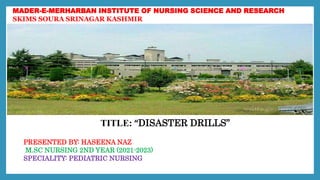
MADER-E-MERHARBAN INSTITUTE OF NURSING SCIENCE AND RESEARCH
SKIMS SOURA SRINAGAR KASHMIR
TITLE: “DISASTER DRILLS”
PRESENTED BY: HASEENA NAZ
M.SC NURSING 2ND YEAR (2021-2023)
SPECIALITY: PEDIATRIC NURSING
DISASTER DRILLS
INTRODUCTION
To provide prompt and efficient care
during a disaster ,the personnel involved
must be trained for such an event and
have practiced the technique and
procedures to be used during the disaster.
Disaster drills provide an opportunity to
educate hospital employees about
emergencies preparedness.
DEFINITION
A disaster drill is a process where people enter
into a hypothetical situation of a natural
calamity.The natural disaster could be a
Tsunami, earthquake or landslide. Each
disaster has a different set of measures to deal
with. However, some general instructions are
standard in all kinds of disaster drills.
THREE TYPES OF EMERGENCY PREPAREDNESS DRILLSLS
1.Table Top Drill:
● A facilitated analysis of an emergency situation in a formal,
stress free environment.
● It is designed to elicit constructive discussion as participants
examine and resolve problems based on existing operational
plans and identify where those plans need to be resolved.
●There is minimal attempt of stimulation in table top
exercises. Equipment is not used; resources are not deployed
and time pressure is not introduced there.
●This is simplest type of exercise to conduct in term of
planning, preparation and coordinating.
2.Functional Drill: This type of drill stimulates
emergency in most realistic manner possible, short
of moving real people and equipment to an actual
site. As the name suggests, its goal is to test or
evaluate the capability of one or more functions in
the context of an emergency event.
3.Full scale Drill: As close to the real timing is
possible, a full-scale drill is comparatively lengthy
event on location, using equipment and personnel
that would be called upon in a real event.
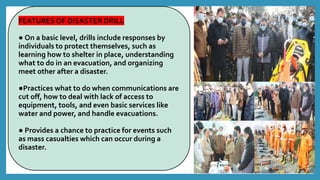
FEATURES OF DISASTER DRILL
● On a basic level, drills include responses by
individuals to protect themselves, such as
learning how to shelter in place, understanding
what to do in an evacuation, and organizing
meet other after a disaster.
●Practices what to do when communications are
cut off, how to deal with lack of access to
equipment, tools, and even basic services like
water and power, and handle evacuations.
● Provides a chance to practice for events such
as mass casualties which can occur during a
disaster.
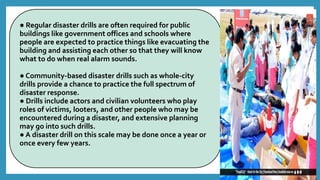
● Regular disaster drills are often required for public
buildings like government offices and schools where
people are expected to practice things like evacuating the
building and assisting each other so that they will know
what to do when real alarm sounds.
● Community-based disaster drills such as whole-city
drills provide a chance to practice the full spectrum of
disaster response.
● Drills include actors and civilian volunteers who play
roles of victims, looters, and other people who may be
encountered during a disaster, and extensive planning
may go into such drills.
● A disaster drill on this scale may be done once a year or
once every few years.
BENEFITS
●Used to identify weak points in a
disaster response plan.
●It helps to increase moral and
confidence of employees.
●It improve co-ordination.
●It check the competency of planned
actions
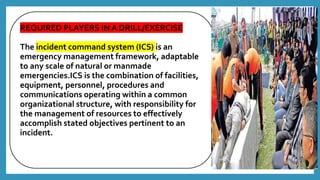
REQUIRED PLAYERS IN A DRILL/EXERCISE
The incident command system (ICS) is an
emergency management framework, adaptable
to any scale of natural or manmade
emergencies.ICS is the combination of facilities,
equipment, personnel, procedures and
communications operating within a common
organizational structure, with responsibility for
the management of resources to effectively
accomplish stated objectives pertinent to an
incident.
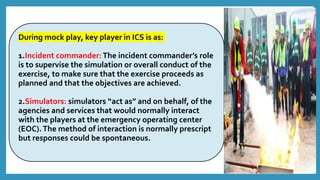
During mock play, key player in ICS is as:
1.Incident commander: The incident commander’s role
is to supervise the simulation or overall conduct of the
exercise, to make sure that the exercise proceeds as
planned and that the objectives are achieved.
2.Simulators: simulators “act as” and on behalf, of the
agencies and services that would normally interact
with the players at the emergency operating center
(EOC).The method of interaction is normally prescript
but responses could be spontaneous.
3.Participants: The participants should be from
community volunteers, DMT(Disaster
management team) members and
ESFs(emergency support function), led by
decision makers from various departments.
4. Evaluators:The role is to observe the actions
and decisions of the players, in order to later
report what went and what did not.The main
focus is on the performance of functions and
or/agencies, institutions, facilities being tested,
keeping in mind the objectives of the exercise.
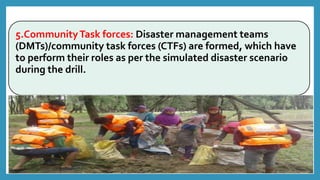
5.CommunityTask forces: Disaster management teams
(DMTs)/community task forces (CTFs) are formed, which have
to perform their roles as per the simulated disaster scenario
during the drill.
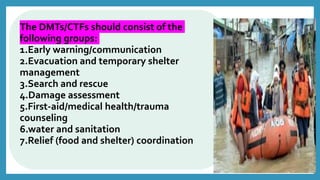
The DMTs/CTFs should consist of the
following groups:
1.Early warning/communication
2.Evacuation and temporary shelter
management
3.Search and rescue
4.Damage assessment
5.First-aid/medical health/trauma
counseling
6.water and sanitation
7.Relief (food and shelter) coordination
GUIDELINES FOR DRILL DESIGN
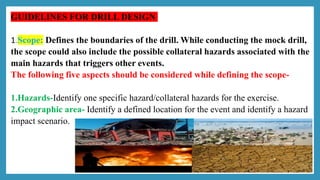
1.Scope: Defines the boundaries of the drill. While conducting the mock drill,
the scope could also include the possible collateral hazards associated with the
main hazards that triggers other events.
The following five aspects should be considered while defining the scope-
1.Hazards-Identify one specific hazard/collateral hazards for the exercise.
2.Geographic area- Identify a defined location for the event and identify a hazard
impact scenario.
3.Agencies and personnel-Identify which agencies will
participate and the personnel required.
4.Exercise type- Identify the type of exercise to be
conducted based on realistically achievable results within
the drill scenario.
5.Operating Procedures-Identify SOPs(Standard
operating procedure) as per the scenario to test
emergency response functions and coordination.
2.Statement of purpose: It is a statement to communicated the scope of the exercise
to the entities participating in the mock drill.
3.Objectives: Objectives should be clear, concise, specific, performance based and
attainable. The number of objectives needed for an exercise may vary according to
the scale and expected output of the exercise. Objectives can be classified into
“general/functional/specific”. General objectives will provide the overall scope of
the exercise with reference to the community, agency, institution, industry or
organization (for example: the community of Nari village will respond and recover
from the flash floods).
Functional or specific objectives form the core of the mock drill. These further
define the statement of purpose for the exercise by clearly describing the expected
outcomes(performance)of the disaster management functions being tested.
4.Scenario narrative-The scenario narrative describes the events leading
up to the time the exercise begins. It sets the scene for later events and also
captures the attention of the participants. It could include answers to
question such as:
. What event?
. How was the information relayed?
. What damages have been reported
. What was the sequence of events?
. Was there any advance warning issued and how long before the event.
. What factors influence emergency procedures.
5.Drill Activity-Activities should be planned in such a
way that it should provide sufficient scope to test the
pre-identified standard operating procedures (SOPs),
drill scenario and the needs of the identified
participants (e.g., Members of ESF teams, schools,
industries, public/commercial settings).
6.Termination-States the event(s) that indicate when
the drill should be concluded once all the required and
expected actions have been completed. In case of safety
problems, procedures violation or an emergency, the
drill may be prematurely terminated.
7.Expected actions/roles and responsibilities-Describes the expected
response to actions undertaken. Each ESF and its respective team
members should be listed by name so that there is no confusion as to who
is responsible for each function.
8.Expected response/evaluation criteria-The expected response is already
pre-identified and defined in a procedure. Specific areas need to be
identified for evaluation in the design stage of the mock drill. Details of
the procedure must be included so that evaluation is properly carried
out. The criteria for evaluation should focus on response recovery based
on the hazards scenario stimulated and emergency.
CONCLUSION
Emergency response training is not
providing a recipe, but psychologically
preparing the staff to respond efficiently,
effectively and creatively without undue
stress.
?
REFERENCES
1.K Park-Textbook of community medicine
2.www.ndmindia.nic.in
3.http//.disasterdrills.Wikipedia.com.
4.”Medical Surgical Nursing”,Joyce M.Black
and Jane Hokanson Hawks,vol-2,8th
edition,Elsevier publlications,India.
5.Internet:Disaster Management in Google.com
disaster drill

disaster drill

  • 1.
    MADER-E-MERHARBAN INSTITUTE OFNURSING SCIENCE AND RESEARCH SKIMS SOURA SRINAGAR KASHMIR TITLE: “DISASTER DRILLS” PRESENTED BY: HASEENA NAZ M.SC NURSING 2ND YEAR (2021-2023) SPECIALITY: PEDIATRIC NURSING
  • 3.
    DISASTER DRILLS INTRODUCTION To provideprompt and efficient care during a disaster ,the personnel involved must be trained for such an event and have practiced the technique and procedures to be used during the disaster. Disaster drills provide an opportunity to educate hospital employees about emergencies preparedness.
  • 4.
    DEFINITION A disaster drillis a process where people enter into a hypothetical situation of a natural calamity.The natural disaster could be a Tsunami, earthquake or landslide. Each disaster has a different set of measures to deal with. However, some general instructions are standard in all kinds of disaster drills.
  • 5.
    THREE TYPES OFEMERGENCY PREPAREDNESS DRILLSLS 1.Table Top Drill: ● A facilitated analysis of an emergency situation in a formal, stress free environment. ● It is designed to elicit constructive discussion as participants examine and resolve problems based on existing operational plans and identify where those plans need to be resolved. ●There is minimal attempt of stimulation in table top exercises. Equipment is not used; resources are not deployed and time pressure is not introduced there. ●This is simplest type of exercise to conduct in term of planning, preparation and coordinating.
  • 6.
    2.Functional Drill: Thistype of drill stimulates emergency in most realistic manner possible, short of moving real people and equipment to an actual site. As the name suggests, its goal is to test or evaluate the capability of one or more functions in the context of an emergency event. 3.Full scale Drill: As close to the real timing is possible, a full-scale drill is comparatively lengthy event on location, using equipment and personnel that would be called upon in a real event.
  • 7.
    FEATURES OF DISASTERDRILL ● On a basic level, drills include responses by individuals to protect themselves, such as learning how to shelter in place, understanding what to do in an evacuation, and organizing meet other after a disaster. ●Practices what to do when communications are cut off, how to deal with lack of access to equipment, tools, and even basic services like water and power, and handle evacuations. ● Provides a chance to practice for events such as mass casualties which can occur during a disaster.
  • 8.
    ● Regular disasterdrills are often required for public buildings like government offices and schools where people are expected to practice things like evacuating the building and assisting each other so that they will know what to do when real alarm sounds. ● Community-based disaster drills such as whole-city drills provide a chance to practice the full spectrum of disaster response. ● Drills include actors and civilian volunteers who play roles of victims, looters, and other people who may be encountered during a disaster, and extensive planning may go into such drills. ● A disaster drill on this scale may be done once a year or once every few years.
  • 9.
    BENEFITS ●Used to identifyweak points in a disaster response plan. ●It helps to increase moral and confidence of employees. ●It improve co-ordination. ●It check the competency of planned actions
  • 10.
    REQUIRED PLAYERS INA DRILL/EXERCISE The incident command system (ICS) is an emergency management framework, adaptable to any scale of natural or manmade emergencies.ICS is the combination of facilities, equipment, personnel, procedures and communications operating within a common organizational structure, with responsibility for the management of resources to effectively accomplish stated objectives pertinent to an incident.
  • 11.
    During mock play,key player in ICS is as: 1.Incident commander: The incident commander’s role is to supervise the simulation or overall conduct of the exercise, to make sure that the exercise proceeds as planned and that the objectives are achieved. 2.Simulators: simulators “act as” and on behalf, of the agencies and services that would normally interact with the players at the emergency operating center (EOC).The method of interaction is normally prescript but responses could be spontaneous.
  • 12.
    3.Participants: The participantsshould be from community volunteers, DMT(Disaster management team) members and ESFs(emergency support function), led by decision makers from various departments. 4. Evaluators:The role is to observe the actions and decisions of the players, in order to later report what went and what did not.The main focus is on the performance of functions and or/agencies, institutions, facilities being tested, keeping in mind the objectives of the exercise.
  • 13.
    5.CommunityTask forces: Disastermanagement teams (DMTs)/community task forces (CTFs) are formed, which have to perform their roles as per the simulated disaster scenario during the drill.
  • 14.
    The DMTs/CTFs shouldconsist of the following groups: 1.Early warning/communication 2.Evacuation and temporary shelter management 3.Search and rescue 4.Damage assessment 5.First-aid/medical health/trauma counseling 6.water and sanitation 7.Relief (food and shelter) coordination
  • 15.
    GUIDELINES FOR DRILLDESIGN 1.Scope: Defines the boundaries of the drill. While conducting the mock drill, the scope could also include the possible collateral hazards associated with the main hazards that triggers other events. The following five aspects should be considered while defining the scope- 1.Hazards-Identify one specific hazard/collateral hazards for the exercise. 2.Geographic area- Identify a defined location for the event and identify a hazard impact scenario.
  • 16.
    3.Agencies and personnel-Identifywhich agencies will participate and the personnel required. 4.Exercise type- Identify the type of exercise to be conducted based on realistically achievable results within the drill scenario. 5.Operating Procedures-Identify SOPs(Standard operating procedure) as per the scenario to test emergency response functions and coordination.
  • 17.
    2.Statement of purpose:It is a statement to communicated the scope of the exercise to the entities participating in the mock drill. 3.Objectives: Objectives should be clear, concise, specific, performance based and attainable. The number of objectives needed for an exercise may vary according to the scale and expected output of the exercise. Objectives can be classified into “general/functional/specific”. General objectives will provide the overall scope of the exercise with reference to the community, agency, institution, industry or organization (for example: the community of Nari village will respond and recover from the flash floods). Functional or specific objectives form the core of the mock drill. These further define the statement of purpose for the exercise by clearly describing the expected outcomes(performance)of the disaster management functions being tested.
  • 18.
    4.Scenario narrative-The scenarionarrative describes the events leading up to the time the exercise begins. It sets the scene for later events and also captures the attention of the participants. It could include answers to question such as: . What event? . How was the information relayed? . What damages have been reported . What was the sequence of events? . Was there any advance warning issued and how long before the event. . What factors influence emergency procedures.
  • 19.
    5.Drill Activity-Activities shouldbe planned in such a way that it should provide sufficient scope to test the pre-identified standard operating procedures (SOPs), drill scenario and the needs of the identified participants (e.g., Members of ESF teams, schools, industries, public/commercial settings). 6.Termination-States the event(s) that indicate when the drill should be concluded once all the required and expected actions have been completed. In case of safety problems, procedures violation or an emergency, the drill may be prematurely terminated.
  • 20.
    7.Expected actions/roles andresponsibilities-Describes the expected response to actions undertaken. Each ESF and its respective team members should be listed by name so that there is no confusion as to who is responsible for each function. 8.Expected response/evaluation criteria-The expected response is already pre-identified and defined in a procedure. Specific areas need to be identified for evaluation in the design stage of the mock drill. Details of the procedure must be included so that evaluation is properly carried out. The criteria for evaluation should focus on response recovery based on the hazards scenario stimulated and emergency.
  • 21.
    CONCLUSION Emergency response trainingis not providing a recipe, but psychologically preparing the staff to respond efficiently, effectively and creatively without undue stress. ?
  • 22.
    REFERENCES 1.K Park-Textbook ofcommunity medicine 2.www.ndmindia.nic.in 3.http//.disasterdrills.Wikipedia.com. 4.”Medical Surgical Nursing”,Joyce M.Black and Jane Hokanson Hawks,vol-2,8th edition,Elsevier publlications,India. 5.Internet:Disaster Management in Google.com