DISABILITY & ITS INDICATORS
Dr SANTOSH KUMAR A
Dept of Community Medicine
J S S M C
Mysore
1
OVERVIEW
• INTRODUCTION
• DISABILITY CATEGORIES
• PROBLEM STATEMENT
• NEED FOR DISABILITY INDICATORS
• DISABILITY INDICATORS
• DALY, PYLL, ICF MODEL, ADL, IADL
• HALE, QALY
• LEGISLATIONS FOR DISABLED
• REHABILITATION FOR DISABLED
2
“DEATH RATES FAILS TO TELL
THE ENTIRE STORY”
Dempsey, 1947
3
DEFINITIONS….
• IMPAIRMENT –
“Any loss or abnormality of psychological,
physiological or anatomical structure or
function”
Eg: loss of foot, defective vision
4
• DISABILITY
Given by WHO International Classification of
Impairments, Disabilities & Handicaps [ICIDH]
• “Any restriction or lack of ability to perform
an activity in the manner or within range
considered normal for a human being”
• A disability may be temporary or
permanent, reversible or irreversible, &
progressive or regressive
5
• HANDICAP –
• “A disadvantage for a given individual,
resulting from impairment or a disability,
that limits or prevents the fulfillment of a
role that is normal (depending on age, sex &
social & cultural factors) for that individual”
6
Main Disability Categories [ICIDH-1980]
• Behavioral disabilities: Awareness, Relations
• Communication disabilities: speaking, Listening, Seeing
• Personal care disabilities: Excretion, personal hygiene,
dressing
• Locomotor disabilities: Ambulatory, Confining
• Body disposition: Domestic, Body movement
• Dexterity disabilities: Daily activity, Manual activity
7
• Situational dependence: Dependence & endurance,
Environment
• Particular skill disabilities
• Other activity restrictions
8
PROBLEM STATEMENT
• GLOBAL BURDEN
• Roughly 10-12 percent of the world’s population has a
disability and they are among the poorest of the poor
• 18.6 million (2.9%) were severely disabled & another
79.7 million (12.4%) had moderate long term disability
• Average global prevalence moderate & severe disability
ranges from 5% in children aged 0-14 years, 15% in
adults aged 15-59 and 42% in adults aged 60 years &
older
9
• Recent estimates 600 million people live with disabilities
of various types due to chronic diseases, injuries,
violence, infectious diseases, malnutrition
• All types of disability are more in low & middle income
countries
• The global average burden of disease across all regions in
2004 was 237 DALYs per 1000 population,
10
• The most common causes of disability globally are adult-
onset hearing loss and refractive errors.
• Mental disorders such as depression , alcohol use
disorders and psychoses are among the top 20 leading
causes of disability
• Disability due to unintentional injuries, among the
younger population, and cataracts, among the older
population, are far more common.
11
12
13
• “Severe” disability, defined as severity classes VI and VII (the
equivalent of having blindness, Down syndrome, quadriplegia,
severe depression or active psychosis)
• “Moderate and severe” disability, defined as severity classes
III and greater (the equivalent of having angina, arthritis, low
vision or alcohol dependence).
14
• 500 million healthy life years are lost each year due to
disability associated with health conditions
IN INDIA
• Study conducted from July to Dec 2002, 18.49(1.8%)
million people were disabled
• 11% disabled persons suffered from more than one type
of disability
• Locomotor disability is the commonest, followed by visual
disability & hearing disability
15
What is an INDICATOR….?
• They are variables which help to measure changes.
• Characteristic of a good indicator
• It should be valid
• Should be reliable
• Should be sensitive
• Should be specific
• Should be feasible
• Should be relevant
16
Uses of a indicator
• Measure health status of a community
• Compare health status of one country with that of another
• For assessment of health care needs
• Allocation of scarce resources
• Monitoring & evaluation of health services
17
Need for disability statistics & indicators
• Disability statistics can play a pivotal role in all areas of
policy-making
• For the protection and promotion of the rights and the
dignity of persons with disabilities
• Information about functional status is integral to identify
needs
• Broader social needs of persons with disabilities, such as
provision of assistive technology for use in employment
or education or broader policy and laws.
• For monitoring the quality and outcomes of policies for
persons with disabilities. 18
Purpose of disability statistics &
indicators
• To assist in the development and evaluation of
programmes and policies for service provision
• To monitor the level of functioning in the population
• To assess equalization of opportunities.
• Early detection, early intervention and education
• Training and employment, including self-employment
19
• Poverty alleviation through capacity-building, social
security and sustainable livelihood programmes
• Including people with disabilities in economic
development activities, therefore, is key to achieving the
UN Millennium Development Goals
20
DISABILITY RATES
• Based on notion that health implies full range of daily
activities
• Commonly used disability rates
• Event type indicators –
a. Number of days of restricted activity
b. bed disability days
c. Work loss days/school loss days within a
specified period
Person type indicators –
a. Limitation of mobility
b. Limitation of activity
21
DISABILITY ADJUSTED LIFE YEARS (DALY)
• Created by WHO, World bank & Harvard university
• Measure of burden of disease & effectiveness of
interventions in a defined population
• It express years of life lost to premature death & years
lived with disability adjusted for the severity of the
disability
• It is equal to the sum of the number of years of life lost in
a population (YLL) and the number of years lived with
disability of known severity
22
• YLL (years of life lost):
Losses from premature death, defined as difference
between the actual age at death & life expectancy at that
age in a low mortality population
• YLD(Years lived with disability):
Loss of healthy life years resulting from disability
23
DALY = YLL + YLD
Disadvantages of DALY
• In estimation of YLL, non consideration of competing
causes may be a concern in case of developing countries
where general mortality is relatively high
• Estimation of YLD requires estimation of incidence,
duration & disability weights & this requires extensive
resources.
• DALYs do not reflect the change in people’s functional
status or well-being if they receive rehabilitation services,
assistive devices.
• DALYs only reflect the presence of a medical condition
that is associated with certain functional limitations
TO MEASURE DALY….
It requires two things
• Life table of that country, to measure days lost from
premature death
• Loss of healthy life years resulting from disability &
disease
25
USES OF DALY
• To assist in setting health services priorities
• Targeting health interventions
• Measuring results of health interventions
• Compare health status of different countries
• To identify the disadvantaged group
26
• The three leading causes of DALYs in 2030 are projected
to be unipolar depressive disorders, ischaemic heart
disease and road traffic accidents.
• global average burden of disease across all regions in
2004 was 237 DALYs per 1000 population, 60% was due
to premature death
27
• World wide, 1.49 billion DALYs were lost in 2002,
• 36% of total loss were as a result of disease & injury in
children less than 15 years & 50% in adults 15-59 years
Potential Years of Life Lost (PYLL):
• It is a measure of the impact of premature mortality on
the population.
• PYLL is the sum of the years that people dying would
have lived, had they experienced a normal life
expectancy, usually determined at 65 years.
28
The ICF and the Social Model of Disability
• Disability arises out of the interaction between functional
limitations and an unaccommodating environment
• People are not identified as having a disability based
upon a medical condition, as in DALYS,
• Classified according to a detailed description of their
functioning within various domains:
Body Function and Structure
Activities
Participation.
29
Body structure and function
• Most closely related to the medical model as it refers to
the physiological and psychological functions of body
systems.
• Body structures are defined by the ICF as “anatomic parts of
the body such as organs, limbs and their components.”
Activity
• Activities pertain to a wide range of deliberate actions
performed by an individual, such as walking or climbing
stairs.
30
• Participation
• Refers to activities that are integral to economic and
social life and the social roles that accomplish that life
• Ex - being able to attend school or hold a job.
31
ICF Model
32
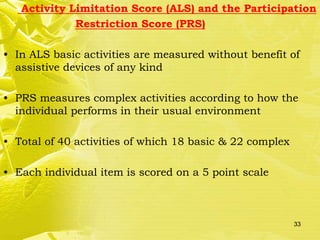
Activity Limitation Score (ALS) and the Participation
Restriction Score (PRS)
• In ALS basic activities are measured without benefit of
assistive devices of any kind
• PRS measures complex activities according to how the
individual performs in their usual environment
• Total of 40 activities of which 18 basic & 22 complex
• Each individual item is scored on a 5 point scale
33
34
35
36
37
• The ALS and PRS were scaled from 0 through 100.
• Weights are constructed for each domain so that the
maximum score for each of the 4 ALS domains is 25 and
the maximum score for each of the 5 PRS domains is 20
38
The advantages of the ALS and PRS score to other
indicators referred to above, are that they:
 Allow for the variability in functional capacity of people
with the same medical diagnoses
 Can measure improvements in functionality that result
from interventions that do not change an underlying
diagnosis
 Separate out activity limitations from participation
restrictions
 Reduce the degree of counting particular activity
limitations more than once
 Weight different domains equally 39
Activities of Daily Living (ADL):
• Measures six basic functions (moving between rooms,
using the lavatory, washing and bathing, dressing and
undressing, getting in and out of bed, and feeding
oneself)
• Score of A - independent in every item
• B - dependent in one item
• C - dependent in two items
• D - dependent in three items
• E - dependent in four items
• F - dependent in five items
• G - dependent in all functions
40
Instrumental Activities of Daily Living (IADL):
• IADL-scale measures more complex functions like
Using the telephone, getting to places beyond walking
distance
grocery shopping, preparing meals, doing housework
or handyman work, doing laundry, taking
medications, managing money
The score ranges from
• 8 - able to perform all functions to
• 0 - cannot perform any function
41
Functional Independence Measure
 It includes 13 motor & 5 cognitive measures rated on a
seven level scale
 It provides an estimate of the expected reduced
functional capacity
42
• Sullivans Index
• Expectation of life free of disability
• Obtained by subtracting from the life expectancy the
probable duration of bed disability & inability to perform
major activities
• Its considered as one of the most advanced indicators
currently available
43
Health adjusted life expectancy (HALE)
• Based on life expectancy at birth & includes an
adjustment for time spent in poor health
• Number of years in full health that a newborn can expect
to live based on current rates of ill health & mortality
Quality adjusted life year (QALY)
• Years of healthy life afforded by different treatments of a
condition
• Adjustments are based on subjective judgements
44
LEGISLATIONS FOR THE
DISABLED
• Rehabilitation council of India (RCI) Act, 1992
• The persons with Disabilities (Equal opportunities,
Protection of rights & full participation) Act, 1995
• The National trust for welfare of persons with Autism,
Cerebral palsy, Mental retardation & multiple Disabilities
Act, 1999
45
Rehabilitation council of India (RCI) Act, 1992
• Came into force from 31st july, 1993
• Main objectives
Regulate training policies & programs in the field of
rehabilitation of persons with disabilities
To prescribe minimum standards of education &
training in the field of rehabilitation
To regulate these standards in all training institutions
uniformly through out the country
To maintain central rehabilitation register
To encourage rehabilitation education & research
46
The persons with Disabilities (Equal opportunities,
Protection of rights & full participation) Act, 1995
• Came into force on Feb 7, 1996
• Provisions of act
• Prevention & early detection of disabilities
• Right to free education till 18 years
• 3% reservation in Govt jobs
• Disabled friendly designed public places & transport
• Research & man power development
• Social security (special insurance schemes for disabled
employees)
47
WELFARE SCHEMES FOR DISABLED
• Exemptions & assistance:
• Travelling –
• Ministry if railways gives 75% concession on travel
fare
• Indian airlines allows 50% concession fare to blind on
all domestic flights
• Postage exemption-
• Payment of postages for blind literature packets is
exempted
• Telecommunication preference-
• Telephone facility to blind persons on 50% of normal
rental & priority basis
48
• Conveyance allowance –
• Handicapped government employee to get conveyance
allowance at 5% basic pay
• For disabled children –
• Special schools for children with severe disability
• Scholarships on monthly basis for disabled student for
a maximum period of 6 years after class 12
49
REHABILITATION
• Defined as
“ The combined & coordinated use of medical,
social, educational & vocational measures for
training & retraining the individual to the highest
possible level of functional ability”
50
• Types of rehabilitation:
 Medical rehabilitation – restoration of function
 Vocational rehabilitation – restoration of capacity
to earn livelihood
Social rehabilitation – restoration of family &
social relationships
Psychological rehabilitation – restoration of
personal dignity & confidence
51
Bibliography
• Park text book of Preventive & Social Medicine
• Oxford text book of public health
• Concepts of epidemiology, Raj gopal
• Text book of P& SM, O. P. Ghai
• Text book of P&SM, Sunderlal
• www.who.int/icf
• www.cdc.gov/ncbddd/dh
• www.disabilityresources.org
52
53
THANK YOU…

DISABILITY & ITS INDICATORS.pptx

  • 1.
    DISABILITY & ITSINDICATORS Dr SANTOSH KUMAR A Dept of Community Medicine J S S M C Mysore 1
  • 2.
    OVERVIEW • INTRODUCTION • DISABILITYCATEGORIES • PROBLEM STATEMENT • NEED FOR DISABILITY INDICATORS • DISABILITY INDICATORS • DALY, PYLL, ICF MODEL, ADL, IADL • HALE, QALY • LEGISLATIONS FOR DISABLED • REHABILITATION FOR DISABLED 2
  • 3.
    “DEATH RATES FAILSTO TELL THE ENTIRE STORY” Dempsey, 1947 3
  • 4.
    DEFINITIONS…. • IMPAIRMENT – “Anyloss or abnormality of psychological, physiological or anatomical structure or function” Eg: loss of foot, defective vision 4
  • 5.
    • DISABILITY Given byWHO International Classification of Impairments, Disabilities & Handicaps [ICIDH] • “Any restriction or lack of ability to perform an activity in the manner or within range considered normal for a human being” • A disability may be temporary or permanent, reversible or irreversible, & progressive or regressive 5
  • 6.
    • HANDICAP – •“A disadvantage for a given individual, resulting from impairment or a disability, that limits or prevents the fulfillment of a role that is normal (depending on age, sex & social & cultural factors) for that individual” 6
  • 7.
    Main Disability Categories[ICIDH-1980] • Behavioral disabilities: Awareness, Relations • Communication disabilities: speaking, Listening, Seeing • Personal care disabilities: Excretion, personal hygiene, dressing • Locomotor disabilities: Ambulatory, Confining • Body disposition: Domestic, Body movement • Dexterity disabilities: Daily activity, Manual activity 7
  • 8.
    • Situational dependence:Dependence & endurance, Environment • Particular skill disabilities • Other activity restrictions 8
  • 9.
    PROBLEM STATEMENT • GLOBALBURDEN • Roughly 10-12 percent of the world’s population has a disability and they are among the poorest of the poor • 18.6 million (2.9%) were severely disabled & another 79.7 million (12.4%) had moderate long term disability • Average global prevalence moderate & severe disability ranges from 5% in children aged 0-14 years, 15% in adults aged 15-59 and 42% in adults aged 60 years & older 9
  • 10.
    • Recent estimates600 million people live with disabilities of various types due to chronic diseases, injuries, violence, infectious diseases, malnutrition • All types of disability are more in low & middle income countries • The global average burden of disease across all regions in 2004 was 237 DALYs per 1000 population, 10
  • 11.
    • The mostcommon causes of disability globally are adult- onset hearing loss and refractive errors. • Mental disorders such as depression , alcohol use disorders and psychoses are among the top 20 leading causes of disability • Disability due to unintentional injuries, among the younger population, and cataracts, among the older population, are far more common. 11
  • 12.
  • 13.
  • 14.
    • “Severe” disability,defined as severity classes VI and VII (the equivalent of having blindness, Down syndrome, quadriplegia, severe depression or active psychosis) • “Moderate and severe” disability, defined as severity classes III and greater (the equivalent of having angina, arthritis, low vision or alcohol dependence). 14
  • 15.
    • 500 millionhealthy life years are lost each year due to disability associated with health conditions IN INDIA • Study conducted from July to Dec 2002, 18.49(1.8%) million people were disabled • 11% disabled persons suffered from more than one type of disability • Locomotor disability is the commonest, followed by visual disability & hearing disability 15
  • 16.
    What is anINDICATOR….? • They are variables which help to measure changes. • Characteristic of a good indicator • It should be valid • Should be reliable • Should be sensitive • Should be specific • Should be feasible • Should be relevant 16
  • 17.
    Uses of aindicator • Measure health status of a community • Compare health status of one country with that of another • For assessment of health care needs • Allocation of scarce resources • Monitoring & evaluation of health services 17
  • 18.
    Need for disabilitystatistics & indicators • Disability statistics can play a pivotal role in all areas of policy-making • For the protection and promotion of the rights and the dignity of persons with disabilities • Information about functional status is integral to identify needs • Broader social needs of persons with disabilities, such as provision of assistive technology for use in employment or education or broader policy and laws. • For monitoring the quality and outcomes of policies for persons with disabilities. 18
  • 19.
    Purpose of disabilitystatistics & indicators • To assist in the development and evaluation of programmes and policies for service provision • To monitor the level of functioning in the population • To assess equalization of opportunities. • Early detection, early intervention and education • Training and employment, including self-employment 19
  • 20.
    • Poverty alleviationthrough capacity-building, social security and sustainable livelihood programmes • Including people with disabilities in economic development activities, therefore, is key to achieving the UN Millennium Development Goals 20
  • 21.
    DISABILITY RATES • Basedon notion that health implies full range of daily activities • Commonly used disability rates • Event type indicators – a. Number of days of restricted activity b. bed disability days c. Work loss days/school loss days within a specified period Person type indicators – a. Limitation of mobility b. Limitation of activity 21
  • 22.
    DISABILITY ADJUSTED LIFEYEARS (DALY) • Created by WHO, World bank & Harvard university • Measure of burden of disease & effectiveness of interventions in a defined population • It express years of life lost to premature death & years lived with disability adjusted for the severity of the disability • It is equal to the sum of the number of years of life lost in a population (YLL) and the number of years lived with disability of known severity 22
  • 23.
    • YLL (yearsof life lost): Losses from premature death, defined as difference between the actual age at death & life expectancy at that age in a low mortality population • YLD(Years lived with disability): Loss of healthy life years resulting from disability 23 DALY = YLL + YLD
  • 24.
    Disadvantages of DALY •In estimation of YLL, non consideration of competing causes may be a concern in case of developing countries where general mortality is relatively high • Estimation of YLD requires estimation of incidence, duration & disability weights & this requires extensive resources. • DALYs do not reflect the change in people’s functional status or well-being if they receive rehabilitation services, assistive devices. • DALYs only reflect the presence of a medical condition that is associated with certain functional limitations
  • 25.
    TO MEASURE DALY…. Itrequires two things • Life table of that country, to measure days lost from premature death • Loss of healthy life years resulting from disability & disease 25
  • 26.
    USES OF DALY •To assist in setting health services priorities • Targeting health interventions • Measuring results of health interventions • Compare health status of different countries • To identify the disadvantaged group 26
  • 27.
    • The threeleading causes of DALYs in 2030 are projected to be unipolar depressive disorders, ischaemic heart disease and road traffic accidents. • global average burden of disease across all regions in 2004 was 237 DALYs per 1000 population, 60% was due to premature death 27
  • 28.
    • World wide,1.49 billion DALYs were lost in 2002, • 36% of total loss were as a result of disease & injury in children less than 15 years & 50% in adults 15-59 years Potential Years of Life Lost (PYLL): • It is a measure of the impact of premature mortality on the population. • PYLL is the sum of the years that people dying would have lived, had they experienced a normal life expectancy, usually determined at 65 years. 28
  • 29.
    The ICF andthe Social Model of Disability • Disability arises out of the interaction between functional limitations and an unaccommodating environment • People are not identified as having a disability based upon a medical condition, as in DALYS, • Classified according to a detailed description of their functioning within various domains: Body Function and Structure Activities Participation. 29
  • 30.
    Body structure andfunction • Most closely related to the medical model as it refers to the physiological and psychological functions of body systems. • Body structures are defined by the ICF as “anatomic parts of the body such as organs, limbs and their components.” Activity • Activities pertain to a wide range of deliberate actions performed by an individual, such as walking or climbing stairs. 30
  • 31.
    • Participation • Refersto activities that are integral to economic and social life and the social roles that accomplish that life • Ex - being able to attend school or hold a job. 31
  • 32.
  • 33.
    Activity Limitation Score(ALS) and the Participation Restriction Score (PRS) • In ALS basic activities are measured without benefit of assistive devices of any kind • PRS measures complex activities according to how the individual performs in their usual environment • Total of 40 activities of which 18 basic & 22 complex • Each individual item is scored on a 5 point scale 33
  • 34.
  • 35.
  • 36.
  • 37.
  • 38.
    • The ALSand PRS were scaled from 0 through 100. • Weights are constructed for each domain so that the maximum score for each of the 4 ALS domains is 25 and the maximum score for each of the 5 PRS domains is 20 38
  • 39.
    The advantages ofthe ALS and PRS score to other indicators referred to above, are that they:  Allow for the variability in functional capacity of people with the same medical diagnoses  Can measure improvements in functionality that result from interventions that do not change an underlying diagnosis  Separate out activity limitations from participation restrictions  Reduce the degree of counting particular activity limitations more than once  Weight different domains equally 39
  • 40.
    Activities of DailyLiving (ADL): • Measures six basic functions (moving between rooms, using the lavatory, washing and bathing, dressing and undressing, getting in and out of bed, and feeding oneself) • Score of A - independent in every item • B - dependent in one item • C - dependent in two items • D - dependent in three items • E - dependent in four items • F - dependent in five items • G - dependent in all functions 40
  • 41.
    Instrumental Activities ofDaily Living (IADL): • IADL-scale measures more complex functions like Using the telephone, getting to places beyond walking distance grocery shopping, preparing meals, doing housework or handyman work, doing laundry, taking medications, managing money The score ranges from • 8 - able to perform all functions to • 0 - cannot perform any function 41
  • 42.
    Functional Independence Measure It includes 13 motor & 5 cognitive measures rated on a seven level scale  It provides an estimate of the expected reduced functional capacity 42
  • 43.
    • Sullivans Index •Expectation of life free of disability • Obtained by subtracting from the life expectancy the probable duration of bed disability & inability to perform major activities • Its considered as one of the most advanced indicators currently available 43
  • 44.
    Health adjusted lifeexpectancy (HALE) • Based on life expectancy at birth & includes an adjustment for time spent in poor health • Number of years in full health that a newborn can expect to live based on current rates of ill health & mortality Quality adjusted life year (QALY) • Years of healthy life afforded by different treatments of a condition • Adjustments are based on subjective judgements 44
  • 45.
    LEGISLATIONS FOR THE DISABLED •Rehabilitation council of India (RCI) Act, 1992 • The persons with Disabilities (Equal opportunities, Protection of rights & full participation) Act, 1995 • The National trust for welfare of persons with Autism, Cerebral palsy, Mental retardation & multiple Disabilities Act, 1999 45
  • 46.
    Rehabilitation council ofIndia (RCI) Act, 1992 • Came into force from 31st july, 1993 • Main objectives Regulate training policies & programs in the field of rehabilitation of persons with disabilities To prescribe minimum standards of education & training in the field of rehabilitation To regulate these standards in all training institutions uniformly through out the country To maintain central rehabilitation register To encourage rehabilitation education & research 46
  • 47.
    The persons withDisabilities (Equal opportunities, Protection of rights & full participation) Act, 1995 • Came into force on Feb 7, 1996 • Provisions of act • Prevention & early detection of disabilities • Right to free education till 18 years • 3% reservation in Govt jobs • Disabled friendly designed public places & transport • Research & man power development • Social security (special insurance schemes for disabled employees) 47
  • 48.
    WELFARE SCHEMES FORDISABLED • Exemptions & assistance: • Travelling – • Ministry if railways gives 75% concession on travel fare • Indian airlines allows 50% concession fare to blind on all domestic flights • Postage exemption- • Payment of postages for blind literature packets is exempted • Telecommunication preference- • Telephone facility to blind persons on 50% of normal rental & priority basis 48
  • 49.
    • Conveyance allowance– • Handicapped government employee to get conveyance allowance at 5% basic pay • For disabled children – • Special schools for children with severe disability • Scholarships on monthly basis for disabled student for a maximum period of 6 years after class 12 49
  • 50.
    REHABILITATION • Defined as “The combined & coordinated use of medical, social, educational & vocational measures for training & retraining the individual to the highest possible level of functional ability” 50
  • 51.
    • Types ofrehabilitation:  Medical rehabilitation – restoration of function  Vocational rehabilitation – restoration of capacity to earn livelihood Social rehabilitation – restoration of family & social relationships Psychological rehabilitation – restoration of personal dignity & confidence 51
  • 52.
    Bibliography • Park textbook of Preventive & Social Medicine • Oxford text book of public health • Concepts of epidemiology, Raj gopal • Text book of P& SM, O. P. Ghai • Text book of P&SM, Sunderlal • www.who.int/icf • www.cdc.gov/ncbddd/dh • www.disabilityresources.org 52
  • 53.