1
Community Based
Rehabilitation
2
Rehabilitation
 The combined and coordinated use of medical,
social, educational and vocational measures for
training and retraining the individual to the highest
possible level of functional ability.
 Social integration- The active participation of disabled
and handicapped people in the mainstream of
community life
3
Rehabilitation
 Rehabilitation is a process that assists people with
disabilities to develop or strengthen their physical,
mental and social skills to meet their
individual/collective specific skills
 Rehabilitation traditionally involves provision of
therapy (physical, occupational and speech) in
various settings like special institutions, hospitals,
out-patient clinics or community homes.
4
History of rehabilitation
 AD400-1400- people ridiculed the handicapped and
regarded them with suspicion
 Some nobles used physically handicapped as jesters
 Many handicapped people were burned as witches
 Spartans let deformed children die of exposure
 In Rome, parents could legally drown a disfigured
infant
5
History of rehabilitation
 1800s- Attitude towards handicaps began to change-
people began to pity
 Handicaps were brought to bring shame on
themselves and their families
 Most handicapped people were kept hidden away at
home or in special institutions
 Mid 1900s – Important advances were made in the
treatment of handicapped
 During and after world war II extreme efforts were
made to rehabilitate disabled servicemen
 Military hospitals established rehabilitation centers
6
Areas of concern in rehabilitation
 Medical rehabilitation
 Vocational rehabilitation
 Social rehabilitation
 Psychological rehabilitation
7
Examples of rehabilitation
 Establishing schools for the blind
 Provision of aids for the crippled
 Reconstructive surgery in leprosy
 Muscle re-education and graded exercise in
neurological disorders
 Change of profession for a more suitable one
 Modification of life in general (for TB, Cardiac
patients)
8
Three major strategies in rehabilitation
 Institutions based rehabilitation (IBR)
 Out reach programme for rehabilitation
 Community based rehabilitation (CBR)
9
Institution based rehabilitation
 Assessment
 Informal education
 Vocational counseling and training
 Use of aids and appliances
 Are the common services offered
 Often run by NGO/private management
 Depend on external funding
 Children from middle and upper class are benefited
 Located only nearer to/in towns and cities
10
Outreach programmes
 Through periodic visits by specialists, social workers and
rehabilitation workers
 Less population covered
 Sustainability
11
Impairment, Disability, Handicap
definitions
 Impairment
Any loss or abnormality of psychological,
physiological or anatomical structure and function
 Disability
Any restriction or lack of ability to perform an activity
in the manner or within the range considered normal
for a human being
 Handicap
A disadvantage for a given individual, resulting in an
impairment or disability that limits or prevents the
fulfillment of a role that is normal for that individual
12
Classification of disabilities
 Locomotor disabilities
 Visual disabilities
 Communication disabilities
 Mental retardation
 Cerebral palsy
 Mental illness
 Multiple disabilities
13
Causes of disability
 Macro-economic conditions
 Nutritional deficiencies
 Weapons and violence
 Chemical substances
 Other causes
14
Situational analysis of disabilities
Estimated number of physically disabled persons
in India are 16.154 million
 8.939 million people of locomotor disability
 4.005 million visually disabled,
 3.242 million hearing disabled
 1.966 million speech disabled
 78.32% (12.65 million) of physically disabled
people are living in rural area
 proportion of males is higher (58.93%) than
females
15
Situational analysis of disabilities
Age-wise distribution of physically disabled
Out of every 1,000 disabled
 398 are in 60+ age group,
 425 in 15-59 age
 150 are in less than 14 years age
16
Situational analysis of disabilities
Visual and hearing disabilities are more common in
60+ age group
Out of every 1,000 visually disabled
 717 are in 60+ age group
 526 out of 1,000 hearing disabled are in 60+ age
group
17
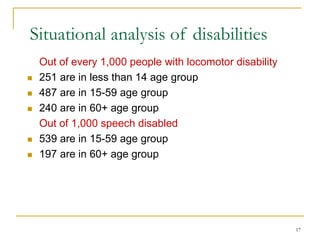
Situational analysis of disabilities
Out of every 1,000 people with locomotor disability
 251 are in less than 14 age group
 487 are in 15-59 age group
 240 are in 60+ age group
Out of 1,000 speech disabled
 539 are in 15-59 age group
 197 are in 60+ age group
18
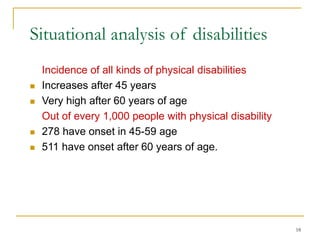
Situational analysis of disabilities
Incidence of all kinds of physical disabilities
 Increases after 45 years
 Very high after 60 years of age
Out of every 1,000 people with physical disability
 278 have onset in 45-59 age
 511 have onset after 60 years of age.
19
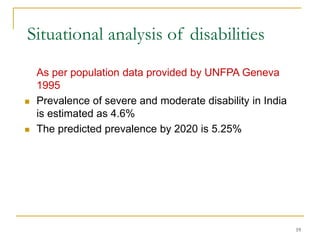
Situational analysis of disabilities
As per population data provided by UNFPA Geneva
1995
 Prevalence of severe and moderate disability in India
is estimated as 4.6%
 The predicted prevalence by 2020 is 5.25%
20
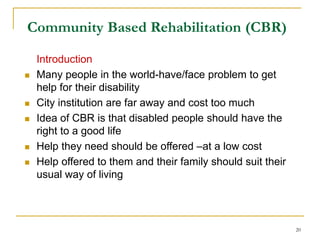
Community Based Rehabilitation (CBR)
Introduction
 Many people in the world-have/face problem to get
help for their disability
 City institution are far away and cost too much
 Idea of CBR is that disabled people should have the
right to a good life
 Help they need should be offered –at a low cost
 Help offered to them and their family should suit their
usual way of living
21
CBR (Introduction)
 They should be able to take up jobs and earn their
living
 They should be able to take a full part in all the
activities of their village, town or city
 They should be respected for being men and women,
girls and boys
 Information should be given to people in a way they
understand
22
Community Based Rehabilitation (CBR)
 CBR is a strategy within general community
development for rehabilitation, equalization of
opportunities and social inclusion of all children and
adults with disabilities.
 CBR is implemented through the combined efforts of
people with disabilities themselves, their families and
communities, and the appropriate health, education,
vocational and social services.
23
Community Based Rehabilitation (CBR)
 Community based rehabilitation is characterized by
the active role of people with disabilities, their families
and the community in the rehabilitation process.
 Knowledge and skills for the basic training of disabled
people are transferred to disabled adults themselves,
to their families and to the community members
 Personnel skilled in rehabilitation technology train
and support community workers, and provide skilled
intervention as necessary
24
Community Based Rehabilitation (CBR)
 It calls for the full and coordinated involvement of all
levels of society
 Community
 Intermediate
 National
• It seeks the integration of the interventions of all
relevant sectors
 Educational
 Health
 Legislative
 Social
 vocational
25
Community Based Rehabilitation (CBR)
 At the community level
 Seen as a component of an integrated community
development programme
 Should be based on decisions taken by its members
 Should rely as much as possible on the mobilization of
local resources
 Family of the disabled person is the most important
resource
 Community should support the basic necessities of life
and help the families who carry out rehabilitation at home
 A community structure (committee) should be set up to
provide the local management
26
Community Based Rehabilitation (CBR)
 At the intermediate level
 Network of professional support services should be
provided by the government
 Its personnel should be involved in the training and
technical supervision of community personnel
 Should provide services and managerial support
 Should liaise with referral services
27
Community Based Rehabilitation (CBR)
 At the national level
 Seeks the involvement of the government in the
leading managerial role
 Concerns planning, implementing, coordinating and
evaluating the CBR system
 In cooperation with the communities, the intermediate
level and the non governmental sector
28
CBR background - technical
advances and rehabilitation
 World War II -many countries had large numbers of
disabled servicemen
 survived serious injury due to medical advances
 were able to reintegrate into their communities due to
advances in technical aids, appliances and assistive
technology
 A new specialty, rehabilitation, rapidly developed
 A United Nations Rehabilitation Unit was established
in 1951 to facilitate the transfer of these new medical
and technical advances to developing countries.
29
Definitions
By UN
 “A strategy within community development for the
rehabilitation, equalization of opportunities and
social integration of all people with disabilities”
By Einar Helander
 “CBR is a strategy for enhancing the quality of life
of disabled people by improving service delivery,
by providing more equitable opportunities and by
promoting and protecting their human rights”
30
Principles of CBR
 Inclusion
 Participation
 Sustainability
 Empowerment
 Self advocacy
31
Components of CBR
 Health
 Promotive
 Preventive
 Curative
 Rehabilitative
 Assistive devices
32
Components of CBR
 Education
 Early childhood development
 Non formal education
 Basic education
 Higher education
 Special and transitory
33
Components of CBR
 Livelihoods
 Skills training
 Access to capital
 Income generating activities
 Open employment
 Economic contribution and social protection
34
Components of CBR
 Empowerments
 Self help groups
 Disabled peoples organizations (DPOs)
 Social mobilization
 Political empowerment
 Language and communication
35
Components of CBR
 Social
 Legal protection
 Culture and religion
 Sports and leisure
 Relationships, marriage and family
 Personal assistance
36
Prevention of disabilities
 Efforts of UNICEF and WHO
 Child survival, protection and development
 Immunization
 Improved infant feeding practices
 Child growth monitoring
 Home based diarrhea management
 Drinking water
 Environmental sanitation
 Birth spacing
 Education of girls
37
Prevention of disabilities
 Efforts of Government of India
 Universal immunization program
 Reproductive and child health program
 Leprosy eradication program
38
The Persons with Disabilities (Equal
Opportunity, Protection of Rights and Full
Participation) Act 1995
 The PWD Act was implemented in 1995
 Envisages equal opportunities, protection of right and full
participation of people with disability
 Prevention and early detection of disabilities is the most
important component of the Act.
39
The Persons with Disabilities (Equal
Opportunity, Protection of Rights and Full
Participation) Act 1995
Various Measures Under The Act
 To undertake surveys, investigation and research
concerning the cause of disabilities.
 To promote various methods of preventing disabilities.
 To screen all the children at least once in a year for the
purpose of identifying at risk and cause of disability.
 To provide facilities for training to the staff at the primary
health centre.
40
The Persons with Disabilities (Equal
Opportunity, Protection of Rights and Full
Participation) Act 1995
Activities to be taken by the Govt. & local bodies
 Prevention and early detection of disabilities
 Education
 Employment
 Nondiscrimination
 Research and development
 Affirmative action
 Social security
 Grievance redressal
 Mass awareness
41
The Persons with Disabilities (Equal
Opportunity, Protection of Rights and Full
Participation) Act 1995
Penalties
 Imprisonment upto 2 years or a fine upto Rs 20000
42
Various Measures Under The Act
 To sponsor awareness campaigns and disseminate
information for general hygiene.
 To take measures for prenatal, perinatal and
postnatal care of the mother and child.
 To educate the public through the preschools,
schools and primary health centers with the help of
village level workers and Anganwadi workers.
 To create awareness amongst the masses through
television, radio and other mass media on the causes
of disabilities and preventive measures to be
adopted.
43
National trust for welfare of persons with
Autism, Cerebral Palsy, Mental Retardation
and Multiple Disabilities Act 1999
Objectives
 To enable and empower persons with disability to live as
independently and as fully as possible within and close
to the community to which they belong
 To strengthen facilities to provide support to persons with
disabilities to live within their own families
 To extend support to registered organizations to provide
need based services during the period of crisis in the
family of persons with disability
44
 To deal with problems of persons with disability who do
not have family support
 To promote measures for the care and protection of
persons with disabilities in the event of death of their
parent or guardian
 To evolve procedure for the appointment of guardian
and trusties for persons with disability requiring such
protection
 To facilitate the realization of equal opportunities,
protection of rights and full participation of persons with
disability
45
Mental health act 1987
 The mental health act 1987 repeals Indian lunacy act
1912 and lunacy act 1977
 Mentally ill person- A person who is in need of treatment
by reason of any mental disorder other than mental
retardation (subsec (1) of sec 2 )
 This act gives guide lines for the admission and
discharge of the patients to any psychiatric hospital
 Psychiatric services provided from a general hospital or
nursing home would not be covered
46
Government programmes
 GOI supports more than 600 NGOs
 Both GOI and State Govts support disabled persons
with:
 Aids and appliances
 Maintenance allowance
 Support disability programs by NGOs
47
Approaches seen in India
 Empowerment of persons with disability
 Empowerment of community
 Service approach
 Service plus empowerment approach
 Prevention of disabilities
 Trauma care and sports medicine
48
Attempts by GOI to scale up operations
 District rehabilitation center scheme, grameena
punarvasa yojana and national programs for
rehabilitation
 Establishment of National institute of mentally
handicapped
 Establishment of National institute of visually impaired
 National institute of orthopedically handicapped
 National institute for hearing impaired
 All India istitute of speech and hearing
 NIHMANS
49
NIMHANS
 Rehabilitation and vocational training activities for
subjects with psychiatric disabilities dates from 1848
AD
 Separate department was created for psychiatric and
neurological rehabilitation in 1985
 One of the oldest department of this institute
 Largest day care center and vocational training
facility for psychiatric patients in the world
 Has 16 different vocational sections
50
NIMHANS (Activities)
 Clinical services
 Training and research in neurological and psychiatric
rehabilitation
 Department has outpatient, inpatient and day care
services
 There are 22 beds for inpatient neurological
rehabilitation
51
Clinical services
Day care for chronic mentally ill
 Assessment of Disability
 Planning and extension of rehabilitation programs
 Placement services
 Family intervention
52
Clinical services
 Community resource utilization
 Vocational training
 Behavioral modification programs
 Social skill training
 Recreational program
53
Neuro-Rehabilitation
 Inpatient and out patient neurorehabilitation in the
rehabilitation department
 Outpatient physiotherapy
 Inpatient occupational therapy
 Outpatient occupational therapy
 Neurology services
 Neuro developmental therapy services
54
List of important organization in
India
 Action of disability and development India (ADD)
 All India Institute of physical medicine and rehabilitation
 All India Institute of speech and hearing
 Amar Jyoti research and rehabilitation center
 Association of the physically handicapped
 Center for special education
 Chetna Institute for the mentally handicapped
 Child in need institute
 Christian Medical College
 Education and training institute for mentally retarded
children
55
List of NGOs
 Manovikas kendra purb sarania
 Amar jyoti charitable trust
 Samadhan
 Naval public school
 Spastic society of India
 B M Institute of mental health
 Navajyoti trust
 Institute of child health
 Sri Ramana Maharishi academy for the blind
 Mobility India
 Association of people with disabilities
56
Resources for programmes for the
mentally ill
 NIMHNS
 National institute of mentally handicapped
 Sanjivini
 Dept of psychiatry
57
References
 Park’s text book of Preventive & Social Medicine - K.
Park.Banarasidas Bhanot publishers .18th edition
 National health programmes of India (National policies
and legislations related to health)-J. Kishore
 http://www.wcc-coe.org (accessed on 2.11.06)
 http://web.worldbank.org (accessed on 4.11.06)
 http://www.nimhans.kar.nic.in (accessed on 4.11.06)
 http://cbrresources.org (accessed on 6.11.06)
 http://www.dpi.org (accessed on 4.11.06)
 http://www.spasticsocietyofkarnataka.org (accessed on
4.11.06)
 Text book of Community Medicine. Sridhar Rao
 Community based rehabilitation of persons with
disabilities. S Pruthvish. Jaypee publishers.

Community Based Rehabilitation.ppt

  • 1.
  • 2.
    2 Rehabilitation  The combinedand coordinated use of medical, social, educational and vocational measures for training and retraining the individual to the highest possible level of functional ability.  Social integration- The active participation of disabled and handicapped people in the mainstream of community life
  • 3.
    3 Rehabilitation  Rehabilitation isa process that assists people with disabilities to develop or strengthen their physical, mental and social skills to meet their individual/collective specific skills  Rehabilitation traditionally involves provision of therapy (physical, occupational and speech) in various settings like special institutions, hospitals, out-patient clinics or community homes.
  • 4.
    4 History of rehabilitation AD400-1400- people ridiculed the handicapped and regarded them with suspicion  Some nobles used physically handicapped as jesters  Many handicapped people were burned as witches  Spartans let deformed children die of exposure  In Rome, parents could legally drown a disfigured infant
  • 5.
    5 History of rehabilitation 1800s- Attitude towards handicaps began to change- people began to pity  Handicaps were brought to bring shame on themselves and their families  Most handicapped people were kept hidden away at home or in special institutions  Mid 1900s – Important advances were made in the treatment of handicapped  During and after world war II extreme efforts were made to rehabilitate disabled servicemen  Military hospitals established rehabilitation centers
  • 6.
    6 Areas of concernin rehabilitation  Medical rehabilitation  Vocational rehabilitation  Social rehabilitation  Psychological rehabilitation
  • 7.
    7 Examples of rehabilitation Establishing schools for the blind  Provision of aids for the crippled  Reconstructive surgery in leprosy  Muscle re-education and graded exercise in neurological disorders  Change of profession for a more suitable one  Modification of life in general (for TB, Cardiac patients)
  • 8.
    8 Three major strategiesin rehabilitation  Institutions based rehabilitation (IBR)  Out reach programme for rehabilitation  Community based rehabilitation (CBR)
  • 9.
    9 Institution based rehabilitation Assessment  Informal education  Vocational counseling and training  Use of aids and appliances  Are the common services offered  Often run by NGO/private management  Depend on external funding  Children from middle and upper class are benefited  Located only nearer to/in towns and cities
  • 10.
    10 Outreach programmes  Throughperiodic visits by specialists, social workers and rehabilitation workers  Less population covered  Sustainability
  • 11.
    11 Impairment, Disability, Handicap definitions Impairment Any loss or abnormality of psychological, physiological or anatomical structure and function  Disability Any restriction or lack of ability to perform an activity in the manner or within the range considered normal for a human being  Handicap A disadvantage for a given individual, resulting in an impairment or disability that limits or prevents the fulfillment of a role that is normal for that individual
  • 12.
    12 Classification of disabilities Locomotor disabilities  Visual disabilities  Communication disabilities  Mental retardation  Cerebral palsy  Mental illness  Multiple disabilities
  • 13.
    13 Causes of disability Macro-economic conditions  Nutritional deficiencies  Weapons and violence  Chemical substances  Other causes
  • 14.
    14 Situational analysis ofdisabilities Estimated number of physically disabled persons in India are 16.154 million  8.939 million people of locomotor disability  4.005 million visually disabled,  3.242 million hearing disabled  1.966 million speech disabled  78.32% (12.65 million) of physically disabled people are living in rural area  proportion of males is higher (58.93%) than females
  • 15.
    15 Situational analysis ofdisabilities Age-wise distribution of physically disabled Out of every 1,000 disabled  398 are in 60+ age group,  425 in 15-59 age  150 are in less than 14 years age
  • 16.
    16 Situational analysis ofdisabilities Visual and hearing disabilities are more common in 60+ age group Out of every 1,000 visually disabled  717 are in 60+ age group  526 out of 1,000 hearing disabled are in 60+ age group
  • 17.
    17 Situational analysis ofdisabilities Out of every 1,000 people with locomotor disability  251 are in less than 14 age group  487 are in 15-59 age group  240 are in 60+ age group Out of 1,000 speech disabled  539 are in 15-59 age group  197 are in 60+ age group
  • 18.
    18 Situational analysis ofdisabilities Incidence of all kinds of physical disabilities  Increases after 45 years  Very high after 60 years of age Out of every 1,000 people with physical disability  278 have onset in 45-59 age  511 have onset after 60 years of age.
  • 19.
    19 Situational analysis ofdisabilities As per population data provided by UNFPA Geneva 1995  Prevalence of severe and moderate disability in India is estimated as 4.6%  The predicted prevalence by 2020 is 5.25%
  • 20.
    20 Community Based Rehabilitation(CBR) Introduction  Many people in the world-have/face problem to get help for their disability  City institution are far away and cost too much  Idea of CBR is that disabled people should have the right to a good life  Help they need should be offered –at a low cost  Help offered to them and their family should suit their usual way of living
  • 21.
    21 CBR (Introduction)  Theyshould be able to take up jobs and earn their living  They should be able to take a full part in all the activities of their village, town or city  They should be respected for being men and women, girls and boys  Information should be given to people in a way they understand
  • 22.
    22 Community Based Rehabilitation(CBR)  CBR is a strategy within general community development for rehabilitation, equalization of opportunities and social inclusion of all children and adults with disabilities.  CBR is implemented through the combined efforts of people with disabilities themselves, their families and communities, and the appropriate health, education, vocational and social services.
  • 23.
    23 Community Based Rehabilitation(CBR)  Community based rehabilitation is characterized by the active role of people with disabilities, their families and the community in the rehabilitation process.  Knowledge and skills for the basic training of disabled people are transferred to disabled adults themselves, to their families and to the community members  Personnel skilled in rehabilitation technology train and support community workers, and provide skilled intervention as necessary
  • 24.
    24 Community Based Rehabilitation(CBR)  It calls for the full and coordinated involvement of all levels of society  Community  Intermediate  National • It seeks the integration of the interventions of all relevant sectors  Educational  Health  Legislative  Social  vocational
  • 25.
    25 Community Based Rehabilitation(CBR)  At the community level  Seen as a component of an integrated community development programme  Should be based on decisions taken by its members  Should rely as much as possible on the mobilization of local resources  Family of the disabled person is the most important resource  Community should support the basic necessities of life and help the families who carry out rehabilitation at home  A community structure (committee) should be set up to provide the local management
  • 26.
    26 Community Based Rehabilitation(CBR)  At the intermediate level  Network of professional support services should be provided by the government  Its personnel should be involved in the training and technical supervision of community personnel  Should provide services and managerial support  Should liaise with referral services
  • 27.
    27 Community Based Rehabilitation(CBR)  At the national level  Seeks the involvement of the government in the leading managerial role  Concerns planning, implementing, coordinating and evaluating the CBR system  In cooperation with the communities, the intermediate level and the non governmental sector
  • 28.
    28 CBR background -technical advances and rehabilitation  World War II -many countries had large numbers of disabled servicemen  survived serious injury due to medical advances  were able to reintegrate into their communities due to advances in technical aids, appliances and assistive technology  A new specialty, rehabilitation, rapidly developed  A United Nations Rehabilitation Unit was established in 1951 to facilitate the transfer of these new medical and technical advances to developing countries.
  • 29.
    29 Definitions By UN  “Astrategy within community development for the rehabilitation, equalization of opportunities and social integration of all people with disabilities” By Einar Helander  “CBR is a strategy for enhancing the quality of life of disabled people by improving service delivery, by providing more equitable opportunities and by promoting and protecting their human rights”
  • 30.
    30 Principles of CBR Inclusion  Participation  Sustainability  Empowerment  Self advocacy
  • 31.
    31 Components of CBR Health  Promotive  Preventive  Curative  Rehabilitative  Assistive devices
  • 32.
    32 Components of CBR Education  Early childhood development  Non formal education  Basic education  Higher education  Special and transitory
  • 33.
    33 Components of CBR Livelihoods  Skills training  Access to capital  Income generating activities  Open employment  Economic contribution and social protection
  • 34.
    34 Components of CBR Empowerments  Self help groups  Disabled peoples organizations (DPOs)  Social mobilization  Political empowerment  Language and communication
  • 35.
    35 Components of CBR Social  Legal protection  Culture and religion  Sports and leisure  Relationships, marriage and family  Personal assistance
  • 36.
    36 Prevention of disabilities Efforts of UNICEF and WHO  Child survival, protection and development  Immunization  Improved infant feeding practices  Child growth monitoring  Home based diarrhea management  Drinking water  Environmental sanitation  Birth spacing  Education of girls
  • 37.
    37 Prevention of disabilities Efforts of Government of India  Universal immunization program  Reproductive and child health program  Leprosy eradication program
  • 38.
    38 The Persons withDisabilities (Equal Opportunity, Protection of Rights and Full Participation) Act 1995  The PWD Act was implemented in 1995  Envisages equal opportunities, protection of right and full participation of people with disability  Prevention and early detection of disabilities is the most important component of the Act.
  • 39.
    39 The Persons withDisabilities (Equal Opportunity, Protection of Rights and Full Participation) Act 1995 Various Measures Under The Act  To undertake surveys, investigation and research concerning the cause of disabilities.  To promote various methods of preventing disabilities.  To screen all the children at least once in a year for the purpose of identifying at risk and cause of disability.  To provide facilities for training to the staff at the primary health centre.
  • 40.
    40 The Persons withDisabilities (Equal Opportunity, Protection of Rights and Full Participation) Act 1995 Activities to be taken by the Govt. & local bodies  Prevention and early detection of disabilities  Education  Employment  Nondiscrimination  Research and development  Affirmative action  Social security  Grievance redressal  Mass awareness
  • 41.
    41 The Persons withDisabilities (Equal Opportunity, Protection of Rights and Full Participation) Act 1995 Penalties  Imprisonment upto 2 years or a fine upto Rs 20000
  • 42.
    42 Various Measures UnderThe Act  To sponsor awareness campaigns and disseminate information for general hygiene.  To take measures for prenatal, perinatal and postnatal care of the mother and child.  To educate the public through the preschools, schools and primary health centers with the help of village level workers and Anganwadi workers.  To create awareness amongst the masses through television, radio and other mass media on the causes of disabilities and preventive measures to be adopted.
  • 43.
    43 National trust forwelfare of persons with Autism, Cerebral Palsy, Mental Retardation and Multiple Disabilities Act 1999 Objectives  To enable and empower persons with disability to live as independently and as fully as possible within and close to the community to which they belong  To strengthen facilities to provide support to persons with disabilities to live within their own families  To extend support to registered organizations to provide need based services during the period of crisis in the family of persons with disability
  • 44.
    44  To dealwith problems of persons with disability who do not have family support  To promote measures for the care and protection of persons with disabilities in the event of death of their parent or guardian  To evolve procedure for the appointment of guardian and trusties for persons with disability requiring such protection  To facilitate the realization of equal opportunities, protection of rights and full participation of persons with disability
  • 45.
    45 Mental health act1987  The mental health act 1987 repeals Indian lunacy act 1912 and lunacy act 1977  Mentally ill person- A person who is in need of treatment by reason of any mental disorder other than mental retardation (subsec (1) of sec 2 )  This act gives guide lines for the admission and discharge of the patients to any psychiatric hospital  Psychiatric services provided from a general hospital or nursing home would not be covered
  • 46.
    46 Government programmes  GOIsupports more than 600 NGOs  Both GOI and State Govts support disabled persons with:  Aids and appliances  Maintenance allowance  Support disability programs by NGOs
  • 47.
    47 Approaches seen inIndia  Empowerment of persons with disability  Empowerment of community  Service approach  Service plus empowerment approach  Prevention of disabilities  Trauma care and sports medicine
  • 48.
    48 Attempts by GOIto scale up operations  District rehabilitation center scheme, grameena punarvasa yojana and national programs for rehabilitation  Establishment of National institute of mentally handicapped  Establishment of National institute of visually impaired  National institute of orthopedically handicapped  National institute for hearing impaired  All India istitute of speech and hearing  NIHMANS
  • 49.
    49 NIMHANS  Rehabilitation andvocational training activities for subjects with psychiatric disabilities dates from 1848 AD  Separate department was created for psychiatric and neurological rehabilitation in 1985  One of the oldest department of this institute  Largest day care center and vocational training facility for psychiatric patients in the world  Has 16 different vocational sections
  • 50.
    50 NIMHANS (Activities)  Clinicalservices  Training and research in neurological and psychiatric rehabilitation  Department has outpatient, inpatient and day care services  There are 22 beds for inpatient neurological rehabilitation
  • 51.
    51 Clinical services Day carefor chronic mentally ill  Assessment of Disability  Planning and extension of rehabilitation programs  Placement services  Family intervention
  • 52.
    52 Clinical services  Communityresource utilization  Vocational training  Behavioral modification programs  Social skill training  Recreational program
  • 53.
    53 Neuro-Rehabilitation  Inpatient andout patient neurorehabilitation in the rehabilitation department  Outpatient physiotherapy  Inpatient occupational therapy  Outpatient occupational therapy  Neurology services  Neuro developmental therapy services
  • 54.
    54 List of importantorganization in India  Action of disability and development India (ADD)  All India Institute of physical medicine and rehabilitation  All India Institute of speech and hearing  Amar Jyoti research and rehabilitation center  Association of the physically handicapped  Center for special education  Chetna Institute for the mentally handicapped  Child in need institute  Christian Medical College  Education and training institute for mentally retarded children
  • 55.
    55 List of NGOs Manovikas kendra purb sarania  Amar jyoti charitable trust  Samadhan  Naval public school  Spastic society of India  B M Institute of mental health  Navajyoti trust  Institute of child health  Sri Ramana Maharishi academy for the blind  Mobility India  Association of people with disabilities
  • 56.
    56 Resources for programmesfor the mentally ill  NIMHNS  National institute of mentally handicapped  Sanjivini  Dept of psychiatry
  • 57.
    57 References  Park’s textbook of Preventive & Social Medicine - K. Park.Banarasidas Bhanot publishers .18th edition  National health programmes of India (National policies and legislations related to health)-J. Kishore  http://www.wcc-coe.org (accessed on 2.11.06)  http://web.worldbank.org (accessed on 4.11.06)  http://www.nimhans.kar.nic.in (accessed on 4.11.06)  http://cbrresources.org (accessed on 6.11.06)  http://www.dpi.org (accessed on 4.11.06)  http://www.spasticsocietyofkarnataka.org (accessed on 4.11.06)  Text book of Community Medicine. Sridhar Rao  Community based rehabilitation of persons with disabilities. S Pruthvish. Jaypee publishers.