Family Planning Methods
MBBS Phase 3 Part 1 – Community
Medicine
Exam-oriented | CBME aligned |
Ready-to-teach
CBME / NMC Alignment
• Competency addressed: CM5, CM7, CM10
(Reproductive & Child Health)
– Describe methods of contraception and
indications
– Demonstrate ability to counsel individuals and
couples
– Emphasis on choice, safety, effectiveness and
national programs
Introduction
• Family planning enables individuals and
couples to decide the number and spacing of
children.
– It is a core component of Reproductive and Child
Health (RCH).
– Directly contributes to reduction in maternal and
infant mortality.
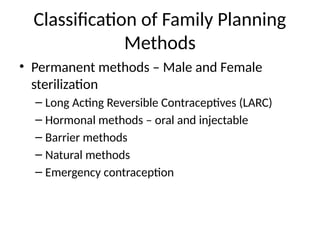
Classification of Family Planning
Methods
• Permanent methods – Male and Female
sterilization
– Long Acting Reversible Contraceptives (LARC)
– Hormonal methods – oral and injectable
– Barrier methods
– Natural methods
– Emergency contraception
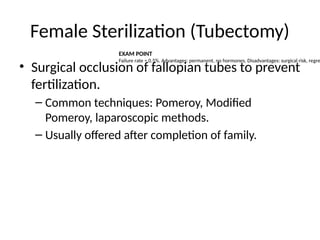
Female Sterilization (Tubectomy)
• Surgical occlusion of fallopian tubes to prevent
fertilization.
– Common techniques: Pomeroy, Modified
Pomeroy, laparoscopic methods.
– Usually offered after completion of family.
EXAM POINT
Failure rate ≈ 0.5%. Advantages: permanent, no hormones. Disadvantages: surgical risk, regre
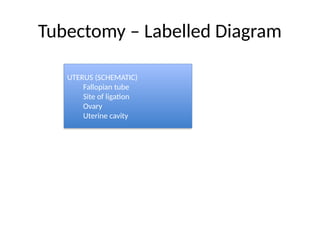
Tubectomy – Labelled Diagram
UTERUS (SCHEMATIC)
Fallopian tube
Site of ligation
Ovary
Uterine cavity
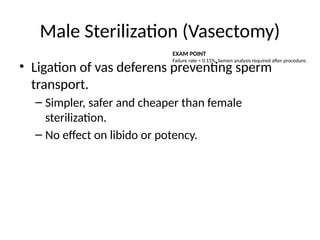
Male Sterilization (Vasectomy)
• Ligation of vas deferens preventing sperm
transport.
– Simpler, safer and cheaper than female
sterilization.
– No effect on libido or potency.
EXAM POINT
Failure rate ≈ 0.15%. Semen analysis required after procedure.
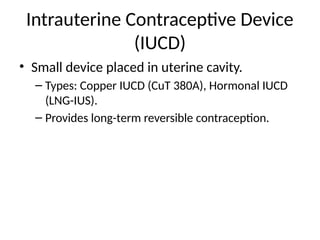
Intrauterine Contraceptive Device
(IUCD)
• Small device placed in uterine cavity.
– Types: Copper IUCD (CuT 380A), Hormonal IUCD
(LNG-IUS).
– Provides long-term reversible contraception.
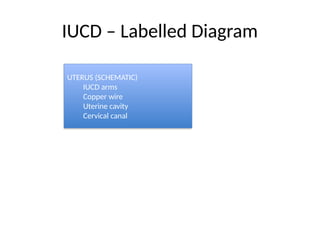
IUCD – Labelled Diagram
UTERUS (SCHEMATIC)
IUCD arms
Copper wire
Uterine cavity
Cervical canal
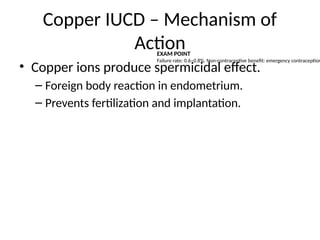
Copper IUCD – Mechanism of
Action
• Copper ions produce spermicidal effect.
– Foreign body reaction in endometrium.
– Prevents fertilization and implantation.
EXAM POINT
Failure rate: 0.6–0.8%. Non-contraceptive benefit: emergency contraception
Hormonal IUCD (LNG-IUS)
• Releases levonorgestrel locally inside uterus.
– Thickens cervical mucus and suppresses
endometrium.
– Also used for menorrhagia.
EXAM POINT
Failure rate ≈ 0.2%. Reduces menstrual blood loss.
Contraceptive Implants
• Subdermal implants releasing progestin.
– Effective for 3–5 years.
– Highly effective spacing method.
Implants – Mechanism
• Suppress ovulation.
– Thicken cervical mucus.
– Alter endometrium.
EXAM POINT
Failure rate <1%. Common side effect: irregular bleeding.
Combined Oral Contraceptive Pills
(COCs)
• Contain estrogen and progestin.
– Inhibit ovulation and thicken cervical mucus.
– Require daily intake.
EXAM POINT
Failure rate: ~7% (typical use). Non-contraceptive benefits: acne control, cycle regu
Injectable Contraceptives (DMPA,
NET-EN)
• Long-acting hormonal injections.
– Given every 2–3 months.
– Useful for women needing spacing.
EXAM POINT
Failure rate ≈ 6%. Causes delayed return of fertility.
Barrier Methods – Condoms
• Prevent sperm from entering female genital
tract.
– Male and female condoms available.
– Only method providing STI/HIV protection.
EXAM POINT
Failure rate: Male condom ~13%, Female condom ~21%.
Natural Methods
• Based on fertility awareness.
– Includes rhythm, basal body temperature and
cervical mucus methods.
– Requires high motivation.
EXAM POINT
Failure rate ~24%. No STI protection.
Emergency Contraception
• Used after unprotected intercourse.
– Levonorgestrel, Ulipristal acetate, Copper IUCD.
– Acts mainly by delaying ovulation.
EXAM POINT
Must be used within recommended time. Does NOT terminate pregnancy.
Unmet Need for Family Planning
• Women wanting to avoid pregnancy but not
using contraception.
– Reflects gaps in access, awareness and quality of
services.
Recent Advances in India
• Introduction of injectable contraceptive
(Antara / Sayana Press).
– Focus on spacing methods under FP2020.
– Digital counseling and logistics strengthening.
Summary for Exams
• Know classification, mechanism, uses and
failure rates.
– Be able to compare methods.
– Emphasize informed choice and counseling.
Family_Planning_Methods_MBBS_Exam_Oriented_CBME.pptx

  • 1.
    Family Planning Methods MBBSPhase 3 Part 1 – Community Medicine Exam-oriented | CBME aligned | Ready-to-teach
  • 2.
    CBME / NMCAlignment • Competency addressed: CM5, CM7, CM10 (Reproductive & Child Health) – Describe methods of contraception and indications – Demonstrate ability to counsel individuals and couples – Emphasis on choice, safety, effectiveness and national programs
  • 3.
    Introduction • Family planningenables individuals and couples to decide the number and spacing of children. – It is a core component of Reproductive and Child Health (RCH). – Directly contributes to reduction in maternal and infant mortality.
  • 4.
    Classification of FamilyPlanning Methods • Permanent methods – Male and Female sterilization – Long Acting Reversible Contraceptives (LARC) – Hormonal methods – oral and injectable – Barrier methods – Natural methods – Emergency contraception
  • 5.
    Female Sterilization (Tubectomy) •Surgical occlusion of fallopian tubes to prevent fertilization. – Common techniques: Pomeroy, Modified Pomeroy, laparoscopic methods. – Usually offered after completion of family. EXAM POINT Failure rate ≈ 0.5%. Advantages: permanent, no hormones. Disadvantages: surgical risk, regre
  • 6.
    Tubectomy – LabelledDiagram UTERUS (SCHEMATIC) Fallopian tube Site of ligation Ovary Uterine cavity
  • 7.
    Male Sterilization (Vasectomy) •Ligation of vas deferens preventing sperm transport. – Simpler, safer and cheaper than female sterilization. – No effect on libido or potency. EXAM POINT Failure rate ≈ 0.15%. Semen analysis required after procedure.
  • 8.
    Intrauterine Contraceptive Device (IUCD) •Small device placed in uterine cavity. – Types: Copper IUCD (CuT 380A), Hormonal IUCD (LNG-IUS). – Provides long-term reversible contraception.
  • 9.
    IUCD – LabelledDiagram UTERUS (SCHEMATIC) IUCD arms Copper wire Uterine cavity Cervical canal
  • 10.
    Copper IUCD –Mechanism of Action • Copper ions produce spermicidal effect. – Foreign body reaction in endometrium. – Prevents fertilization and implantation. EXAM POINT Failure rate: 0.6–0.8%. Non-contraceptive benefit: emergency contraception
  • 11.
    Hormonal IUCD (LNG-IUS) •Releases levonorgestrel locally inside uterus. – Thickens cervical mucus and suppresses endometrium. – Also used for menorrhagia. EXAM POINT Failure rate ≈ 0.2%. Reduces menstrual blood loss.
  • 12.
    Contraceptive Implants • Subdermalimplants releasing progestin. – Effective for 3–5 years. – Highly effective spacing method.
  • 13.
    Implants – Mechanism •Suppress ovulation. – Thicken cervical mucus. – Alter endometrium. EXAM POINT Failure rate <1%. Common side effect: irregular bleeding.
  • 14.
    Combined Oral ContraceptivePills (COCs) • Contain estrogen and progestin. – Inhibit ovulation and thicken cervical mucus. – Require daily intake. EXAM POINT Failure rate: ~7% (typical use). Non-contraceptive benefits: acne control, cycle regu
  • 15.
    Injectable Contraceptives (DMPA, NET-EN) •Long-acting hormonal injections. – Given every 2–3 months. – Useful for women needing spacing. EXAM POINT Failure rate ≈ 6%. Causes delayed return of fertility.
  • 16.
    Barrier Methods –Condoms • Prevent sperm from entering female genital tract. – Male and female condoms available. – Only method providing STI/HIV protection. EXAM POINT Failure rate: Male condom ~13%, Female condom ~21%.
  • 17.
    Natural Methods • Basedon fertility awareness. – Includes rhythm, basal body temperature and cervical mucus methods. – Requires high motivation. EXAM POINT Failure rate ~24%. No STI protection.
  • 18.
    Emergency Contraception • Usedafter unprotected intercourse. – Levonorgestrel, Ulipristal acetate, Copper IUCD. – Acts mainly by delaying ovulation. EXAM POINT Must be used within recommended time. Does NOT terminate pregnancy.
  • 19.
    Unmet Need forFamily Planning • Women wanting to avoid pregnancy but not using contraception. – Reflects gaps in access, awareness and quality of services.
  • 20.
    Recent Advances inIndia • Introduction of injectable contraceptive (Antara / Sayana Press). – Focus on spacing methods under FP2020. – Digital counseling and logistics strengthening.
  • 21.
    Summary for Exams •Know classification, mechanism, uses and failure rates. – Be able to compare methods. – Emphasize informed choice and counseling.