Understanding the disability
1
DR. C. BEULAH JAYARANI
M.Sc., M.A, M.Ed, M.Phil (Edn), M.Phil (ZOO),
NET, Ph.D (Edn)
ASST. PROFESSOR,
LOYOLA COLLEGE OF EDUCATION, CHENNAI - 34
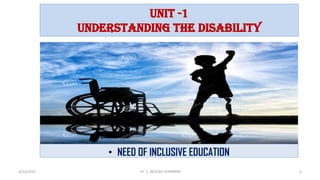
Unit -1
Understanding the disability
• NEED OF INCLUSIVE EDUCATION
4/13/2022 2
Dr. C. BEULAH JAYARANIi
Unit i-Understanding the disability
• Meaning and Definition of disability
• Meaning and definition of impairment
• Difference between disability and impairment
• Characteristics of disabilities
• Causes of disabilities
Types of Disabilities
1. Hearing impairment
2. Speech impairment
3. Visual impairment
4. Morbidity/Physicallychallenged
5. Psychologicaldisorders
6. Mentally retarded
7. Cerebral palsy
8. Multiple disability
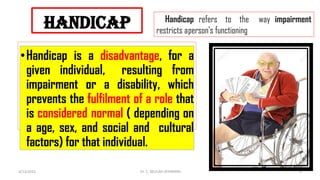
handicap
•Handicap is a disadvantage, for a
given individual, resulting from
impairment or a disability, which
prevents the fulfilment of a role that
is considered normal ( depending on
a age, sex, and social and cultural
factors) for that individual.
Handicap refers to the way impairment
restricts aperson's functioning
4/13/2022 4
Dr. C. BEULAH JAYARANIi
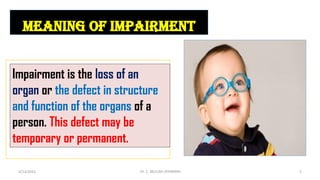
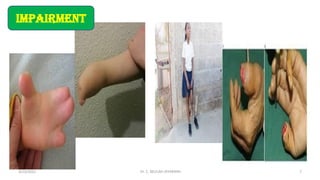
meaning of impairment
Impairment is the loss of an
organ or the defect in structure
and function of the organs of a
person. This defect may be
temporary or permanent.
4/13/2022 5
Dr. C. BEULAH JAYARANIi
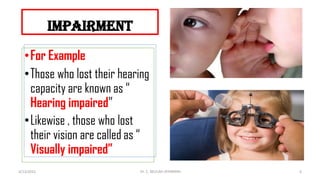
impairment
•For Example
•Those who lost their hearing
capacity are known as “
Hearing impaired”
•Likewise , those who lost
their vision are called as “
Visually impaired”
4/13/2022 6
Dr. C. BEULAH JAYARANIi
impairment
4/13/2022 7
Dr. C. BEULAH JAYARANIi
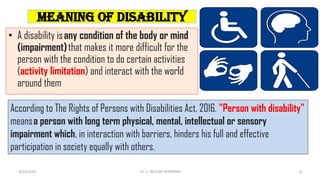
meaning of disability
• A disability is any condition of the body or mind
(impairment) that makes it more difficult for the
person with the condition to do certain activities
(activity limitation) and interact with the world
around them
According to The Rights of Persons with Disabilities Act, 2016. "Person with disability"
means a person with long term physical, mental, intellectual or sensory
impairment which, in interaction with barriers, hinders his full and effective
participation in society equally with others.
4/13/2022 8
Dr. C. BEULAH JAYARANIi
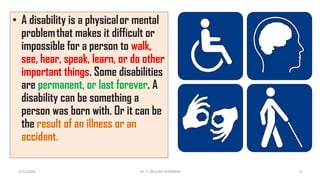
• A disability is a physical or mental
problem that makes it difficult or
impossible for a person to walk,
see, hear, speak, learn, or do other
important things. Some disabilities
are permanent, or last forever. A
disability can be something a
person was born with. Or it can be
the result of an illness or an
accident.
4/13/2022 9
Dr. C. BEULAH JAYARANIi
disability
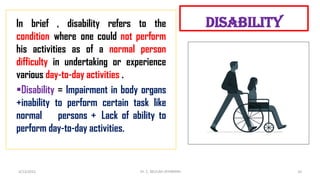
In brief , disability refers to the
condition where one could not perform
his activities as of a normal person
difficulty in undertaking or experience
various day-to-day activities .
§Disability = Impairment in body organs
+inability to perform certain task like
normal persons + Lack of ability to
perform day-to-day activities.
4/13/2022 10
Dr. C. BEULAH JAYARANIi
disability
4/13/2022 11
Dr. C. BEULAH JAYARANIi
characteristics of disabilities
1. Due to loss or abnormality of physical organs (e.g.) mal-formation of
limbs, cleft lip, disfigured fingers.
Disorders due to disfunctioning of organs of the body even though they
may have normal anatomical structure.
Impairment of organs of the body.
Due to genetic disorders, developmental defects, accidents or diseases,
opportunities and facilities in the society.
4/13/2022 12
Dr. C. BEULAH JAYARANIi
characteristics of disabilities……
Due to the limitation of one’s functioning arising from impairments.
Due to the inability to undertake activities of daily life like others. i.e. one’s
functional efficiency getting affected.
The degree of disability could be reduced with the use of appropriate
equipments and appliances.
The handicap arising out of disability could be greatly reduced by providing
appropriate
4/13/2022 13
Dr. C. BEULAH JAYARANIi
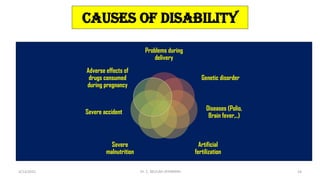
caUses of disability
Problems during
delivery
Genetic disorder
Diseases (Polio,
Brain fever,..)
Artificial
fertilization
Severe
malnutrition
Severe accident
Adverse effects of
drugs consumed
during pregnancy
4/13/2022 14
Dr. C. BEULAH JAYARANIi
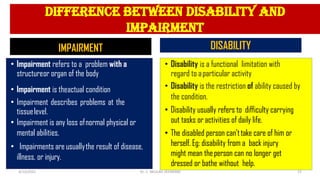
difference between disability and
impairment
IMPAIRMENT
• Impairment refers to a problem with a
structureor organ of the body
• Impairment is theactual condition
• Impairment describes problems at the
tissuelevel.
• Impairment is any loss ofnormal physical or
mental abilities.
• Impairments are usuallythe result of disease,
illness, or injury.
DISABILITY
• Disability is a functional limitation with
regard to aparticular activity
• Disability is the restriction of ability caused by
the condition.
• Disability usually refers to difficulty carrying
out tasks or activities of daily life.
• The disabled person can’ttake care of him or
herself. Eg: disability from a back injury
might mean theperson can no longer get
dressed or bathe without help.
4/13/2022 15
Dr. C. BEULAH JAYARANIi
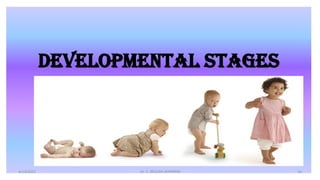
developmental stages
4/13/2022 16
Dr. C. BEULAH JAYARANIi
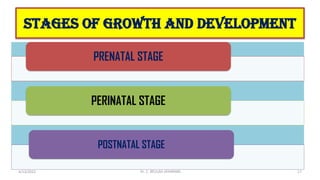
stages of growth and development
PRENATAL STAGE
PERINATAL STAGE
POSTNATAL STAGE
4/13/2022 17
Dr. C. BEULAH JAYARANIi
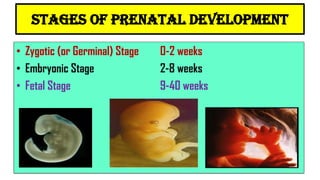
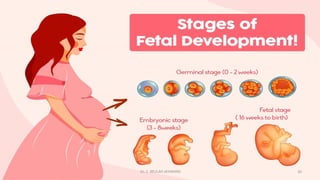
stages of prenatal development
• Zygotic (or Germinal) Stage 0-2 weeks
• Embryonic Stage 2-8 weeks
• Fetal Stage 9-40 weeks
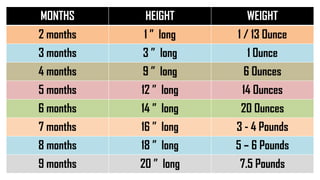
MONTHS HEIGHT WEIGHT
2 months 1 ” long 1 / 13 Ounce
3 months 3 ” long 1 Ounce
4 months 9 ” long 6 Ounces
5 months 12 ” long 14 Ounces
6 months 14 ” long 20 Ounces
7 months 16 ” long 3 - 4 Pounds
8 months 18 ” long 5 – 6 Pounds
9 months 20 ” long 7.5 Pounds
4/13/2022 20
Dr. C. BEULAH JAYARANIi
4/13/2022
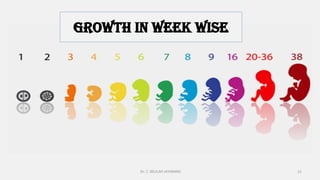
growth in week wise
21
Dr. C. BEULAH JAYARANIi
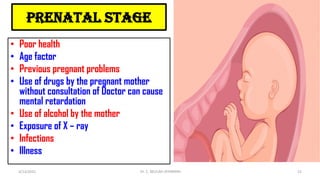
prenatal stage
• Poor health
• Age factor
• Previous pregnant problems
• Use of drugs by the pregnant mother
without consultation of Doctor can cause
mental retardation
• Use of alcohol by the mother
• Exposure of X – ray
• Infections
• Illness
4/13/2022 22
Dr. C. BEULAH JAYARANIi
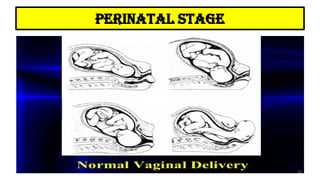
perinatal stage
23
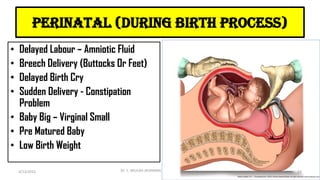
perinatal (dUring birth process)
• Delayed Labour – Amniotic Fluid
• Breech Delivery (Buttocks Or Feet)
• Delayed Birth Cry
• Sudden Delivery - Constipation
Problem
• Baby Big – Virginal Small
• Pre Matured Baby
• Low Birth Weight
4/13/2022 24
Dr. C. BEULAH JAYARANIi
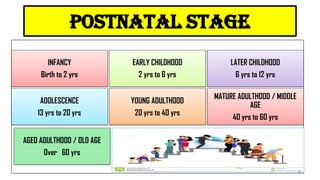
INFANCY
Birth to 2 yrs
EARLY CHILDHOOD
2 yrs to 6 yrs
LATER CHILDHOOD
6 yrs to 12 yrs
ADOLESCENCE
13 yrs to 20 yrs
YOUNG ADULTHOOD
20 yrs to 40 yrs
MATURE ADULTHOOD / MIDDLE
AGE
40 yrs to 60 yrs
AGED ADULTHOOD / OLD AGE
Over 60 yrs
postnatal stage
25
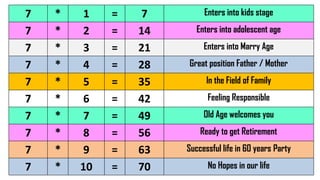
7 * 1 = 7 Enters into kids stage
7 * 2 = 14 Enters into adolescent age
7 * 3 = 21 Enters into Marry Age
7 * 4 = 28 Great position Father / Mother
7 * 5 = 35 In the Field of Family
7 * 6 = 42 Feeling Responsible
7 * 7 = 49 Old Age welcomes you
7 * 8 = 56 Ready to get Retirement
7 * 9 = 63 Successful life in 60 years Party
7 * 10 = 70 No Hopes in our life
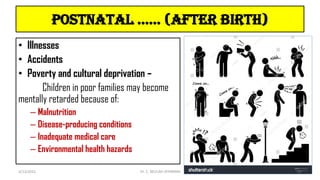
postnatal …… (after birth)
• Illnesses
• Accidents
• Poverty and cultural deprivation –
Children in poor families may become
mentally retarded because of:
– Malnutrition
– Disease-producing conditions
– Inadequate medical care
– Environmental health hazards
4/13/2022 27
Dr. C. BEULAH JAYARANIi
• GENETIC INFLUENCE IN AUTISM
– MONOZYGOTIC (Identical twins) & DIZYGOTIC TWINS(Fraternal twins)
• VIRUS
– RUBELLA (Cough, Sore throat and Red spots on your skin)
• ENVIRONMENTAL FACTORS
– Toxin (Poisonous Substance produced by bacteria, animals or plants)
• DRUGS AND MEDICINES
– Intake of some drugs or medicines during pregnancy time
• DIABETIC
– Diabetes during pregnancy
• BRAIN DYSFUNCTION
– Due to lack of oxygen, injuries, abnormal development
4/13/2022 28
Dr. C. BEULAH JAYARANIi
• Hearing impairment
• Speech impairment
• Visual impairment
• Morbidity/Physically challenged
• Psychological disorders
• Mentally retarded
• Cerebral palsy
• Multiple disability
Types of
Disabilities
4/13/2022 29
Dr. C. BEULAH JAYARANIi
4/13/2022 Dr. C. BEULAH JAYARANI 30
references
“Inclusive Education”
• TNTEU – Study Material
• Ram Publications
• Sri Krishna Publications
• Samyukdha Publications
• Google Images

DISABILITY AND IMPAIRMENT.pdf

  • 1.
    Understanding the disability 1 DR.C. BEULAH JAYARANI M.Sc., M.A, M.Ed, M.Phil (Edn), M.Phil (ZOO), NET, Ph.D (Edn) ASST. PROFESSOR, LOYOLA COLLEGE OF EDUCATION, CHENNAI - 34
  • 2.
    Unit -1 Understanding thedisability • NEED OF INCLUSIVE EDUCATION 4/13/2022 2 Dr. C. BEULAH JAYARANIi
  • 3.
    Unit i-Understanding thedisability • Meaning and Definition of disability • Meaning and definition of impairment • Difference between disability and impairment • Characteristics of disabilities • Causes of disabilities Types of Disabilities 1. Hearing impairment 2. Speech impairment 3. Visual impairment 4. Morbidity/Physicallychallenged 5. Psychologicaldisorders 6. Mentally retarded 7. Cerebral palsy 8. Multiple disability
  • 4.
    handicap •Handicap is adisadvantage, for a given individual, resulting from impairment or a disability, which prevents the fulfilment of a role that is considered normal ( depending on a age, sex, and social and cultural factors) for that individual. Handicap refers to the way impairment restricts aperson's functioning 4/13/2022 4 Dr. C. BEULAH JAYARANIi
  • 5.
    meaning of impairment Impairmentis the loss of an organ or the defect in structure and function of the organs of a person. This defect may be temporary or permanent. 4/13/2022 5 Dr. C. BEULAH JAYARANIi
  • 6.
    impairment •For Example •Those wholost their hearing capacity are known as “ Hearing impaired” •Likewise , those who lost their vision are called as “ Visually impaired” 4/13/2022 6 Dr. C. BEULAH JAYARANIi
  • 7.
  • 8.
    meaning of disability •A disability is any condition of the body or mind (impairment) that makes it more difficult for the person with the condition to do certain activities (activity limitation) and interact with the world around them According to The Rights of Persons with Disabilities Act, 2016. "Person with disability" means a person with long term physical, mental, intellectual or sensory impairment which, in interaction with barriers, hinders his full and effective participation in society equally with others. 4/13/2022 8 Dr. C. BEULAH JAYARANIi
  • 9.
    • A disabilityis a physical or mental problem that makes it difficult or impossible for a person to walk, see, hear, speak, learn, or do other important things. Some disabilities are permanent, or last forever. A disability can be something a person was born with. Or it can be the result of an illness or an accident. 4/13/2022 9 Dr. C. BEULAH JAYARANIi
  • 10.
    disability In brief ,disability refers to the condition where one could not perform his activities as of a normal person difficulty in undertaking or experience various day-to-day activities . §Disability = Impairment in body organs +inability to perform certain task like normal persons + Lack of ability to perform day-to-day activities. 4/13/2022 10 Dr. C. BEULAH JAYARANIi
  • 11.
  • 12.
    characteristics of disabilities 1.Due to loss or abnormality of physical organs (e.g.) mal-formation of limbs, cleft lip, disfigured fingers. Disorders due to disfunctioning of organs of the body even though they may have normal anatomical structure. Impairment of organs of the body. Due to genetic disorders, developmental defects, accidents or diseases, opportunities and facilities in the society. 4/13/2022 12 Dr. C. BEULAH JAYARANIi
  • 13.
    characteristics of disabilities…… Dueto the limitation of one’s functioning arising from impairments. Due to the inability to undertake activities of daily life like others. i.e. one’s functional efficiency getting affected. The degree of disability could be reduced with the use of appropriate equipments and appliances. The handicap arising out of disability could be greatly reduced by providing appropriate 4/13/2022 13 Dr. C. BEULAH JAYARANIi
  • 14.
    caUses of disability Problemsduring delivery Genetic disorder Diseases (Polio, Brain fever,..) Artificial fertilization Severe malnutrition Severe accident Adverse effects of drugs consumed during pregnancy 4/13/2022 14 Dr. C. BEULAH JAYARANIi
  • 15.
    difference between disabilityand impairment IMPAIRMENT • Impairment refers to a problem with a structureor organ of the body • Impairment is theactual condition • Impairment describes problems at the tissuelevel. • Impairment is any loss ofnormal physical or mental abilities. • Impairments are usuallythe result of disease, illness, or injury. DISABILITY • Disability is a functional limitation with regard to aparticular activity • Disability is the restriction of ability caused by the condition. • Disability usually refers to difficulty carrying out tasks or activities of daily life. • The disabled person can’ttake care of him or herself. Eg: disability from a back injury might mean theperson can no longer get dressed or bathe without help. 4/13/2022 15 Dr. C. BEULAH JAYARANIi
  • 16.
  • 17.
    stages of growthand development PRENATAL STAGE PERINATAL STAGE POSTNATAL STAGE 4/13/2022 17 Dr. C. BEULAH JAYARANIi
  • 18.
    stages of prenataldevelopment • Zygotic (or Germinal) Stage 0-2 weeks • Embryonic Stage 2-8 weeks • Fetal Stage 9-40 weeks
  • 19.
    MONTHS HEIGHT WEIGHT 2months 1 ” long 1 / 13 Ounce 3 months 3 ” long 1 Ounce 4 months 9 ” long 6 Ounces 5 months 12 ” long 14 Ounces 6 months 14 ” long 20 Ounces 7 months 16 ” long 3 - 4 Pounds 8 months 18 ” long 5 – 6 Pounds 9 months 20 ” long 7.5 Pounds
  • 20.
    4/13/2022 20 Dr. C.BEULAH JAYARANIi
  • 21.
    4/13/2022 growth in weekwise 21 Dr. C. BEULAH JAYARANIi
  • 22.
    prenatal stage • Poorhealth • Age factor • Previous pregnant problems • Use of drugs by the pregnant mother without consultation of Doctor can cause mental retardation • Use of alcohol by the mother • Exposure of X – ray • Infections • Illness 4/13/2022 22 Dr. C. BEULAH JAYARANIi
  • 23.
  • 24.
    perinatal (dUring birthprocess) • Delayed Labour – Amniotic Fluid • Breech Delivery (Buttocks Or Feet) • Delayed Birth Cry • Sudden Delivery - Constipation Problem • Baby Big – Virginal Small • Pre Matured Baby • Low Birth Weight 4/13/2022 24 Dr. C. BEULAH JAYARANIi
  • 25.
    INFANCY Birth to 2yrs EARLY CHILDHOOD 2 yrs to 6 yrs LATER CHILDHOOD 6 yrs to 12 yrs ADOLESCENCE 13 yrs to 20 yrs YOUNG ADULTHOOD 20 yrs to 40 yrs MATURE ADULTHOOD / MIDDLE AGE 40 yrs to 60 yrs AGED ADULTHOOD / OLD AGE Over 60 yrs postnatal stage 25
  • 26.
    7 * 1= 7 Enters into kids stage 7 * 2 = 14 Enters into adolescent age 7 * 3 = 21 Enters into Marry Age 7 * 4 = 28 Great position Father / Mother 7 * 5 = 35 In the Field of Family 7 * 6 = 42 Feeling Responsible 7 * 7 = 49 Old Age welcomes you 7 * 8 = 56 Ready to get Retirement 7 * 9 = 63 Successful life in 60 years Party 7 * 10 = 70 No Hopes in our life
  • 27.
    postnatal …… (afterbirth) • Illnesses • Accidents • Poverty and cultural deprivation – Children in poor families may become mentally retarded because of: – Malnutrition – Disease-producing conditions – Inadequate medical care – Environmental health hazards 4/13/2022 27 Dr. C. BEULAH JAYARANIi
  • 28.
    • GENETIC INFLUENCEIN AUTISM – MONOZYGOTIC (Identical twins) & DIZYGOTIC TWINS(Fraternal twins) • VIRUS – RUBELLA (Cough, Sore throat and Red spots on your skin) • ENVIRONMENTAL FACTORS – Toxin (Poisonous Substance produced by bacteria, animals or plants) • DRUGS AND MEDICINES – Intake of some drugs or medicines during pregnancy time • DIABETIC – Diabetes during pregnancy • BRAIN DYSFUNCTION – Due to lack of oxygen, injuries, abnormal development 4/13/2022 28 Dr. C. BEULAH JAYARANIi
  • 29.
    • Hearing impairment •Speech impairment • Visual impairment • Morbidity/Physically challenged • Psychological disorders • Mentally retarded • Cerebral palsy • Multiple disability Types of Disabilities 4/13/2022 29 Dr. C. BEULAH JAYARANIi
  • 30.
    4/13/2022 Dr. C.BEULAH JAYARANI 30 references “Inclusive Education” • TNTEU – Study Material • Ram Publications • Sri Krishna Publications • Samyukdha Publications • Google Images