NADAR SARASWATHI COLLEGE
OF ARTS AND SCIENCE
DEPARTMENT OF COMPUTER SCIENCE
COMPILER DESIGN
CODE OPTIMIZATION
BY
S.SAMEENA FATHIMA
I-MSC(CS)
WHAT IS CODE OPTIMIZATION?
Contd...
Code optimization is a program modification strategy
that endeavours to enhance the intermediate code, so a
program utilises the least potential memory, minimises
its CPU time and offers high speed.
The process of code optimization involves-
• Eliminating the unwanted code lines
• Rearranging the statements of the code
Advantages:
• The optimized code has the
following advantages-
• Optimized code has faster
execution speed.
• Optimized code utilizes the
memory efficiently.
• Optimized code gives better
performance.
Code Optimization Techniques-
1. Compile Time Evaluation
2. Common sub-expression
elimination
3. Dead Code Elimination
4. Code Movement
5. Strength Reduction
1. Compile Time Evaluation-
Two techniques that falls under compile time evaluation are-
A) Constant Folding-
• In this technique,
• As the name suggests, it involves folding the constants.
• The expressions that contain the operands having constant
values at compile time are evaluated.
• Those expressions are then replaced with their respective
results.
Example-
Circumference of Circle = (22/7) x Diameter
Here,
This technique evaluates the expression 22/7 at compile time.
The expression is then replaced with its result 3.14.
This saves the time at run time.
B) Constant Propagation-
• In this technique,
• If some variable has been assigned some constant value, then it replaces
that variable with its constant value in the further program during
compilation.
• The condition is that the value of variable must not get alter in between.
Example-
• pi = 3.14
• radius = 10
• Area of circle = pi x radius x radius
• Here,
• This technique substitutes the value of variables ‘pi’ and ‘radius’ at compile
time.
• It then evaluates the expression 3.14 x 10 x 10.
• The expression is then replaced with its result 314.
• This saves the time at run time.
The expression that has been already computed before and appears
again in the code for computation
is called as Common Sub-Expression.
2. Common Sub-Expression Elimination-
In this technique,
•As the name suggests, it involves eliminating the common sub expressions.
•The redundant expressions are eliminated to avoid their re-computation.
•The already computed result is used in the further program when required.
3. Code Movement-
• In this technique,
• As the name suggests, it involves movement of the code.
• The code present inside the loop is moved out if it does not matter whether it is
present inside or outside.
• Such a code unnecessarily gets execute again and again with each iteration of the
loop.
• This leads to the wastage of time at run time.
Code Before Optimization Code After Optimization
for ( int j = 0 ; j < n ; j ++)
{
x = y + z ;
a[j] = 6 x j;
}
x = y + z ;
for ( int j = 0 ; j < n ; j ++)
{
a[j] = 6 x j;
}
4. Dead Code Elimination-
• In this technique,
• As the name suggests, it involves eliminating the dead code.
• The statements of the code which either never executes or are unreachable
or their output is never used are eliminated.
Code Before Optimization Code After Optimization
i = 0 ;
if (i == 1)
{
a = x + 5 ;
}
i = 0 ;
5. Strength Reduction-
• In this technique,
• As the name suggests, it involves reducing the strength of expressions.
• This technique replaces the expensive and costly operators with the
simple and cheaper ones.
Code Before Optimization Code After Optimization
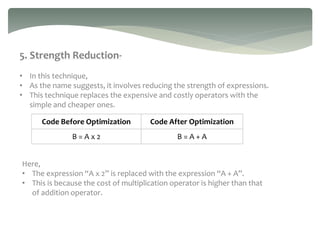
B = A x 2 B = A + A
Here,
• The expression “A x 2” is replaced with the expression “A + A”.
• This is because the cost of multiplication operator is higher than that
of addition operator.
THANK YOU !

Code optimization

  • 1.
    NADAR SARASWATHI COLLEGE OFARTS AND SCIENCE DEPARTMENT OF COMPUTER SCIENCE COMPILER DESIGN CODE OPTIMIZATION BY S.SAMEENA FATHIMA I-MSC(CS)
  • 2.
    WHAT IS CODEOPTIMIZATION? Contd... Code optimization is a program modification strategy that endeavours to enhance the intermediate code, so a program utilises the least potential memory, minimises its CPU time and offers high speed. The process of code optimization involves- • Eliminating the unwanted code lines • Rearranging the statements of the code
  • 3.
    Advantages: • The optimizedcode has the following advantages- • Optimized code has faster execution speed. • Optimized code utilizes the memory efficiently. • Optimized code gives better performance.
  • 4.
    Code Optimization Techniques- 1.Compile Time Evaluation 2. Common sub-expression elimination 3. Dead Code Elimination 4. Code Movement 5. Strength Reduction
  • 5.
    1. Compile TimeEvaluation- Two techniques that falls under compile time evaluation are- A) Constant Folding- • In this technique, • As the name suggests, it involves folding the constants. • The expressions that contain the operands having constant values at compile time are evaluated. • Those expressions are then replaced with their respective results. Example- Circumference of Circle = (22/7) x Diameter Here, This technique evaluates the expression 22/7 at compile time. The expression is then replaced with its result 3.14. This saves the time at run time.
  • 6.
    B) Constant Propagation- •In this technique, • If some variable has been assigned some constant value, then it replaces that variable with its constant value in the further program during compilation. • The condition is that the value of variable must not get alter in between. Example- • pi = 3.14 • radius = 10 • Area of circle = pi x radius x radius • Here, • This technique substitutes the value of variables ‘pi’ and ‘radius’ at compile time. • It then evaluates the expression 3.14 x 10 x 10. • The expression is then replaced with its result 314. • This saves the time at run time.
  • 7.
    The expression thathas been already computed before and appears again in the code for computation is called as Common Sub-Expression. 2. Common Sub-Expression Elimination- In this technique, •As the name suggests, it involves eliminating the common sub expressions. •The redundant expressions are eliminated to avoid their re-computation. •The already computed result is used in the further program when required.
  • 8.
    3. Code Movement- •In this technique, • As the name suggests, it involves movement of the code. • The code present inside the loop is moved out if it does not matter whether it is present inside or outside. • Such a code unnecessarily gets execute again and again with each iteration of the loop. • This leads to the wastage of time at run time. Code Before Optimization Code After Optimization for ( int j = 0 ; j < n ; j ++) { x = y + z ; a[j] = 6 x j; } x = y + z ; for ( int j = 0 ; j < n ; j ++) { a[j] = 6 x j; }
  • 9.
    4. Dead CodeElimination- • In this technique, • As the name suggests, it involves eliminating the dead code. • The statements of the code which either never executes or are unreachable or their output is never used are eliminated. Code Before Optimization Code After Optimization i = 0 ; if (i == 1) { a = x + 5 ; } i = 0 ;
  • 10.
    5. Strength Reduction- •In this technique, • As the name suggests, it involves reducing the strength of expressions. • This technique replaces the expensive and costly operators with the simple and cheaper ones. Code Before Optimization Code After Optimization B = A x 2 B = A + A Here, • The expression “A x 2” is replaced with the expression “A + A”. • This is because the cost of multiplication operator is higher than that of addition operator.
  • 11.