FIRSTUP
CONSULTANTS
DIGITALIMAGEPROCESSING-
FUNDAMENTALS
Dr.M.UMADEVI
ASSISTANT PROFESSOR
DEPARTMENT OF CS
SACWC
CUMBUM
1
FIRSTUP
CONSULTANTS
FUNDAMENTALS OF DIGITAL IMAGE PROCESSING
• Applications of image processing
• What's an image?
• A simple image model
• Fundamental steps in image processing
• Elements of digital image processing systems
2
FIRSTUP
CONSULTANTS
APPLICATIONS OF IMAGE PROCESSING
Interest in digital image processing methods stems from 2
principal application areas:
(1) improvement of pictorial information for human
interpretation, and
(2) processing of scene data for autonomous machine
perception.
(3) In the second application area, interest focuses on
procedures for extracting from an image information in a
form suitable for computer processing.
(4) Examples include automatic character recognition,
industrial machine vision for product assembly and
inspection, military recognizance, automatic processing of
fingerprints etc. 3
FIRSTUP
CONSULTANTS
FUNDAMENTALS OF DIGITAL IMAGE PROCESSING
What's an image?
• An image refers to a 2D light intensity function f(x,y),
where (x,y) denote spatial coordinates and the value of f at
any point (x,y) is proportional to the brightness or gray levels
of the image at that point.
• A digital image is an image f(x,y) that has been discretized
both in spatial coordinates and brightness.
• The elements of such a digital array are called image
elements or pixels.
4
FIRSTUP
CONSULTANTS
FUNDAMENTALS OF DIGITAL IMAGE PROCESSING
A simple image model:
• To be suitable for computer processing, an image f(x,y)
must be digitalized both spatially and in amplitude.
• Digitization of the spatial coordinates (x,y) is called image
sampling.
• Amplitude digitization is called gray-level quantization
5
FIRSTUP
CONSULTANTS
FUNDAMENTALS OF DIGITAL IMAGE PROCESSING
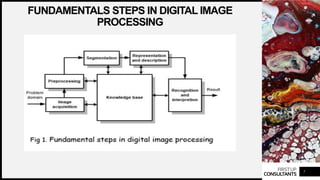
1. Image acquisition: to acquire a digital image
2. Image pre-processing: to improve the image in ways that increase the chances
for success of the other processes.
3. Image segmentation: to partitions an input image into its constituent parts or
objects.
4. Image representation: to convert the input data to a form suitable for computer
processing.
5. Image description: to extract features that result in some quantitative information
of interest or features that are basic for differentiating one class of objects from
another.
6. Image recognition: to assign a label to an object based on the information
provided by its descriptors.
7. Image interpretation: to assign meaning to an ensemble of recognized objects.
6
FIRSTUP
CONSULTANTS
FUNDAMENTALS STEPS IN DIGITAL IMAGE
PROCESSING
7
FIRSTUP
CONSULTANTS
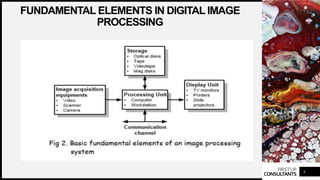
FUNDAMENTAL ELEMENTS IN DIGITAL IMAGE
PROCESSING
8
FIRSTUP
CONSULTANTS
THANK YOU
9

Dip

  • 1.
  • 2.
    FIRSTUP CONSULTANTS FUNDAMENTALS OF DIGITALIMAGE PROCESSING • Applications of image processing • What's an image? • A simple image model • Fundamental steps in image processing • Elements of digital image processing systems 2
  • 3.
    FIRSTUP CONSULTANTS APPLICATIONS OF IMAGEPROCESSING Interest in digital image processing methods stems from 2 principal application areas: (1) improvement of pictorial information for human interpretation, and (2) processing of scene data for autonomous machine perception. (3) In the second application area, interest focuses on procedures for extracting from an image information in a form suitable for computer processing. (4) Examples include automatic character recognition, industrial machine vision for product assembly and inspection, military recognizance, automatic processing of fingerprints etc. 3
  • 4.
    FIRSTUP CONSULTANTS FUNDAMENTALS OF DIGITALIMAGE PROCESSING What's an image? • An image refers to a 2D light intensity function f(x,y), where (x,y) denote spatial coordinates and the value of f at any point (x,y) is proportional to the brightness or gray levels of the image at that point. • A digital image is an image f(x,y) that has been discretized both in spatial coordinates and brightness. • The elements of such a digital array are called image elements or pixels. 4
  • 5.
    FIRSTUP CONSULTANTS FUNDAMENTALS OF DIGITALIMAGE PROCESSING A simple image model: • To be suitable for computer processing, an image f(x,y) must be digitalized both spatially and in amplitude. • Digitization of the spatial coordinates (x,y) is called image sampling. • Amplitude digitization is called gray-level quantization 5
  • 6.
    FIRSTUP CONSULTANTS FUNDAMENTALS OF DIGITALIMAGE PROCESSING 1. Image acquisition: to acquire a digital image 2. Image pre-processing: to improve the image in ways that increase the chances for success of the other processes. 3. Image segmentation: to partitions an input image into its constituent parts or objects. 4. Image representation: to convert the input data to a form suitable for computer processing. 5. Image description: to extract features that result in some quantitative information of interest or features that are basic for differentiating one class of objects from another. 6. Image recognition: to assign a label to an object based on the information provided by its descriptors. 7. Image interpretation: to assign meaning to an ensemble of recognized objects. 6
  • 7.
  • 8.
  • 9.