MITOSIS
Mitosis is normal cell division, which
goes on throughout life in all parts of
the body.
Mitosis occurs regularly in tissues that
require new cells continuously such as
skin cells, hair follicles, the lining of
the digestive tract and in a newly
fertilized egg.
• Besides multiplication, old and dying
cells are regularly replaced.
• Somatic cell division includes 2 major
steps:
I. Karyokinesis or mitosis
II. Cytokinesis or division of cytoplasm
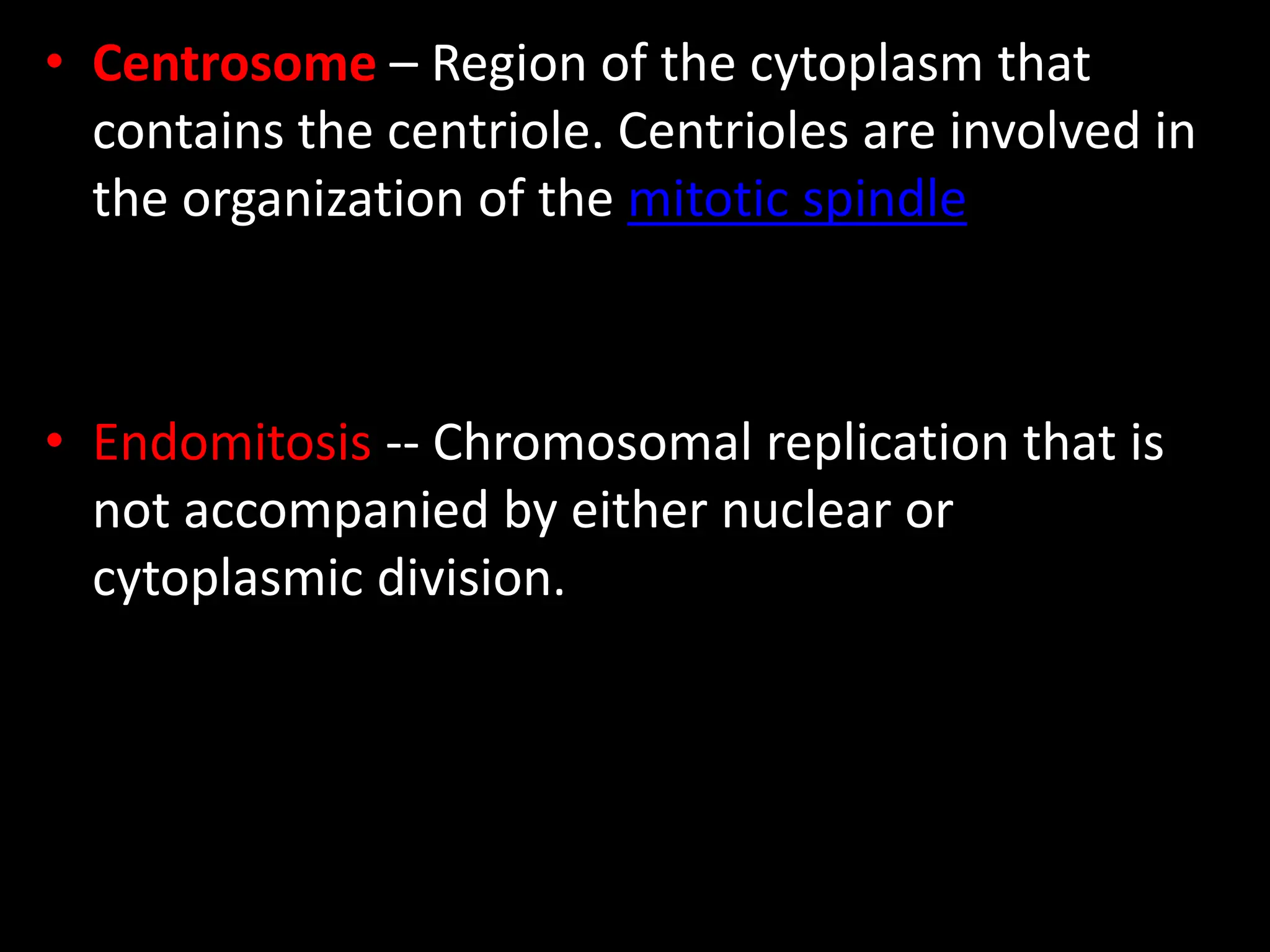
Mitosis  Mitosis is the process by which a eukaryotic cell
separates the chromosomes in its cell nucleus
into two identical sets in two nuclei
(karyokinesis).
 It is generally followed immediately by
cytokinesis, which divides the nuclei, cytoplasm,
organelles and cell membrane into two cells
containing roughly equal shares of these cellular
components.
 karyokinesis and cytokinesis together define the
mitotic (M) phase of the cell cycle—the division
of the mother cell into two daughter cells,
genetically identical to each other and to their
parent cell.
CELL DIVISION
(1) Nucleolus
(2) Nucleus
(3) Ribosomes (little dots)
(4) Vesicle
(5) Rough endoplasmic
reticulum (ER)
(6) Golgi apparatus
(7) Cytoskeleton
(8) Smooth ER
(9) Mitochondria
(10) Vacuole
(11) Cytosol
(12) Lysosome
(13) Centrioles within
Centrosome
Important terms
• Diploid -- A condition in which each chromosome exists in pairs; having
two of each chromosome
• Somatic cells -- All cells other than the germ cells or gametes in an
organism
• Gamete -- A specialized reproductive cell with a haploid number of
chromosomes.
• Kinetochore -- A fibrous structure with a size of about 400 nm, located
within the centromere. It appears to be the site of microtubule
attachment during division.
• Disjunction -- The separation of chromosomes at the anaphase stage of
cell division.
• Spindle fibers -- Cytoplasmic fibrils formed during cell division that are
involved with the separation of chromatids at anaphase and their
movement toward opposite poles in the cell.
• Centrosome – Region of the cytoplasm that
contains the centriole. Centrioles are involved in
the organization of the mitotic spindle
• Endomitosis -- Chromosomal replication that is
not accompanied by either nuclear or
cytoplasmic division.
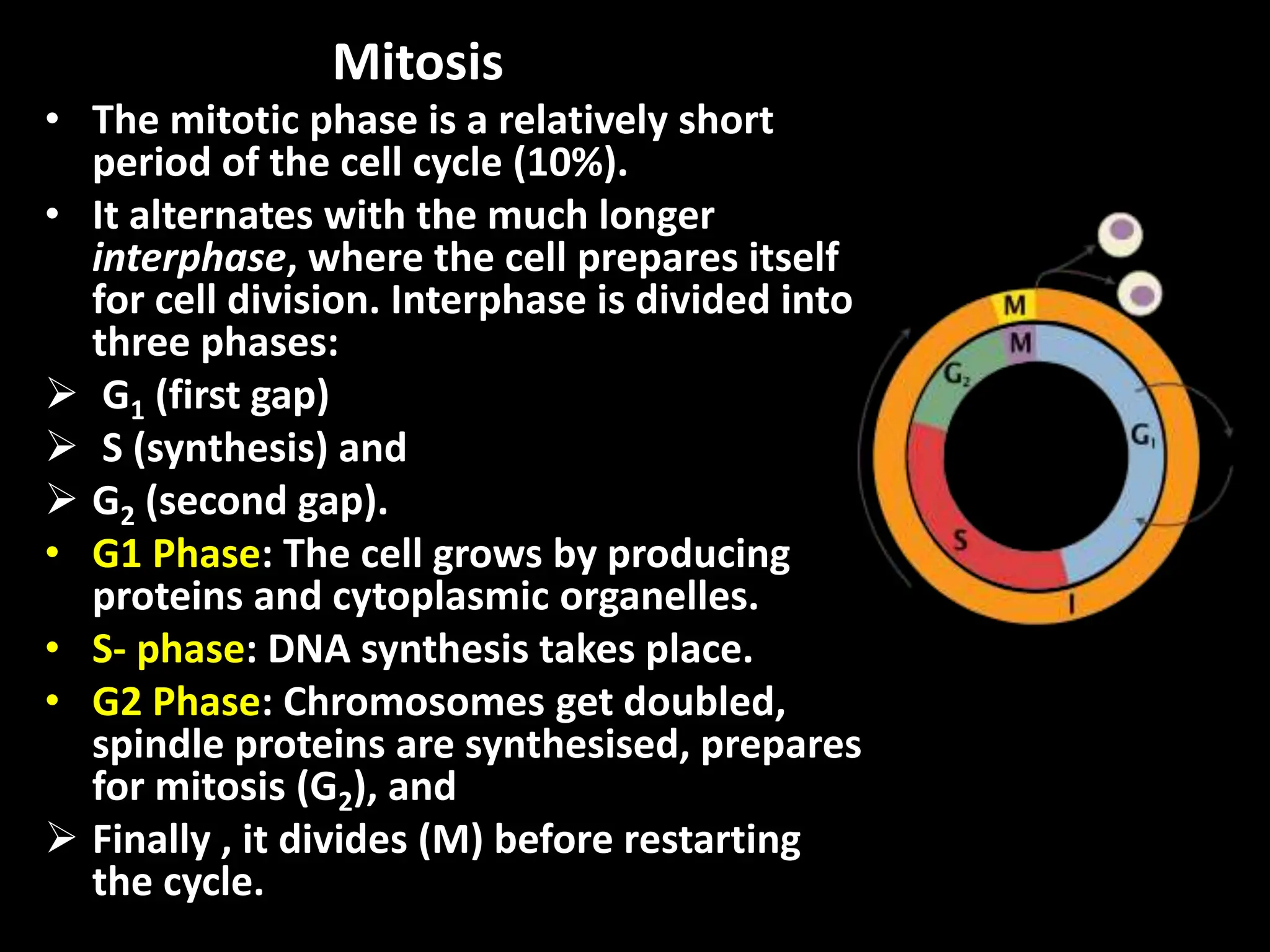
Mitosis
• The mitotic phase is a relatively short
period of the cell cycle (10%).
• It alternates with the much longer
interphase, where the cell prepares itself
for cell division. Interphase is divided into
three phases:
 G1 (first gap)
 S (synthesis) and
 G2 (second gap).
• G1 Phase: The cell grows by producing
proteins and cytoplasmic organelles.
• S- phase: DNA synthesis takes place.
• G2 Phase: Chromosomes get doubled,
spindle proteins are synthesised, prepares
for mitosis (G2), and
 Finally , it divides (M) before restarting
the cycle.
Machinery of Mitosis
• The chromosomes are pulled apart
by the spindle, which is made of
microtubules. The spindle fibers are
attached to each centromere (which
is part of the chromosome), and
anchored on the other end to a
centrosome (which is the organizing
center for the spindle).
• There are 2 centrosomes, one at each
end of the spindle. The
chromosomes are lined up between
the poles of the spindle.
• When the spindle fibers contract, the
chromosomes are pulled to the
opposing poles.
• The cell then divides to separate the
two poles.
• Stages of mitosis: prophase,
metaphase, anaphase, telophase.
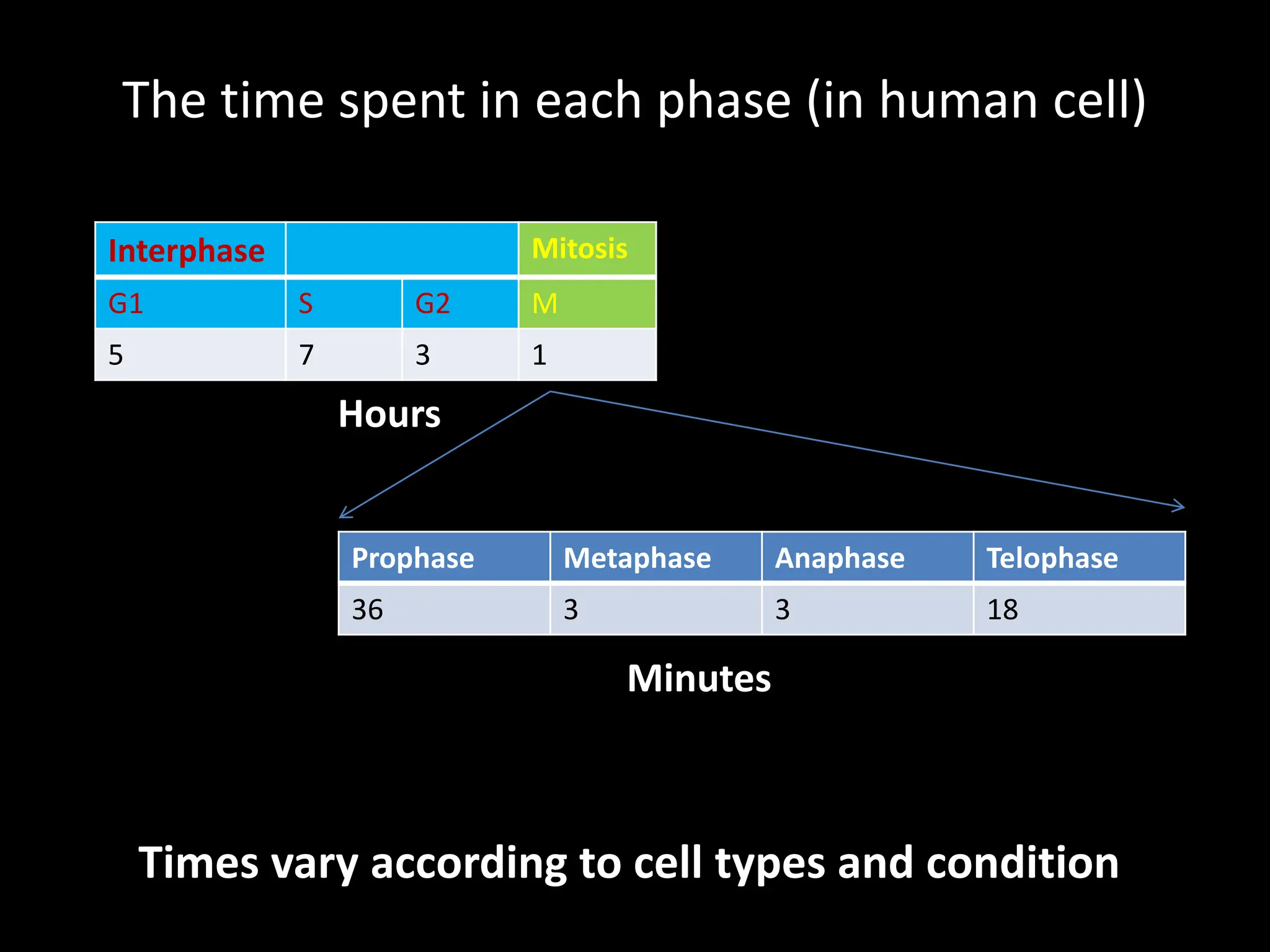
The time spent in each phase (in human cell)
Interphase Mitosis
G1 S G2 M
5 7 3 1
Prophase Metaphase Anaphase Telophase
36 3 3 18
Hours
Minutes
Times vary according to cell types and condition
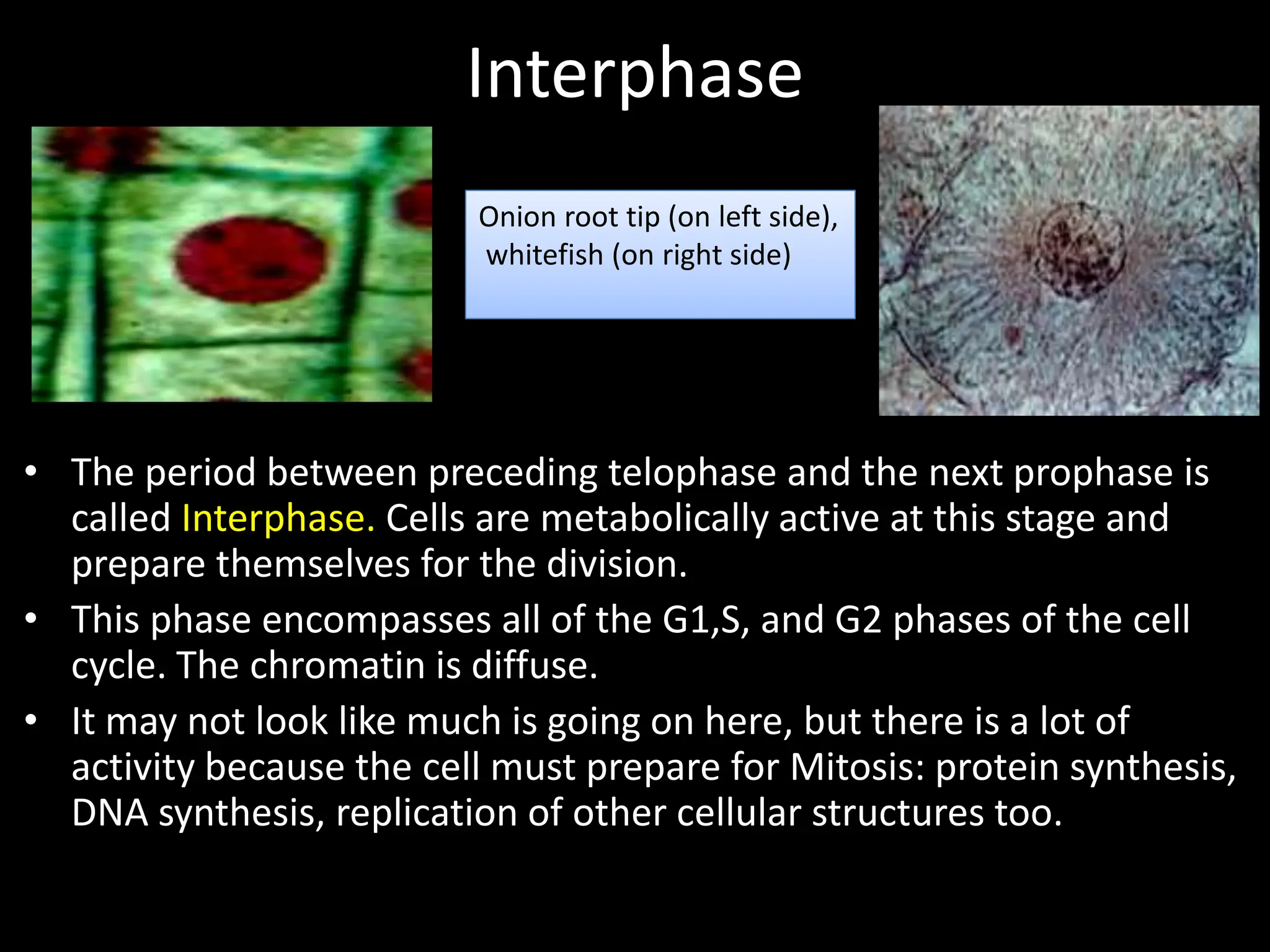
Interphase
• The period between preceding telophase and the next prophase is
called Interphase. Cells are metabolically active at this stage and
prepare themselves for the division.
• This phase encompasses all of the G1,S, and G2 phases of the cell
cycle. The chromatin is diffuse.
• It may not look like much is going on here, but there is a lot of
activity because the cell must prepare for Mitosis: protein synthesis,
DNA synthesis, replication of other cellular structures too.
Onion root tip (on left side),
whitefish (on right side)
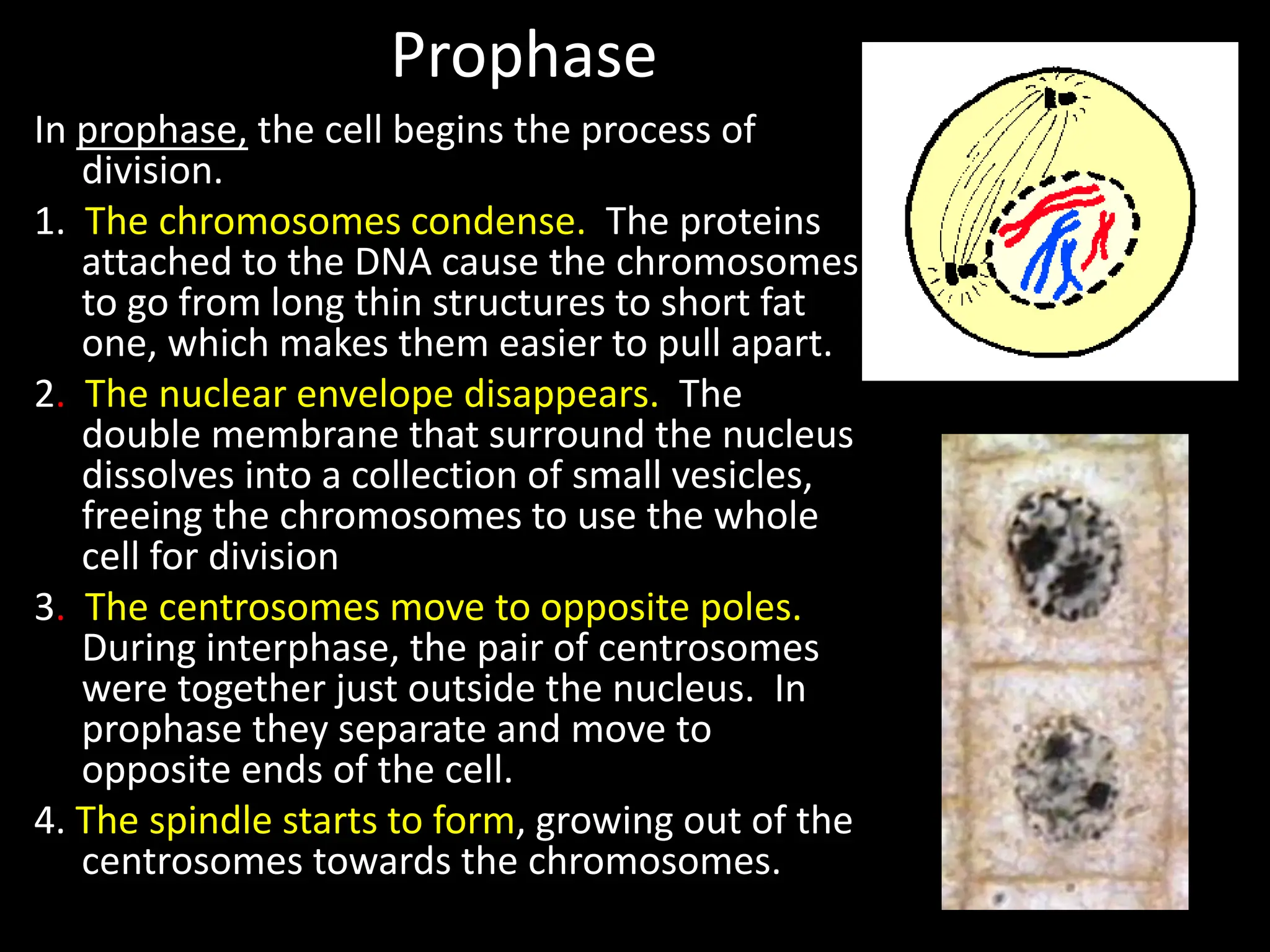
Prophase
In prophase, the cell begins the process of
division.
1. The chromosomes condense. The proteins
attached to the DNA cause the chromosomes
to go from long thin structures to short fat
one, which makes them easier to pull apart.
2. The nuclear envelope disappears. The
double membrane that surround the nucleus
dissolves into a collection of small vesicles,
freeing the chromosomes to use the whole
cell for division
3. The centrosomes move to opposite poles.
During interphase, the pair of centrosomes
were together just outside the nucleus. In
prophase they separate and move to
opposite ends of the cell.
4. The spindle starts to form, growing out of the
centrosomes towards the chromosomes.
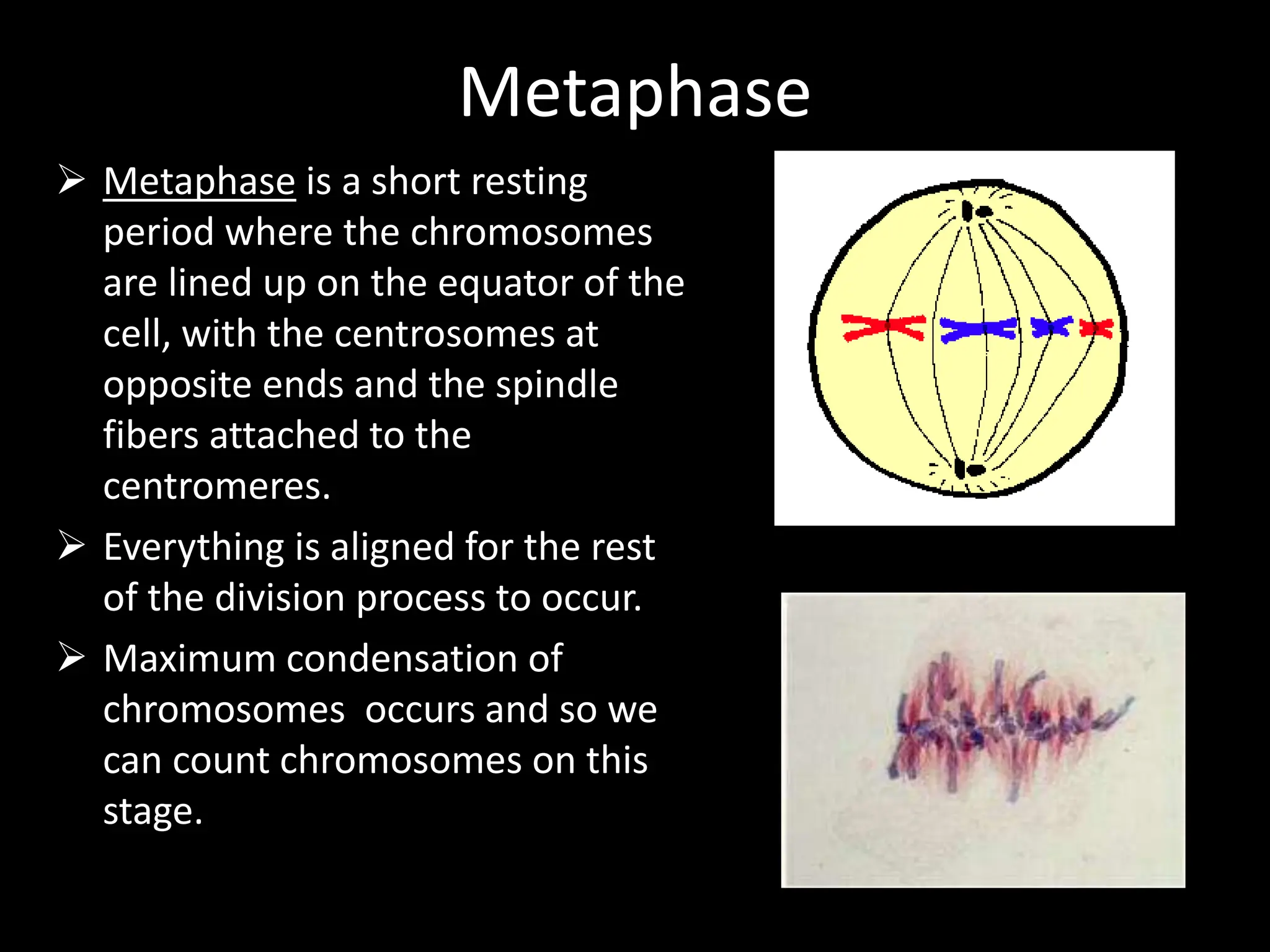
Metaphase
 Metaphase is a short resting
period where the chromosomes
are lined up on the equator of the
cell, with the centrosomes at
opposite ends and the spindle
fibers attached to the
centromeres.
 Everything is aligned for the rest
of the division process to occur.
 Maximum condensation of
chromosomes occurs and so we
can count chromosomes on this
stage.
Anaphase
 In anaphase, the centromeres
splits longitudinally and become
functionally doubled.
 The two centromeres repel each
other and start moving in
opposite directions along the
spindle fibres.
 At this point, each individual
chromosome goes from:
1 chromosome with 2 chromatids to:
2 chromosomes with one chromatid
each.
 Then the spindle fibers contract,
and the chromosomes are pulled
to opposite poles, towards the
centrosomes.
Telophase
• In telophase ,the chromosomes
start regrouping . They uncoil and
become thinner and longer.
• The chromosomes are at the poles
of the spindle.
• The spindle disintegrates
• The nuclear envelope re-forms
around the two sets of
chromosomes.
• The cytoplasm is divided into 2
separate cells (cytokinesis).
Cytokinesis
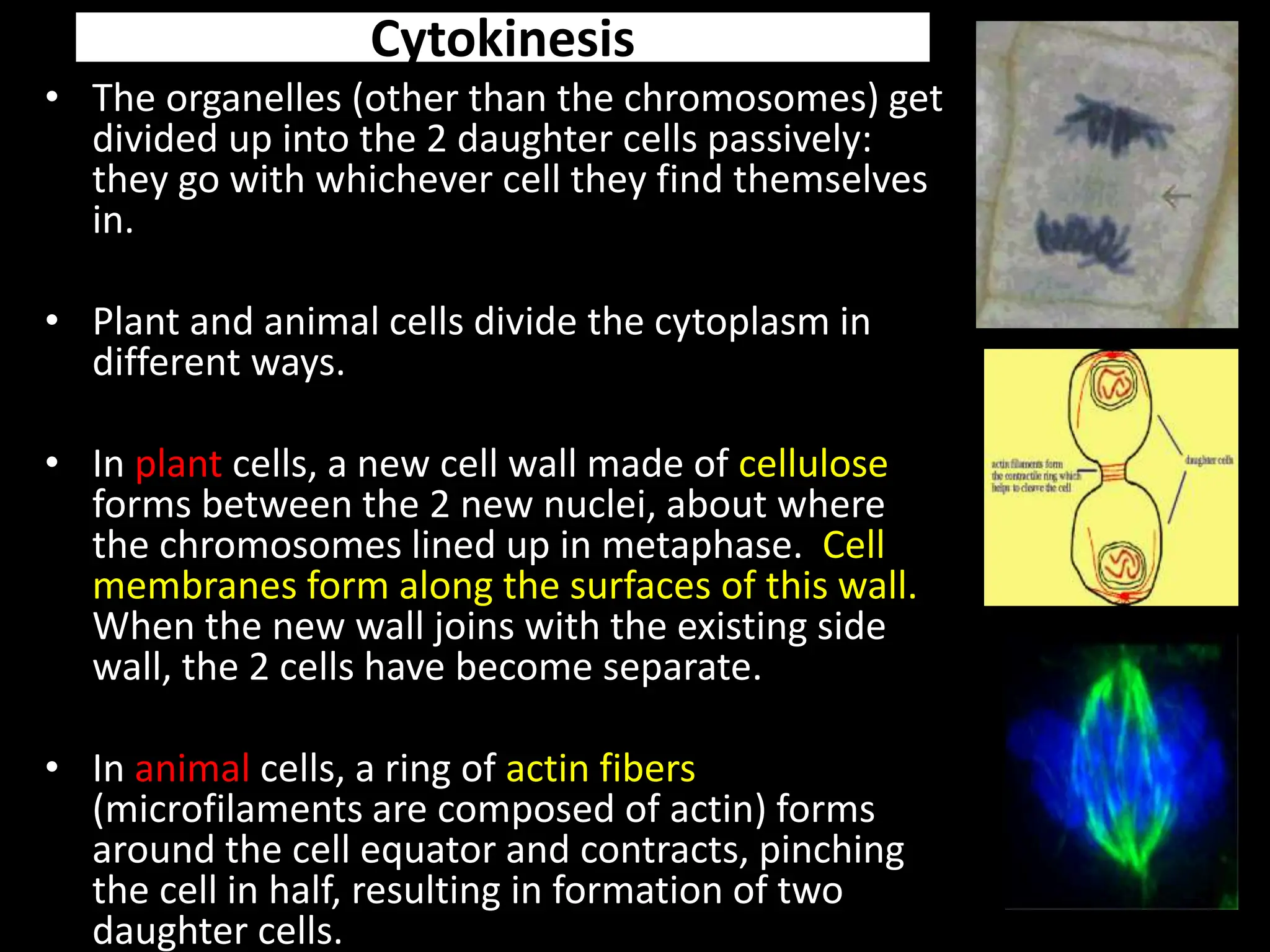
• The organelles (other than the chromosomes) get
divided up into the 2 daughter cells passively:
they go with whichever cell they find themselves
in.
• Plant and animal cells divide the cytoplasm in
different ways.
• In plant cells, a new cell wall made of cellulose
forms between the 2 new nuclei, about where
the chromosomes lined up in metaphase. Cell
membranes form along the surfaces of this wall.
When the new wall joins with the existing side
wall, the 2 cells have become separate.
• In animal cells, a ring of actin fibers
(microfilaments are composed of actin) forms
around the cell equator and contracts, pinching
the cell in half, resulting in formation of two
daughter cells.
Can you identify these stages?
Answers:
A.
Telophase
B.
Prophase
C.
Cytokinesis
D.
Metaphase
A
B
C D
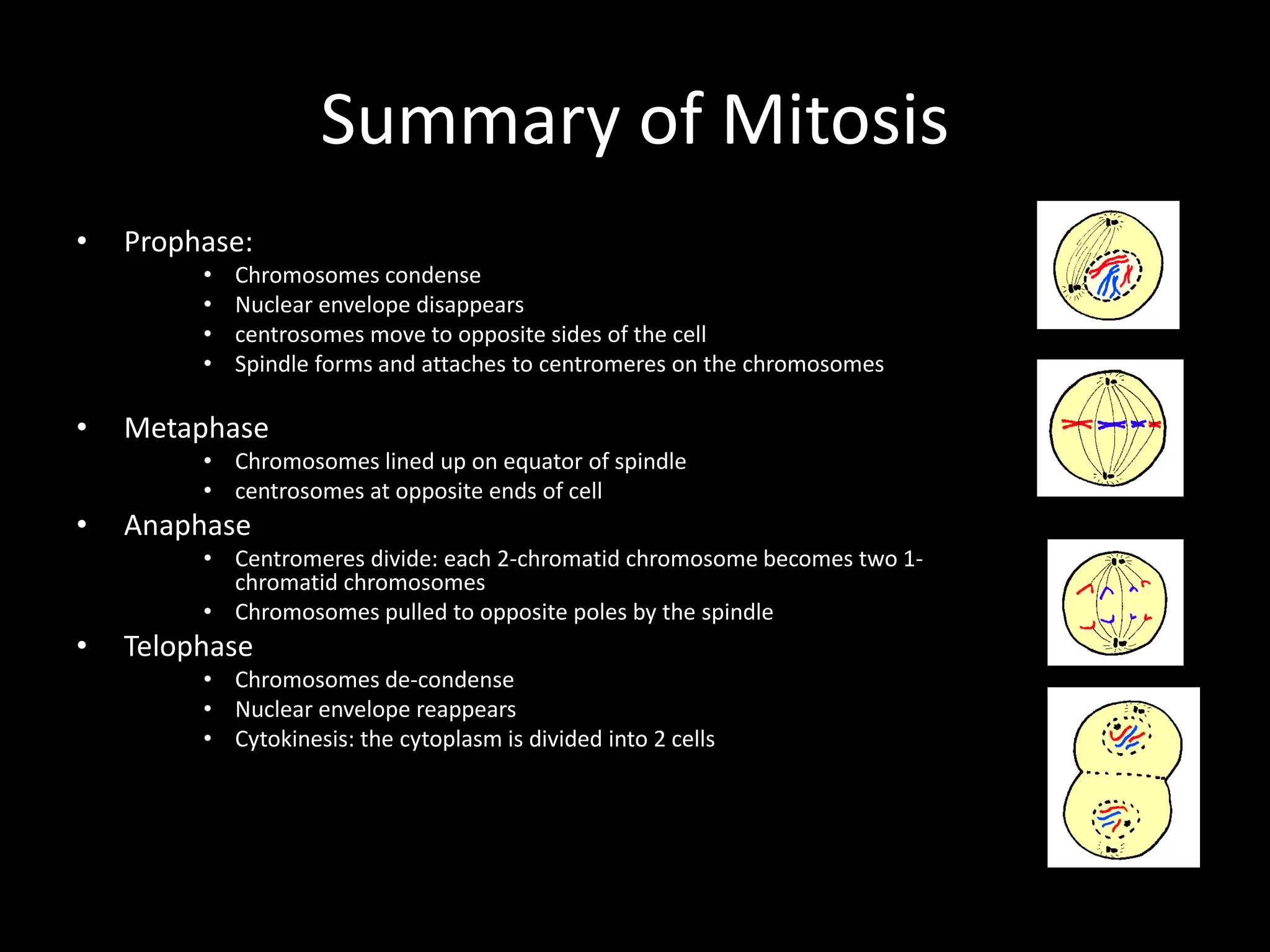
Summary of Mitosis
• Prophase:
• Chromosomes condense
• Nuclear envelope disappears
• centrosomes move to opposite sides of the cell
• Spindle forms and attaches to centromeres on the chromosomes
• Metaphase
• Chromosomes lined up on equator of spindle
• centrosomes at opposite ends of cell
• Anaphase
• Centromeres divide: each 2-chromatid chromosome becomes two 1-
chromatid chromosomes
• Chromosomes pulled to opposite poles by the spindle
• Telophase
• Chromosomes de-condense
• Nuclear envelope reappears
• Cytokinesis: the cytoplasm is divided into 2 cells
THANKS…

1-mitosis-genetics-cytogenetics-cell.pptx

  • 1.
    MITOSIS Mitosis is normalcell division, which goes on throughout life in all parts of the body. Mitosis occurs regularly in tissues that require new cells continuously such as skin cells, hair follicles, the lining of the digestive tract and in a newly fertilized egg. • Besides multiplication, old and dying cells are regularly replaced. • Somatic cell division includes 2 major steps: I. Karyokinesis or mitosis II. Cytokinesis or division of cytoplasm
  • 2.
    Mitosis  Mitosisis the process by which a eukaryotic cell separates the chromosomes in its cell nucleus into two identical sets in two nuclei (karyokinesis).  It is generally followed immediately by cytokinesis, which divides the nuclei, cytoplasm, organelles and cell membrane into two cells containing roughly equal shares of these cellular components.  karyokinesis and cytokinesis together define the mitotic (M) phase of the cell cycle—the division of the mother cell into two daughter cells, genetically identical to each other and to their parent cell.
  • 3.
  • 4.
    (1) Nucleolus (2) Nucleus (3)Ribosomes (little dots) (4) Vesicle (5) Rough endoplasmic reticulum (ER) (6) Golgi apparatus (7) Cytoskeleton (8) Smooth ER (9) Mitochondria (10) Vacuole (11) Cytosol (12) Lysosome (13) Centrioles within Centrosome
  • 5.
    Important terms • Diploid-- A condition in which each chromosome exists in pairs; having two of each chromosome • Somatic cells -- All cells other than the germ cells or gametes in an organism • Gamete -- A specialized reproductive cell with a haploid number of chromosomes. • Kinetochore -- A fibrous structure with a size of about 400 nm, located within the centromere. It appears to be the site of microtubule attachment during division. • Disjunction -- The separation of chromosomes at the anaphase stage of cell division. • Spindle fibers -- Cytoplasmic fibrils formed during cell division that are involved with the separation of chromatids at anaphase and their movement toward opposite poles in the cell.
  • 6.
    • Centrosome –Region of the cytoplasm that contains the centriole. Centrioles are involved in the organization of the mitotic spindle • Endomitosis -- Chromosomal replication that is not accompanied by either nuclear or cytoplasmic division.
  • 7.
    Mitosis • The mitoticphase is a relatively short period of the cell cycle (10%). • It alternates with the much longer interphase, where the cell prepares itself for cell division. Interphase is divided into three phases:  G1 (first gap)  S (synthesis) and  G2 (second gap). • G1 Phase: The cell grows by producing proteins and cytoplasmic organelles. • S- phase: DNA synthesis takes place. • G2 Phase: Chromosomes get doubled, spindle proteins are synthesised, prepares for mitosis (G2), and  Finally , it divides (M) before restarting the cycle.
  • 8.
    Machinery of Mitosis •The chromosomes are pulled apart by the spindle, which is made of microtubules. The spindle fibers are attached to each centromere (which is part of the chromosome), and anchored on the other end to a centrosome (which is the organizing center for the spindle). • There are 2 centrosomes, one at each end of the spindle. The chromosomes are lined up between the poles of the spindle. • When the spindle fibers contract, the chromosomes are pulled to the opposing poles. • The cell then divides to separate the two poles. • Stages of mitosis: prophase, metaphase, anaphase, telophase.
  • 9.
    The time spentin each phase (in human cell) Interphase Mitosis G1 S G2 M 5 7 3 1 Prophase Metaphase Anaphase Telophase 36 3 3 18 Hours Minutes Times vary according to cell types and condition
  • 10.
    Interphase • The periodbetween preceding telophase and the next prophase is called Interphase. Cells are metabolically active at this stage and prepare themselves for the division. • This phase encompasses all of the G1,S, and G2 phases of the cell cycle. The chromatin is diffuse. • It may not look like much is going on here, but there is a lot of activity because the cell must prepare for Mitosis: protein synthesis, DNA synthesis, replication of other cellular structures too. Onion root tip (on left side), whitefish (on right side)
  • 11.
    Prophase In prophase, thecell begins the process of division. 1. The chromosomes condense. The proteins attached to the DNA cause the chromosomes to go from long thin structures to short fat one, which makes them easier to pull apart. 2. The nuclear envelope disappears. The double membrane that surround the nucleus dissolves into a collection of small vesicles, freeing the chromosomes to use the whole cell for division 3. The centrosomes move to opposite poles. During interphase, the pair of centrosomes were together just outside the nucleus. In prophase they separate and move to opposite ends of the cell. 4. The spindle starts to form, growing out of the centrosomes towards the chromosomes.
  • 12.
    Metaphase  Metaphase isa short resting period where the chromosomes are lined up on the equator of the cell, with the centrosomes at opposite ends and the spindle fibers attached to the centromeres.  Everything is aligned for the rest of the division process to occur.  Maximum condensation of chromosomes occurs and so we can count chromosomes on this stage.
  • 13.
    Anaphase  In anaphase,the centromeres splits longitudinally and become functionally doubled.  The two centromeres repel each other and start moving in opposite directions along the spindle fibres.  At this point, each individual chromosome goes from: 1 chromosome with 2 chromatids to: 2 chromosomes with one chromatid each.  Then the spindle fibers contract, and the chromosomes are pulled to opposite poles, towards the centrosomes.
  • 14.
    Telophase • In telophase,the chromosomes start regrouping . They uncoil and become thinner and longer. • The chromosomes are at the poles of the spindle. • The spindle disintegrates • The nuclear envelope re-forms around the two sets of chromosomes. • The cytoplasm is divided into 2 separate cells (cytokinesis).
  • 15.
    Cytokinesis • The organelles(other than the chromosomes) get divided up into the 2 daughter cells passively: they go with whichever cell they find themselves in. • Plant and animal cells divide the cytoplasm in different ways. • In plant cells, a new cell wall made of cellulose forms between the 2 new nuclei, about where the chromosomes lined up in metaphase. Cell membranes form along the surfaces of this wall. When the new wall joins with the existing side wall, the 2 cells have become separate. • In animal cells, a ring of actin fibers (microfilaments are composed of actin) forms around the cell equator and contracts, pinching the cell in half, resulting in formation of two daughter cells.
  • 16.
    Can you identifythese stages? Answers: A. Telophase B. Prophase C. Cytokinesis D. Metaphase A B C D
  • 17.
    Summary of Mitosis •Prophase: • Chromosomes condense • Nuclear envelope disappears • centrosomes move to opposite sides of the cell • Spindle forms and attaches to centromeres on the chromosomes • Metaphase • Chromosomes lined up on equator of spindle • centrosomes at opposite ends of cell • Anaphase • Centromeres divide: each 2-chromatid chromosome becomes two 1- chromatid chromosomes • Chromosomes pulled to opposite poles by the spindle • Telophase • Chromosomes de-condense • Nuclear envelope reappears • Cytokinesis: the cytoplasm is divided into 2 cells
  • 19.