Introduction
-cardiac glycosides are compounds which all
posess steroid nucleus with unsaturated lactone
at c17 position and at least one glycoside at c3
position.
-organ system effect of cardiac glycosides
…… increase inotropy in cardiac myocsites
…… affects cells in vascular smooth muscle
……affect Autonomic nervous system.
Electrophysiologic effect mechanism
-shorten atrial and ventricular repolarization by
decreasing the refractory period and thus
increasing automaticity.
- increase vagal tone via action at the carotid body
by reducing conduction through the sinoatrial and
atrioventricular nodes.
-In toxic concentrations can increase sympathetic
tone.
……contineud
- Reduce plasma renin concentrations in patients
with advanced heart failure resulting in peripheral
vasodilation.
-patients without heart failure digoxin can cause
vasoconstriction.
-Increased central vagal tone typically produces
cardiac manifestations such as
…….bradydysrhythmias
……atrioventricular block.
……..continued
-Direct cellular effect
…….. inhibiting the membrane sodium-potassium
(Na+-K+) pump
…… raising intracellular levels of sodium
……leading to an accumulation of intracellular
calcium.
…..results increases cardiac contractility.
-Indirect effect
……enhancing vagal tone.
Therapeutic Uses of Digitalis Compounds
A) Heart Failure
↑ inotropy
↑ ejection fraction
↓ preload
↓ pulmonary congestion/edema
B)Arrhythmias
↓ AV nodal conduction
(parasympathomimetic effect)
↓ ventricular rate in atrial flutter
and fibrillation
Cardiac glycosides are found naturally in Plants
and animals.
A. Cardenolides :
1. Digitalis purpurea – Digitoxin, Gitoxin and
Gitalin
2. Digitalis lanata - Digitoxin, Gitoxin and Digoxin
3. Strophanthus gratus – Ouabin
……….continued
4. Thevetia nerifolia – Thevetin
5. Convallaria majalis – Convallotoxin
B. Bufadienolides: Bufo vulgris - Bufotoxin
Digoxin- the only cardiac glycoside mostly used
in current clinical practice around the world.
-some times digitoxin is used in Europe
-One of top toxins in the world because
…… wide availability of digoxin
….. narrow therapeutic window.
Mechanism Of Action
-Direct inhibition of membrane-bound Na+/K+ -
ATPase which pumps (3 Na+ outside for 2 K+
inside the cell)
-This is responsible for maintenance of resting
membrane potential in most excitable cells.
….continued
-This leads to an increase intracellular
sodium that gradually decrease in
intracellular potassium.
- In Cardiac fiber [Ca2+] is exchanged for
extracellular sodium (3:1 ratio) by Na+/Ca+
exchanger transport system that is forced by
the concentration gradient for these ions
and the transmembrane potential.
……Continued
-increase in [Na+]i is related crucially to the
positive inotropic effect of digitalis.
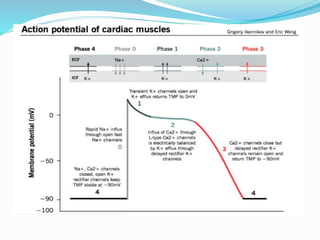
-Facilitation of Ca+ entry through the voltage
gated Ca+ channels of the membrane.
-That is associated with increase in slow inward
calcium current during the plateau of action
potential.
……Continued
-They decrease AV conduction through direct
action on the myocardium and vagal stimulation.
-They increase heart automaticity in overdose
only leading to pulse bigeminus and pulse
trigeminus.
Pharmacokinetics
-Therapeutic daily dose from 5-15mcg/kg.
- bioavailability is 95%.
-excreted by kideny 60-80% of the dose
unchanged.
-The onset of action
…..oral in 30-120 minutes.
…. intravenous in 5-30 minutes.
-Half life is 1-3 days
……continued
-1% of the total amount of digoxin in the body is
in the serum.
- about 30 % bound to plasma proteins.
- volume of distribution 6- 7L/kg which is large.
-A dose less than 5 mg is rarely to cause toxicity.
-A dose higher than 11 mg may be fatal.
-In pediatrics 4 mg can cause toxicity.
Use of digoxin during pregnancy
-Widely in the acute management and
prophylaxis of
----fetal paroxysmal supraventricular tachycardia
---- in rate control of atrial fibrillation.
-It is a category C drug.
-Increased digoxin dosage because of
…….enhanced renal clearance
……expanded blood volume.
Toxic Effect of on specific organ
system
Cardiac:
1-Dysrrhythmia - Alterations in cardiac rate and
rhythm occurring in digitalis toxicity may simulate
almost every known type of dysrhythmia.
-The most common dysrhythmia in digoxin toxicity is
premature ventricular contractions.
-Decrease AV conduction leading to
………bradycardia
…….. heart block (first, second, third).
…..continued
-AV junctional block of varying degrees
with increased ventricular automaticity.
-manifestations of toxicity occur in 30-40%
of patients with recognized digoxin toxicity.
………continued
-increase automaticity leading to several types of
tachyarrhythmias.
-When conduction and normal pacemaker are
both depressed ectopic pacemakers take over
producing
….atrial tachycardia
…ventricular tachycardia.
Nonspecific ECG findings of toxicity
include :
-Premature ventricular contractions
-First-second- and third-degree AV block
-Sinus bradycardia
-Sinus tachycardia
-Sinoatrial block or arrest
….continued
-Atrial fibrillation with slower ventricular
response
-Atrial tachycardia
-Junctional (escape) rhythm
-AV dissociation
-Ventricular bigeminy and trigeminy
-Ventricular tachycardia
-Torsade de pointes
-Ventricular fibrillation
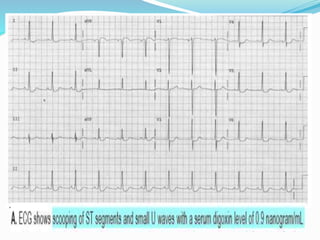
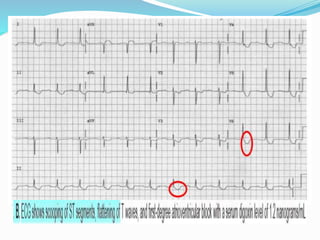
-Four ECG findings are seen with therapeutic
levels of digoxin and are not indicators of toxicity.
-They are:
…….. T-wave flattening or inversion
…….. QT-interval shortening
……..a “scooped” appearance of the ST segment
with ST-segment depression
……..an increase in U-wave amplitude.
More specific not pathognomonic ECG
findings include :
-Atrial fibrillation with a slow regular ventricular
rate (ie, AV dissociation)
-Nonparoxysmal junctional tachycardia (rate
greater than 100 bpm
-Atrial tachycardia with block (atrial rate usually
150-200 bpm)
- ventricular tachycardia
2) CNS and renal
-can cause inadequate tissue perfusion with
resultant CNS and renal complications such as :
-Hypoxic seizures and
-Acute tubular necrosis.
3- Hyperkalemia- is the major electrolytic
complication in acute massive digitoxin poisoning
due to inhibition of sodium-potassium ATPase.
….continued
-Hyperkalmemia slows AV conduction adding to
digoxin toxicity.
-Hypokalemia is seen with chronic toxicity.
4- GIT manifestations: cause
abdominal pain, nausea and vomiting where
it increases vagal stimulation and activates
chemoreceptor trigger zone.
5- Visual disturbance:
-colored vision (yellow and green patches),
Scotomata, diplopia.
-A patient with normal digoxin levels (0.5-2
ng/mL) can have cardiotoxicity in case of
……. renal insufficiency
……..severe hypokalemia
…..continued
-Conditions which precipitate digoxin
chronic toxicity are:
----Deteriorating renal function
-----dehydration
-----electrolyte disturbances
----- drug interactions
Digoxin drug Interaction
- Drugs interaction that cause chronic digoxin toxicity
include :
-Amiloride - May reduce the inotropic response to
digoxin
-Amiodarone - Reduces renal and nonrenal clearance
and have additive effects on the heart rate.
-Benzodiazepines ( alprazolam, diazepam) - Have been
associated with isolated reports of digoxin toxicity.
……continued
-Beta-blockers ( propranolol, metoprolol,
atenolol) - May have additive effects on the heart
rate.
carvedilol may increase digoxin blood levels in
addition to potentiating its effects on the heart
rate.
-Calcium channel blockers - Diltiazem and
verapamil increase serum digoxin levels.
-not all calcium channel blockers share this effect.
….continued
-Cyclosporine - May increase digoxin levels,
possibly due to reduced renal excretion
-Erythromycin, clarithromycin, and
tetracyclines - May increase digoxin levels
Propafenone - Increases digoxin level.
….continued
-Quinidine - Increases digoxin level.
-Hydroxychloroquine and quinine - may
also affect levels.
-Propylthiouracil - May increase
digoxin levels by reducing thyroid hormone
levels.
…..continued
-Spironolactone - may directly increase
digoxin levels and may alter renal excretion.
-Hydrochlorothiazide
Furosemide and other loop diuretics
-Amphotericin B - May precipitate
hypokalemia and subsequent digoxin toxicity
-Succinylcholine - Increased risk of
dysrhythmias has been reported.
Work up in digoxin toxicity
-Morbidity and mortality rates in digoxin
toxicity increase if the patient has
……Dysrhythmia
…..advanced AV block
….. other significant ECG abnormality
…..comorbid condition
…..Advanced age
.Investigations
-plasma digoxin level
-serum electrolyte
-Electrocardiography
-Renal function test
-liver function test
-toxicologic screen
-chest x-ray
-echocardiography
-cardiac biomarkers
…..continued
-The lethal dose of most glycosides is 5-10 times
the minimal effective dose .
-only about twice the dose that leads to minor
toxic manifestations.
-suggestive of acute toxicity in young
…..bradyarythmias
…..hyperkalemia.
….continued
-Suggestive of chronic toxicity in old age
……Visual disturbances
….Hypokalemia
….. tachyarrhythmias).
-The plasma digoxin level can be used to
monitor compliance and toxicity and can be
used as a guide to the appropriate dosing of
medication .
……continued
-Therapeutic digoxin levels vary:
…. lower limit from 0.6-1.3 ng/mL
…. upper limit agreed to be 2.6 ng/mL.
-Initial potassium levels are better correlated with
the prognosis.
- all patients with an initial potassium level
greater than 5.5 died.
-Measure Na+, K+, Mg++, Ca++, blood urea
nitrogen (BUN), and creatinine levels.
……..continued
-conditions which affect serum magneseium level
are:
……..Long-term digoxin users
……..long-term diuretic users
-Importantly magnesium is a cofactor of the
Na+/K+ -ATPase pump and alterations of its
concentration will affect the pump's actions.
ECG shows any of the following:
- Atrial fibrillation with slow regular
ventricular rate.
-Atrial tachycardia with block (atrial rate
usually 150-200 bpm).
-ventricular tachycardia.
-Inverted T wave.
-Peaked T wave (hyperkalemia)
-Torsade de pointes
Approach to digoxin toxicity
-The clinical manifestations digoxin toxicity
are the same across all these age groups.
(infants, children, and adults)
-Treatment of digoxin toxicity should be
guided by
……the patient’s signs and symptoms
…..the specific toxic effects
…..not necessarily by digoxin levels alone.
Therapeutic options includes:
-supportive care
-Digoxin Fab fragments
- cardioversion and Cardiac pacing
-Antiarrhythmic drugs
-GI decontamination and enhance elimination
-gastric lavage and induce emesis and whole bowl
irregation and forced diuresis
-binding resins
- Hemodialysis for severe acute toxicity.
prehospital care includes:
-Administration of oxygen
-cardiac monitoring
-establishment of IV access
-and transport are usually requiered
Supportive care includes :
-Hydration with IV fluids
-oxygenation
-support of ventilatory function
-discontinuation of the drug
-correction of electrolyte imbalances.
General and specific principles of
management of toxicity
-Assessment of the severity of the toxicity and its
etiology .
-Consideration of factors that influence treatment
include:
…..age and ECG changes
…..medical history and renal insuffieciency
…..chronicity of intoxication
…..existing heart disease
…..continued
-Continuous hemodynamic assessment,
including 12-lead electrocardiogram and
cardiac monitoring.
-Prompt measurement of electrolyte levels
and of serum creatinine and digoxin levels.
-intensive care unit admission.
Binding resins
-cholestyramine –drug may bind
enterohepatically-recycled digoxin and
digitoxin.
- more appropriately used for treatment of
chronic toxicity in patients with renal
insufficiency.
GI Decontamination and Enhanced
Elimination:
-The first-line treatment for acute ingestion
is repeated dosing of activated charcoal to
reduce absorption and interrupt
enterohepatic circulation.
-1 gram/kg PO can be considered in an
awake alert cooperative patient who
presents within 1 h of ingestion.
Gastric lavage
- increases vagal tone and may precipitate or
worsen arrhythmias.
-Consider pretreatment with atropine if gastric
lavage is performed.
-Treatment with digitalis Fab antibody usually
renders gastric lavage unnecessary.
-Induced emesis with ipecac syrup -
is not recommended because of the
increased vagal effect.
-Whole-bowel irrigation - may be
useful if clinical data are lacking.
-Forced diuresis - is not recommended
because it can worsen electrolyte
abnormalities.
-Dialysis - has been shown to produce only
small additional clearance.
Treatment of Electrolyte Imbalance
-Correct hyperkalemia, hypokalemia, and
hypomagnesemia.
-Correction of electrolyte imbalances may reverse
dysrhythmias.
Digoxin Immune Fab Therapy
-Digoxin immune Fab is an immunoglobulin fragment
that binds with digoxin.
- first-line treatment for significant dysrhythmias
(severe bradyarrhythmia, second- or third-degree
heart block, ventricular tachycardia or fibrillation) from
sever acute digitalis toxicity.
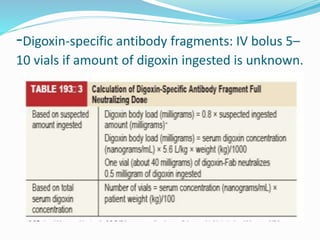
-Digoxin-specific antibody fragments: IV bolus 5–
10 vials if amount of digoxin ingested is unknown.
Indications for immunotherapy with
digoxin Fab fragment include :
- ingestion of massive quantities of digitalis (in
children 4 mg and adults 10 mg).
-Hyperkalemia (serum potassium level greater
than 5 mEq/L).
-Altered mental status attributed to digoxin
toxicity.
-Rapidly progressive signs and symptoms of
toxicity
-For patients with rate-related ischemia or
hemodynamic instability.
……..continued
Management of digoxin toxicity
dysrhythmias depending on :
-Presence or absence of hemodynamic instability
-Nature of the dysrhythmia
-Presence or absence of electrolyte disturbances
-Preferences of toxicology and/or cardiology
consultants.
……continued
-Early in acute intoxication, depression of
sinoatrial or AV nodal function may be reversed
by atropine.
-Subsequent manifestations are the result of
direct and vagomimetic actions of the drug on
the heart and are not reversed by atropine.
Ectopic rhythms due to digoxin toxicity
are due to
-enhanced automaticity
-reentry
-both and may include:
-Nonparoxysmal junctional tachycardia
-Extrasystole
-Premature ventricular contractions
-Ventricular flutter and fibrillation
-Atrial flutter and fibrillation
- ventricular tachycardia
…….continued
-Bidirectional ventricular tachycardia is
particularly characteristic of severe digitalis
toxicity and results from
---------alterations in intraventricular conduction
----- -- junctional tachycardia with aberrant
intraventricular conduction --
--------or rarerly alternating ventricular
pacemakers.
The following features may also be seen
in digoxin toxicity:
-Depression of the atrial pacemakers resulting in
-SA arrest
-SA block
-AV block
-Sinus exit block resulting from depression of
normal conduction
-Nonparoxysmal atrial tachycardia with block
Cardiac arrest
-CPR with current advanced cardiac life support
protocols .
……continued
-In hemodynamically stable patients
……. bradyarrhythmias and
……..supraventricular arrhythmias can be treated
with observation and supportive care.
-Short-acting beta blockers (eg, esmolol) are
helpful for supraventricular tachyarrhythmias
with rapid ventricular rates.
……..continued
-Esmolol may precipitate advanced or complete
atrioventricular block in patients with sinoatrial
or AV node depression.
- Hemodynamically stable PVCs, bigeminy, or
trigeminy may require only observation.
-If they are hemodynamically unstable lidocaine
may be effective.
-Phenytoin has been shown to dissociate the
inotropic and dysrhythmic action of digitalis.
-phenytoin suppress digitalis-induced
tachydysrhythmias without diminishing the
contractile effects.
-Atropine is indicated for hemodynamically
unstable bradyarrhythmic patients.
-lidocaine is indicated for ventricular tachycardia.
………..continued
-Lidocaine dose - given in boluses of 100 mg
and begin a maintenance infusion at 1-4
mg/min.
-Phenytoin has been administered in boluses
of 100 mg every 5-10 minutes, up to a loading
dose of 15 mg/kg.
……….continued
-Magnesium sulfate 2 g IV over 5 minutes to terminate
Torsade de pointes in digoxin-toxic patients with and
without overt cardiac disease.
-After the initial bolus a maintenance infusion at 1-2
g/h is initiated.
-Monitor magnesium levels approximately every 2
hours.
-The therapeutic goal is a level between 4 and 5
mEq/L.
-Magnesium is contraindicated in the setting of
bradycardia or AV block and should be used cautiously
in patients with renal failure.
Electrical cardioversion and pacing
-Cardioversion for severe dysrhythmias due to
digitalis is hazardous.
-it can precipitate ventricular fibrillation and
asystole.
- if the patient is hemodynamically unstable and
has a wide, complex tachycardia and if fascicular
tachycardia has been ruled out, cardioversion will
need to be used early.
Hospital Admission criteria in
digoxin toxicity:
-New cardiac dysrhythmias
-Severe bradyarrhythmias
-Advanced AV block
-Acute prolongation of the QRS interval
-Severe electrolyte abnormalities, especially
hypokalemia or hyperkalemia
-Dehydration
-inability to care for self
-Suicidal ideation
(ICU) admission criteria in digoxin
toxicity include the following:
-Hemodynamic instability
-Refractory dysrhythmias
-Hyperkalemia
-Renal failure
REFERENCE
-Tintinallis 8th edition
-UP to date 21.6
-MEDSCAPE
-SLIDESHARE
-Gold frank toxicology emergency
Digoxin toxicity awe

Digoxin toxicity awe

  • 3.
    Introduction -cardiac glycosides arecompounds which all posess steroid nucleus with unsaturated lactone at c17 position and at least one glycoside at c3 position. -organ system effect of cardiac glycosides …… increase inotropy in cardiac myocsites …… affects cells in vascular smooth muscle ……affect Autonomic nervous system.
  • 4.
    Electrophysiologic effect mechanism -shortenatrial and ventricular repolarization by decreasing the refractory period and thus increasing automaticity. - increase vagal tone via action at the carotid body by reducing conduction through the sinoatrial and atrioventricular nodes. -In toxic concentrations can increase sympathetic tone.
  • 5.
    ……contineud - Reduce plasmarenin concentrations in patients with advanced heart failure resulting in peripheral vasodilation. -patients without heart failure digoxin can cause vasoconstriction. -Increased central vagal tone typically produces cardiac manifestations such as …….bradydysrhythmias ……atrioventricular block.
  • 6.
    ……..continued -Direct cellular effect ……..inhibiting the membrane sodium-potassium (Na+-K+) pump …… raising intracellular levels of sodium ……leading to an accumulation of intracellular calcium. …..results increases cardiac contractility. -Indirect effect ……enhancing vagal tone.
  • 7.
    Therapeutic Uses ofDigitalis Compounds A) Heart Failure ↑ inotropy ↑ ejection fraction ↓ preload ↓ pulmonary congestion/edema B)Arrhythmias ↓ AV nodal conduction (parasympathomimetic effect) ↓ ventricular rate in atrial flutter and fibrillation
  • 9.
    Cardiac glycosides arefound naturally in Plants and animals. A. Cardenolides : 1. Digitalis purpurea – Digitoxin, Gitoxin and Gitalin 2. Digitalis lanata - Digitoxin, Gitoxin and Digoxin 3. Strophanthus gratus – Ouabin
  • 10.
    ……….continued 4. Thevetia nerifolia– Thevetin 5. Convallaria majalis – Convallotoxin B. Bufadienolides: Bufo vulgris - Bufotoxin Digoxin- the only cardiac glycoside mostly used in current clinical practice around the world. -some times digitoxin is used in Europe -One of top toxins in the world because …… wide availability of digoxin ….. narrow therapeutic window.
  • 11.
    Mechanism Of Action -Directinhibition of membrane-bound Na+/K+ - ATPase which pumps (3 Na+ outside for 2 K+ inside the cell) -This is responsible for maintenance of resting membrane potential in most excitable cells.
  • 12.
    ….continued -This leads toan increase intracellular sodium that gradually decrease in intracellular potassium. - In Cardiac fiber [Ca2+] is exchanged for extracellular sodium (3:1 ratio) by Na+/Ca+ exchanger transport system that is forced by the concentration gradient for these ions and the transmembrane potential.
  • 13.
    ……Continued -increase in [Na+]iis related crucially to the positive inotropic effect of digitalis. -Facilitation of Ca+ entry through the voltage gated Ca+ channels of the membrane. -That is associated with increase in slow inward calcium current during the plateau of action potential.
  • 14.
    ……Continued -They decrease AVconduction through direct action on the myocardium and vagal stimulation. -They increase heart automaticity in overdose only leading to pulse bigeminus and pulse trigeminus.
  • 15.
    Pharmacokinetics -Therapeutic daily dosefrom 5-15mcg/kg. - bioavailability is 95%. -excreted by kideny 60-80% of the dose unchanged. -The onset of action …..oral in 30-120 minutes. …. intravenous in 5-30 minutes. -Half life is 1-3 days
  • 16.
    ……continued -1% of thetotal amount of digoxin in the body is in the serum. - about 30 % bound to plasma proteins. - volume of distribution 6- 7L/kg which is large. -A dose less than 5 mg is rarely to cause toxicity. -A dose higher than 11 mg may be fatal. -In pediatrics 4 mg can cause toxicity.
  • 17.
    Use of digoxinduring pregnancy -Widely in the acute management and prophylaxis of ----fetal paroxysmal supraventricular tachycardia ---- in rate control of atrial fibrillation. -It is a category C drug. -Increased digoxin dosage because of …….enhanced renal clearance ……expanded blood volume.
  • 18.
    Toxic Effect ofon specific organ system Cardiac: 1-Dysrrhythmia - Alterations in cardiac rate and rhythm occurring in digitalis toxicity may simulate almost every known type of dysrhythmia. -The most common dysrhythmia in digoxin toxicity is premature ventricular contractions. -Decrease AV conduction leading to ………bradycardia …….. heart block (first, second, third).
  • 19.
    …..continued -AV junctional blockof varying degrees with increased ventricular automaticity. -manifestations of toxicity occur in 30-40% of patients with recognized digoxin toxicity.
  • 20.
    ………continued -increase automaticity leadingto several types of tachyarrhythmias. -When conduction and normal pacemaker are both depressed ectopic pacemakers take over producing ….atrial tachycardia …ventricular tachycardia.
  • 21.
    Nonspecific ECG findingsof toxicity include : -Premature ventricular contractions -First-second- and third-degree AV block -Sinus bradycardia -Sinus tachycardia -Sinoatrial block or arrest
  • 22.
    ….continued -Atrial fibrillation withslower ventricular response -Atrial tachycardia -Junctional (escape) rhythm -AV dissociation -Ventricular bigeminy and trigeminy -Ventricular tachycardia -Torsade de pointes -Ventricular fibrillation
  • 23.
    -Four ECG findingsare seen with therapeutic levels of digoxin and are not indicators of toxicity. -They are: …….. T-wave flattening or inversion …….. QT-interval shortening ……..a “scooped” appearance of the ST segment with ST-segment depression ……..an increase in U-wave amplitude.
  • 26.
    More specific notpathognomonic ECG findings include : -Atrial fibrillation with a slow regular ventricular rate (ie, AV dissociation) -Nonparoxysmal junctional tachycardia (rate greater than 100 bpm -Atrial tachycardia with block (atrial rate usually 150-200 bpm) - ventricular tachycardia
  • 27.
    2) CNS andrenal -can cause inadequate tissue perfusion with resultant CNS and renal complications such as : -Hypoxic seizures and -Acute tubular necrosis. 3- Hyperkalemia- is the major electrolytic complication in acute massive digitoxin poisoning due to inhibition of sodium-potassium ATPase.
  • 28.
    ….continued -Hyperkalmemia slows AVconduction adding to digoxin toxicity. -Hypokalemia is seen with chronic toxicity. 4- GIT manifestations: cause abdominal pain, nausea and vomiting where it increases vagal stimulation and activates chemoreceptor trigger zone.
  • 29.
    5- Visual disturbance: -coloredvision (yellow and green patches), Scotomata, diplopia. -A patient with normal digoxin levels (0.5-2 ng/mL) can have cardiotoxicity in case of ……. renal insufficiency ……..severe hypokalemia
  • 30.
    …..continued -Conditions which precipitatedigoxin chronic toxicity are: ----Deteriorating renal function -----dehydration -----electrolyte disturbances ----- drug interactions
  • 31.
    Digoxin drug Interaction -Drugs interaction that cause chronic digoxin toxicity include : -Amiloride - May reduce the inotropic response to digoxin -Amiodarone - Reduces renal and nonrenal clearance and have additive effects on the heart rate. -Benzodiazepines ( alprazolam, diazepam) - Have been associated with isolated reports of digoxin toxicity.
  • 32.
    ……continued -Beta-blockers ( propranolol,metoprolol, atenolol) - May have additive effects on the heart rate. carvedilol may increase digoxin blood levels in addition to potentiating its effects on the heart rate. -Calcium channel blockers - Diltiazem and verapamil increase serum digoxin levels. -not all calcium channel blockers share this effect.
  • 33.
    ….continued -Cyclosporine - Mayincrease digoxin levels, possibly due to reduced renal excretion -Erythromycin, clarithromycin, and tetracyclines - May increase digoxin levels Propafenone - Increases digoxin level.
  • 34.
    ….continued -Quinidine - Increasesdigoxin level. -Hydroxychloroquine and quinine - may also affect levels. -Propylthiouracil - May increase digoxin levels by reducing thyroid hormone levels.
  • 35.
    …..continued -Spironolactone - maydirectly increase digoxin levels and may alter renal excretion. -Hydrochlorothiazide Furosemide and other loop diuretics -Amphotericin B - May precipitate hypokalemia and subsequent digoxin toxicity -Succinylcholine - Increased risk of dysrhythmias has been reported.
  • 36.
    Work up indigoxin toxicity -Morbidity and mortality rates in digoxin toxicity increase if the patient has ……Dysrhythmia …..advanced AV block ….. other significant ECG abnormality …..comorbid condition …..Advanced age
  • 37.
    .Investigations -plasma digoxin level -serumelectrolyte -Electrocardiography -Renal function test -liver function test -toxicologic screen -chest x-ray -echocardiography -cardiac biomarkers
  • 38.
    …..continued -The lethal doseof most glycosides is 5-10 times the minimal effective dose . -only about twice the dose that leads to minor toxic manifestations. -suggestive of acute toxicity in young …..bradyarythmias …..hyperkalemia.
  • 39.
    ….continued -Suggestive of chronictoxicity in old age ……Visual disturbances ….Hypokalemia ….. tachyarrhythmias). -The plasma digoxin level can be used to monitor compliance and toxicity and can be used as a guide to the appropriate dosing of medication .
  • 40.
    ……continued -Therapeutic digoxin levelsvary: …. lower limit from 0.6-1.3 ng/mL …. upper limit agreed to be 2.6 ng/mL. -Initial potassium levels are better correlated with the prognosis. - all patients with an initial potassium level greater than 5.5 died. -Measure Na+, K+, Mg++, Ca++, blood urea nitrogen (BUN), and creatinine levels.
  • 41.
    ……..continued -conditions which affectserum magneseium level are: ……..Long-term digoxin users ……..long-term diuretic users -Importantly magnesium is a cofactor of the Na+/K+ -ATPase pump and alterations of its concentration will affect the pump's actions.
  • 42.
    ECG shows anyof the following: - Atrial fibrillation with slow regular ventricular rate. -Atrial tachycardia with block (atrial rate usually 150-200 bpm). -ventricular tachycardia. -Inverted T wave. -Peaked T wave (hyperkalemia) -Torsade de pointes
  • 43.
    Approach to digoxintoxicity -The clinical manifestations digoxin toxicity are the same across all these age groups. (infants, children, and adults) -Treatment of digoxin toxicity should be guided by ……the patient’s signs and symptoms …..the specific toxic effects …..not necessarily by digoxin levels alone.
  • 44.
    Therapeutic options includes: -supportivecare -Digoxin Fab fragments - cardioversion and Cardiac pacing -Antiarrhythmic drugs -GI decontamination and enhance elimination -gastric lavage and induce emesis and whole bowl irregation and forced diuresis -binding resins - Hemodialysis for severe acute toxicity.
  • 45.
    prehospital care includes: -Administrationof oxygen -cardiac monitoring -establishment of IV access -and transport are usually requiered
  • 46.
    Supportive care includes: -Hydration with IV fluids -oxygenation -support of ventilatory function -discontinuation of the drug -correction of electrolyte imbalances.
  • 47.
    General and specificprinciples of management of toxicity -Assessment of the severity of the toxicity and its etiology . -Consideration of factors that influence treatment include: …..age and ECG changes …..medical history and renal insuffieciency …..chronicity of intoxication …..existing heart disease
  • 48.
    …..continued -Continuous hemodynamic assessment, including12-lead electrocardiogram and cardiac monitoring. -Prompt measurement of electrolyte levels and of serum creatinine and digoxin levels. -intensive care unit admission.
  • 49.
    Binding resins -cholestyramine –drugmay bind enterohepatically-recycled digoxin and digitoxin. - more appropriately used for treatment of chronic toxicity in patients with renal insufficiency.
  • 50.
    GI Decontamination andEnhanced Elimination: -The first-line treatment for acute ingestion is repeated dosing of activated charcoal to reduce absorption and interrupt enterohepatic circulation. -1 gram/kg PO can be considered in an awake alert cooperative patient who presents within 1 h of ingestion.
  • 51.
    Gastric lavage - increasesvagal tone and may precipitate or worsen arrhythmias. -Consider pretreatment with atropine if gastric lavage is performed. -Treatment with digitalis Fab antibody usually renders gastric lavage unnecessary.
  • 52.
    -Induced emesis withipecac syrup - is not recommended because of the increased vagal effect. -Whole-bowel irrigation - may be useful if clinical data are lacking. -Forced diuresis - is not recommended because it can worsen electrolyte abnormalities. -Dialysis - has been shown to produce only small additional clearance.
  • 53.
    Treatment of ElectrolyteImbalance -Correct hyperkalemia, hypokalemia, and hypomagnesemia. -Correction of electrolyte imbalances may reverse dysrhythmias. Digoxin Immune Fab Therapy -Digoxin immune Fab is an immunoglobulin fragment that binds with digoxin. - first-line treatment for significant dysrhythmias (severe bradyarrhythmia, second- or third-degree heart block, ventricular tachycardia or fibrillation) from sever acute digitalis toxicity.
  • 54.
    -Digoxin-specific antibody fragments:IV bolus 5– 10 vials if amount of digoxin ingested is unknown.
  • 55.
    Indications for immunotherapywith digoxin Fab fragment include : - ingestion of massive quantities of digitalis (in children 4 mg and adults 10 mg). -Hyperkalemia (serum potassium level greater than 5 mEq/L). -Altered mental status attributed to digoxin toxicity. -Rapidly progressive signs and symptoms of toxicity -For patients with rate-related ischemia or hemodynamic instability.
  • 56.
    ……..continued Management of digoxintoxicity dysrhythmias depending on : -Presence or absence of hemodynamic instability -Nature of the dysrhythmia -Presence or absence of electrolyte disturbances -Preferences of toxicology and/or cardiology consultants.
  • 57.
    ……continued -Early in acuteintoxication, depression of sinoatrial or AV nodal function may be reversed by atropine. -Subsequent manifestations are the result of direct and vagomimetic actions of the drug on the heart and are not reversed by atropine.
  • 58.
    Ectopic rhythms dueto digoxin toxicity are due to -enhanced automaticity -reentry -both and may include: -Nonparoxysmal junctional tachycardia -Extrasystole -Premature ventricular contractions -Ventricular flutter and fibrillation -Atrial flutter and fibrillation - ventricular tachycardia
  • 59.
    …….continued -Bidirectional ventricular tachycardiais particularly characteristic of severe digitalis toxicity and results from ---------alterations in intraventricular conduction ----- -- junctional tachycardia with aberrant intraventricular conduction -- --------or rarerly alternating ventricular pacemakers.
  • 60.
    The following featuresmay also be seen in digoxin toxicity: -Depression of the atrial pacemakers resulting in -SA arrest -SA block -AV block -Sinus exit block resulting from depression of normal conduction -Nonparoxysmal atrial tachycardia with block Cardiac arrest -CPR with current advanced cardiac life support protocols .
  • 61.
    ……continued -In hemodynamically stablepatients ……. bradyarrhythmias and ……..supraventricular arrhythmias can be treated with observation and supportive care. -Short-acting beta blockers (eg, esmolol) are helpful for supraventricular tachyarrhythmias with rapid ventricular rates.
  • 62.
    ……..continued -Esmolol may precipitateadvanced or complete atrioventricular block in patients with sinoatrial or AV node depression. - Hemodynamically stable PVCs, bigeminy, or trigeminy may require only observation. -If they are hemodynamically unstable lidocaine may be effective.
  • 63.
    -Phenytoin has beenshown to dissociate the inotropic and dysrhythmic action of digitalis. -phenytoin suppress digitalis-induced tachydysrhythmias without diminishing the contractile effects. -Atropine is indicated for hemodynamically unstable bradyarrhythmic patients. -lidocaine is indicated for ventricular tachycardia.
  • 64.
    ………..continued -Lidocaine dose -given in boluses of 100 mg and begin a maintenance infusion at 1-4 mg/min. -Phenytoin has been administered in boluses of 100 mg every 5-10 minutes, up to a loading dose of 15 mg/kg.
  • 65.
    ……….continued -Magnesium sulfate 2g IV over 5 minutes to terminate Torsade de pointes in digoxin-toxic patients with and without overt cardiac disease. -After the initial bolus a maintenance infusion at 1-2 g/h is initiated. -Monitor magnesium levels approximately every 2 hours. -The therapeutic goal is a level between 4 and 5 mEq/L. -Magnesium is contraindicated in the setting of bradycardia or AV block and should be used cautiously in patients with renal failure.
  • 66.
    Electrical cardioversion andpacing -Cardioversion for severe dysrhythmias due to digitalis is hazardous. -it can precipitate ventricular fibrillation and asystole. - if the patient is hemodynamically unstable and has a wide, complex tachycardia and if fascicular tachycardia has been ruled out, cardioversion will need to be used early.
  • 67.
    Hospital Admission criteriain digoxin toxicity: -New cardiac dysrhythmias -Severe bradyarrhythmias -Advanced AV block -Acute prolongation of the QRS interval -Severe electrolyte abnormalities, especially hypokalemia or hyperkalemia -Dehydration -inability to care for self -Suicidal ideation
  • 68.
    (ICU) admission criteriain digoxin toxicity include the following: -Hemodynamic instability -Refractory dysrhythmias -Hyperkalemia -Renal failure
  • 69.
    REFERENCE -Tintinallis 8th edition -UPto date 21.6 -MEDSCAPE -SLIDESHARE -Gold frank toxicology emergency

Editor's Notes