Cardiotonics
Dr. Binu Babu
Ph.D., M.Sc. (N), MBA
Mrs. Jincy Ealias
M.Sc. (N)
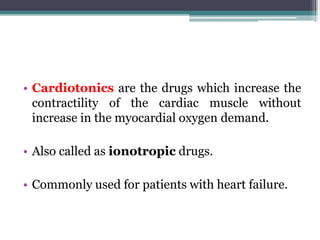
• Cardiotonics are the drugs which increase the
contractility of the cardiac muscle without
increase in the myocardial oxygen demand.
• Also called as ionotropic drugs.
• Commonly used for patients with heart failure.
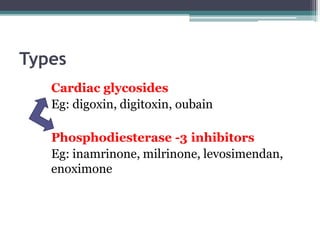
Types
Cardiac glycosides
Eg: digoxin, digitoxin, oubain
Phosphodiesterase -3 inhibitors
Eg: inamrinone, milrinone, levosimendan,
enoximone
Introduction
• The word digitalis is used to mean cardiac
glycosides.
• William Withering, an English physician first
described the clinical effects of digitalis in CCF in
1785.
• Obtained from the foxglove plant family.
• Digoxin is the only cardiac glycoside used
clinically, because of its favorable pharmacokinetic
properties.
Mechanism of action
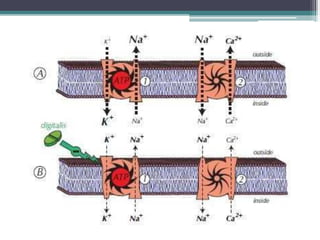
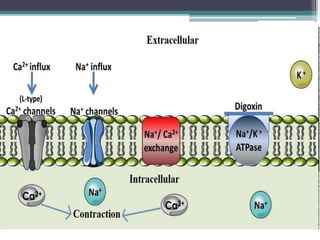
Inhibit the enzyme Na+K+ATPase (also called sodium
pump) present on the cardiac myocytes
Accumulation of intracellular Na+
Prevents extrusion Increase Ca++ entry
of Ca++ through Ca++ channels
Increase intracellular Ca++
Increase force and velocity of contraction
Positive ionotropic effect
Pharmacological Actions
1. Cardiac actions
2. Extracardiac actions
1. Cardiac actions
• Positive inotropic effect:
▫ Increases force of contraction of heart increases
stroke volume increases cardiac output.
▫ The systole is shortened and the diastole is prolonged
which allows more rest to the heart.
▫ The ventricles are more completely emptied because of
more forceful contractions.
• Heart rate is reduced.
• Effects on electrophysiological properties
▫ Digitalis depresses AV conduction and enhances
automaticity of the ventricles and the Purkinje cells.
• Blood pressure:
▫ No significant effects in CCF patients.
▫ Pulse pressure may increase.
• Improves Coronary circulation
▫ Due to increased cardiac output and prolonged
diastole during which the coronaries get filled better.
2. Extracardiac actions
• Kidney
▫ Diuresis occurs which relieves edema in CCF
patients.
• CNS
▫ High doses stimulate CTZ resulting in nausea and
vomiting.
Pharmacokinetics
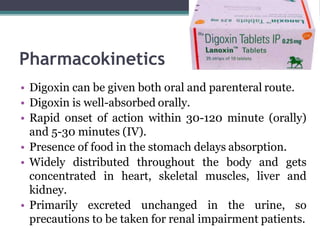
• Digoxin can be given both oral and parenteral route.
• Digoxin is well-absorbed orally.
• Rapid onset of action within 30-120 minute (orally)
and 5-30 minutes (IV).
• Presence of food in the stomach delays absorption.
• Widely distributed throughout the body and gets
concentrated in heart, skeletal muscles, liver and
kidney.
• Primarily excreted unchanged in the urine, so
precautions to be taken for renal impairment patients.
Dose
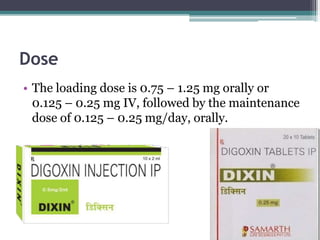
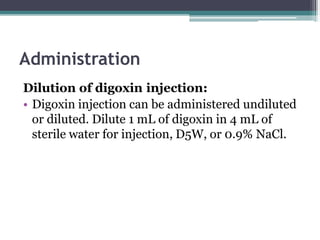
• The loading dose is 0.75 – 1.25 mg orally or
0.125 – 0.25 mg IV, followed by the maintenance
dose of 0.125 – 0.25 mg/day, orally.
Administration
Dilution of digoxin injection:
• Digoxin injection can be administered undiluted
or diluted. Dilute 1 mL of digoxin in 4 mL of
sterile water for injection, D5W, or 0.9% NaCl.
Loading dose
• One-half the loading dose given immediately IV
or PO
• One-fourth the loading dose given 8 to 12 hours
later IV or PO
• The remaining one-fourth loading dose given
after an additional 8 to 12 hours IV or PO
• Administer IV slow push over 5 to 10 minutes
• Obtain ECG 6 hours after digitalizing dose to
assess for toxicity
Maintenance dose
• should be started 12 hours after the loading dose
is completed
Indications
• CCF
• Arrhythmias
▫ Atrial flutter - reduces the ventricular rate
▫ Atrial fibrillation - reduces the ventricular rate
▫ Atrial tachycardia- digoxin is an alternative to
verapamil.
Contraindications
• Hypokalemia - enhances toxicity
• MI, thyrotoxicosis patients and elderly - more
prone to arrhythmias.
• Acid base imbalance - prone to toxicity
Adverse effects
Extracardiac:
• First symptoms are;
▫ Anorexia
▫ Nausea
▫ Vomiting
▫ Diarrhea
• Other extracardiac symptoms;
▫ Weakness
▫ Confusion
▫ Hallucinations
▫ Blurred vision
▫ Gynecomastia
Cardiac toxicity
• Arrhythmias
▫ Bradycardia
▫ Ventricular tachycardia
▫ Ventricular fibrillation
▫ AV block
▫ Ventricular extra
systole
▫ Atrial flutter
▫ Atrial fibrillation
▫ Pulses bigeminy
Digoxin toxicity
• The usual therapeutic range is 1–2 ng/ml.
• Toxic plasma level is above 2.4 ng/ml.
Symptoms
• Anorexia
• Nausea
• Vomiting
• Diarrhea
• Palpitation
• Irregular heart block,
Bradycardia, Junctional
tachycardia
• Confusion
• Lethargy
• Visual changes
▫ Halos or rings of light
around objects
▫ Seeing lights or bright
spots
▫ Changes in colour
perception –especially
yellow, green
▫ Blind spots in vision
Treatment of digoxin toxicity
• Stop digitalis.
• Stop diuretics if given concurrently.
• Determine serum digoxin level
• Determine electrolytes, particularly serum K,
Mg, and Ca, and treat any abnormalities
• Oral or parenteral K+ supplements are given.
• Obtain continuous ECG monitoring and treat
arrhythmias
• Ventricular arrhythmias are treated with IV
lignocaine.
• Bradycardia is treated with IM/IV atropine.
• Supraventricular arrhythmias is treated with IV
propranolol.
• Gastric lavage for acute toxicity to limit digoxin
absorption.
• In severe toxicity - antidigoxin
immunotherapy (antidigoxin antibodies) IV
infusion (digoxin Fab - digibind) which is an
antidote.
• Digibind IV over 30 minutes.
Drug interactions
• Drugs that enhance digoxin toxicity
▫ Diuretics (due to hypokalaemia)
▫ Quinidine
▫ Calcium
▫ Verapamil
▫ Methyldopa
• Drugs that reduce digoxin levels
▫ Antacids, neomycin, metoclopramide- decrease
absorption
▫ Rifampicin, phenobarbitone - accelerate metabolism
due to enzyme induction
• Cardiotonic agents
• Eg: inamrinone, milrinone, levosimendan,
enoximone
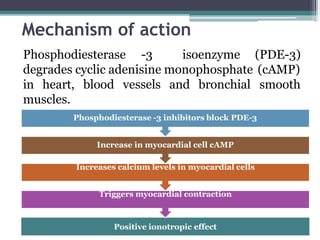
Mechanism of action
Phosphodiesterase -3 isoenzyme (PDE-3)
degrades cyclic adenisine monophosphate (cAMP)
smooth
Increase in myocardial cell cAMP
Increases calcium levels in myocardial cells
Triggers myocardial contraction
Positive ionotropic effect
in heart, blood vessels and bronchial
muscles.
Phosphodiesterase -3 inhibitors block PDE-3
Pharmacokinetics
• Given only by IV route.
• Metabolized in the liver and excreted in the
urine.
Dose
• Inamrinone
▫ Loading dose is 0.5 mg/kg IV bolus, followed by the
maintenance dose of 5 – 10 μg/kg/min IV infusion,
(max 10 mg/kg in 24 hrs).
• Milrinone
▫ More potent & short lasting with fewer side effects.
▫ Loading dose is 50 mcg/kg IV bolus over 10
minutes, followed by the maintenance dose of
0.375 – 0.75 mcg/kg/min IV infusion.
Indications
• Short term management of severe heart failure
• Heart failure refractory to other treatments.
Adverse effects
• GIT
▫ Anorexia
▫ Nausea
▫ Vomiting
▫ Abdominal pain
• CVS
▫ Ventricular arrhythmias
▫ Hypotension
▫ Chest pain
• Blood
▫ Thrombocytopenia
• Hypersensitivity
reaction
▫ Vasculitis
▫ Pleuritis
▫ Pericarditis
▫ Ascites
Nursing implication
• Serum digoxin estimation at least 4 hrs after IV
dose and 6 hrs after oral dose.
• IV digoxin slowly over 5 minutes.
• Assess the manifestations of digoxin toxicity.
• Hold the digoxin if the heart rate below 60
beats/min.
• Assess electrolyte levels especially potassium,
magnesium.
• Monitor for drug interactions.
• Monitor apical pulse for 1 minute before
administering the drug to monitor for adverse
effects.
• Maintain emergency equipment ready.
• IM injection of digoxin should be discouraged,
as absorption is only 80% compared to IV; local
irritation, muscle damage, and necrosis may also
occur
2-210601121744.pptx

2-210601121744.pptx

  • 1.
    Cardiotonics Dr. Binu Babu Ph.D.,M.Sc. (N), MBA Mrs. Jincy Ealias M.Sc. (N)
  • 2.
    • Cardiotonics arethe drugs which increase the contractility of the cardiac muscle without increase in the myocardial oxygen demand. • Also called as ionotropic drugs. • Commonly used for patients with heart failure.
  • 3.
    Types Cardiac glycosides Eg: digoxin,digitoxin, oubain Phosphodiesterase -3 inhibitors Eg: inamrinone, milrinone, levosimendan, enoximone
  • 5.
    Introduction • The worddigitalis is used to mean cardiac glycosides. • William Withering, an English physician first described the clinical effects of digitalis in CCF in 1785. • Obtained from the foxglove plant family. • Digoxin is the only cardiac glycoside used clinically, because of its favorable pharmacokinetic properties.
  • 6.
    Mechanism of action Inhibitthe enzyme Na+K+ATPase (also called sodium pump) present on the cardiac myocytes Accumulation of intracellular Na+ Prevents extrusion Increase Ca++ entry of Ca++ through Ca++ channels Increase intracellular Ca++ Increase force and velocity of contraction Positive ionotropic effect
  • 9.
    Pharmacological Actions 1. Cardiacactions 2. Extracardiac actions
  • 10.
    1. Cardiac actions •Positive inotropic effect: ▫ Increases force of contraction of heart increases stroke volume increases cardiac output. ▫ The systole is shortened and the diastole is prolonged which allows more rest to the heart. ▫ The ventricles are more completely emptied because of more forceful contractions. • Heart rate is reduced. • Effects on electrophysiological properties ▫ Digitalis depresses AV conduction and enhances automaticity of the ventricles and the Purkinje cells. • Blood pressure: ▫ No significant effects in CCF patients. ▫ Pulse pressure may increase. • Improves Coronary circulation ▫ Due to increased cardiac output and prolonged diastole during which the coronaries get filled better.
  • 11.
    2. Extracardiac actions •Kidney ▫ Diuresis occurs which relieves edema in CCF patients. • CNS ▫ High doses stimulate CTZ resulting in nausea and vomiting.
  • 12.
    Pharmacokinetics • Digoxin canbe given both oral and parenteral route. • Digoxin is well-absorbed orally. • Rapid onset of action within 30-120 minute (orally) and 5-30 minutes (IV). • Presence of food in the stomach delays absorption. • Widely distributed throughout the body and gets concentrated in heart, skeletal muscles, liver and kidney. • Primarily excreted unchanged in the urine, so precautions to be taken for renal impairment patients.
  • 13.
    Dose • The loadingdose is 0.75 – 1.25 mg orally or 0.125 – 0.25 mg IV, followed by the maintenance dose of 0.125 – 0.25 mg/day, orally.
  • 14.
    Administration Dilution of digoxininjection: • Digoxin injection can be administered undiluted or diluted. Dilute 1 mL of digoxin in 4 mL of sterile water for injection, D5W, or 0.9% NaCl.
  • 15.
    Loading dose • One-halfthe loading dose given immediately IV or PO • One-fourth the loading dose given 8 to 12 hours later IV or PO • The remaining one-fourth loading dose given after an additional 8 to 12 hours IV or PO • Administer IV slow push over 5 to 10 minutes • Obtain ECG 6 hours after digitalizing dose to assess for toxicity Maintenance dose • should be started 12 hours after the loading dose is completed
  • 16.
    Indications • CCF • Arrhythmias ▫Atrial flutter - reduces the ventricular rate ▫ Atrial fibrillation - reduces the ventricular rate ▫ Atrial tachycardia- digoxin is an alternative to verapamil.
  • 17.
    Contraindications • Hypokalemia -enhances toxicity • MI, thyrotoxicosis patients and elderly - more prone to arrhythmias. • Acid base imbalance - prone to toxicity
  • 18.
    Adverse effects Extracardiac: • Firstsymptoms are; ▫ Anorexia ▫ Nausea ▫ Vomiting ▫ Diarrhea • Other extracardiac symptoms; ▫ Weakness ▫ Confusion ▫ Hallucinations ▫ Blurred vision ▫ Gynecomastia Cardiac toxicity • Arrhythmias ▫ Bradycardia ▫ Ventricular tachycardia ▫ Ventricular fibrillation ▫ AV block ▫ Ventricular extra systole ▫ Atrial flutter ▫ Atrial fibrillation ▫ Pulses bigeminy
  • 19.
    Digoxin toxicity • Theusual therapeutic range is 1–2 ng/ml. • Toxic plasma level is above 2.4 ng/ml.
  • 20.
    Symptoms • Anorexia • Nausea •Vomiting • Diarrhea • Palpitation • Irregular heart block, Bradycardia, Junctional tachycardia • Confusion • Lethargy • Visual changes ▫ Halos or rings of light around objects ▫ Seeing lights or bright spots ▫ Changes in colour perception –especially yellow, green ▫ Blind spots in vision
  • 21.
    Treatment of digoxintoxicity • Stop digitalis. • Stop diuretics if given concurrently. • Determine serum digoxin level • Determine electrolytes, particularly serum K, Mg, and Ca, and treat any abnormalities • Oral or parenteral K+ supplements are given. • Obtain continuous ECG monitoring and treat arrhythmias
  • 22.
    • Ventricular arrhythmiasare treated with IV lignocaine. • Bradycardia is treated with IM/IV atropine. • Supraventricular arrhythmias is treated with IV propranolol. • Gastric lavage for acute toxicity to limit digoxin absorption. • In severe toxicity - antidigoxin immunotherapy (antidigoxin antibodies) IV infusion (digoxin Fab - digibind) which is an antidote. • Digibind IV over 30 minutes.
  • 23.
    Drug interactions • Drugsthat enhance digoxin toxicity ▫ Diuretics (due to hypokalaemia) ▫ Quinidine ▫ Calcium ▫ Verapamil ▫ Methyldopa • Drugs that reduce digoxin levels ▫ Antacids, neomycin, metoclopramide- decrease absorption ▫ Rifampicin, phenobarbitone - accelerate metabolism due to enzyme induction
  • 25.
    • Cardiotonic agents •Eg: inamrinone, milrinone, levosimendan, enoximone
  • 26.
    Mechanism of action Phosphodiesterase-3 isoenzyme (PDE-3) degrades cyclic adenisine monophosphate (cAMP) smooth Increase in myocardial cell cAMP Increases calcium levels in myocardial cells Triggers myocardial contraction Positive ionotropic effect in heart, blood vessels and bronchial muscles. Phosphodiesterase -3 inhibitors block PDE-3
  • 27.
    Pharmacokinetics • Given onlyby IV route. • Metabolized in the liver and excreted in the urine.
  • 28.
    Dose • Inamrinone ▫ Loadingdose is 0.5 mg/kg IV bolus, followed by the maintenance dose of 5 – 10 μg/kg/min IV infusion, (max 10 mg/kg in 24 hrs). • Milrinone ▫ More potent & short lasting with fewer side effects. ▫ Loading dose is 50 mcg/kg IV bolus over 10 minutes, followed by the maintenance dose of 0.375 – 0.75 mcg/kg/min IV infusion.
  • 29.
    Indications • Short termmanagement of severe heart failure • Heart failure refractory to other treatments.
  • 30.
    Adverse effects • GIT ▫Anorexia ▫ Nausea ▫ Vomiting ▫ Abdominal pain • CVS ▫ Ventricular arrhythmias ▫ Hypotension ▫ Chest pain • Blood ▫ Thrombocytopenia • Hypersensitivity reaction ▫ Vasculitis ▫ Pleuritis ▫ Pericarditis ▫ Ascites
  • 31.
    Nursing implication • Serumdigoxin estimation at least 4 hrs after IV dose and 6 hrs after oral dose. • IV digoxin slowly over 5 minutes. • Assess the manifestations of digoxin toxicity. • Hold the digoxin if the heart rate below 60 beats/min. • Assess electrolyte levels especially potassium, magnesium. • Monitor for drug interactions.
  • 32.
    • Monitor apicalpulse for 1 minute before administering the drug to monitor for adverse effects. • Maintain emergency equipment ready. • IM injection of digoxin should be discouraged, as absorption is only 80% compared to IV; local irritation, muscle damage, and necrosis may also occur