Digoxin Toxicity
Dr.S.R.Sruthi Meenaxshi
DIGOXIN
• Cardiac glycosides (digitalis preparations including digoxin and digitoxin are
used clinically in two situations: heart failure due to systolic dysfunction, and
in certain supraventricular tachyarrhythmias
●The ability to enhance cardiac contractility and modulate neurohumoral
activation can lead to symptomatic improvement in systolic heart failure,
although it is unclear if survival is prolonged even in carefully selected patients
with low therapeutic serum levels.
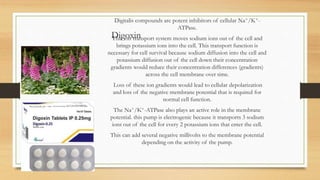
Digoxin
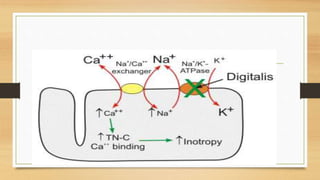
Digitalis compounds are potent inhibitors of cellular Na+/K+-
ATPase.
This ion transport system moves sodium ions out of the cell and
brings potassium ions into the cell. This transport function is
necessary for cell survival because sodium diffusion into the cell and
potassium diffusion out of the cell down their concentration
gradients would reduce their concentration differences (gradients)
across the cell membrane over time.
Loss of these ion gradients would lead to cellular depolarization
and loss of the negative membrane potential that is required for
normal cell function.
The Na+/K+-ATPase also plays an active role in the membrane
potential. this pump is electrogenic because it transports 3 sodium
ions out of the cell for every 2 potassium ions that enter the cell.
This can add several negative millivolts to the membrane potential
depending on the activity of the pump.
• Digoxin also slows conduction through the atrioventricular (AV) junction (node) by increasing
cardiac vagal tone modulation.
• It may also have a sympathoinhibitory effect in therapeutic doses.
• As a result, it is sometimes used (usually adjunctively with beta blockers or calcium channel
blockers) for controlling the ventricular response in atrial fibrillation and atrial flutter when there
is excessively rapid transmission of stimuli from the atria to the ventricles through the AV
junction.
● Digoxin may also be effective in the treatment of certain types of reentrant paroxysmal
supraventricular tachycardia involving the AV node.
PLASMA DIGOXIN LEVELS
ASSOCIATED WITH TOXICITY
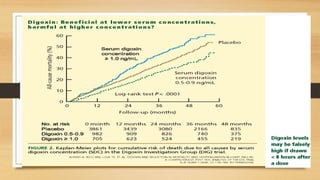
• Life-threatening digoxin-induced arrhythmias and other toxic manifestations occur at substantially increasing
frequency as the plasma digoxin concentration rises above 2.0 ng/mL (2.6 nmol/L).
• However, clinicians should be aware that signs of toxicity may occur at levels below 1.3 to 1.5 ng/mL (1.7 to
1.9 nmol/L), and such toxicity is more likely in the presence of one or more comorbid conditions (eg,
hypokalemia, hypomagnesemia, hypercalcemia, myocardial ischemia).
• Hypokalemia is a particularly important risk factor that can promote digoxin-induced arrhythmias.
• Patients with heart failure who are older than 65 years are also at increased risk.
• Retrospective analysis of data from the large digitalis investigation group
(DIG trial) revealed that serum digoxin levels ranging from 1.2 to 2.0 ng/mL
(1.5 to 2.6 nmol/L) were associated with an excess mortality versus placebo
in women with heart failure .
• Therefore, we recommend maintaining trough digoxin levels at the lower
range (eg, between 0.5 and 0.8 ng/mL [0.6 to 1.0 nmol/L]) in both male and
female patients to help minimize toxicity
MECHANISMS OF CARDIAC
TOXICITY
• The mechanism by which digoxin toxicity promotes the development of
arrhythmias remain incompletely understood.
• Two general categories have been described: enhanced ectopy with
tachyarrhythmias, and bradyarrhythmias . Digoxin can affect cardiac tissue in a
number of ways which may result in toxicity:
●Digoxin directly inhibits the ATPase dependent sodium-potassium pump, increasing
intracellular sodium. This, in turn, reduces the activity of a sodium-calcium exchanger
that normally extrudes calcium from the cell .
The resulting increase in intracellular calcium is responsible for the positive inotropic
action of digoxin. The fluxes in calcium can also have electrophysiologic effects.
●Cardiac glycosides activate ryanodine receptors, which could contribute to increased calcium
release from the sarcoplasmic reticulum and could play a role in the inotropic action of
glycosides in vivo .
● increases vagal tone through central and peripheral effects; however, at excess levels, digoxin
may augment cardiac sympathetic tone
• As a result of the effect on intracellular calcium concentrations and vagal tone, high levels
of digoxin can have a variety of effects that facilitate the development of arrhythmias. They
can enhance and depress automaticity, induce triggered membrane activity (especially
delayed afterdepolarizations), increase or decrease excitability, slow conduction, and alter
refractoriness, also producing conditions conducive to the development of reentrant
arrhythmias.
Sinus bradycardia, tachycardia, block, and
arrest
• The effect of digoxin and digoxin toxicity on the SA node is often difficult to
determine because of both indirect and direct actions.
• As an example, improved hemodynamics in heart failure usually results in a fall in
heart rate due to alterations in autonomic balance. Alternatively, sinus bradycardia
may also be one of the earliest signs of digoxin excess.
• Cardiac glycosides have no direct effect on slowing automaticity in the isolated SA
node or in the transplanted human heart .
• However, the diseased SA node may be quite sensitive to cardiac glycosides,
resulting in sinus bradycardia and SA nodal block.
Ectopic Atrial tachycardia with block
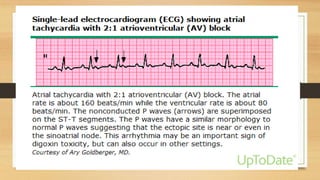
• Ectopic atrial tachycardia with block — Therapeutic concentrations of digoxin have little
effect on atrial tissue, but toxic levels may result in an ectopic atrial tachycardia, often with 2:1 AV
block.
• the vagotonic activity and a direct effect of digoxin on AV nodal conduction
• Also referred to as "paroxysmal" (ectopic) atrial tachycardia (PAT) with AV block, this arrhythmia
is strongly suggestive of digoxin toxicity in patients taking this medication or in cases of
suspected overdose.
• However, the arrhythmia is typically not paroxysmal when induced by digoxin; rather, it is a
persistent arrhythmia until specific therapy is instituted or digoxin levels fall below the toxic range
• It should be noted that most cases of ectopic atrial tachycardia with block are not due to digoxin
excess in contemporary practice.
• Atrial tachycardia with block may superficially resemble atrial flutter. There are two
major distinguishing features between these arrhythmias:
●The atrial rate is faster (usually 250 to 350 beats/min) with atrial flutter.
●The baseline between P waves is isoelectric in atrial tachycardia with block, while
there is a constantly undulating baseline between the flutter waves in atrial flutter.
• It is important to distinguish between atrial flutter and atrial tachycardia due
to excess digoxin since the administration of additional digoxin, which may be an
appropriate therapy for atrial flutter, can accelerate the atrial rate in an atrial
tachycardia, increasing the degree of AV block and potentially precipitating a more
serious digoxin-toxic arrhythmia.
Atrial fibrillation and flutter
• Digoxin toxicity can occur in patients with atrial fibrillation or flutter, even though these arrhythmias are rarely caused by
digoxin. A more important clinical problem is the effect of digoxin toxicity on transmission of atrial stimuli through the AV
node in patients with preexisting atrial fibrillation.
• The electrocardiographic findings vary with increasing degrees of digoxin toxicity and with the possible presence of block
above or below the pacemaker .
• Casual evaluation of such a patient who might have severe digoxin toxicity may lead to the mistaken conclusion that the
irregular rhythm is due to persistent AF and the digoxin may be inappropriately continued or the dose even increased.
• Atrial flutter is rarely, if ever, the result of digoxin intoxication.
• However, the diagnosis of atrial flutter may be difficult to establish when, as commonly occurs during digoxin therapy, the
atrial flutter has a slow ventricular response, with a rate that overlaps that seen in other supraventricular tachycardias, such
as nonparoxysmal atrial tachycardia with a 2:1 AV response due to digoxin intoxication.
Atrioventricular nodal block
Therapeutic concentrations of digoxin decrease the conduction velocity through the AV node and
increase the refractoriness of the AV node; this affects the conduction of the normal as well as a
premature impulse. These effects are mediated primarily by an increase in vagal tone and, to a lesser
degree, a reduction in sympathetic activity .
As a result of this dependence on autonomic balance, digoxin is of little value in controlling the
ventricular response in patients who have undergone cardiac transplantation due to the denervated
nature of the transplanted heart .
• AV conduction may be blocked partially or completely by digoxin excess.
●First degree block (AV conduction delay) – Some degree of PR lengthening may be expected
with digoxin therapy .
More marked widening of the PR interval to above 0.2 sec suggests early digoxin toxicity.
• Second degree AV block – With higher levels of digoxin, first degree AV
block may progress to second degree block of the Mobitz type I
(Wenckebach) variety .
• By contrast, Mobitz type II second degree AV block is rarely, if ever,
induced by digoxin alone.
• Third degree AV block – Third-degree (complete) heart block and other
types of AV dissociation may also occur with digoxin toxicity
Junctional rhythm, tachycardia, and
bradycardia
 AV junctional rhythms are sometimes a sign of digoxin toxicity.
 Digoxin toxicity can result in varying degrees of AV block that may allow the appearance of
junctional escape beats and escape junctional (or atrioventricular nodal) rhythms.
 The junctional rate may be normal (40 to 60 beats/min), accelerated (60 to 120 beats/min, due to
direct effects or adrenergic influences), or depressed (less than 40 beats/min, due to enhanced
vagal tone, dysfunctional pacemakers in organic heart disease, or to hyperkalemia caused by the
digoxin toxicity) .
• The QRS complex is usually narrow with junctional rhythms, since the pacemaker is typically
above the bifurcation of the bundle branches.
• However, the QRS may be wide if there is a conduction disturbance distal to the pacemaker, a
dominant subjunctional pacemaker, or a dominant ventricular pacemaker
• Ventricular arrhythmias — A variety of ventricular arrhythmias may result
from digoxin toxicity, including ventricular premature beats, ventricular tachycardia,
and ventricular fibrillation.
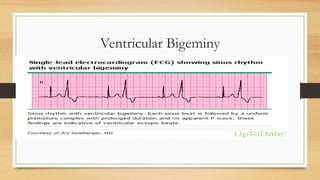
• Ventricular premature beats — Ventricular premature beats (VPBs), often the
first sign of digoxin toxicity, are also the most common arrhythmia due to digoxin
toxicity.
• While isolated VPBs may be seen, the VPBs often appear in a bigeminal pattern .
• Although ventricular bigeminy can result from organic heart disease, it should raise
the suspicion of digoxin intoxication in relevant contexts.
Ventricular Bigeminy
Ventricular tachycardia
• Due to reentry or possibly to triggered membrane activity (delayed
afterdepolarizations), ventricular tachycardia (VT) can be induced by digoxin
excess .
• With triggered membrane activity, VT may be resistant to interruption by
ventricular pacing since the faster rate of pacing may in itself increase the
transient inward current and worsen the arrhythmia.
• The axis and width of the QRS complex on the ECG are determined by the
site of origin of the VT, which may be in the specialized fascicles.
Bidirectional ventricular tachycardia
An unusual arrhythmia is the so-called "bidirectional" ventricular tachycardia in which the rhythm is
regular but every other beat has a different axis as it travels alternately down different conduction
pathways .
In most cases, the rhythm has a right bundle branch block morphology with an alternating left and
right axis .
However, alternating right and left bundle branch patterns may be seen. Bidirectional ventricular
tachycardia may be confused with ventricular bigeminy.
In true bigeminy, the ventricular beat in the bigeminal pattern is premature. By comparison, the R-R
interval is regular with a bidirectional tachycardia, since all of the beats arise from a single focus.
• Bidirectional ventricular tachycardia is not specific for digoxin intoxication. It is a frequent
finding in familial catecholaminergic polymorphic VT, a much less common disorder
Bi directional Ventricular tachycardia
Thankyou

Digoxin toxicity

  • 1.
  • 2.
    DIGOXIN • Cardiac glycosides(digitalis preparations including digoxin and digitoxin are used clinically in two situations: heart failure due to systolic dysfunction, and in certain supraventricular tachyarrhythmias ●The ability to enhance cardiac contractility and modulate neurohumoral activation can lead to symptomatic improvement in systolic heart failure, although it is unclear if survival is prolonged even in carefully selected patients with low therapeutic serum levels.
  • 3.
    Digoxin Digitalis compounds arepotent inhibitors of cellular Na+/K+- ATPase. This ion transport system moves sodium ions out of the cell and brings potassium ions into the cell. This transport function is necessary for cell survival because sodium diffusion into the cell and potassium diffusion out of the cell down their concentration gradients would reduce their concentration differences (gradients) across the cell membrane over time. Loss of these ion gradients would lead to cellular depolarization and loss of the negative membrane potential that is required for normal cell function. The Na+/K+-ATPase also plays an active role in the membrane potential. this pump is electrogenic because it transports 3 sodium ions out of the cell for every 2 potassium ions that enter the cell. This can add several negative millivolts to the membrane potential depending on the activity of the pump.
  • 5.
    • Digoxin alsoslows conduction through the atrioventricular (AV) junction (node) by increasing cardiac vagal tone modulation. • It may also have a sympathoinhibitory effect in therapeutic doses. • As a result, it is sometimes used (usually adjunctively with beta blockers or calcium channel blockers) for controlling the ventricular response in atrial fibrillation and atrial flutter when there is excessively rapid transmission of stimuli from the atria to the ventricles through the AV junction. ● Digoxin may also be effective in the treatment of certain types of reentrant paroxysmal supraventricular tachycardia involving the AV node.
  • 6.
    PLASMA DIGOXIN LEVELS ASSOCIATEDWITH TOXICITY • Life-threatening digoxin-induced arrhythmias and other toxic manifestations occur at substantially increasing frequency as the plasma digoxin concentration rises above 2.0 ng/mL (2.6 nmol/L). • However, clinicians should be aware that signs of toxicity may occur at levels below 1.3 to 1.5 ng/mL (1.7 to 1.9 nmol/L), and such toxicity is more likely in the presence of one or more comorbid conditions (eg, hypokalemia, hypomagnesemia, hypercalcemia, myocardial ischemia). • Hypokalemia is a particularly important risk factor that can promote digoxin-induced arrhythmias. • Patients with heart failure who are older than 65 years are also at increased risk.
  • 8.
    • Retrospective analysisof data from the large digitalis investigation group (DIG trial) revealed that serum digoxin levels ranging from 1.2 to 2.0 ng/mL (1.5 to 2.6 nmol/L) were associated with an excess mortality versus placebo in women with heart failure . • Therefore, we recommend maintaining trough digoxin levels at the lower range (eg, between 0.5 and 0.8 ng/mL [0.6 to 1.0 nmol/L]) in both male and female patients to help minimize toxicity
  • 10.
    MECHANISMS OF CARDIAC TOXICITY •The mechanism by which digoxin toxicity promotes the development of arrhythmias remain incompletely understood. • Two general categories have been described: enhanced ectopy with tachyarrhythmias, and bradyarrhythmias . Digoxin can affect cardiac tissue in a number of ways which may result in toxicity: ●Digoxin directly inhibits the ATPase dependent sodium-potassium pump, increasing intracellular sodium. This, in turn, reduces the activity of a sodium-calcium exchanger that normally extrudes calcium from the cell . The resulting increase in intracellular calcium is responsible for the positive inotropic action of digoxin. The fluxes in calcium can also have electrophysiologic effects.
  • 11.
    ●Cardiac glycosides activateryanodine receptors, which could contribute to increased calcium release from the sarcoplasmic reticulum and could play a role in the inotropic action of glycosides in vivo . ● increases vagal tone through central and peripheral effects; however, at excess levels, digoxin may augment cardiac sympathetic tone • As a result of the effect on intracellular calcium concentrations and vagal tone, high levels of digoxin can have a variety of effects that facilitate the development of arrhythmias. They can enhance and depress automaticity, induce triggered membrane activity (especially delayed afterdepolarizations), increase or decrease excitability, slow conduction, and alter refractoriness, also producing conditions conducive to the development of reentrant arrhythmias.
  • 12.
    Sinus bradycardia, tachycardia,block, and arrest • The effect of digoxin and digoxin toxicity on the SA node is often difficult to determine because of both indirect and direct actions. • As an example, improved hemodynamics in heart failure usually results in a fall in heart rate due to alterations in autonomic balance. Alternatively, sinus bradycardia may also be one of the earliest signs of digoxin excess. • Cardiac glycosides have no direct effect on slowing automaticity in the isolated SA node or in the transplanted human heart . • However, the diseased SA node may be quite sensitive to cardiac glycosides, resulting in sinus bradycardia and SA nodal block.
  • 14.
    Ectopic Atrial tachycardiawith block • Ectopic atrial tachycardia with block — Therapeutic concentrations of digoxin have little effect on atrial tissue, but toxic levels may result in an ectopic atrial tachycardia, often with 2:1 AV block. • the vagotonic activity and a direct effect of digoxin on AV nodal conduction • Also referred to as "paroxysmal" (ectopic) atrial tachycardia (PAT) with AV block, this arrhythmia is strongly suggestive of digoxin toxicity in patients taking this medication or in cases of suspected overdose. • However, the arrhythmia is typically not paroxysmal when induced by digoxin; rather, it is a persistent arrhythmia until specific therapy is instituted or digoxin levels fall below the toxic range • It should be noted that most cases of ectopic atrial tachycardia with block are not due to digoxin excess in contemporary practice.
  • 16.
    • Atrial tachycardiawith block may superficially resemble atrial flutter. There are two major distinguishing features between these arrhythmias: ●The atrial rate is faster (usually 250 to 350 beats/min) with atrial flutter. ●The baseline between P waves is isoelectric in atrial tachycardia with block, while there is a constantly undulating baseline between the flutter waves in atrial flutter. • It is important to distinguish between atrial flutter and atrial tachycardia due to excess digoxin since the administration of additional digoxin, which may be an appropriate therapy for atrial flutter, can accelerate the atrial rate in an atrial tachycardia, increasing the degree of AV block and potentially precipitating a more serious digoxin-toxic arrhythmia.
  • 17.
    Atrial fibrillation andflutter • Digoxin toxicity can occur in patients with atrial fibrillation or flutter, even though these arrhythmias are rarely caused by digoxin. A more important clinical problem is the effect of digoxin toxicity on transmission of atrial stimuli through the AV node in patients with preexisting atrial fibrillation. • The electrocardiographic findings vary with increasing degrees of digoxin toxicity and with the possible presence of block above or below the pacemaker . • Casual evaluation of such a patient who might have severe digoxin toxicity may lead to the mistaken conclusion that the irregular rhythm is due to persistent AF and the digoxin may be inappropriately continued or the dose even increased. • Atrial flutter is rarely, if ever, the result of digoxin intoxication. • However, the diagnosis of atrial flutter may be difficult to establish when, as commonly occurs during digoxin therapy, the atrial flutter has a slow ventricular response, with a rate that overlaps that seen in other supraventricular tachycardias, such as nonparoxysmal atrial tachycardia with a 2:1 AV response due to digoxin intoxication.
  • 19.
    Atrioventricular nodal block Therapeuticconcentrations of digoxin decrease the conduction velocity through the AV node and increase the refractoriness of the AV node; this affects the conduction of the normal as well as a premature impulse. These effects are mediated primarily by an increase in vagal tone and, to a lesser degree, a reduction in sympathetic activity . As a result of this dependence on autonomic balance, digoxin is of little value in controlling the ventricular response in patients who have undergone cardiac transplantation due to the denervated nature of the transplanted heart . • AV conduction may be blocked partially or completely by digoxin excess. ●First degree block (AV conduction delay) – Some degree of PR lengthening may be expected with digoxin therapy . More marked widening of the PR interval to above 0.2 sec suggests early digoxin toxicity.
  • 21.
    • Second degreeAV block – With higher levels of digoxin, first degree AV block may progress to second degree block of the Mobitz type I (Wenckebach) variety . • By contrast, Mobitz type II second degree AV block is rarely, if ever, induced by digoxin alone.
  • 23.
    • Third degreeAV block – Third-degree (complete) heart block and other types of AV dissociation may also occur with digoxin toxicity
  • 24.
    Junctional rhythm, tachycardia,and bradycardia  AV junctional rhythms are sometimes a sign of digoxin toxicity.  Digoxin toxicity can result in varying degrees of AV block that may allow the appearance of junctional escape beats and escape junctional (or atrioventricular nodal) rhythms.  The junctional rate may be normal (40 to 60 beats/min), accelerated (60 to 120 beats/min, due to direct effects or adrenergic influences), or depressed (less than 40 beats/min, due to enhanced vagal tone, dysfunctional pacemakers in organic heart disease, or to hyperkalemia caused by the digoxin toxicity) . • The QRS complex is usually narrow with junctional rhythms, since the pacemaker is typically above the bifurcation of the bundle branches. • However, the QRS may be wide if there is a conduction disturbance distal to the pacemaker, a dominant subjunctional pacemaker, or a dominant ventricular pacemaker
  • 25.
    • Ventricular arrhythmias— A variety of ventricular arrhythmias may result from digoxin toxicity, including ventricular premature beats, ventricular tachycardia, and ventricular fibrillation. • Ventricular premature beats — Ventricular premature beats (VPBs), often the first sign of digoxin toxicity, are also the most common arrhythmia due to digoxin toxicity. • While isolated VPBs may be seen, the VPBs often appear in a bigeminal pattern . • Although ventricular bigeminy can result from organic heart disease, it should raise the suspicion of digoxin intoxication in relevant contexts.
  • 26.
  • 28.
    Ventricular tachycardia • Dueto reentry or possibly to triggered membrane activity (delayed afterdepolarizations), ventricular tachycardia (VT) can be induced by digoxin excess . • With triggered membrane activity, VT may be resistant to interruption by ventricular pacing since the faster rate of pacing may in itself increase the transient inward current and worsen the arrhythmia. • The axis and width of the QRS complex on the ECG are determined by the site of origin of the VT, which may be in the specialized fascicles.
  • 29.
    Bidirectional ventricular tachycardia Anunusual arrhythmia is the so-called "bidirectional" ventricular tachycardia in which the rhythm is regular but every other beat has a different axis as it travels alternately down different conduction pathways . In most cases, the rhythm has a right bundle branch block morphology with an alternating left and right axis . However, alternating right and left bundle branch patterns may be seen. Bidirectional ventricular tachycardia may be confused with ventricular bigeminy. In true bigeminy, the ventricular beat in the bigeminal pattern is premature. By comparison, the R-R interval is regular with a bidirectional tachycardia, since all of the beats arise from a single focus. • Bidirectional ventricular tachycardia is not specific for digoxin intoxication. It is a frequent finding in familial catecholaminergic polymorphic VT, a much less common disorder
  • 31.
  • 32.