CARDIAC
ARRHYTHMIA
DRUGS
Presented to: Dr. F. Deane
Presenter : Shenellie Harry
Course: Pharmacology
Class: Med 4
NORMAL PHYSIOLOGICAL
CONDUCTION OF THE
HEART
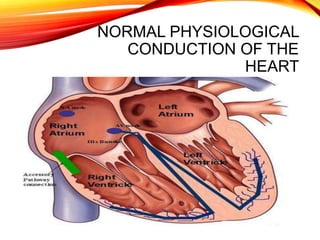
NORMAL PHYSIOLOGICAL
CONDUCTION OF THE
HEART
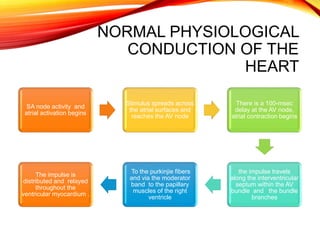
SA node activity and
atrial activation begins
Stimulus spreads across
the atrial surfaces and
reaches the AV node
There is a 100-msec
delay at the AV node,
atrial contraction begins
the impulse travels
along the interventricular
septum within the AV
bundle and the bundle
branches
To the purkinjie fibers
and via the moderator
band to the papillary
muscles of the right
ventricle
The impulse is
distributed and relayed
throughout the
ventricular myocardium .
CARDIAC ARRHYTHMIA
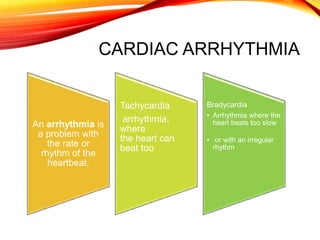
An arrhythmia is
a problem with
the rate or
rhythm of the
heartbeat.
Tachycardia
arrhythmia,
where
the heart can
beat too
Bradycardia
• Arrhythmia where the
heart beats too slow
• or with an irregular
rhythm
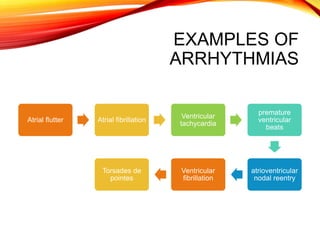
EXAMPLES OF
ARRHYTHMIAS
Atrial flutter Atrial fibrillation
Ventricular
tachycardia
premature
ventricular
beats
atrioventricular
nodal reentry
Ventricular
fibrillation
Torsades de
pointes
MECHANISMS FOR
ARRHYTHMIAS
MECHANISM
ABNORMAL
AUTOMATICITY
Pacemaker activity
that originates
anywhere other than
in the sinoatrial node
ABNORMAL
CONDUCTION
Conduction of an
impulse that does
not follow the
pathway
Re- enters tissue
previously excited
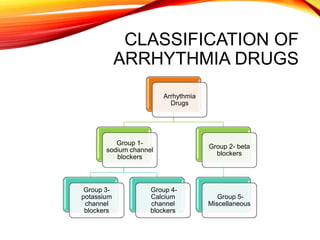
CLASSIFICATION OF
ARRHYTHMIA DRUGS
Arrhythmia
Drugs
Group 1-
sodium channel
blockers
Group 3-
potassium
channel
blockers
Group 4-
Calcium
channel
blockers
Group 2- beta
blockers
Group 5-
Miscellaneous
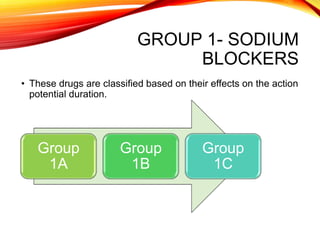
GROUP 1- SODIUM
BLOCKERS
• These drugs are classified based on their effects on the action
potential duration.
Group
1A
Group
1B
Group
1C
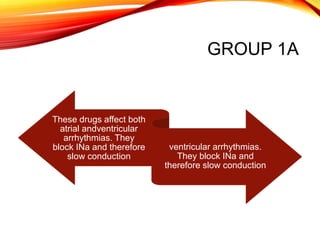
GROUP 1A
These drugs affect both
atrial andventricular
arrhythmias. They
block INa and therefore
slow conduction
ventricular arrhythmias.
They block INa and
therefore slow conduction
PROCAINAMIDE:
MECHANISM OF ACTION
During an action potential, voltage-gated sodium channels open,
allowing sodium ions to diffuse across the membrane down their
electrochemical gradient, further depolarizing the membrane of the
cell. Blocking these channels slows conductivity and thereby
prolongs the action potential and the refractory period.
This results in an increase in the refractory period and a decrease in
excitability and impulse conduction velocity of the atria and
ventricles, relieving symptoms of arrhythmia and tachycardia.
Procainamide also has weak vagolytic activity, which can result in an
increased heart rate and other side effects.
Procainamide can be metabolized in the liver to N-
acetylprocainamide, a metabolite that also has antiarrhythmic action
and slower renal clearance than procainamide, effectively increasing
the therapeutic half-life of the drug.
PHARMACOKINETICS
AND DOSAGE
Procainamide can be administered safely by intravenous and
intramuscular routes and is well absorbed orally.
Excessive accumulation of NAPA has been implicated in torsades
de pointes during procainamide therapy, especially in patients with
renal failure.
Procainamide is eliminated by hepatic metabolism to NAPAand by
renal elimination. Its half-life is only 3–4 hours, which necessitates
frequent dosing or use of a slow-release formulation
PHARMACOKINETICS
AND DOSAGE
NAPA is eliminated by the kidneys. Thus,procainamide
dosage must be reduced in patients with renal failure.
The reduced volume of distribution and renal clearance
associated with heart failure also require reduction in
dosage.
The half-life of NAPA is considerably longer than that of
procainamide , and it therefore accumulates more slowly.
PHARMACOKINETICS AND
DOSAGE- PROCAINAMIDE
If a rapid procainamide effect is needed, an intravenous
loading dose of up to 12 mg/kg can be given at a rate of
0.3 mg/kg/min or less rapidly. This dose is followed by a
maintenance dosage of 2–5 mg/min, with careful
monitoring of plasma levels.
The risk of gastrointestinal (GI) or cardiac toxicity rises at
plasma concentrations greater than 8 mcg/mL or NAPA
concentrations greater than 20 mcg/mL
PHARMACOKINETICS
AND DOSAGE
To control ventricular arrhythmias, a total
procainamide dosage of 2–5 g/d is usually required.
In an occasional patient who accumulates high levels
of NAPA, less frequent dosing may be possible.
This is also possible in renal disease, where
procainamide elimination is slowed.
ADVERSE EFFECTS OF
PROCAINAMIDE
Adverse
effects
Pericarditis
arthralgia
and arthritis
parenchymal
pulmonary
disease
nausea and
diarrhea
rash, fever,
hepatitis
QUINIDINE : MECHANISM
OF ACTION
Quinidine stabilizes the neuronal membrane by binding to and
inhibiting voltage-gated sodium channels, thereby inhibiting the
sodium influx required for the initiation and conduction of impulses.
This results in an increase of the threshold for excitation and
decreased depolarization during phase 0 of the action potential.
The drug also prolongs the action potential duration by blockadeof
several potassium channels
QUINIDINE :
PHARMACOKINETICS AND
DOSAGE
100 to 600 mg/dose orally every 4 to 6 hours; begin at 200 mg/dose and
titrate to desired effect (maximum daily dose: 3 to 4 g).
The elimination of quinidine is accomplished by a combination of renal
excretion of the intact drug (15 to 40% of total clearance) and hepatic
biotransformation to a variety of metabolites (60 to 85% of total clearance).
Quinidine is readily absorbed from the GI tract.
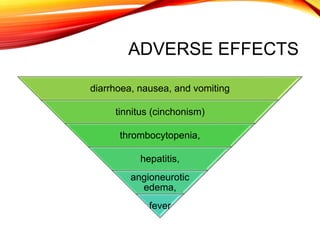
ADVERSE EFFECTS
diarrhoea, nausea, and vomiting
tinnitus (cinchonism)
thrombocytopenia,
hepatitis,
angioneurotic
edema,
fever
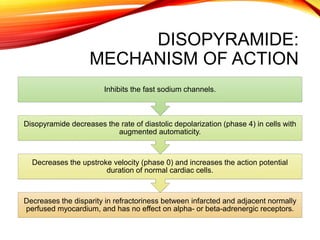
DISOPYRAMIDE:
MECHANISM OF ACTION
Decreases the disparity in refractoriness between infarcted and adjacent normally
perfused myocardium, and has no effect on alpha- or beta-adrenergic receptors.
Decreases the upstroke velocity (phase 0) and increases the action potential
duration of normal cardiac cells.
Disopyramide decreases the rate of diastolic depolarization (phase 4) in cells with
augmented automaticity.
Inhibits the fast sodium channels.
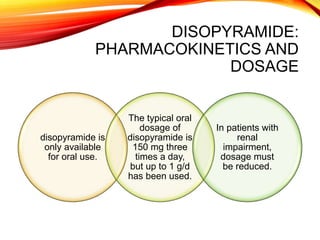
DISOPYRAMIDE:
PHARMACOKINETICS AND
DOSAGE
disopyramide is
only available
for oral use.
The typical oral
dosage of
disopyramide is
150 mg three
times a day,
but up to 1 g/d
has been used.
In patients with
renal
impairment,
dosage must
be reduced.
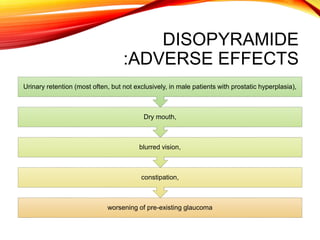
DISOPYRAMIDE
:ADVERSE EFFECTS
worsening of pre-existing glaucoma
constipation,
blurred vision,
Dry mouth,
Urinary retention (most often, but not exclusively, in male patients with prostatic hyperplasia),
GROUP 1B:
These are the most
selective agents which
have significant effects
on sodium channels in
ischemic tissue.
However, they have
negligible effects on
channels in normal cells.
LIDOCAINE: MECHANISM
OF ACTION
The increased inactivation and slower unbinding kinetics result in the selective
depression of conduction in depolarized cells
The rapid kinetics at normal resting potentials result in recovery from block
between action potentials and no effect on conduction.
the inactivated state block ensures greater effects on cells with long action
potentials such as Purkinje and ventricular cells, compared with atrial cells.
Lidocaine blocks activated and inactivated sodium channels with rapid kinetics ;
LIDOCAINE :
PHARMACOKINETICS AND
DOSAGE
In adults, a loading dose of 150–200 mg administeredover about 15 minutes (as a single infusion or as a
series of slow boluses) should be followed by a maintenance infusion of 2–4mg/min to achieve a therapeutic
plasma level of 2–6 mcg/mL.
Lidocaine has a half-life of 1–2 hours.
Thus, lidocaine must be given parenterally.
Lidocaine goes through first-pass hepatic metabolism, only 3% of orally administered Lidocaine appears in
the plasma.
LIDOCAINE: ADVERSE
EFFECTS
paresthesias,
tremor,
nausea of central origin,
lightheadedness,
hearing disturbances,
slurred speech,
convulsions
MEXILETINE:
MECHANISM OF ACTION
Mexiletine, like lidocaine,
inhibits the inward sodium
current, thus reducing the rate
of rise of the action potential,
Phase 0.
Mexiletine decreased the
effective refractory period
(ERP) in Purkinje fibers.
MEXILETINE:
PHARMACOKINETICS AND
DOSAGE
Mexiletine is well absorbed (~90%) from the
gastrointestinal tract.
Its first-pass metabolism is low. Peak blood levels
are reached in two to three hours.
The elimination half-life is 8–20 hours and permits
administration two or three times per day.
The usual daily dosage of mexiletine is 600–1200
mg/d.
MEXILETINE: ADVERSE
EFFECTS
Tremor
Blurred
vision
Lethargy
Nausea
GROUP 1C
Group 1C drugs
have no effect on
AP duration.
In contrast to group
1B it can cause some
reduction of INa even
in normal cells.
FLECAINIDE:
MECHANISM OF ACTION
Flecainide is a potent
blocker of sodium and
potassium channels
with slow unblocking
kinetics.
Although it does block
certain potassium
channels, it does not
prolong the action
potential or the QT
interval.
Flecainide is very
effective in
suppressing
premature ventricular
contractions.
However, it may
cause severe
exacerbation of
arrhythmia even
when normal doses
are administered to
patients with
preexisting ventricular
tachyarrhythmias and
those with a previous
myocardial infarction
and ventricular
ectopy.
FLECAINIDE:
PHARMACOKINETICS AND
DOSAGE
Flecainide is well absorbed and has a
half-life of approximately 20 hours.
Elimination is both by hepatic metabolism
and by the kidney.
The usual dosage of flecainide is 100–
200 mg twice a day.
PROPAFENONE:
MECHANISM OF ACTION
The electrophysiological effect of propafenone manifests itself
in a reduction of upstroke velocity (Phase 0) of the monophasic
action potential.
In Purkinje fibers, and to a lesser extent myocardial fibers,
propafenone reduces the fast inward current carried by sodium
ions, which is responsible for the drugs antiarrhythmic actions.
Diastolic excitability threshold is increased and effective
refractory period prolonged. Propafenone reduces
spontaneous automaticity and depresses triggered activity.
PROPAFENONE :
PHARMACOKINETICS AND
DOSAGE
Propafenone is
metabolized in the
liver, with an
average half-life of
5–7 hours.
The usual daily
dosage of
propafenone is 450–
900 mg in three
divided doses.
MORICIZINE:
MECHANISM OF ACTION
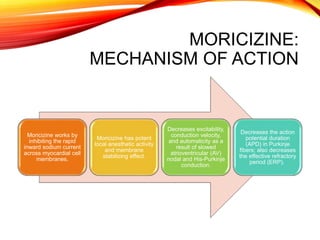
Moricizine works by
inhibiting the rapid
inward sodium current
across myocardial cell
membranes.
Moricizine has potent
local anesthetic activity
and membrane
stabilizing effect.
Decreases excitability,
conduction velocity,
and automaticity as a
result of slowed
atrioventricular (AV)
nodal and His-Purkinje
conduction.
Decreases the action
potential duration
(APD) in Purkinje
fibers; also decreases
the effective refractory
period (ERP).
MORICIZINE :
PHARMACOKINETICS AND
DOSAGE
well absorbed,
absorption is
complete within 2
to 3 hours.
Metabolized in the
liver.
(CLASS 2 )PROPRANOLOL :
MECHANISM OF ACTION
Propranolol competes with sympathomimetic
neurotransmitters such as catecholamines for
binding at beta(1)-adrenergic receptors in the
heart, inhibiting sympathetic stimulation.
This results in a reduction in resting heart rate,
cardiac output, systolic and diastolic blood
pressure, and reflex orthostatic hypotension
PROPRANOLOL:
PHARMACOKINETICS AND
DOSAGE
Propranolol is highly lipophilic and almost completely absorbed after oral
administration.
However, it undergoes high first-pass metabolism by the liver and on
average, only about 25% of propranolol reaches the systemic circulation.
Peak plasma concentrations occur about 1 to 4 hours after an oral dose.
10 to 30 mg orally 3 to 4 times a day, before meals and at bedtime.
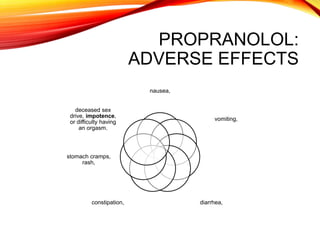
PROPRANOLOL:
ADVERSE EFFECTS
nausea,
vomiting,
diarrhea,
constipation,
stomach cramps,
rash,
deceased sex
drive, impotence,
or difficulty having
an orgasm.
ESMOLOL: MECHANISM
OF ACTION
Cardiac arrhythmia drugs