For any help regarding Matlab Assignment Help visit :
https://www.matlabassignmentexperts.com/,
Email - info@matlabassignmentexperts.comor call us at - +1 678 648 4277
matlabassignmentexperts.com
Problem 12.1
Consider the discrete-time linear causal system defined by the difference equation
Draw a signal flow graph to implement this system in each of the following forms:
(a)Direct form I.
(b) Direct form II.
(c) Cascade.
(d) Parallel.
For the cascade and parallel forms use only first-order sections.
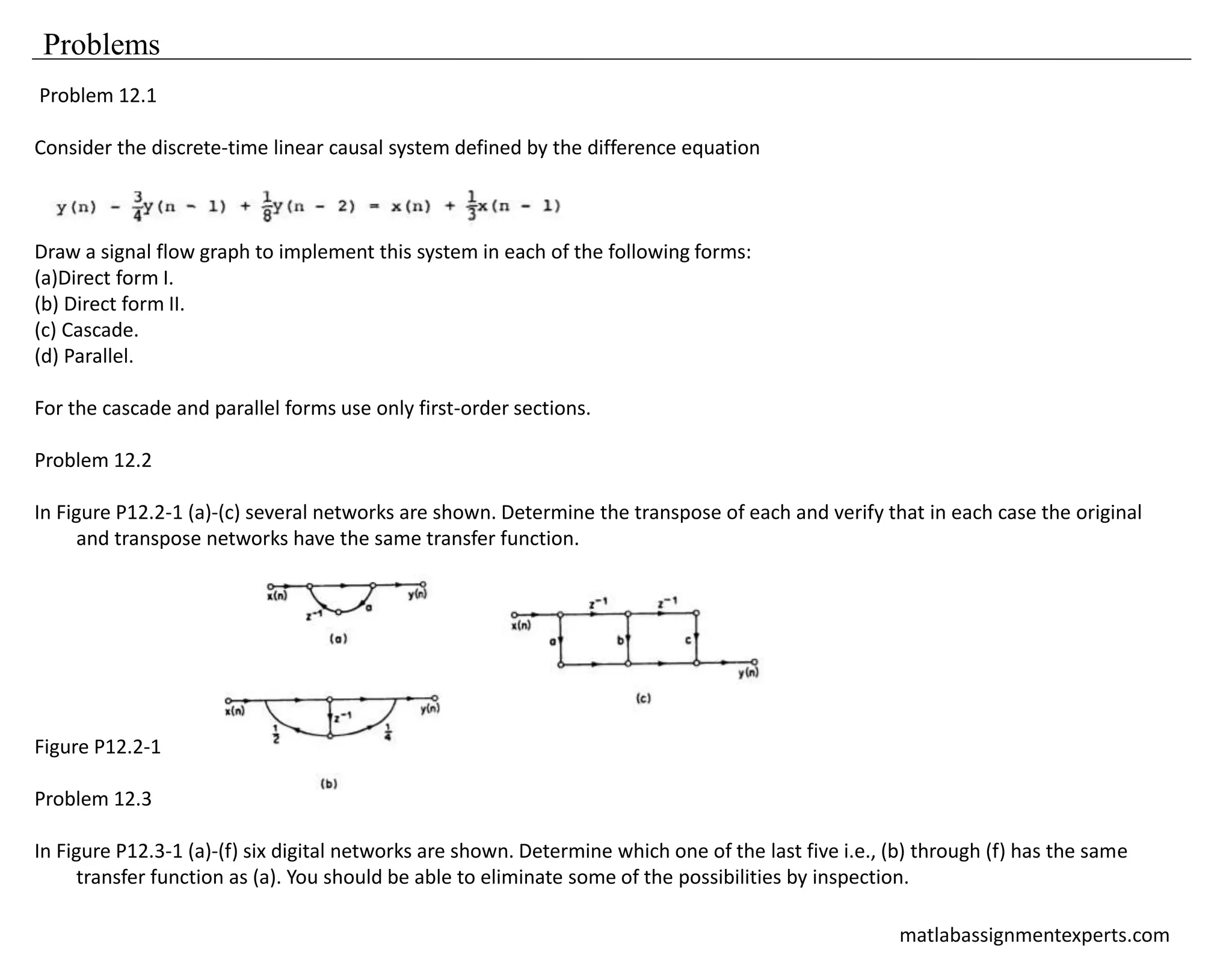
Problem 12.2
In Figure P12.2-1 (a)-(c) several networks are shown. Determine the transpose of each and verify that in each case the original
and transpose networks have the same transfer function.
Figure P12.2-1
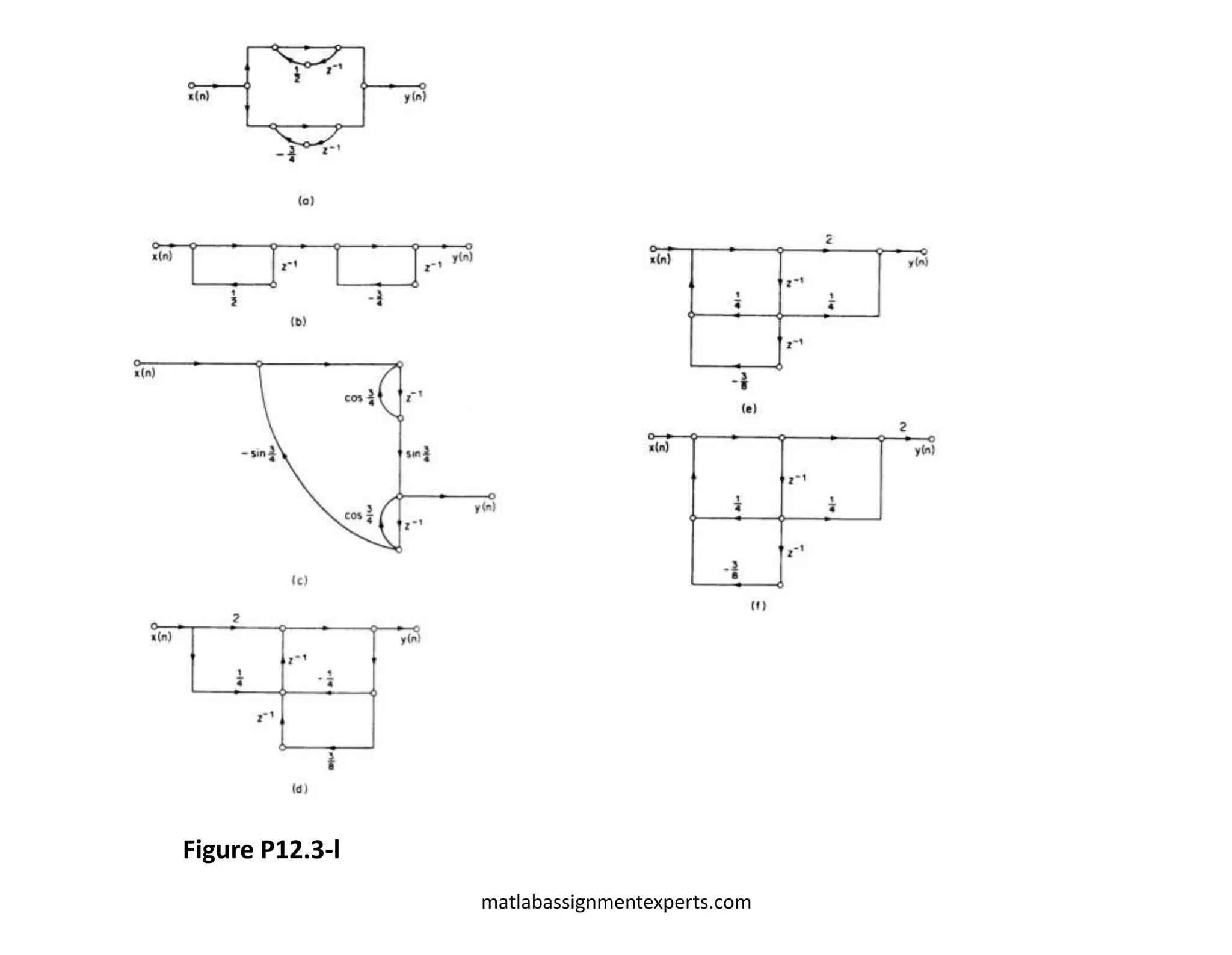
Problem 12.3
In Figure P12.3-1 (a)-(f) six digital networks are shown. Determine which one of the last five i.e., (b) through (f) has the same
transfer function as (a). You should be able to eliminate some of the possibilities by inspection.
Problems
matlabassignmentexperts.com
Figure P12.3-l
matlabassignmentexperts.com
Problem 12.4 –
The system with transfer function H(z) = is an allpass system, 1 - az i.e. the frequency response has unity
magnitude.
(a) Draw a network realization of this system in direct II form; and indicate in particular the number of delay branches
required and the number of branches requiring multiplication by other than +1 or -1.
(b) An alternative implementation is suggested by noting that the difference equation of the allpass system can be
expressed as
y(n) - ay(n - 1) = x(n - 1) - a x(n)
or equivalently,
y(n)=a [y(n - 1) - x(n)] + x(n - 1)
Draw a network realization of this equation requiring two delay branches but only one branch with a multiplication by
other than +1 or -1.
The primary disadvantage to the network in (b) as compared to that in
(a) is that two delay brances are required. In some applications, however, it is necessary to implement a cascade of
allpass sections. For N allpass sections it is possible to utilize a realization of each in the form determined in part
(b) but using only (N + 1) delay branches. This is accomplished essentially by sharing a delay between sections.
(c) Consider the allpass system with transfer functions
Draw a network realization of this system by "cascading" two networks of the form obtained in part (b) in such a way
that only three delay branches are required.
Problem 12.5
Speech production can be modeled as a linear system representing the vocal cavity, excited by puffs of air released
through the vocal cords. In synthesizing speech on a digital computer, one approach is to represent the vocal cavity
as a connection of cylindrical acoustic tubes with equal length but with different cross-sectional areas, as depicted
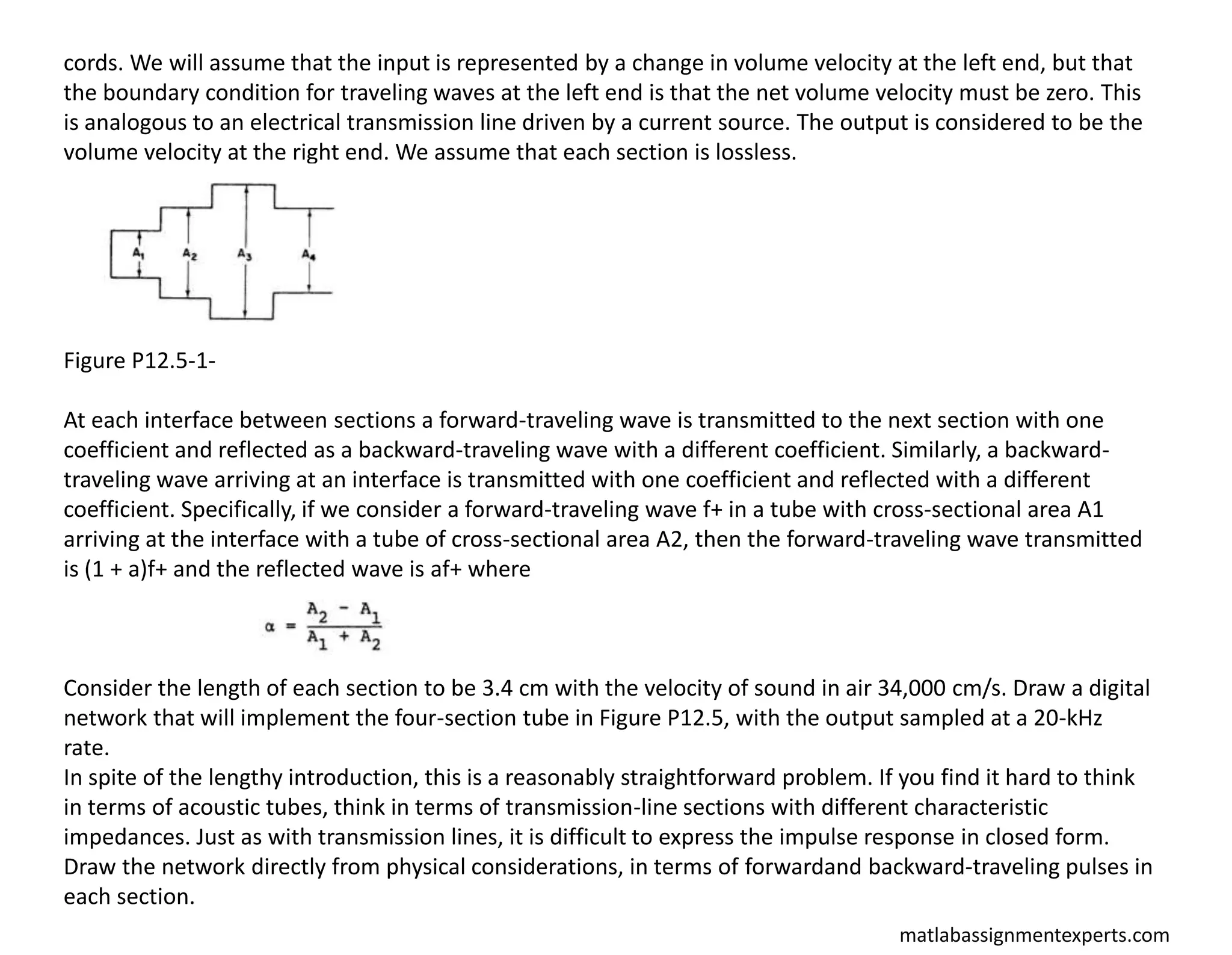
in Figure 12.5-1. Let us assume that we want to simulate this system in terms of the volume velocity representing air
flow. The input is coupled into the vocal tract through a small constriction, the vocal
matlabassignmentexperts.com
cords. We will assume that the input is represented by a change in volume velocity at the left end, but that
the boundary condition for traveling waves at the left end is that the net volume velocity must be zero. This
is analogous to an electrical transmission line driven by a current source. The output is considered to be the
volume velocity at the right end. We assume that each section is lossless.
Figure P12.5-1-
At each interface between sections a forward-traveling wave is transmitted to the next section with one
coefficient and reflected as a backward-traveling wave with a different coefficient. Similarly, a backward-
traveling wave arriving at an interface is transmitted with one coefficient and reflected with a different
coefficient. Specifically, if we consider a forward-traveling wave f+ in a tube with cross-sectional area A1
arriving at the interface with a tube of cross-sectional area A2, then the forward-traveling wave transmitted
is (1 + a)f+ and the reflected wave is af+ where
Consider the length of each section to be 3.4 cm with the velocity of sound in air 34,000 cm/s. Draw a digital
network that will implement the four-section tube in Figure P12.5, with the output sampled at a 20-kHz
rate.
In spite of the lengthy introduction, this is a reasonably straightforward problem. If you find it hard to think
in terms of acoustic tubes, think in terms of transmission-line sections with different characteristic
impedances. Just as with transmission lines, it is difficult to express the impulse response in closed form.
Draw the network directly from physical considerations, in terms of forwardand backward-traveling pulses in
each section.
matlabassignmentexperts.com
Solutions
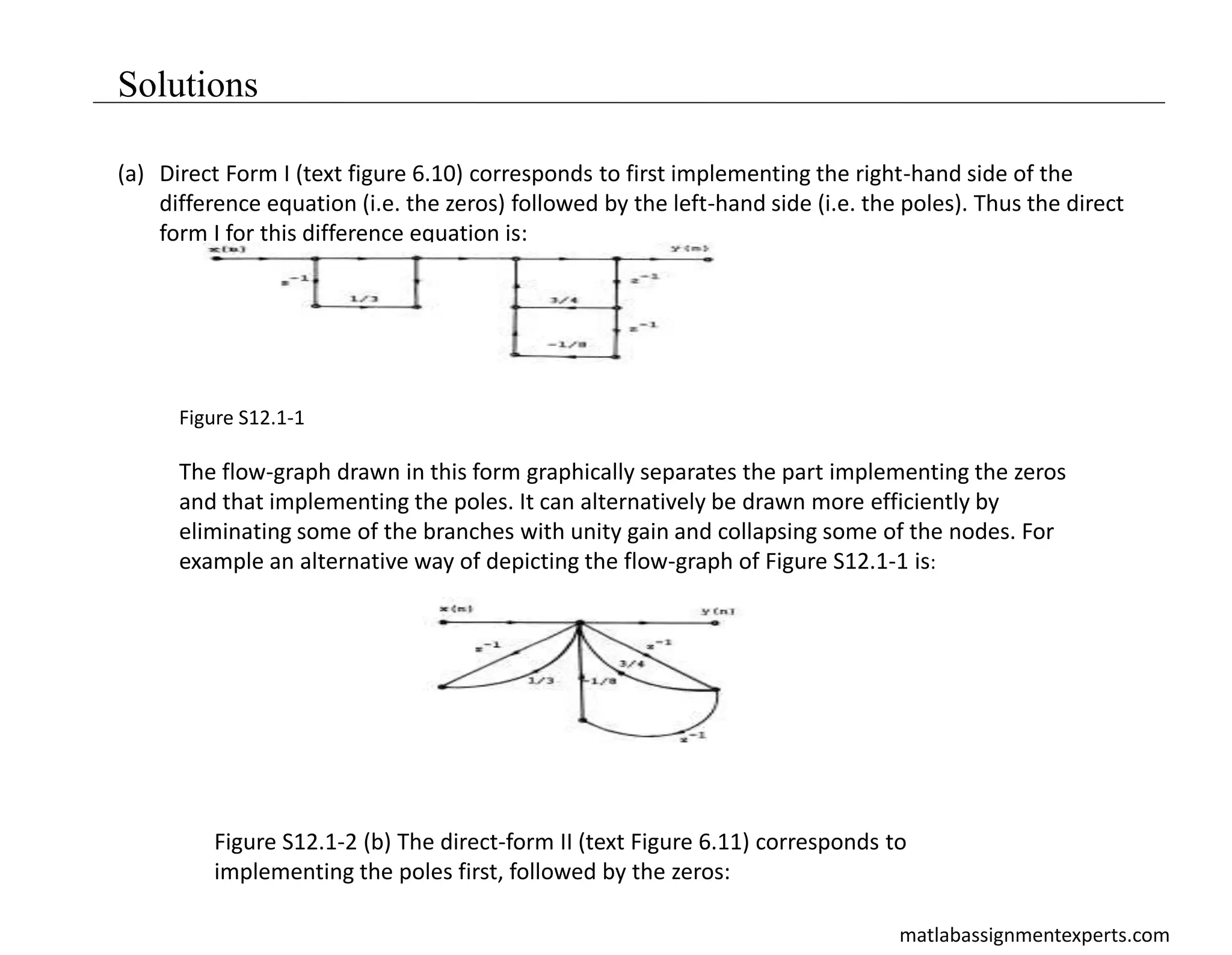
(a) Direct Form I (text figure 6.10) corresponds to first implementing the right-hand side of the
difference equation (i.e. the zeros) followed by the left-hand side (i.e. the poles). Thus the direct
form I for this difference equation is:
Figure S12.1-1
The flow-graph drawn in this form graphically separates the part implementing the zeros
and that implementing the poles. It can alternatively be drawn more efficiently by
eliminating some of the branches with unity gain and collapsing some of the nodes. For
example an alternative way of depicting the flow-graph of Figure S12.1-1 is:
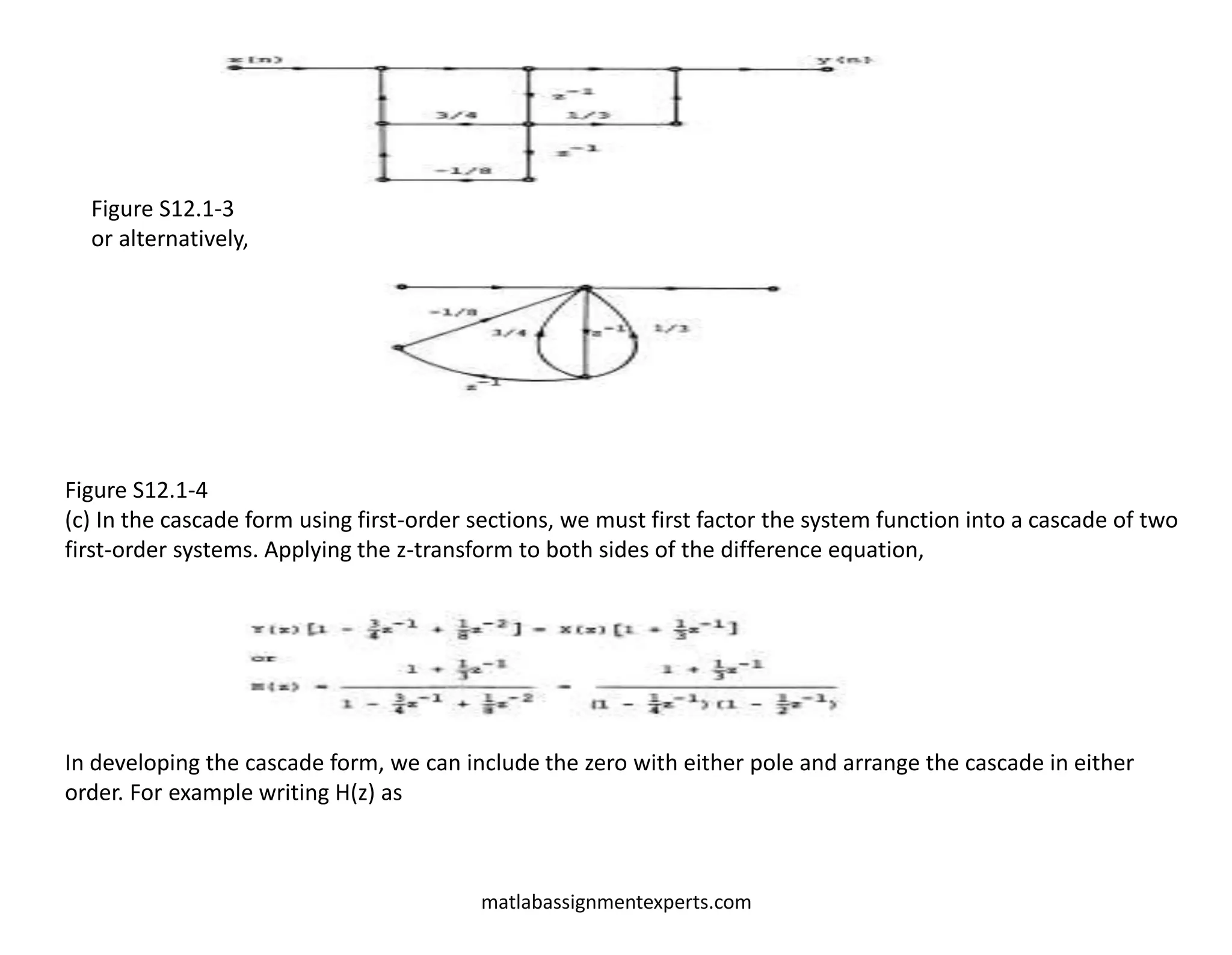
Figure S12.1-2 (b) The direct-form II (text Figure 6.11) corresponds to
implementing the poles first, followed by the zeros:
matlabassignmentexperts.com
Figure S12.1-3
or alternatively,
Figure S12.1-4
(c) In the cascade form using first-order sections, we must first factor the system function into a cascade of two
first-order systems. Applying the z-transform to both sides of the difference equation,
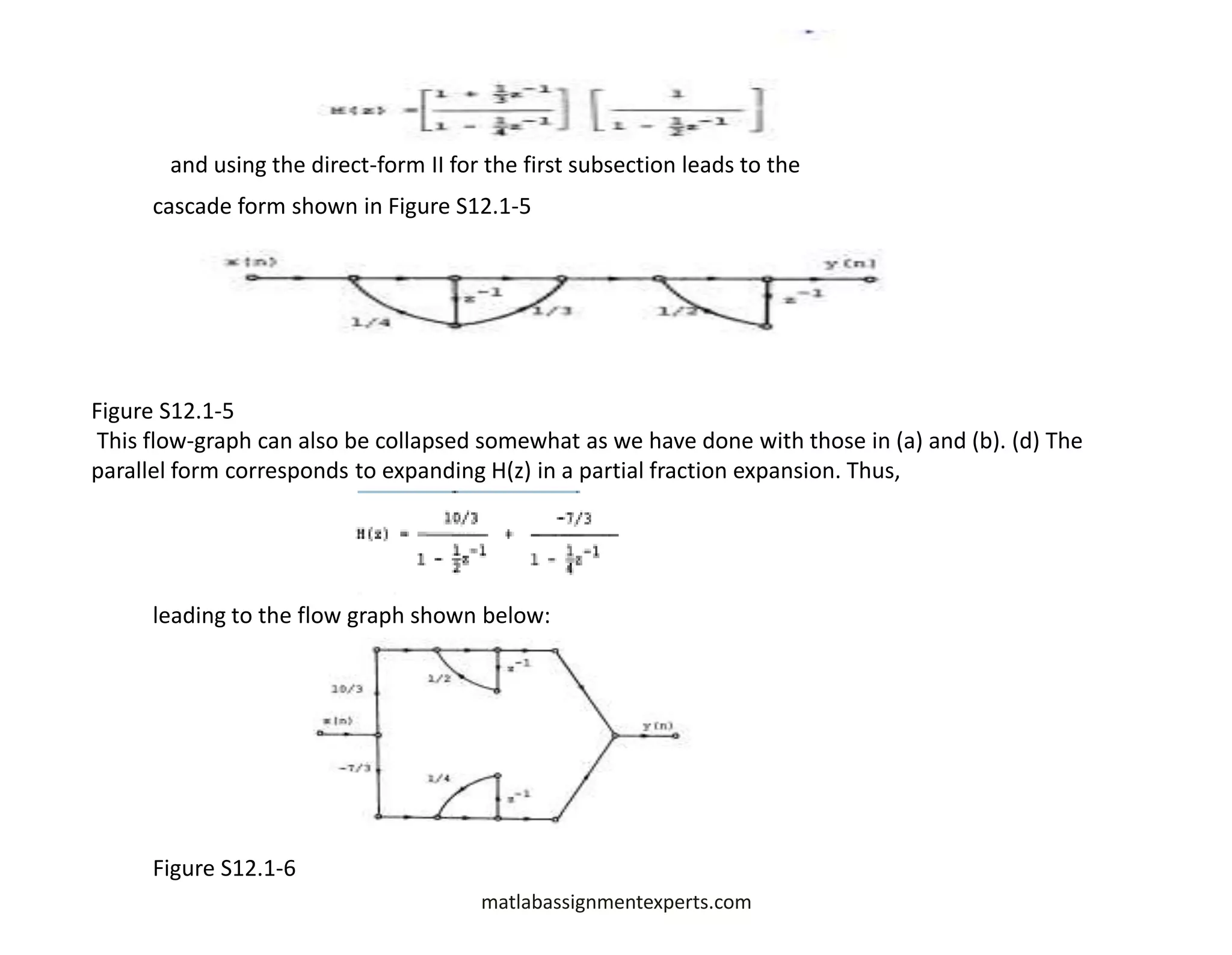
In developing the cascade form, we can include the zero with either pole and arrange the cascade in either
order. For example writing H(z) as
matlabassignmentexperts.com
and using the direct-form II for the first subsection leads to the
cascade form shown in Figure S12.1-5
Figure S12.1-5
This flow-graph can also be collapsed somewhat as we have done with those in (a) and (b). (d) The
parallel form corresponds to expanding H(z) in a partial fraction expansion. Thus,
leading to the flow graph shown below:
Figure S12.1-6
matlabassignmentexperts.com
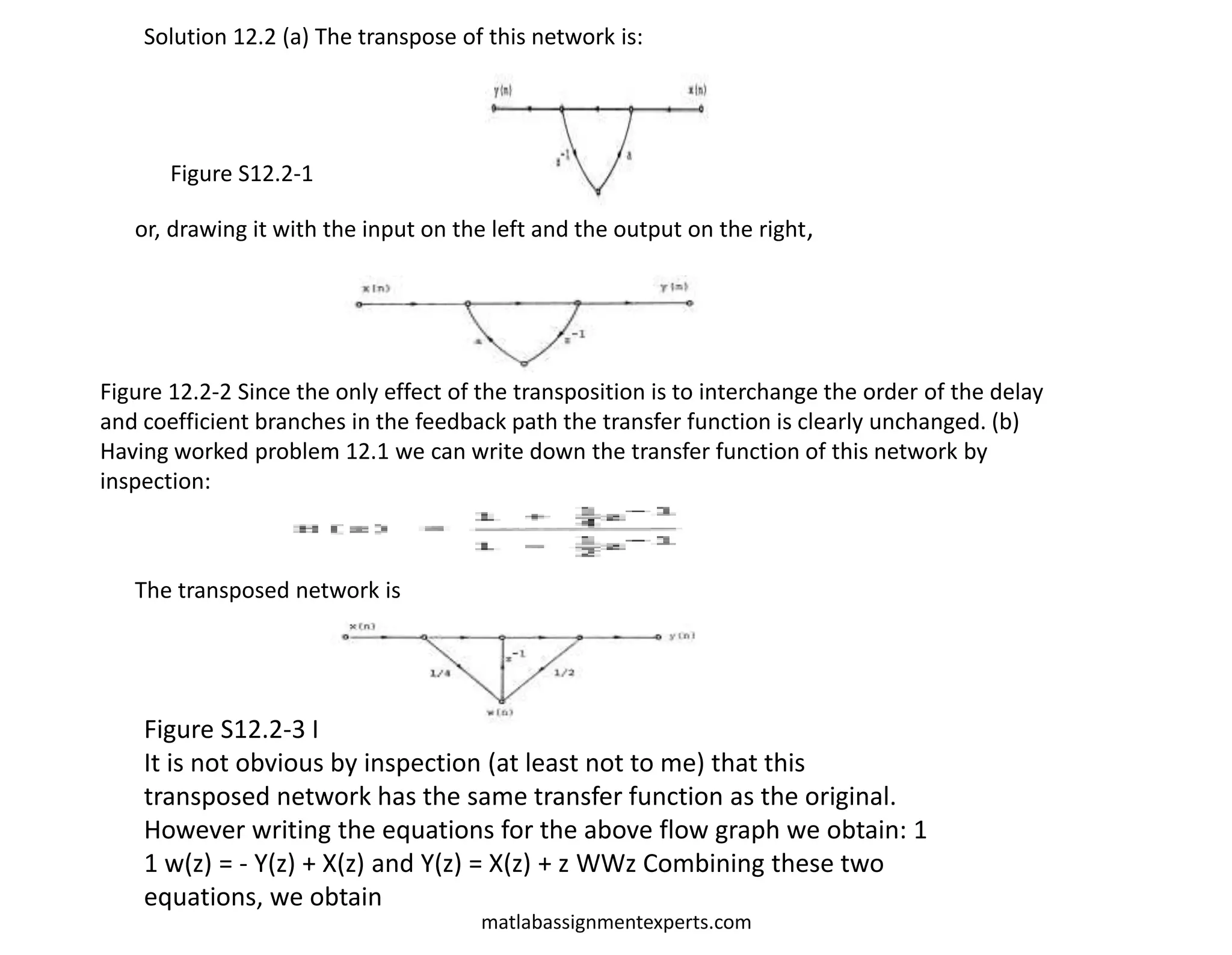
Solution 12.2 (a) The transpose of this network is:
Figure S12.2-1
or, drawing it with the input on the left and the output on the right,
Figure 12.2-2 Since the only effect of the transposition is to interchange the order of the delay
and coefficient branches in the feedback path the transfer function is clearly unchanged. (b)
Having worked problem 12.1 we can write down the transfer function of this network by
inspection:
The transposed network is
Figure S12.2-3 I
It is not obvious by inspection (at least not to me) that this
transposed network has the same transfer function as the original.
However writing the equations for the above flow graph we obtain: 1
1 w(z) = - Y(z) + X(z) and Y(z) = X(z) + z WWz Combining these two
equations, we obtain
matlabassignmentexperts.com
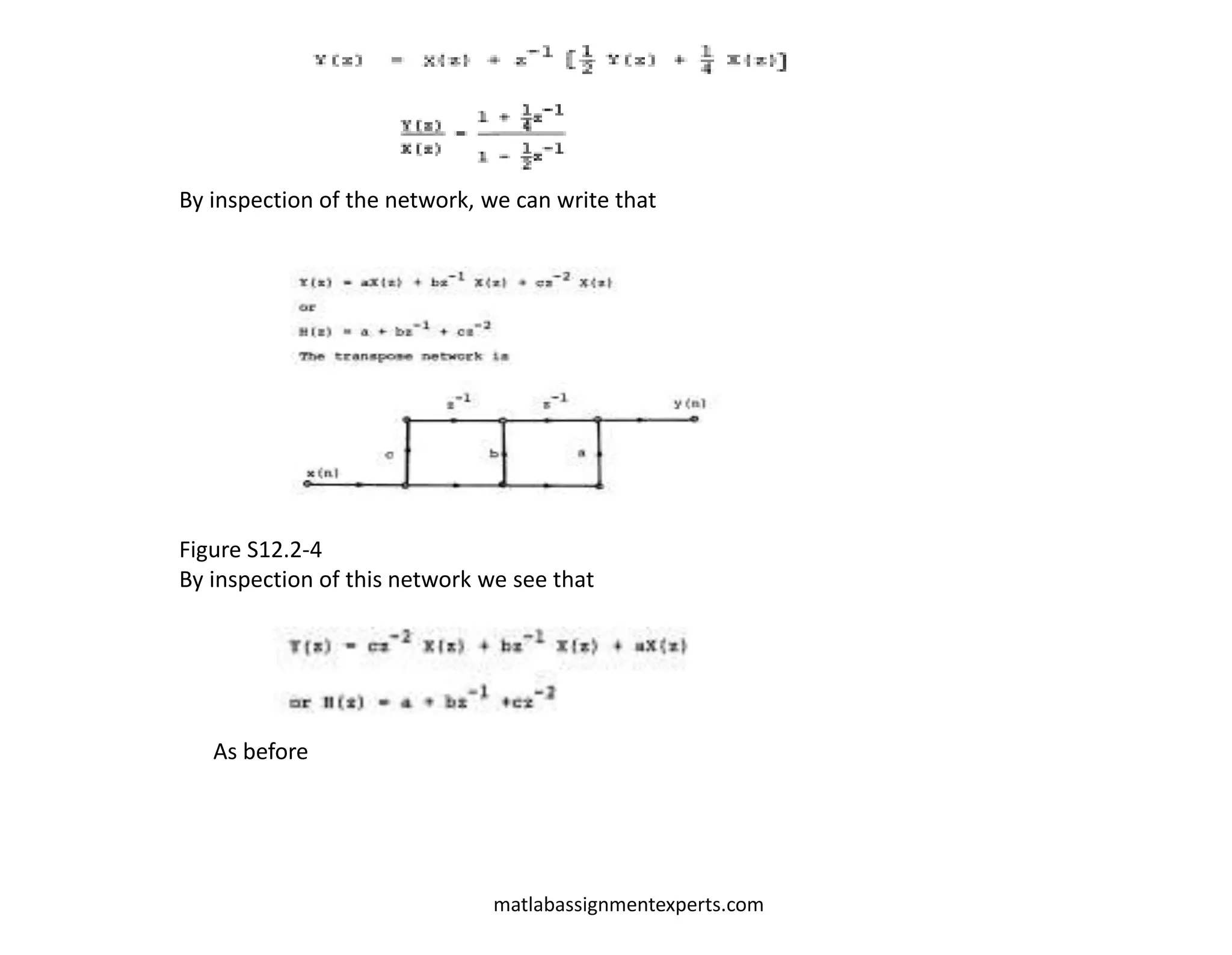
By inspection of the network, we can write that
Figure S12.2-4
By inspection of this network we see that
As before
matlabassignmentexperts.com
Solution 12.3
By inspection we observe that for network (a) there is a delay free path with a gain of 2 from input to output, i.e. if
x(n) = 6(n) then y(O) = 2. Since this is not true for networks (b) or (c), they are eliminated. Second, by inspection of
(a) we note that there are two poles, one at z = 1/2 and one at z = - 3/4, i.e. the denominator of the system function
is
Since networks (e) and (f) correspond to system functions with denominator polynomial
given by
these networks are eliminated. The remaining possibility, which is the correct answer, is network
(d).
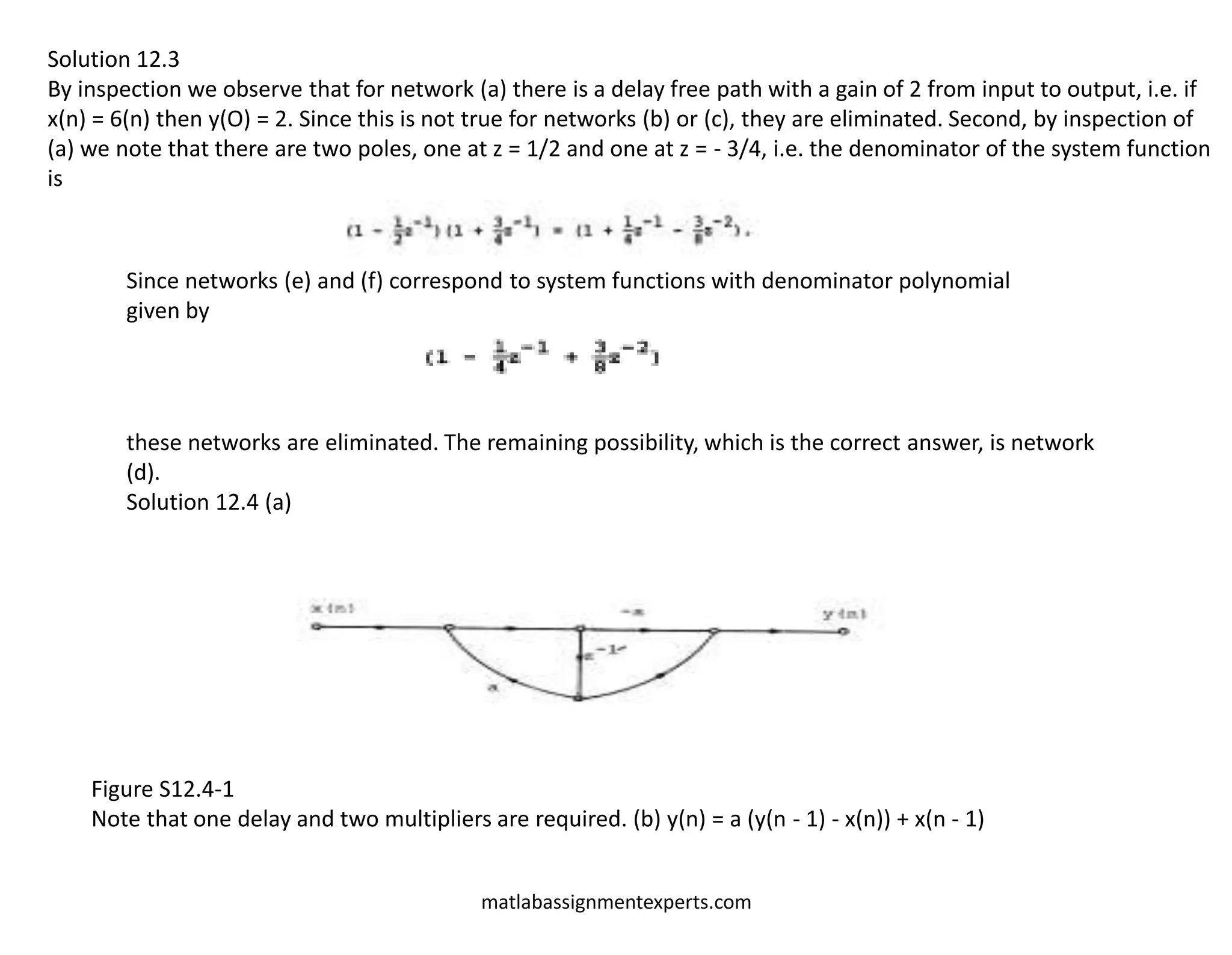
Solution 12.4 (a)
Figure S12.4-1
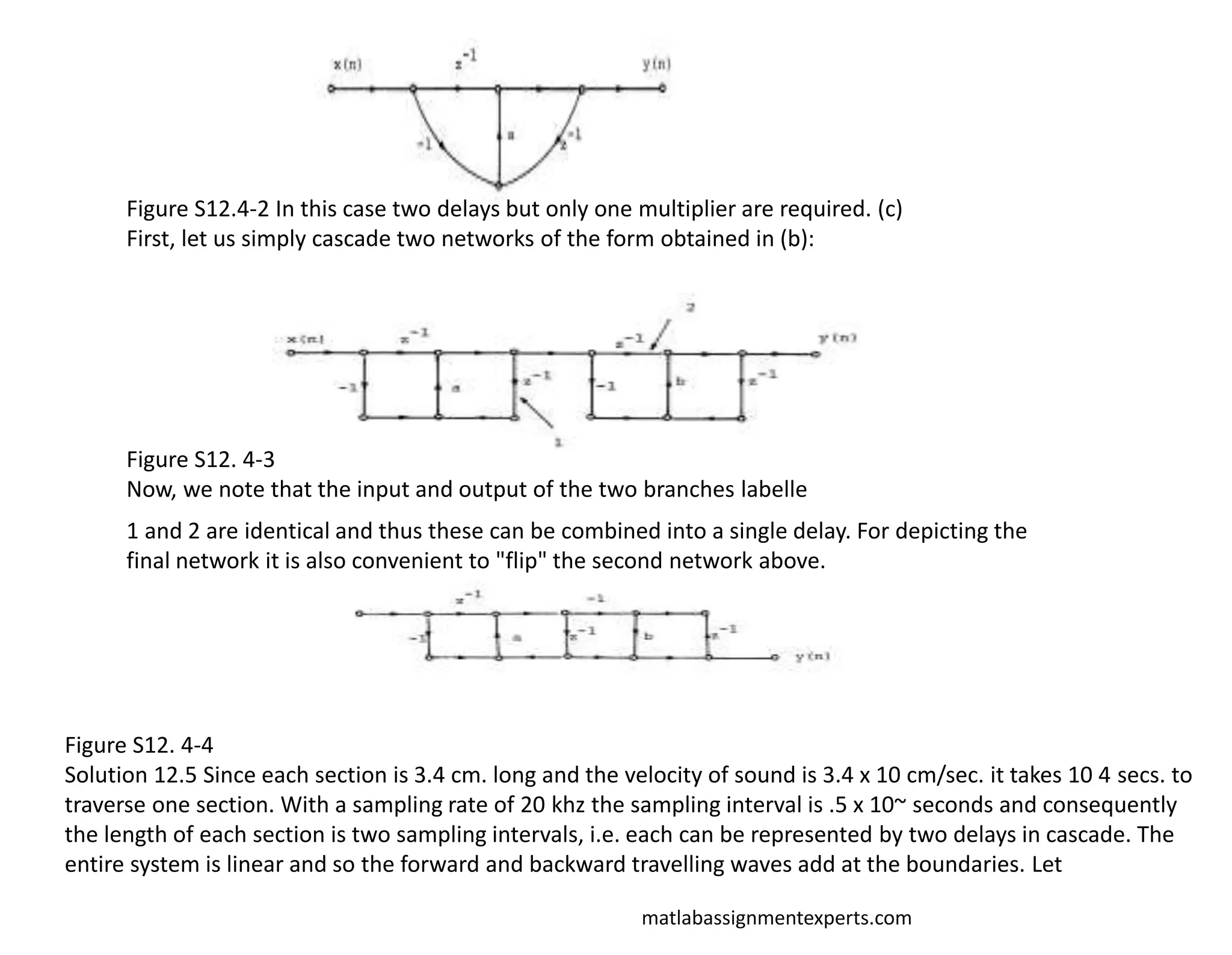
Note that one delay and two multipliers are required. (b) y(n) = a (y(n - 1) - x(n)) + x(n - 1)
matlabassignmentexperts.com
Figure S12.4-2 In this case two delays but only one multiplier are required. (c)
First, let us simply cascade two networks of the form obtained in (b):
Figure S12. 4-3
Now, we note that the input and output of the two branches labelle
1 and 2 are identical and thus these can be combined into a single delay. For depicting the
final network it is also convenient to "flip" the second network above.
Figure S12. 4-4
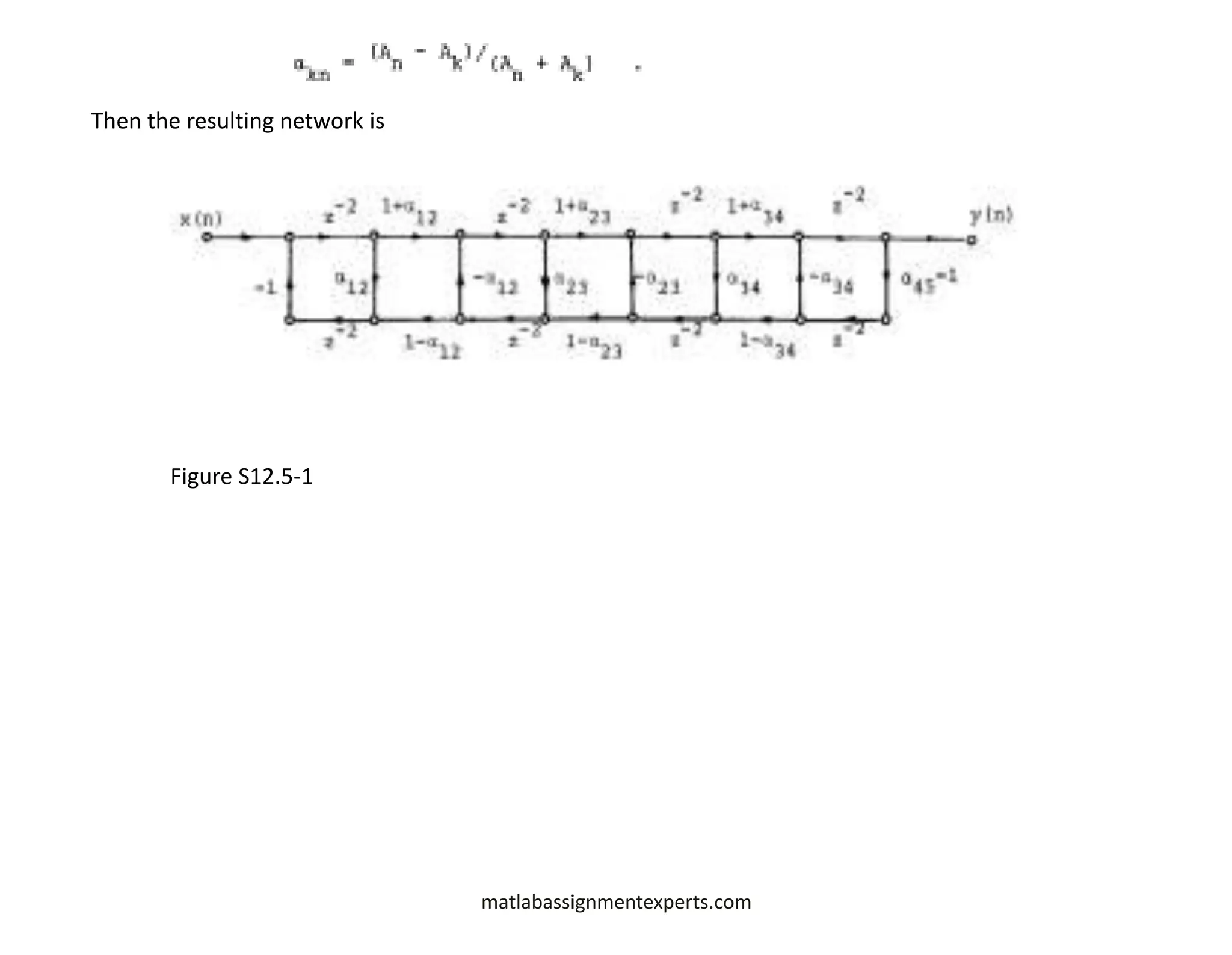
Solution 12.5 Since each section is 3.4 cm. long and the velocity of sound is 3.4 x 10 cm/sec. it takes 10 4 secs. to
traverse one section. With a sampling rate of 20 khz the sampling interval is .5 x 10~ seconds and consequently
the length of each section is two sampling intervals, i.e. each can be represented by two delays in cascade. The
entire system is linear and so the forward and backward travelling waves add at the boundaries. Let
matlabassignmentexperts.com
Then the resulting network is
Figure S12.5-1

Digital Signal Processing Homework Help

  • 1.
    For any helpregarding Matlab Assignment Help visit : https://www.matlabassignmentexperts.com/, Email - info@matlabassignmentexperts.comor call us at - +1 678 648 4277 matlabassignmentexperts.com
  • 2.
    matlabassignmentexperts.com Problem 12.1 Consider thediscrete-time linear causal system defined by the difference equation Draw a signal flow graph to implement this system in each of the following forms: (a)Direct form I. (b) Direct form II. (c) Cascade. (d) Parallel. For the cascade and parallel forms use only first-order sections. Problem 12.2 In Figure P12.2-1 (a)-(c) several networks are shown. Determine the transpose of each and verify that in each case the original and transpose networks have the same transfer function. Figure P12.2-1 Problem 12.3 In Figure P12.3-1 (a)-(f) six digital networks are shown. Determine which one of the last five i.e., (b) through (f) has the same transfer function as (a). You should be able to eliminate some of the possibilities by inspection. Problems
  • 3.
  • 4.
    matlabassignmentexperts.com Problem 12.4 – Thesystem with transfer function H(z) = is an allpass system, 1 - az i.e. the frequency response has unity magnitude. (a) Draw a network realization of this system in direct II form; and indicate in particular the number of delay branches required and the number of branches requiring multiplication by other than +1 or -1. (b) An alternative implementation is suggested by noting that the difference equation of the allpass system can be expressed as y(n) - ay(n - 1) = x(n - 1) - a x(n) or equivalently, y(n)=a [y(n - 1) - x(n)] + x(n - 1) Draw a network realization of this equation requiring two delay branches but only one branch with a multiplication by other than +1 or -1. The primary disadvantage to the network in (b) as compared to that in (a) is that two delay brances are required. In some applications, however, it is necessary to implement a cascade of allpass sections. For N allpass sections it is possible to utilize a realization of each in the form determined in part (b) but using only (N + 1) delay branches. This is accomplished essentially by sharing a delay between sections. (c) Consider the allpass system with transfer functions Draw a network realization of this system by "cascading" two networks of the form obtained in part (b) in such a way that only three delay branches are required. Problem 12.5 Speech production can be modeled as a linear system representing the vocal cavity, excited by puffs of air released through the vocal cords. In synthesizing speech on a digital computer, one approach is to represent the vocal cavity as a connection of cylindrical acoustic tubes with equal length but with different cross-sectional areas, as depicted in Figure 12.5-1. Let us assume that we want to simulate this system in terms of the volume velocity representing air flow. The input is coupled into the vocal tract through a small constriction, the vocal
  • 5.
    matlabassignmentexperts.com cords. We willassume that the input is represented by a change in volume velocity at the left end, but that the boundary condition for traveling waves at the left end is that the net volume velocity must be zero. This is analogous to an electrical transmission line driven by a current source. The output is considered to be the volume velocity at the right end. We assume that each section is lossless. Figure P12.5-1- At each interface between sections a forward-traveling wave is transmitted to the next section with one coefficient and reflected as a backward-traveling wave with a different coefficient. Similarly, a backward- traveling wave arriving at an interface is transmitted with one coefficient and reflected with a different coefficient. Specifically, if we consider a forward-traveling wave f+ in a tube with cross-sectional area A1 arriving at the interface with a tube of cross-sectional area A2, then the forward-traveling wave transmitted is (1 + a)f+ and the reflected wave is af+ where Consider the length of each section to be 3.4 cm with the velocity of sound in air 34,000 cm/s. Draw a digital network that will implement the four-section tube in Figure P12.5, with the output sampled at a 20-kHz rate. In spite of the lengthy introduction, this is a reasonably straightforward problem. If you find it hard to think in terms of acoustic tubes, think in terms of transmission-line sections with different characteristic impedances. Just as with transmission lines, it is difficult to express the impulse response in closed form. Draw the network directly from physical considerations, in terms of forwardand backward-traveling pulses in each section.
  • 6.
    matlabassignmentexperts.com Solutions (a) Direct FormI (text figure 6.10) corresponds to first implementing the right-hand side of the difference equation (i.e. the zeros) followed by the left-hand side (i.e. the poles). Thus the direct form I for this difference equation is: Figure S12.1-1 The flow-graph drawn in this form graphically separates the part implementing the zeros and that implementing the poles. It can alternatively be drawn more efficiently by eliminating some of the branches with unity gain and collapsing some of the nodes. For example an alternative way of depicting the flow-graph of Figure S12.1-1 is: Figure S12.1-2 (b) The direct-form II (text Figure 6.11) corresponds to implementing the poles first, followed by the zeros:
  • 7.
    matlabassignmentexperts.com Figure S12.1-3 or alternatively, FigureS12.1-4 (c) In the cascade form using first-order sections, we must first factor the system function into a cascade of two first-order systems. Applying the z-transform to both sides of the difference equation, In developing the cascade form, we can include the zero with either pole and arrange the cascade in either order. For example writing H(z) as
  • 8.
    matlabassignmentexperts.com and using thedirect-form II for the first subsection leads to the cascade form shown in Figure S12.1-5 Figure S12.1-5 This flow-graph can also be collapsed somewhat as we have done with those in (a) and (b). (d) The parallel form corresponds to expanding H(z) in a partial fraction expansion. Thus, leading to the flow graph shown below: Figure S12.1-6
  • 9.
    matlabassignmentexperts.com Solution 12.2 (a)The transpose of this network is: Figure S12.2-1 or, drawing it with the input on the left and the output on the right, Figure 12.2-2 Since the only effect of the transposition is to interchange the order of the delay and coefficient branches in the feedback path the transfer function is clearly unchanged. (b) Having worked problem 12.1 we can write down the transfer function of this network by inspection: The transposed network is Figure S12.2-3 I It is not obvious by inspection (at least not to me) that this transposed network has the same transfer function as the original. However writing the equations for the above flow graph we obtain: 1 1 w(z) = - Y(z) + X(z) and Y(z) = X(z) + z WWz Combining these two equations, we obtain
  • 10.
    matlabassignmentexperts.com By inspection ofthe network, we can write that Figure S12.2-4 By inspection of this network we see that As before
  • 11.
    matlabassignmentexperts.com Solution 12.3 By inspectionwe observe that for network (a) there is a delay free path with a gain of 2 from input to output, i.e. if x(n) = 6(n) then y(O) = 2. Since this is not true for networks (b) or (c), they are eliminated. Second, by inspection of (a) we note that there are two poles, one at z = 1/2 and one at z = - 3/4, i.e. the denominator of the system function is Since networks (e) and (f) correspond to system functions with denominator polynomial given by these networks are eliminated. The remaining possibility, which is the correct answer, is network (d). Solution 12.4 (a) Figure S12.4-1 Note that one delay and two multipliers are required. (b) y(n) = a (y(n - 1) - x(n)) + x(n - 1)
  • 12.
    matlabassignmentexperts.com Figure S12.4-2 Inthis case two delays but only one multiplier are required. (c) First, let us simply cascade two networks of the form obtained in (b): Figure S12. 4-3 Now, we note that the input and output of the two branches labelle 1 and 2 are identical and thus these can be combined into a single delay. For depicting the final network it is also convenient to "flip" the second network above. Figure S12. 4-4 Solution 12.5 Since each section is 3.4 cm. long and the velocity of sound is 3.4 x 10 cm/sec. it takes 10 4 secs. to traverse one section. With a sampling rate of 20 khz the sampling interval is .5 x 10~ seconds and consequently the length of each section is two sampling intervals, i.e. each can be represented by two delays in cascade. The entire system is linear and so the forward and backward travelling waves add at the boundaries. Let
  • 13.