For any help regarding Digital Signal Processing Assignment Help
visit https://www.matlabassignmentexperts.com/
Email - info@matlabassignmentexperts.com
or call us at - +1 678 648 4277
Matlab Assignment Help
Problems
Problem 16.1
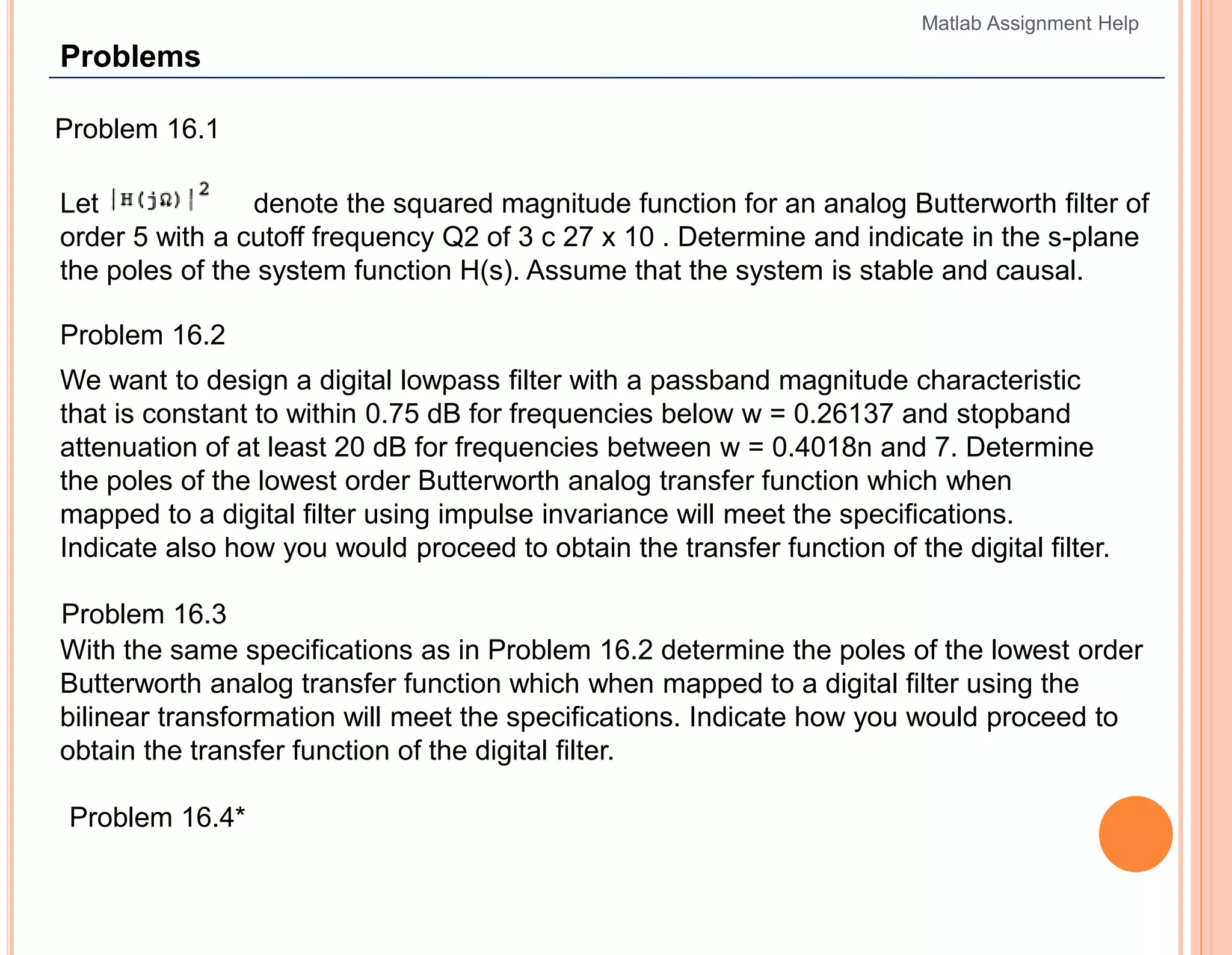
Let denote the squared magnitude function for an analog Butterworth filter of
order 5 with a cutoff frequency Q2 of 3 c 27 x 10 . Determine and indicate in the s-plane
the poles of the system function H(s). Assume that the system is stable and causal.
Problem 16.2
We want to design a digital lowpass filter with a passband magnitude characteristic
that is constant to within 0.75 dB for frequencies below w = 0.26137 and stopband
attenuation of at least 20 dB for frequencies between w = 0.4018n and 7. Determine
the poles of the lowest order Butterworth analog transfer function which when
mapped to a digital filter using impulse invariance will meet the specifications.
Indicate also how you would proceed to obtain the transfer function of the digital filter.
Problem 16.3
With the same specifications as in Problem 16.2 determine the poles of the lowest order
Butterworth analog transfer function which when mapped to a digital filter using the
bilinear transformation will meet the specifications. Indicate how you would proceed to
obtain the transfer function of the digital filter.
Problem 16.4*
Matlab Assignment Help
The filter designed in Problem 16.3 is to be converted to a highpass filter using a lowpass
to highpass transformation as discussed in section 7.2. In the filter designed in Problem
16.3 the pass band edge occurred at w = 0.2613w and the stopband edge at w =
0.4018w. The new highpass filter is to have the passband edge at w = 0.4018w. Specify
how to obtain the transfer function of the highpass filter from the lowpass filter of Problem
16.3, and determine the frequency of the stopband edge.
Solutions
Solution 16.1
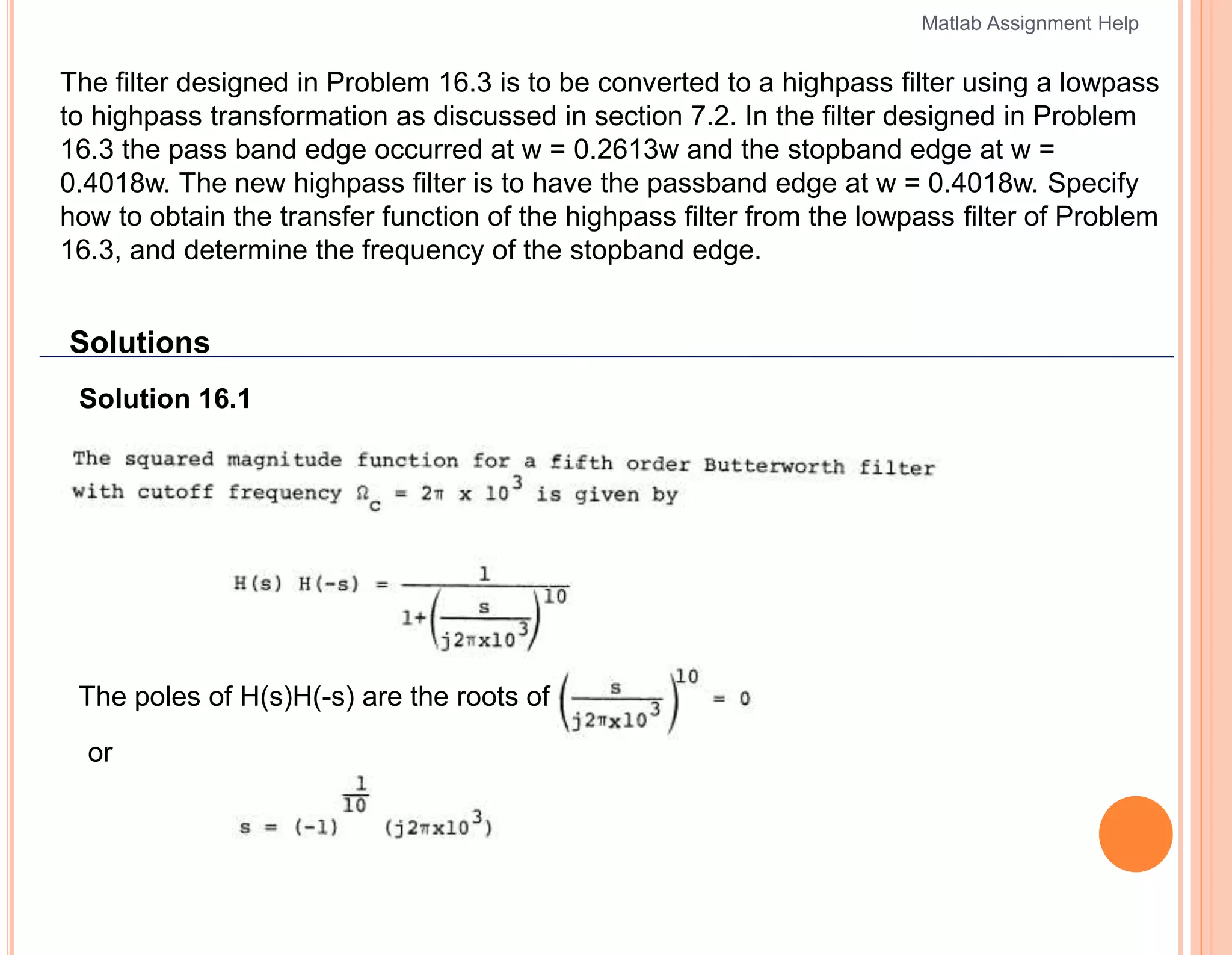
The poles of H(s)H(-s) are the roots of 1 +
or
Matlab Assignment Help
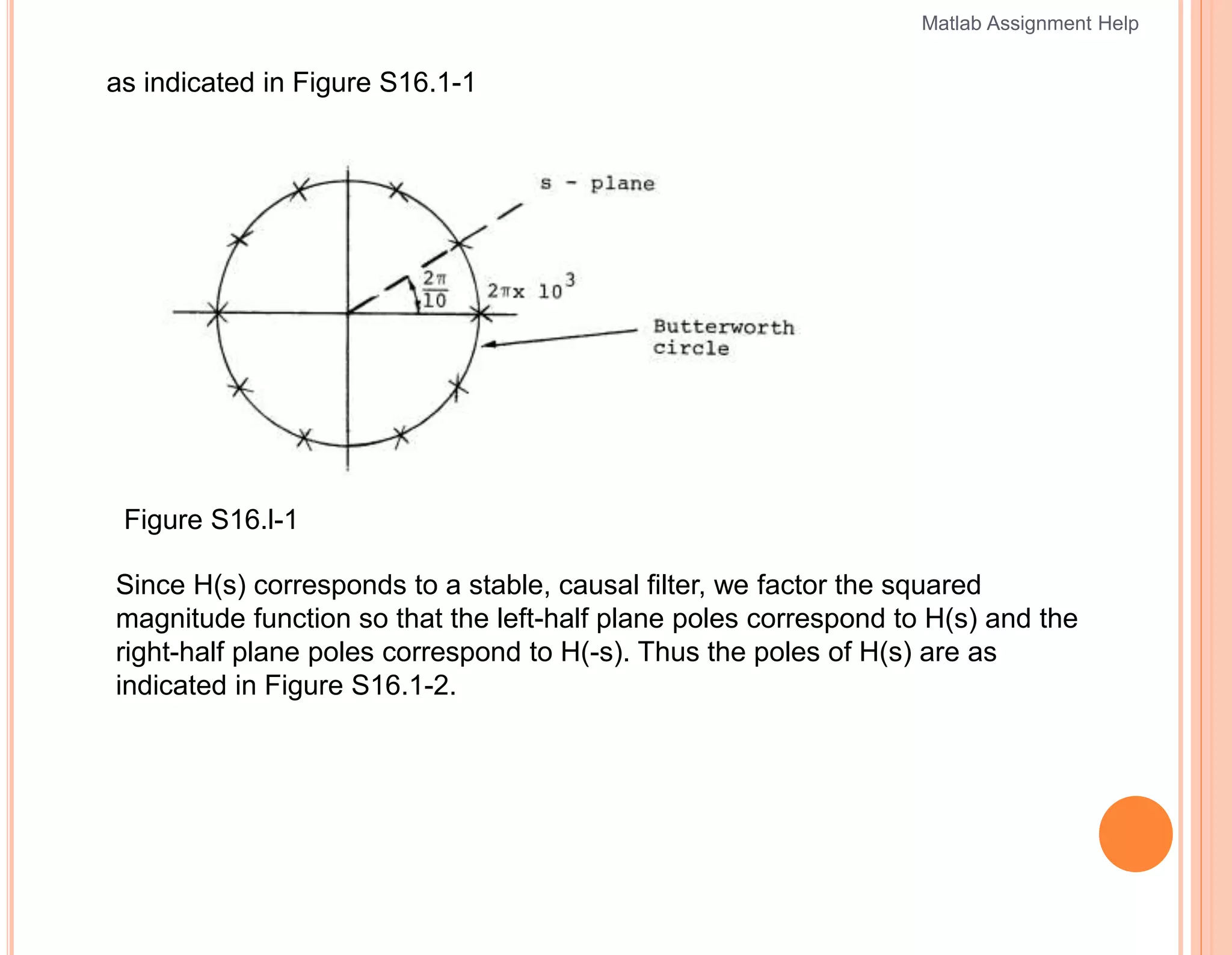
as indicated in Figure S16.1-1
Figure S16.l-1
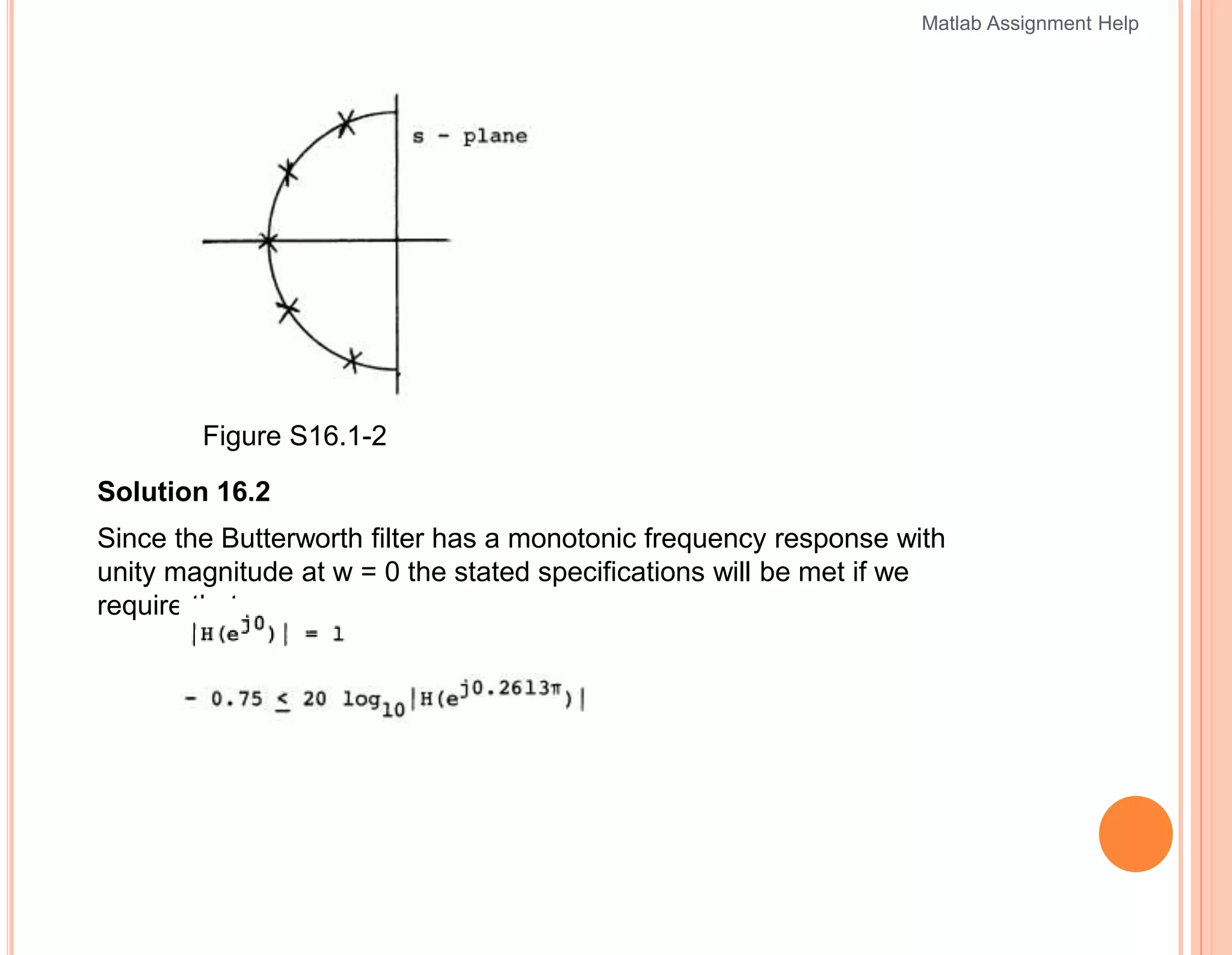
Since H(s) corresponds to a stable, causal filter, we factor the squared
magnitude function so that the left-half plane poles correspond to H(s) and the
right-half plane poles correspond to H(-s). Thus the poles of H(s) are as
indicated in Figure S16.1-2.
Matlab Assignment Help
Figure S16.1-2
Solution 16.2
Since the Butterworth filter has a monotonic frequency response with
unity magnitude at w = 0 the stated specifications will be met if we
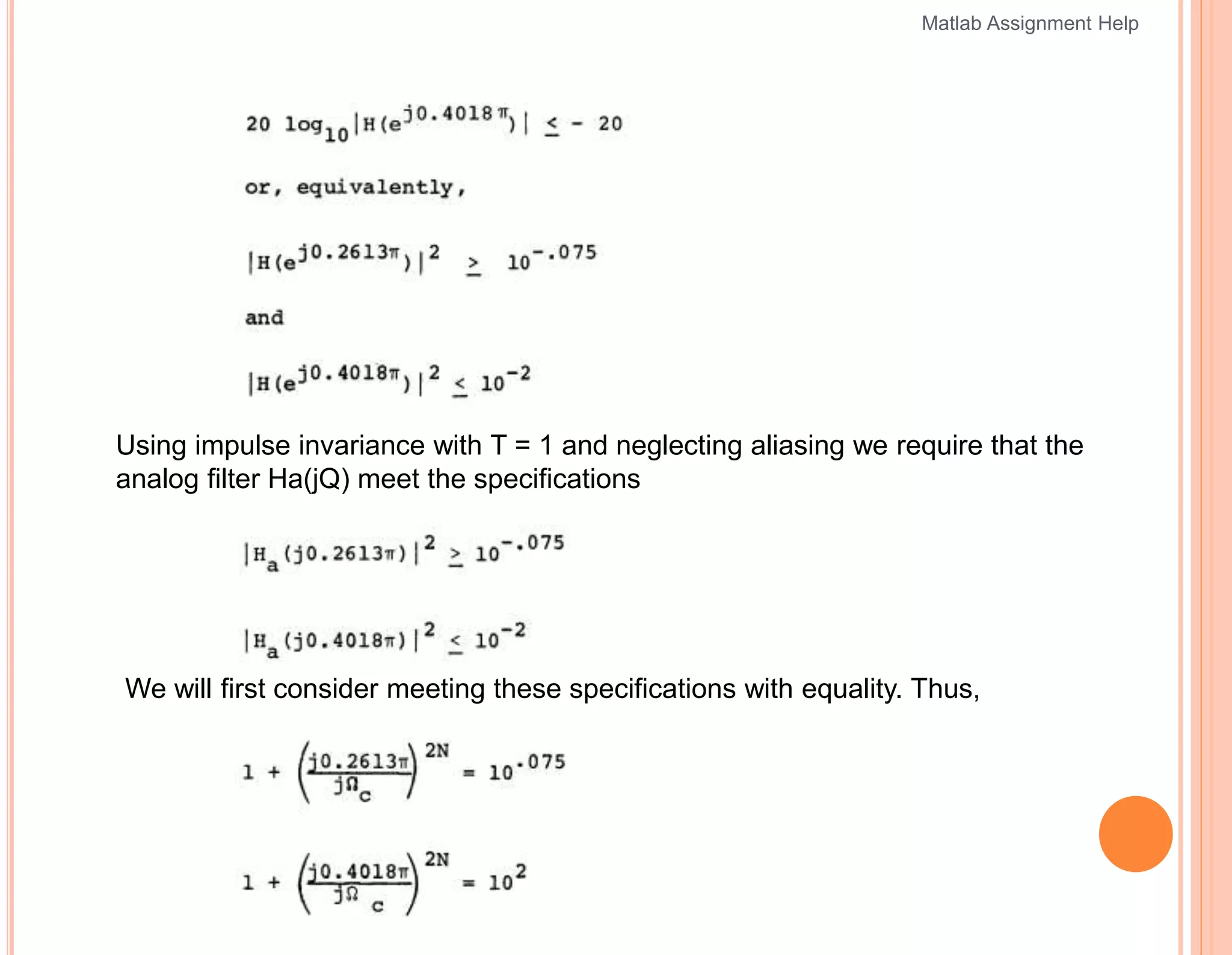
require that
Matlab Assignment Help
Using impulse invariance with T = 1 and neglecting aliasing we require that the
analog filter Ha(jQ) meet the specifications
We will first consider meeting these specifications with equality. Thus,
Matlab Assignment Help
or
or
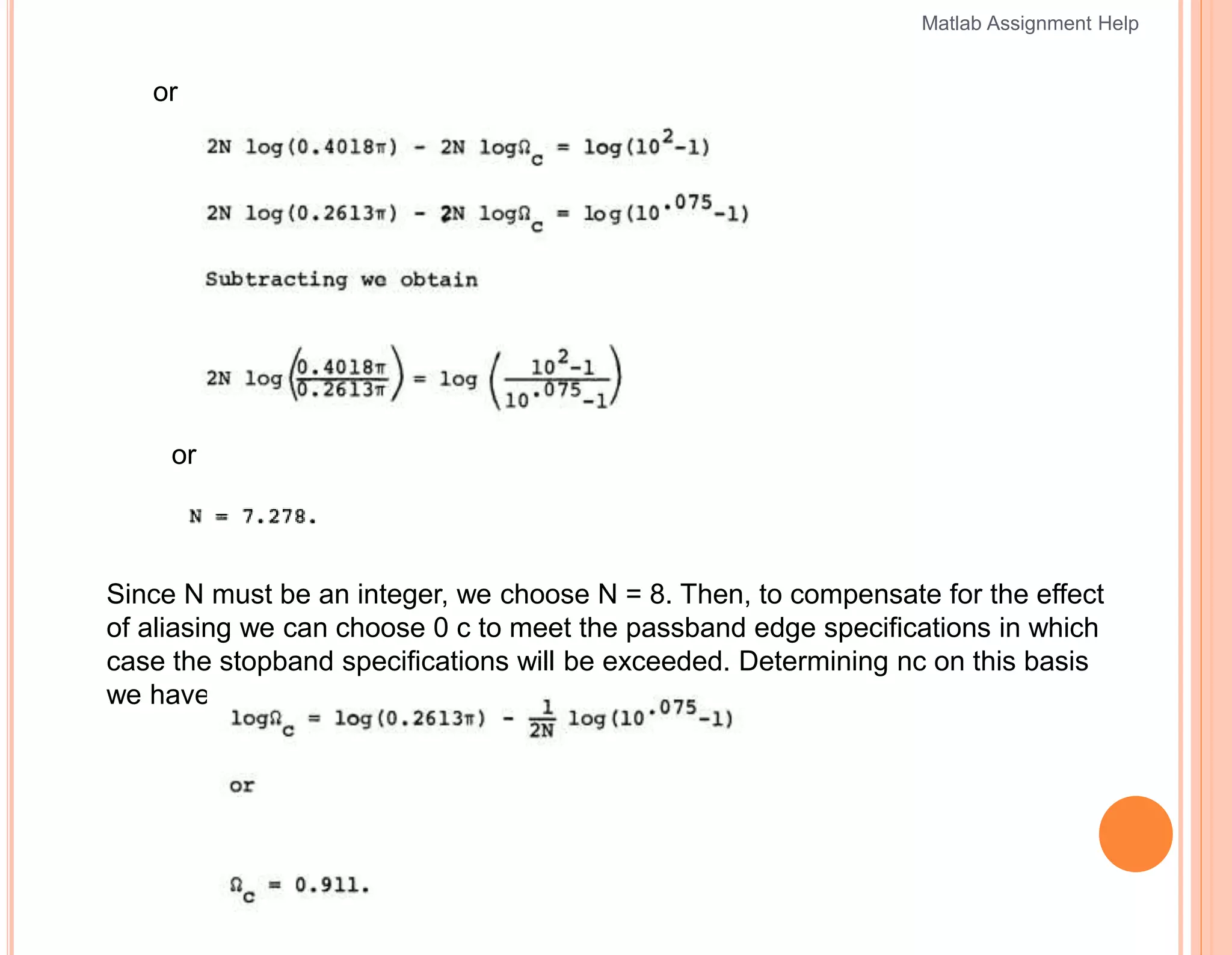
Since N must be an integer, we choose N = 8. Then, to compensate for the effect
of aliasing we can choose 0 c to meet the passband edge specifications in which
case the stopband specifications will be exceeded. Determining nc on this basis
we have
Matlab Assignment Help
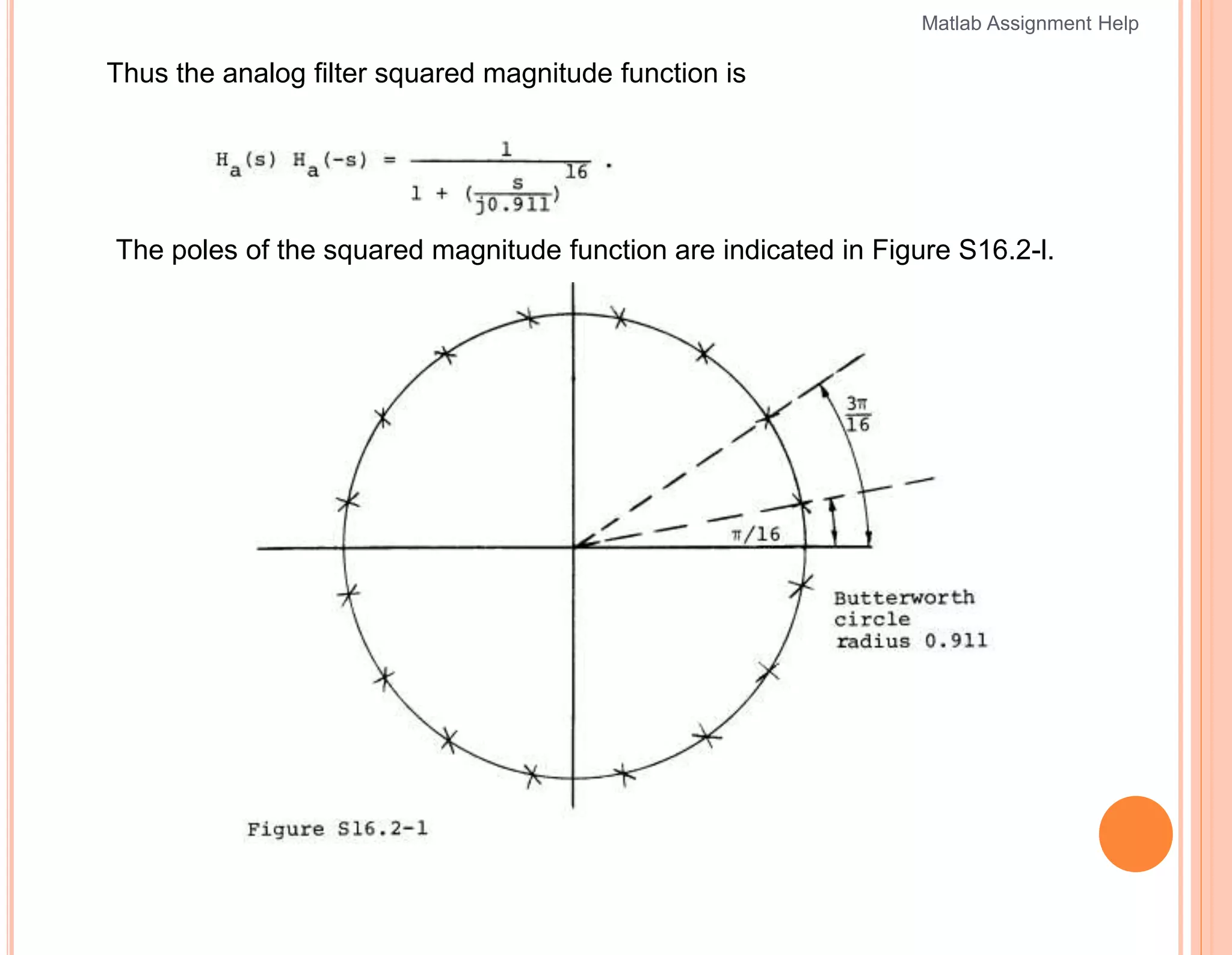
Thus the analog filter squared magnitude function is
The poles of the squared magnitude function are indicated in Figure S16.2-l.
Matlab Assignment Help
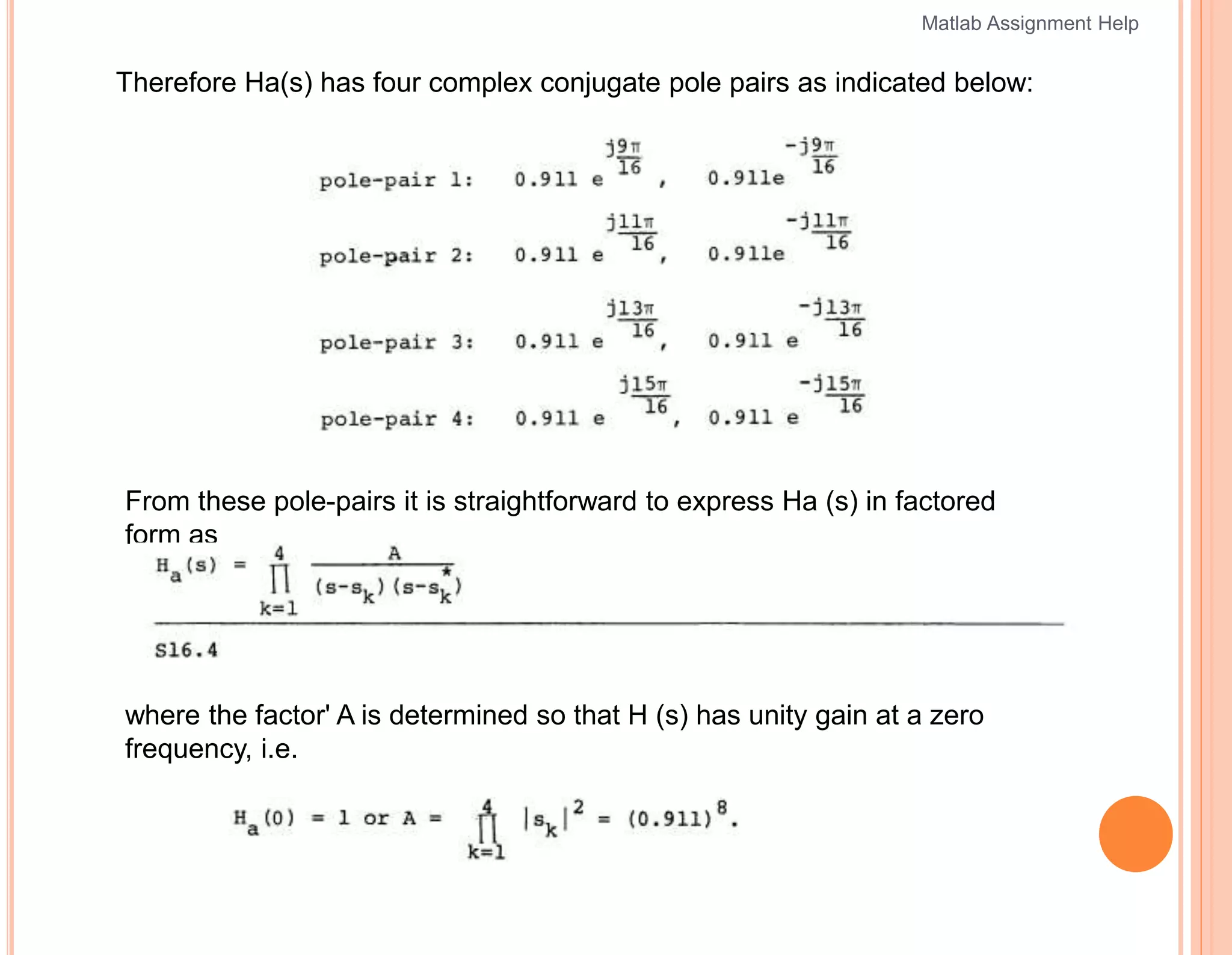
Therefore Ha(s) has four complex conjugate pole pairs as indicated below:
From these pole-pairs it is straightforward to express Ha (s) in factored
form as
where the factor' A is determined so that H (s) has unity gain at a zero
frequency, i.e.
Matlab Assignment Help
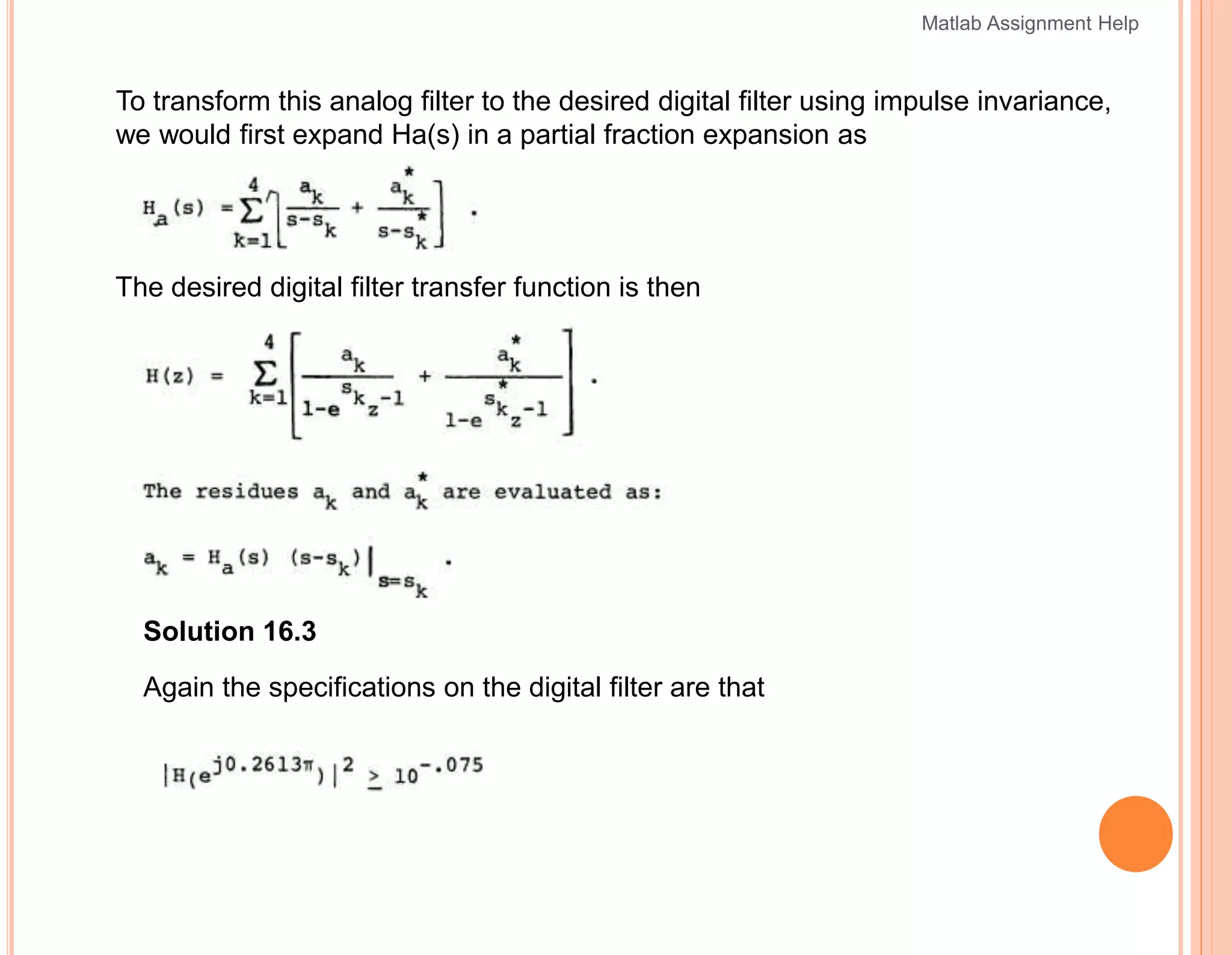
To transform this analog filter to the desired digital filter using impulse invariance,
we would first expand Ha(s) in a partial fraction expansion as
The desired digital filter transfer function is then
Solution 16.3
Again the specifications on the digital filter are that
Matlab Assignment Help
and
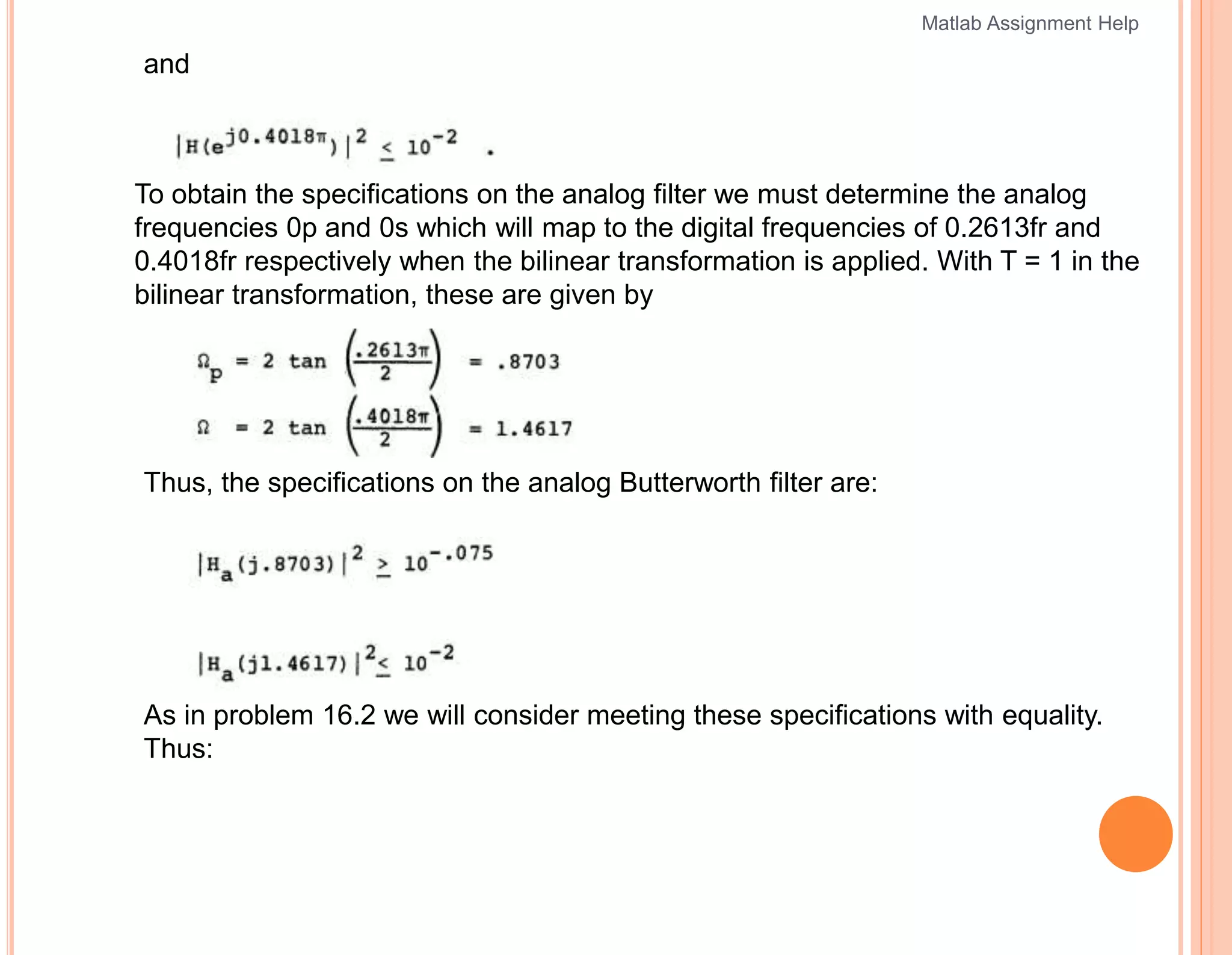
To obtain the specifications on the analog filter we must determine the analog
frequencies 0p and 0s which will map to the digital frequencies of 0.2613fr and
0.4018fr respectively when the bilinear transformation is applied. With T = 1 in the
bilinear transformation, these are given by
Thus, the specifications on the analog Butterworth filter are:
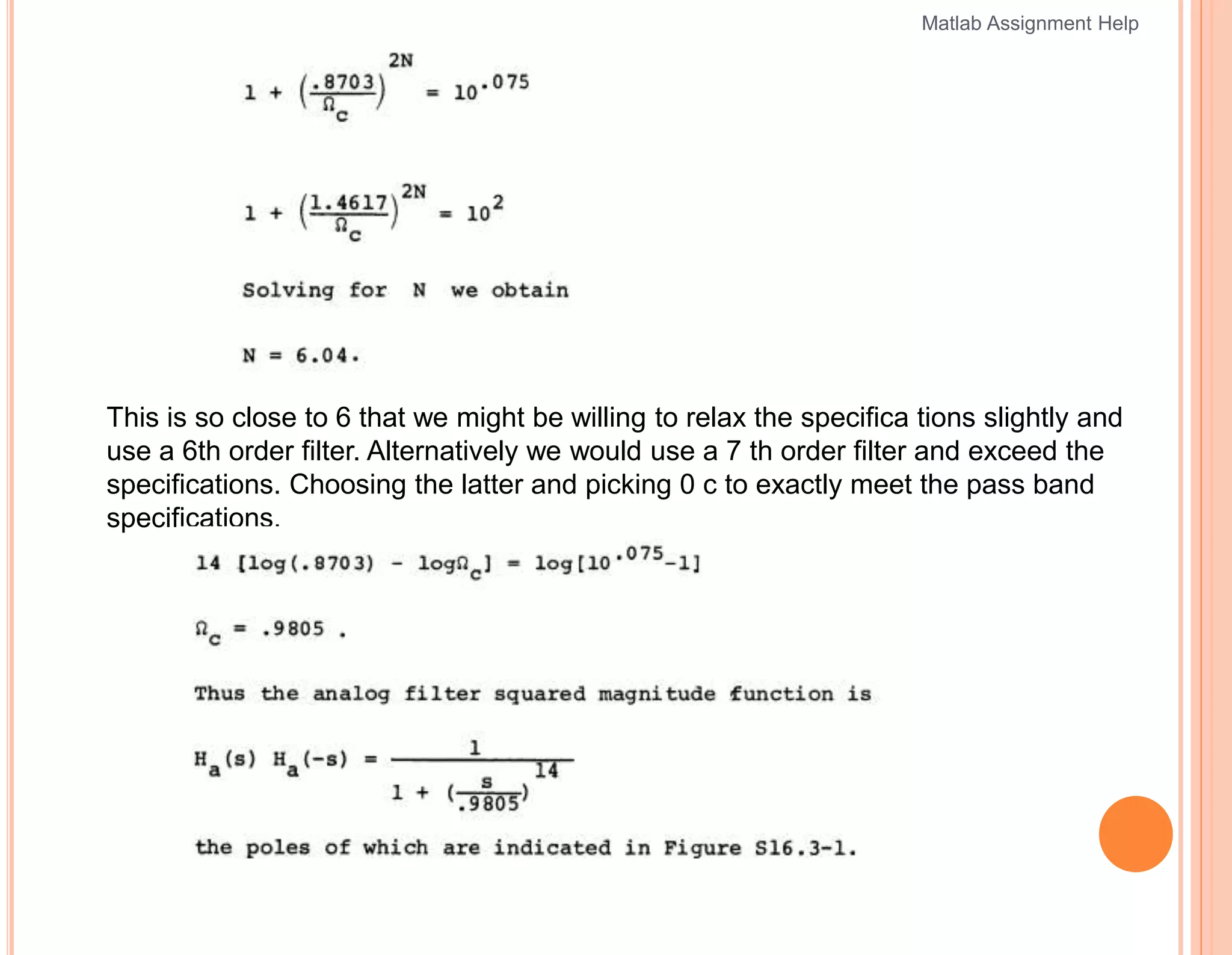
As in problem 16.2 we will consider meeting these specifications with equality.
Thus:
Matlab Assignment Help
This is so close to 6 that we might be willing to relax the specifica tions slightly and
use a 6th order filter. Alternatively we would use a 7 th order filter and exceed the
specifications. Choosing the latter and picking 0 c to exactly meet the pass band
specifications,
Matlab Assignment Help
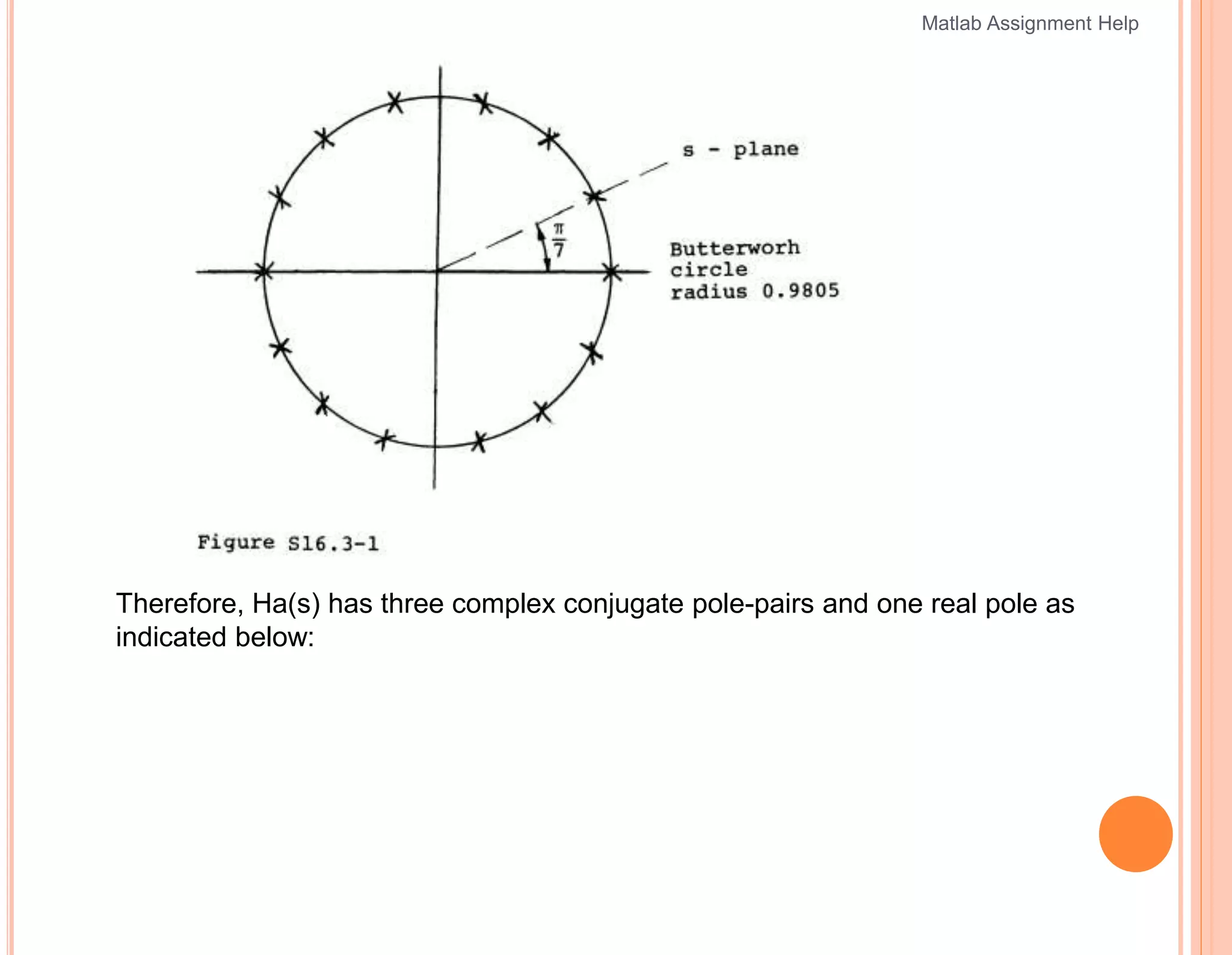
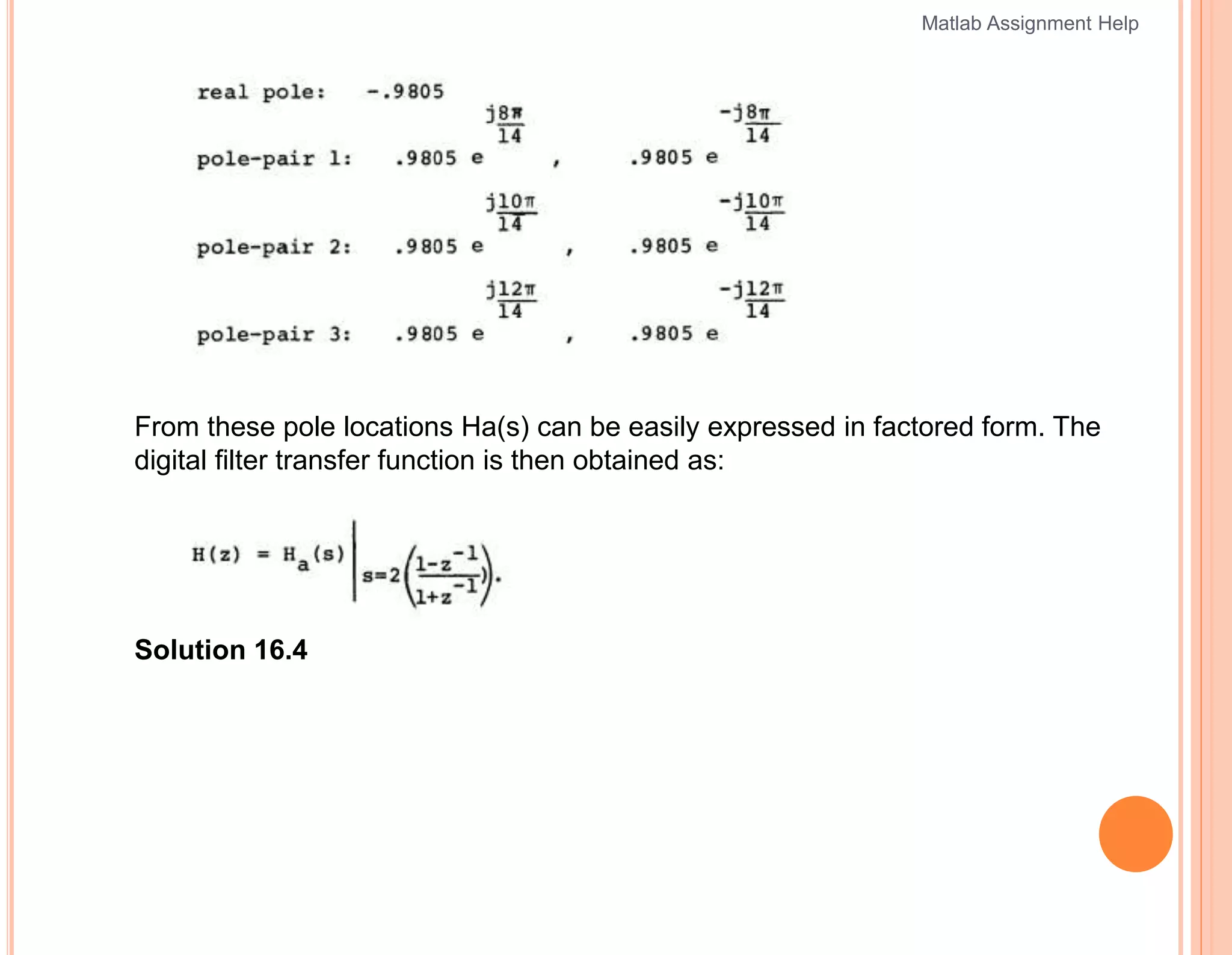
Therefore, Ha(s) has three complex conjugate pole-pairs and one real pole as
indicated below:
Matlab Assignment Help
From these pole locations Ha(s) can be easily expressed in factored form. The
digital filter transfer function is then obtained as:
Solution 16.4
Matlab Assignment Help
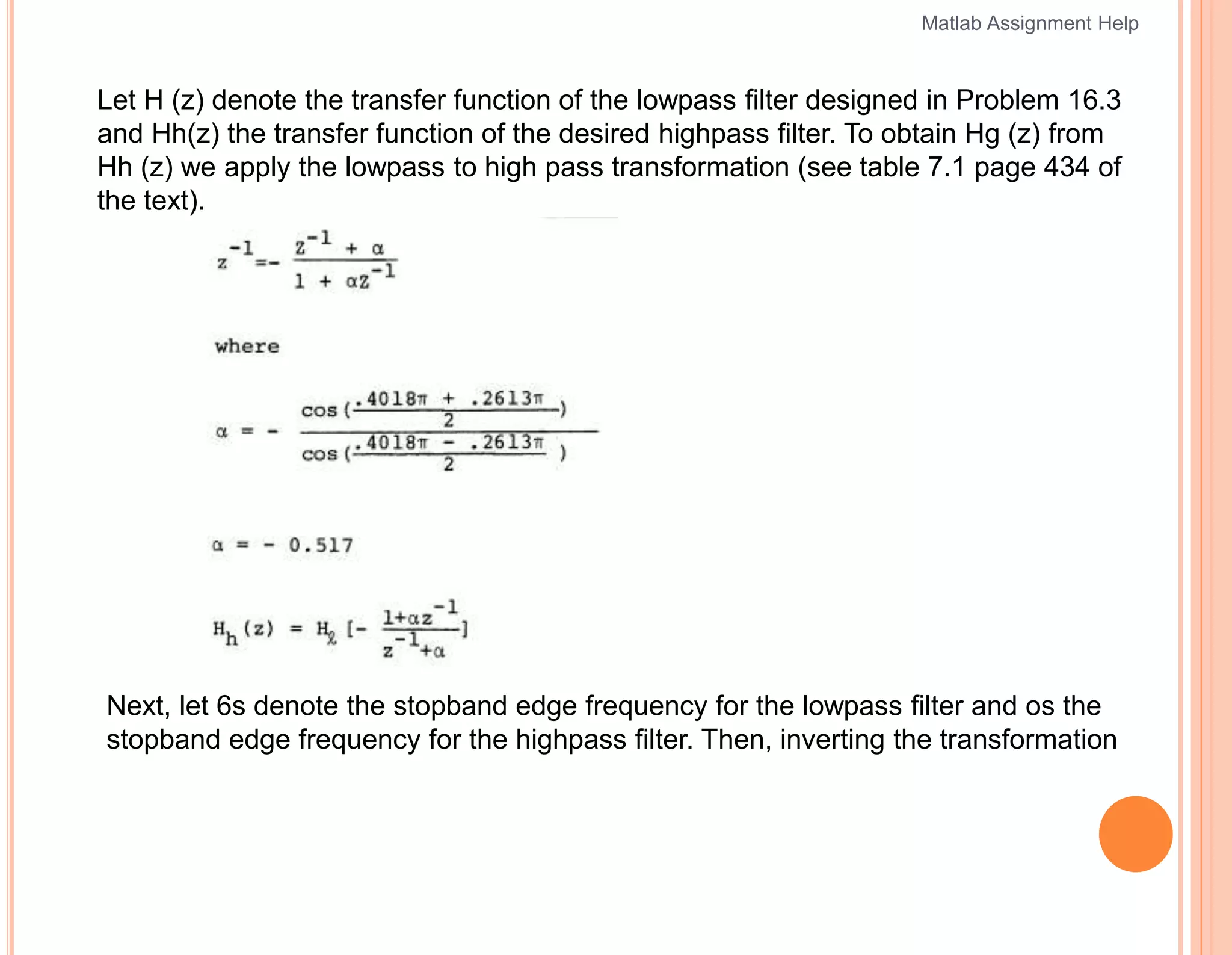
Let H (z) denote the transfer function of the lowpass filter designed in Problem 16.3
and Hh(z) the transfer function of the desired highpass filter. To obtain Hg (z) from
Hh (z) we apply the lowpass to high pass transformation (see table 7.1 page 434 of
the text).
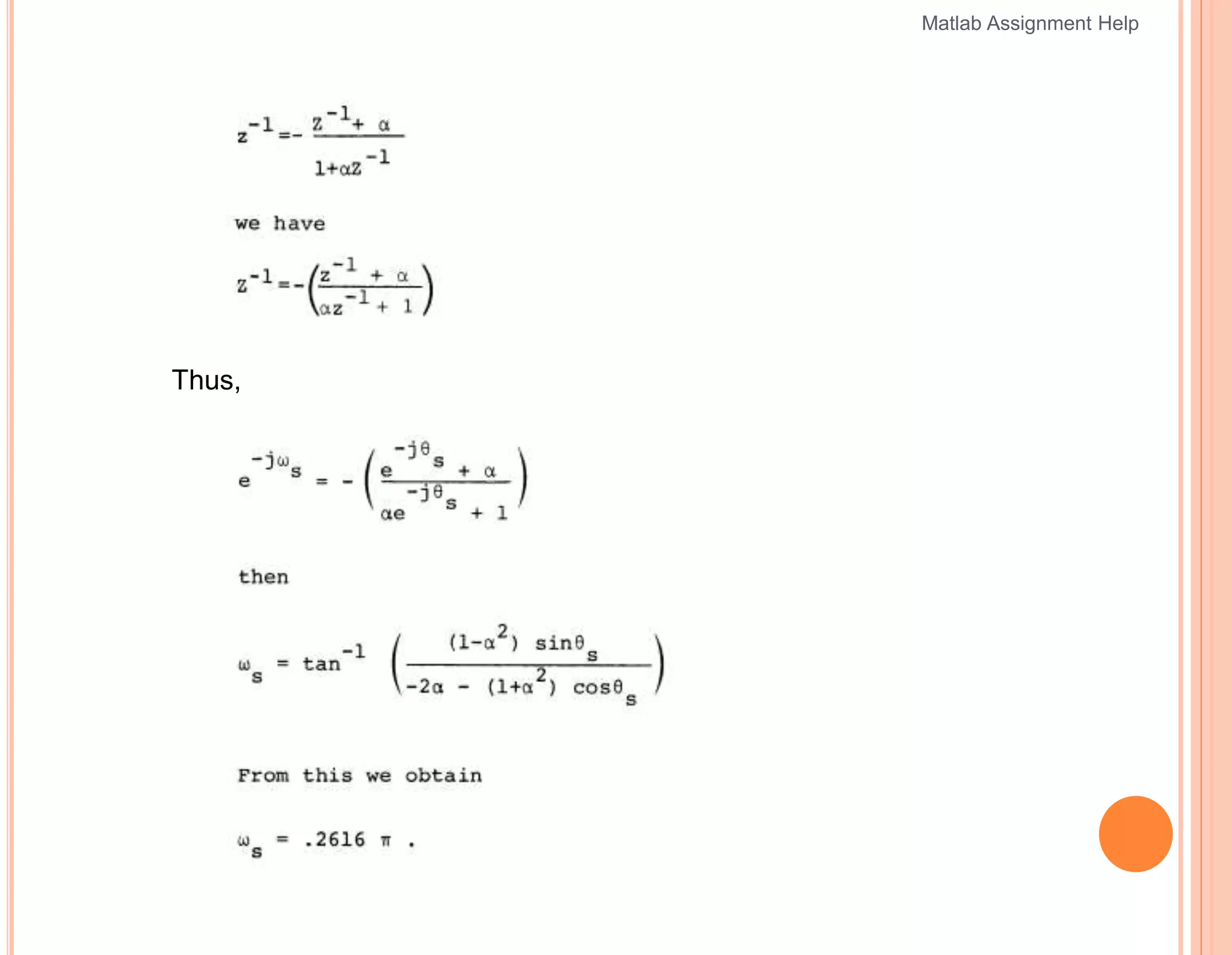
Next, let 6s denote the stopband edge frequency for the lowpass filter and os the
stopband edge frequency for the highpass filter. Then, inverting the transformation
Matlab Assignment Help
Thus,
Matlab Assignment Help

Signal Processing Assignment Help

  • 1.
    For any helpregarding Digital Signal Processing Assignment Help visit https://www.matlabassignmentexperts.com/ Email - info@matlabassignmentexperts.com or call us at - +1 678 648 4277 Matlab Assignment Help
  • 2.
    Problems Problem 16.1 Let denotethe squared magnitude function for an analog Butterworth filter of order 5 with a cutoff frequency Q2 of 3 c 27 x 10 . Determine and indicate in the s-plane the poles of the system function H(s). Assume that the system is stable and causal. Problem 16.2 We want to design a digital lowpass filter with a passband magnitude characteristic that is constant to within 0.75 dB for frequencies below w = 0.26137 and stopband attenuation of at least 20 dB for frequencies between w = 0.4018n and 7. Determine the poles of the lowest order Butterworth analog transfer function which when mapped to a digital filter using impulse invariance will meet the specifications. Indicate also how you would proceed to obtain the transfer function of the digital filter. Problem 16.3 With the same specifications as in Problem 16.2 determine the poles of the lowest order Butterworth analog transfer function which when mapped to a digital filter using the bilinear transformation will meet the specifications. Indicate how you would proceed to obtain the transfer function of the digital filter. Problem 16.4* Matlab Assignment Help
  • 3.
    The filter designedin Problem 16.3 is to be converted to a highpass filter using a lowpass to highpass transformation as discussed in section 7.2. In the filter designed in Problem 16.3 the pass band edge occurred at w = 0.2613w and the stopband edge at w = 0.4018w. The new highpass filter is to have the passband edge at w = 0.4018w. Specify how to obtain the transfer function of the highpass filter from the lowpass filter of Problem 16.3, and determine the frequency of the stopband edge. Solutions Solution 16.1 The poles of H(s)H(-s) are the roots of 1 + or Matlab Assignment Help
  • 4.
    as indicated inFigure S16.1-1 Figure S16.l-1 Since H(s) corresponds to a stable, causal filter, we factor the squared magnitude function so that the left-half plane poles correspond to H(s) and the right-half plane poles correspond to H(-s). Thus the poles of H(s) are as indicated in Figure S16.1-2. Matlab Assignment Help
  • 5.
    Figure S16.1-2 Solution 16.2 Sincethe Butterworth filter has a monotonic frequency response with unity magnitude at w = 0 the stated specifications will be met if we require that Matlab Assignment Help
  • 6.
    Using impulse invariancewith T = 1 and neglecting aliasing we require that the analog filter Ha(jQ) meet the specifications We will first consider meeting these specifications with equality. Thus, Matlab Assignment Help
  • 7.
    or or Since N mustbe an integer, we choose N = 8. Then, to compensate for the effect of aliasing we can choose 0 c to meet the passband edge specifications in which case the stopband specifications will be exceeded. Determining nc on this basis we have Matlab Assignment Help
  • 8.
    Thus the analogfilter squared magnitude function is The poles of the squared magnitude function are indicated in Figure S16.2-l. Matlab Assignment Help
  • 9.
    Therefore Ha(s) hasfour complex conjugate pole pairs as indicated below: From these pole-pairs it is straightforward to express Ha (s) in factored form as where the factor' A is determined so that H (s) has unity gain at a zero frequency, i.e. Matlab Assignment Help
  • 10.
    To transform thisanalog filter to the desired digital filter using impulse invariance, we would first expand Ha(s) in a partial fraction expansion as The desired digital filter transfer function is then Solution 16.3 Again the specifications on the digital filter are that Matlab Assignment Help
  • 11.
    and To obtain thespecifications on the analog filter we must determine the analog frequencies 0p and 0s which will map to the digital frequencies of 0.2613fr and 0.4018fr respectively when the bilinear transformation is applied. With T = 1 in the bilinear transformation, these are given by Thus, the specifications on the analog Butterworth filter are: As in problem 16.2 we will consider meeting these specifications with equality. Thus: Matlab Assignment Help
  • 12.
    This is soclose to 6 that we might be willing to relax the specifica tions slightly and use a 6th order filter. Alternatively we would use a 7 th order filter and exceed the specifications. Choosing the latter and picking 0 c to exactly meet the pass band specifications, Matlab Assignment Help
  • 13.
    Therefore, Ha(s) hasthree complex conjugate pole-pairs and one real pole as indicated below: Matlab Assignment Help
  • 14.
    From these polelocations Ha(s) can be easily expressed in factored form. The digital filter transfer function is then obtained as: Solution 16.4 Matlab Assignment Help
  • 15.
    Let H (z)denote the transfer function of the lowpass filter designed in Problem 16.3 and Hh(z) the transfer function of the desired highpass filter. To obtain Hg (z) from Hh (z) we apply the lowpass to high pass transformation (see table 7.1 page 434 of the text). Next, let 6s denote the stopband edge frequency for the lowpass filter and os the stopband edge frequency for the highpass filter. Then, inverting the transformation Matlab Assignment Help
  • 16.