Grunt Productions 2009
Digital Selective Calling (DSC)
A Brief By Lance Grindley
Grunt Productions 2009
Digital Selective Calling (DSC)
Digital Selective Calling (DSC) is an integral
part of the GMDSS and is used for transmitting
distress alerts from ships and for transmitting the
associated acknowledgements from coast
stations. It is also used by ships and coast
stations for relaying distress alerts and for other
urgency and safety calls.
Grunt Productions 2007
Ch. 70
Ch. 70
PRESS for 5 Secs.
Press SEND to
acknowledge
Mayday….. This
is….. Over!
Understood!....
Assistance will
be….
Grunt Productions 2007
Basic description of DSC Technical Characteristics
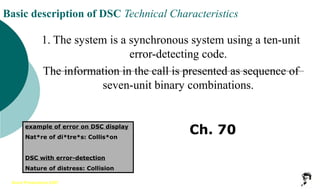
1. The system is a synchronous system using a ten-unit
error-detecting code.
The information in the call is presented as sequence of
seven-unit binary combinations.
Ch. 70example of error on DSC display
Nat*re of di*tre*s: Collis*on
DSC with error-detection
Nature of distress: Collision
Grunt Productions 2009
2. The classes of emission, frequency shifts and
modulation rates are as follows:
(a) F1B or J2B 170Hz and 100 band for use on HF and MF channels.
When frequency-shift keying is effected by applying audio signals to
the input of single-side band transmitters (J2B), the center of the audio
frequency spectrum offered to the transmitter is 1700 Hz.
(b) Frequency modulation with a pre-emphasis of 6 dB/octave with
frequency shift of the modulating sub carrier for use on VHF channels:
(c) the frequency shift is between 1300Hz and 2100 Hz, the sub carrier
being at 1700 Hz;
(d) the frequency tolerance of the 1300 Hz and 2100 Hz tones is ± 10Hz;
(e) the modulation rate is 1,200 baud;
(f) the modulation index is 2.0 ±10%.
Grunt Productions 2009
Operational procedures
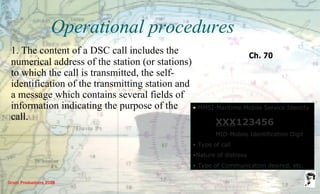
1. The content of a DSC call includes the
numerical address of the station (or stations)
to which the call is transmitted, the self-
identification of the transmitting station and
a message which contains several fields of
information indicating the purpose of the
call.
Ch. 70
• MMSI-Maritime Mobile Service Identity
XXX123456
MID-Mobile Identification Digit
• Type of call
•Nature of distress
• Type of Communication desired, etc.
Grunt Productions 2009
2. Various types of DSC calls are available, being
broadly either distress and safety-related calls
or "commercial" calls (to indicate that a
commercial communication, e.g. a telephony
or telegraphy call, etc., is required). In the
case of VHF, automatic connection to the
public network can also be established
through suitably equipped coast stations.
Grunt Productions 2009
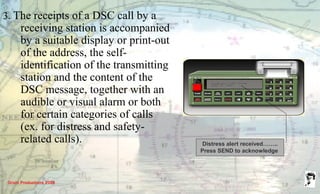
3. The receipts of a DSC call by a
receiving station is accompanied
by a suitable display or print-out
of the address, the self-
identification of the transmitting
station and the content of the
DSC message, together with an
audible or visual alarm or both
for certain categories of calls
(ex. for distress and safety-
related calls). Distress alert received……..
Press SEND to acknowledge
Grunt Productions 2009
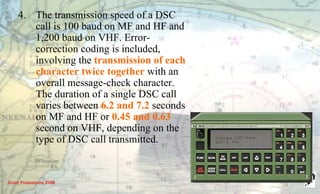
DI ISSTTRREESSS SD
4. The transmission speed of a DSC
call is 100 baud on MF and HF and
1,200 baud on VHF. Error-
correction coding is included,
involving the transmission of each
character twice together with an
overall message-check character.
The duration of a single DSC call
varies between 6.2 and 7.2 seconds
on MF and HF or 0.45 and 0.63
second on VHF, depending on the
type of DSC call transmitted.
Grunt Productions 2009
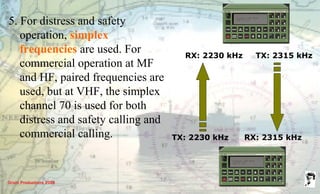
5. For distress and safety
operation, simplex
frequencies are used. For
commercial operation at MF
and HF, paired frequencies are
used, but at VHF, the simplex
channel 70 is used for both
distress and safety calling and
commercial calling.
TX: 2315 kHz
RX: 2315 kHz
RX: 2230 kHz
TX: 2230 kHz
Grunt Productions 2009
In order to increase the probability of a DSC distress call or a DSC
distress relay being received it is repeated several times to form a
distress call attempt.
Methods:
MF/HF – 5 consecutive DSC distress calls on one frequency
(single-frequency call attempt)
MF/HF – up to 6 consecutive DSC distress calls dispersed
over any of the 6 frequencies
(multi-frequency call attempt)
VHF – only a single-frequency call attempt
VHF and MF/HF distress calls may be transmitted simultaneously.

Digital selective calling lrg

  • 1.
    Grunt Productions 2009 DigitalSelective Calling (DSC) A Brief By Lance Grindley
  • 2.
    Grunt Productions 2009 DigitalSelective Calling (DSC) Digital Selective Calling (DSC) is an integral part of the GMDSS and is used for transmitting distress alerts from ships and for transmitting the associated acknowledgements from coast stations. It is also used by ships and coast stations for relaying distress alerts and for other urgency and safety calls.
  • 3.
    Grunt Productions 2007 Ch.70 Ch. 70 PRESS for 5 Secs. Press SEND to acknowledge Mayday….. This is….. Over! Understood!.... Assistance will be….
  • 4.
    Grunt Productions 2007 Basicdescription of DSC Technical Characteristics 1. The system is a synchronous system using a ten-unit error-detecting code. The information in the call is presented as sequence of seven-unit binary combinations. Ch. 70example of error on DSC display Nat*re of di*tre*s: Collis*on DSC with error-detection Nature of distress: Collision
  • 5.
    Grunt Productions 2009 2.The classes of emission, frequency shifts and modulation rates are as follows: (a) F1B or J2B 170Hz and 100 band for use on HF and MF channels. When frequency-shift keying is effected by applying audio signals to the input of single-side band transmitters (J2B), the center of the audio frequency spectrum offered to the transmitter is 1700 Hz. (b) Frequency modulation with a pre-emphasis of 6 dB/octave with frequency shift of the modulating sub carrier for use on VHF channels: (c) the frequency shift is between 1300Hz and 2100 Hz, the sub carrier being at 1700 Hz; (d) the frequency tolerance of the 1300 Hz and 2100 Hz tones is ± 10Hz; (e) the modulation rate is 1,200 baud; (f) the modulation index is 2.0 ±10%.
  • 6.
    Grunt Productions 2009 Operationalprocedures 1. The content of a DSC call includes the numerical address of the station (or stations) to which the call is transmitted, the self- identification of the transmitting station and a message which contains several fields of information indicating the purpose of the call. Ch. 70 • MMSI-Maritime Mobile Service Identity XXX123456 MID-Mobile Identification Digit • Type of call •Nature of distress • Type of Communication desired, etc.
  • 7.
    Grunt Productions 2009 2.Various types of DSC calls are available, being broadly either distress and safety-related calls or "commercial" calls (to indicate that a commercial communication, e.g. a telephony or telegraphy call, etc., is required). In the case of VHF, automatic connection to the public network can also be established through suitably equipped coast stations.
  • 8.
    Grunt Productions 2009 3.The receipts of a DSC call by a receiving station is accompanied by a suitable display or print-out of the address, the self- identification of the transmitting station and the content of the DSC message, together with an audible or visual alarm or both for certain categories of calls (ex. for distress and safety- related calls). Distress alert received…….. Press SEND to acknowledge
  • 9.
    Grunt Productions 2009 DIISSTTRREESSS SD 4. The transmission speed of a DSC call is 100 baud on MF and HF and 1,200 baud on VHF. Error- correction coding is included, involving the transmission of each character twice together with an overall message-check character. The duration of a single DSC call varies between 6.2 and 7.2 seconds on MF and HF or 0.45 and 0.63 second on VHF, depending on the type of DSC call transmitted.
  • 10.
    Grunt Productions 2009 5.For distress and safety operation, simplex frequencies are used. For commercial operation at MF and HF, paired frequencies are used, but at VHF, the simplex channel 70 is used for both distress and safety calling and commercial calling. TX: 2315 kHz RX: 2315 kHz RX: 2230 kHz TX: 2230 kHz
  • 11.
    Grunt Productions 2009 Inorder to increase the probability of a DSC distress call or a DSC distress relay being received it is repeated several times to form a distress call attempt. Methods: MF/HF – 5 consecutive DSC distress calls on one frequency (single-frequency call attempt) MF/HF – up to 6 consecutive DSC distress calls dispersed over any of the 6 frequencies (multi-frequency call attempt) VHF – only a single-frequency call attempt VHF and MF/HF distress calls may be transmitted simultaneously.