©2015 ACR Electronics, Inc., Confidential
Options
• VHF radio
• Mobile phone
• SEND devices
• Iridium satellite phone
• 406 MHz beacons
VHF Radioremains the primary means of communication for vessels
throughout the United States.
Benefits to having a VHF Radio on board are:
• Distress calling and safety CH 16
• Ship to shore communications
• Navigation (vessels to bridges, etc.)
• Marine operator to place calls to shore
• NOAA Weather Broadcasts
• Mobile Phones
• Apps
• Saved contacts
• Iridium Satellite phonesRange: Worldwide
• Cost: $1500-$2500 plus $1.49 per minute plus $20
per month
• SEND – Satellite Emergency Notification Devices
• Uses commercial satellite systems rather than
the COSPAS-SARSAT satellite system.
406 MHz
Beacons
406 MHz
Beacons
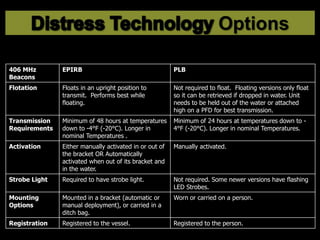
EPIRB PLB
Flotation Floats in an upright position to
transmit. Performs best while
floating.
Not required to float. Floating versions only float
so it can be retrieved if dropped in water. Unit
needs to be held out of the water or attached
high on a PFD for best transmission.
Transmission
Requirements
Minimum of 48 hours at temperatures
down to -4°F (-20°C). Longer in
nominal Temperatures .
Minimum of 24 hours at temperatures down to -
4°F (-20°C). Longer in nominal Temperatures.
Activation Either manually activated in or out of
the bracket OR Automatically
activated when out of its bracket and
in the water.
Manually activated.
Strobe Light Required to have strobe light. Not required. Some newer versions have flashing
LED Strobes.
Mounting
Options
Mounted in a bracket (automatic or
manual deployment), or carried in a
ditch bag.
Worn or carried on a person.
Registration Registered to the vessel. Registered to the person.
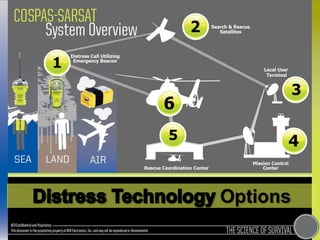
How The System Works
1.406 MHz Distress Call
2.Search and Rescue (SAR) satellites forward distress signal to Earth stations
3.Ground stations forward the distress call to Mission Control Centers (MCC)
4.The MCCs alert the closest Rescue Coordination Center (RCC)
5.The RCCs call emergency contacts and dispatch SAR teams
6.SAR teams arrive at the scene!
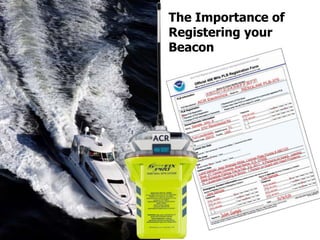
The Importance of
Registering your
Beacon
Visit www.survivorclub.com to read
over 100 real life survivor stories.
9
COME SEE US NEXT TIME
YOU ARE IN SOUTH FLORIDA!
Nichole 954-862-2180

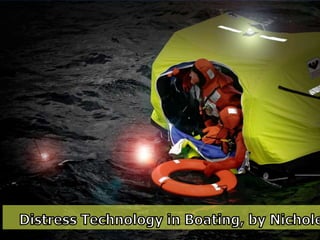
Distress Technology in Boating - Nichole Kalil, ACR Electronics

  • 1.
    ©2015 ACR Electronics,Inc., Confidential
  • 2.
    Options • VHF radio •Mobile phone • SEND devices • Iridium satellite phone • 406 MHz beacons
  • 3.
    VHF Radioremains theprimary means of communication for vessels throughout the United States. Benefits to having a VHF Radio on board are: • Distress calling and safety CH 16 • Ship to shore communications • Navigation (vessels to bridges, etc.) • Marine operator to place calls to shore • NOAA Weather Broadcasts
  • 4.
    • Mobile Phones •Apps • Saved contacts • Iridium Satellite phonesRange: Worldwide • Cost: $1500-$2500 plus $1.49 per minute plus $20 per month • SEND – Satellite Emergency Notification Devices • Uses commercial satellite systems rather than the COSPAS-SARSAT satellite system.
  • 5.
    406 MHz Beacons 406 MHz Beacons EPIRBPLB Flotation Floats in an upright position to transmit. Performs best while floating. Not required to float. Floating versions only float so it can be retrieved if dropped in water. Unit needs to be held out of the water or attached high on a PFD for best transmission. Transmission Requirements Minimum of 48 hours at temperatures down to -4°F (-20°C). Longer in nominal Temperatures . Minimum of 24 hours at temperatures down to - 4°F (-20°C). Longer in nominal Temperatures. Activation Either manually activated in or out of the bracket OR Automatically activated when out of its bracket and in the water. Manually activated. Strobe Light Required to have strobe light. Not required. Some newer versions have flashing LED Strobes. Mounting Options Mounted in a bracket (automatic or manual deployment), or carried in a ditch bag. Worn or carried on a person. Registration Registered to the vessel. Registered to the person.
  • 6.
    How The SystemWorks 1.406 MHz Distress Call 2.Search and Rescue (SAR) satellites forward distress signal to Earth stations 3.Ground stations forward the distress call to Mission Control Centers (MCC) 4.The MCCs alert the closest Rescue Coordination Center (RCC) 5.The RCCs call emergency contacts and dispatch SAR teams 6.SAR teams arrive at the scene!
  • 7.
  • 8.
    Visit www.survivorclub.com toread over 100 real life survivor stories.
  • 9.
    9 COME SEE USNEXT TIME YOU ARE IN SOUTH FLORIDA! Nichole 954-862-2180