MARKETING
STRATEGIES
Unit 2
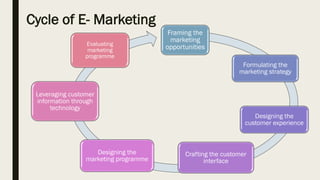
Cycle of E- Marketing
Framing the
marketing
opportunities
Formulating the
marketing strategy
Designing the
customer experience
Crafting the customer
interface
Designing the
marketing programme
Leveraging customer
information through
technology
Evaluating
marketing
programme
Product Strategy
■ Product : Tangible and Intangible (Services)
■ Product Mix: Set of products offered by an organisation
1. Width : How many different product lines?
2. Length: Total number of items in product line
3. Depth: How many variants are offered?
4. Consistency: How closely relate the product line with the needs and
expectations of end users, effectiveness of distribution channels, etc.
Mass Customisation:
■ It deals with making changes to a product or service to satisfy a given consumer group. The
changes could be as small as a variety of different flavors or colors or as complex as developing a
completely new product for a particular client-base.
■ Approaches:
1. Collaborative Customisation: Talk to client to know their need, and produce the product to satisfy
their needs.
2. Adaptive Customisation: Offer one standard product with few options for customisation
3. Cosmetic Customisation: Cosmetic customizers advertize a standard product differently to different
groups of clients. This approach works well when clients use the same product but want them to be
presented differently. Such products are not customized but instead they are packaged differently to
suit different kinds of customers.
4. Transparent Customisation: Transparent Customization deals with providing customized products to
individual clients without telling them that the products are exclusively produced for them. This
approach work in cases where the customer does not want to repeat what she/he needs incessantly
or when client needs are predictable or obvious.
Bundling:
■ Offering multiple products or services as a single combined product or service offering.
■ Bundling is based upon the idea that consumers usually save 7 to 15 percent more on the value
of the grouped package than the individual items when purchased separately.
■ Advantages:
1. Attract more customers
2. Increase marketing efficiency
3. Reduces Distribution as well as Marketing cost
■ Disadvantages:
1. Organisation has provide discount on products
2. Sometime negative attitude can be generated among customers regarding the products.
Online Branding:
■ Technique used for online brand management which uses internet as a
medium to position the brand in market
■ Steps involved in online branding:
1. Research for your audience
2. Give voice to brand
3. Balance online media mix
4. Plan for social media integration
5. Build up reputation of brand (Online)
How to go for Online Branding?
■ Brand story- You-Tube, Blogs
■ Identify customer base
■ Brand awareness
■ Build awareness
■ Build dialogues with customers
■ Value propositions
■ Driving sales
Pricing:
■ A pricing strategy takes into account segments, ability to pay, market
conditions, competitor actions, trade margins and input costs, amongst
others. It is targeted at the defined customers and against competitors.
■ Types of Pricing Strategy:
1. Pricing at Premium
2. Pricing for Market Penetration
3. Economy Pricing
4. Price Skimming
5. Psychological Pricing
6. Bundle Pricing
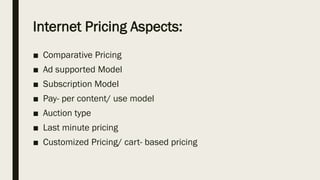
Internet Pricing Aspects:
■ Comparative Pricing
■ Ad supported Model
■ Subscription Model
■ Pay- per content/ use model
■ Auction type
■ Last minute pricing
■ Customized Pricing/ cart- based pricing
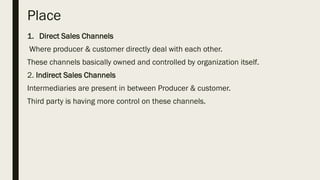
Place
1. Direct Sales Channels
Where producer & customer directly deal with each other.
These channels basically owned and controlled by organization itself.
2. Indirect Sales Channels
Intermediaries are present in between Producer & customer.
Third party is having more control on these channels.
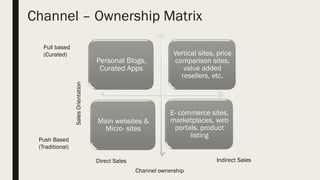
Channel – Ownership Matrix
Personal Blogs,
Curated Apps
Vertical sites, price
comparison sites,
value added
resellers, etc.
Main websites &
Micro- sites
E- commerce sites,
marketplaces, web
portals, product
listing
SalesOrientation
Channel ownership
Pull based
(Curated)
Push Based
(Traditional)
Direct Sales Indirect Sales
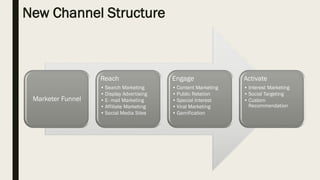
New Channel Structure
Marketer Funnel
Reach
• Search Marketing
• Display Advertising
• E- mail Marketing
• Affiliate Marketing
• Social Media Sites
Engage
• Content Marketing
• Public Relation
• Special Interest
• Viral Marketing
• Gamification
Activate
• Interest Marketing
• Social Targeting
• Custom
Recommendation
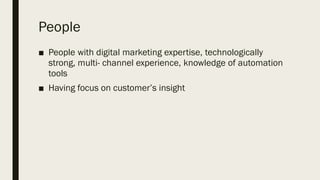
People
■ People with digital marketing expertise, technologically
strong, multi- channel experience, knowledge of automation
tools
■ Having focus on customer’s insight
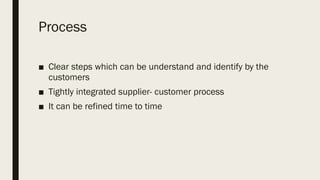
Process
■ Clear steps which can be understand and identify by the
customers
■ Tightly integrated supplier- customer process
■ It can be refined time to time
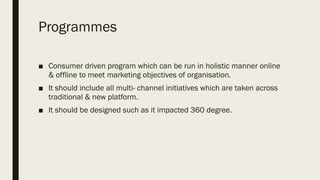
Programmes
■ Consumer driven program which can be run in holistic manner online
& offline to meet marketing objectives of organisation.
■ It should include all multi- channel initiatives which are taken across
traditional & new platform.
■ It should be designed such as it impacted 360 degree.
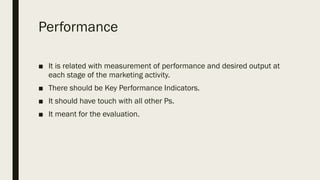
Performance
■ It is related with measurement of performance and desired output at
each stage of the marketing activity.
■ There should be Key Performance Indicators.
■ It should have touch with all other Ps.
■ It meant for the evaluation.

Concepts of e marketing

  • 1.
  • 2.
    Cycle of E-Marketing Framing the marketing opportunities Formulating the marketing strategy Designing the customer experience Crafting the customer interface Designing the marketing programme Leveraging customer information through technology Evaluating marketing programme
  • 3.
    Product Strategy ■ Product: Tangible and Intangible (Services) ■ Product Mix: Set of products offered by an organisation 1. Width : How many different product lines? 2. Length: Total number of items in product line 3. Depth: How many variants are offered? 4. Consistency: How closely relate the product line with the needs and expectations of end users, effectiveness of distribution channels, etc.
  • 4.
    Mass Customisation: ■ Itdeals with making changes to a product or service to satisfy a given consumer group. The changes could be as small as a variety of different flavors or colors or as complex as developing a completely new product for a particular client-base. ■ Approaches: 1. Collaborative Customisation: Talk to client to know their need, and produce the product to satisfy their needs. 2. Adaptive Customisation: Offer one standard product with few options for customisation 3. Cosmetic Customisation: Cosmetic customizers advertize a standard product differently to different groups of clients. This approach works well when clients use the same product but want them to be presented differently. Such products are not customized but instead they are packaged differently to suit different kinds of customers. 4. Transparent Customisation: Transparent Customization deals with providing customized products to individual clients without telling them that the products are exclusively produced for them. This approach work in cases where the customer does not want to repeat what she/he needs incessantly or when client needs are predictable or obvious.
  • 5.
    Bundling: ■ Offering multipleproducts or services as a single combined product or service offering. ■ Bundling is based upon the idea that consumers usually save 7 to 15 percent more on the value of the grouped package than the individual items when purchased separately. ■ Advantages: 1. Attract more customers 2. Increase marketing efficiency 3. Reduces Distribution as well as Marketing cost ■ Disadvantages: 1. Organisation has provide discount on products 2. Sometime negative attitude can be generated among customers regarding the products.
  • 6.
    Online Branding: ■ Techniqueused for online brand management which uses internet as a medium to position the brand in market ■ Steps involved in online branding: 1. Research for your audience 2. Give voice to brand 3. Balance online media mix 4. Plan for social media integration 5. Build up reputation of brand (Online)
  • 7.
    How to gofor Online Branding? ■ Brand story- You-Tube, Blogs ■ Identify customer base ■ Brand awareness ■ Build awareness ■ Build dialogues with customers ■ Value propositions ■ Driving sales
  • 8.
    Pricing: ■ A pricingstrategy takes into account segments, ability to pay, market conditions, competitor actions, trade margins and input costs, amongst others. It is targeted at the defined customers and against competitors. ■ Types of Pricing Strategy: 1. Pricing at Premium 2. Pricing for Market Penetration 3. Economy Pricing 4. Price Skimming 5. Psychological Pricing 6. Bundle Pricing
  • 9.
    Internet Pricing Aspects: ■Comparative Pricing ■ Ad supported Model ■ Subscription Model ■ Pay- per content/ use model ■ Auction type ■ Last minute pricing ■ Customized Pricing/ cart- based pricing
  • 10.
    Place 1. Direct SalesChannels Where producer & customer directly deal with each other. These channels basically owned and controlled by organization itself. 2. Indirect Sales Channels Intermediaries are present in between Producer & customer. Third party is having more control on these channels.
  • 11.
    Channel – OwnershipMatrix Personal Blogs, Curated Apps Vertical sites, price comparison sites, value added resellers, etc. Main websites & Micro- sites E- commerce sites, marketplaces, web portals, product listing SalesOrientation Channel ownership Pull based (Curated) Push Based (Traditional) Direct Sales Indirect Sales
  • 12.
    New Channel Structure MarketerFunnel Reach • Search Marketing • Display Advertising • E- mail Marketing • Affiliate Marketing • Social Media Sites Engage • Content Marketing • Public Relation • Special Interest • Viral Marketing • Gamification Activate • Interest Marketing • Social Targeting • Custom Recommendation
  • 13.
    People ■ People withdigital marketing expertise, technologically strong, multi- channel experience, knowledge of automation tools ■ Having focus on customer’s insight
  • 14.
    Process ■ Clear stepswhich can be understand and identify by the customers ■ Tightly integrated supplier- customer process ■ It can be refined time to time
  • 15.
    Programmes ■ Consumer drivenprogram which can be run in holistic manner online & offline to meet marketing objectives of organisation. ■ It should include all multi- channel initiatives which are taken across traditional & new platform. ■ It should be designed such as it impacted 360 degree.
  • 16.
    Performance ■ It isrelated with measurement of performance and desired output at each stage of the marketing activity. ■ There should be Key Performance Indicators. ■ It should have touch with all other Ps. ■ It meant for the evaluation.