JOURNALISM
Changing
How
Technology
is
the Rules of
Let’s
Discus !
Think about a story you came across recently.
Where did you come across it?
Why did it catch your attention?
What do you remember?
What’s so
DIFFERENT
?
about the social web
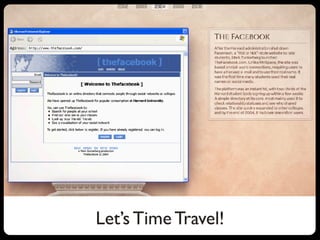
Let’s Time Travel!
Let’s
Discus !
Click around and see what the Internet
looked like in the 90s, 2000s, 2010s.
What stands out at you?
How was it di
ff
erent?
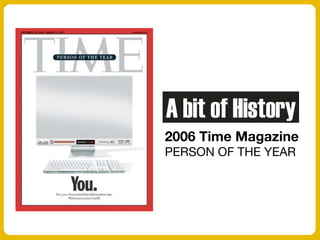
2006 Time Magazine
PERSON OF THE YEAR
A bit of History
- Richard Edelman (President & CEO of Edelman PR)
The media, communications, and marketing
landscape in which the PR industry was developed
is being knocked down. [...]
It is the decline of media based on a top-down
model of communications. [...] This model is
premised on the audience being passive receptors
for the message [...]
In the emerging model, as epitomized by YouTube,
MySpace, Oh My News and Wikipedia, ordinary
people provide content to others. Ideas and
information are passed virally. This consumer
generated content alters the laws of control of
message. Many are calling this new social and user
driven media ‘Web 2.0.’
Web 2.0 - the social web
Video by Dr. Mike Wesch
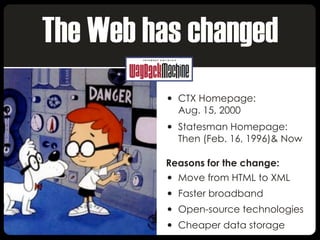
• CTX Homepage:
Aug. 15, 2000
• Statesman Homepage:
Then (Feb. 16, 1996)& Now
Reasons for the change:
• Move from HTML to XML
• Faster broadband
• Open-source technologies
• Cheaper data storage
The Web has changed
Hypertext Markup Language
Form & content inseparable
HTML:
Easy to export content
Easy to create content
The Result:
Extensible Markup Language
Form & content separate
XML:
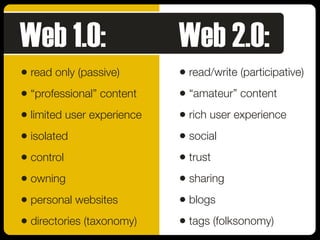
• read only (passive)
• “professional” content
• limited user experience
• isolated
• control
• owning
• personal websites
• directories (taxonomy)
• read/write (participative)
• “amateur” content
• rich user experience
• social
• trust
• sharing
• blogs
• tags (folksonomy)
Web 1.0: Web 2.0:
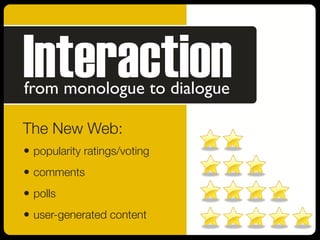
• popularity ratings/voting
• comments
• polls
• user-generated content
Interaction
from monologue to dialogue
The New Web:
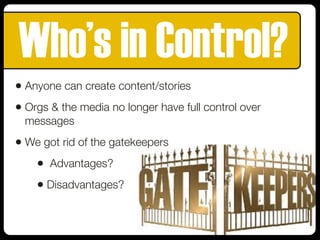
Who’s in Control?
• Anyone can create content/stories
• Orgs & the media no longer have full control over
messages
• We got rid of the gatekeepers
• Advantages?
• Disadvantages?
JOURNALISM
Changing
How
Technology
is
the Rules of
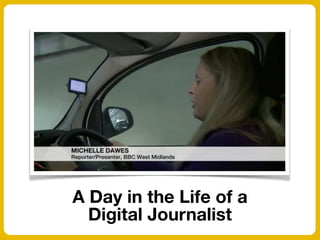
A Day in the Life of a
Digital Journalist
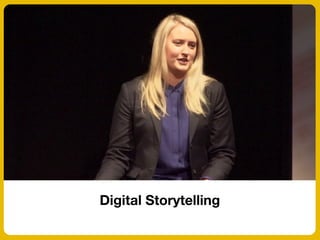
Digital Storytelling
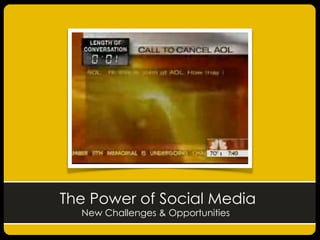
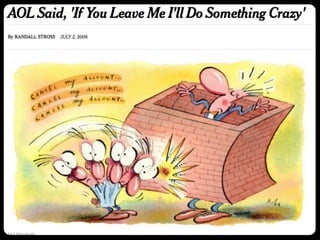
The Power of Social Media
New Challenges & Opportunities
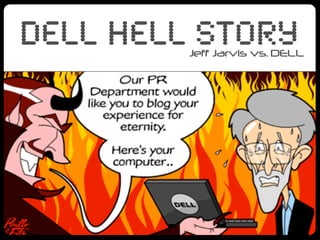
Dell Hell Story
Jeff Jarvis vs. DELL
Types of Media
First Assignment:
Beat & Story Ideas

Digital Journalism | Digital Storytelling

  • 1.
  • 2.
    Let’s Discus ! Think abouta story you came across recently. Where did you come across it? Why did it catch your attention? What do you remember?
  • 3.
  • 4.
  • 5.
    Let’s Discus ! Click aroundand see what the Internet looked like in the 90s, 2000s, 2010s. What stands out at you? How was it di ff erent?
  • 6.
    2006 Time Magazine PERSONOF THE YEAR A bit of History
  • 7.
    - Richard Edelman(President & CEO of Edelman PR) The media, communications, and marketing landscape in which the PR industry was developed is being knocked down. [...] It is the decline of media based on a top-down model of communications. [...] This model is premised on the audience being passive receptors for the message [...] In the emerging model, as epitomized by YouTube, MySpace, Oh My News and Wikipedia, ordinary people provide content to others. Ideas and information are passed virally. This consumer generated content alters the laws of control of message. Many are calling this new social and user driven media ‘Web 2.0.’
  • 8.
    Web 2.0 -the social web Video by Dr. Mike Wesch
  • 9.
    • CTX Homepage: Aug.15, 2000 • Statesman Homepage: Then (Feb. 16, 1996)& Now Reasons for the change: • Move from HTML to XML • Faster broadband • Open-source technologies • Cheaper data storage The Web has changed
  • 10.
    Hypertext Markup Language Form& content inseparable HTML:
  • 11.
    Easy to exportcontent Easy to create content The Result: Extensible Markup Language Form & content separate XML:
  • 12.
    • read only(passive) • “professional” content • limited user experience • isolated • control • owning • personal websites • directories (taxonomy) • read/write (participative) • “amateur” content • rich user experience • social • trust • sharing • blogs • tags (folksonomy) Web 1.0: Web 2.0:
  • 13.
    • popularity ratings/voting •comments • polls • user-generated content Interaction from monologue to dialogue The New Web:
  • 14.
    Who’s in Control? •Anyone can create content/stories • Orgs & the media no longer have full control over messages • We got rid of the gatekeepers • Advantages? • Disadvantages?
  • 15.
  • 16.
    A Day inthe Life of a Digital Journalist
  • 17.
  • 18.
    The Power ofSocial Media New Challenges & Opportunities
  • 20.
    Dell Hell Story JeffJarvis vs. DELL
  • 21.
  • 22.