Week 1 Lecture Notes COM325
Assigned reading covered:
Personal Connections, part of chap 1 (pages 1-13),
plus pages 124-133 (Self-presentation)
Blogging: Chapter One
Reactionsto&
purposeofnew
media
 Typical reactions:
 Concern that communication has become shallow
 Hope based on idea that more connections are possible for
people
 Anxiety over possible changes
 Purpose of Communication Technology
 Allow people to exchange message without being physically
present
 Technology removes barriers to communication such as time,
distance, social structures
 Telegraph (1800s) removed the limitation of geography
 Telephone removed the loss of speech and hearing brought by
the telegraph, adding audio back to communication
 Internet (and email): removed the limitations of time,
geography, adding speed and allowing asynchronous
conversation with a mass audience
Digitalmedia
disruption
 The ability to communicate across distance at high
speeds disrupts social understandings.
Disruption questions:
 What is the self if it is not a body?
 How can we be both present and absent?
 What do public and private mean?
 What is virtual and what is real?
 Gergen (2000) described the challenge of “absent
presence.” We are physically present in one space, but
mentally and emotionally engaged somewhere else!
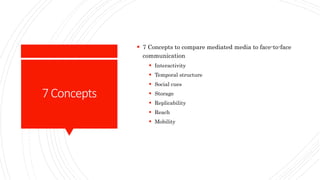
7Concepts
 7 Concepts to compare mediated media to face-to-face
communication
 Interactivity
 Temporal structure
 Social cues
 Storage
 Replicability
 Reach
 Mobility
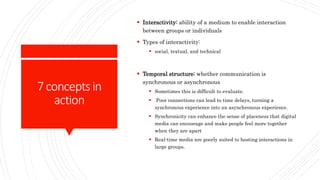
7conceptsin
action
 Interactivity: ability of a medium to enable interaction
between groups or individuals
 Types of interactivity:
 social, textual, and technical
 Temporal structure: whether communication is
synchronous or asynchronous
 Sometimes this is difficult to evaluate.
 Poor connections can lead to time delays, turning a
synchronous experience into an asynchronous experience.
 Synchronicity can enhance the sense of placeness that digital
media can encourage and make people feel more together
when they are apart
 Real-time media are poorly suited to hosting interactions in
large groups.
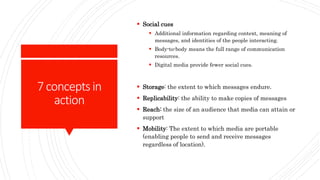
7conceptsin
action
 Social cues
 Additional information regarding context, meaning of
messages, and identities of the people interacting.
 Body-to-body means the full range of communication
resources.
 Digital media provide fewer social cues.
 Storage: the extent to which messages endure.
 Replicability: the ability to make copies of messages
 Reach: the size of an audience that media can attain or
support
 Mobility: The extent to which media are portable
(enabling people to send and receive messages
regardless of location).
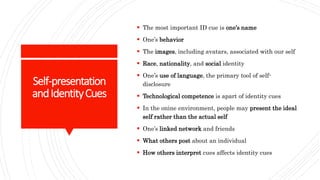
Self-presentation
andIdentityCues
 The most important ID cue is one’s name
 One’s behavior
 The images, including avatars, associated with our self
 Race, nationality, and social identity
 One’s use of language, the primary tool of self-
disclosure
 Technological competence is apart of identity cues
 In the onine environment, people may present the ideal
self rather than the actual self
 One’s linked network and friends
 What others post about an individual
 How others interpret cues affects identity cues
Theblog
New communication form in the 1990s founded on connections to
related topics. Blogging is the poster child for the shift from the one-
to-many mass media to participatory media
 A contraction of “Web log*”
 Term first used by Jorn Barger
 is the sum of writing, layout, links, and the pace of publication
 is a part of a larger context
 is a cumulative process
 The global network of blogs is known as the blogosphere
 Early blogs were like Tweets with links. Very few graphics
 Bloggers wrote their own code for each blog update
 * log is a nautical term meaning a chronological record of event
during a sea journey
Timelinefor
blogs
 1993 World Wide Web opens with the release of Mosaic
browser
 1994 Justin Hall begins blogging “Justin’s Links”
 1997 Jorn Burger coins the term “blog”
 1998-1999 Free tools Pitas and Blogger allow bloggers to
publish without needing to write code
 Open Diary launches as a free host for anonymous bloggers
 2002 First blog search engine: Technorati. Number of
blogs doubles ever few months
 2003 About 100,000 blogs exist
 2004 Blog is word of the year at Merriam-Webster. 3
million blogs exist
 2004 Facebook launches for students.
 2005 YouTube launches
 2006 Facebook accepts anyone. Twitter is founded
 2008 the term “social media” is used to describe online
many-to-many communication
3typesofblogs:
PersonalDiarystyle
Filterstyle
TopicStyle
 Personal diary style: Tells the reflections and experiences of the
blogger off line. This tell-all style resulted in some bloggers
getting fired for too much disclosure
 Filter blogs
 More male than female filter bloggers
 Tell about the blogger’s online experiences and Web findings
 At first, filter blogs were just a list of links with brief
comments
 Have evolved to include more commentary
 Topic driven blog
 Focus on a topic rather than the interests of the blogger
 Often run by a group of contributors
 Typically political or craft topics
 Craft blog such as those on Pinterest have grown from 2000
to 2012
Characteristics
ofblogs
 Defining characteristics are frequency, brevity, and
personality
 Written in first person
 Conversational and social allowing reader comments
 Has a large potential audience
 Links to other blogs
 Has persistence (is archived for future reference).
BlogLayout
 Basic unit of the post is called “discrete entries”
 Has a time stamp
 Has a post title
 Includes a blogroll (List of links)
 Has an “about” page identifying the author
 Dated entries are arranged in reverse chronological
order so that most recent appears first.
ChangesinBlogs
from2000to2016
 Increased centralization in each service (such as
Facebook) where the blogger has little control over
layout and must accept ads
 More emphasis on image
 Briefer content to fit mobile reading style
 Fragmentation of conversations across Twitter and
Facebook
 Feature more images, as in one per post
 Smartphones introduced better cameras increasing
images and shifting to shorter text posts. Phone
technology allows faster download and better quality of
images. Tablets and phones are cheaper than
computers and overtake computers in the number of
users in 2016
Whoblogs?
 20 % of users in United Arab Emirates blog once a
week
 5% of Australians blog weekly
 95% of New Zealanders blog weekly
 Never Bloggers:
 94 % of Swedes NEVER work on a blog;
 62 % of Mexicans never blog;
 61% of people in Cyprus never blog
 Source: World Internet Project
 In 2013, 1.7 million Americans listed making money as
one of the reasons they blog.
How many
blogs?
 There is no central counting house for blogs. Inactive
blogs still appear, confusing a count. Spam blogs mar
the effort to count blogs.
 Media monitoring company NMIncite tracked 181
million blogs in 2011.
 China reported 300 million blogs in 2011.
 In 2012, Wordpress hosted 50 million blogs
References
 Baym, N. (2015). Personal connections in the digital
age (2nd ed). Malden, MA: Polity Press.
 Rettberg. J.W., (2013). Blogging (2nd ed). Malden,
MA: Polity Press.

Week1 lecture notes_com325

  • 1.
    Week 1 LectureNotes COM325 Assigned reading covered: Personal Connections, part of chap 1 (pages 1-13), plus pages 124-133 (Self-presentation) Blogging: Chapter One
  • 2.
    Reactionsto& purposeofnew media  Typical reactions: Concern that communication has become shallow  Hope based on idea that more connections are possible for people  Anxiety over possible changes  Purpose of Communication Technology  Allow people to exchange message without being physically present  Technology removes barriers to communication such as time, distance, social structures  Telegraph (1800s) removed the limitation of geography  Telephone removed the loss of speech and hearing brought by the telegraph, adding audio back to communication  Internet (and email): removed the limitations of time, geography, adding speed and allowing asynchronous conversation with a mass audience
  • 3.
    Digitalmedia disruption  The abilityto communicate across distance at high speeds disrupts social understandings. Disruption questions:  What is the self if it is not a body?  How can we be both present and absent?  What do public and private mean?  What is virtual and what is real?  Gergen (2000) described the challenge of “absent presence.” We are physically present in one space, but mentally and emotionally engaged somewhere else!
  • 4.
    7Concepts  7 Conceptsto compare mediated media to face-to-face communication  Interactivity  Temporal structure  Social cues  Storage  Replicability  Reach  Mobility
  • 5.
    7conceptsin action  Interactivity: abilityof a medium to enable interaction between groups or individuals  Types of interactivity:  social, textual, and technical  Temporal structure: whether communication is synchronous or asynchronous  Sometimes this is difficult to evaluate.  Poor connections can lead to time delays, turning a synchronous experience into an asynchronous experience.  Synchronicity can enhance the sense of placeness that digital media can encourage and make people feel more together when they are apart  Real-time media are poorly suited to hosting interactions in large groups.
  • 6.
    7conceptsin action  Social cues Additional information regarding context, meaning of messages, and identities of the people interacting.  Body-to-body means the full range of communication resources.  Digital media provide fewer social cues.  Storage: the extent to which messages endure.  Replicability: the ability to make copies of messages  Reach: the size of an audience that media can attain or support  Mobility: The extent to which media are portable (enabling people to send and receive messages regardless of location).
  • 7.
    Self-presentation andIdentityCues  The mostimportant ID cue is one’s name  One’s behavior  The images, including avatars, associated with our self  Race, nationality, and social identity  One’s use of language, the primary tool of self- disclosure  Technological competence is apart of identity cues  In the onine environment, people may present the ideal self rather than the actual self  One’s linked network and friends  What others post about an individual  How others interpret cues affects identity cues
  • 8.
    Theblog New communication formin the 1990s founded on connections to related topics. Blogging is the poster child for the shift from the one- to-many mass media to participatory media  A contraction of “Web log*”  Term first used by Jorn Barger  is the sum of writing, layout, links, and the pace of publication  is a part of a larger context  is a cumulative process  The global network of blogs is known as the blogosphere  Early blogs were like Tweets with links. Very few graphics  Bloggers wrote their own code for each blog update  * log is a nautical term meaning a chronological record of event during a sea journey
  • 9.
    Timelinefor blogs  1993 WorldWide Web opens with the release of Mosaic browser  1994 Justin Hall begins blogging “Justin’s Links”  1997 Jorn Burger coins the term “blog”  1998-1999 Free tools Pitas and Blogger allow bloggers to publish without needing to write code  Open Diary launches as a free host for anonymous bloggers  2002 First blog search engine: Technorati. Number of blogs doubles ever few months  2003 About 100,000 blogs exist  2004 Blog is word of the year at Merriam-Webster. 3 million blogs exist  2004 Facebook launches for students.  2005 YouTube launches  2006 Facebook accepts anyone. Twitter is founded  2008 the term “social media” is used to describe online many-to-many communication
  • 10.
    3typesofblogs: PersonalDiarystyle Filterstyle TopicStyle  Personal diarystyle: Tells the reflections and experiences of the blogger off line. This tell-all style resulted in some bloggers getting fired for too much disclosure  Filter blogs  More male than female filter bloggers  Tell about the blogger’s online experiences and Web findings  At first, filter blogs were just a list of links with brief comments  Have evolved to include more commentary  Topic driven blog  Focus on a topic rather than the interests of the blogger  Often run by a group of contributors  Typically political or craft topics  Craft blog such as those on Pinterest have grown from 2000 to 2012
  • 11.
    Characteristics ofblogs  Defining characteristicsare frequency, brevity, and personality  Written in first person  Conversational and social allowing reader comments  Has a large potential audience  Links to other blogs  Has persistence (is archived for future reference).
  • 12.
    BlogLayout  Basic unitof the post is called “discrete entries”  Has a time stamp  Has a post title  Includes a blogroll (List of links)  Has an “about” page identifying the author  Dated entries are arranged in reverse chronological order so that most recent appears first.
  • 13.
    ChangesinBlogs from2000to2016  Increased centralizationin each service (such as Facebook) where the blogger has little control over layout and must accept ads  More emphasis on image  Briefer content to fit mobile reading style  Fragmentation of conversations across Twitter and Facebook  Feature more images, as in one per post  Smartphones introduced better cameras increasing images and shifting to shorter text posts. Phone technology allows faster download and better quality of images. Tablets and phones are cheaper than computers and overtake computers in the number of users in 2016
  • 14.
    Whoblogs?  20 %of users in United Arab Emirates blog once a week  5% of Australians blog weekly  95% of New Zealanders blog weekly  Never Bloggers:  94 % of Swedes NEVER work on a blog;  62 % of Mexicans never blog;  61% of people in Cyprus never blog  Source: World Internet Project  In 2013, 1.7 million Americans listed making money as one of the reasons they blog.
  • 15.
    How many blogs?  Thereis no central counting house for blogs. Inactive blogs still appear, confusing a count. Spam blogs mar the effort to count blogs.  Media monitoring company NMIncite tracked 181 million blogs in 2011.  China reported 300 million blogs in 2011.  In 2012, Wordpress hosted 50 million blogs
  • 16.
    References  Baym, N.(2015). Personal connections in the digital age (2nd ed). Malden, MA: Polity Press.  Rettberg. J.W., (2013). Blogging (2nd ed). Malden, MA: Polity Press.