James Howison
PhD Dissertation Defense
iSchool @ Syracuse University
4 December 2008
Alone Together:
Patterns of Collaboration in
Free and Open Source
Software Development
Advisor: Kevin Crowston
Committee: Bob Heckman,
Carsten Østerlund, Don Harter (B-school)
Inside Reader: Steve Sawyer
Outside Reader: Francesco Bolici (Remote)
Chair: Sumitro Bannerjee (B-school) CC Credit: http://www.flickr.com/photos/baggis/
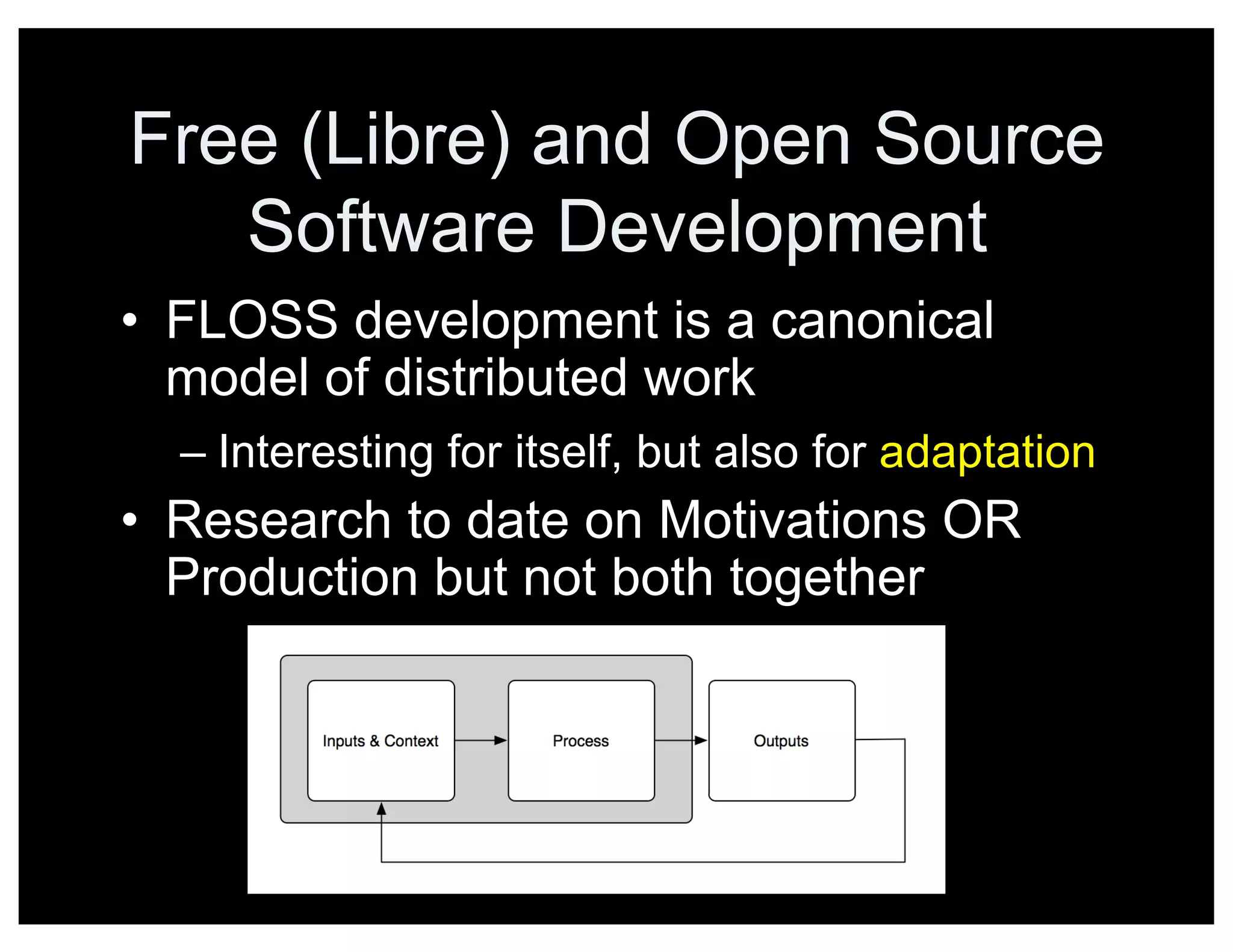
Free (Libre) and Open Source
Software Development
• FLOSS development is a canonical
model of distributed work
– Interesting for itself, but also for adaptation
• Research to date on Motivations OR
Production but not both together
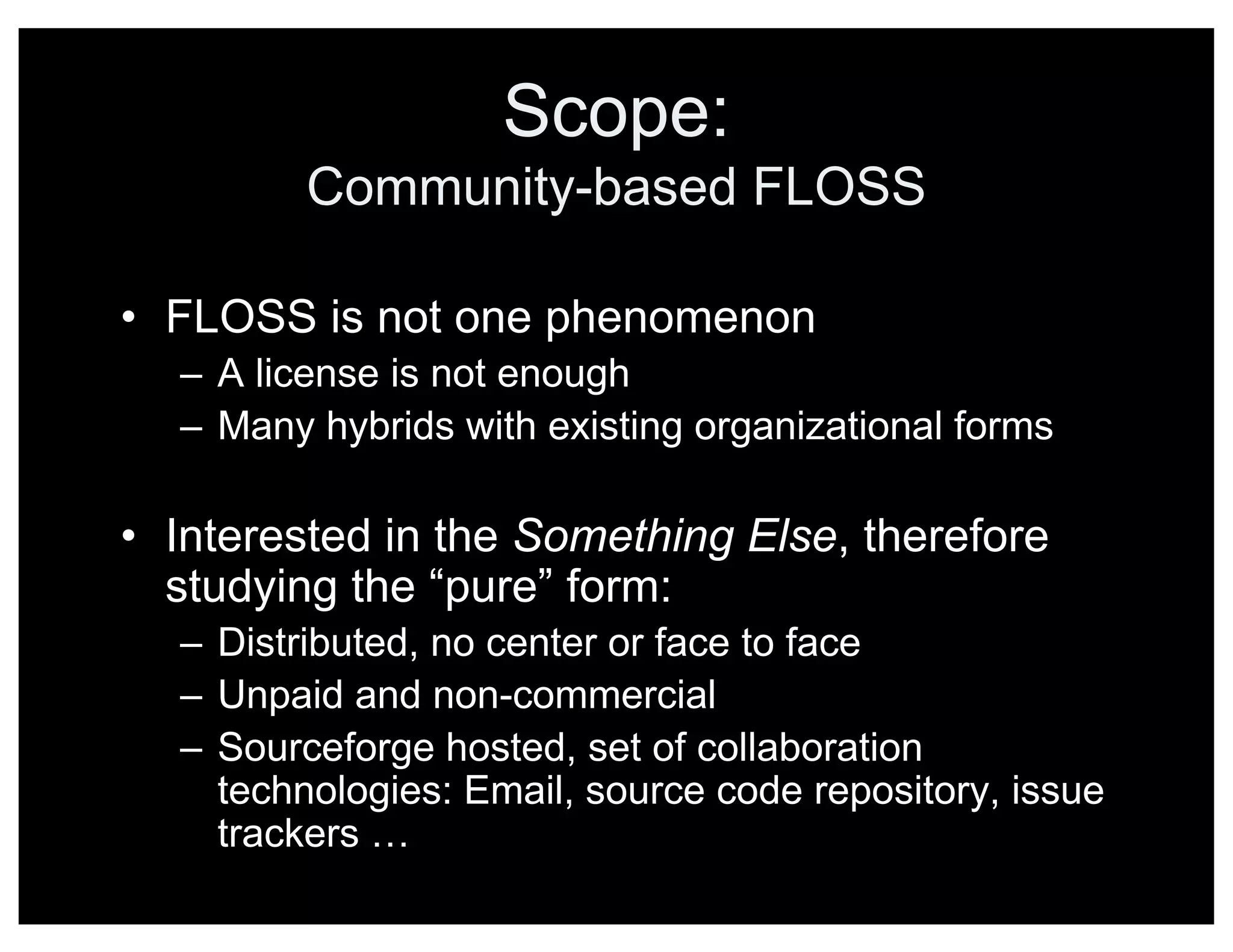
Scope:
Community-based FLOSS
• FLOSS is not one phenomenon
– A license is not enough
– Many hybrids with existing organizational forms
• Interested in the Something Else, therefore
studying the “pure” form:
– Distributed, no center or face to face
– Unpaid and non-commercial
– Sourceforge hosted, set of collaboration
technologies: Email, source code repository, issue
trackers …
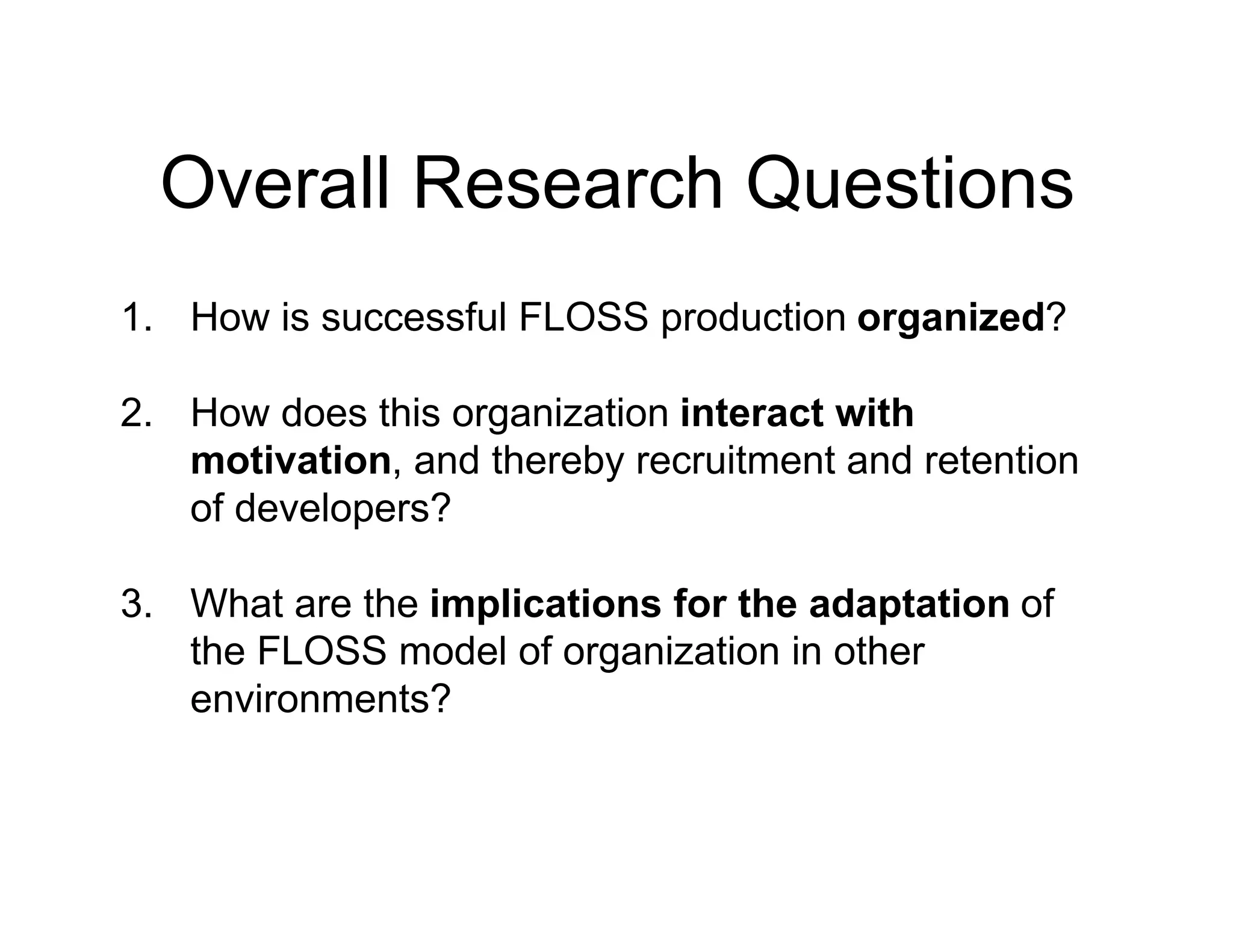
Overall Research Questions
1. How is successful FLOSS production organized?
2. How does this organization interact with
motivation, and thereby recruitment and retention
of developers?
3. What are the implications for the adaptation of
the FLOSS model of organization in other
environments?
Structure
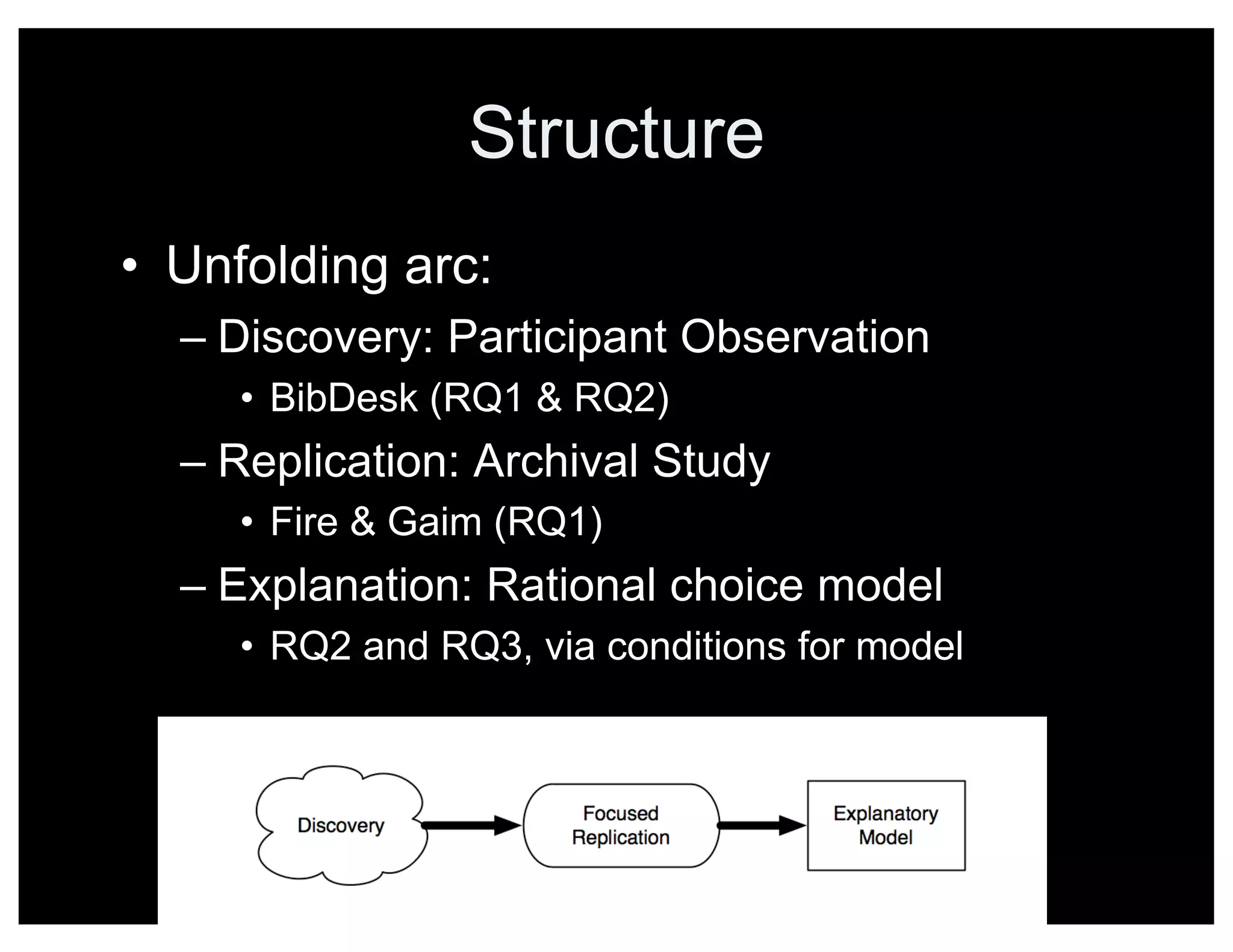
• Unfolding arc:
– Discovery: Participant Observation
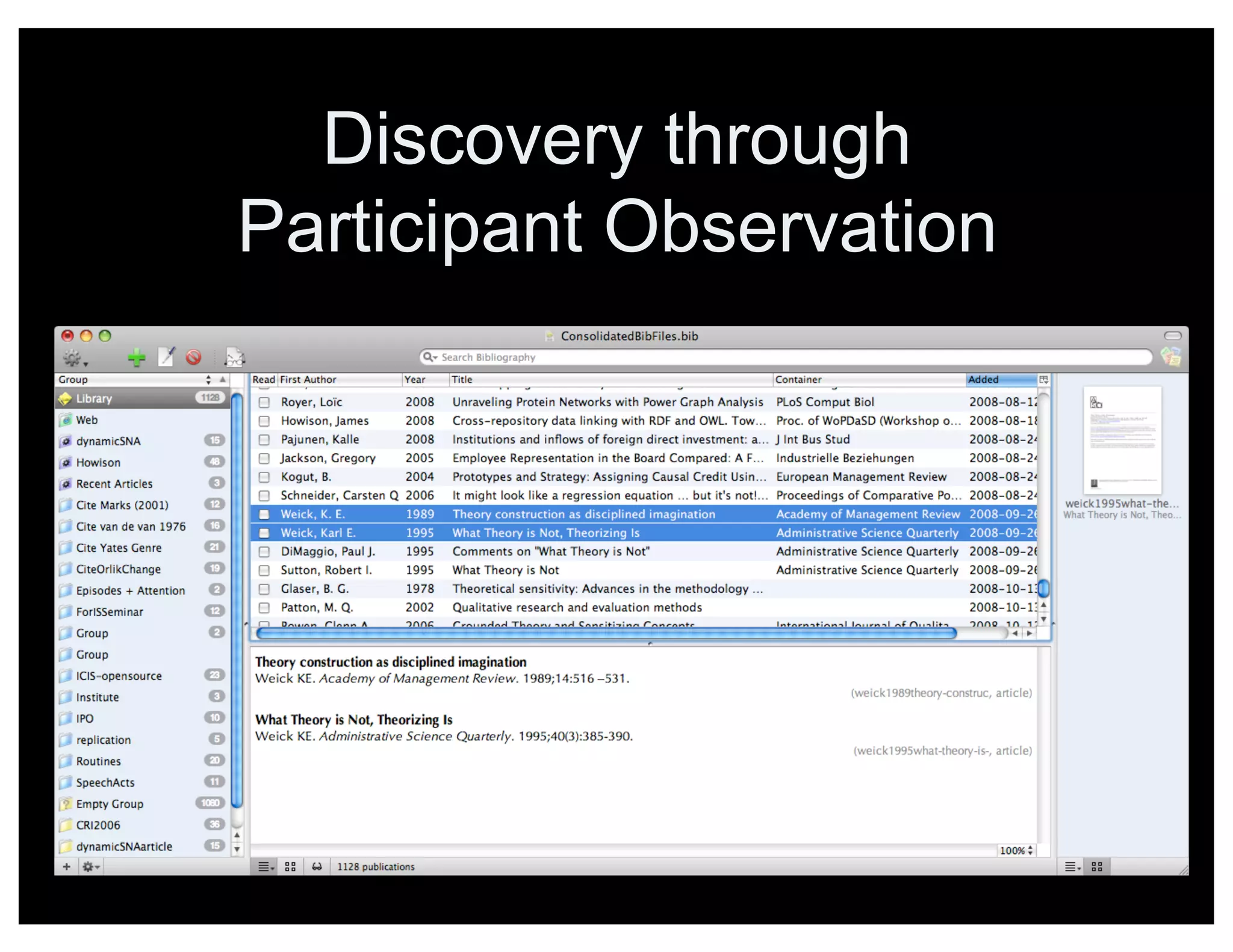
• BibDesk (RQ1 & RQ2)
– Replication: Archival Study
• Fire & Gaim (RQ1)
– Explanation: Rational choice model
• RQ2 and RQ3, via conditions for model
Today’s Goal:
An image of FLOSS production
CC Credit: http://flickr.com/photos/anthea/
Discovery through
Participant Observation
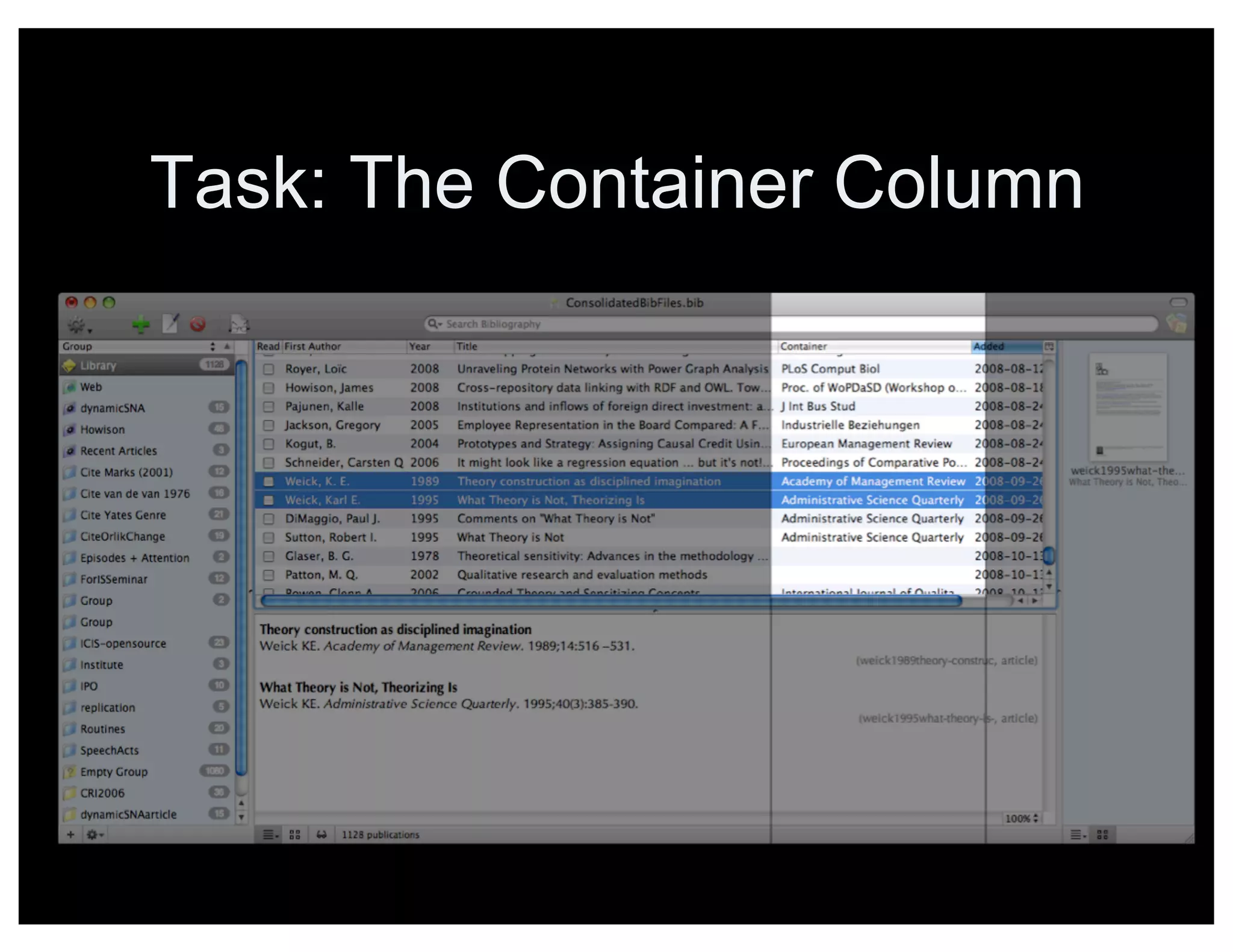
Task: The Container Column
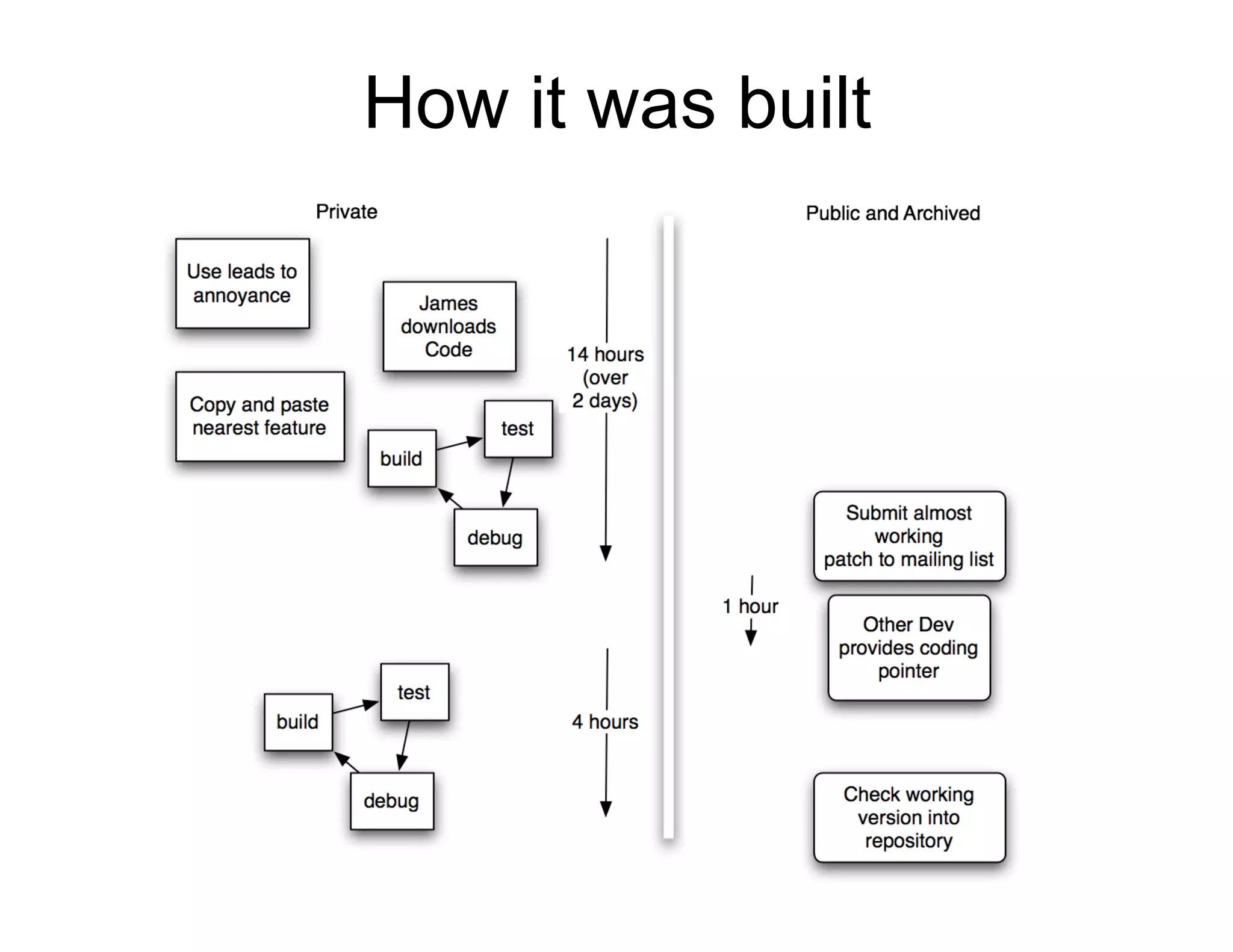
How it was built
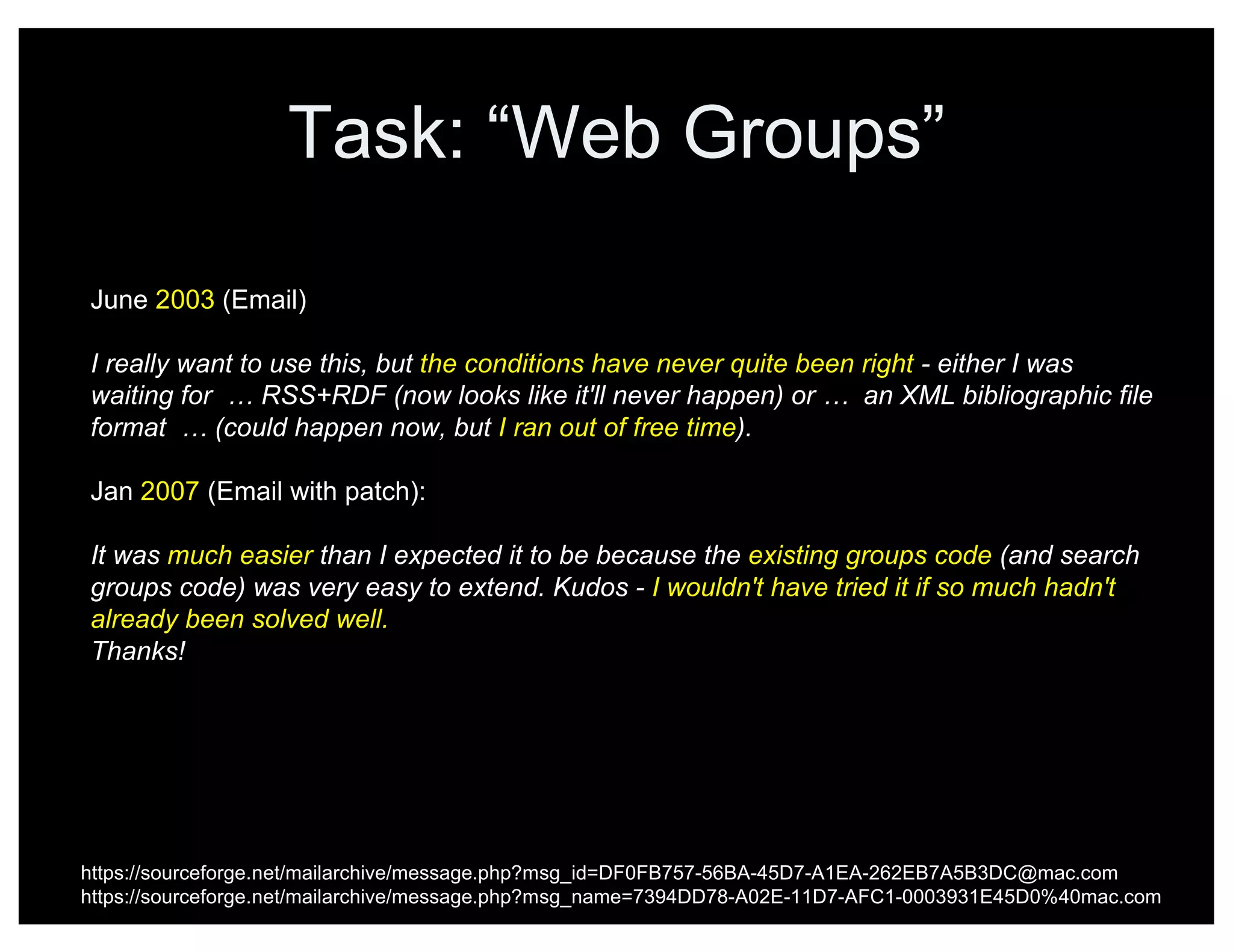
Task: “Web Groups”
https://sourceforge.net/mailarchive/message.php?msg_id=DF0FB757-56BA-45D7-A1EA-262EB7A5B3DC@mac.com
https://sourceforge.net/mailarchive/message.php?msg_name=7394DD78-A02E-11D7-AFC1-0003931E45D0%40mac.com
June 2003 (Email)
I really want to use this, but the conditions have never quite been right - either I was
waiting for … RSS+RDF (now looks like it'll never happen) or … an XML bibliographic file
format … (could happen now, but I ran out of free time).
Jan 2007 (Email with patch):
It was much easier than I expected it to be because the existing groups code (and search
groups code) was very easy to extend. Kudos - I wouldn't have tried it if so much hadn't
already been solved well.
Thanks!
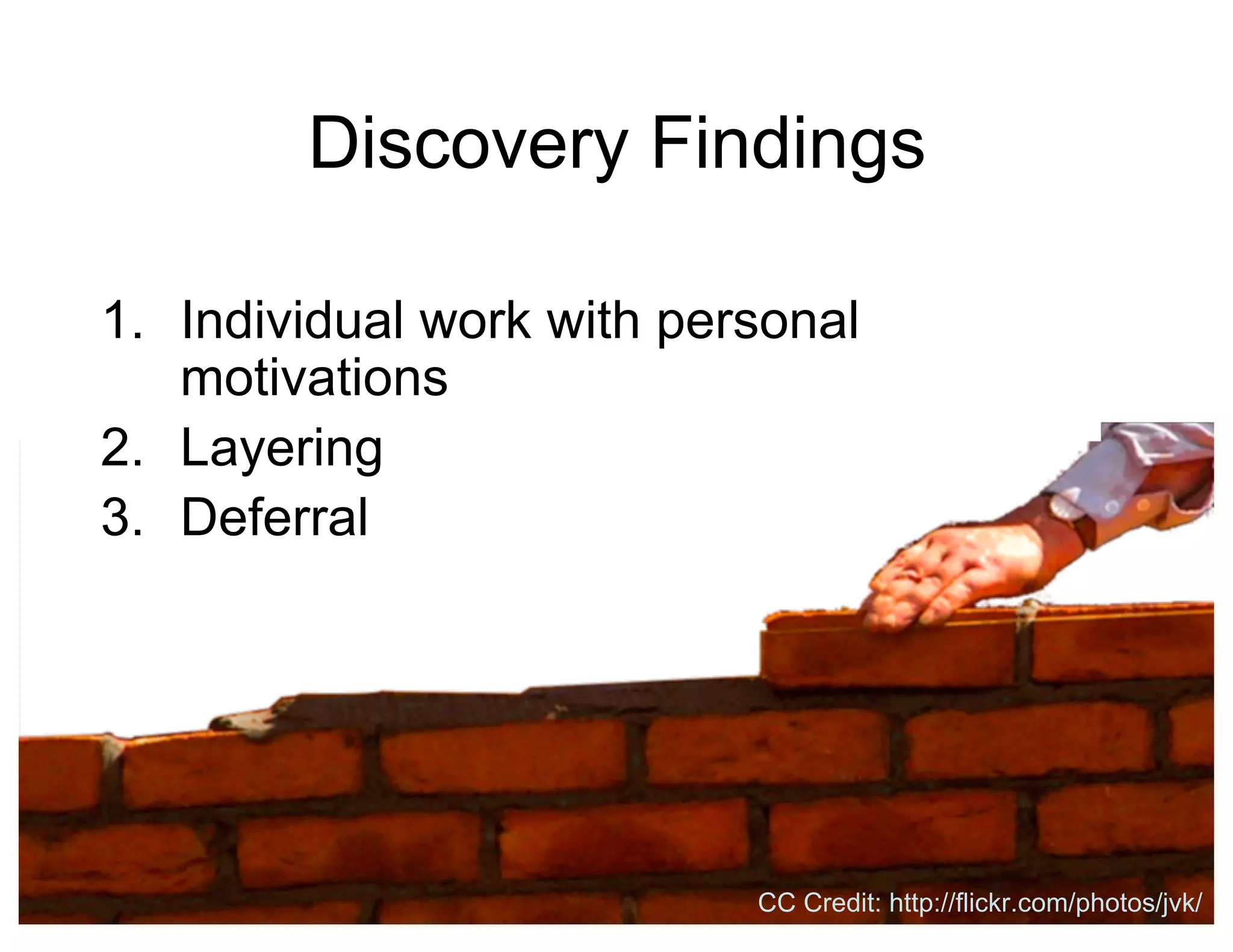
Discovery Findings
1. Individual work with personal
motivations
2. Layering
3. Deferral
CC Credit: http://flickr.com/photos/jvk/
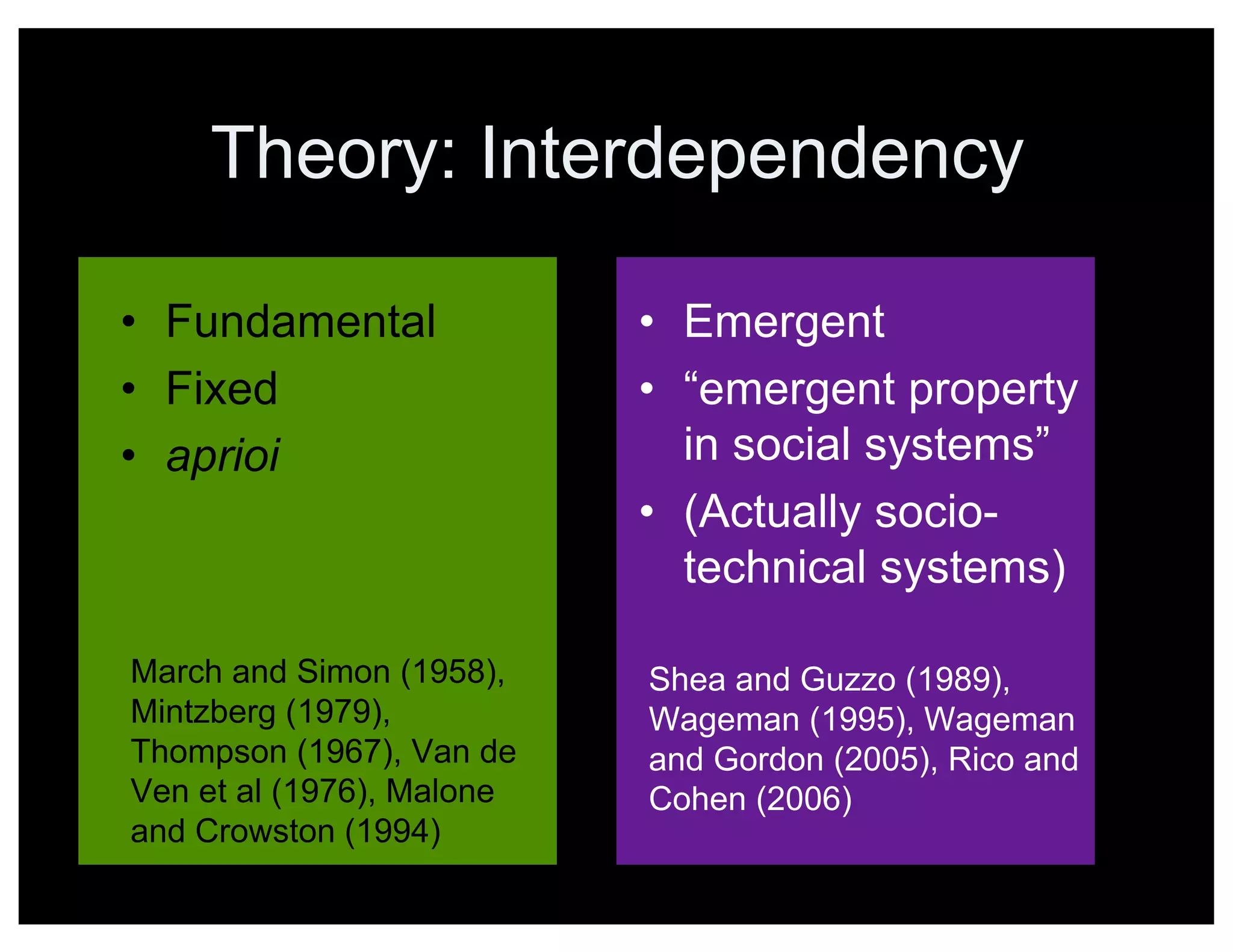
Theory: Interdependency
• Fundamental
• Fixed
• aprioi
• Emergent
• “emergent property
in social systems”
• (Actually socio-
technical systems)
March and Simon (1958),
Mintzberg (1979),
Thompson (1967), Van de
Ven et al (1976), Malone
and Crowston (1994)
Shea and Guzzo (1989),
Wageman (1995), Wageman
and Gordon (2005), Rico and
Cohen (2006)
CC Credit: http://www.flickr.com/photos/johnwiechecki/
CC Credit: http://www.flickr.com/photos/ejpphoto/
CCCredit:http://www.flickr.com/photos/kojihachisu/
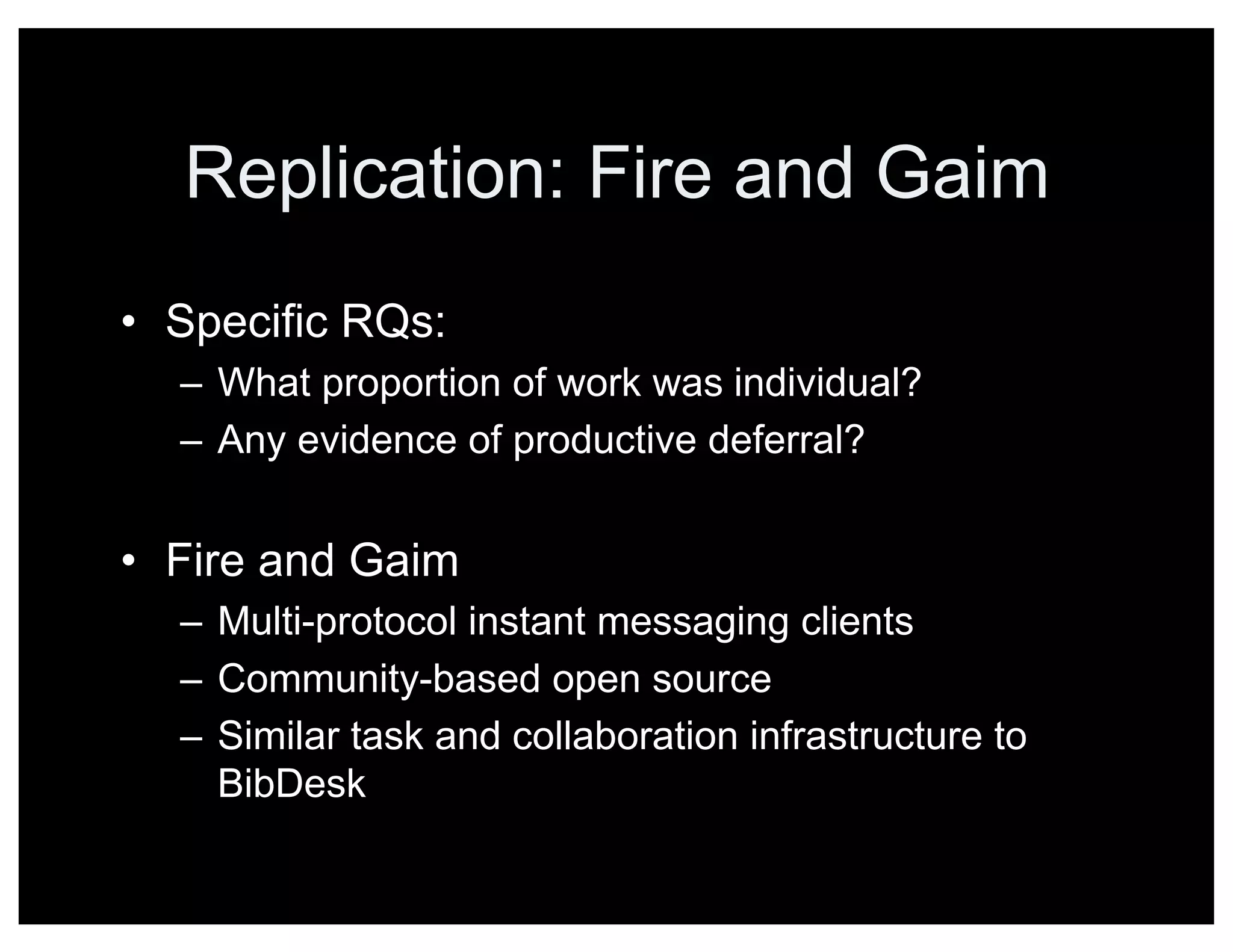
Replication: Fire and Gaim
• Specific RQs:
– What proportion of work was individual?
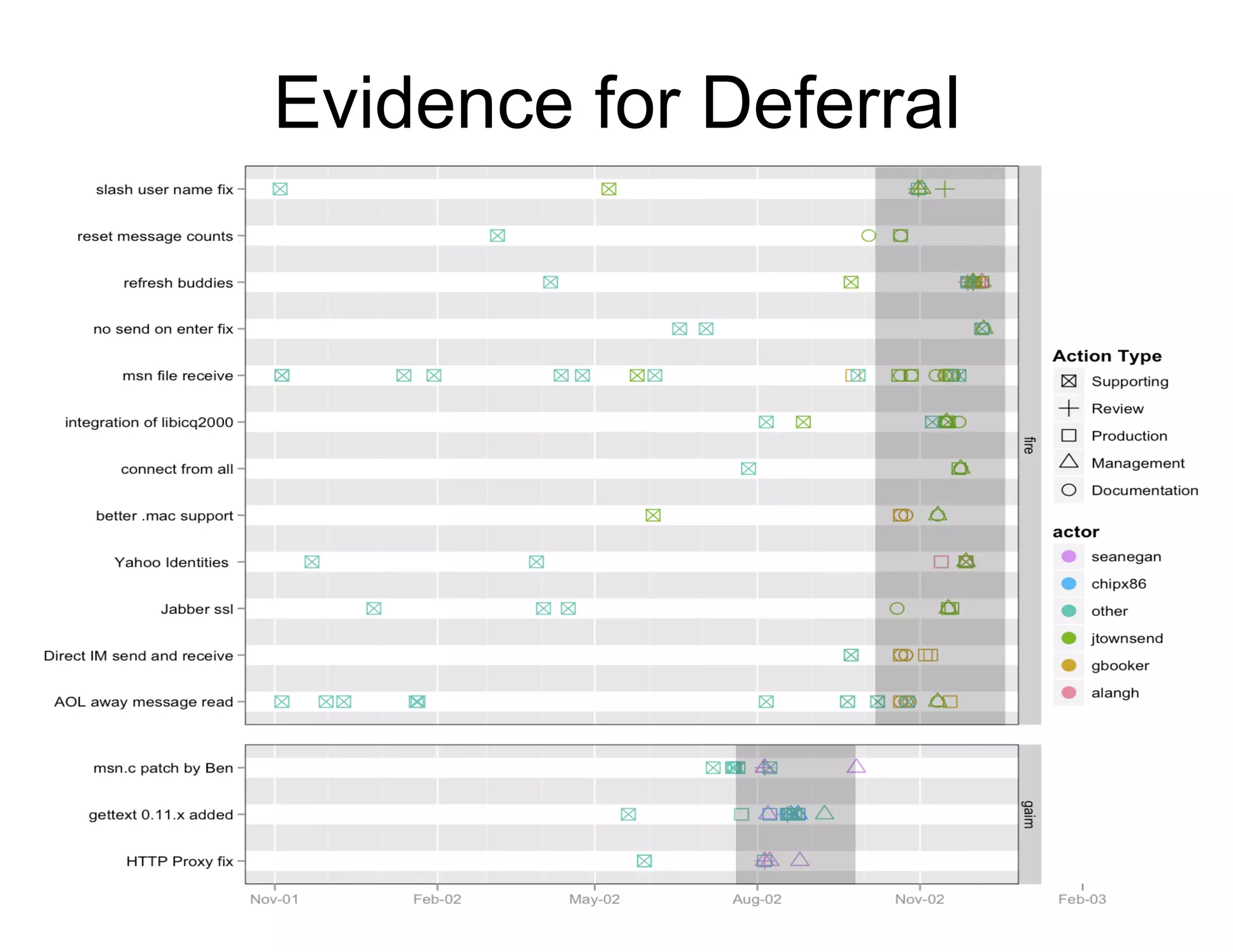
– Any evidence of productive deferral?
• Fire and Gaim
– Multi-protocol instant messaging clients
– Community-based open source
– Similar task and collaboration infrastructure to
BibDesk
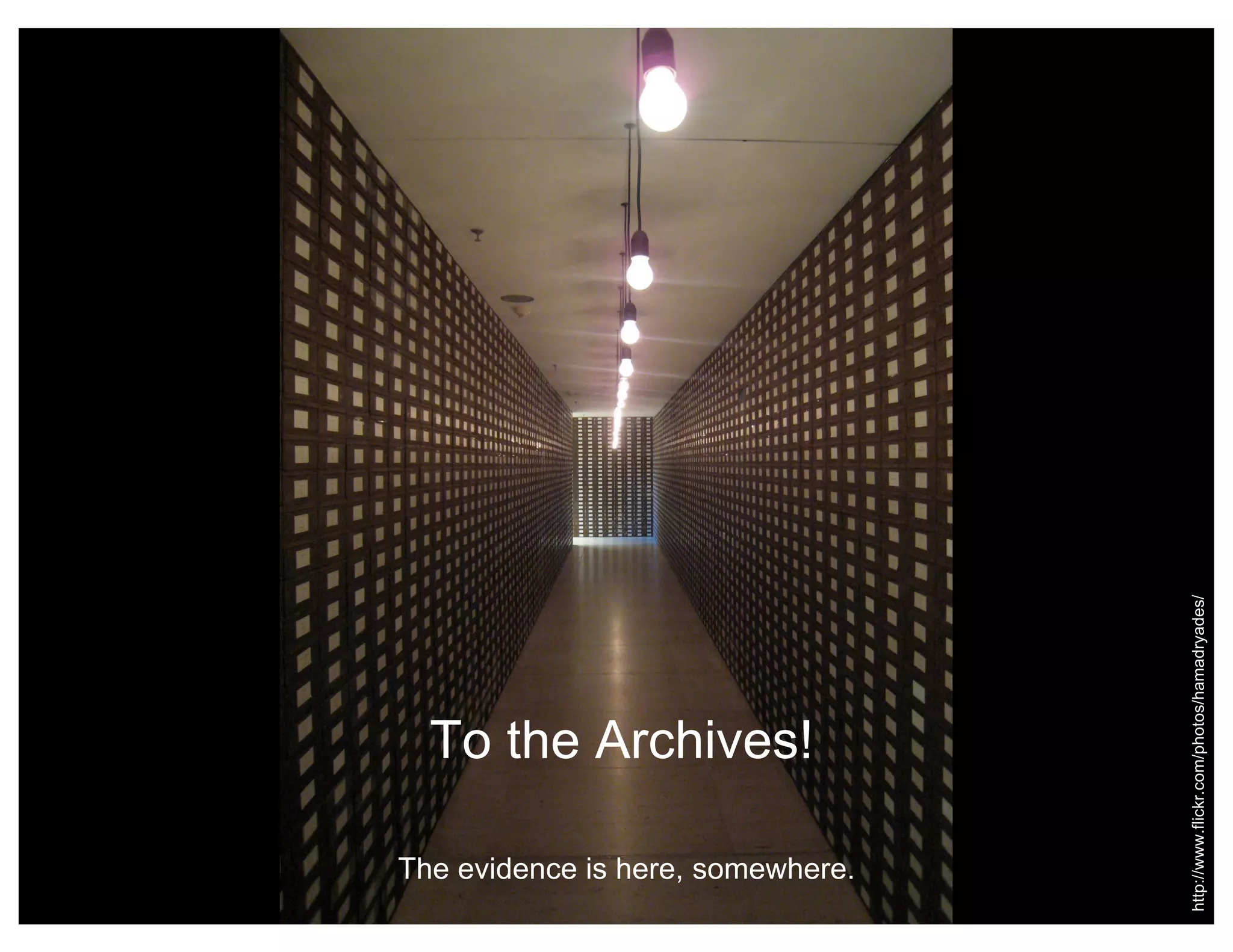
To the Archives!
The evidence is here, somewhere.
http://www.flickr.com/photos/hamadryades/
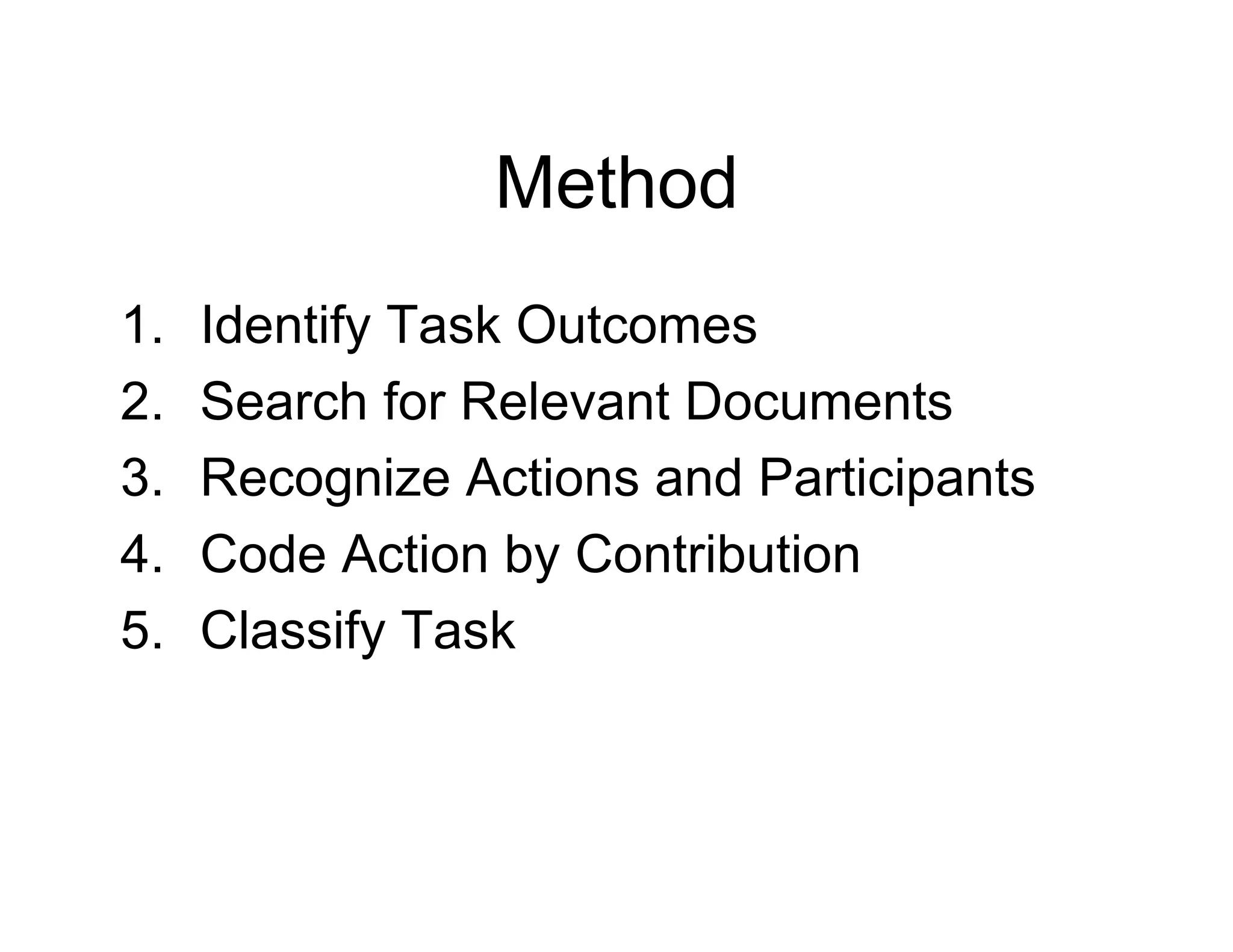
Method
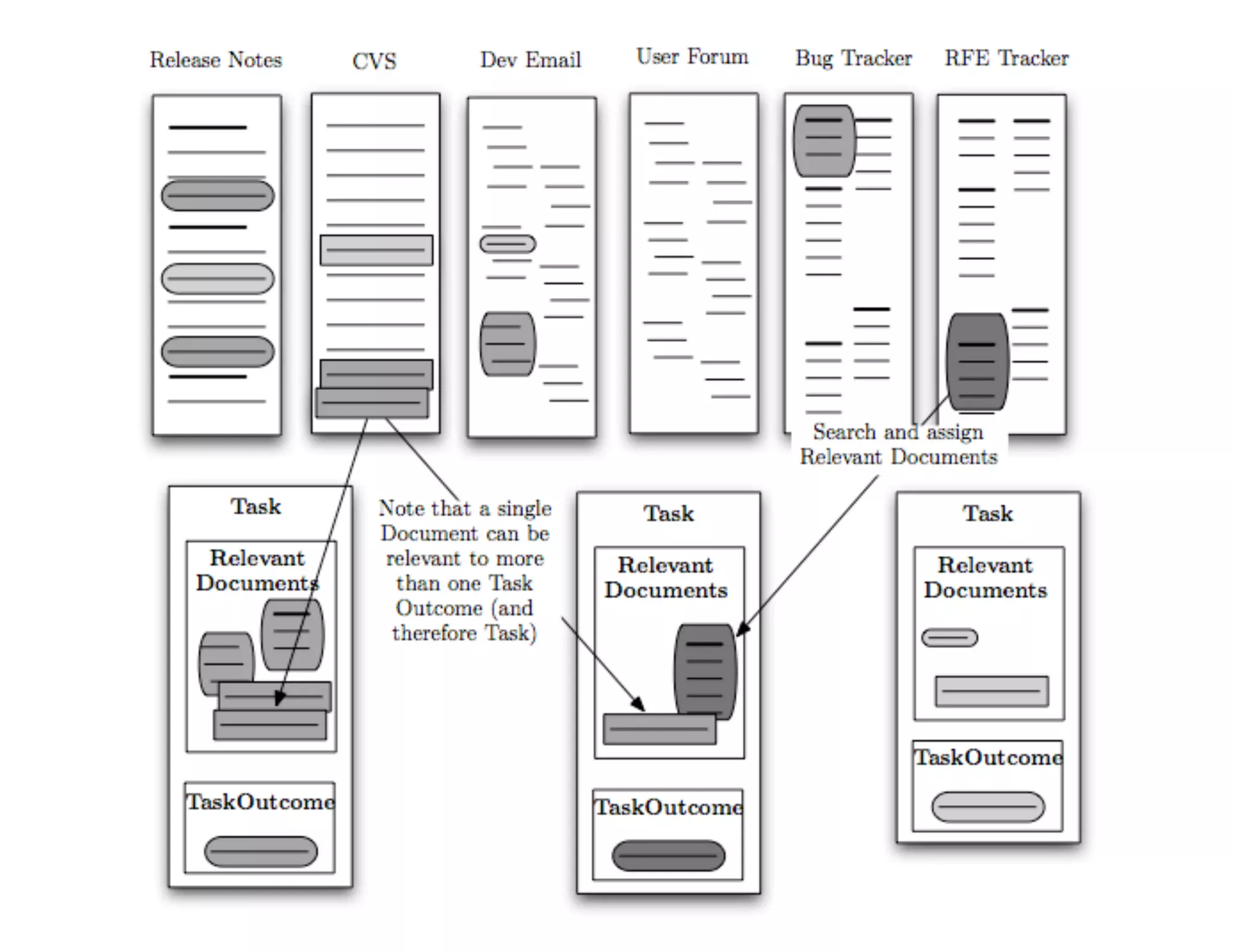
1. Identify Task Outcomes
2. Search for Relevant Documents
3. Recognize Actions and Participants
4. Code Action by Contribution
5. Classify Task
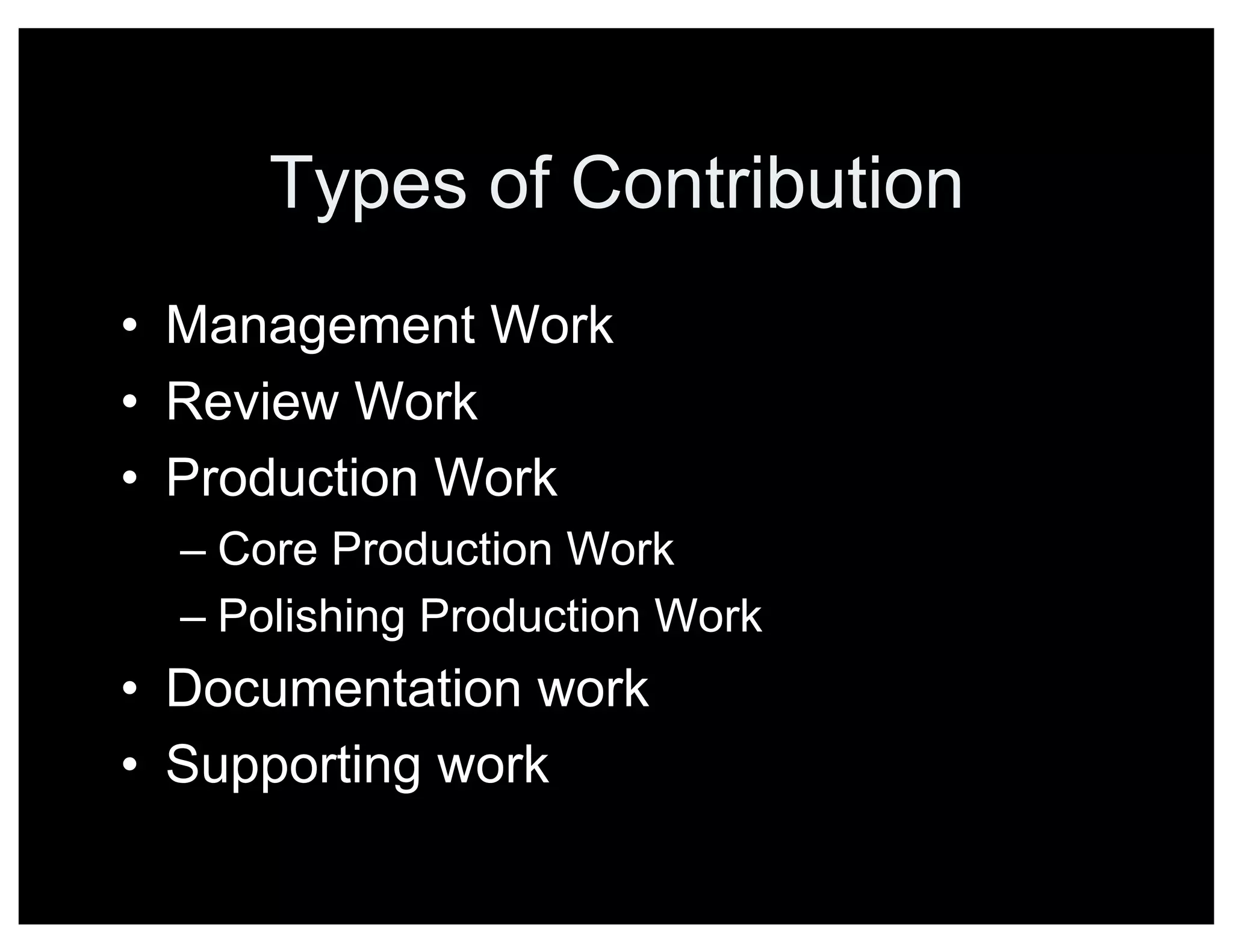
Types of Contribution
• Management Work
• Review Work
• Production Work
– Core Production Work
– Polishing Production Work
• Documentation work
• Supporting work
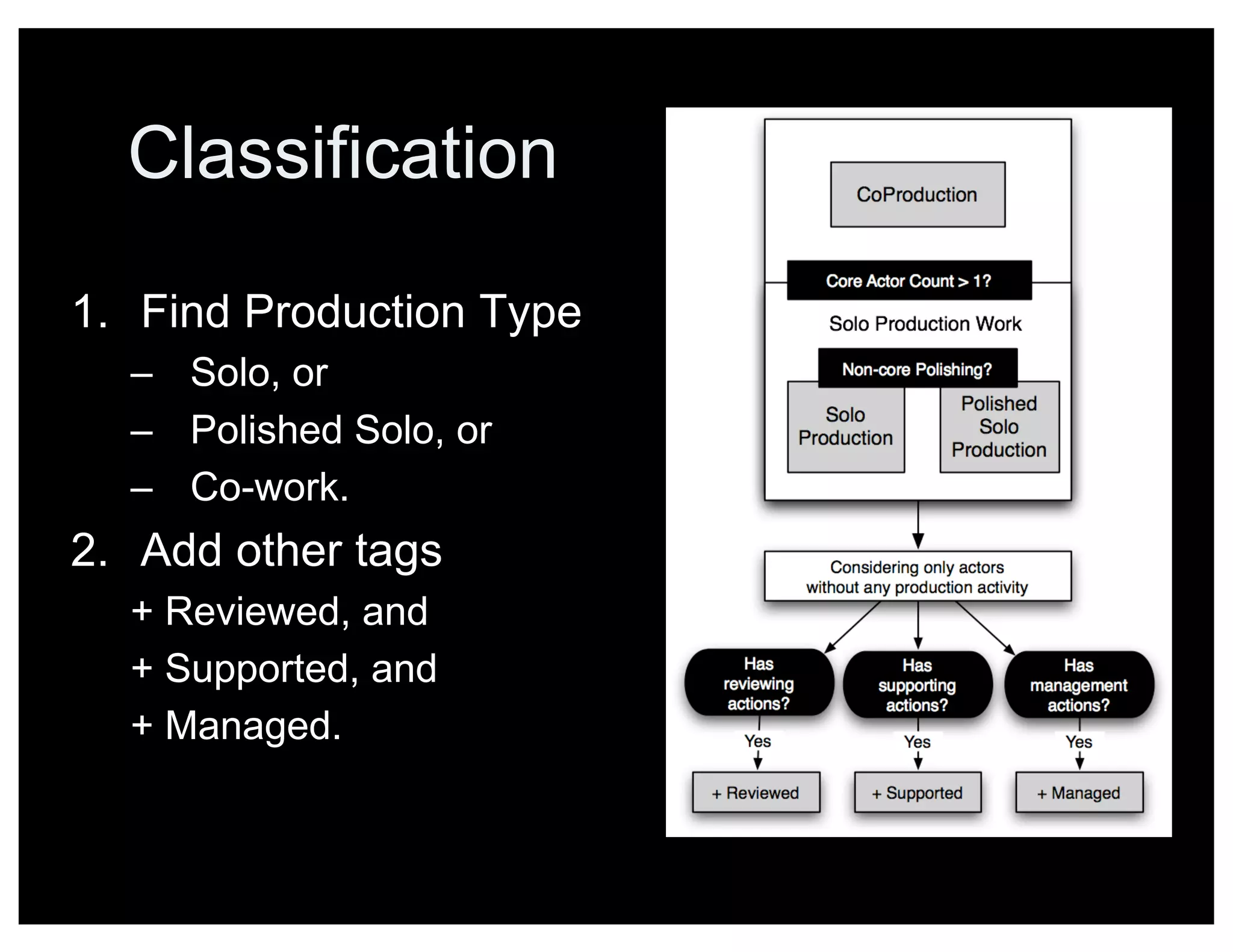
Classification
1. Find Production Type
– Solo, or
– Polished Solo, or
– Co-work.
2. Add other tags
+ Reviewed, and
+ Supported, and
+ Managed.
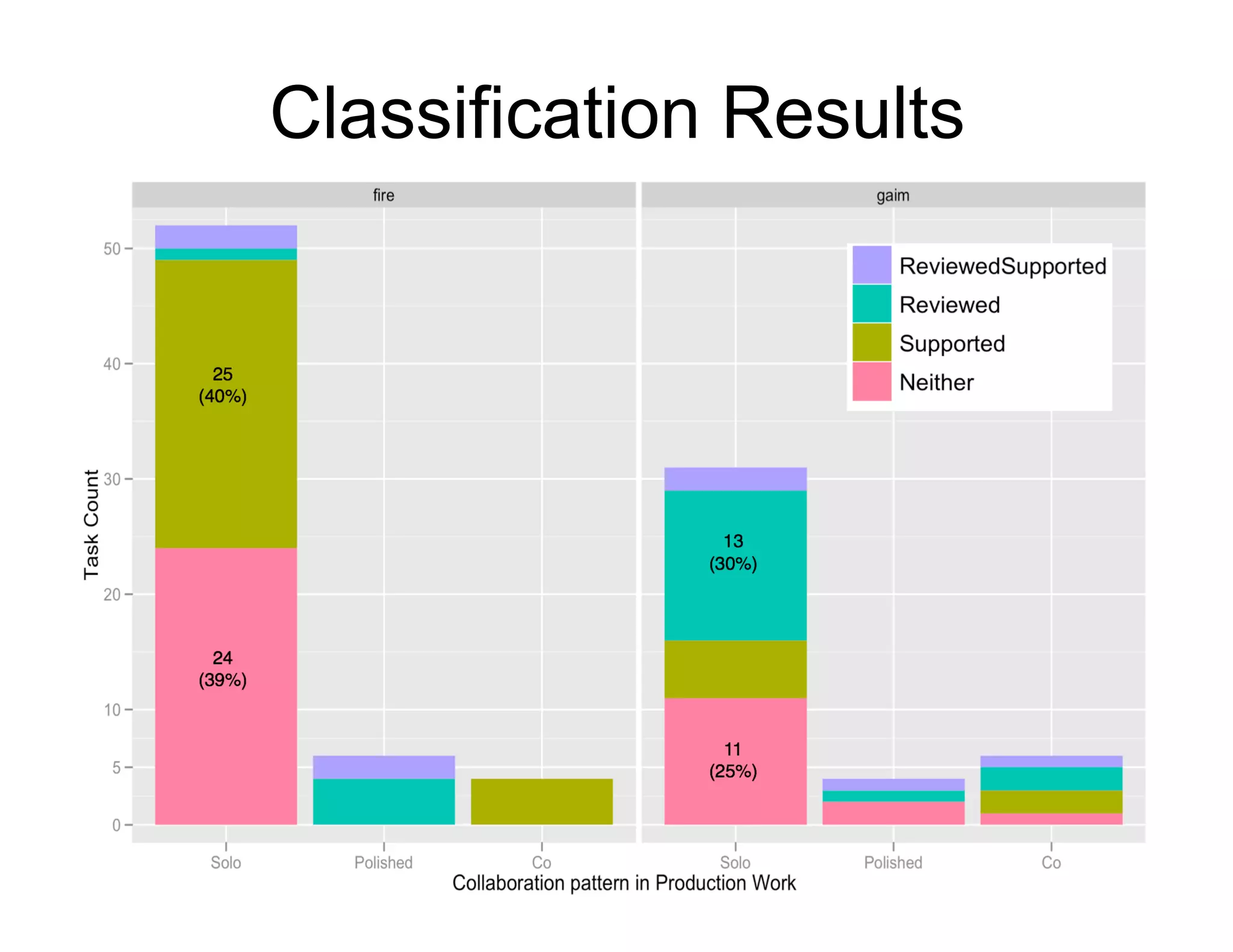
Classification Results
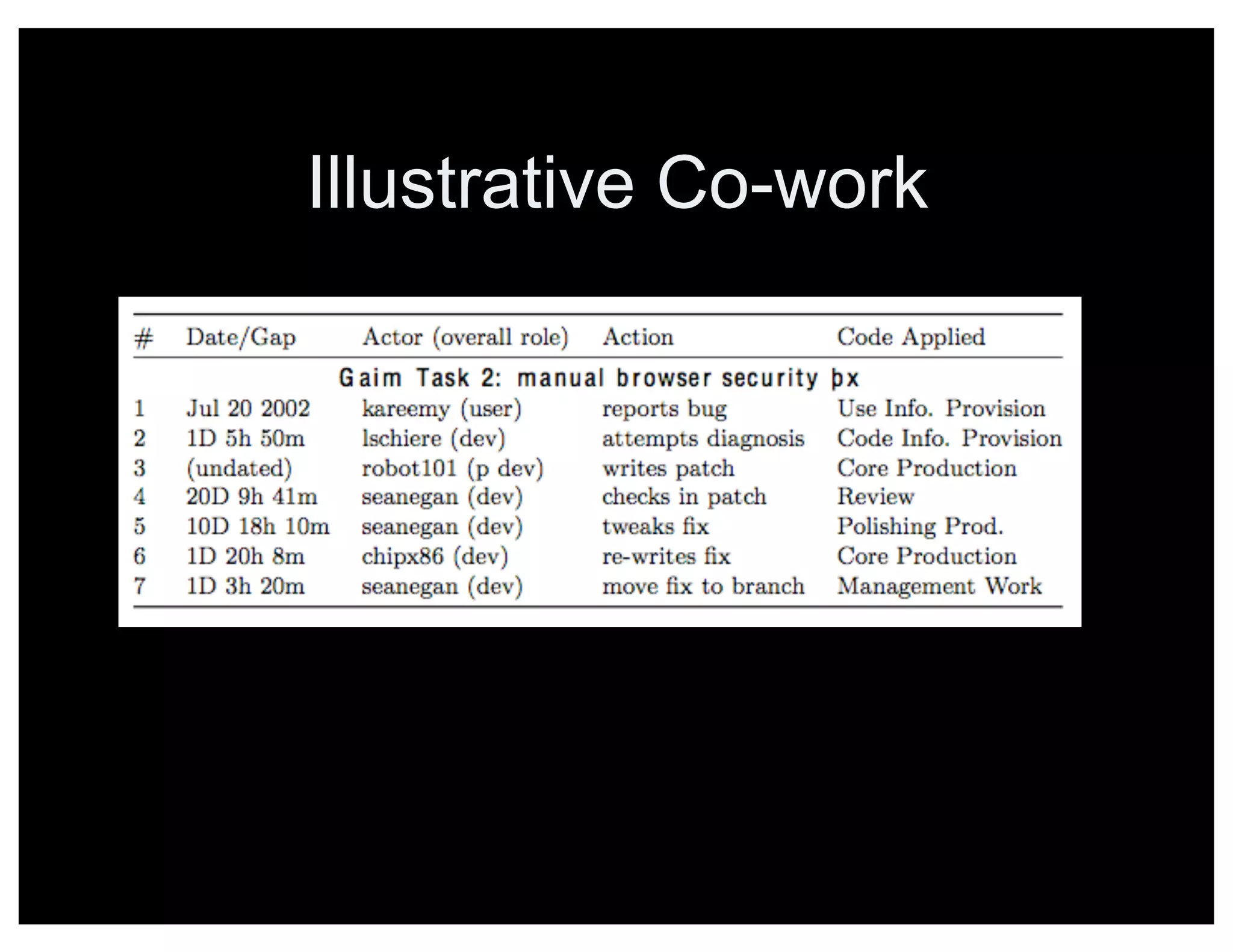
Illustrative Co-work
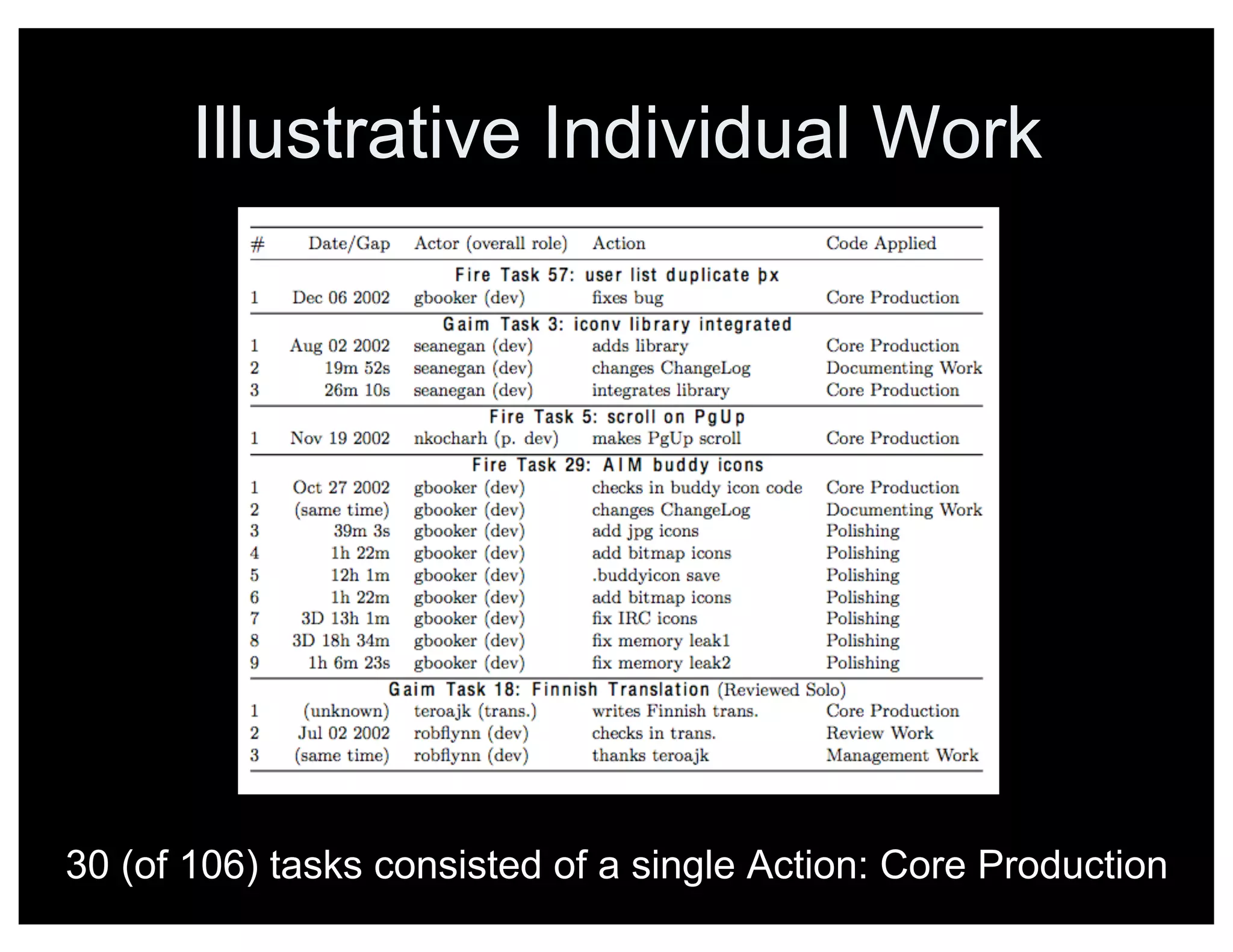
Illustrative Individual Work
30 (of 106) tasks consisted of a single Action: Core Production
Evidence for Deferral
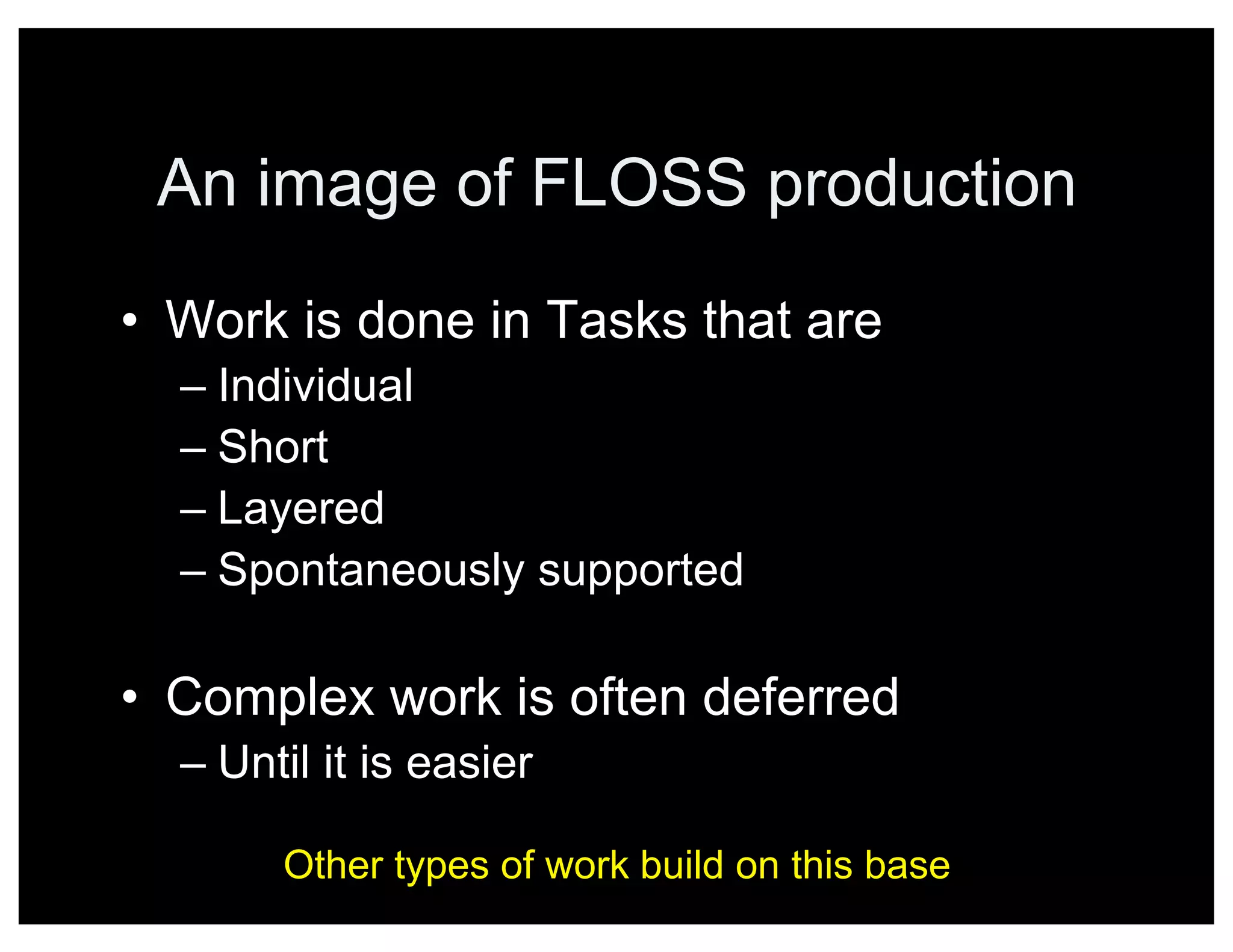
An image of FLOSS production
• Work is done in Tasks that are
– Individual
– Short
– Layered
– Spontaneously supported
• Complex work is often deferred
– Until it is easier
Other types of work build on this base
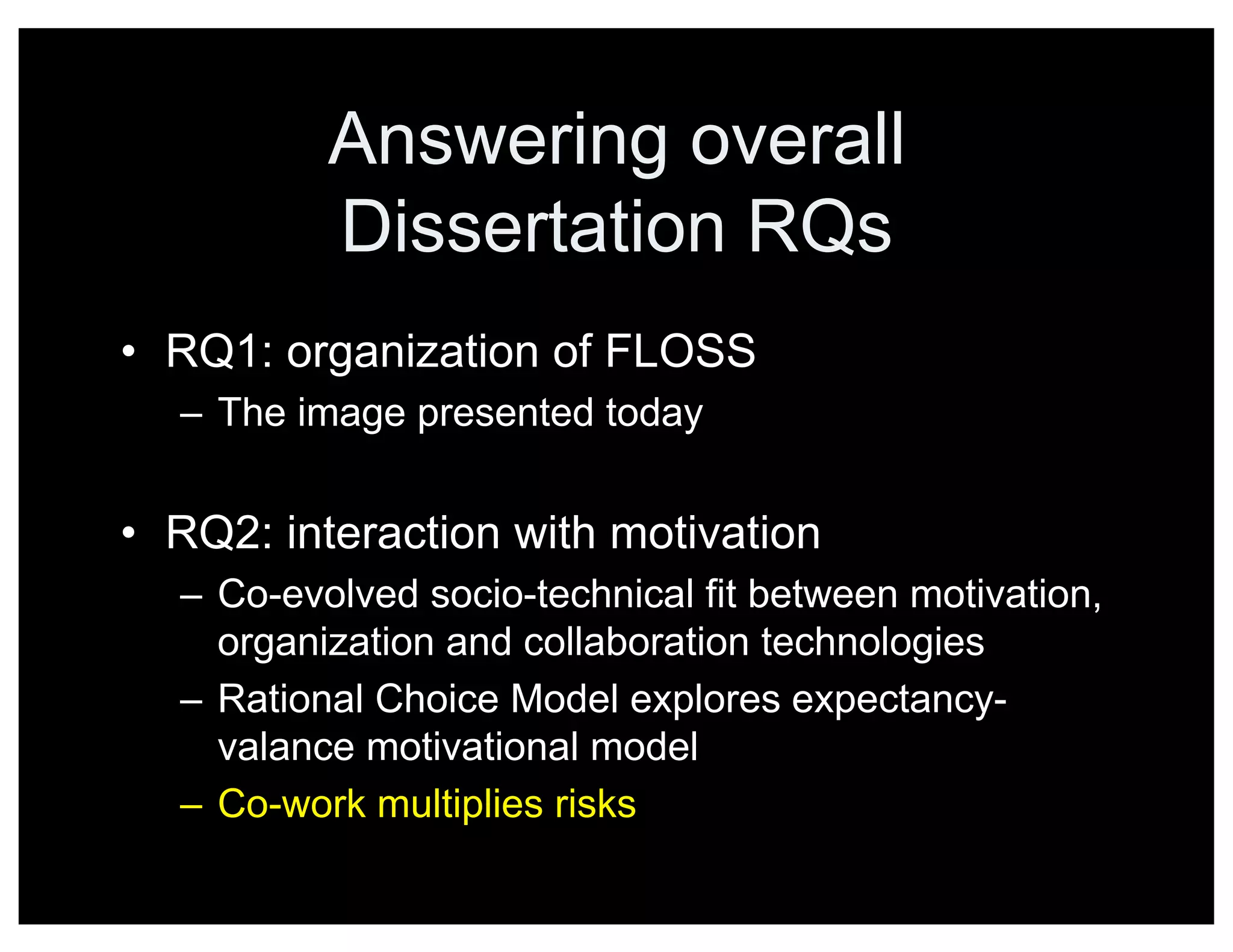
Answering overall
Dissertation RQs
• RQ1: organization of FLOSS
– The image presented today
• RQ2: interaction with motivation
– Co-evolved socio-technical fit between motivation,
organization and collaboration technologies
– Rational Choice Model explores expectancy-
valance motivational model
– Co-work multiplies risks
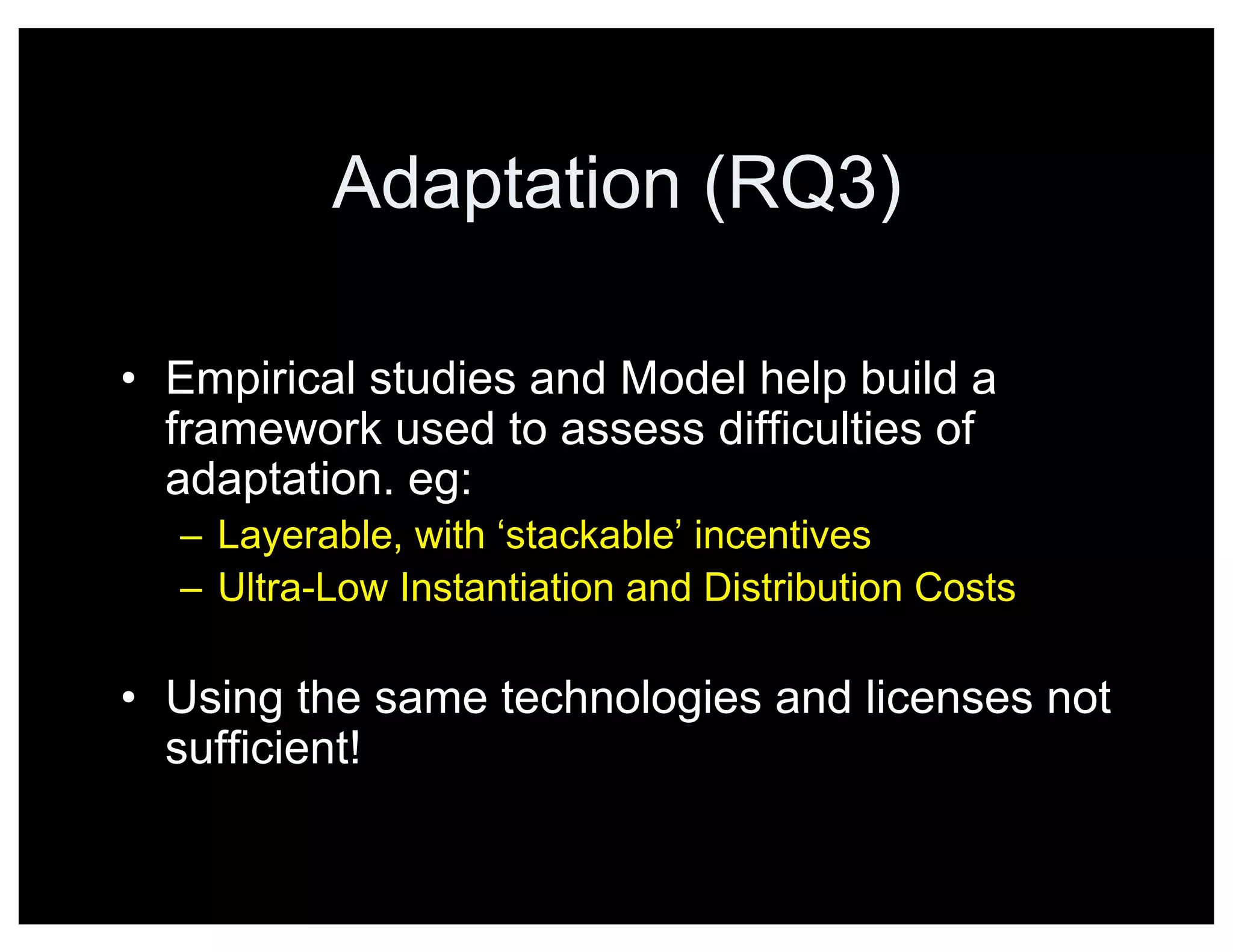
Adaptation (RQ3)
• Empirical studies and Model help build a
framework used to assess difficulties of
adaptation. eg:
– Layerable, with ‘stackable’ incentives
– Ultra-Low Instantiation and Distribution Costs
• Using the same technologies and licenses not
sufficient!
Contributions I
• Information Systems
– Empirically grounded socio-technical theory of IS
development and distributed teams, IT artifacts
play important roles.
• Organizational Science
– Identification and description of a novel
organizational form
– Empirical evidence of low-interdependency
complex work
– Deferral may have wider applicability
Contributions II
• Methodology
– Concepts and Method for reconstructing work from archives
• Teaching
– Set of annotated narrative cases of FLOSS work, useful for
teaching those working with communities
• Open Source practicioners
– Give “Community managers” a lens to understand their own
communities
– Those starting projects: a (partial) guide to existing
experience
Thanks especially to:
• The BibDesk developers and users and the rest of the Free
and Open Source communities
• Kevin, my advisor
• My committee (Bob, Carsten and Don)
• My 2 writing groups (Anu and Indira & Saira and Isabelle)
• The FLOSS research team (Kevin, Bob, Hala, Chengetai,
Andrea, Yeliz, Kangning, Qing, Mike, Lina, Steve and Eileen)
• All the iSchool colleagues, junior and senior, who’ve
challenged and inspired me.
• Jennifer, Maureen, Ellen and Bridget!
• Becks and Joe
• Becky (so, so cool), Kal and Drogo
• Judes & Bobs, Kate & Andy (never far away, really :)
And, of course, the NSF (03-41475, 04–14468, 05-27457 and 07–08437)
fin

Alone Together: Patterns of collaboration in free and open source software development

  • 1.
    James Howison PhD DissertationDefense iSchool @ Syracuse University 4 December 2008 Alone Together: Patterns of Collaboration in Free and Open Source Software Development Advisor: Kevin Crowston Committee: Bob Heckman, Carsten Østerlund, Don Harter (B-school) Inside Reader: Steve Sawyer Outside Reader: Francesco Bolici (Remote) Chair: Sumitro Bannerjee (B-school) CC Credit: http://www.flickr.com/photos/baggis/
  • 2.
    Free (Libre) andOpen Source Software Development • FLOSS development is a canonical model of distributed work – Interesting for itself, but also for adaptation • Research to date on Motivations OR Production but not both together
  • 3.
    Scope: Community-based FLOSS • FLOSSis not one phenomenon – A license is not enough – Many hybrids with existing organizational forms • Interested in the Something Else, therefore studying the “pure” form: – Distributed, no center or face to face – Unpaid and non-commercial – Sourceforge hosted, set of collaboration technologies: Email, source code repository, issue trackers …
  • 4.
    Overall Research Questions 1.How is successful FLOSS production organized? 2. How does this organization interact with motivation, and thereby recruitment and retention of developers? 3. What are the implications for the adaptation of the FLOSS model of organization in other environments?
  • 5.
    Structure • Unfolding arc: –Discovery: Participant Observation • BibDesk (RQ1 & RQ2) – Replication: Archival Study • Fire & Gaim (RQ1) – Explanation: Rational choice model • RQ2 and RQ3, via conditions for model
  • 6.
    Today’s Goal: An imageof FLOSS production CC Credit: http://flickr.com/photos/anthea/
  • 7.
  • 8.
  • 9.
  • 10.
    Task: “Web Groups” https://sourceforge.net/mailarchive/message.php?msg_id=DF0FB757-56BA-45D7-A1EA-262EB7A5B3DC@mac.com https://sourceforge.net/mailarchive/message.php?msg_name=7394DD78-A02E-11D7-AFC1-0003931E45D0%40mac.com June2003 (Email) I really want to use this, but the conditions have never quite been right - either I was waiting for … RSS+RDF (now looks like it'll never happen) or … an XML bibliographic file format … (could happen now, but I ran out of free time). Jan 2007 (Email with patch): It was much easier than I expected it to be because the existing groups code (and search groups code) was very easy to extend. Kudos - I wouldn't have tried it if so much hadn't already been solved well. Thanks!
  • 11.
    Discovery Findings 1. Individualwork with personal motivations 2. Layering 3. Deferral CC Credit: http://flickr.com/photos/jvk/
  • 12.
    Theory: Interdependency • Fundamental •Fixed • aprioi • Emergent • “emergent property in social systems” • (Actually socio- technical systems) March and Simon (1958), Mintzberg (1979), Thompson (1967), Van de Ven et al (1976), Malone and Crowston (1994) Shea and Guzzo (1989), Wageman (1995), Wageman and Gordon (2005), Rico and Cohen (2006)
  • 13.
  • 15.
  • 16.
  • 17.
    Replication: Fire andGaim • Specific RQs: – What proportion of work was individual? – Any evidence of productive deferral? • Fire and Gaim – Multi-protocol instant messaging clients – Community-based open source – Similar task and collaboration infrastructure to BibDesk
  • 18.
    To the Archives! Theevidence is here, somewhere. http://www.flickr.com/photos/hamadryades/
  • 19.
    Method 1. Identify TaskOutcomes 2. Search for Relevant Documents 3. Recognize Actions and Participants 4. Code Action by Contribution 5. Classify Task
  • 21.
    Types of Contribution •Management Work • Review Work • Production Work – Core Production Work – Polishing Production Work • Documentation work • Supporting work
  • 22.
    Classification 1. Find ProductionType – Solo, or – Polished Solo, or – Co-work. 2. Add other tags + Reviewed, and + Supported, and + Managed.
  • 23.
  • 24.
  • 25.
    Illustrative Individual Work 30(of 106) tasks consisted of a single Action: Core Production
  • 26.
  • 27.
    An image ofFLOSS production • Work is done in Tasks that are – Individual – Short – Layered – Spontaneously supported • Complex work is often deferred – Until it is easier Other types of work build on this base
  • 28.
    Answering overall Dissertation RQs •RQ1: organization of FLOSS – The image presented today • RQ2: interaction with motivation – Co-evolved socio-technical fit between motivation, organization and collaboration technologies – Rational Choice Model explores expectancy- valance motivational model – Co-work multiplies risks
  • 29.
    Adaptation (RQ3) • Empiricalstudies and Model help build a framework used to assess difficulties of adaptation. eg: – Layerable, with ‘stackable’ incentives – Ultra-Low Instantiation and Distribution Costs • Using the same technologies and licenses not sufficient!
  • 30.
    Contributions I • InformationSystems – Empirically grounded socio-technical theory of IS development and distributed teams, IT artifacts play important roles. • Organizational Science – Identification and description of a novel organizational form – Empirical evidence of low-interdependency complex work – Deferral may have wider applicability
  • 31.
    Contributions II • Methodology –Concepts and Method for reconstructing work from archives • Teaching – Set of annotated narrative cases of FLOSS work, useful for teaching those working with communities • Open Source practicioners – Give “Community managers” a lens to understand their own communities – Those starting projects: a (partial) guide to existing experience
  • 32.
    Thanks especially to: •The BibDesk developers and users and the rest of the Free and Open Source communities • Kevin, my advisor • My committee (Bob, Carsten and Don) • My 2 writing groups (Anu and Indira & Saira and Isabelle) • The FLOSS research team (Kevin, Bob, Hala, Chengetai, Andrea, Yeliz, Kangning, Qing, Mike, Lina, Steve and Eileen) • All the iSchool colleagues, junior and senior, who’ve challenged and inspired me. • Jennifer, Maureen, Ellen and Bridget! • Becks and Joe • Becky (so, so cool), Kal and Drogo • Judes & Bobs, Kate & Andy (never far away, really :) And, of course, the NSF (03-41475, 04–14468, 05-27457 and 07–08437) fin