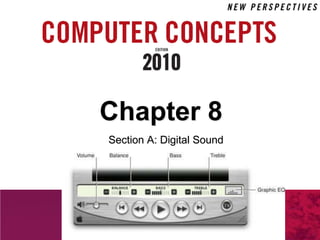
Chapter 8Section A: Digital Sound
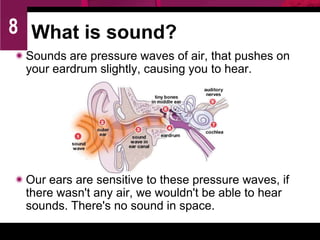
What is sound?Sounds are pressure waves of air, that pushes on your eardrum slightly, causing you to hear.Our ears are sensitive to these pressure waves, if there wasn't any air, we wouldn't be able to hear sounds. There's no sound in space.
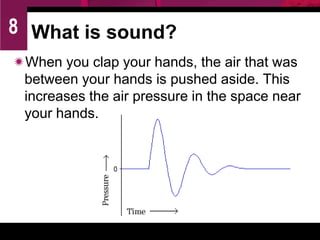
What is sound?When you clap your hands, the air that was between your hands is pushed aside. This increases the air pressure in the space near your hands.
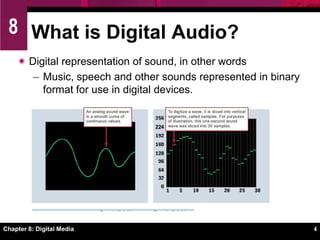
Chapter 8: Digital Media4What is Digital Audio?Digital representation of sound, in other wordsMusic, speech and other sounds represented in binary format for use in digital devices.
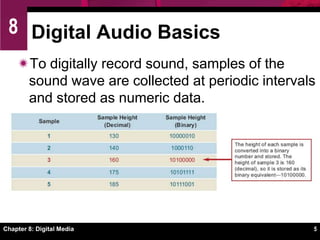
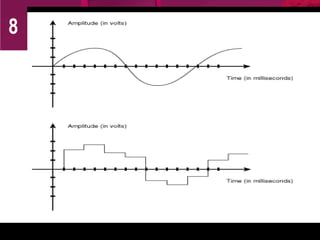
Digital Audio BasicsTo digitally record sound, samples of the sound wave are collected at periodic intervals and stored as numeric data.Chapter 8: Digital Media5
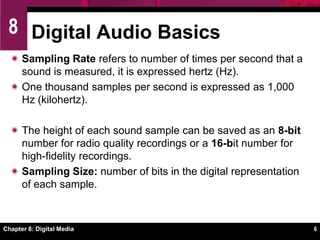
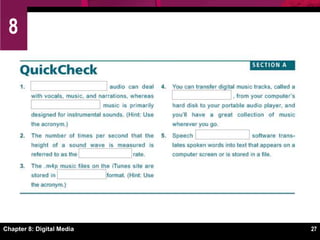
Chapter 8: Digital Media6Digital Audio BasicsSampling Rate refers to number of times per second that a sound is measured, it is expressed hertz (Hz).
One thousand samples per second is expressed as 1,000 Hz (kilohertz).
The height of each sound sample can be saved as an 8-bit number for radio quality recordings or a 16-bit number for high-fidelity recordings.Sampling Size: number of bits in the digital representation of each sample.
Chapter 8: Digital Media7Digital Audio BasicsHigher sampling rate = more realistic digital sounds
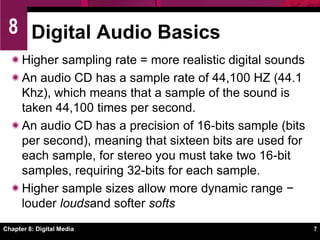
An audio CD has a sample rate of 44,100 HZ (44.1 Khz), which means that a sample of the sound is taken 44,100 times per second.
An audio CD has a precision of 16-bits sample (bits per second), meaning that sixteen bits are used for each sample, for stereo you must take two 16-bit samples, requiring 32-bits for each sample.
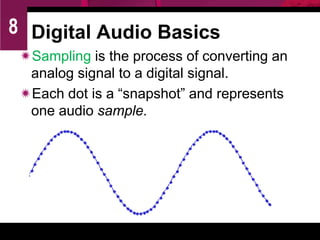
Higher sample sizes allow more dynamic range − louder loudsand softer softsDigital Audio BasicsSampling is the process of converting an analog signal to a digital signal.Each dot is a “snapshot” and represents one audio sample.
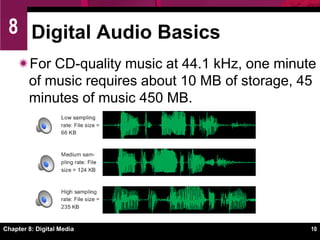
Digital Audio BasicsFor CD-quality music at 44.1 kHz, one minute of music requires about 10 MB of storage, 45 minutes of music 450 MB.Chapter 8: Digital Media10
Audio CompressionAudio compression reduces the size of sound file by removing bits that represent extraneous noise and sounds that are beyond the frequencies of normal hearing.Advantage: a compressed file requires less storage space than an uncompressed file and can be transmitted faster over a network.Chapter 8: Digital Media11
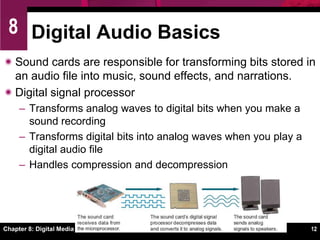
Chapter 8: Digital Media12Digital Audio BasicsSound cards are responsible for transforming bits stored in an audio file into music, sound effects, and narrations.Digital signal processorTransforms analog waves to digital bits when you make a sound recordingTransforms digital bits into analog waves when you play a digital audio fileHandles compression and decompression
Chapter 8: Digital Media13Digital Audio BasicsThe most popular digital audio formats include AAC, AIFF, MP3, RealAudio, Wave, and WMAAudio or media player software allows you to record and play digital audio filesYou can embed digital audio files into a Web page.Streaming audio plays as its file is downloaded, avoiding lengthy delays (entire file downloaded)
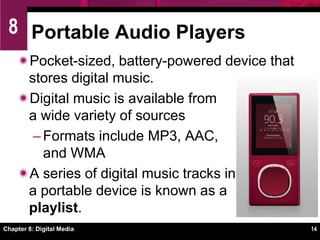
Chapter 8: Digital Media14Portable Audio PlayersPocket-sized, battery-powered device that stores digital music.Digital music is available from a wide variety of sourcesFormats include MP3, AAC, and WMAA series of digital music tracks in                            a portable device is known as a              playlist.
Synthesized SoundWhile digital audio is a recording of real analog sound signals converted into digital signals, synthesized sound is an artificially created, sound.Synthetic Artificial .Chapter 8: Digital Media15
Chapter 8: Digital Media16MIDI MusicMIDI (Musical Instrument Digital Interface) specifies a standard way to store music data for synthesizers, electronic MIDI instruments, and computersMIDI-capable sound cards contain aWavetable (set of prerecorded musical instrument sounds)Does not produce high-quality vocalsDoes not have full resonance of “real” soundMidi Files have a non-Wave form, they contain instructions as to how to create the sound, rather than a digitized version of the actual sound
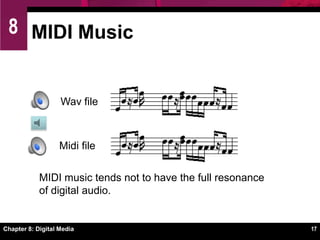
Chapter 8: Digital Media17MIDI MusicWav fileMidi fileMIDI music tends not to have the full resonance of digital audio.
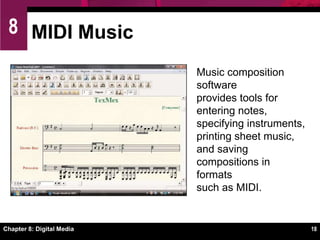
Chapter 8: Digital Media18MIDI MusicMusic composition softwareprovides tools for entering notes, specifying instruments, printing sheet music, and saving compositions in formatssuch as MIDI.
Digital Audio BasicsSamplers: Instruments that can digitize, or sample audio sounds, turn them into notes, and play them back at any pitch.Synthesizer: An electronic instrument that synthesize (manufacture, create) sounds using mathematical formulas.Sequencers: Interprets the sequence of MIDI commands Slide 19
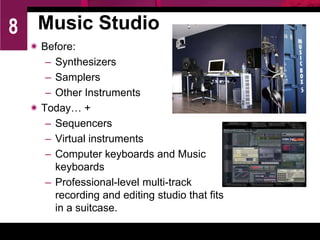
Music StudioBefore:SynthesizersSamplers	Other InstrumentsToday… +SequencersVirtual instruments Computer keyboards and Music keyboardsProfessional-level multi-track recording and editing studio that fits in a suitcase.
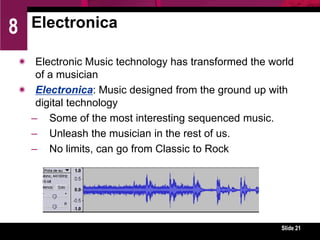
ElectronicaElectronic Music technology has transformed the world of a musicianElectronica: Music designed from the ground up with digital technologySome of the most interesting sequenced music.Unleash the musician in the rest of us.No limits, can go from Classic to RockSlide 21
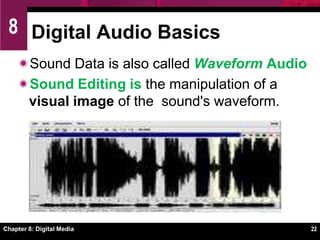
Digital Audio BasicsSound Data is also called Waveform AudioSound Editing is the manipulation of a visual image of the  sound's waveform.Chapter 8: Digital Media22
Change a sound's volumeChange a sound's pitchAdd special effectsEchoesRemove irrelevant noisesRearrange musical passagesInclude voices (or mix) Include non-electronic instruments in the mix.Slide 23Sound Editing Software

Ch8 Section A: Audio Basics

  • 1.
    Chapter 8Section A:Digital Sound
  • 2.
    What is sound?Soundsare pressure waves of air, that pushes on your eardrum slightly, causing you to hear.Our ears are sensitive to these pressure waves, if there wasn't any air, we wouldn't be able to hear sounds. There's no sound in space.
  • 3.
    What is sound?Whenyou clap your hands, the air that was between your hands is pushed aside. This increases the air pressure in the space near your hands.
  • 4.
    Chapter 8: DigitalMedia4What is Digital Audio?Digital representation of sound, in other wordsMusic, speech and other sounds represented in binary format for use in digital devices.
  • 5.
    Digital Audio BasicsTodigitally record sound, samples of the sound wave are collected at periodic intervals and stored as numeric data.Chapter 8: Digital Media5
  • 6.
    Chapter 8: DigitalMedia6Digital Audio BasicsSampling Rate refers to number of times per second that a sound is measured, it is expressed hertz (Hz).
  • 7.
    One thousand samplesper second is expressed as 1,000 Hz (kilohertz).
  • 8.
    The height ofeach sound sample can be saved as an 8-bit number for radio quality recordings or a 16-bit number for high-fidelity recordings.Sampling Size: number of bits in the digital representation of each sample.
  • 9.
    Chapter 8: DigitalMedia7Digital Audio BasicsHigher sampling rate = more realistic digital sounds
  • 10.
    An audio CDhas a sample rate of 44,100 HZ (44.1 Khz), which means that a sample of the sound is taken 44,100 times per second.
  • 11.
    An audio CDhas a precision of 16-bits sample (bits per second), meaning that sixteen bits are used for each sample, for stereo you must take two 16-bit samples, requiring 32-bits for each sample.
  • 12.
    Higher sample sizesallow more dynamic range − louder loudsand softer softsDigital Audio BasicsSampling is the process of converting an analog signal to a digital signal.Each dot is a “snapshot” and represents one audio sample.
  • 14.
    Digital Audio BasicsForCD-quality music at 44.1 kHz, one minute of music requires about 10 MB of storage, 45 minutes of music 450 MB.Chapter 8: Digital Media10
  • 15.
    Audio CompressionAudio compressionreduces the size of sound file by removing bits that represent extraneous noise and sounds that are beyond the frequencies of normal hearing.Advantage: a compressed file requires less storage space than an uncompressed file and can be transmitted faster over a network.Chapter 8: Digital Media11
  • 16.
    Chapter 8: DigitalMedia12Digital Audio BasicsSound cards are responsible for transforming bits stored in an audio file into music, sound effects, and narrations.Digital signal processorTransforms analog waves to digital bits when you make a sound recordingTransforms digital bits into analog waves when you play a digital audio fileHandles compression and decompression
  • 17.
    Chapter 8: DigitalMedia13Digital Audio BasicsThe most popular digital audio formats include AAC, AIFF, MP3, RealAudio, Wave, and WMAAudio or media player software allows you to record and play digital audio filesYou can embed digital audio files into a Web page.Streaming audio plays as its file is downloaded, avoiding lengthy delays (entire file downloaded)
  • 18.
    Chapter 8: DigitalMedia14Portable Audio PlayersPocket-sized, battery-powered device that stores digital music.Digital music is available from a wide variety of sourcesFormats include MP3, AAC, and WMAA series of digital music tracks in a portable device is known as a playlist.
  • 19.
    Synthesized SoundWhile digitalaudio is a recording of real analog sound signals converted into digital signals, synthesized sound is an artificially created, sound.Synthetic Artificial .Chapter 8: Digital Media15
  • 20.
    Chapter 8: DigitalMedia16MIDI MusicMIDI (Musical Instrument Digital Interface) specifies a standard way to store music data for synthesizers, electronic MIDI instruments, and computersMIDI-capable sound cards contain aWavetable (set of prerecorded musical instrument sounds)Does not produce high-quality vocalsDoes not have full resonance of “real” soundMidi Files have a non-Wave form, they contain instructions as to how to create the sound, rather than a digitized version of the actual sound
  • 21.
    Chapter 8: DigitalMedia17MIDI MusicWav fileMidi fileMIDI music tends not to have the full resonance of digital audio.
  • 22.
    Chapter 8: DigitalMedia18MIDI MusicMusic composition softwareprovides tools for entering notes, specifying instruments, printing sheet music, and saving compositions in formatssuch as MIDI.
  • 23.
    Digital Audio BasicsSamplers:Instruments that can digitize, or sample audio sounds, turn them into notes, and play them back at any pitch.Synthesizer: An electronic instrument that synthesize (manufacture, create) sounds using mathematical formulas.Sequencers: Interprets the sequence of MIDI commands Slide 19
  • 24.
    Music StudioBefore:SynthesizersSamplers Other InstrumentsToday…+SequencersVirtual instruments Computer keyboards and Music keyboardsProfessional-level multi-track recording and editing studio that fits in a suitcase.
  • 25.
    ElectronicaElectronic Music technologyhas transformed the world of a musicianElectronica: Music designed from the ground up with digital technologySome of the most interesting sequenced music.Unleash the musician in the rest of us.No limits, can go from Classic to RockSlide 21
  • 26.
    Digital Audio BasicsSoundData is also called Waveform AudioSound Editing is the manipulation of a visual image of the sound's waveform.Chapter 8: Digital Media22
  • 27.
    Change a sound'svolumeChange a sound's pitchAdd special effectsEchoesRemove irrelevant noisesRearrange musical passagesInclude voices (or mix) Include non-electronic instruments in the mix.Slide 23Sound Editing Software