Digestion Clip by Brainpop
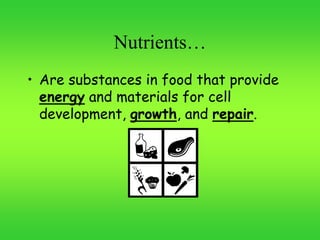
Nutrients…
• Are substances in food that provide
energy and materials for cell
development, growth, and repair.
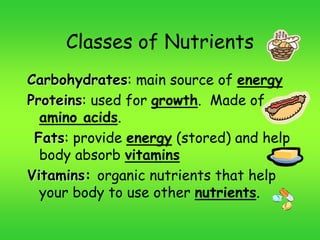
Classes of Nutrients
Carbohydrates: main source of energy
Proteins: used for growth. Made of
amino acids.
Fats: provide energy (stored) and help
body absorb vitamins
Vitamins: organic nutrients that help
your body to use other nutrients.
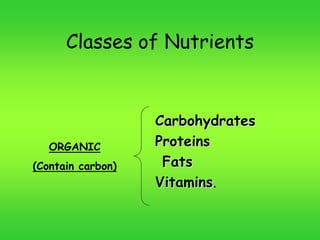
Classes of Nutrients
Carbohydrates
Proteins
Fats
Vitamins.
ORGANIC
(Contain carbon)
Classes of Nutrients
Minerals: Inorganic nutrients that
regulate many chemical reactions in
your body.
Water: Most vital factor for survival,
other than oxygen. Water enables
chemical reactions to take place in
your cells.
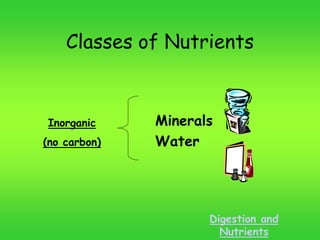
Classes of Nutrients
Minerals
Water
Digestion and
Nutrients
Inorganic
(no carbon)
Enzymes
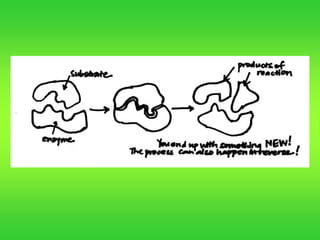
 Enzymes are molecules that speed up the
rate of chemical reactions
 They do this without being changed or
used up.
 Enzymes also speed up reactions by
reducing amount of energy necessary for
a chemical change to begin.
Digestive Enzymes are:
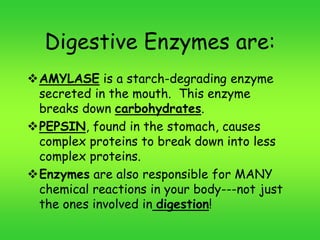
AMYLASE is a starch-degrading enzyme
secreted in the mouth. This enzyme
breaks down carbohydrates.
PEPSIN, found in the stomach, causes
complex proteins to break down into less
complex proteins.
Enzymes are also responsible for MANY
chemical reactions in your body---not just
the ones involved in digestion!
Your Digestive System
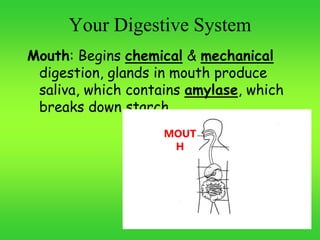
Mouth: Begins chemical & mechanical
digestion, glands in mouth produce
saliva, which contains amylase, which
breaks down starch
MOUT
H
Your Digestive System
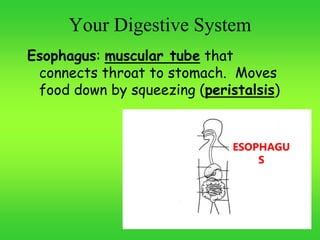
Esophagus: muscular tube that
connects throat to stomach. Moves
food down by squeezing (peristalsis)
ESOPHAGU
S
Your Digestive System
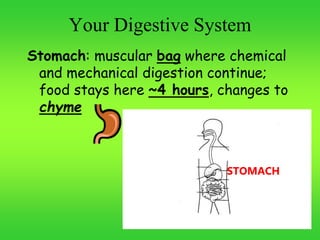
Stomach: muscular bag where chemical
and mechanical digestion continue;
food stays here ~4 hours, changes to
chyme
STOMACH
Your Digestive System
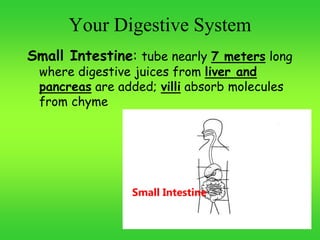
Small Intestine: tube nearly 7 meters long
where digestive juices from liver and
pancreas are added; villi absorb molecules
from chyme
Small Intestine
Your Digestive System
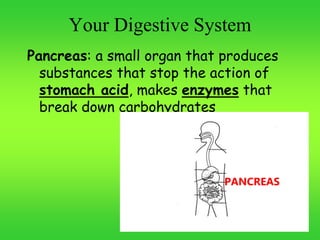
Pancreas: a small organ that produces
substances that stop the action of
stomach acid, makes enzymes that
break down carbohydrates
PANCREAS
Your Digestive System
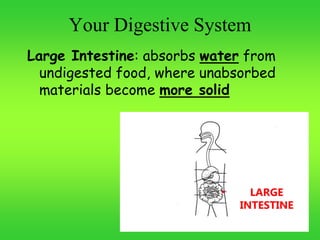
Large Intestine: absorbs water from
undigested food, where unabsorbed
materials become more solid
LARGE
INTESTINE
Your Digestive System
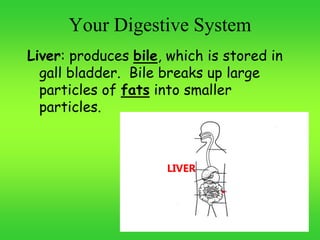
Liver: produces bile, which is stored in
gall bladder. Bile breaks up large
particles of fats into smaller
particles.
LIVER
Your Digestive System
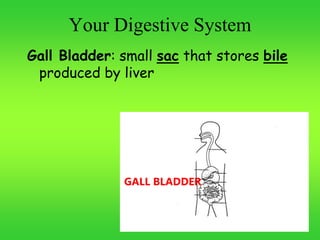
Gall Bladder: small sac that stores bile
produced by liver
GALL BLADDER
Your Digestive System
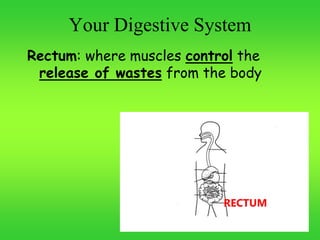
Rectum: where muscles control the
release of wastes from the body
RECTUM
Digestive System Clip by Brainpop
The Process of Digestion Clip
(13 minutes)

Digestive System Grade 4 igcse easy notes ppt