
DIGESTIVE SYSTEM
INDRAJ SAINI
B-PHARMA
ASSIGNMENT BASIC KNOWLEDGE
ALWAR PHARMACY COLLEGE
DIGESTIVE SYSTEM
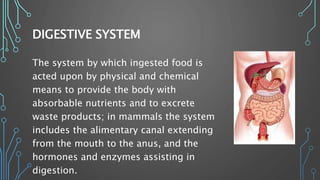
The system by which ingested food is
acted upon by physical and chemical
means to provide the body with
absorbable nutrients and to excrete
waste products; in mammals the system
includes the alimentary canal extending
from the mouth to the anus, and the
hormones and enzymes assisting in
digestion.
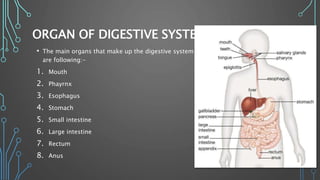
ORGAN OF DIGESTIVE SYSTEM
• The main organs that make up the digestive system
are following:-
1. Mouth
2. Phayrnx
3. Esophagus
4. Stomach
5. Small intestine
6. Large intestine
7. Rectum
8. Anus
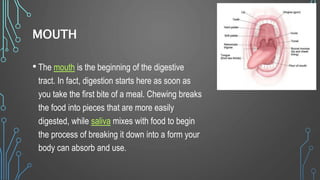
MOUTH
• The mouth is the beginning of the digestive
tract. In fact, digestion starts here as soon as
you take the first bite of a meal. Chewing breaks
the food into pieces that are more easily
digested, while saliva mixes with food to begin
the process of breaking it down into a form your
body can absorb and use.
PHAYRNX
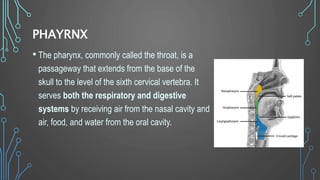
• The pharynx, commonly called the throat, is a
passageway that extends from the base of the
skull to the level of the sixth cervical vertebra. It
serves both the respiratory and digestive
systems by receiving air from the nasal cavity and
air, food, and water from the oral cavity.
ESOPHAGUS
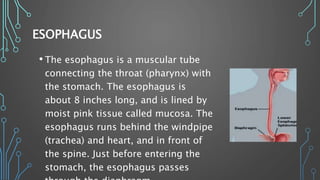
• The esophagus is a muscular tube
connecting the throat (pharynx) with
the stomach. The esophagus is
about 8 inches long, and is lined by
moist pink tissue called mucosa. The
esophagus runs behind the windpipe
(trachea) and heart, and in front of
the spine. Just before entering the
stomach, the esophagus passes
STOMACH
• The stomach is a sac-like organ that’s an important
part of the digestive system.The stomach then starts
to digest the food by secreting gastric juice
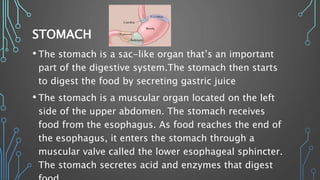
• The stomach is a muscular organ located on the left
side of the upper abdomen. The stomach receives
food from the esophagus. As food reaches the end of
the esophagus, it enters the stomach through a
muscular valve called the lower esophageal sphincter.
The stomach secretes acid and enzymes that digest
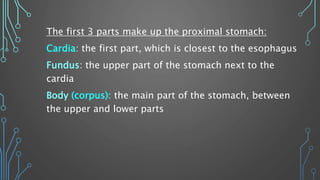
The first 3 parts make up the proximal stomach:
Cardia: the first part, which is closest to the esophagus
Fundus: the upper part of the stomach next to the
cardia
Body (corpus): the main part of the stomach, between
the upper and lower parts
FUNCTIONS OF STOMACH
• Functions of stomach is to store food.This allow You to go
many hour between meals.
• The stomach secretes acid and enzymes that digest food.
SMALL INTESTINE
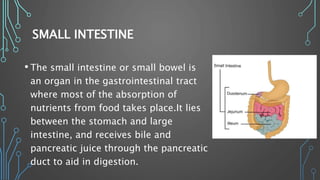
• The small intestine or small bowel is
an organ in the gastrointestinal tract
where most of the absorption of
nutrients from food takes place.It lies
between the stomach and large
intestine, and receives bile and
pancreatic juice through the pancreatic
duct to aid in digestion.
PARTS OF INTESTINE
• The small intestine consists of three parts:-
1. Duodenum
2. Jejunum
3. ileum
• Duidenum:-
The duodenum is the first part of the small intestine. The main
role of the duodenum is to complete the first phase of digestion.
• Jejunum :-
The middle part of the small intestine. It is between the
duodenum (first part of the small intestine) and the ileum (last
part of the small intestine). The jejunum helps to further digest
food coming from the stomach.
• ileum:-
The last part of the small intestine. It connects to the cecum (first part of the large
intestine). The ileum helps to further digest food coming from the stomach and other
parts of the small intestine
FACTION OF SMALL INTESTINE
• The main functions of the small intestine are to break
down, or digest, food and to absorb nutrients, such as
electrolytes, vitamins and minerals.
• The small intestine is the most important absorbing
organ in the GI tract. About 90% of nutrient absorption
takes place in the small intestine.
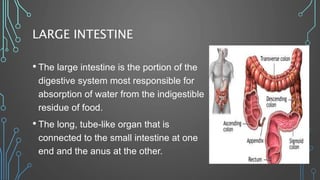
LARGE INTESTINE
• The large intestine is the portion of the
digestive system most responsible for
absorption of water from the indigestible
residue of food.
• The long, tube-like organ that is
connected to the small intestine at one
end and the anus at the other.
• large intestine has four parts: cecum, colon, rectum, and anal canal.
👉 Fanction :-
• The purpose of the large intestine is to absorb water and
salts from the material that has not been digested as food,
and get rid of any waste products left over. By the time
food mixed with digestive juices reaches your large
intestine, most digestion and absorption has already taken
place.
• The large intestine also Absorb vitamins such as vitamin
B12 , Vitamin A etc .
ANUS
• The anus is the opening where the gastrointestinal tract ends
and exits the body. The anus starts at the bottom of the
rectum, the last portion of the colon (large intestine). The
anorectal line separates the anus from the rectum.
Fanction:-
The anus is the end of the gastrointestinal (GI) tract. When the
rectum is full, your body feels the urge to have a bowel
movement. The internal anal sphincter relaxes and pushes the
stool from the rectum into the anal canal.rectal
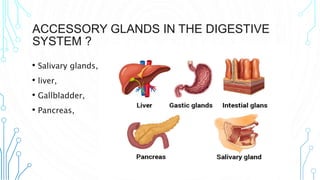
ACCESSORY GLANDS IN THE DIGESTIVE
SYSTEM ?
• Salivary glands,
• liver,
• Gallbladder,
• Pancreas,
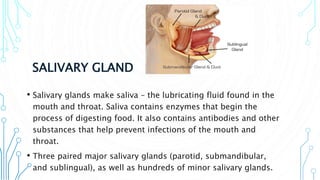
SALIVARY GLAND
• Salivary glands make saliva – the lubricating fluid found in the
mouth and throat. Saliva contains enzymes that begin the
process of digesting food. It also contains antibodies and other
substances that help prevent infections of the mouth and
throat.
• Three paired major salivary glands (parotid, submandibular,
and sublingual), as well as hundreds of minor salivary glands.
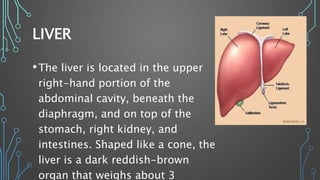
LIVER
•The liver is located in the upper
right-hand portion of the
abdominal cavity, beneath the
diaphragm, and on top of the
stomach, right kidney, and
intestines. Shaped like a cone, the
liver is a dark reddish-brown
organ that weighs about 3
FANCTION OF LIVER
• Bile production and excretion.
• Excretion of bilirubin, cholesterol, hormones, and drugs.
• Metabolism of fats, proteins, and carbohydrates.
• Enzyme activation.
• Storage of glycogen, vitamins, and minerals.
PANCREAS
• Organ near the stomach that
produces the substance that controls
the amount of sugar in the blood
(insulin) and which helps your body to
deal with (digest) the food you eat.
• It makes pancreatic juices, which
contain enzymes that aid in digestion.
FANCTION OF PANCREAS
• During digestion, your pancreas makes pancreatic
juices called enzymes
• These enzymes break down sugars, fats, and
starches.
• Your pancreas also helps your digestive system by
making hormones.
• An exocrine function that helps in digestion and an
endocrine function that regulates blood sugar.
THANKING YOU
Indraj Saini
B-pharma
Alwar pharmacy college
Human anatomy and
physiology •